
Judge, 1919-04-26 · page 7 of 32
Judge — April 26, 1919 — page 7: what you’re looking at
What you’re looking at
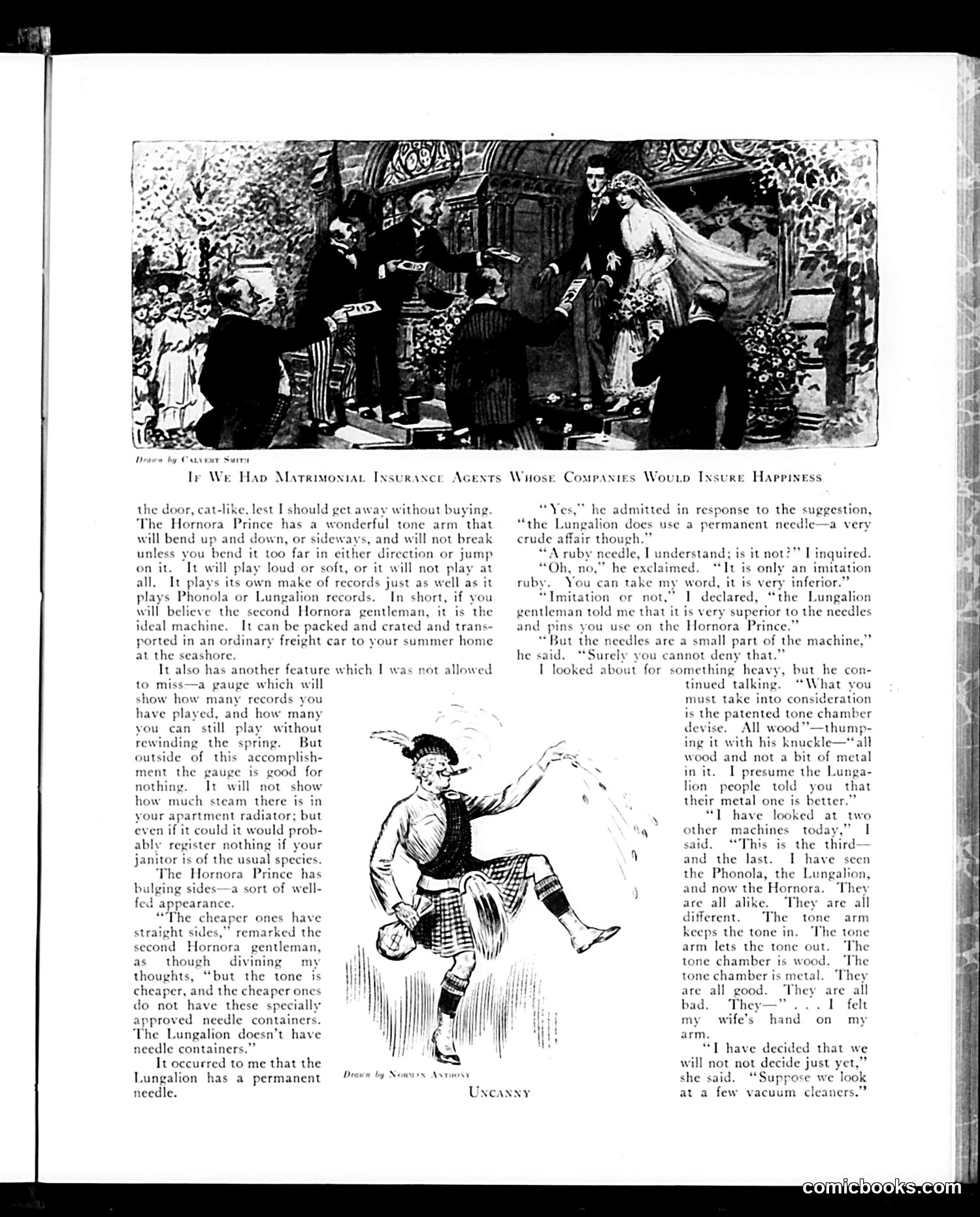
This page satirizes **aggressive door-to-door phonograph salesmen** of the early 20th century. The top illustration shows a wedding scene where a salesman appears to be making his pitch—even at intimate moments. The main text is a humorous monologue about a man being cornered by a Hornora Prince phonograph salesman who uses manipulative tactics: praising his own product while denigrating competitors (Phonola, Lungalion brands). The salesman makes contradictory claims—saying cheaper models have inferior tone while simultaneously praising his own features. The joke's point: the man is overwhelmed by **contradictory marketing claims**. Every competitor supposedly told him their machine was superior; every salesman dismisses rivals as crude or inferior. By the end, his exasperated wife suggests looking at **vacuum cleaners instead**—implying she'd rather shop for anything else than endure more phonograph sales pitches. The satire mocks both aggressive 1920s-era sales tactics and consumer confusion created by competing product claims with no objective way to verify superiority.
📄 Transcribed text from this page (OCR, searchable)
Machine-transcribed from the original scan — historical spelling and the odd misread are preserved.
Draven by Cousenr Sarre Ir We Hap Martrimoniat Ixsuraxce Acents Wuose Companies Woutp Insure Happiness the door, cat-like, lest I should get away without buying. The Hornora Prince has a wonderful tone arm that will bend up and down, or sideways, and will not break unless you bend it too far in either direction or jump on it. It will play loud or soft, or it will not play at all, It plays its own make of records just as well as it s Phonola or Lungalion records. In short, if you will believe the second Hornora gentleman, it is the ideal machine. It can be packed and crated and tra ported in an ordinary freight car to your summer home at the seashore. It also has another feature which I v to miss—a gauge which will show how many records you have played, and how many you can still play without rewinding the spring. But outside of this accomplish- ment the gauge is good for nothir It will not show how much steam there is in your apartment radiator; but even if it could it would prob- ably register nothing if your janitor is of the usual species. The Hornora Prince has bulging sides—a sort of well- fed appearance. “The cheaper ones have straight sides,” remarked the second Hornora gentleman, as though divining my thoughts, “but the tone is cheaper, and the ches do not have these specially approved needle containers. The Lungalion doesn’t have needle containers.” It occurred to me that the Lungalion has a permanent not allowed per ones needle. Uncanny Yes,” he admitted in response to the suggestion, “the Lungalion does use a permanent necdle—a very crude affair though.” “A ruby needle, I understand; is it not?” I inquired. “Oh, no,” he exclaimed. It is only an imitation ruby. You can take my word, it is very inferior.” Imitation or not,’ 1 declared, “the Lungalion gentleman told me that it is very superior to the needles and pins you use on the Hornora Prince.” “But the needles are a small part of the machine,” urely you cannot deny that. about for something heavy, but he con- tinued talking. “What you must take into consideration is the patented tone chamber devise. All wood”’—thump- ing it with his knuckle—*‘all wood and not a bit of metal in it. | presume the Lunga- lion people told you t their metal one is bette! \ “L have looked at two 4 other chines today,” 1 said. This is the third 4 and the last. I have seen the Phonola, the Lungalion, and now the Hornora. They are all alik They are all different. The tone arm keeps the tone in. The tone arm lets the tone out. The tone chamber is wood. The tone chamber is metal. They are all good. hey are ail bad. They—”... 1 felt my wife's hand on my arm. “T have decided that we will not not decide just yet,” she said. “Suppose we look at a few vacuum cl aners.” he said. I looke —r t CP