
A complete issue · 32 pages · 1919
Judge — March 8, 1919
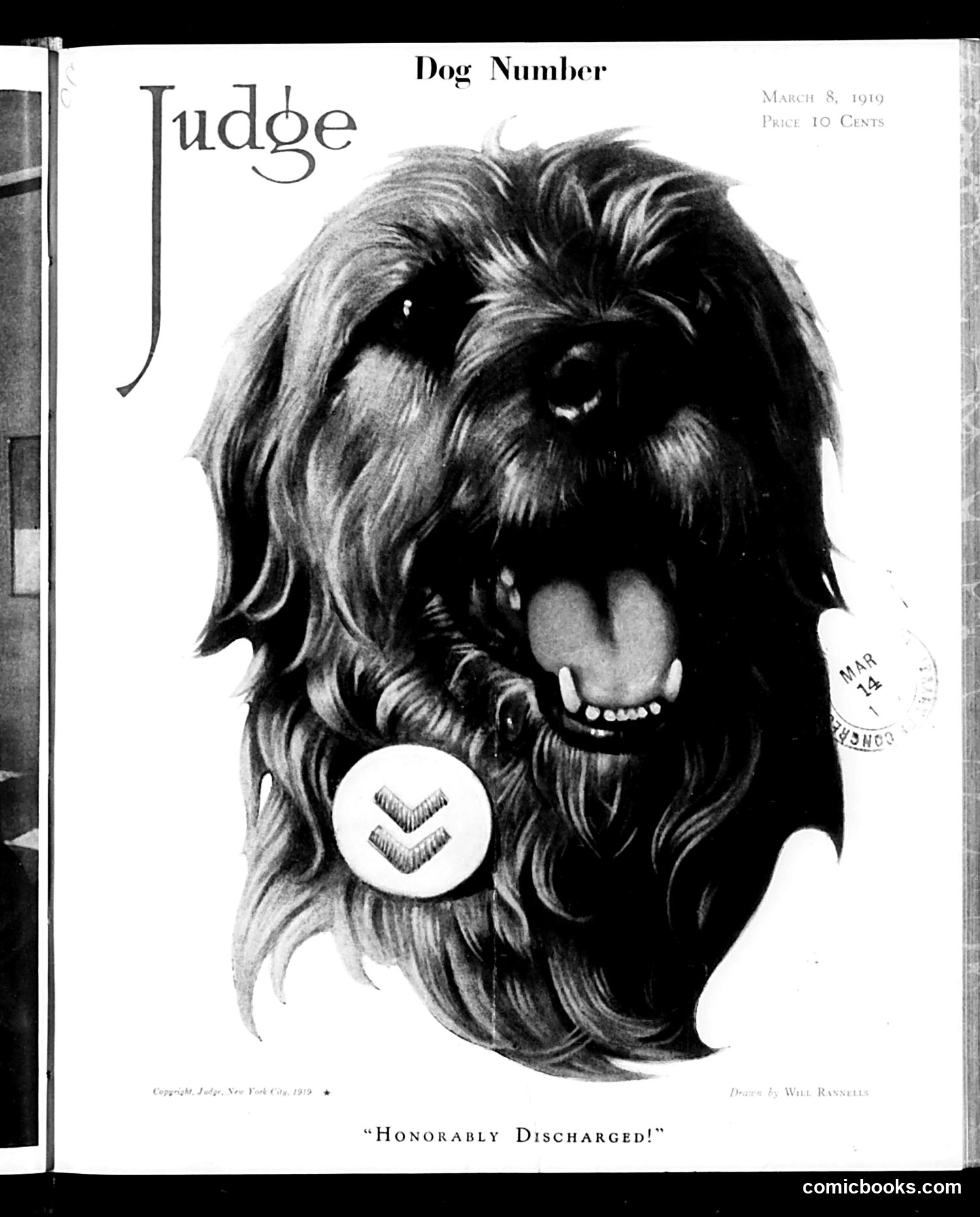
This is the cover of Judge's "Dog Number" issue. The illustration shows a long-haired dog wearing a military medal, captioned "Honorably Discharged!" The satire references World War I, which ended in November 1918. The cartoon appears to humorously compare dogs to returning soldiers—suggesting that even a dog could be decorated and discharged from military service. This plays on the contemporary moment when American servicemen were returning home and receiving medals for their WWI service. The joke likely satirizes either the ease with which medals were distributed, the absurdity of wartime bureaucracy, or makes a humorous observation about patriotism. The dog's dignified expression and formal military decoration create the comedic effect by treating a canine subject with serious military honors.
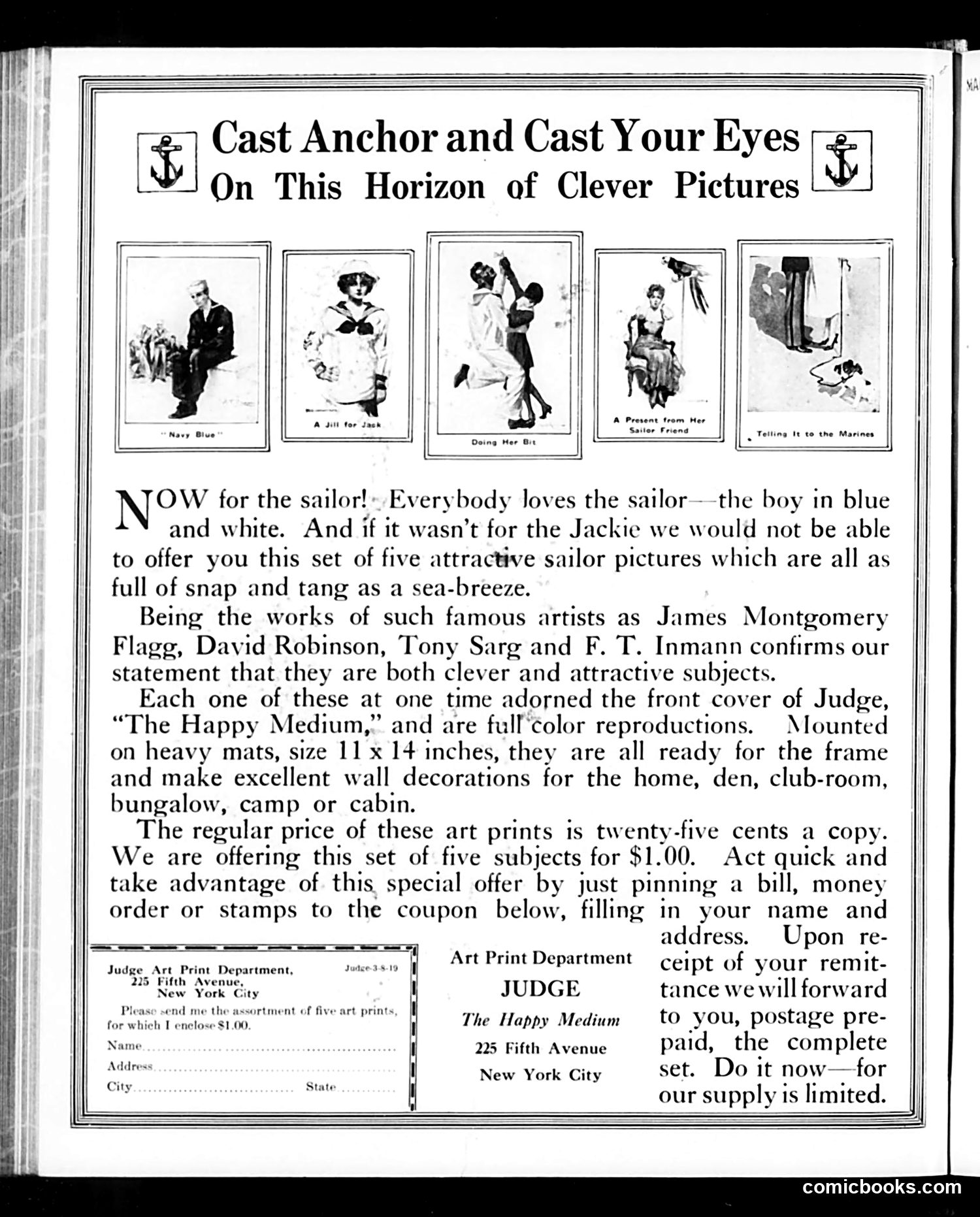
This page is primarily **advertising, not political satire**. It promotes a set of five sailor-themed art prints from Judge magazine's Art Print Department. The ad emphasizes nautical appeal ("everybody loves the sailor") and mentions these prints previously appeared as cover illustrations in Judge and "The Happy Medium." Created by notable artists including James Montgomery Flagg and David Robinson, the prints are mounted on heavy mats (11 x 14 inches) suitable for home decoration. The five titles shown are: "Navy Blue," "A Jilt for Jack," "Doing Her Bit," "A Present from Her Sailor Friend," and "Telling It to the Marines." The special offer: five full-color prints for $1.00 (regular price: 25 cents each), ordered via coupon. The ad notes supply is limited. This reflects early 20th-century magazine merchandising practices.
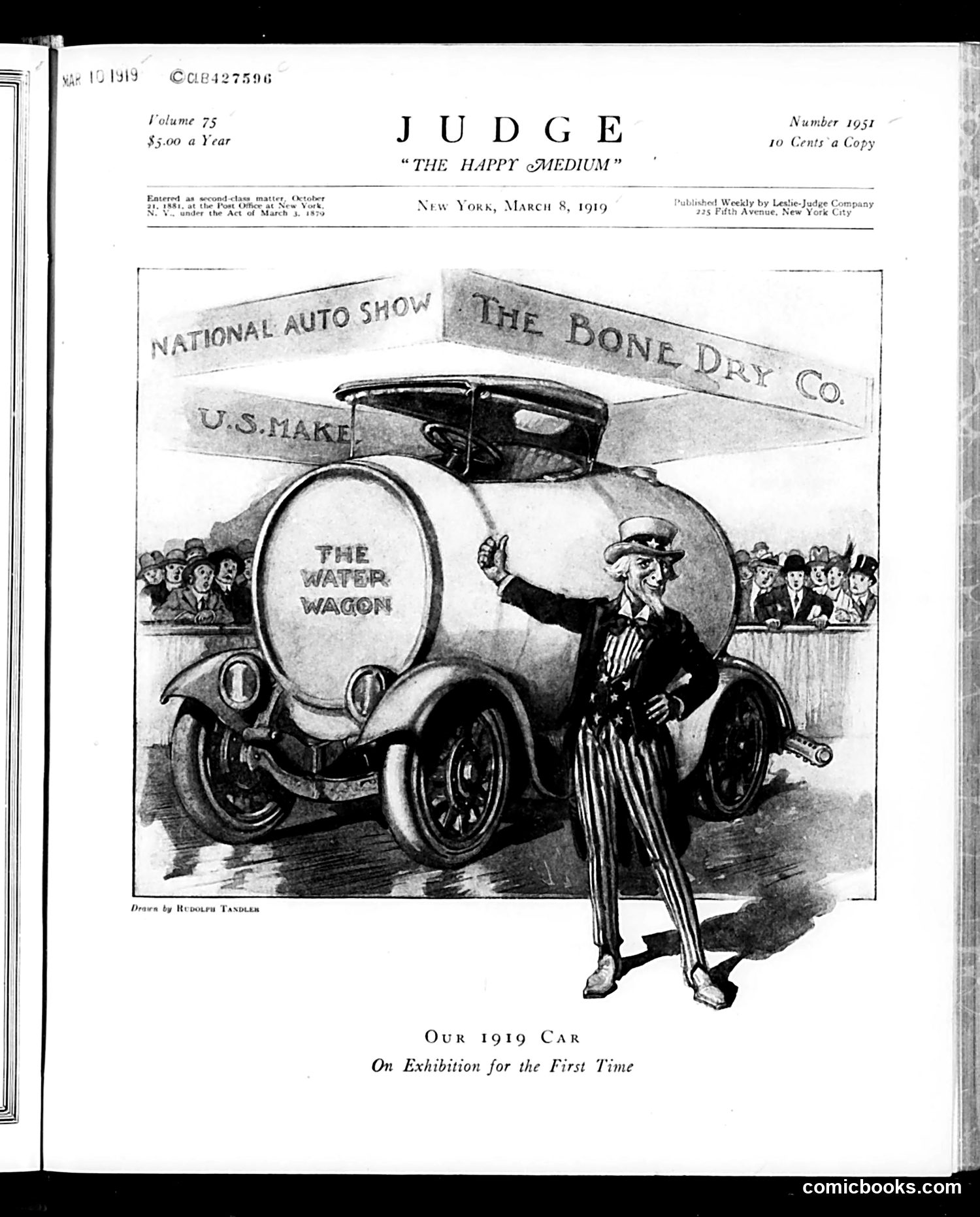
This satirical illustration references **Prohibition**, which was ratified in January 1919 and took effect in 1920. The cartoon depicts "The Bone Dry Co." exhibiting a novelty automobile called "The Water Wagon" at the National Auto Show—a play on the idiom "on the water wagon" (meaning abstinent from alcohol). The caricatured figure appears to be **Uncle Sam**, presenting this vehicle as America's new future under Prohibition. The crowded spectators represent the American public witnessing this enforced sobriety. The satire mocks Prohibition supporters' optimism about the coming alcohol ban, treating mandatory abstinence as something to be publicly celebrated and mechanized like industrial progress. The cartoon captures contemporary skepticism about whether Americans would actually embrace this dramatic lifestyle change.
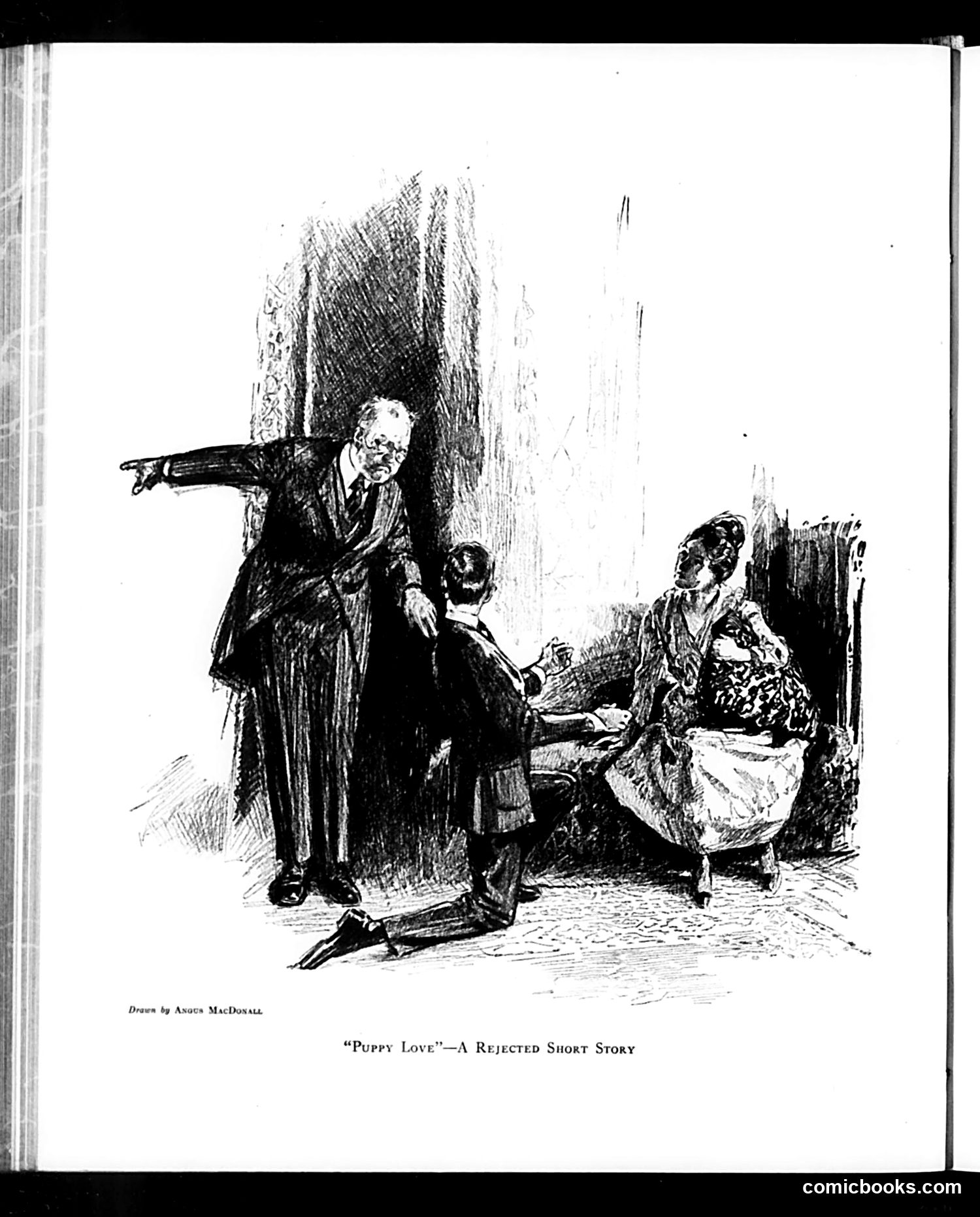
This illustration by Agnes MacDonnell depicts a domestic scene with satirical intent. An older man gestures dismissively while addressing a young couple—a boy and girl in an intimate moment. The title "Puppy Love—A Rejected Short Story" suggests this is mocking the rejection of a romantic manuscript or story submission. The satire likely critiques either sentimental Victorian romance fiction (which editors rejected as overly saccharine) or comments on the foolishness of young love itself. The elder's authoritative posture and pointing gesture implies authority—possibly an editor, publisher, or parental figure—dismissing youthful romantic sentiments as unworthy of serious consideration. The cartoon reflects *Judge* magazine's characteristic mockery of literary pretension and romantic idealism.
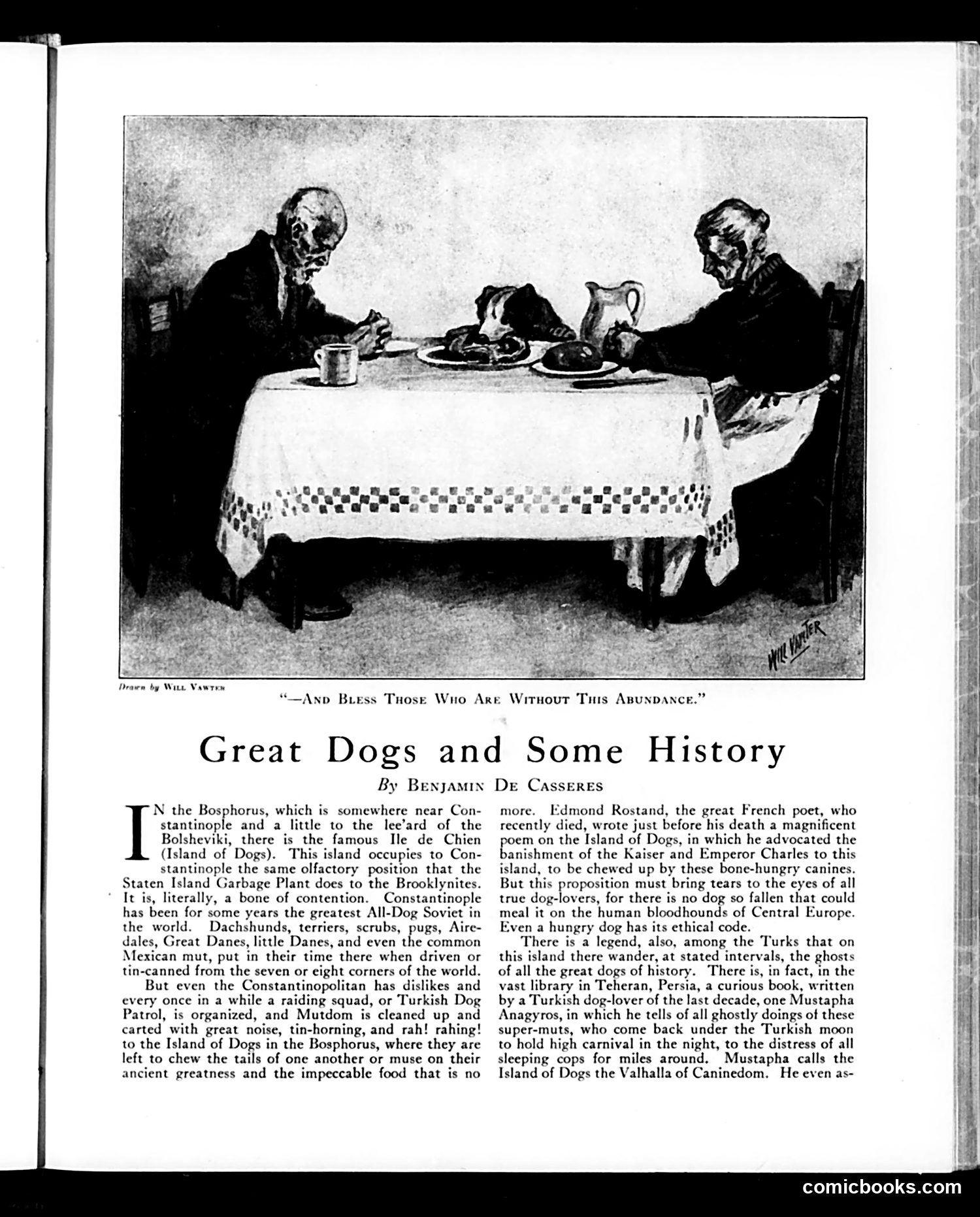
**The Cartoon:** The illustration by Will Vartes depicts two skeletal figures at a meager dinner table with the caption "—AND BLESS THOSE WHO ARE WITHOUT THIS ABUNDANCE." **The Satire:** This is social commentary on poverty and inequality. The skeletal diners—appearing to be starving or impoverished—offer a bitter, ironic grace before meals, "blessing" those who have even less food than they do. The dark humor exposes the contrast between the wealthy and destitute, critiquing both poverty conditions and the hypocrisy of thanking God while people suffer from hunger. **Context:** The accompanying article "Great Dogs and Some History" by Benjamin De Casseres appears unrelated to the cartoon, discussing historical dog breeds and mythology rather than the meal-time satire above it.
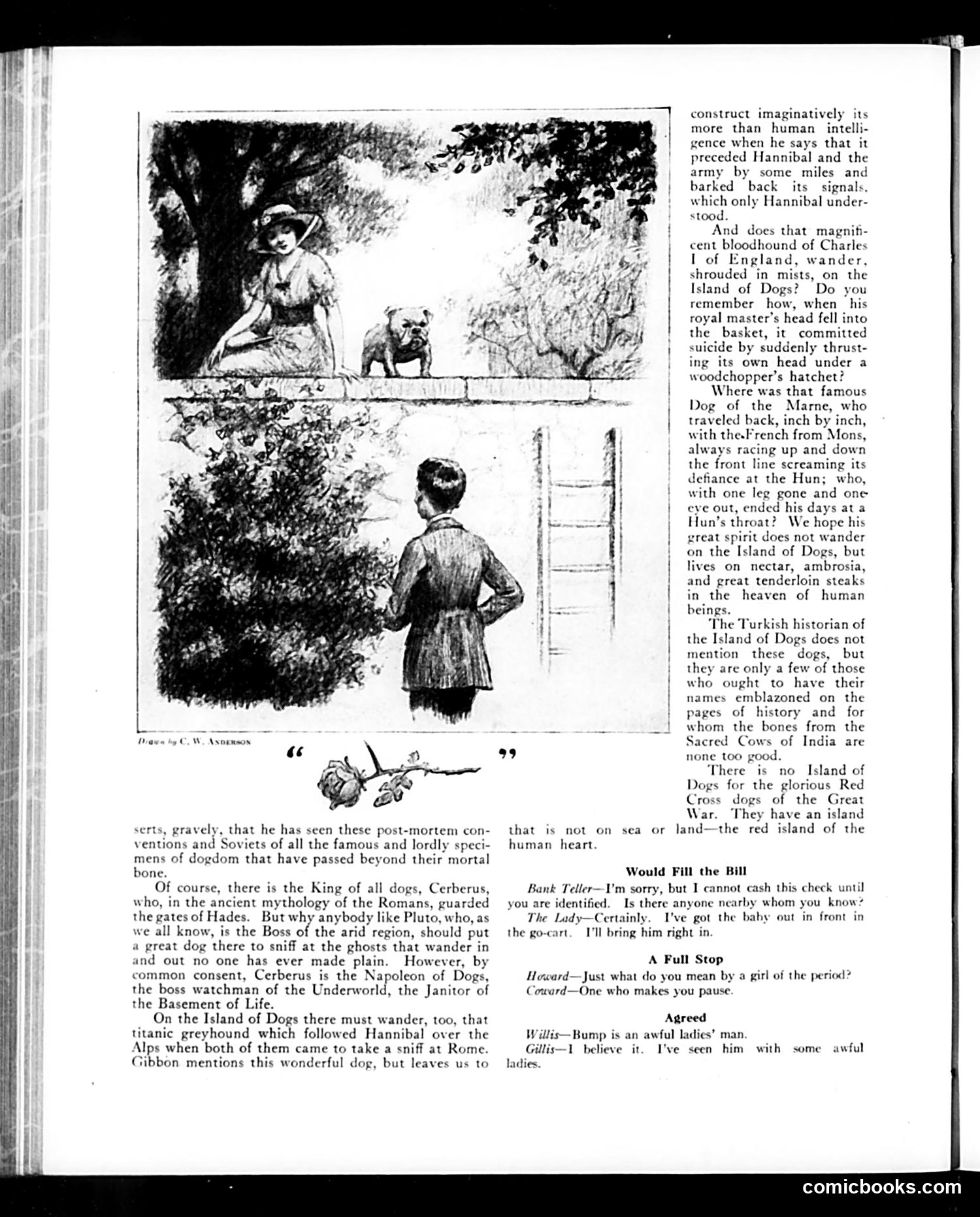
This page from *Judge* magazine features an illustrated essay about famous historical dogs, presented as whimsical commentary rather than direct political satire. The cartoon depicts a child observing a bulldog near a fence, illustrating the text's discussion of notable canines throughout history—from Hannibal's war dogs to Charles I's bloodhound to dogs of the Marne (WWI). The essay employs mock-serious tone, treating dogs' historical contributions with exaggerated reverence. It references real historical events (Hannibal's military campaigns, WWI's "Dog of the Marne") while adding fantastical elements like an imaginary "Island of Dogs" populated by heroic canines. The satire targets human tendency to romanticize history by elevating animals to mythic status. Below, brief comedic dialogues about banking and social observations provide typical *Judge* humor—light social commentary rather than pointed political critique.
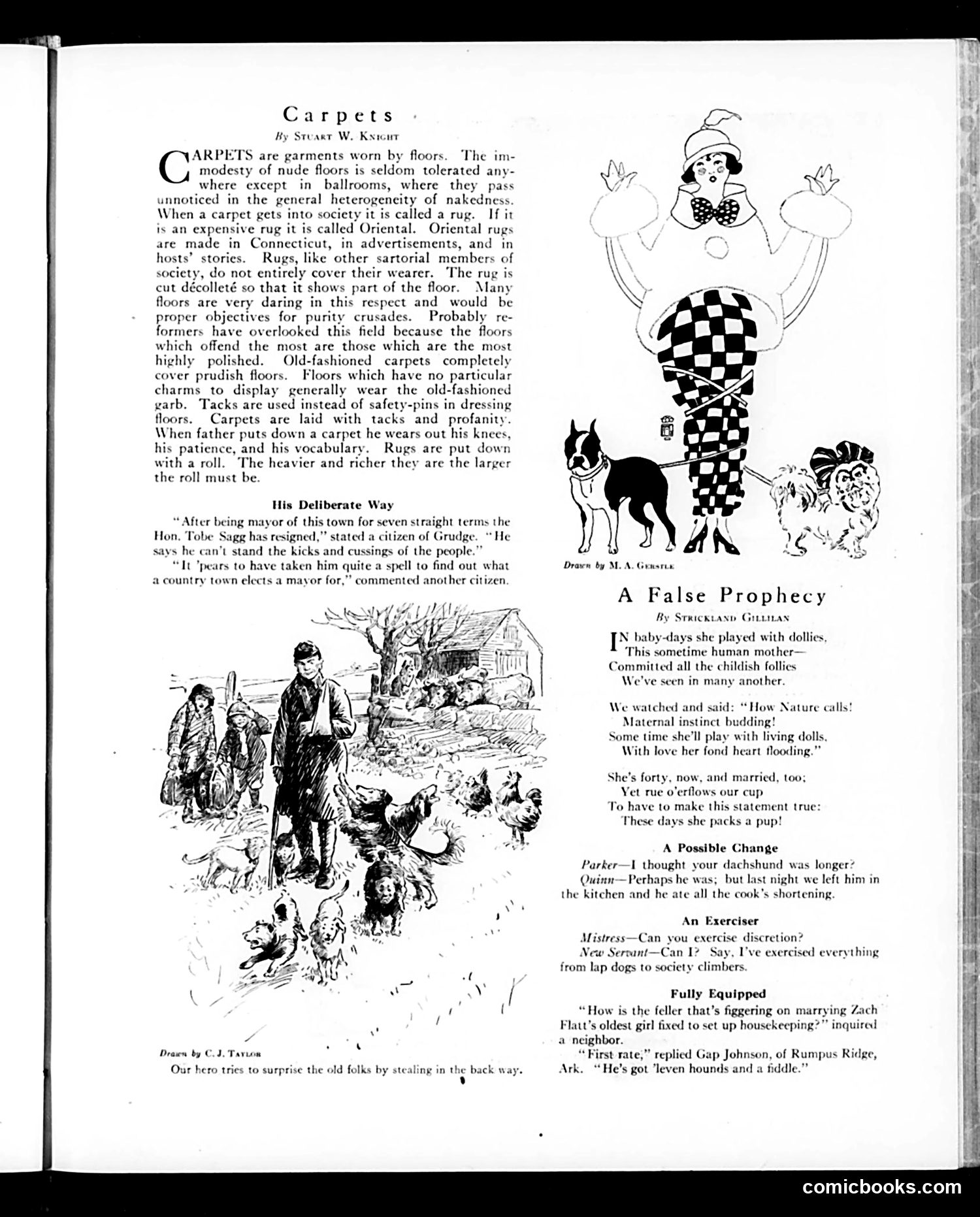
This page contains humorous essays and jokes typical of early 20th-century *Judge* magazine. The main article "Carpets" by Stuart W. Kistner is satirical commentary on domestic life, using carpet/rug installation as metaphor for social pretension. It mocks how Americans display wealth through "Oriental" rugs (actually made in Connecticut), and humorously describes the profanity-laden ordeal of fathers installing carpets. "His Deliberate Way" is a short joke about a small-town mayor (Hon. Tobe Sagg) resigning after seven terms, claiming he can't endure public criticism—prompting another citizen to note it took him remarkably long to understand what mayors face. The remaining items are brief rural humor pieces: "A False Prophecy" jokes that a woman who loved dolls as a child now owns only a dog; other jokes play on dachshunds, servants, and rustic courtship. The drawings by M.A. Grenier and C.J. Taylor are illustrative cartoons accompanying the text. The humor relies on early 1900s social observations and rural American dialect for comedic effect.
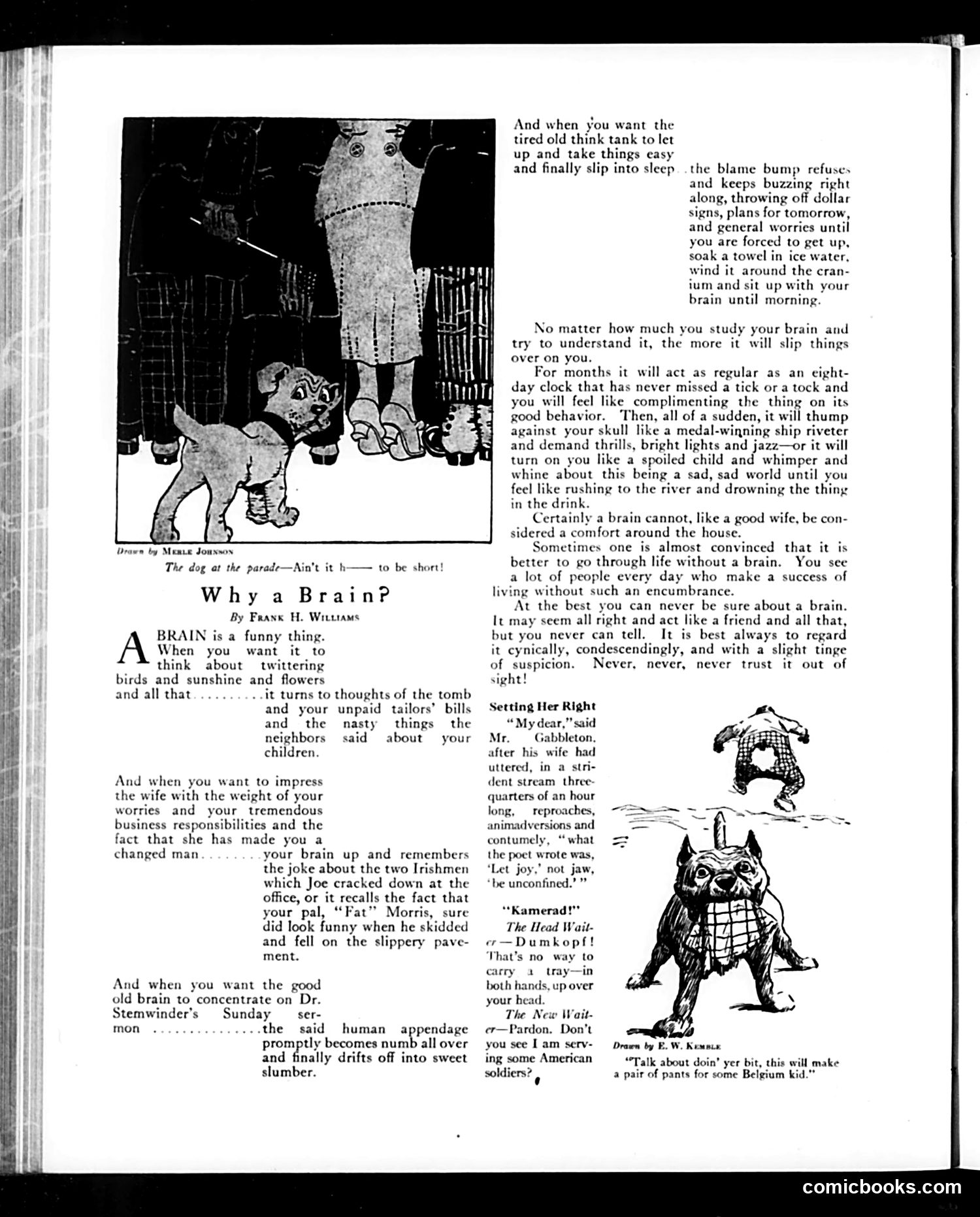
This page from *Judge* magazine contains three separate humorous pieces: **"Why a Brain?" (main article)** is a comedic essay by Frank H. Williams lampooning the human brain's unreliability. It satirizes how the mind refuses to cooperate—wandering to grim thoughts when you want pleasant ones, obsessing during sleep, daydreaming during sermons—concluding that brains are untrustworthy nuisances. The tone is tongue-in-cheek misanthropy about human nature. **"Setting Her Right"** depicts a husband correcting his nagging wife by quoting poetry ("Let joy be unconfined" rather than "jaw"), suggesting wives talk too much—a common period stereotype. **"Talk About Doin' Yer Bit"** references World War I ("American soldiers," "Belgium kid"), with a waiter serving soldiers while holding his hands up in mock surrender ("Kamerad"), implying reluctant patriotic service. The joke conflates serving soldiers with military surrender. The illustrations are cartoonish and exaggerated in period style. The content reflects early 20th-century satire aimed at middle-class anxieties and war-era humor.
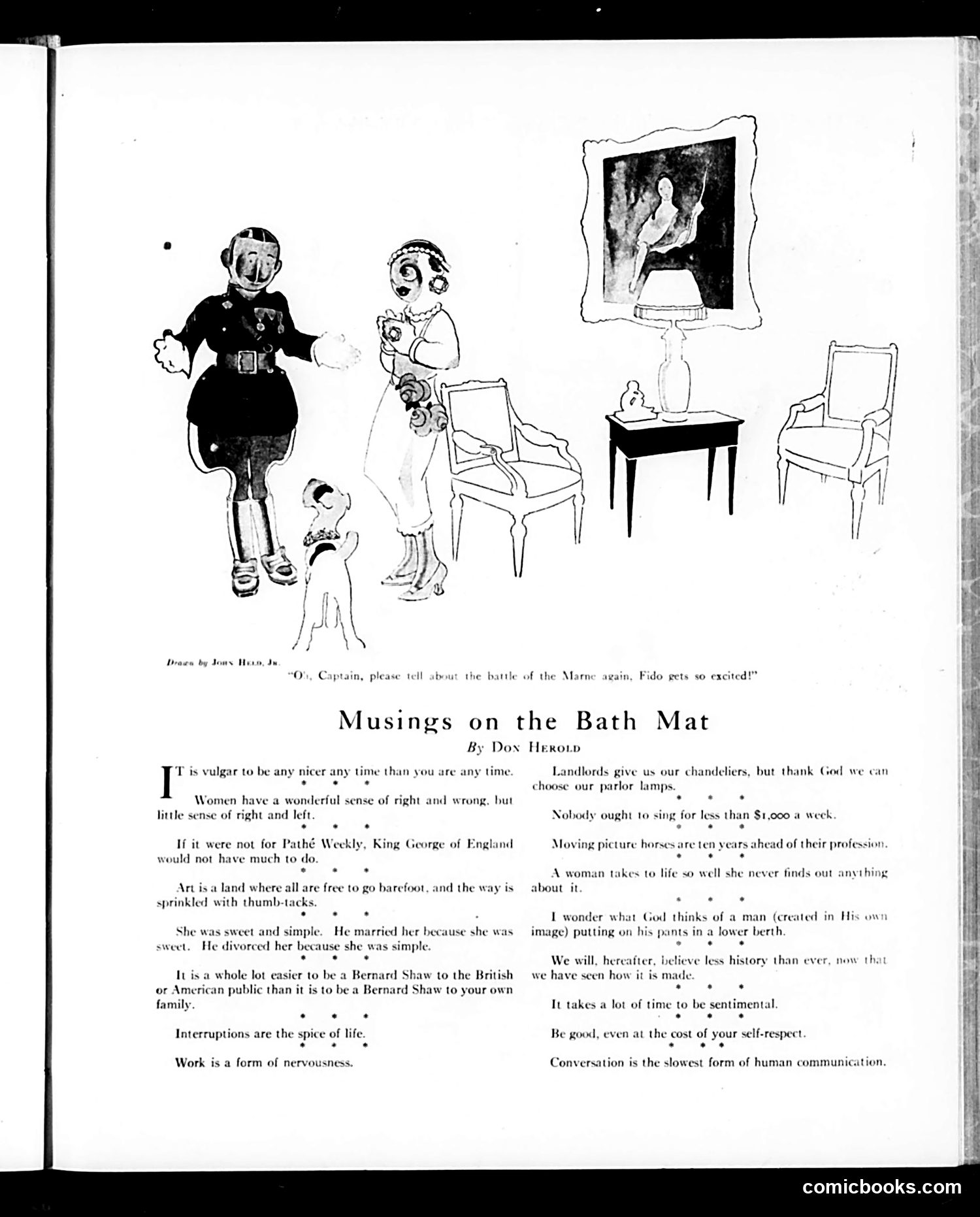
This page from Judge magazine features a cartoon and accompanying satirical essay by Dox Herold. The cartoon depicts a domestic scene where a woman in a belted dress enthusiastically asks a military officer to recount "the battle of the Marne again" because "Fido gets so excited"—the dog being the implied audience member of actual interest. The satire mocks how WWI's Battle of the Marne (1914) had become trivialized entertainment fodder, reduced to a parlor anecdote for amusing pets rather than serious historical discourse. The caption suggests the absurdity of treating major military events as casual drawing-room entertainment. The essay below offers miscellaneous social commentary typical of Judge's wit: observations on gender, marriage, art, labor, and modern life. References to "Pathé Weekly" (newsreels), "Bernard Shaw," and "Moving picture horses" ground it in early 20th-century cultural touchstones. The humor derives from deflating pretensions and exposing human contradictions common to satirical magazines of this era.
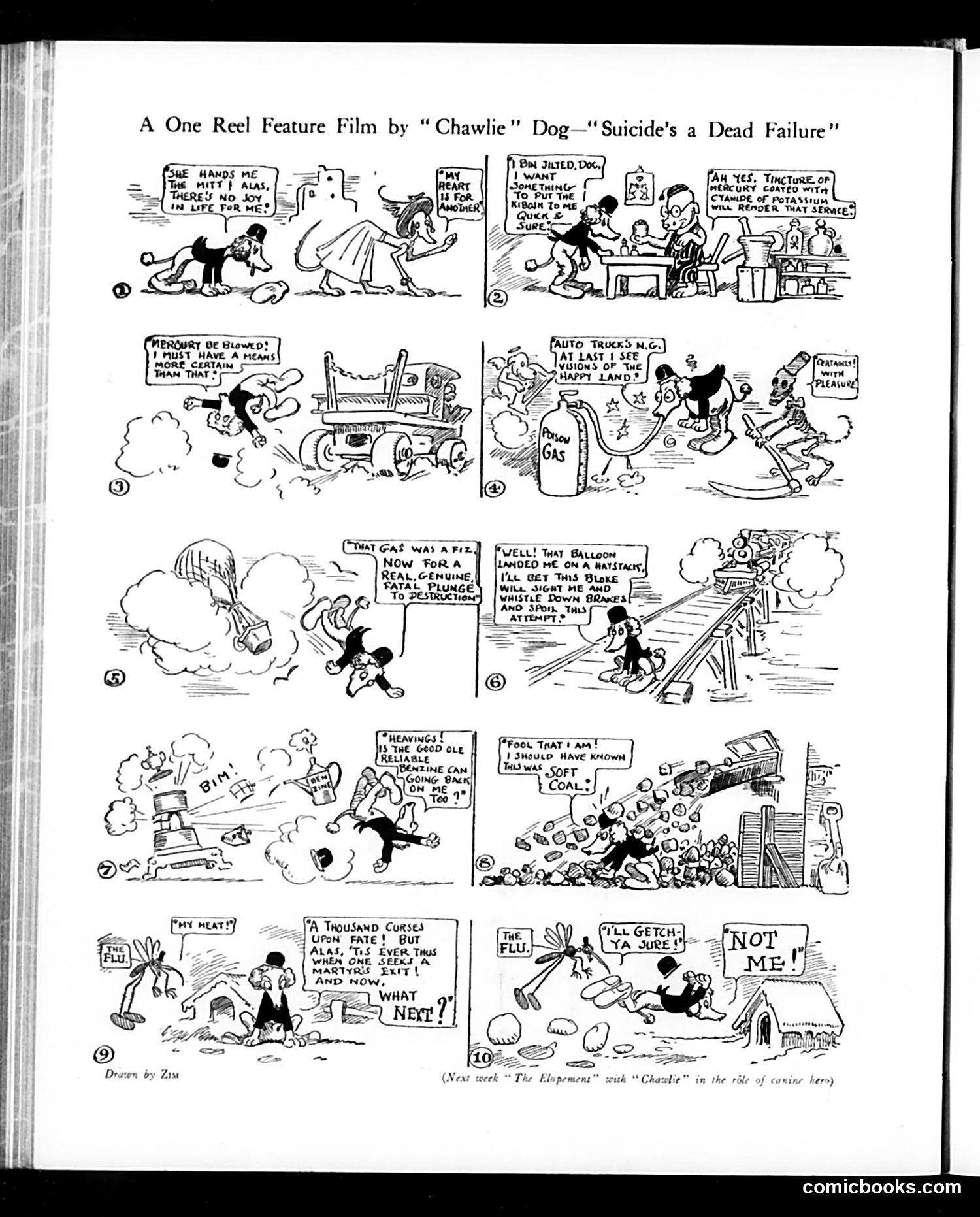
This is a darkly comedic one-reel film scenario by "Chawlie" Dog, a recurring character. The narrative follows a dog attempting suicide through increasingly absurd methods—poisoning, gas, a balloon drop, train tracks, and explosives—each failing spectacularly. The satire targets both melodramatic suicide narratives popular in early cinema and the dog character's incompetence. Each panel presents a different method with the dog's overwrought inner monologues ("Mercury of the dead!" "At last I see visions of the happy land!"), which exaggerates the sentimental tone of serious dramatic films. The joke is that suicide attempts in silent comedies were treated as slapstick—the methods backfire comically rather than tragically. The final panel shows the dog covered in wreckage declaring "NOT ME!"—the ironic punchline that all his efforts have failed. This reflects early 20th-century film comedy conventions where dark subject matter became absurdist humor.
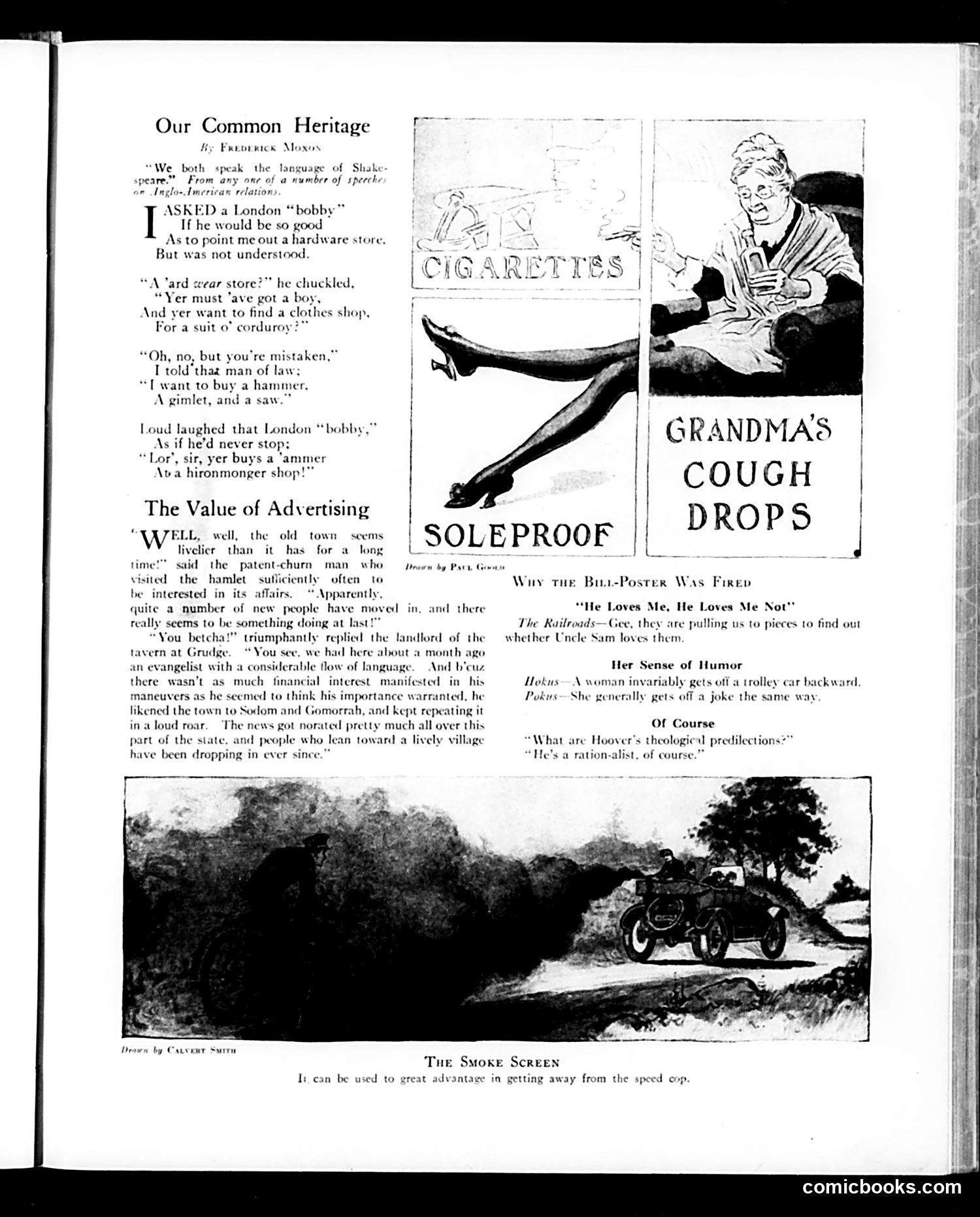
This page from *Judge* contains three distinct pieces: **"Our Common Heritage"** is a dialect humor poem mocking the British accent. An American tourist asks a London police officer ("bobby") for a "hardware store," but the officer's working-class Cockney dialect makes communication impossible—he interprets it as "ard wear store" and suggests a clothing shop instead. The joke turns on linguistic misunderstanding between American and British English speakers, suggesting they don't truly share a common language despite both speaking "Shakespeare." **"The Value of Advertising"** is a brief anecdote about small-town revival. An evangelist's harsh sermons comparing the town to "Sodom and Gomorrah" inadvertently attracted visitors seeking excitement—his negative publicity became positive advertising, revitalizing the village economically. The page also contains minor one-liner jokes about railroads, humor, and avoiding speed cops, plus vintage advertisements for cigarettes and cough drops. These reflect early-20th-century American humor and advertising conventions.
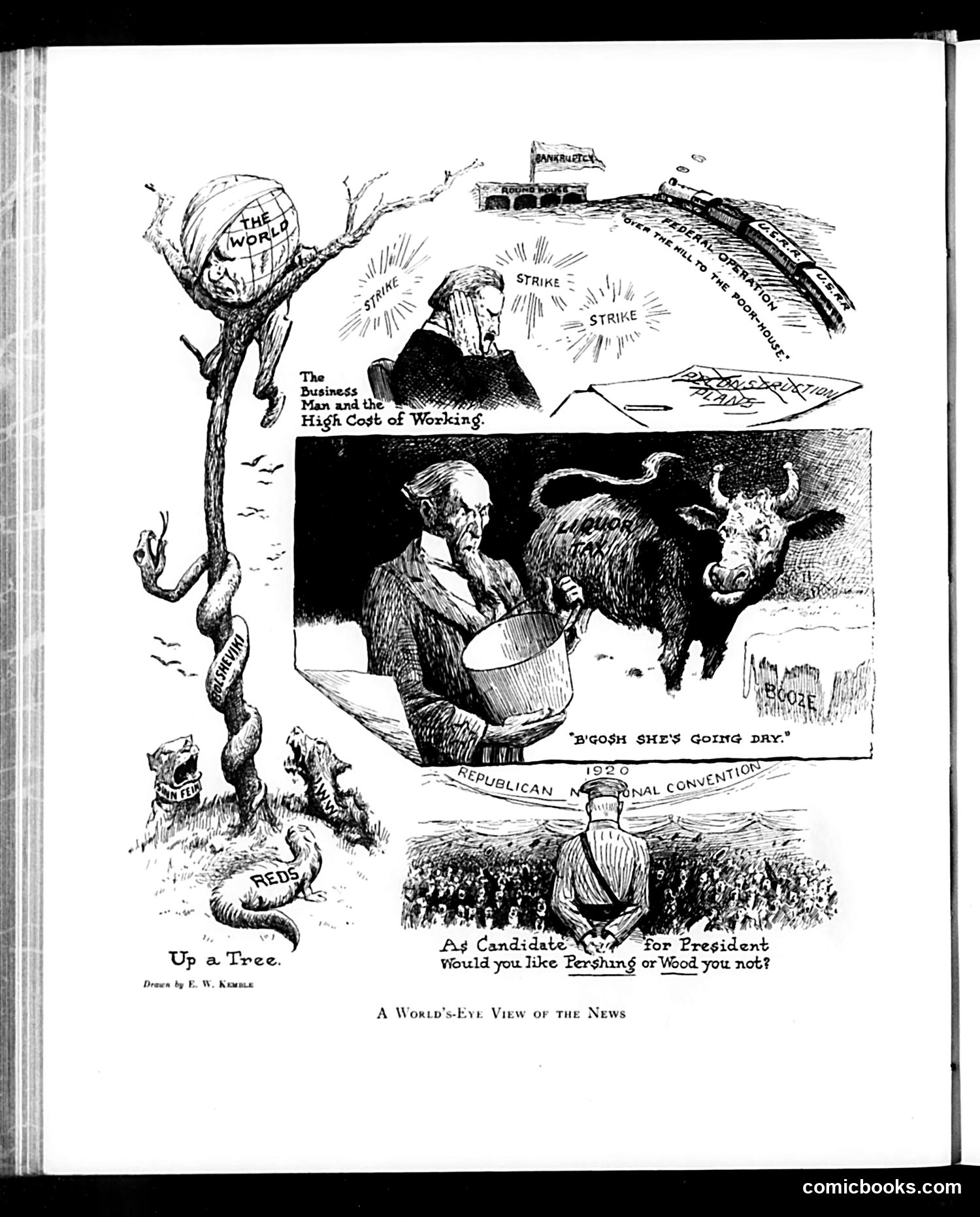
This 1920 cartoon from *Judge* satirizes the Republican National Convention's presidential selection. The central image shows a farmer milking a dry cow, captioned "Begosh She's Going Dry"—metaphorically depicting American business exhausted by labor strikes and high costs of working (referenced in the upper panels showing industrial strife). The bottom section presents a choice between two candidates: General Pershing or General Wood, asking voters "Would you like Pershing or Wood you not?" This is a play on words mocking the decision facing Republicans. Left side: "Up a Tree" shows the "Reds" (communists/labor radicals) literally climbing a tree, symbolizing the threat of radicalism the Republicans hoped to address through their candidate selection. The overall message: American business is exhausted by labor unrest and strikes, and Republicans are choosing between two military leaders to restore order.
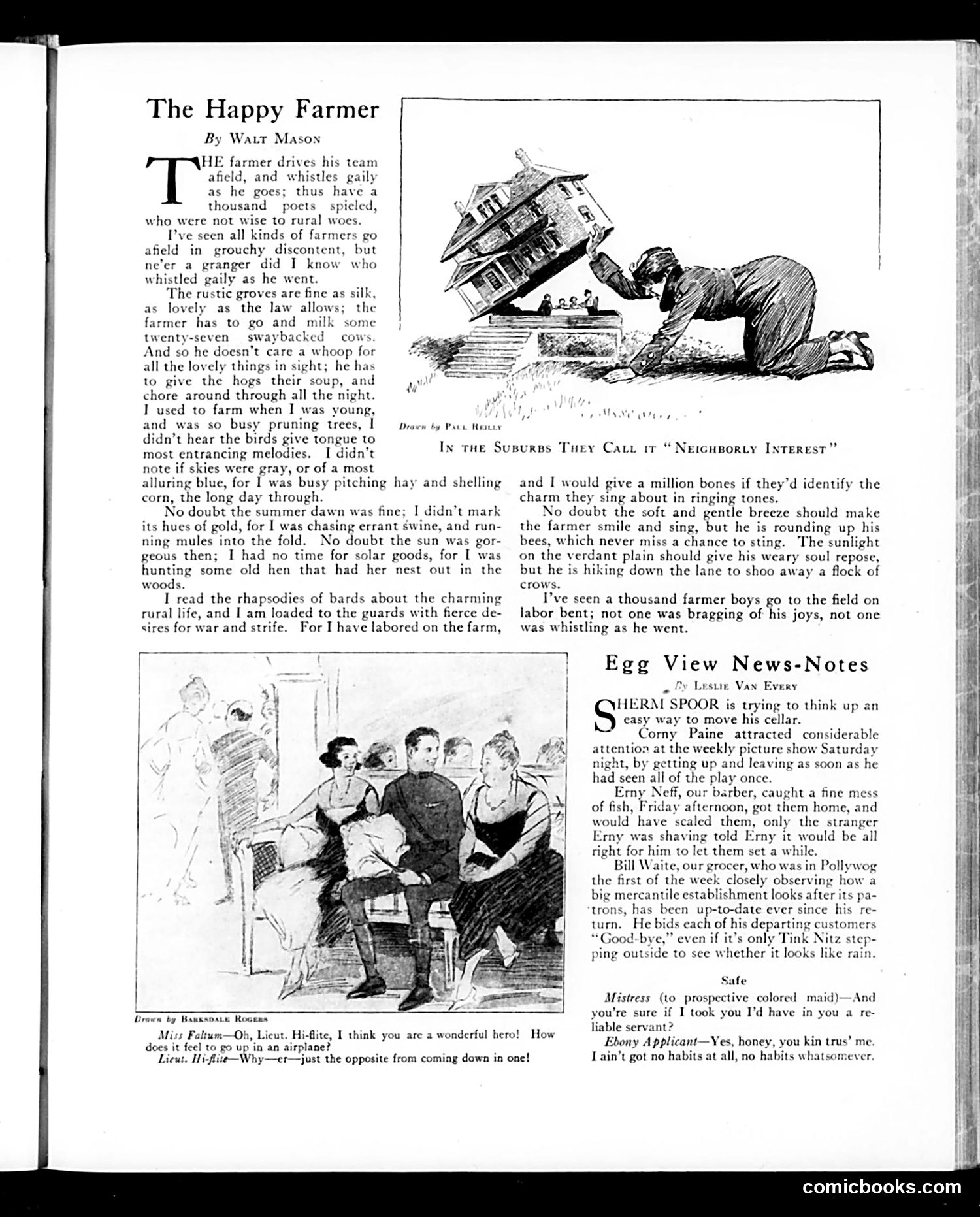
**"The Happy Farmer"** by Walt Mason debunks the romanticized notion—popularized by poets and literature—that farming is idyllic and joyful. Mason, drawing from personal farm experience, argues farmers are too exhausted by relentless labor (milking cows, feeding hogs, chasing livestock through the night) to appreciate nature's beauty. The satire targets sentimental rural mythology: while poets rhapsodize about "charming rural life," actual farmers work continuously without leisure to enjoy sunlight, gentle breezes, or birdsong. Mason's conclusion—that he's "never" met a whistling farmer—directly contradicts the opening cliché. **"In the Suburbs They Call It 'Neighborly Interest'"** (cartoon by Paul Henry) appears to satirize small-town nosiness, depicting what seems a house literally tipping over to spy on neighbors. The **"Egg View News-Notes"** section provides humorous local gossip, including a barber's fish anecdote and a grocer's newfound politeness.
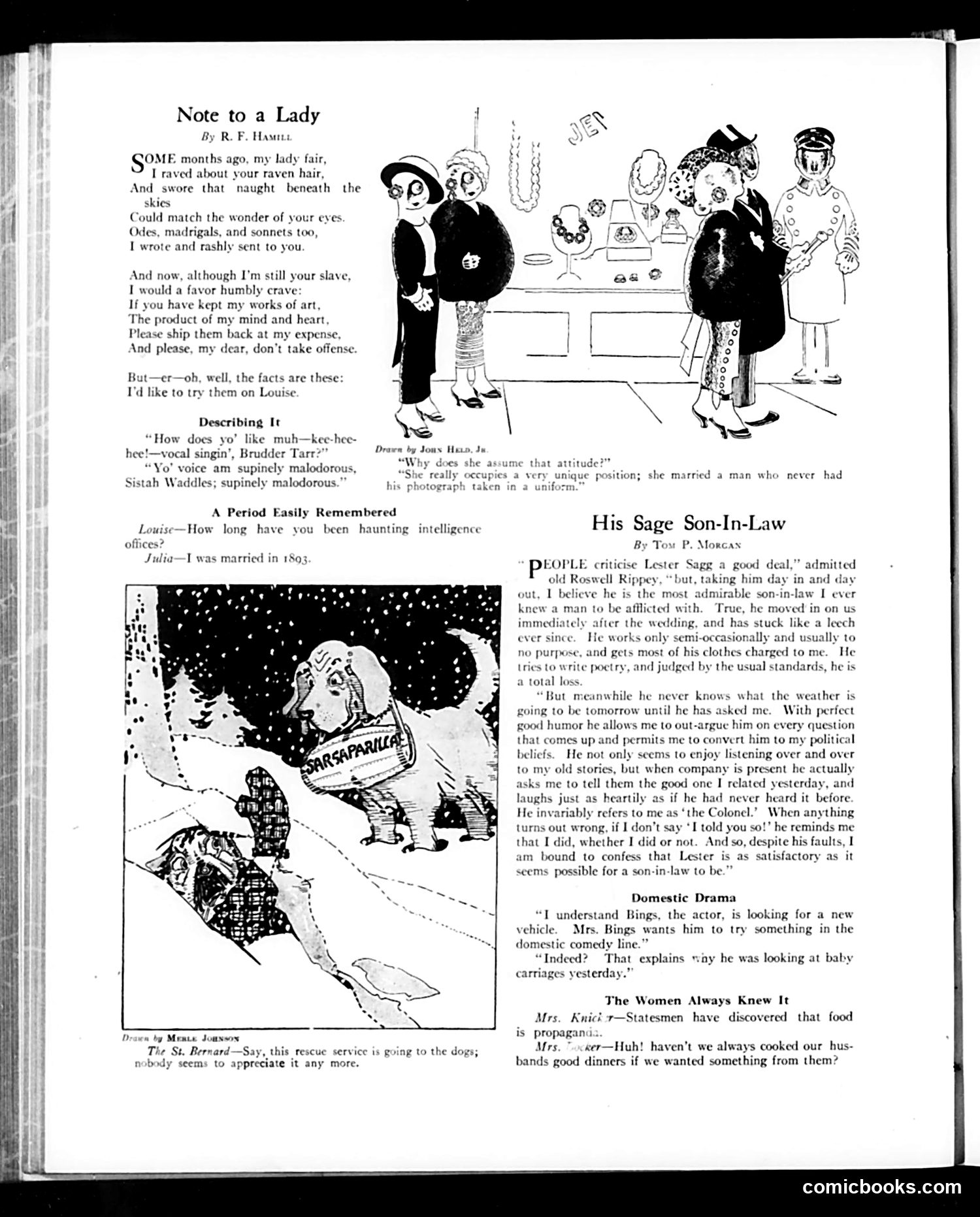
This *Judge* magazine page contains several satirical pieces mocking romantic and domestic life: **"Note to a Lady"** satirizes insincere romantic poetry. A man who wrote flowery verses (odes, sonnets) to woo a woman now wants them back—to recycle them on someone else named Louise. The joke: male romantic gestures are calculated performances, not genuine emotion. **The St. Bernard cartoon** (by Mento Johnson) shows a rescue dog in snow, commenting that nobody appreciates rescue services anymore—likely mocking the decline of charitable sentiment or public gratitude. **"His Sage Son-In-Law"** presents a husband who is useless (unemployed, mooches clothes, writes bad poetry) yet perfectly manipulable—he defers to his father-in-law on everything, takes blame unfairly, and flatters constantly. The satire targets both weak sons-in-law and the fathers-in-law who exploit them. **"The Women Always Knew It"** concludes with women noting they've long used food/cooking as leverage in marriage—predating modern politicians' "discovery" that food is propaganda. The joke: women understood manipulation before men did. All pieces satirize domestic dishonesty and power dynamics.
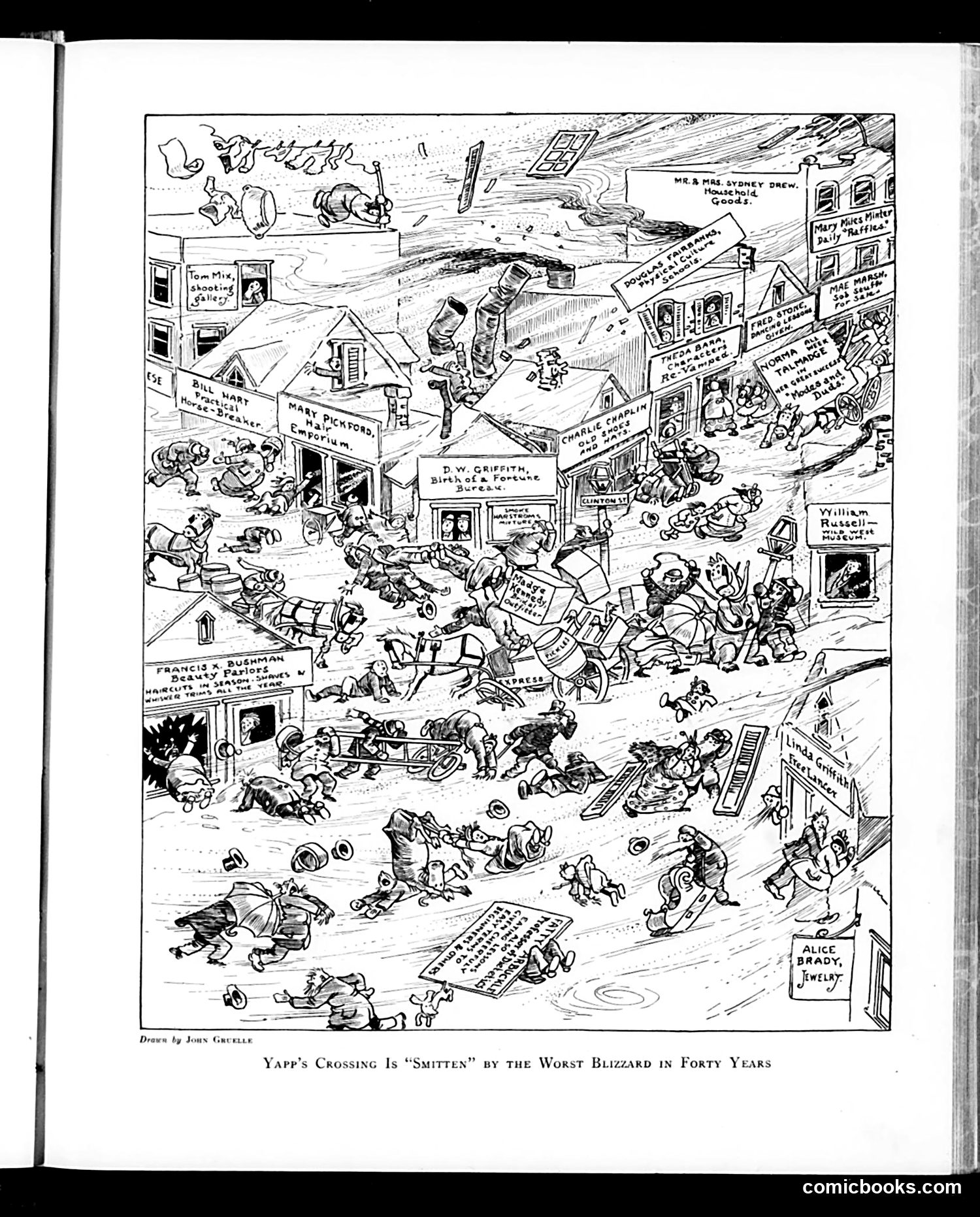
This is a satirical cartoon by John Guelle depicting "Yapp's Crossing" being hit by an extreme blizzard—described as the worst in forty years. The drawing shows a chaotic winter scene at a small town or crossroads, with numerous figures struggling through snow, fallen objects, and disrupted activity. The cartoon appears to be social satire about frontier or rural American life during severe weather. Various business establishments are labeled (visible storefronts and signs), and the busy street scene contrasts sharply with the disaster unfolding. The humor likely derives from exaggerating the blizzard's destructive impact on everyday commerce and community life. Without clearer OCR of all storefront names or additional context about when this was published, the specific local references remain somewhat unclear, but the general point is evident: mocking how a small town's normal operations are completely overwhelmed by nature's extreme weather event.
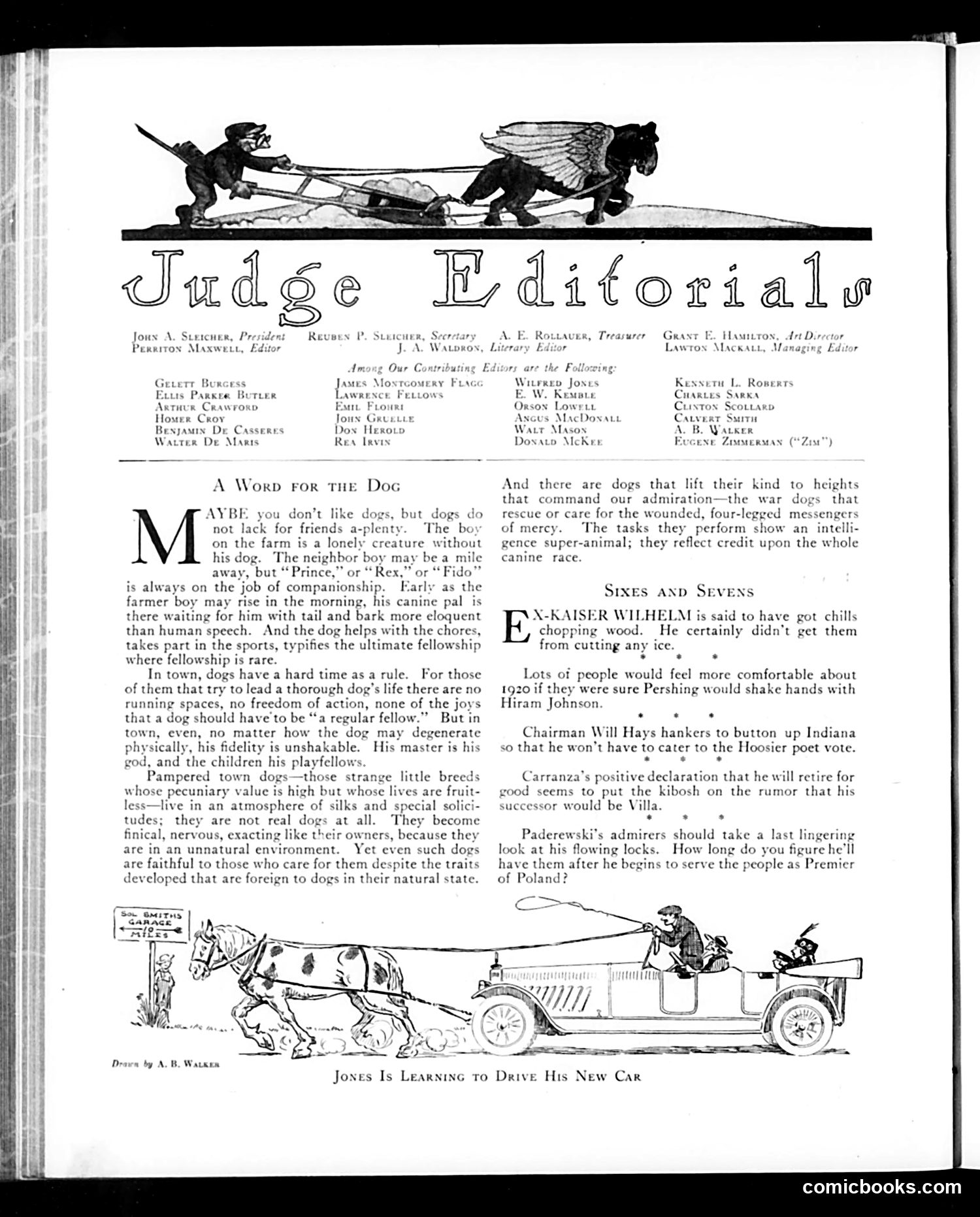
This is a **Judge magazine editorial page** featuring commentary and social satire rather than political cartoons. ## Main Content: "A Word for the Dog" The essay celebrates farm dogs' loyalty and usefulness, contrasting them favorably with pampered town dogs who become "finical, nervous, exacting" due to unnatural urban environments. It also praises war dogs as displaying "super-animal" intelligence. This romanticizes rural/military dog life over urban domesticity—a common early 20th-century theme valuing traditional over modern living. ## "Sixes and Sevens" Gossip Section Brief satirical jabs at contemporary figures: - **Kaiser Wilhelm**: Mocking his claimed illness (chopping wood causing chills) as unconvincing - **Pershing and Hiram Johnson**: References 1920 political concerns (unclear exact context without dates) - **Will Hays**: Political machinations in Indiana - **Carranza and Villa**: Mexican political figures - **Paderewski**: Polish pianist/politician, joking he'll lose his famous locks upon taking office The cartoon shows someone learning to drive a car—likely satirizing early automotive incompetence, a common humor topic of the era.
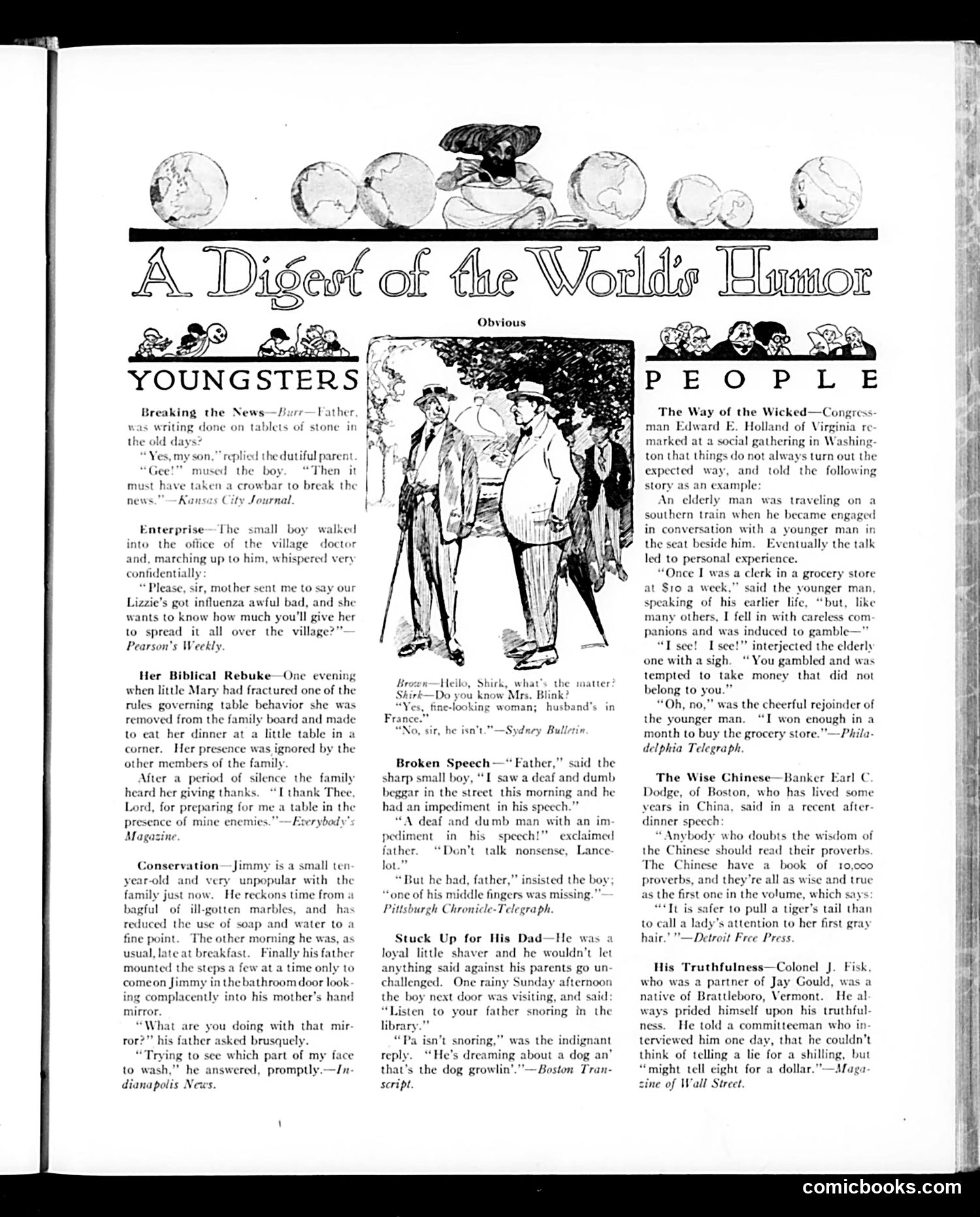
This page collects brief humorous anecdotes organized into two sections: "Youngsters" (left) and "People" (right). The jokes reflect early 20th-century American domestic life and social attitudes. The "Youngsters" section features child-centered humor: a boy's pun about "breaking news" on stone tablets, a child trying to spread influenza for profit, and children's innocent misinterpretations of adult situations. These jokes rely on children's literal-mindedness and naive logic. The "People" section includes anecdotes attributed to congressmen and businessmen, such as Congressman Edward E. Holland's story about a poor clerk who gambled successfully. These establish authority through citation of named public figures. The overall satire targets conventional morality, parental authority, and social pretension through unexpected reversals—children outwitting adults, criminals succeeding, the poor becoming rich. The humor is genteel and family-appropriate, typical of Judge's early 20th-century readership.
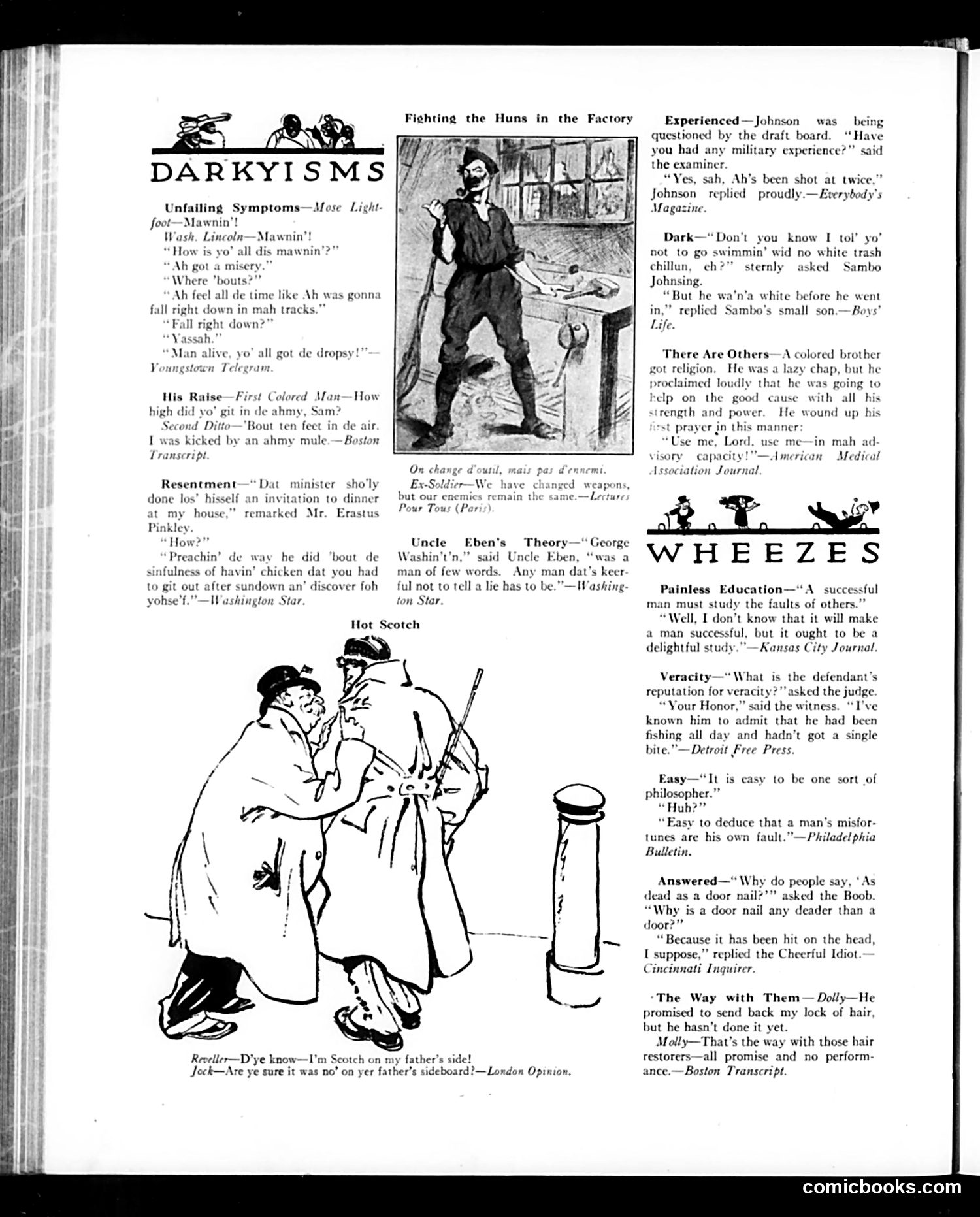
This page from Judge contains racist dialect humor typical of early-20th-century American satire. The content is divided into two sections: **"Darkyisms"** presents stereotyped jokes featuring African American characters rendered in exaggerated dialect. These include medical misunderstandings, military anecdotes, and domestic situations—all relying on caricature and minstrelsy conventions. The humor derives from portraying Black speakers as ignorant or comically malapropistic. **"Wheezes"** is an unrelated section of brief jokes on various topics (Scottish ancestry, military experience, legal testimony, hair restoration). **Context for modern readers:** The racial stereotypes and dialect representations reflect deeply embedded prejudices of the era. Judge, while sophisticated in other respects, normalized this dehumanizing humor. The "Darkyisms" section specifically perpetuates minstrelsy traditions, presenting African Americans as subjects of ridicule rather than as people. This content is historically significant precisely because it documents the casual racism embedded in mainstream American publishing.
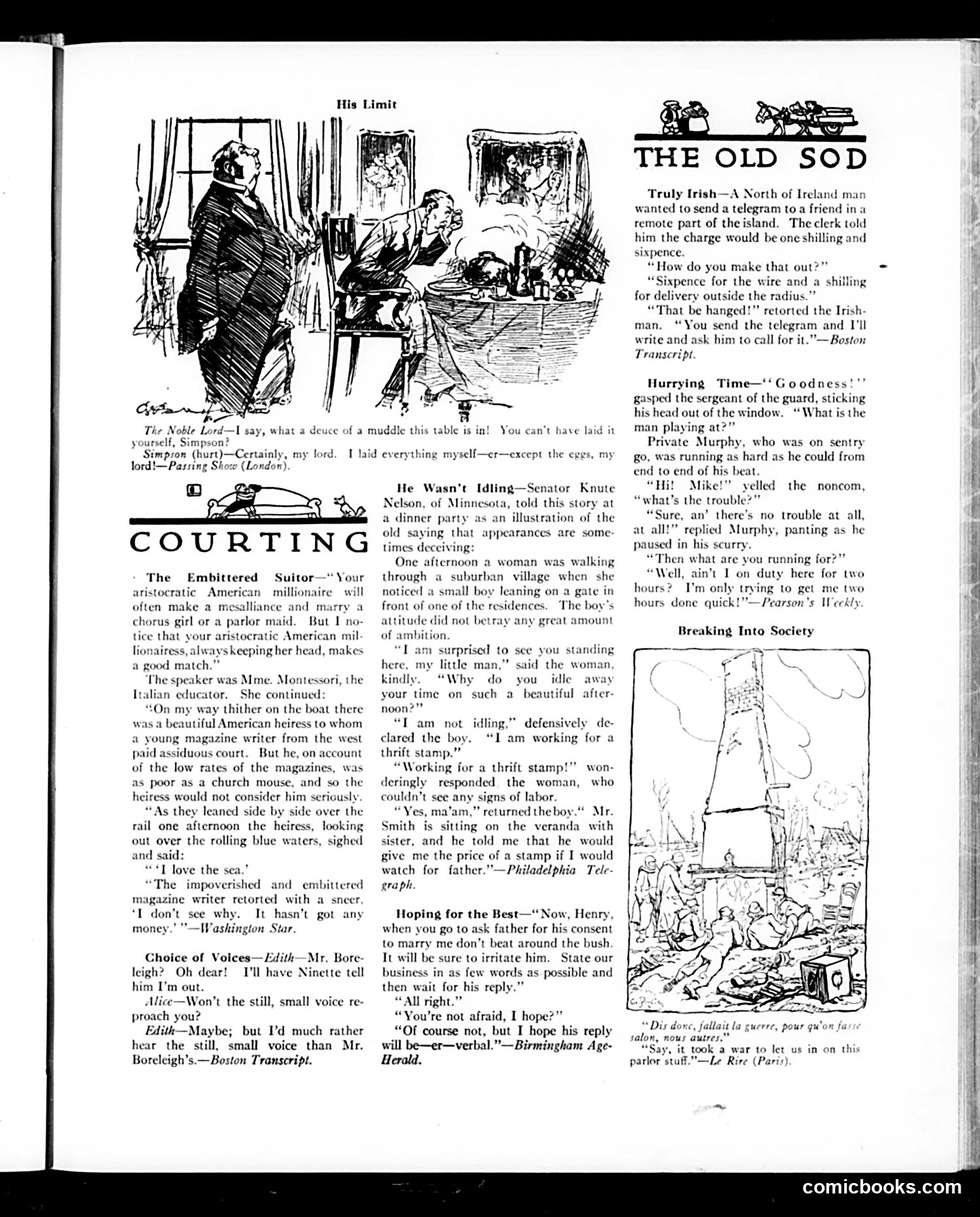
This page from the satirical magazine **Judge** contains several humor pieces targeting early 20th-century social types: **"His Limit"** (top left): A British servant comedy about table-setting incompetence—a straightforward domestic joke with no political content. **"The Embittered Suitor"**: Attributes a quip to Italian educator **Mme. Montessori**, contrasting American heiresses (who marry well) with a poor magazine writer who, resentful of low editorial pay rates, dismissively tells a wealthy heiress "the sea hasn't got any money." The satire mocks both impoverished writers and mercenary courtship. **"He Wasn't Idling"**: Attributed to Senator **Knute Nelson of Minnesota**, this anecdote presents a boy "working" by standing idle—a joke about WWI-era "thrift stamps" (government savings bonds). The humor lies in the apparent idleness masking legitimate labor. **"The Old Sod"**: Irish ethnic humor about an Irishman refusing to pay telegram delivery charges, insisting his friend collect it instead—playing on stereotypical Irish frugality. **"Hurrying Time"**: Irish soldier humor about Private Murphy sprinting his sentry duty to finish his two-hour shift quickly.
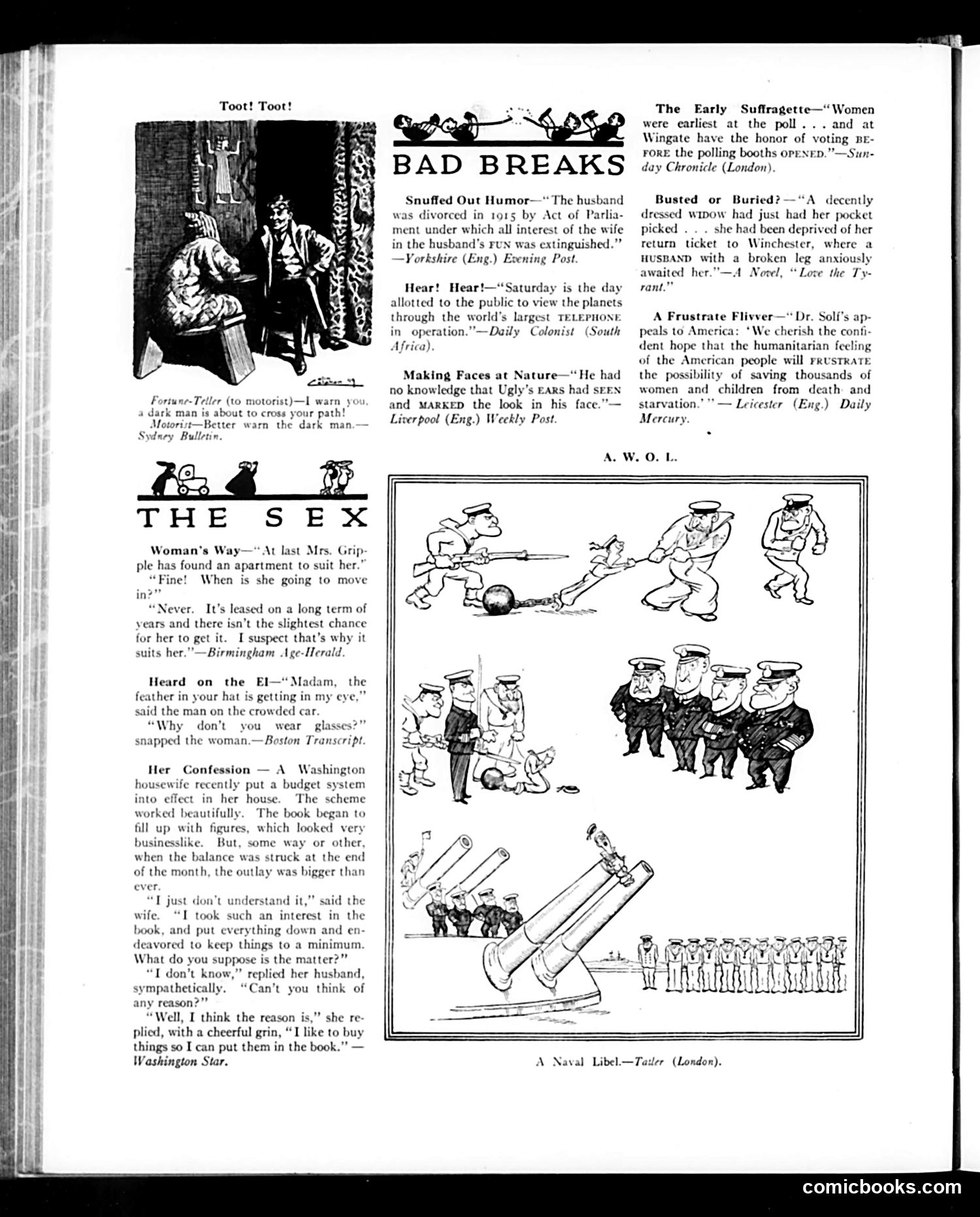
This page collects humorous misquotes and ironic news snippets under the heading "Bad Breaks"—editorial errors or unfortunate phrasings that create unintended comedy. Key examples include: **"Snuffed Out Humor"**: A divorce law accidentally stated the husband's "fun" was extinguished rather than the wife's legal interest—satirizing how legal language can miss the mark. **"Hear! Hear!"**: A South African newspaper called a telescope a "telephone," creating absurd confusion about technology. **"The Early Suffragette"**: References women voting before polling booths opened—likely mocking suffragette enthusiasm or suggesting procedural chaos during early women's voting. **"Busted or Buried?"**: A novel's plot creates dark comedy by stranding a woman without her return ticket while her injured husband waits. The naval cartoon below (credited to Tatler) appears to satirize military discipline or naval operations, though the specific reference is unclear. The page's humor relies on readers catching these editorial gaffes and their unintended meanings—a staple of Judge's satirical format.
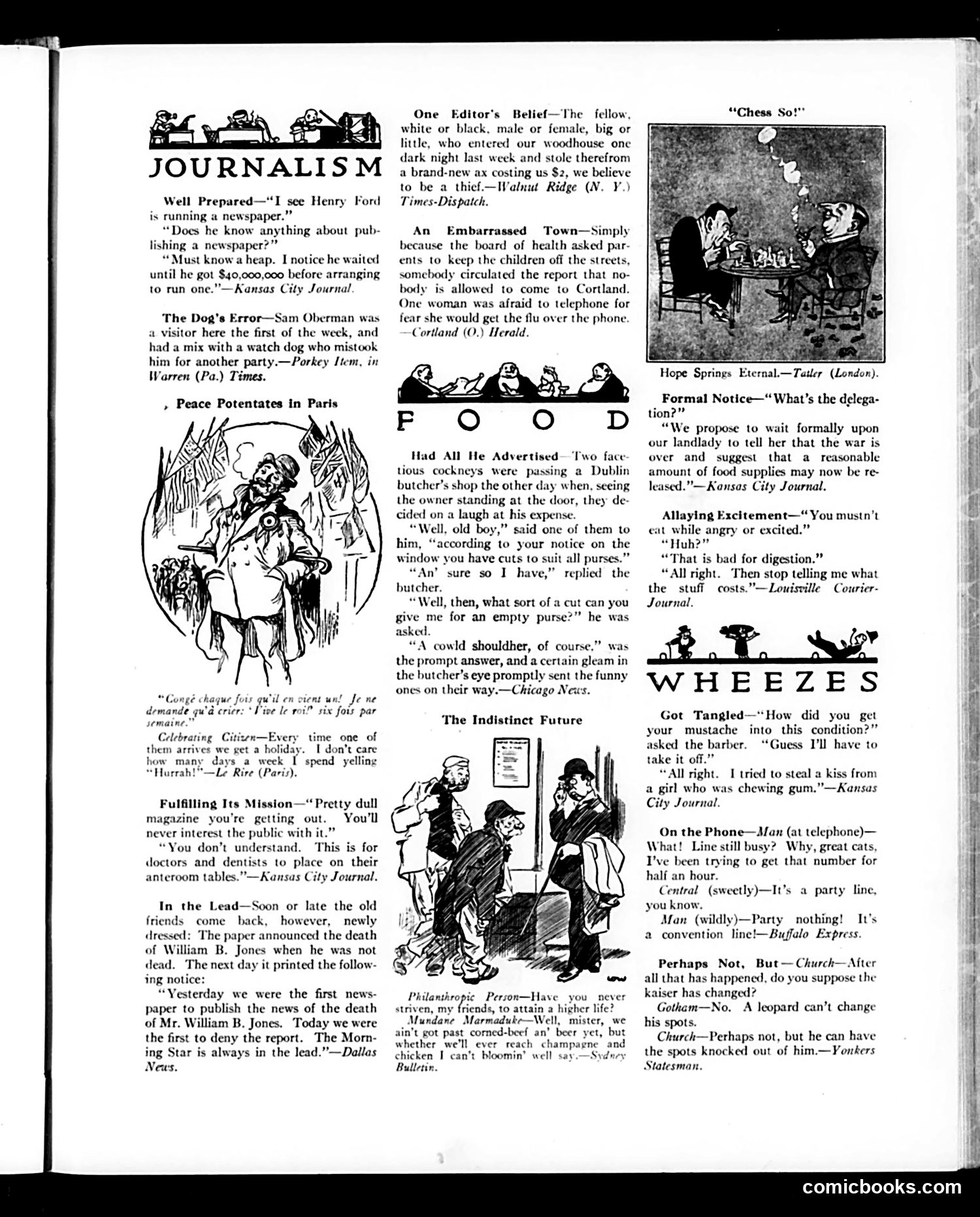
This page from Judge magazine contains satirical commentary on American life circa early 20th century. The main cartoons and jokes mock: **"Journalism" section**: Jokes about newspaper publishing and editorial practices—including a dig at Henry Ford for launching a newspaper only after accumulating $40 million, implying newspapers require financial backing rather than journalistic skill. Other items mock sensationalism and poor reporting (a paper prematurely announcing someone's death, then claiming credit for denying it). **"Food" section**: A Dublin butcher's exchange where cockneys ask for a "cut to suit an empty purse," receiving a "cold shoulder"—a pun on both butcher's cuts and the idiom for rejection. **"Wheezes" section**: Brief humor items including a barber joke about tangled mustaches from stealing kisses from gum-chewing girls, and telephone party-line confusion. The page satirizes American media incompetence, economic pretension, and everyday social awkwardness—typical Judge magazine fare blending class commentary with broad humor.
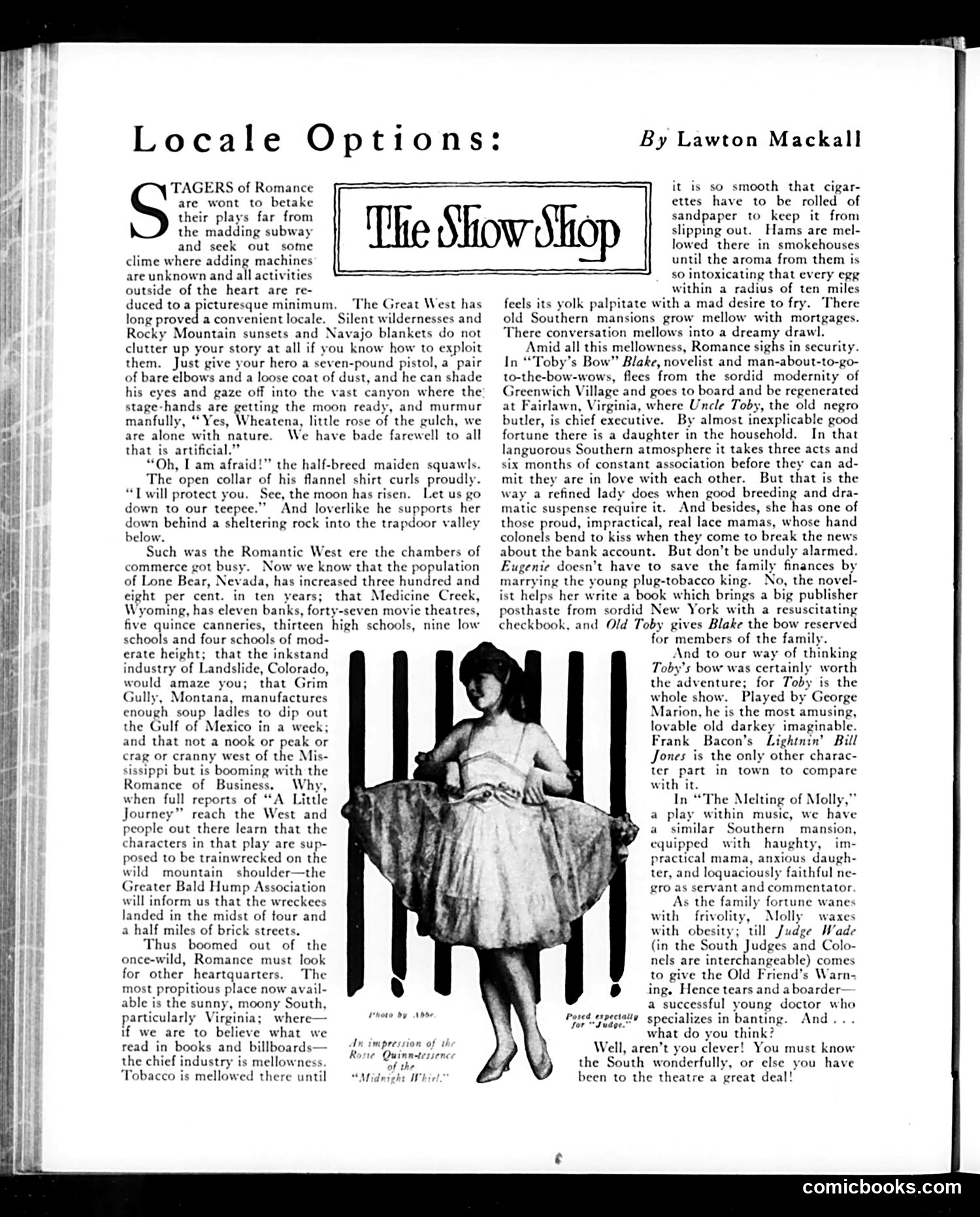
This article by Lawton Mackall satirizes how theatrical producers stage romantic plays in exotic, "authentic" locations. Mackall mocks the cliché of setting dramas in the untamed American West—complete with seven-pound pistols, half-breed maidens, and teepees—to create artificial romance. His real target: modern industrial progress has ruined these supposed wilderness backdrops. He catalogs absurdly specific commercial development (soup ladle factories, brick streets) across Western towns, exposing how "Romance of Business" has replaced actual romance. The solution? Producers now relocate their stories to the American South, where "mellowness" supposedly still exists—old mansions, slow drawls, and languid courtships. Mackall implies this Southern setting is equally manufactured nostalgia. The accompanying photograph shows an actress in period costume, illustrating the theatrical artifice he's critiquing. The piece is a gentle mockery of how entertainment creates false authenticity through selective geography.
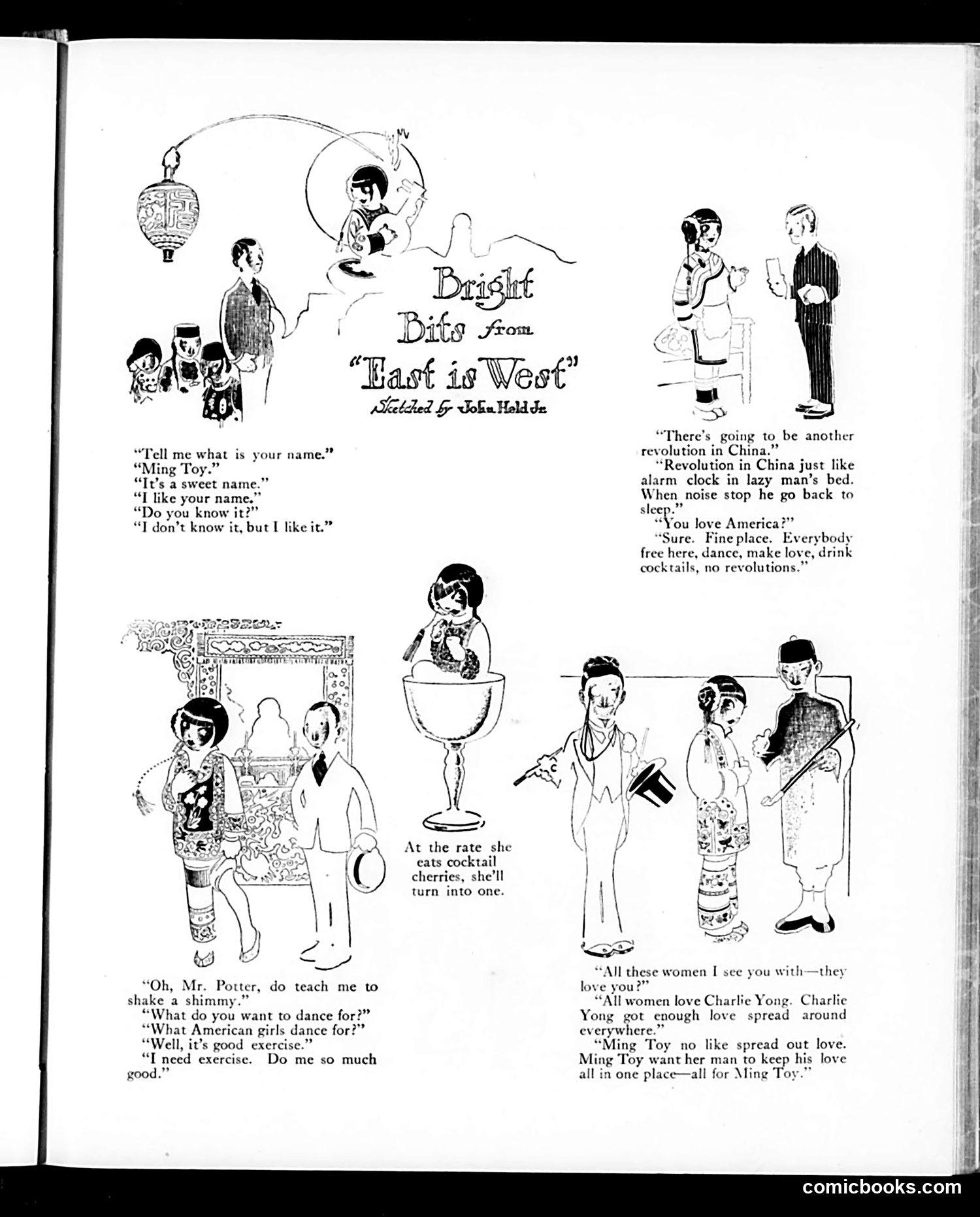
This is a satirical cartoon strip based on a 1920s play, depicting cross-cultural romantic comedy between an American man and a Chinese woman named Ming Toy. The humor relies on ethnic stereotypes common to the era: broken English dialogue, exoticized "Oriental" aesthetics (lanterns, decorative details), and assumptions about Chinese attitudes toward Western culture. The satire targets multiple subjects: American frivolousness (cocktails, dancing, casual affairs); Chinese political instability (references to revolution); and conflicting cultural values around love and commitment. Ming Toy represents the "exotic other" who paradoxically possesses old-fashioned virtue (wanting exclusive devotion) while other women embrace American promiscuity. The jokes assume readers found humor in racial caricature and cultural incompatibility. This reflects Judge magazine's early-20th-century audience and editorial perspective, now recognized as offensive stereotyping rather than sophisticated satire.
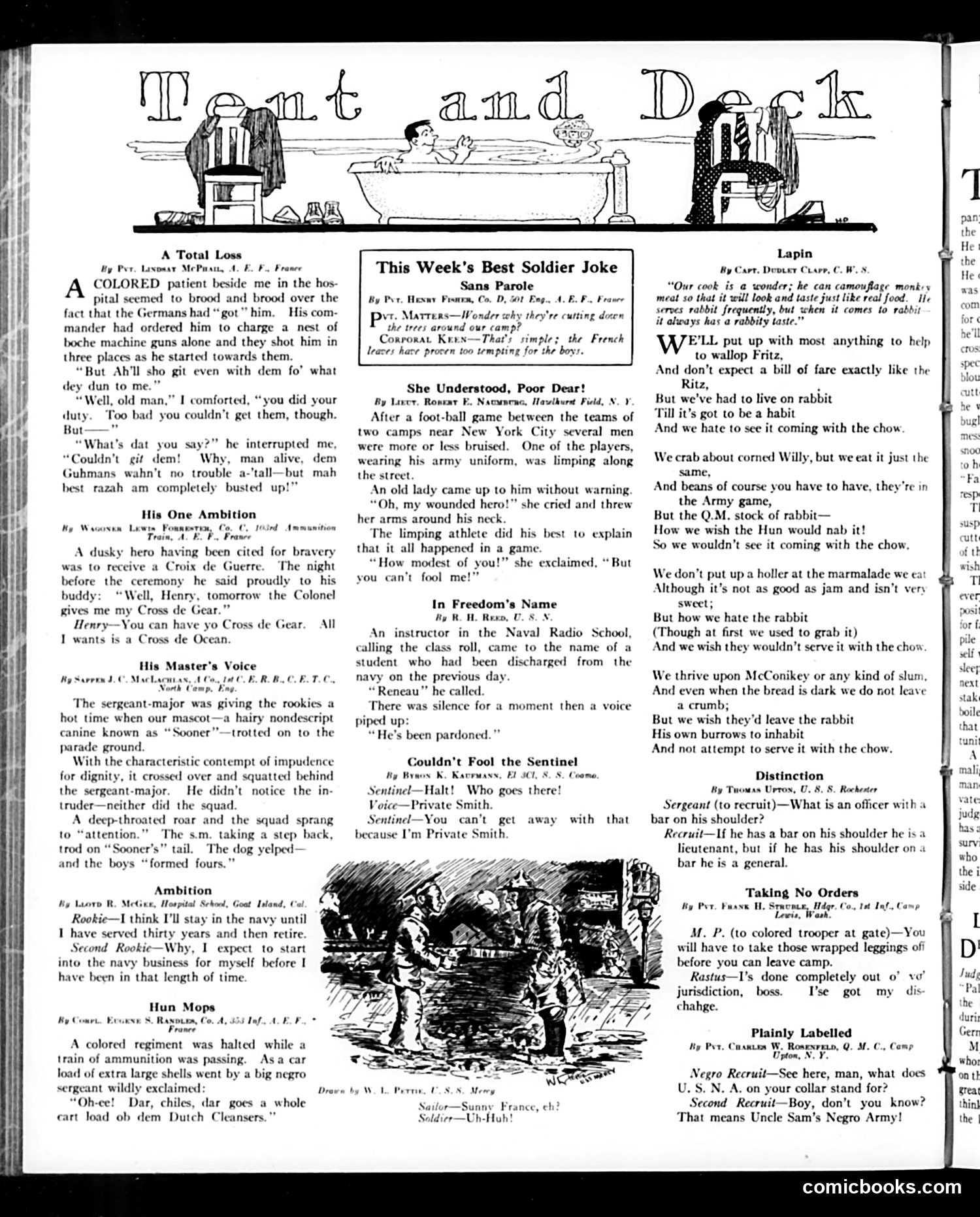
This WWI-era satirical page uses soldier humor to mock racial stereotypes prevalent at the time. The content reflects segregated American military units and racist attitudes. **Key sketches:** - "A Total Loss": A Black soldier is shot by Germans but laments his broken razor—the "joke" being that material possessions matter more than his injuries. This relies on dehumanizing racial caricature. - "His One Ambition": A Black soldier wants a "Cross de Ocean" (passage home) rather than a military medal—satirizing Black soldiers' desire to escape military service. - "Hun Mops": Uses heavy dialect to portray a Black sergeant misidentifying large artillery shells as "Dutch Cleansers"—implying ignorance. - The rabbit/cook joke at right uses similar stereotype humor about food preparation. **Context:** These jokes reflect the deeply segregated, racist military of WWI. Modern readers should understand they document historical prejudice rather than endorse it.
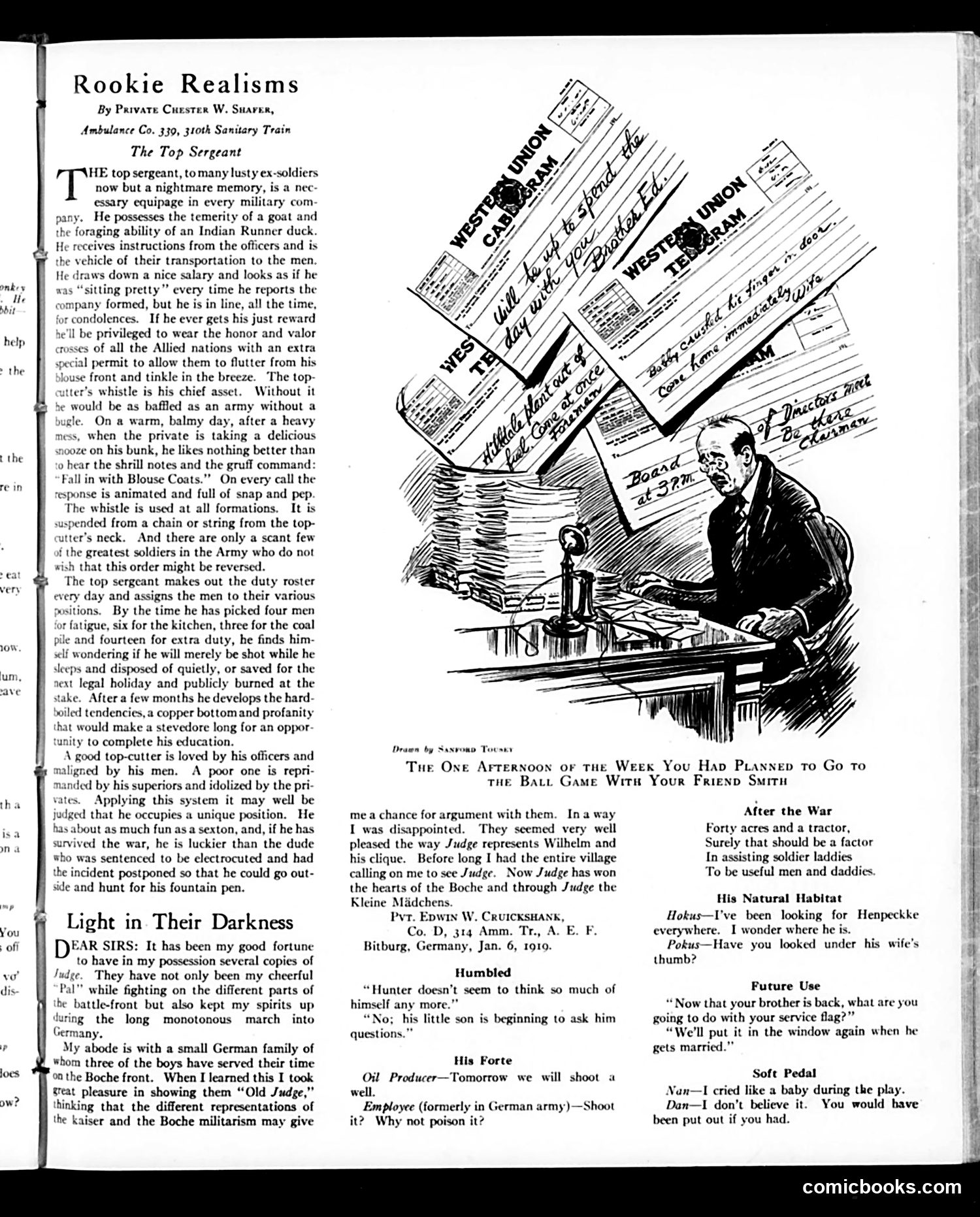
This post-WWI page contains a first-person military humor column by a soldier ("Private Chester W. Sharer") describing the role of the top sergeant—a non-commissioned officer responsible for drilling troops and assigning duties. The main cartoon (drawn by Saxtown Towser) shows a sergeant at a desk buried under stacks of paperwork, illustrating the administrative burden accompanying his authority. The point: the sergeant is caught between officers above and enlisted men below, equally despised by both—"loved by his officers and maligned by his men." Below are three brief jokes: one about a judge's theatrical representation of the Kaiser impressing German civilians; one about an oil producer; and comic dialogue about hunting. The piece reflects **post-war nostalgia and military satire common to Judge magazine**—using humor to process the recent Great War experience. The lengthy column suggests the magazine catered to ex-soldiers seeking recognition of their shared experiences in print.
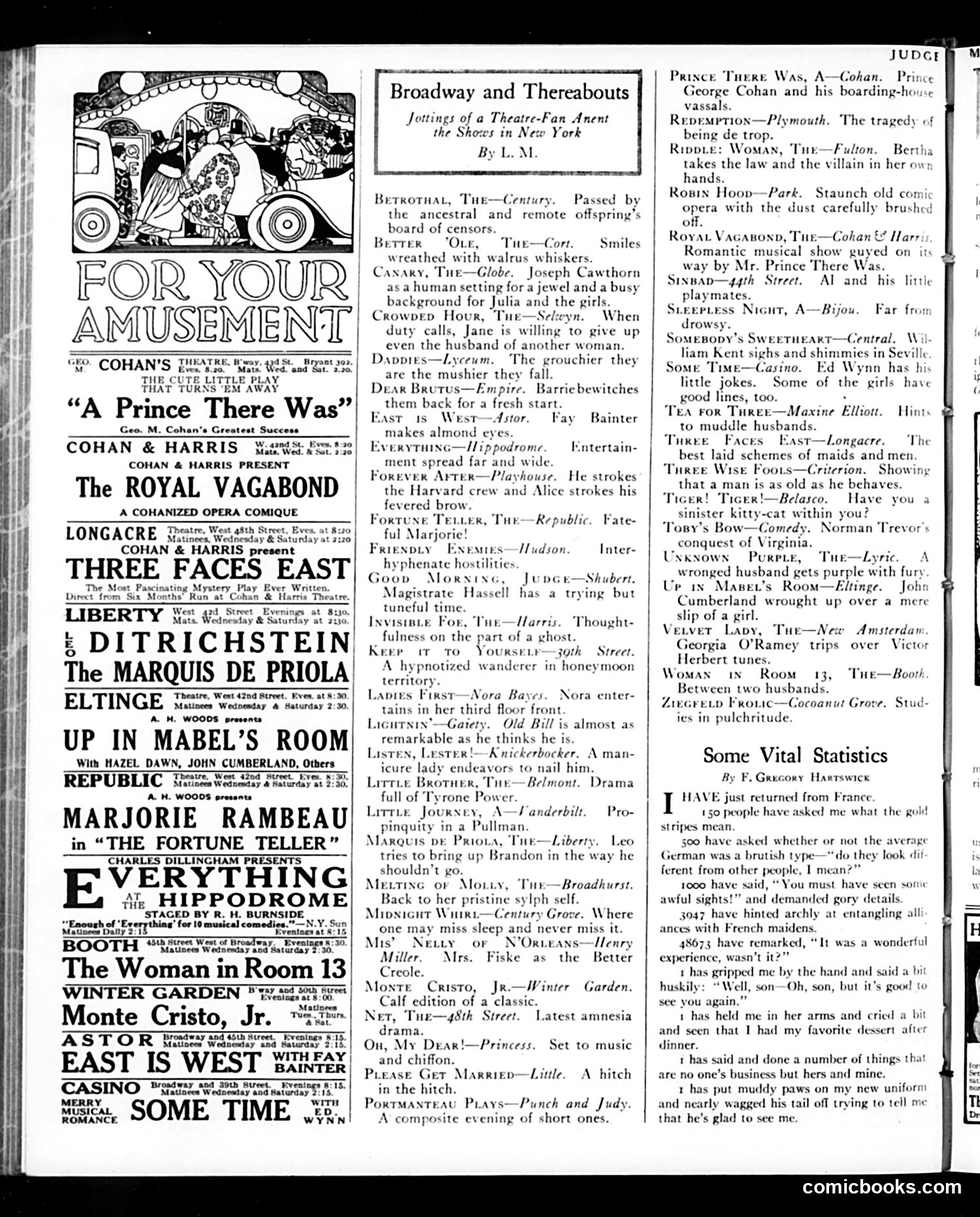
This is primarily a **theater advertisement and review page** from Judge magazine, not a political cartoon. The large decorative illustration at the top depicts theatergoers in an ornate car, celebrating entertainment. The page lists Broadway shows currently running, with brief, witty plot summaries by "L.M." These are one-liners mocking each production's premise—for example, *Crowded Hour* is described as showing "Jane is willing to give up even the husband of another woman," and *Midnight White* notes "Where one may miss sleep and never miss it." The right column, "Some Vital Statistics," contains anecdotal commentary from someone recently returned from France, discussing questions about gold shipments and German wealth. **The satire is gentle**: Judge pokes fun at theatrical tropes (infidelity, drama, romance) rather than engaging in serious political commentary. This reflects Judge's role as an entertainment-focused satirical magazine during this Broadway era.
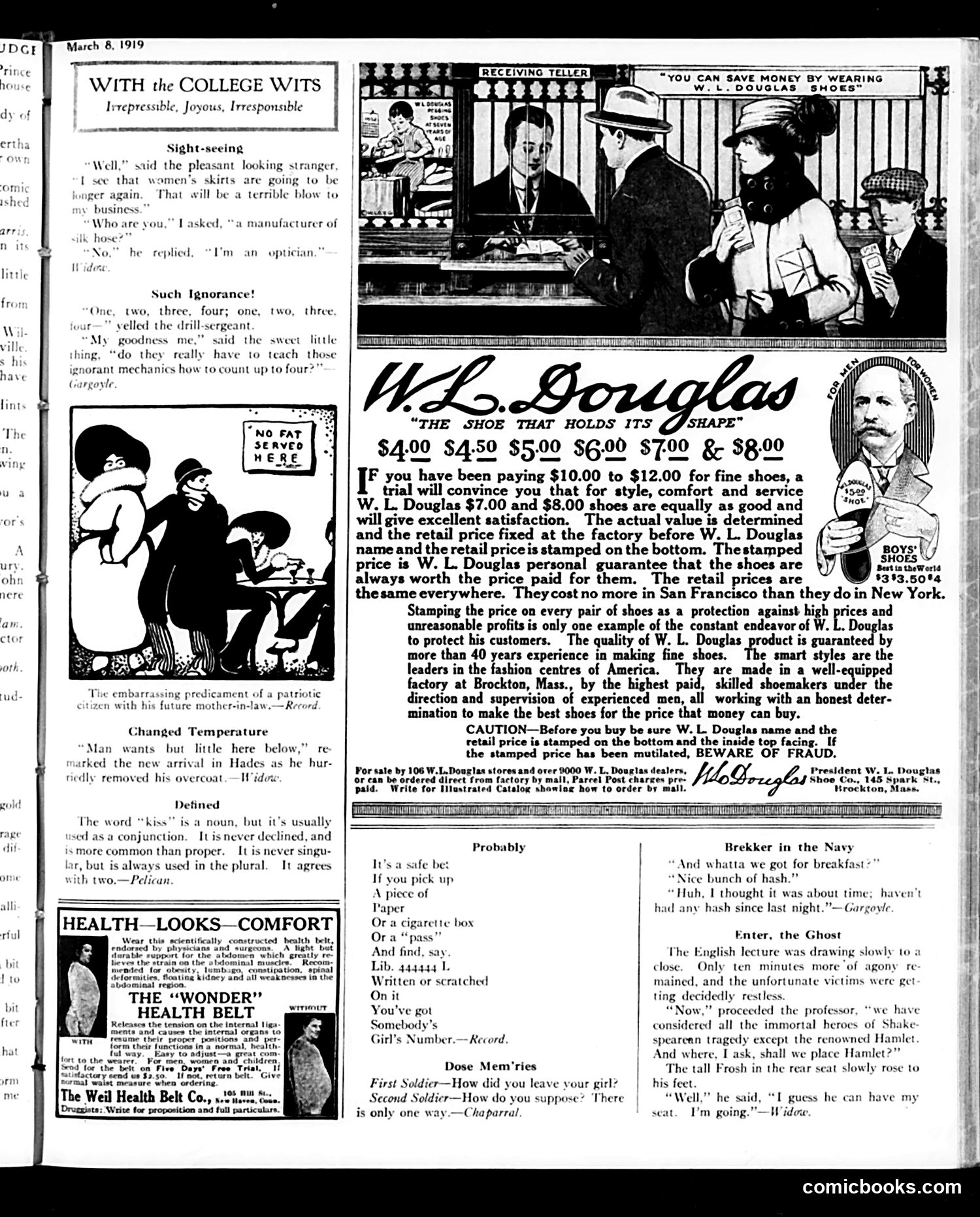
This page mixes humor columns with advertising. The "College Wits" section contains short jokes: one mocks an optician who can't count to four; another jokes about a man arriving in Hell and removing his overcoat due to heat. The dominant feature is a **W.L. Douglas shoe advertisement**, which emphasizes that the brand's retail price is stamped on every shoe as a consumer protection against fraud and inflated markups. This reflects 1919 concerns about price-gouging and profit exploitation—the ad explicitly warns "BEWARE OF FRAUD" if the stamp is tampered with. The large portrait suggests W.L. Douglas was a recognizable brand personality. Secondary ads promote the "Wonder" Health Belt (a medical device claiming to treat kidney and organ issues) and the Weil Health Belt Company. The page closes with brief comedic pieces about naval food ("hash") and an English lecture. These are light filler typical of Judge's satirical magazine format, which mixed social commentary with entertainment and advertising revenue.
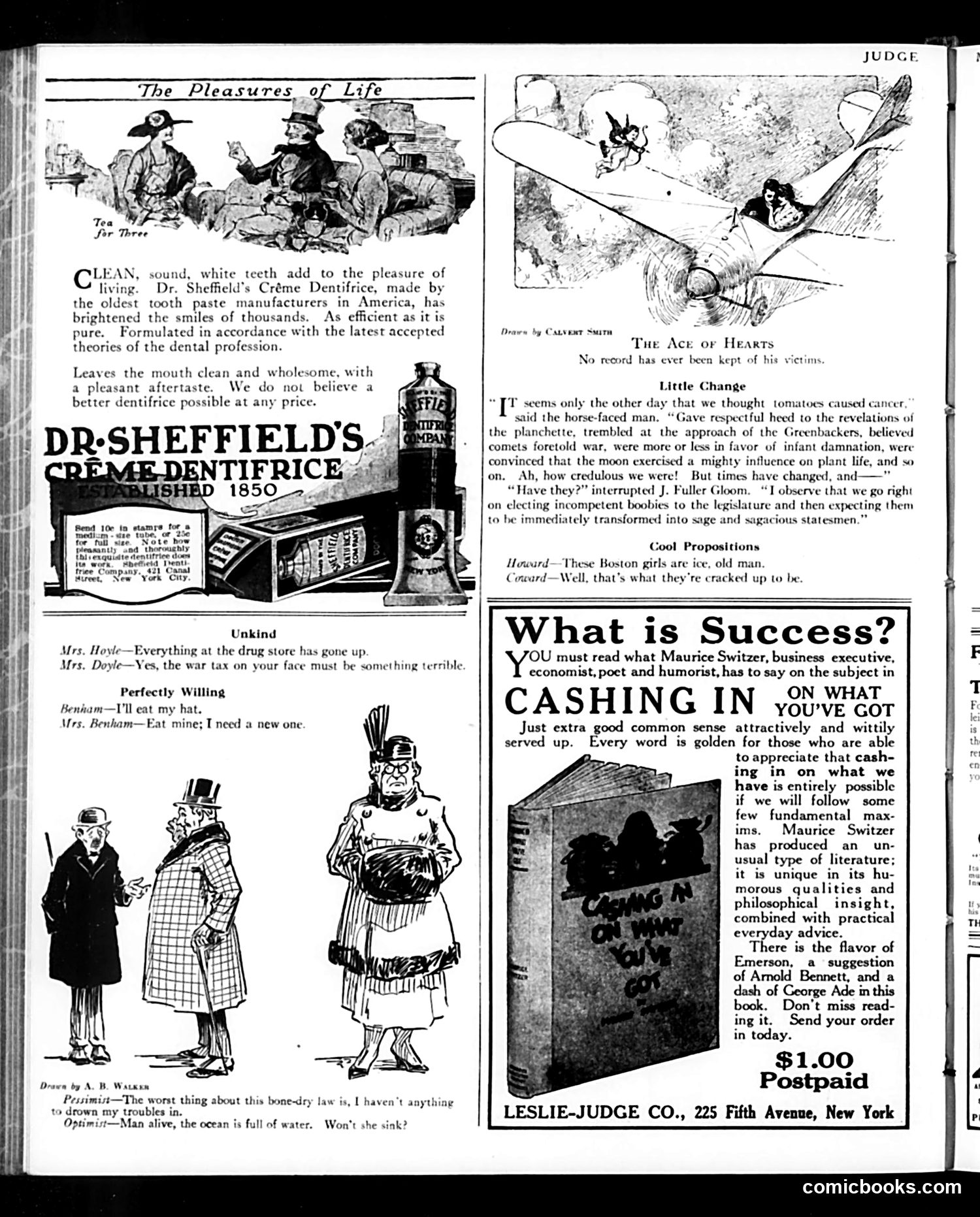
This page from Judge contains several satirical pieces mocking American social attitudes and politics circa 1850-1920s. **"Little Change"** depicts cynicism about human progress: two men discuss how society has abandoned superstitions (belief in planchettes, comets, infant damnation) yet remains foolish—still electing "incompetent boobies" to office expecting them to suddenly become wise leaders. The satire targets voters' naïve faith in electoral solutions. **"Perfectly Willing"** jokes about marital economics during wartime taxation, with women demanding new clothing while men claim poverty. **"Cool Propositions"** and **"Unkind"** are brief one-liners mocking Boston women and drugstore inflation. The **"Bone-Dry Law"** jokes reference Prohibition-era pessimism/optimism—a pessimist sees no drinking outlets; an optimist suggests drowning troubles. The page is primarily **advertising** for Dr. Sheffield's toothpaste and Maurice Switzer's business advice book, using humor to attract readers.
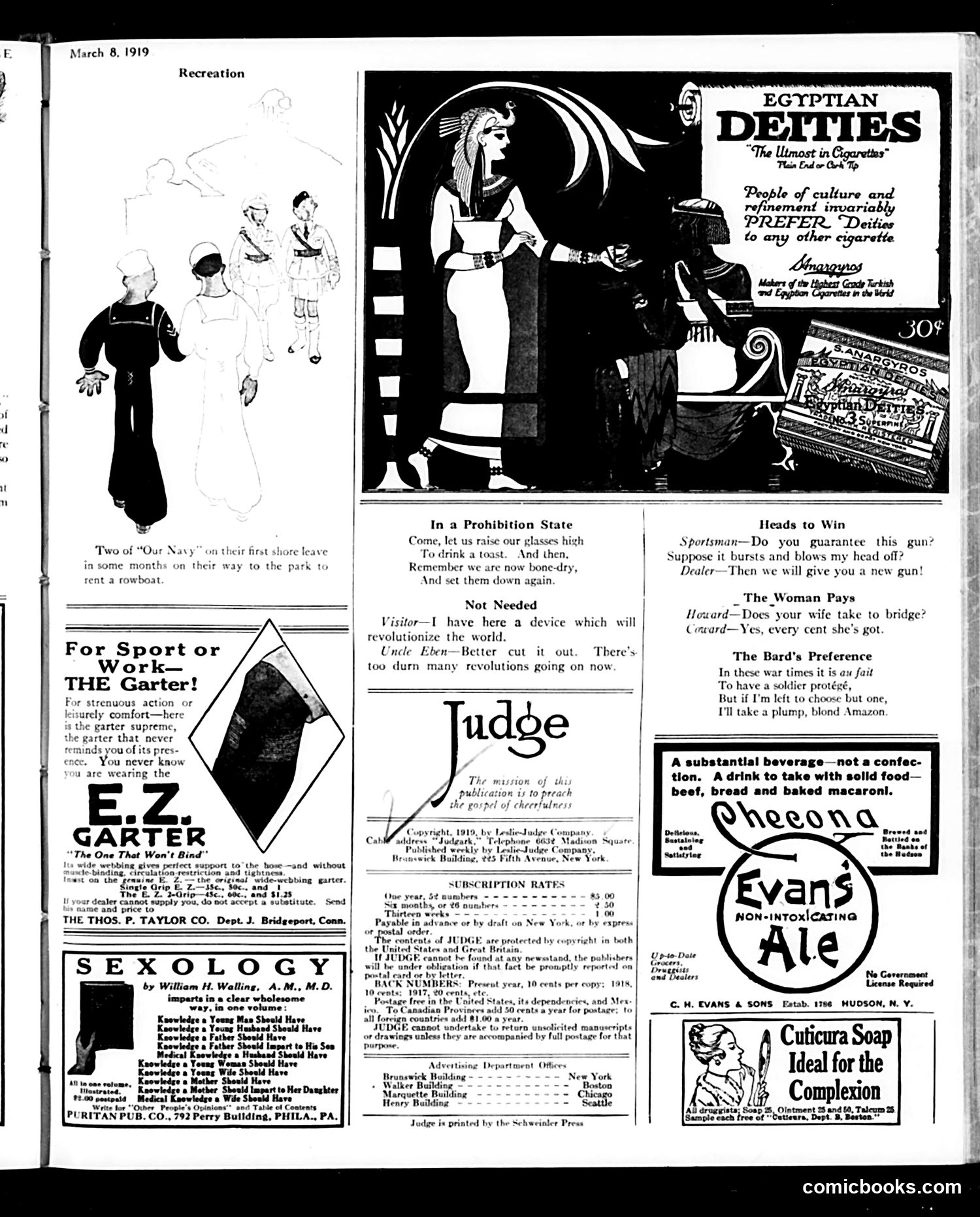
This page mixes advertisements with satirical humor reflecting post-WWI America: **"In a Prohibition State"**: A joke about the recent passage of Prohibition (ratified January 1919, taking effect later that year). The humor: people toast with empty glasses, since alcohol is now illegal—absurd but compliant. **"Not Needed"**: Uncle Eben dismisses an inventor's world-changing device, noting too many revolutions are already happening. This likely references Bolshevik upheaval and post-war social unrest in 1919. **Misc. jokes** ("Heads to Win," "The Woman Pays," "The Bard's Preference"): Simple one-liners about gun guarantees, marriage finances, and wartime romance preferences. **Advertisements** dominate: Egyptian Deities cigarettes, E.Z. Carter garters, Sexology books, Phoeona Ale, and Cuticura Soap fill most space—typical for Judge's revenue model. The overall tone reflects 1919's anxieties: Prohibition's arrival, revolutionary ferment, and post-war social change.
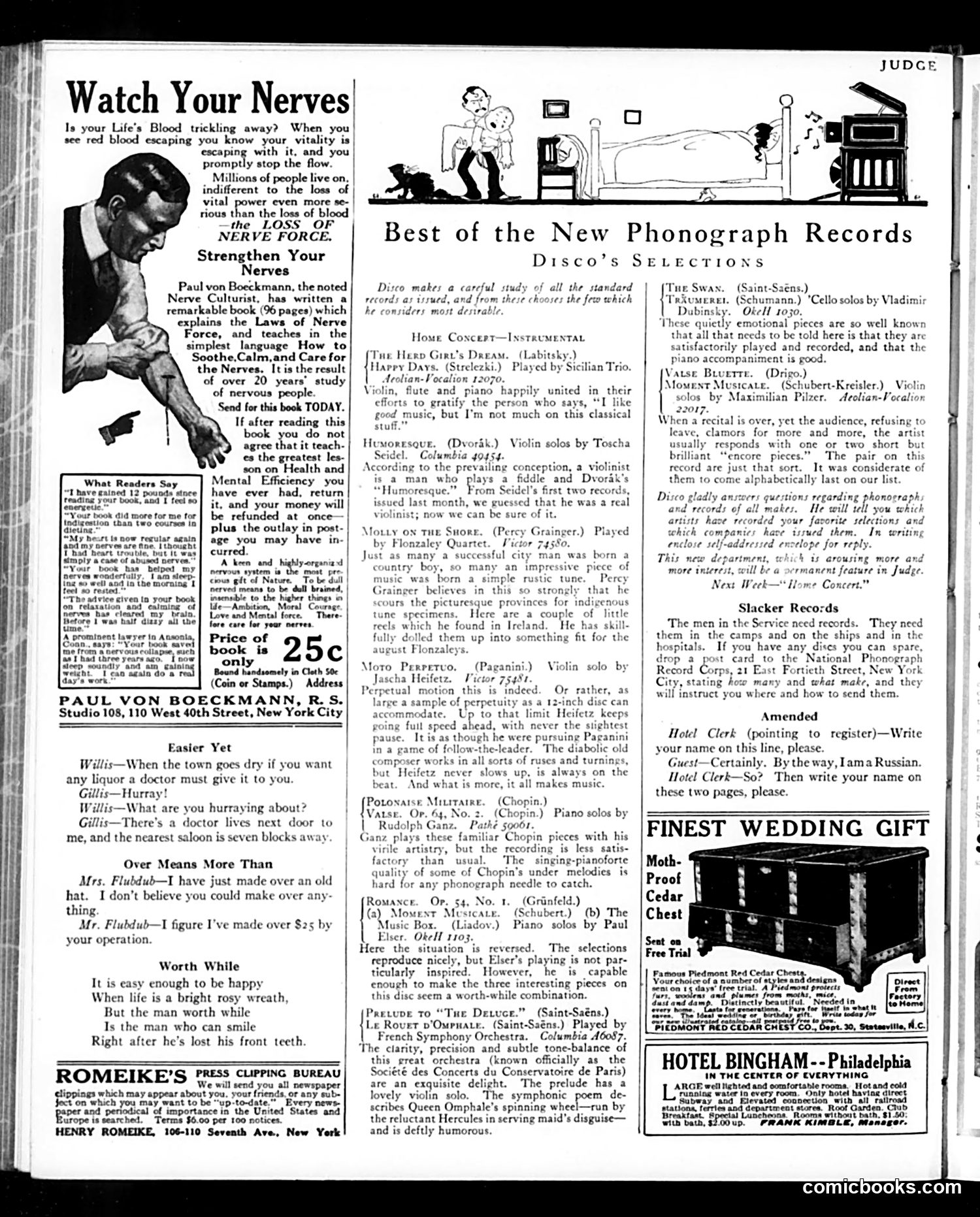
This page mixes advertising with humor pieces typical of Judge magazine's satirical style. **Main Advertisement:** Paul von Boeckmann's "Nerve Culturist" book dominates the left side. This advertises a 1910s-era self-help manual claiming to teach readers how to strengthen their "nerve force"—a period concept linking mental vitality to physical health. The ad uses pseudo-medical language about "vital power" and "nerve force" to sell what appears to be a wellness guide, reflecting early 20th-century pseudoscientific thinking about neurasthenia (nervous exhaustion). **Humor Pieces:** Three brief comedic sketches mock social situations: - A joke about Prohibition-era liquor access through doctors - A marital quip about a wife "making over" a hat versus a husband "making over" money - A greeting-card style poem about maintaining cheerfulness after losing teeth **Right Page:** Phonograph record reviews and hotel advertisements—typical Judge content mixing entertainment coverage with commerce. The overall tone reflects Judge's satirical approach to contemporary American life, consumerism, and social anxieties of the 1910s-1920s era.
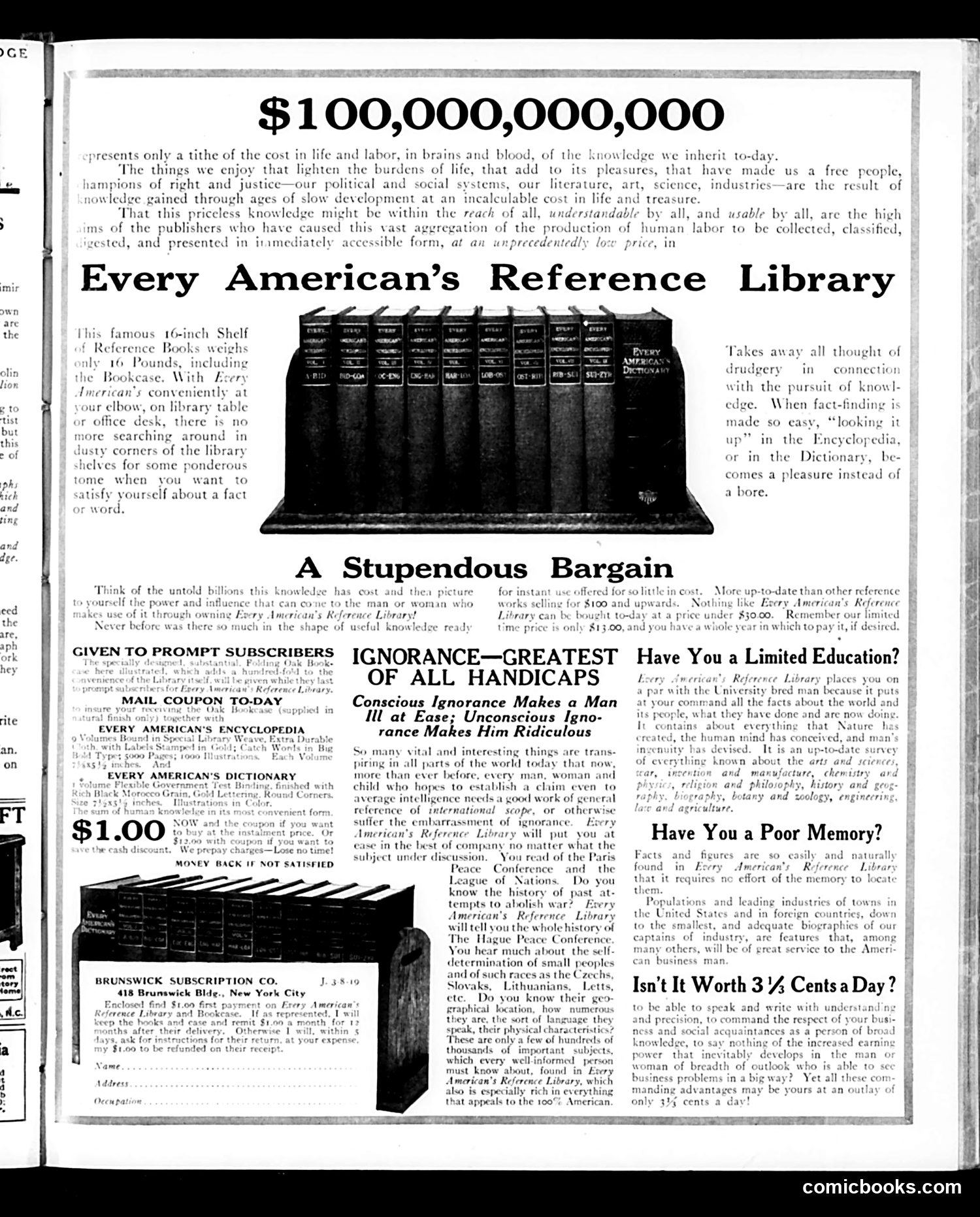
This is primarily a **commercial advertisement**, not a political cartoon. It promotes the Brunswick Subscription Company's 16-volume reference encyclopedia set. The page uses patriotic and moral rhetoric to sell the product. The opening passage—valuing inherited knowledge at "$100,000,000,000"—frames the encyclopedia as democratizing access to civilization's accumulated wisdom, framing it as a moral imperative that such knowledge "be within the reach of all." The ad emphasizes overcoming ignorance as a social/personal handicap, arguing that lack of education causes embarrassment and limits earning power. It positions the reference library as the solution: affordable at "3½ cents a day," it promises to answer questions about current events (the Paris Peace Conference, the League of Nations, war history), enable better speech and writing, and improve business acumen. This reflects early 20th-century American optimism about education's power to uplift citizens and the commercialization of that ideal through mass-marketed products.
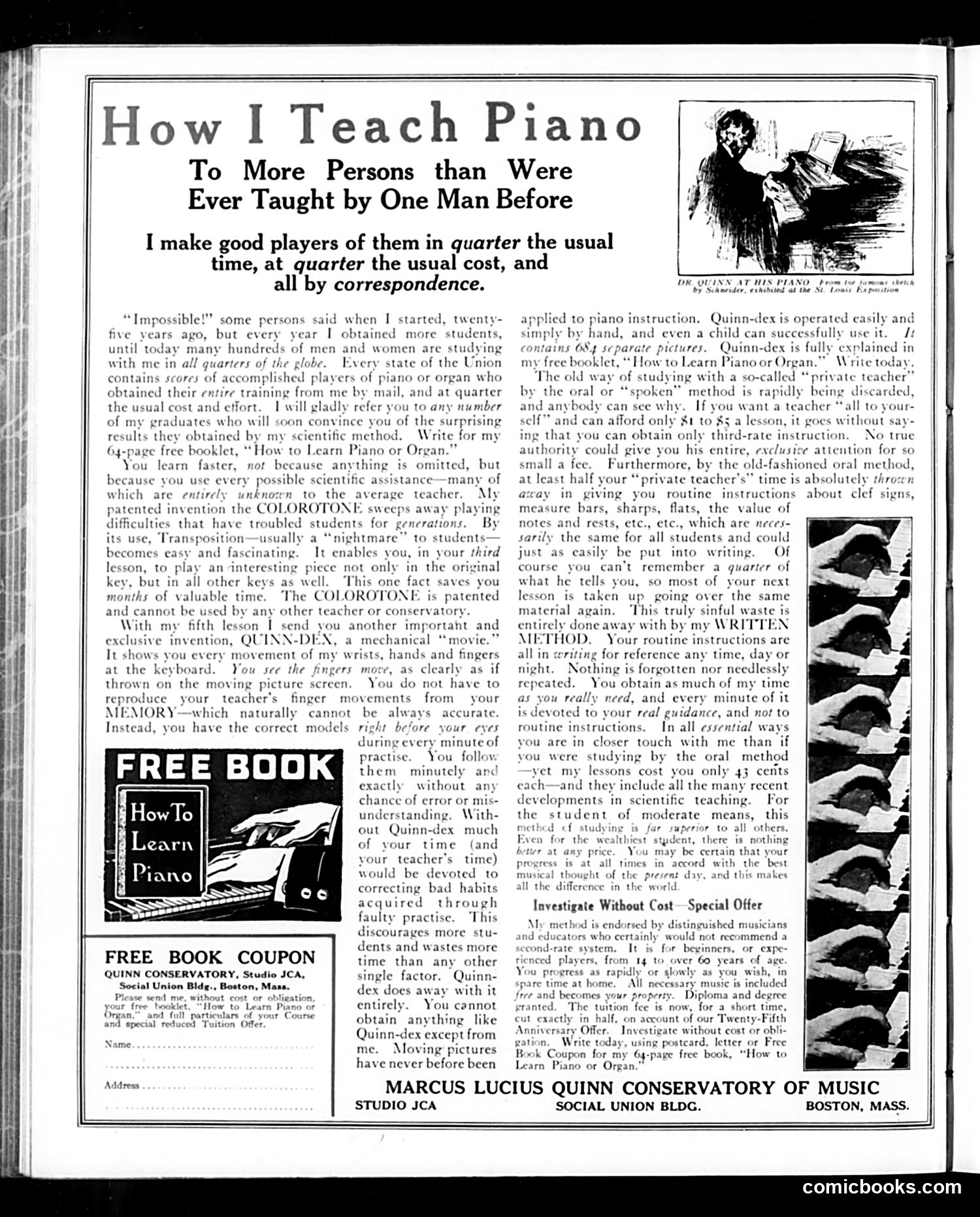
This is primarily a **mail-order correspondence course advertisement**, not satire. It promotes Marcus Lucius Quinn's piano instruction system offered through his Boston conservatory. The page showcases two patented mechanical innovations: the **COLOROTONE** (enabling transposition practice in all keys) and **QUINN-DEX** (a hand-operated "mechanical movie" showing finger movements). These represented genuinely novel teaching aids for the era. The advertisement's claims are typical of early 20th-century correspondence-course marketing: learning in "quarter the usual time" at "quarter the usual cost," with testimonials about graduates nationwide. The rhetoric contrasts Quinn's "scientific method" against traditional "private teachers" as inefficient and expensive. Three photographs on the right show Quinn at the piano demonstrating hand positions—visual proof of his method's legitimacy. The free booklet coupon was standard direct-mail practice. While the claims seem exaggerated by modern standards, there's **no apparent satire here**—this appears a sincere (if optimistic) business advertisement targeting aspiring musicians who couldn't afford conventional lessons.