
Judge, 1919-03-08 · page 19 of 32
Judge — March 8, 1919 — page 19: what you’re looking at
What you’re looking at
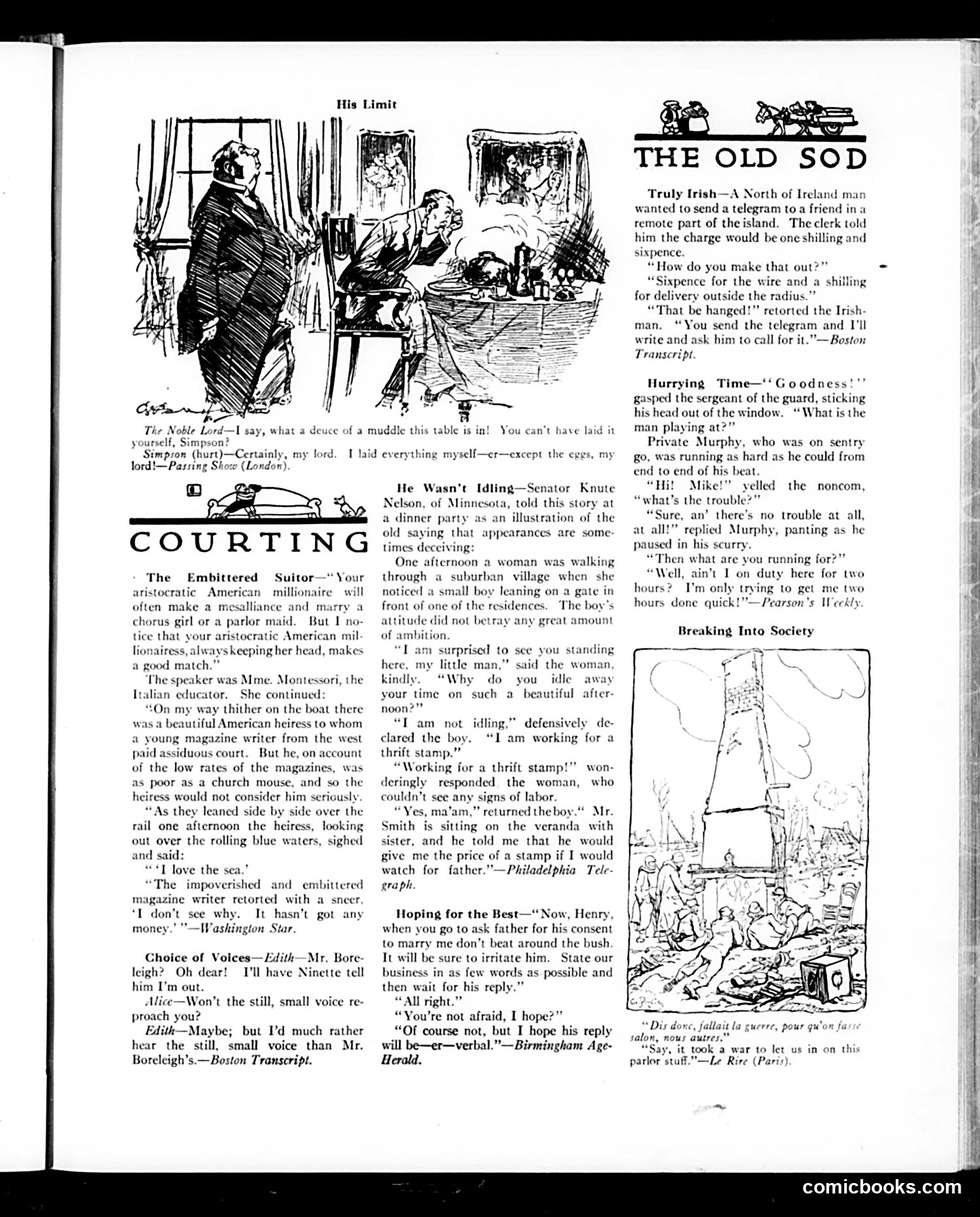
This page from the satirical magazine **Judge** contains several humor pieces targeting early 20th-century social types: **"His Limit"** (top left): A British servant comedy about table-setting incompetence—a straightforward domestic joke with no political content. **"The Embittered Suitor"**: Attributes a quip to Italian educator **Mme. Montessori**, contrasting American heiresses (who marry well) with a poor magazine writer who, resentful of low editorial pay rates, dismissively tells a wealthy heiress "the sea hasn't got any money." The satire mocks both impoverished writers and mercenary courtship. **"He Wasn't Idling"**: Attributed to Senator **Knute Nelson of Minnesota**, this anecdote presents a boy "working" by standing idle—a joke about WWI-era "thrift stamps" (government savings bonds). The humor lies in the apparent idleness masking legitimate labor. **"The Old Sod"**: Irish ethnic humor about an Irishman refusing to pay telegram delivery charges, insisting his friend collect it instead—playing on stereotypical Irish frugality. **"Hurrying Time"**: Irish soldier humor about Private Murphy sprinting his sentry duty to finish his two-hour shift quickly.
📄 Transcribed text from this page (OCR, searchable)
Machine-transcribed from the original scan — historical spelling and the odd misread are preserved.
His Limit ¢ Noble Lord—I say, wh: If, Simpson? Simpson (hurt)—Certainly, my lord lord!—Passing Showo (London) 3) COURTING The mbittered Suitor—" Your aristocratic American millionaire will often make a mesalliance and marry a chorus girl or a parlor maid. But I no- tice that your aristocratic American mil lionairess, alwayskeeping her head, makes a good match.” The speaker was Mme. Montessori, the Italian educator. She continued ‘On my way thither on the boat there was a beautiful American heiress to whom a young magazine writer from the west paid assiduous court. But he, on account of the low rates of the magazines, was as poor as a church mouse, and so the heiress would not consider him seriously “As they leaned side by side over the rail one afternoon the heiress, looking out over the rolling blue waters, sighed and said: “*T love the sea.’ “The impoverished and embittered magazine writer retorted with a sneer ‘I don’t sce why. It hasn’t got any money.’ "—Washington Star. Choice of Voices—Edith—Mr. Bore- leigh? Oh dear! I'll have Ninette tell him I’m out. Alice—Won't the still, small voice re- proach you? Edith—Maybe; but I’d much rather hear the still, small voice than Mr. Boreleigh’s.—Boston Transcript. a deuce of a muddle this table is in! You can’t have laid 1 I laid everything myself—er—except the eggs, my He Wasn't Idling—Senator Knute Nelson, of Minnesota, told this story at a dinner party as an illustration of the old saying that appearances are some- times deceiving: One afternoon a woman was walking through a suburban village when she noticed a small boy leaning on a gate in front of one of the residences. The boy’s attitude did not betray any great amount of ambition. “Iam surprised to sce you standing here, my little man,” said the woman, kindly. “Why do you idle your time on such a beautiful after- noon?”” “Tam not idling,” defensively de- ed the boy. “I am working for a thrift stamp. away “Working for a thrift stamp!” won- deringly responded the woman, who couldn't see any signs of labor. “Yes, ma’am,” returned theboy." Mr. Smith sitting on the veranda with ster, and he told me that he would give me the price of a stamp if I would watch for father.”—Philadelphia Tele- graph Hoping for the Best—“ Now, Henry, when you go to ask father for his consent to marry me don’t beat around the bush It will be sure to irritate him. State our business in as few words as. possible and then wait for his reply “All right.” “You're not afraid, I hope “Of course not, but I hope his reply will be—er—verbal.”—Birmingham Age- Herald. THE OLD SOD Truly Irish—A North of Ireland man wanted to send a telegram toa friend ina remote part of theisland. The clerk told him the charge would be one shilling and sixpence. “How do you make that out?” “Sixpence for the wire and a shilling for delivery outside the radius.” “That be hanged!” retorted the Irish man, “You send the telegram and I'll write and ask him to call for it.”—Boston Transcript. Hurrying Time—‘ Goodness! gasped the sergeant of the guard, sticking his head out of the window. ‘What is the man playing at?” Private Murphy, who was on sentry go, was running as hard as he could from end to end of his beat “Hil Mike!” ) 's the trouble “Sure, an’ there’s no trouble at all, at all!” replied Murphy, panting as he paused in his scurry. Then what are you running for?” “Well, ain't I on duty here for two hours? I’m only trying to get me two hours done quick!”—Pearson’s Weekly led the noncom, Breaking Into Society ne, fallait la guerre, pour qu'on fa salon, nows autres.” “Say, it took a war to let us in on this parlor stuff." —Le Rire (Paris) comicbooks.com