
Judge, 1919-03-08 · page 6 of 32
Judge — March 8, 1919 — page 6: what you’re looking at
What you’re looking at
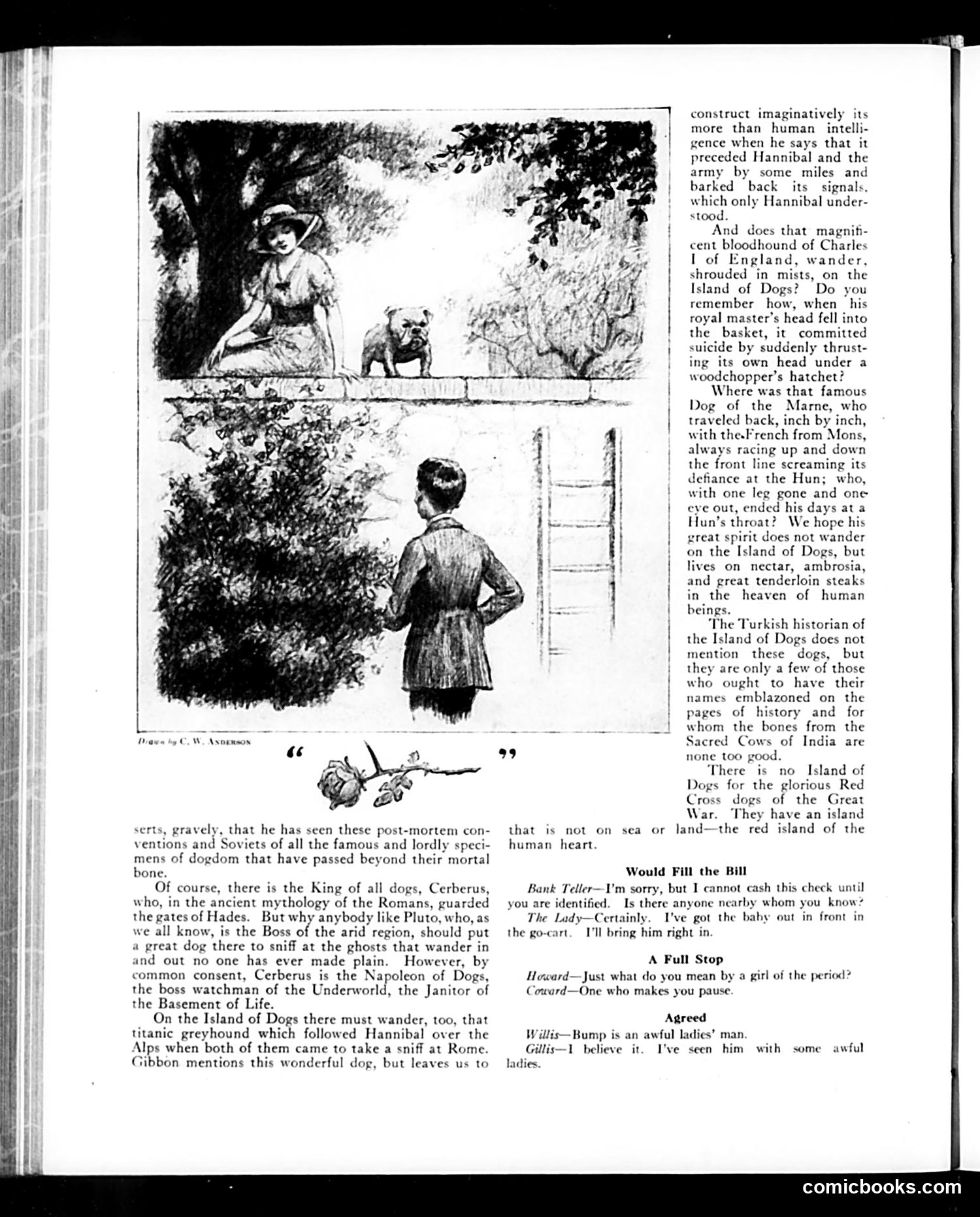
This page from *Judge* magazine features an illustrated essay about famous historical dogs, presented as whimsical commentary rather than direct political satire. The cartoon depicts a child observing a bulldog near a fence, illustrating the text's discussion of notable canines throughout history—from Hannibal's war dogs to Charles I's bloodhound to dogs of the Marne (WWI). The essay employs mock-serious tone, treating dogs' historical contributions with exaggerated reverence. It references real historical events (Hannibal's military campaigns, WWI's "Dog of the Marne") while adding fantastical elements like an imaginary "Island of Dogs" populated by heroic canines. The satire targets human tendency to romanticize history by elevating animals to mythic status. Below, brief comedic dialogues about banking and social observations provide typical *Judge* humor—light social commentary rather than pointed political critique.
📄 Transcribed text from this page (OCR, searchable)
Machine-transcribed from the original scan — historical spelling and the odd misread are preserved.
serts, gravely, that he has seen these post-mortem con- ; ventions and Soviets of all the famous and lordly speci- ; mens of dogdom that have passed beyond their mortal bone. Of course, there is the King of all dogs, Cerberus, who, in the ancient mythology of the Romans, guarded the gates of Hades. But why anybody like Pluto, who, as we all know, is the Boss of the arid region, should put a great dog there to sniff at the ghosts that wander in and out no one has ever made plain. However, by common consent, Cerberus is the Napoleon of Dogs, the boss watchman of the Underworld, the Janitor of the Basement of Life. On the Island of Dogs there must wander, too, that titanic greyhound which followed Hannibal over the Alps when both of them came to take a sniff at Rome. Gibbon mentions this wonderful dog, but leaves us to that is not on human heart you are identified. The Lady—Certainly. sea construct imaginatively its more than human intelli- gence when he says that it preceded Hannibal and the army by some miles and barked back its signals. which only Hannibal under- stood. And does that magnifi- cent bloodhound of Charles I of England, wander, shrouded in mists, on the Island of Dogs? Do you remember how, when_ his royal master’s head fell into the basket, it committed suicide by suddenly thrust- ing its own head under a woodchopper’s hatchet? Where was that famous Dog of the Marne, who traveled back, inch by inch, with the.French from Mons, always racing up and down the front line screaming its defiance at the Hun; who, with one leg gone and one out, ended his days ata Hun’s throat?) We hope his great spirit does not wander on the Island of Dogs, but lives on nectar, ambrosia, and great tenderloin steaks in the heaven of human beings. The Turkish historian of the Island of Dogs does not mention these dogs, but they are only a few of those who ought to have their names emblazoned on the pages of history and for whom the bones from the Sacred Cows of India are none too good. There is no Island of Dogs for the glorious Red Cross dogs of the Great War. They have an island land—the red island of the Would Fill the Bill Bank Teller—I'm sorry, but I cannot cash this check until Is there anyone nearby whom you know? I’ve got the baby out in front in the go-cart. I'll bring him right in. A Full Stop Heward—Just what do you mean by a girl of the period? Corward—One who makes you pause. Agreed Willis—Bump is an awful ladies’ man Gillis—1_ believe ladies. it I've seen him with some awful comicbooks.com