
Judge, 1919-03-08 · page 5 of 32
Judge — March 8, 1919 — page 5: what you’re looking at
What you’re looking at
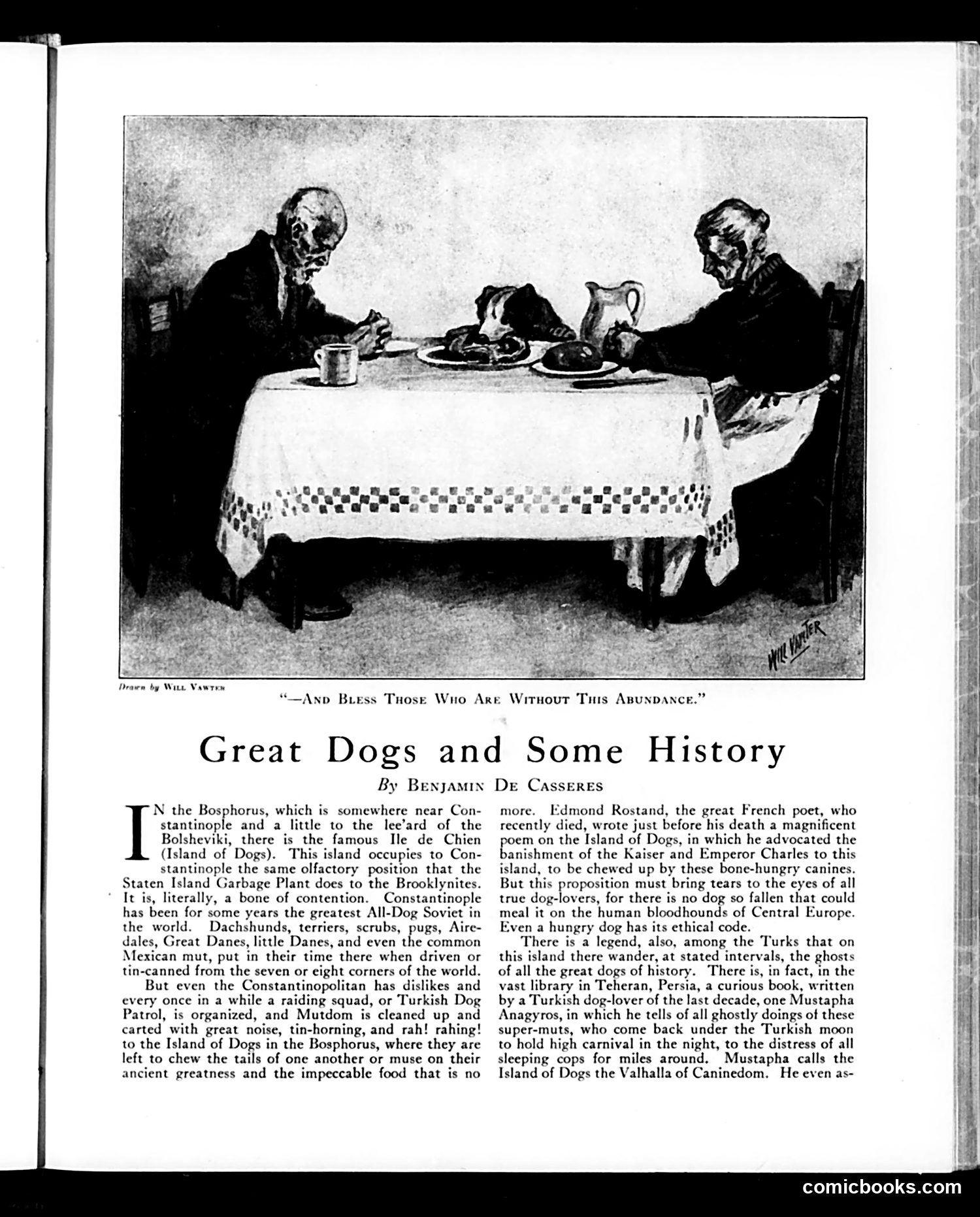
**The Cartoon:** The illustration by Will Vartes depicts two skeletal figures at a meager dinner table with the caption "—AND BLESS THOSE WHO ARE WITHOUT THIS ABUNDANCE." **The Satire:** This is social commentary on poverty and inequality. The skeletal diners—appearing to be starving or impoverished—offer a bitter, ironic grace before meals, "blessing" those who have even less food than they do. The dark humor exposes the contrast between the wealthy and destitute, critiquing both poverty conditions and the hypocrisy of thanking God while people suffer from hunger. **Context:** The accompanying article "Great Dogs and Some History" by Benjamin De Casseres appears unrelated to the cartoon, discussing historical dog breeds and mythology rather than the meal-time satire above it.
📄 Transcribed text from this page (OCR, searchable)
Machine-transcribed from the original scan — historical spelling and the odd misread are preserved.
Drawn by Witt Vawren “—Anp Bess Tuose Wuo Are Wituout Tuts Apunpance.” Great Dogs and Some History By Benyamix De Casseres N the Bosphorus, which is somewhere near Con- stantinople and a little to the lee’ard of the Bolsheviki, there is the famous Ile de Chien (Island of Dogs). This island occupies to Con- stantinople the same olfactory position that the Staten Island Garbage Plant does to the Brooklynites. It is, literally, a bone of contention. Constantinople has been for some years the greatest All-Dog Soviet in the world. Dachshunds, terriers, scrubs, pugs, Aire- dales, Great Danes, little Danes, and even the common Mexican mut, put in their time there when driven or tin-canned from the seven or eight corners of the world. But even the Constantinopolitan has dislikes and every once in a while a raiding squad, or Turkish Dog Patrol, is organized, and Mutdom is cleaned up and carted with great noise, tin-horning, and rah! rahing! to the Island of Dogs in the Bosphorus, where they are left to chew the tails of one another or muse on their ancient greatness and the impeccable food that is no more. Edmond Rostand, the great French poet, who recently died, wrote just before his death a magnificent pecs on the Island of Dogs, in which he advocated the anishment of the Kaiser and Emperor Charles to this island, to be chewed up by these bone-hungry canines. But this proposition must bring tears to the eyes of all true dog-lovers, for there is no dog so fallen that could meal it on the human bloodhounds of Central Europe. Even a hungry dog has its ethical code. There is a legend, also, among the Turks that on this island there wander, at stated intervals, the ghosts of all the great dogs of history. There is, in fact, in the vast library in Teheran, Persia, a curious book, written by a Turkish dog-lover of the last decade, one Mustapha Anagyros, in which he tells of all ghostly doings of these super-muts, who come back under the Turkish moon to hold high carnival in the night, to the distress of all sleeping cops for miles around. Mustapha calls the Island of Dogs the Valhalla of Caninedom. He even as- comicbooks.com