
Judge, 1919-03-08 · page 18 of 32
Judge — March 8, 1919 — page 18: what you’re looking at
What you’re looking at
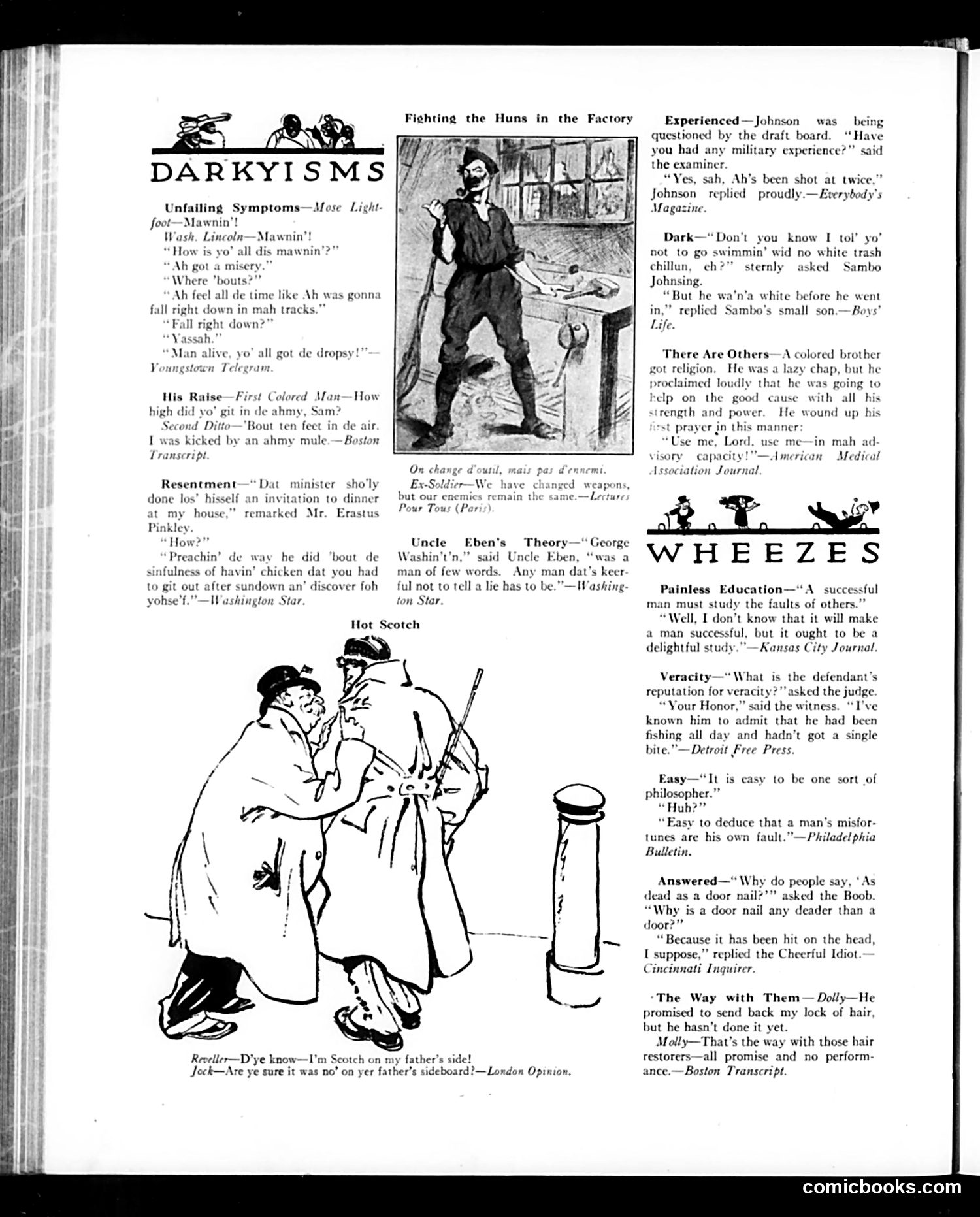
This page from Judge contains racist dialect humor typical of early-20th-century American satire. The content is divided into two sections: **"Darkyisms"** presents stereotyped jokes featuring African American characters rendered in exaggerated dialect. These include medical misunderstandings, military anecdotes, and domestic situations—all relying on caricature and minstrelsy conventions. The humor derives from portraying Black speakers as ignorant or comically malapropistic. **"Wheezes"** is an unrelated section of brief jokes on various topics (Scottish ancestry, military experience, legal testimony, hair restoration). **Context for modern readers:** The racial stereotypes and dialect representations reflect deeply embedded prejudices of the era. Judge, while sophisticated in other respects, normalized this dehumanizing humor. The "Darkyisms" section specifically perpetuates minstrelsy traditions, presenting African Americans as subjects of ridicule rather than as people. This content is historically significant precisely because it documents the casual racism embedded in mainstream American publishing.
📄 Transcribed text from this page (OCR, searchable)
Machine-transcribed from the original scan — historical spelling and the odd misread are preserved.
DARKYISMS Unfailing Symptoms—Mose Light- foot—Mawnin’! Wash. Lincoln—Mawnin’! “How is yo" all dis mawnin’ “Ah got a misery Where ‘bouts?” Ah feel all d fall right down in Fall right down Yassah.”” “Man alive, yo’ all got de dropsy!"”- His Raise—First Colored Man—How high did yo" git in de ahmy, Sam? Second Ditto—'Bout ten fect in de air I was kicked by an ahmy mule.—Boston Transcript. Resentment—" Dat minister sho'ly done los’ hisself an invitation to dinner at my house,” remarked Mr. Erastus Pinkley *How?” ‘Preachin’ de way he did ‘bout de sinfulness of havin’ chicken dat you had er sundown an’ discover foh Washington Star to git out yohse'f. Fighting the Huns in the Factory We have cha s remain the Eben’s Theory—* George Washin’t’n,”” said Uncle Eben, “was a man of few words. Any man dat’s keer ful not to tell a lie has to be.” —Washing- ton Star. Uncle Hot Scotch Reveller—D’ye know—I’m Scotch on my father’s side! Jock—Are ye sure it was no’ on yer father’s sideboard?—London Opinion, Experienced—Johnson was _ being questioned by the draft board. ‘Have you had any military experience?” said the examiner. “Yes, sah, Ah’s been shot at twice,’ Johnson replied proudly.—Everybody’s Magazine. Dark—"Don't you know I tol’ yo’ not to go swimmin’ wid no white trash chillun, ch?’ sternly asked Sambo Johnsing. “But he wa'n’a white before he went in,” replied Sambo’s small son.—Boys’ Life. There Are Others—A colored brother got religion. He was a lazy chap, but he proclaimed loudly that he was going to kelp on the good cause with all his rength and power. He wound up his st prayer in this manner Use me, Lord, use me visory capacity!"—A merican Issociation Journal WHEEZES Painless Education—*A man must study the faults of others.” “Well, I don’t know that it will make a man successful, but it ought to be a delightful study." —Kansas City Journal. in mah ad. Medic successful Veracity—" What is the defendant's reputation for veracity?” asked the judge. “Your Honor,” said the witness. “I've known him to admit that he had been fishing all day and hadn’t got a single bite.”"—Detroit Free Press. is easy to be one sort of tunes are his own fault.” —Philadel phia Bulletin. Answered—“ Why do people say, ‘As dead as a door nail?’” asked the Boob. “Why is a door nail any deader than a door?” “Because it has been hit on the head, I suppose,” replied the Cheerful Idiot Cincinnati Inquirer. The Way with Them— Dolly—He promised to send back my lock of hair, but he hasn’t done it yet. Molly—That’s the way with those hair restorers—all promise and no perform- ance.—Boston Transcript. comicbooks.com