
A complete issue · 32 pages · 1919
Judge — January 11, 1919
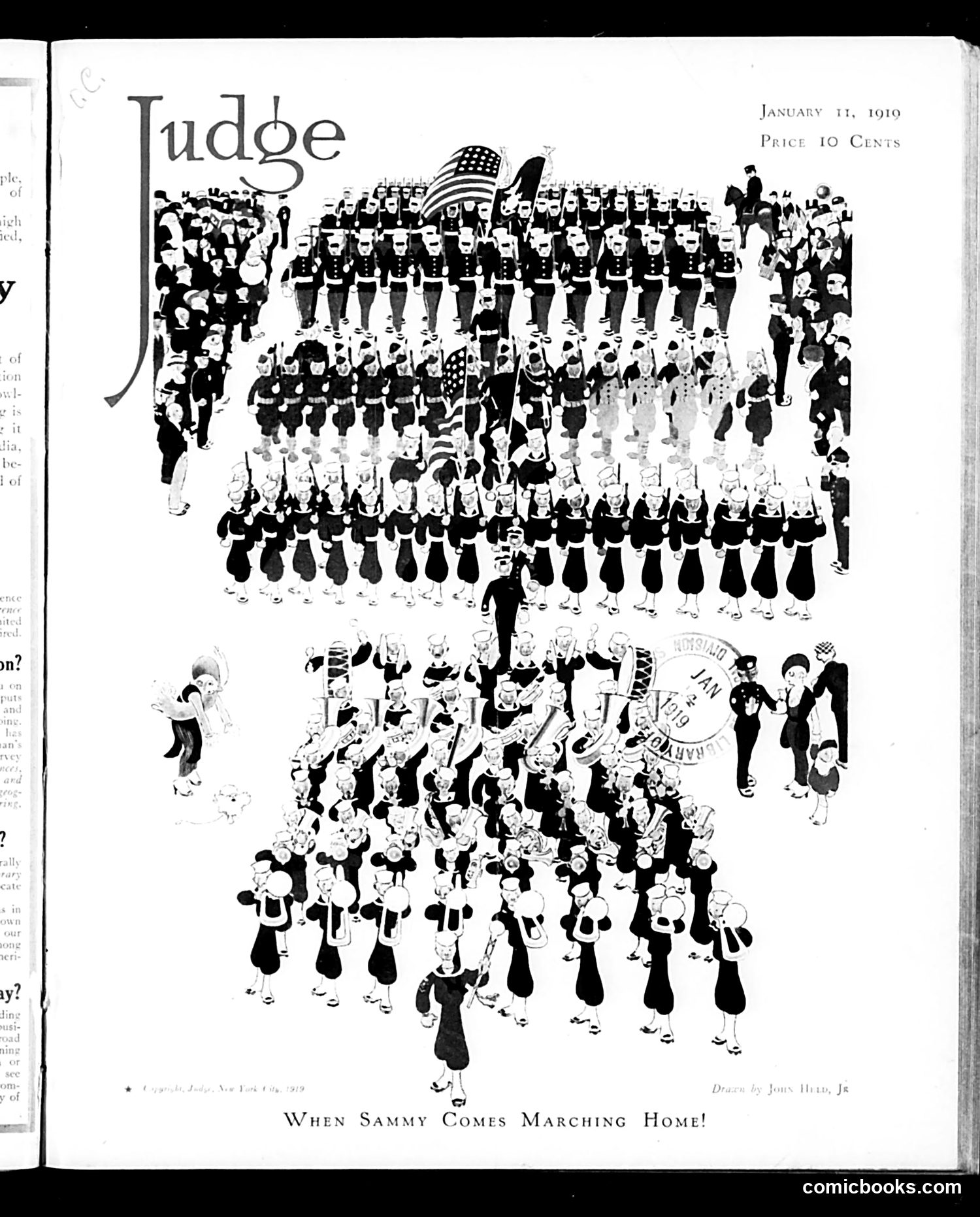
This January 1910 Judge cartoon celebrates the return of American troops from the Philippines, likely referencing the conclusion of the Philippine-American War (1899-1902) or subsequent military operations there. "Sammy" is a personification of the American soldier. The illustration depicts a massive parade with military units, bands, and civilians welcoming returning servicemen. The composition—with orderly marching formations, an American flag, and enthusiastic crowds—conveys triumphant homecoming. The satire likely comments on American imperialism and military expansion in the Pacific, either celebrating the victory or (possibly ironically) questioning the costs of these foreign military adventures. The sheer scale of the parade emphasizes the significance contemporaries placed on these colonial military campaigns.
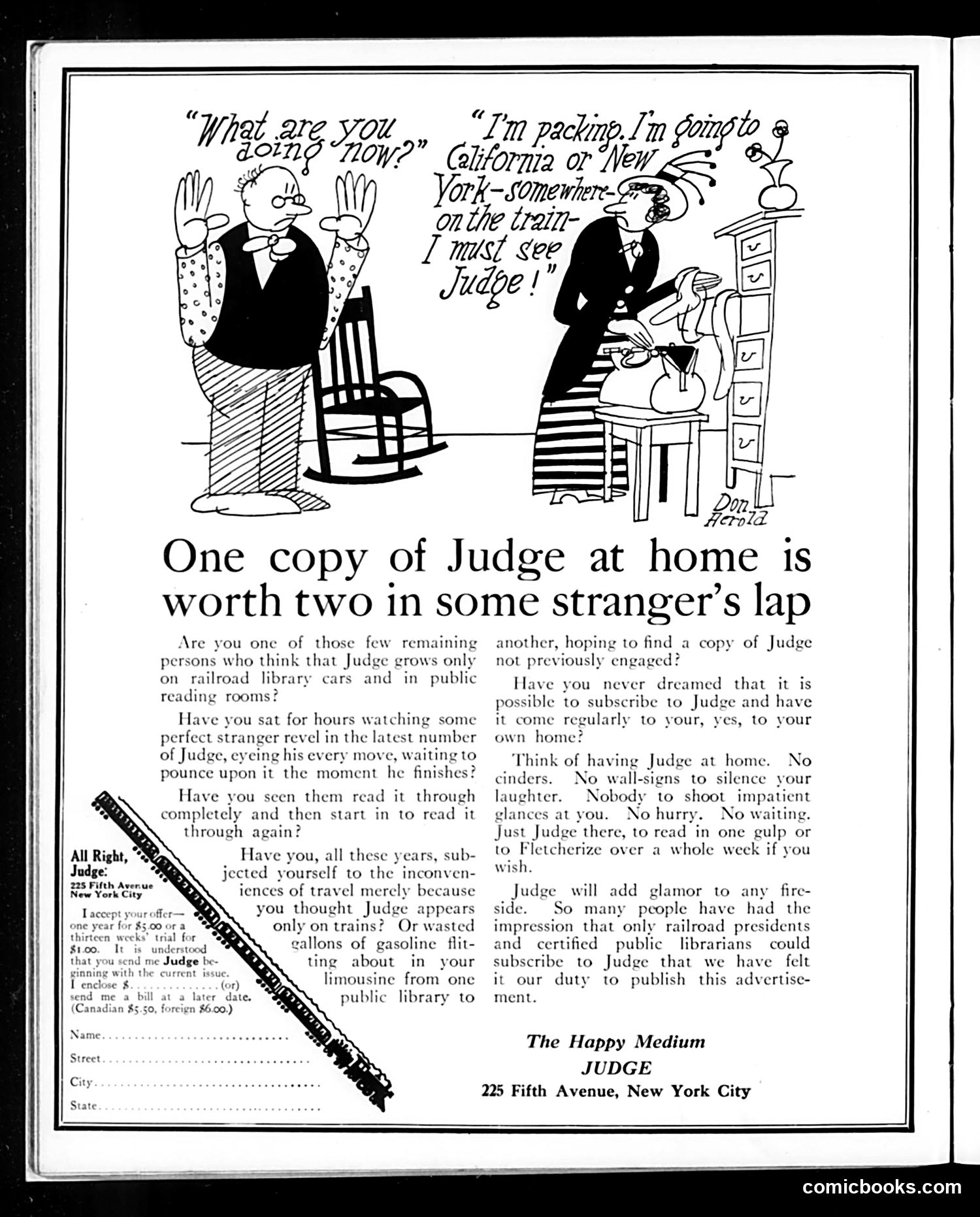
This page is primarily an **advertisement for Judge magazine itself**, using humor to promote subscriptions. The cartoon depicts two scenes: a man enthusiastically packing for travel (left) and a woman preparing to leave on a train (right), both desperate to take Judge with them. The satire targets the magazine's appeal to travelers and commuters who read it on **railroad library cars and in public spaces**. The ad humorously suggests that owning a personal subscription—having Judge at home regularly—would be far more satisfying than the frustration of sharing copies with strangers or waiting to find it in public places. The copy emphasizes convenience and exclusivity: no waiting, no impatient glances, just private enjoyment of the magazine's humor. It's essentially a subscription pitch disguised as satirical commentary on reading habits.
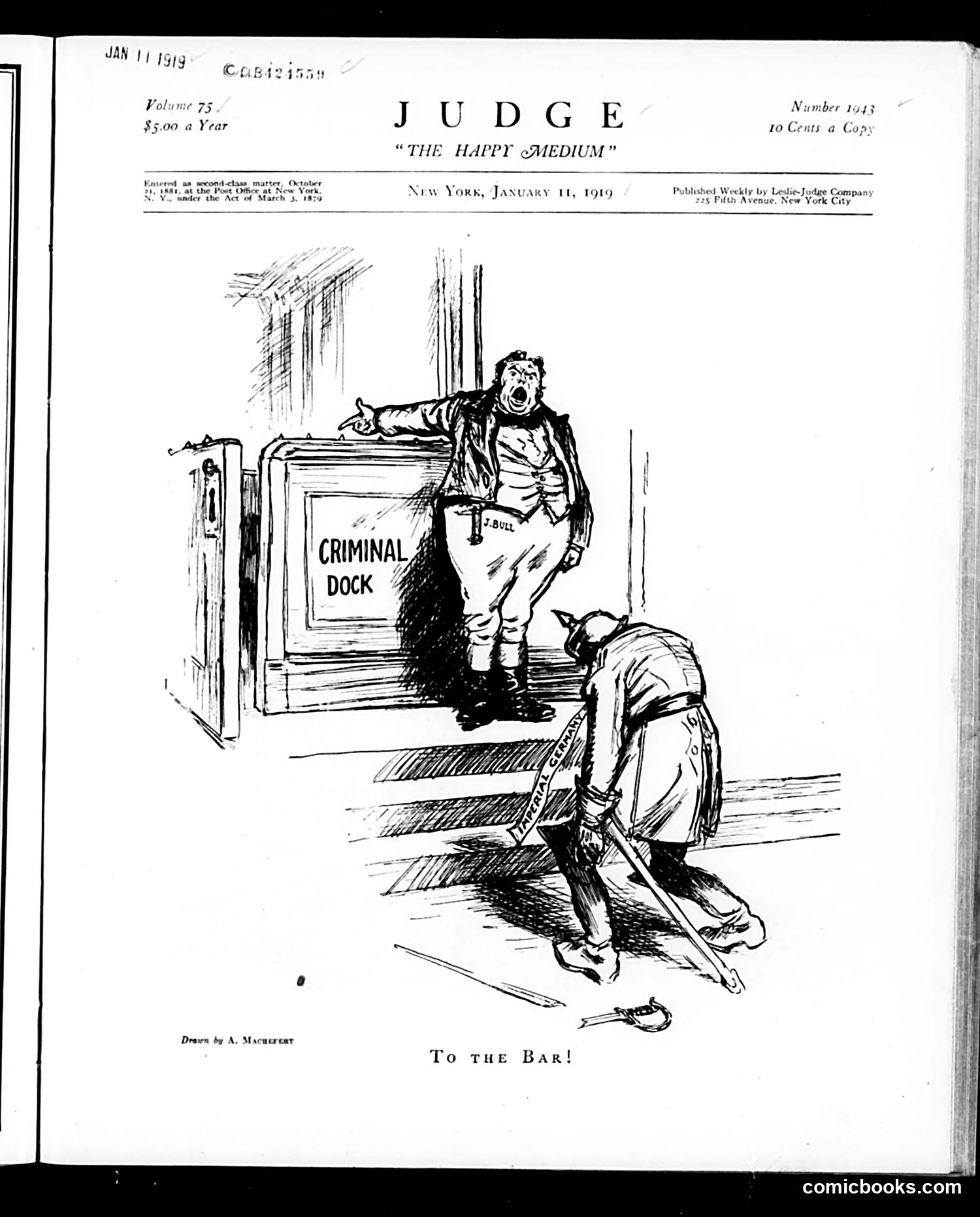
This political cartoon satirizes the judicial system's treatment of criminals. A disheveled man is being ejected from the "Criminal Dock" by a stern judge or court official, with the caption "To the Bar!" The humor relies on a double meaning: "the Bar" refers both to the legal profession (where lawyers practice) and to actual bars/taverns. The cartoon suggests that criminals leaving the criminal dock are simply being sent to drink at bars rather than receiving proper punishment—implying the justice system is ineffective or lenient. The timing (January 1919) coincides with Prohibition's implementation, making the bar reference particularly pointed as alcohol became illegal.
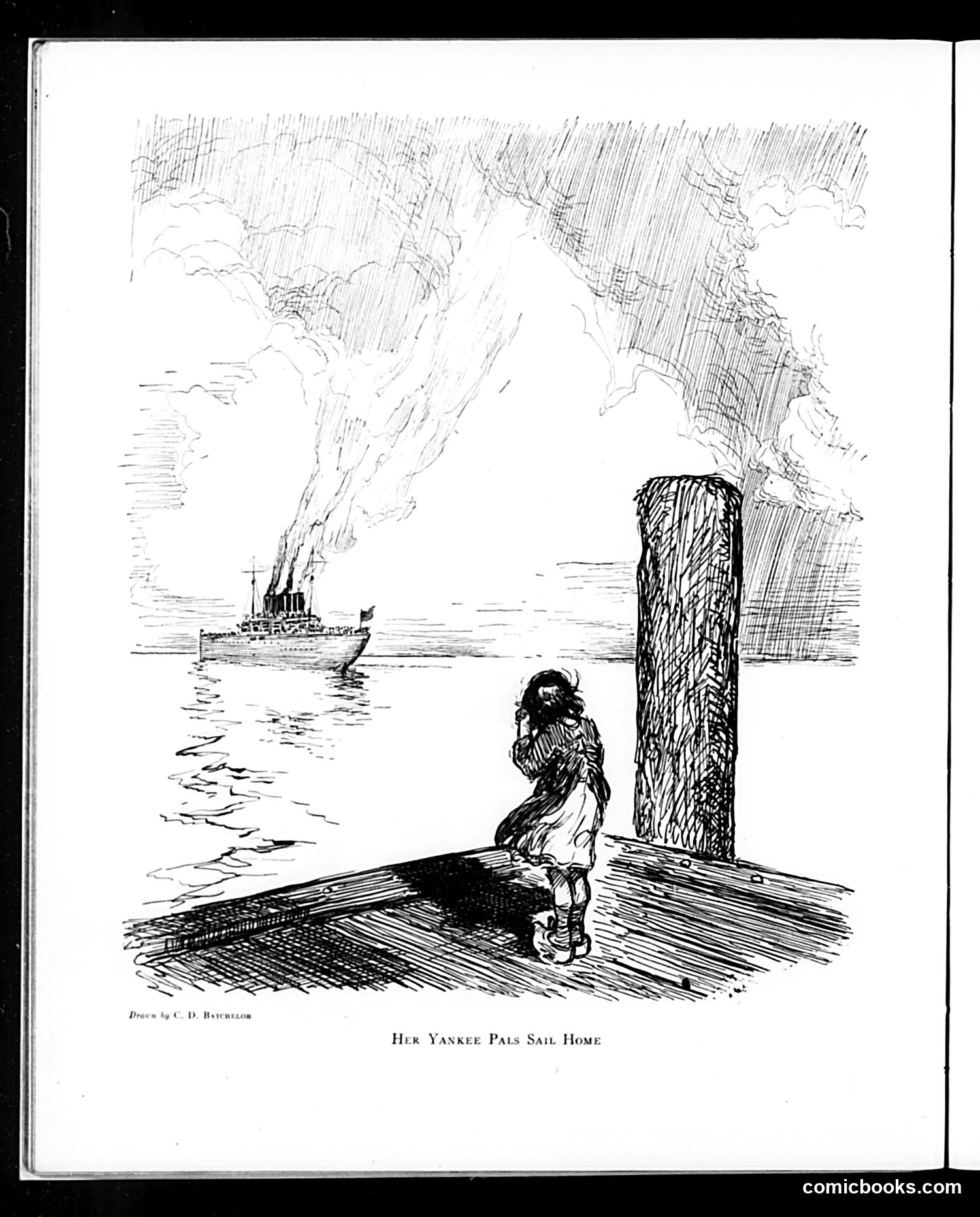
This illustration by C.D. Batchelor depicts a young girl watching a steamship depart from a dock. The title suggests an American ("Yankee") soldier or serviceman leaving after a relationship with a local woman. The satirical point appears to comment on wartime romances—likely from World War I or II era—where American servicemen formed attachments with foreign women before returning home. The girl's lonely posture by the wooden post conveys abandonment and the emotional cost of such temporary wartime connections. The cartoon critiques either the callousness of departing soldiers or, more likely, satirizes the broader social consequences and human tragedy of war-time liaisons left unresolved. The stark composition emphasizes the woman's isolation against the ship's departure.
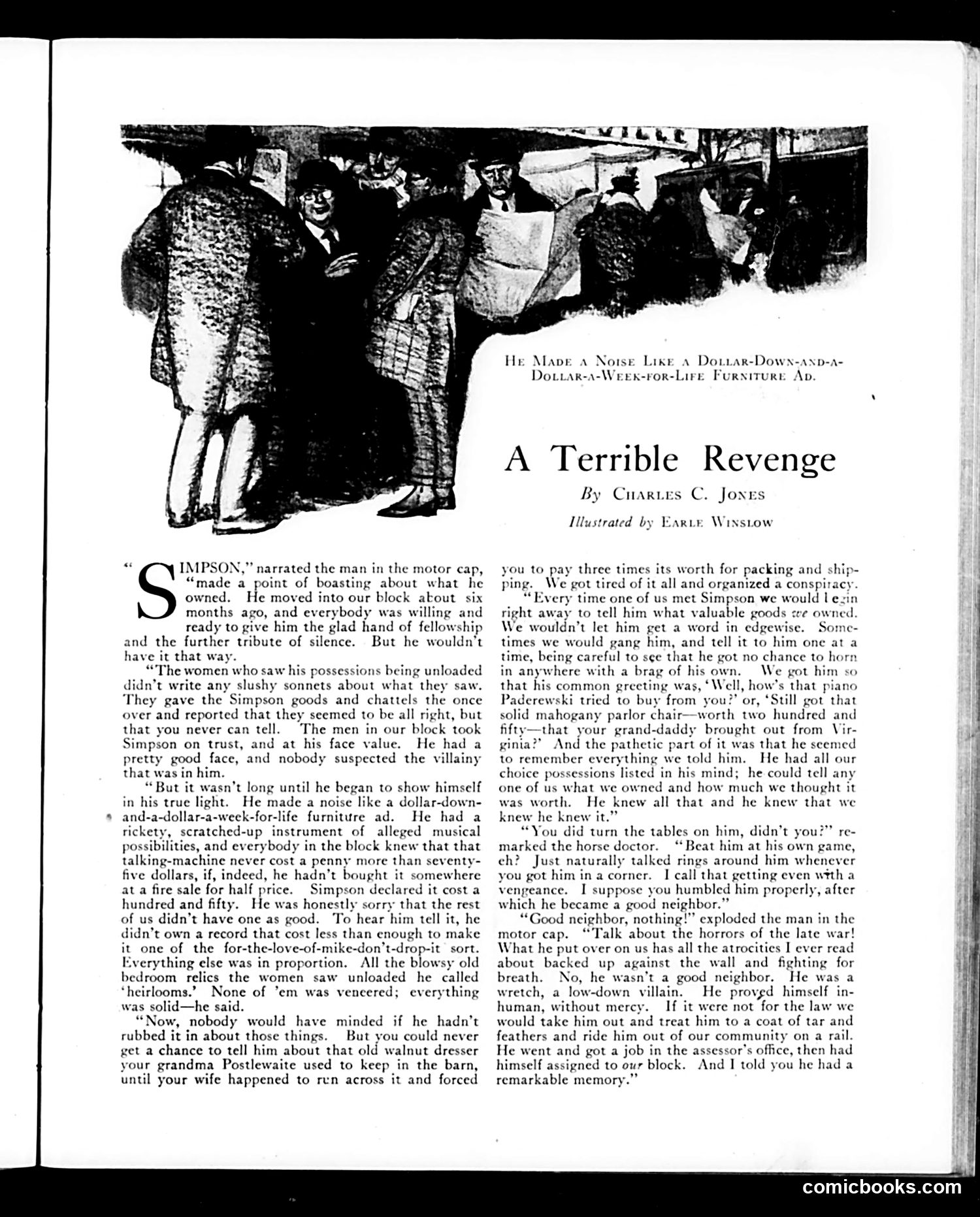
This page contains a short story rather than a political cartoon. The narrative satirizes a petty, vindictive neighbor named Simpson who made noise like a "dollar-down-and-a-dollar-a-week-for-life furniture ad." The satire targets Simpson's boastful materialism and ostentatious display of possessions. The narrator and neighbors take revenge by systematically humiliating him—confronting him about his hypocrisy, spreading rumors about his character, and ultimately forcing him from the community by treating him as a disreputable neighbor. The piece appears to mock both conspicuous consumption and the social power of collective community judgment to ostracize those deemed morally unfit—reflecting early-20th-century concerns about commercialism and social propriety.
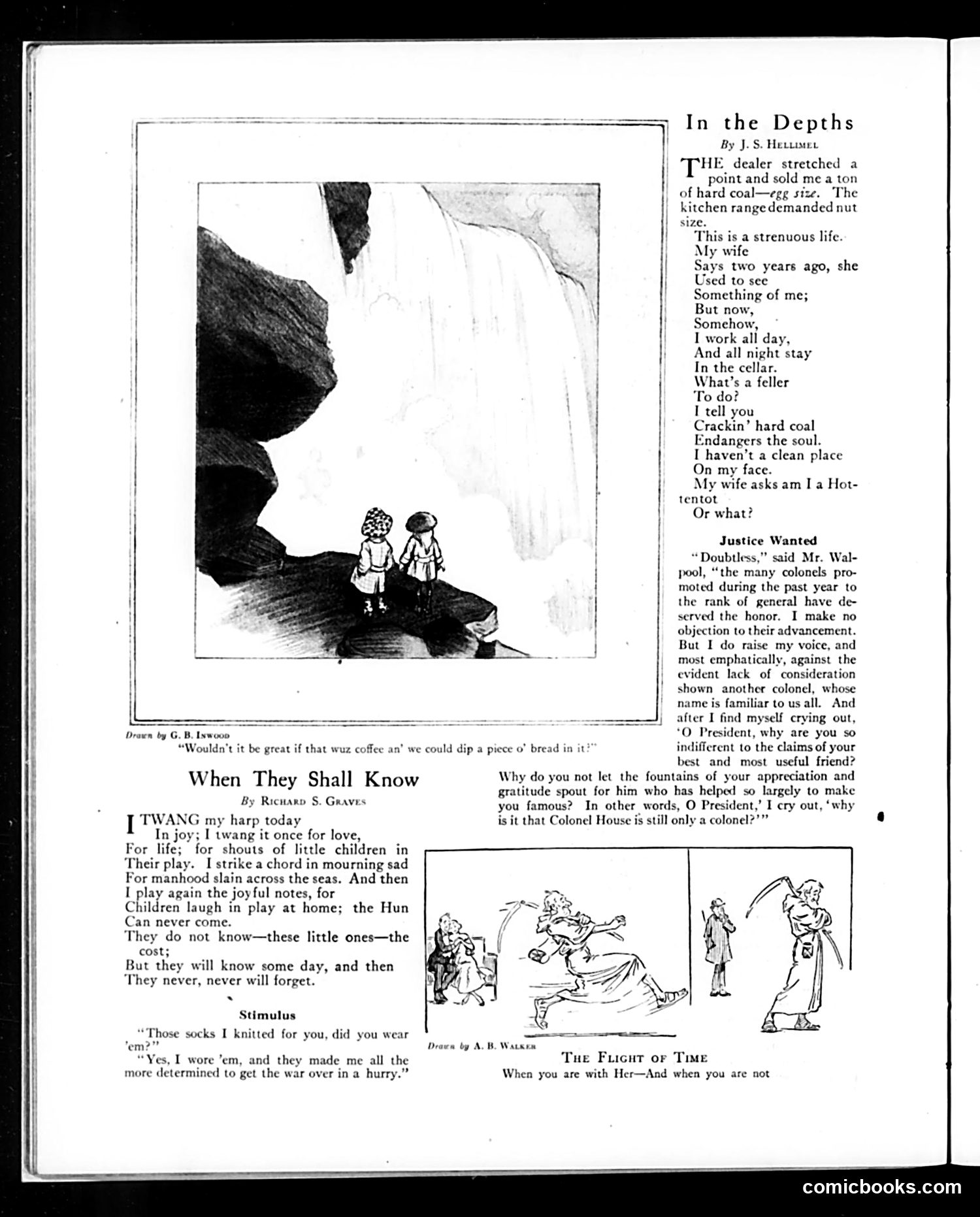
**"In the Depths"** depicts a coal miner's harsh reality—working day and night in cellars for meager wages while his wife grows distant. The satire critiques industrial labor conditions and their toll on family life. **"Justice Wanted"** appears to be a political complaint about a colonel's promotion. The writer protests that another colonel received advancement despite lacking merit, while questioning why President Theodore Roosevelt (implied by "O President") shows such indifference to worthy individuals who've contributed significantly. **"When They Shall Know"** is a sentimental poem about children separated by war, likely referencing WWI's impact on families. **"The Flight of Time"** uses sequential illustrations to humorously contrast time's perception when with versus without a romantic partner.
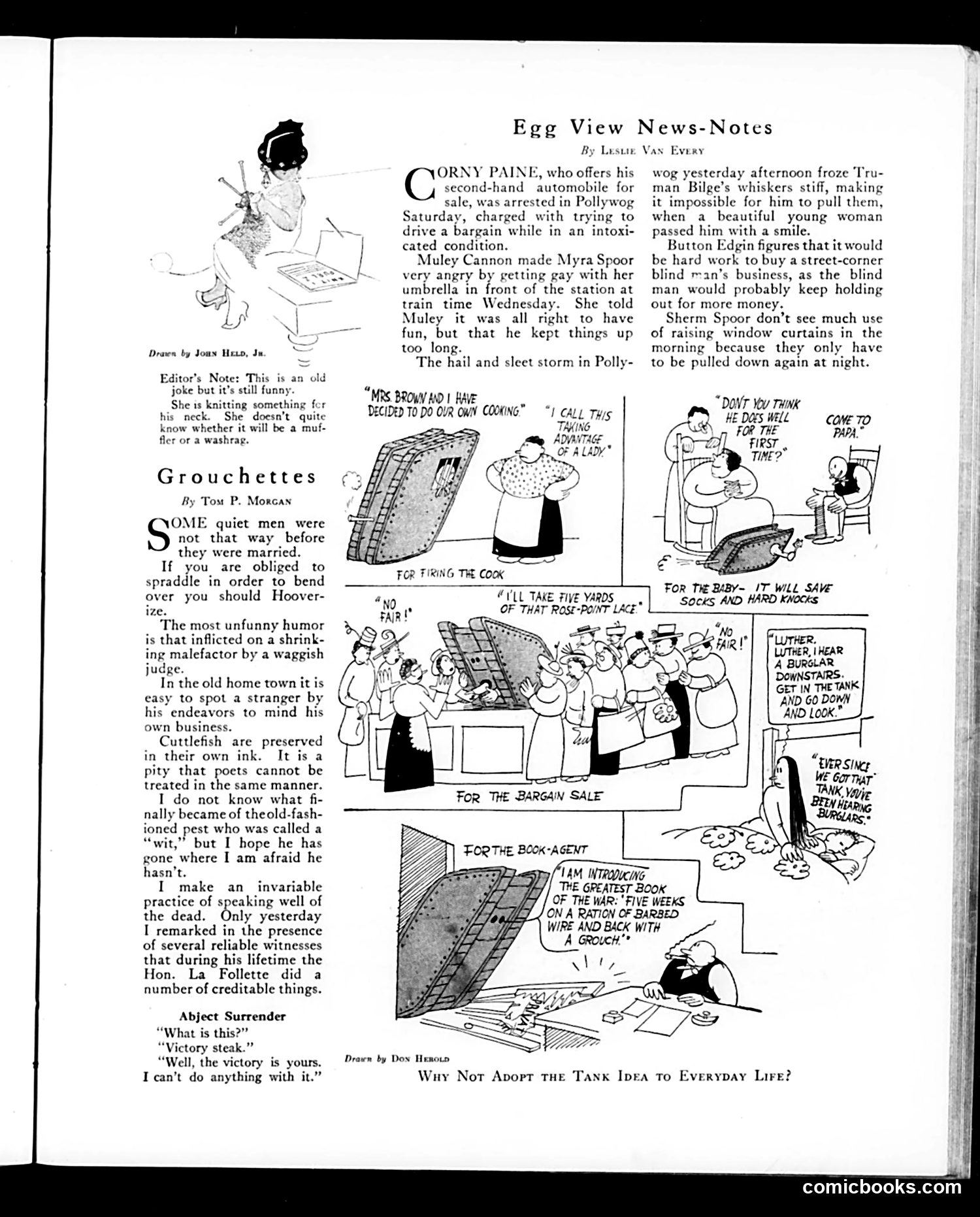
This page from *Judge* magazine contains humorous commentary on small-town life, presented as fictional local gossip from "Egg View" and "Pollywog." The "Egg View News-Notes" section lampoons domestic disputes and petty scandals: a man arrested for drunk driving while haggling over a car sale, a woman angry over flirtation with her umbrella, and a man unable to pluck his frozen whiskers. These are absurdist, trivial complaints meant to mock small-town melodrama. The cartoon strip "Why Not Adopt the Tank Idea to Everyday Life?" satirizes post-WWI practicality by suggesting domestic solutions borrowed from wartime—using a tank idea to protect a baby ("save socks and hard knocks"), humorous because it's absurdly militaristic for civilian life. The "Grouchettes" column offers cynical social observations, including a joke about a woman knitting something for her husband's neck (possibly a noose, implying marital unhappiness). Overall, the page uses exaggeration and absurdist humor to critique small-town gossip culture and post-war American domestic life.
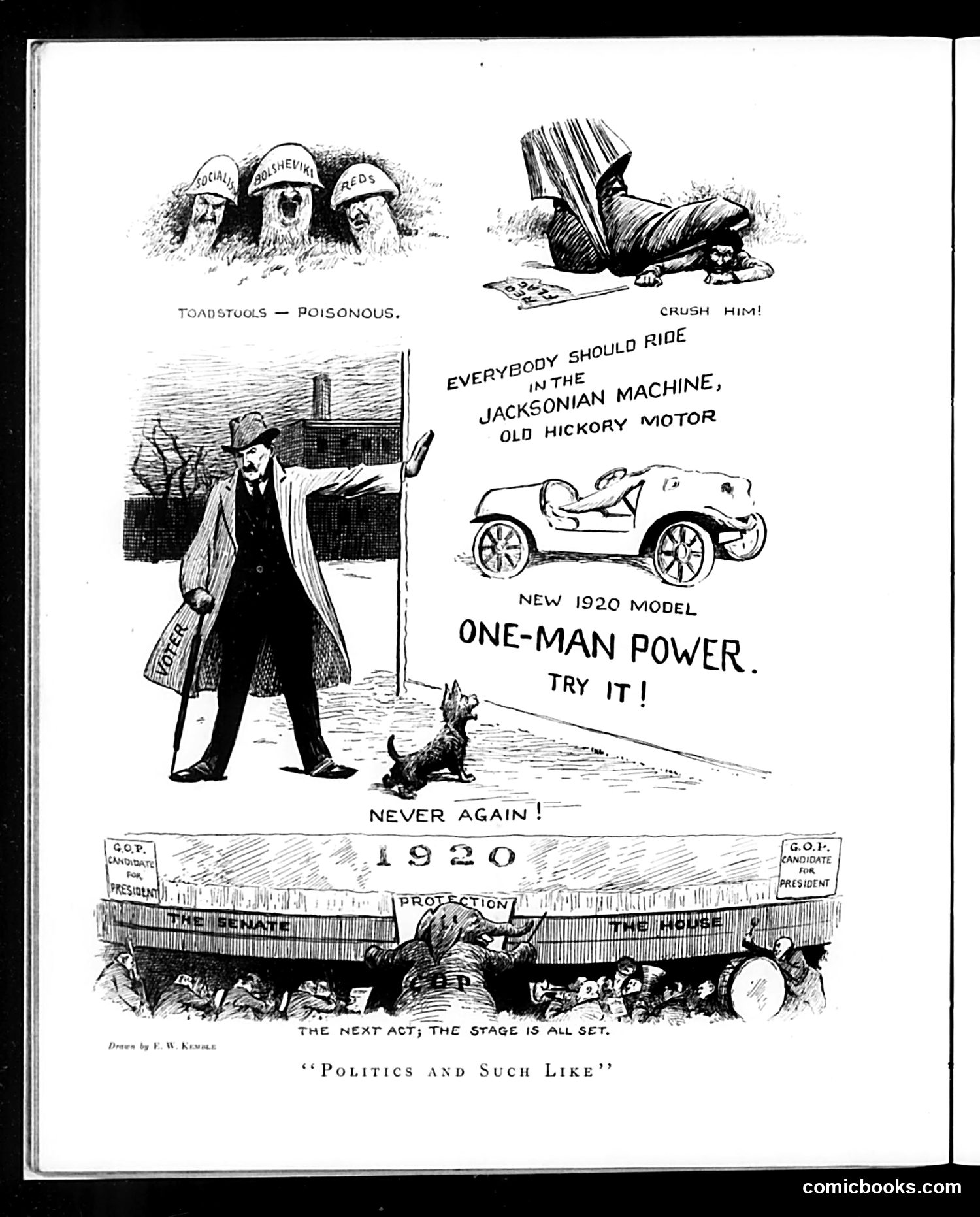
This 1920 political cartoon satirizes the 1920 presidential election. The top panels mock various political figures as "poisonous toadstools" and reference a Jacksonian-themed automobile advertisement as absurd campaign fodder. The central figure—a man with a small dog labeled "NEVER AGAIN!"—represents voter exhaustion after what appears to be a contentious election cycle. The bottom panel depicts the 1920 campaign as theatrical stagecraft, with "Protection" and "The People" visible on the stage set, suggesting both major parties employed empty rhetoric about these themes. The cartoon criticizes how political campaigns reduce serious governance to entertainment and hollow promises, with voters fed up by the performance.
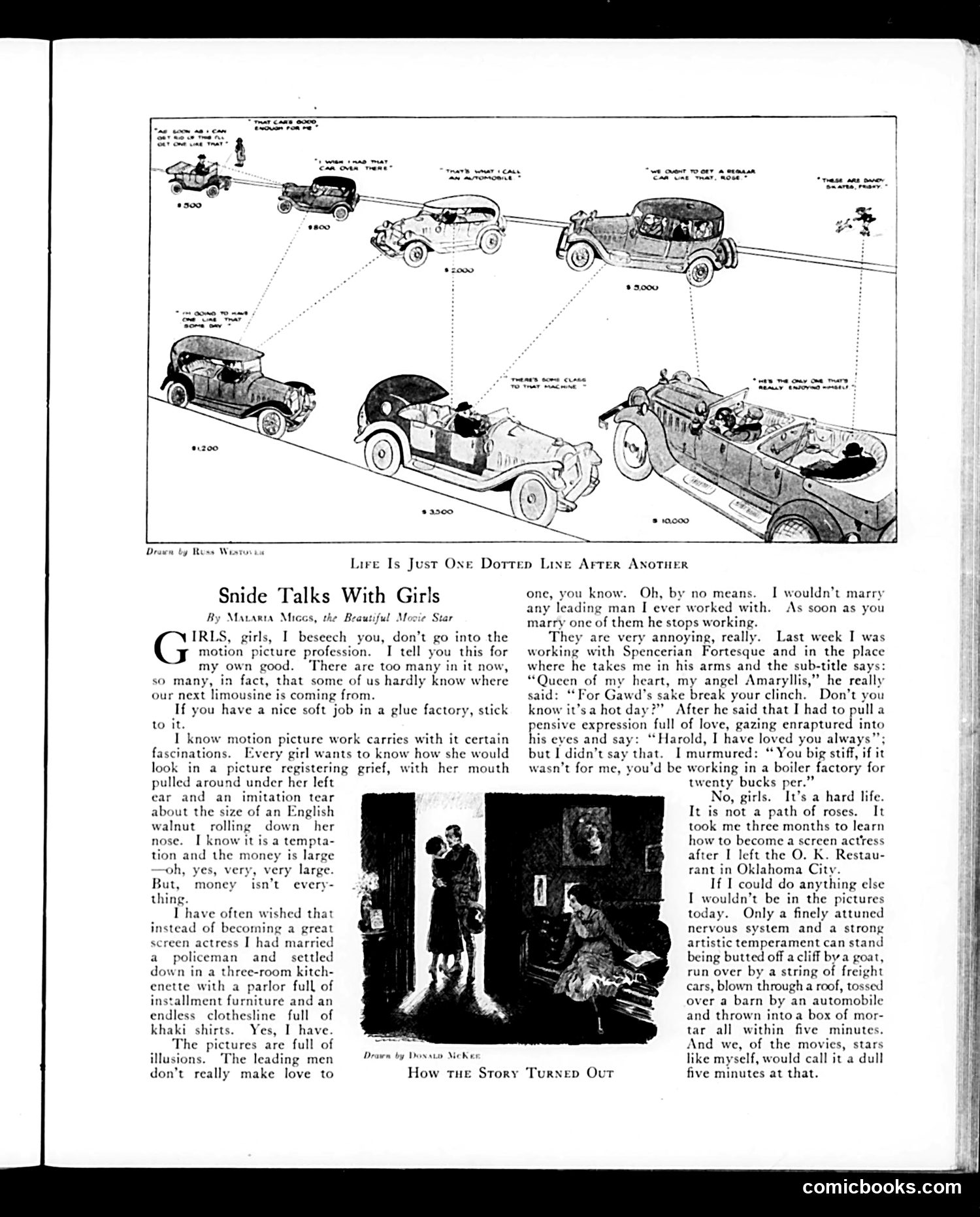
This page contains two distinct pieces satirizing 1920s Hollywood and silent film production. **Top cartoon** ("Life Is Just One Dotted Line After Another"): A visual gag showing the progression of car prices ($1,200 to $10,000) arranged as a "dotted line," suggesting Americans are in an endless cycle of purchasing increasingly expensive automobiles—a commentary on consumerism and aspirational spending during the prosperous 1920s. **Bottom article** ("Snide Talks With Girls"): Attributed to "Malmia Miggs, the Beautiful Movie Star," this is satirical advice *discouraging* young women from entering film. The humor lies in the actress cynically describing movie work's hardships: lazy leading men, dangerous stunt work, and the irony that she'd have preferred marrying a policeman to her glamorous but exhausting career. It's gentle mockery of both the film industry's exploitation and the romanticized image of stardom that attracted hopefuls. Both pieces reflect Jazz Age anxieties about materialism, frivolous celebrity culture, and the gap between Hollywood's glittering image and its unglamorous reality.
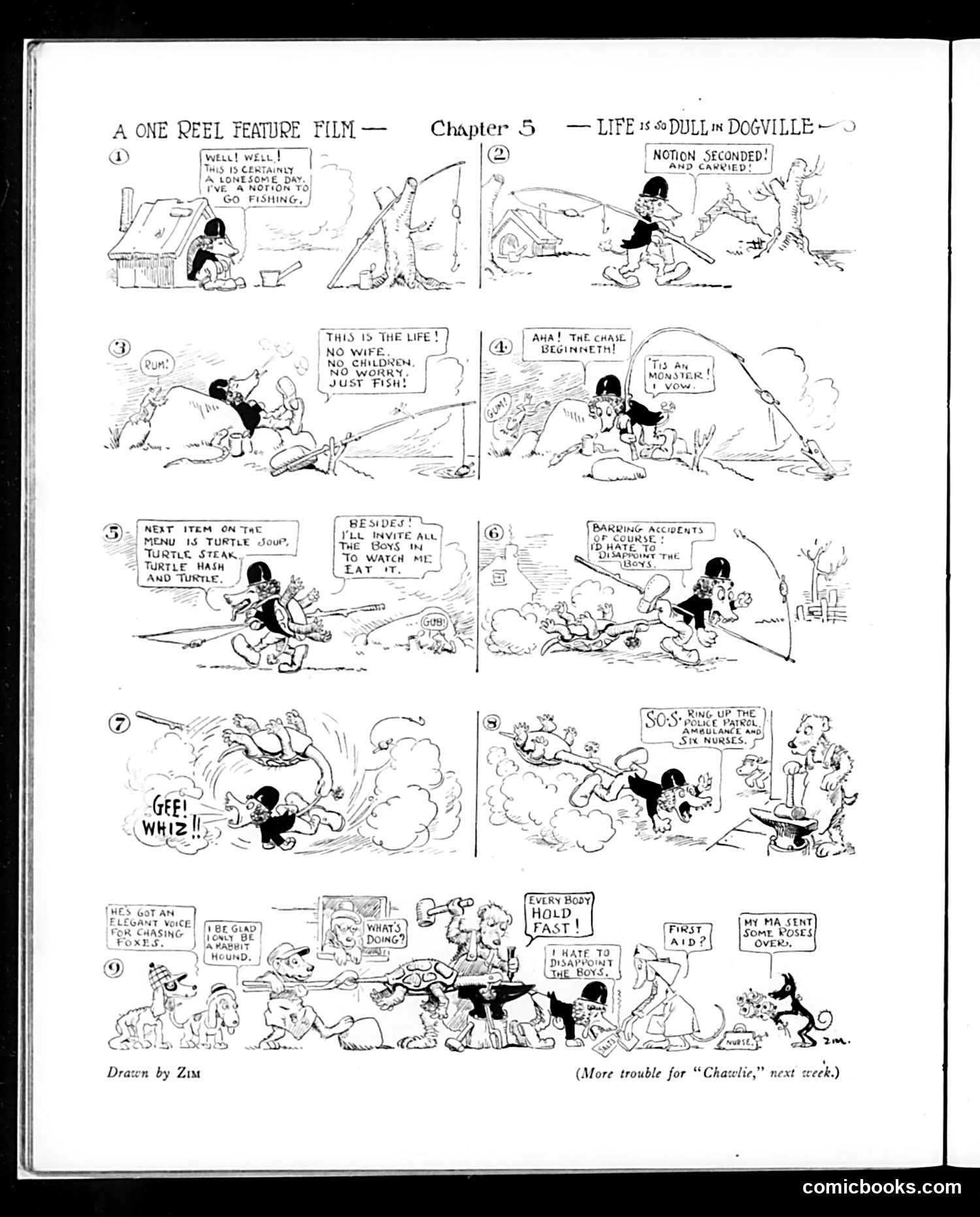
This is a nine-panel comic strip by Zim following a character (appears to be "Charlie," based on the note promising "More trouble for 'Charlie' next week") through a day in a rural setting called Dogville. The humor is slapstick and domestic: A fishing enthusiast celebrates solitude without wife, children, or worries—but is immediately chased by a dog. He plans a turtle-based menu, gets involved in various mishaps (barring accidents, holding the boys), and ultimately creates chaos. The final panel shows multiple figures and animals in complete disorder, with someone declaring "EVERY BODY HOLD FAST!" The satire gently mocks small-town rural life and the gap between peaceful intentions and comedic reality. The recurring theme—wanting simple, quiet leisure that constantly goes awry—reflects early 20th-century humor about the contrast between idealized country living and its actual complications. It's straightforward physical comedy rather than political satire.
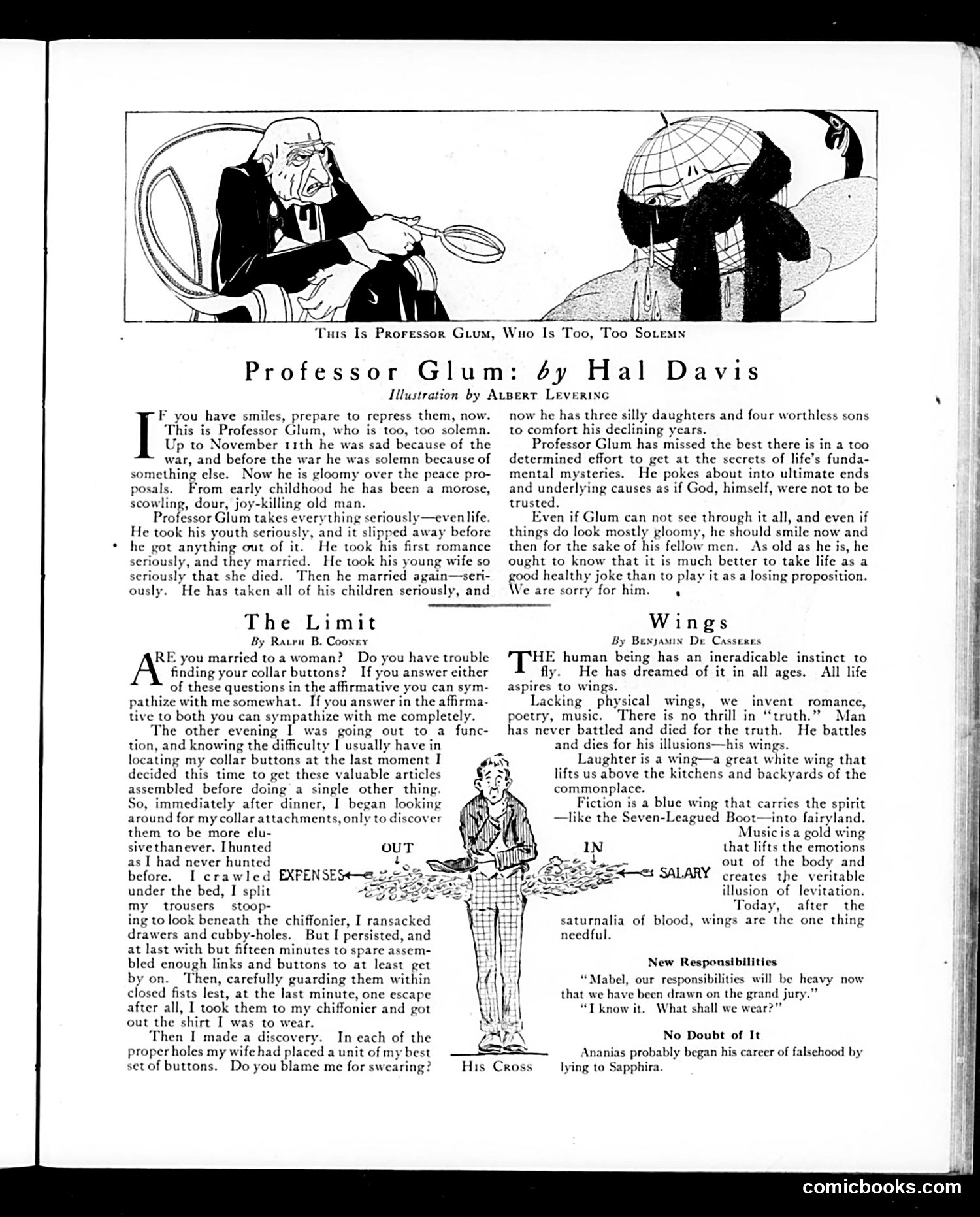
This page contains three separate humor pieces typical of early 20th-century satirical magazines: **"Professor Glum"** is a character sketch mocking an excessively solemn man who takes everything—youth, romance, marriage, children—so seriously that he extracts no joy from life. The satire suggests that excessive solemnity is self-defeating; even post-WWI pessimism shouldn't prevent smiling. **"The Limit"** is a domestic humor piece about a husband's frustration finding collar buttons, only to discover his wife had helpfully placed them in his shirt holes beforehand—a comedic commentary on marital misunderstandings. **"Wings"** is a philosophical essay (not strictly humorous) arguing that humans need "wings"—metaphorical escapes like romance, fiction, laughter, and music—especially needed after the carnage of WWI ("saturnalia of blood"). The small illustration shows a woman in a voting booth, paired with a caption about grand jury duty and fashion concerns—light social satire about women's new civic responsibilities.
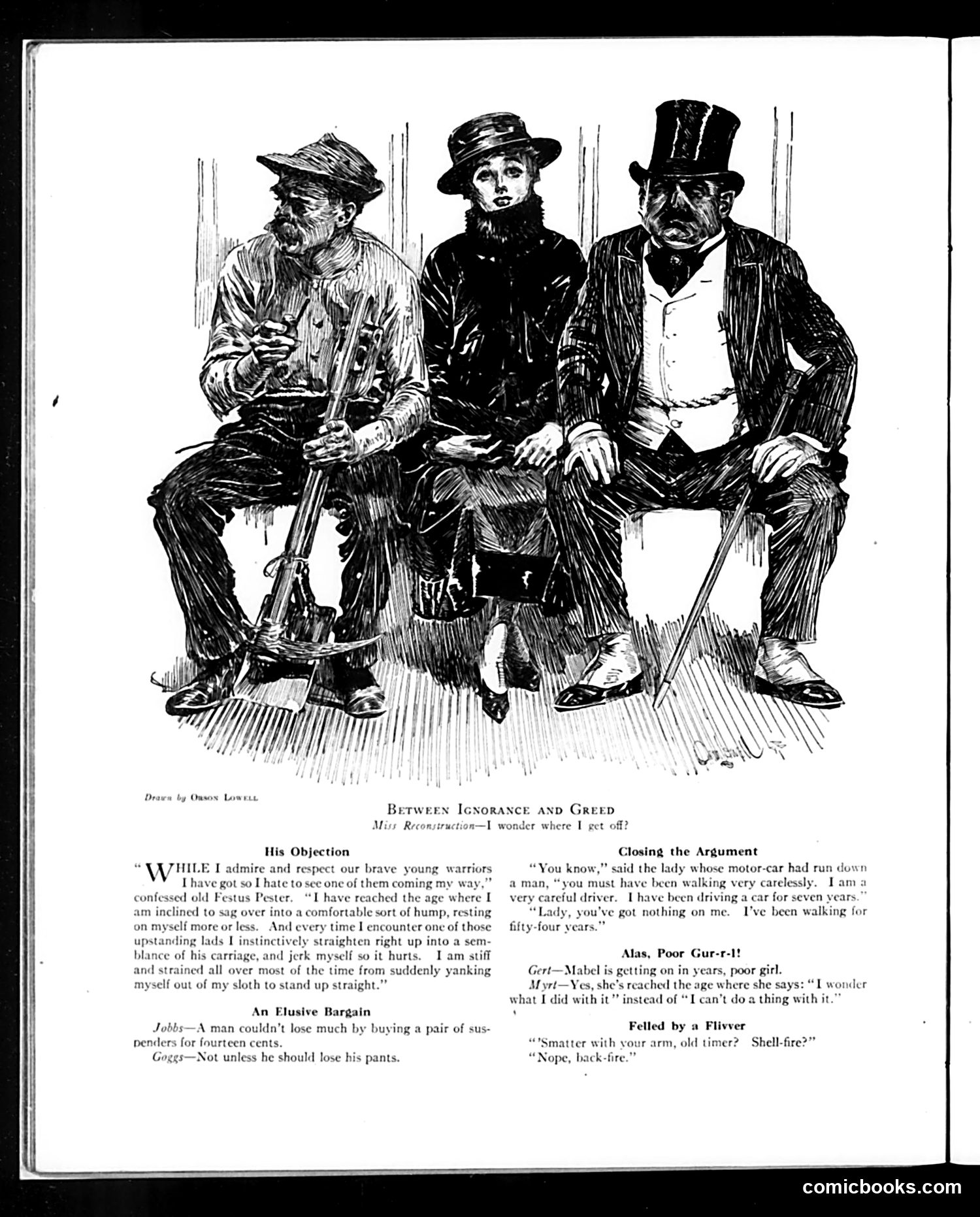
This Judge magazine page presents **three separate humor pieces** satirizing early 20th-century American social attitudes. **"Between Ignorance and Greed"** (main cartoon) depicts three working-class men—appearing to represent labor, poverty, or the underclass—caught between two forces. The title suggests commentary on exploitation of vulnerable populations by those claiming ignorance of conditions versus those motivated purely by profit. **The smaller jokes** mock contemporary anxieties: - An elderly man's discomfort around energetic youth (generational tension) - A cheap suspenders bargain that risks losing pants (working-class economic precarity as humor) - A pedestrian-vs.-motorcar accident where both claim experience, satirizing how modern technology disrupts traditional social hierarchies - A final joke about car "backfire" injuries, poking fun at unreliable new automobiles The overall tone suggests *Judge* using humor to critique social tensions—class division, generational conflict, and the chaotic consequences of industrialization—while maintaining a sardonic, somewhat dismissive stance toward working-class struggle.
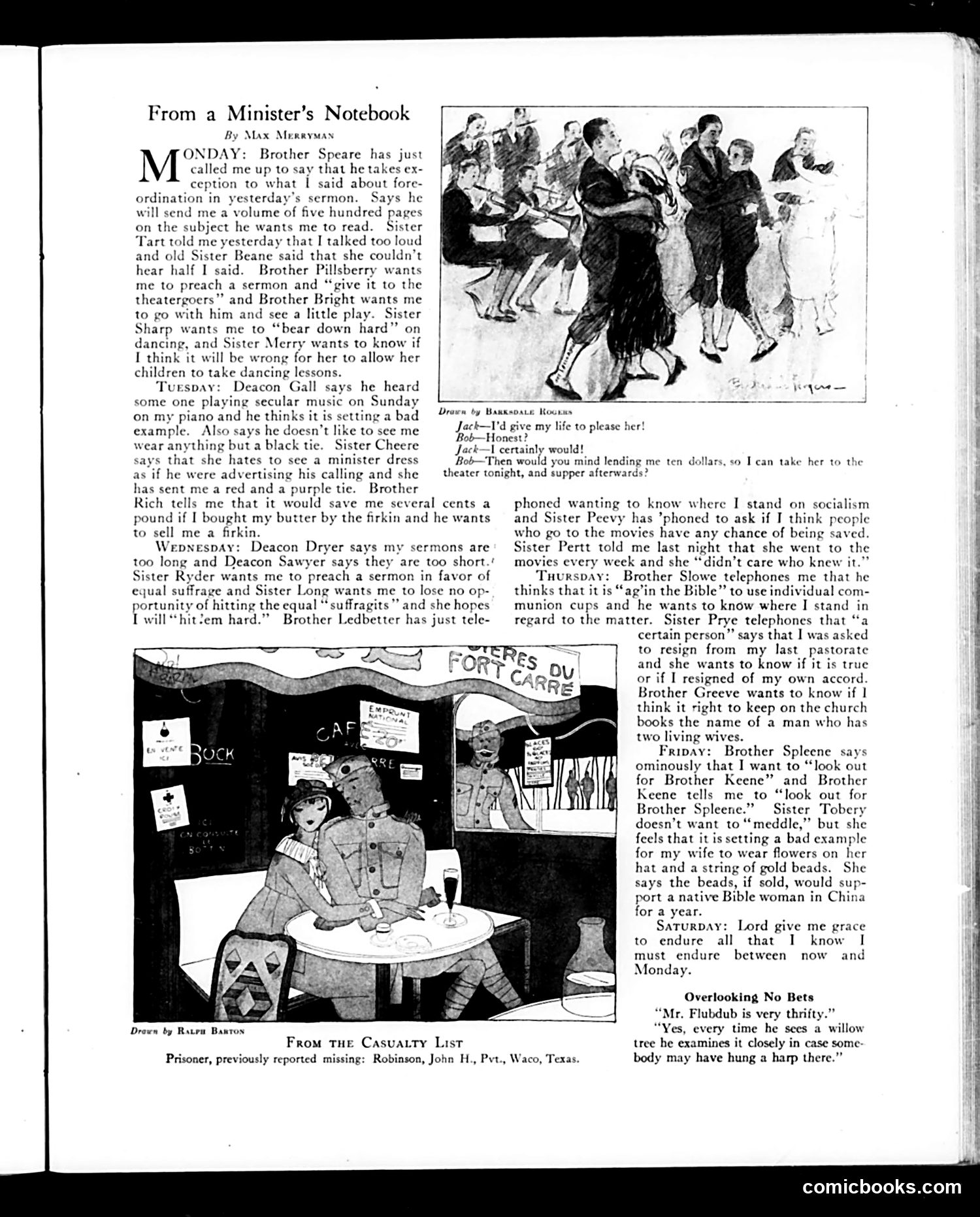
This page satirizes the overwhelming and often contradictory demands church congregants place on their minister. The main feature, "From a Minister's Notebook," documents a week of complaints and requests: parishioners criticize sermon length, musical choices, clothing, and dancing; they demand he take opposing political stances (women's suffrage vs. against it); they question his movie attendance policies and communion cup practices. The satire's point is that ministers face impossible expectations—told simultaneously to be serious yet approachable, conservative yet progressive. The cartoon at top reinforces this: a harried clergyman surrounded by people pulling him in different directions. The two smaller cartoons offer lighter relief. "From the Casualty List" appears to reference WWI military casualties. "Overlooking No Bets" is a simple joke about a miserly man examining willow trees, hoping to find a harp (reference to harps in heaven) someone may have discarded. The humor targets both intrusive congregational meddling and clerical exhaustion.
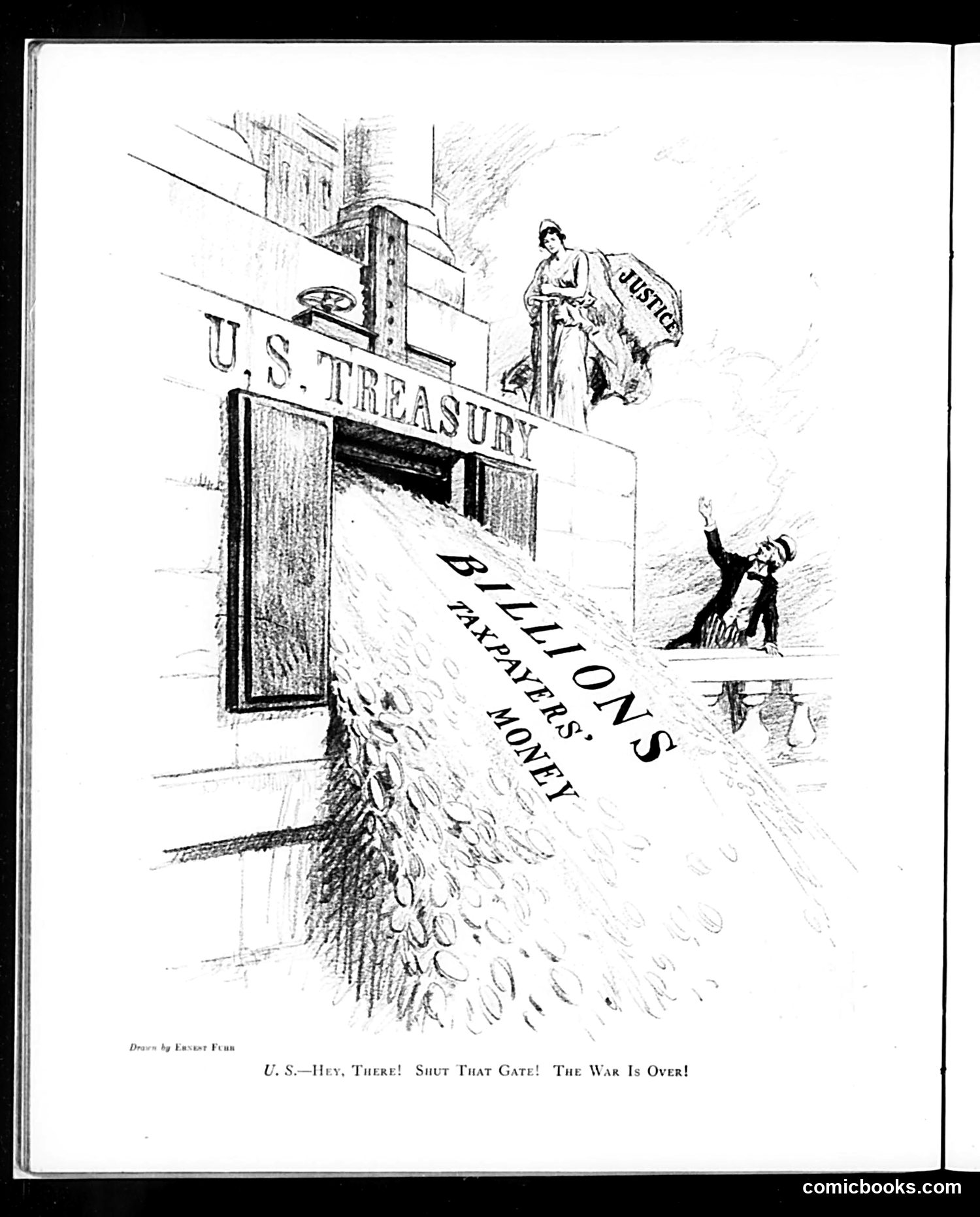
This is a single cartoon by Ernest Fuhr titled "U.S.—HEY, THERE! SHUT THAT GATE! THE WAR IS OVER!" The image depicts the U.S. Treasury building with a large gate. A figure representing "Justice" sits atop the building, while below, a man appears to be trying to prevent money (labeled "BILLION'S TAXPAYERS' MONEY") from flowing out through an open gate. Another figure stands alarmed on the right. The satire critiques continued government spending after World War I's conclusion. The cartoonist argues that despite the war ending, the Treasury continues hemorrhaging taxpayer money—the gate should be "shut" to stop wasteful expenditures. This reflects post-WWI fiscal concerns about maintaining inflated wartime budgets during peacetime.
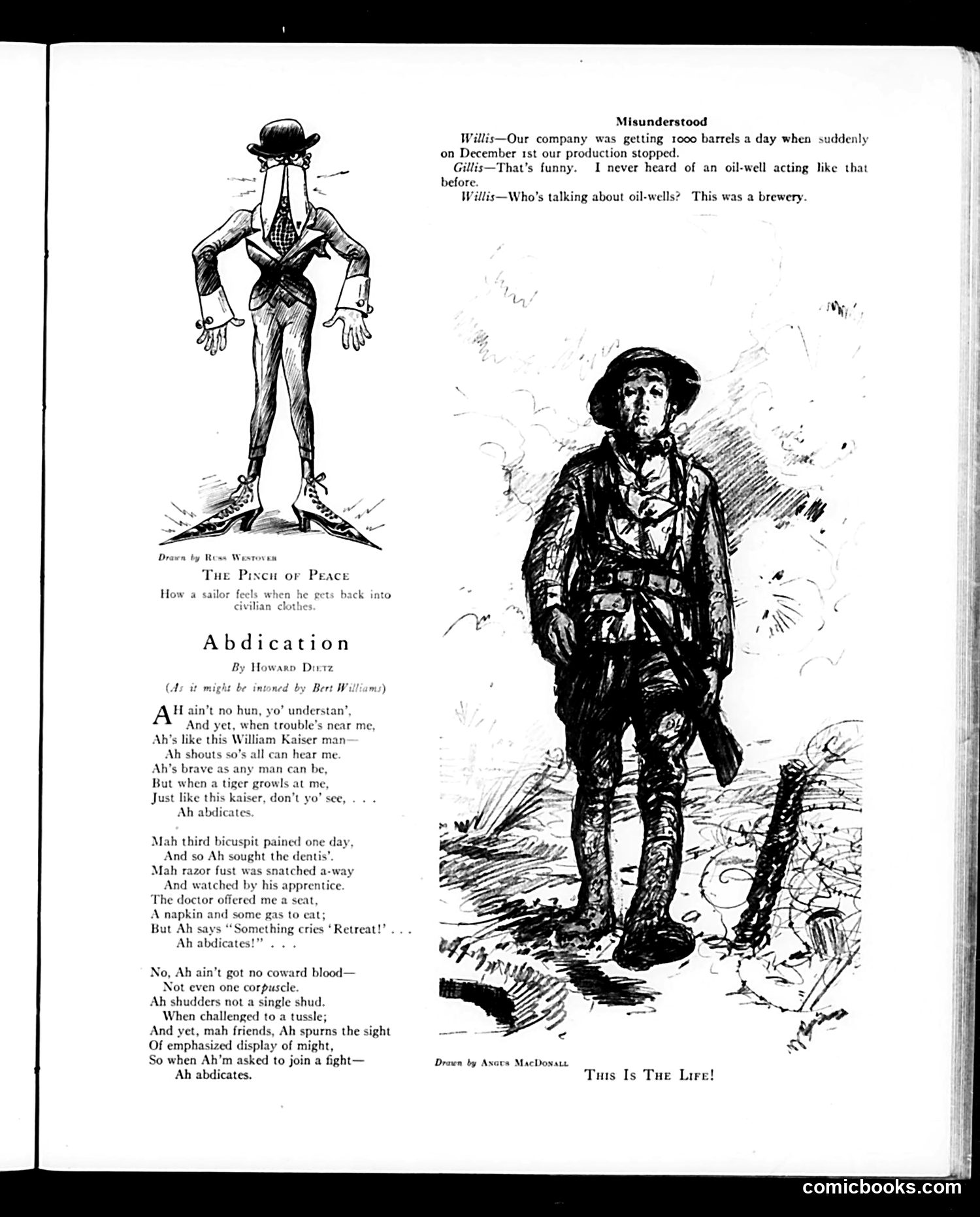
**"Misunderstood"** is a brief joke playing on wartime Prohibition. Willis and Gillis discuss a production stoppage—Willis initially seems to reference an oil well's failure, but reveals he's talking about a *brewery*. The humor lies in the confusion: breweries were forced to shut down on December 1st (likely 1918, as Prohibition approached), mimicking an industrial crisis. The joke satirizes how brewery closures were treated with the gravity of an oil crisis. **"Abdication"** is a poem by Howard Dietz apparently referencing Kaiser Wilhelm II's abdication (1918, ending WWI). The dialect narrator compares himself to the Kaiser—both claim bravery but "abdicate" when facing actual danger: the speaker flees the dentist; the Kaiser fled power when challenged. The satire mocks cowardice dressed up as dignity, likely reflecting American skepticism of Germany's surrender. Both pieces reference recent 1918 events: Prohibition and the war's end.
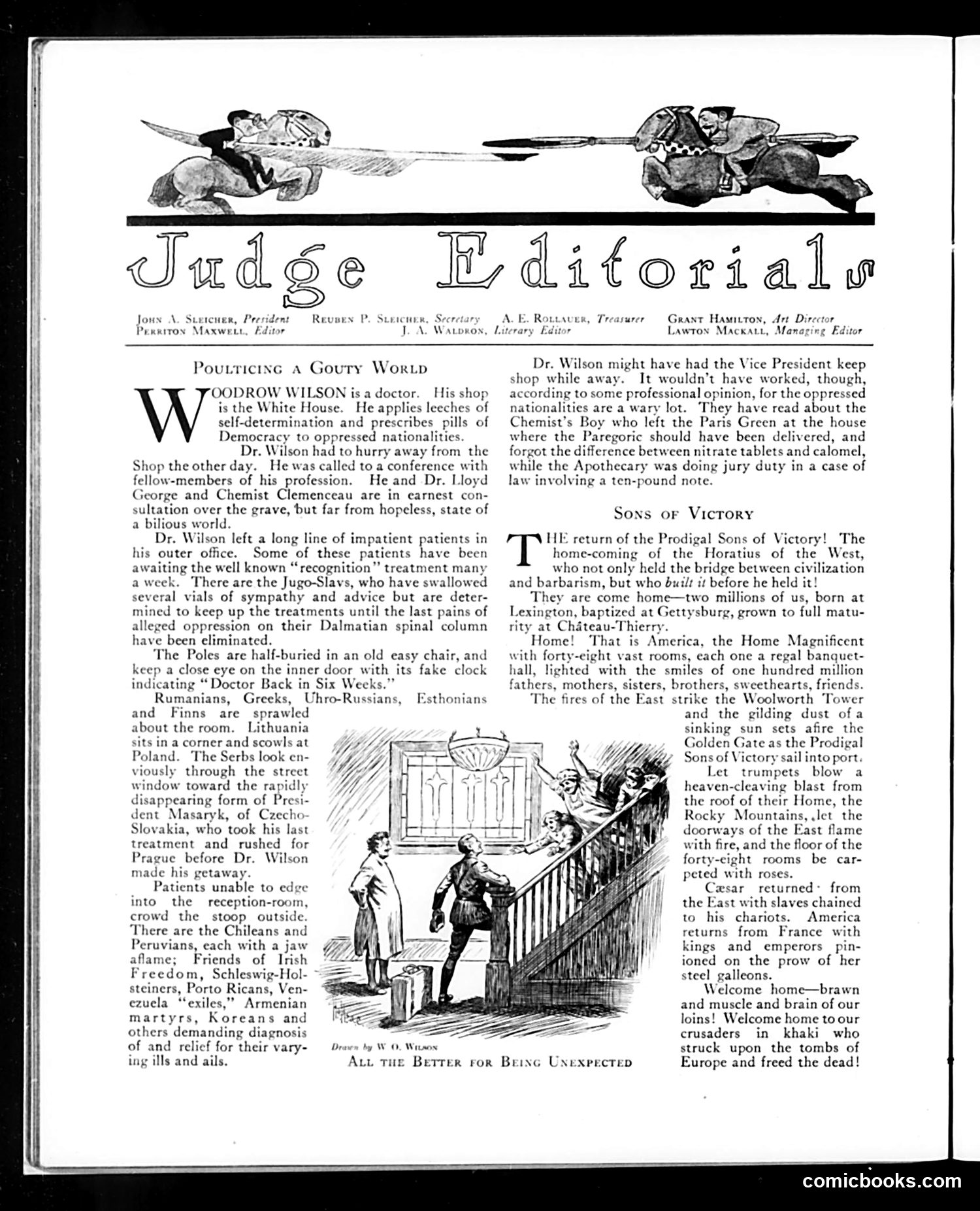
This editorial page uses medical metaphors to satirize President Woodrow Wilson's role in post-WWI diplomacy. Wilson is depicted as a "doctor" treating various "patient" nations seeking self-determination and recognition at the Paris Peace Conference. The left cartoon shows Wilson's "office" overwhelmed with waiting patients: Poles, Jugo-Slavs, Greeks, Rumanians, Czechs (including President Masaryk who "rushed for Prague"), Lithuanians, Serbs, and others—each representing oppressed or newly-independent nations awaiting Wilson's promised "recognition treatment" and solutions to territorial disputes. The satire critiques Wilson's delayed attention to these nations' problems while he consults with fellow leaders ("Dr. Lloyd George and Chemist Clemenceau") over Europe's post-war troubles. The right article celebrates American soldiers' homecoming from WWI as triumphant "Prodigal Sons of Victory," using grandiose language about America welcoming its returned warriors.
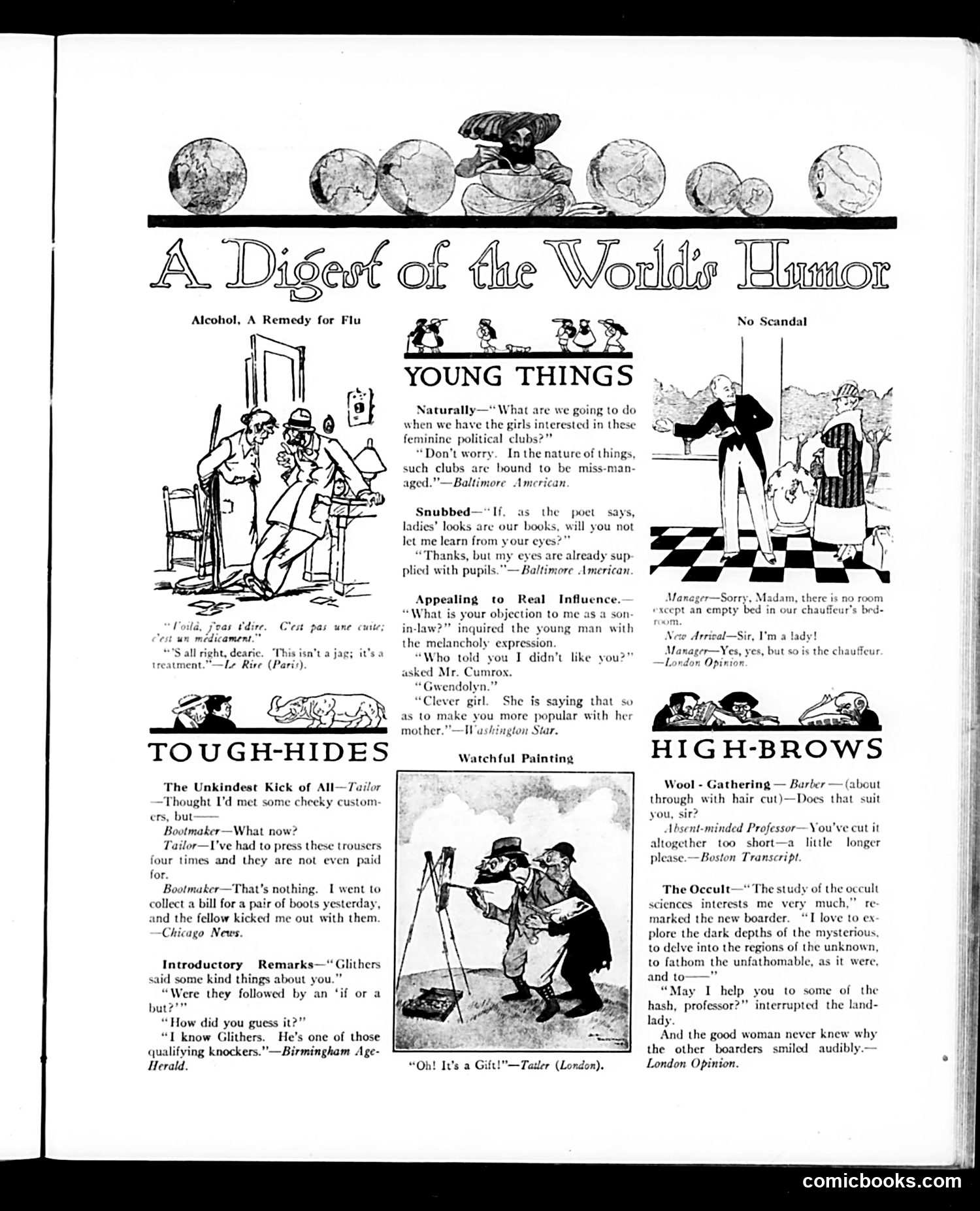
This page presents a collection of short humorous anecdotes organized by social category. The "Tough-Hides" section mocks tradesmen (tailors, bootmakers) complaining about unpaid bills and difficult customers—with one bootmaker claiming a customer literally kicked him out while wearing the boots he'd made. "Young Things" contains jokes about women's political clubs being inherently mismanaged, and flirtation attempts rebuffed by clever wordplay. "High-Brows" ridicules pretentious intellectuals, particularly an absent-minded professor who pontificates about studying "the occult sciences" before being interrupted by a landlady offering hash—suggesting his mystical pretensions are absurd compared to mundane reality. The opening item jokes that alcohol is "not a jag; it's a treatment"—referencing the 1918 flu pandemic when some promoted alcohol as medicinal. The satire targets class stereotypes, gender politics, and intellectual pretension typical of early 20th-century humor magazines.
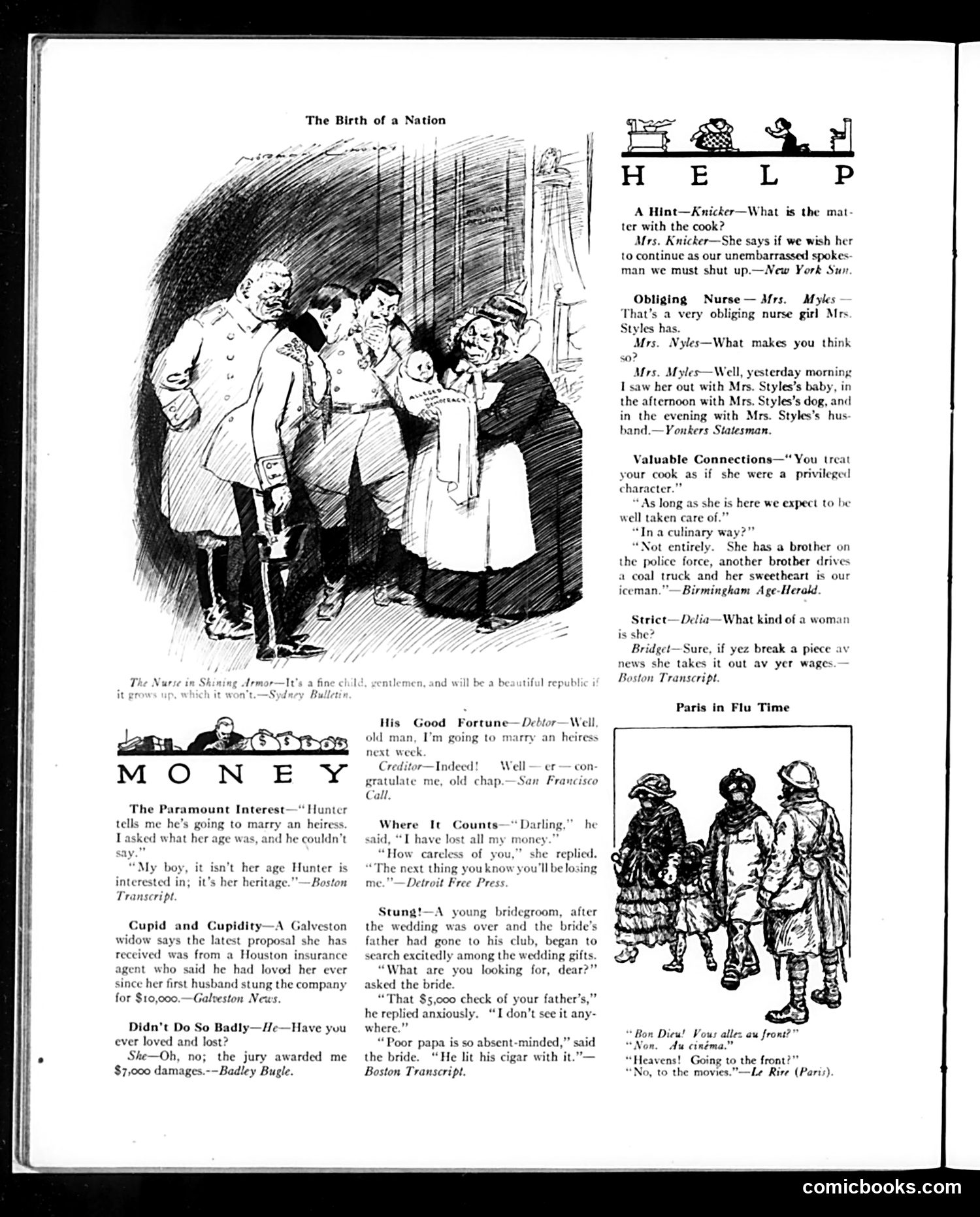
This Judge magazine page collects satirical one-liners about marriage, money, and domestic life—likely from the early 20th century based on references to "flu time" and wartime contexts. The main cartoon depicts a nurse in "shining armor," satirizing how servants (particularly cooks and nurses) wielded social power over employers. The jokes exploit this dynamic: a cook threatens to become an "unembarrassed spokesman," implying servants would gossip or blackmail; a nurse is valuable because her connections include a policeman brother, coal-truck driver, and iceman boyfriend. Other jokes mock mercenary marriages: men pursuing heiresses for money rather than love, and women pursuing men for financial security or legal settlements ("the jury awarded me $7,000"). The "Paris in Flu Time" section jokes darkly about WWI-era priorities: Parisians choosing cinema over military service. The overall satire targets both class anxieties (servants' power) and the commercialization of relationships during this era.
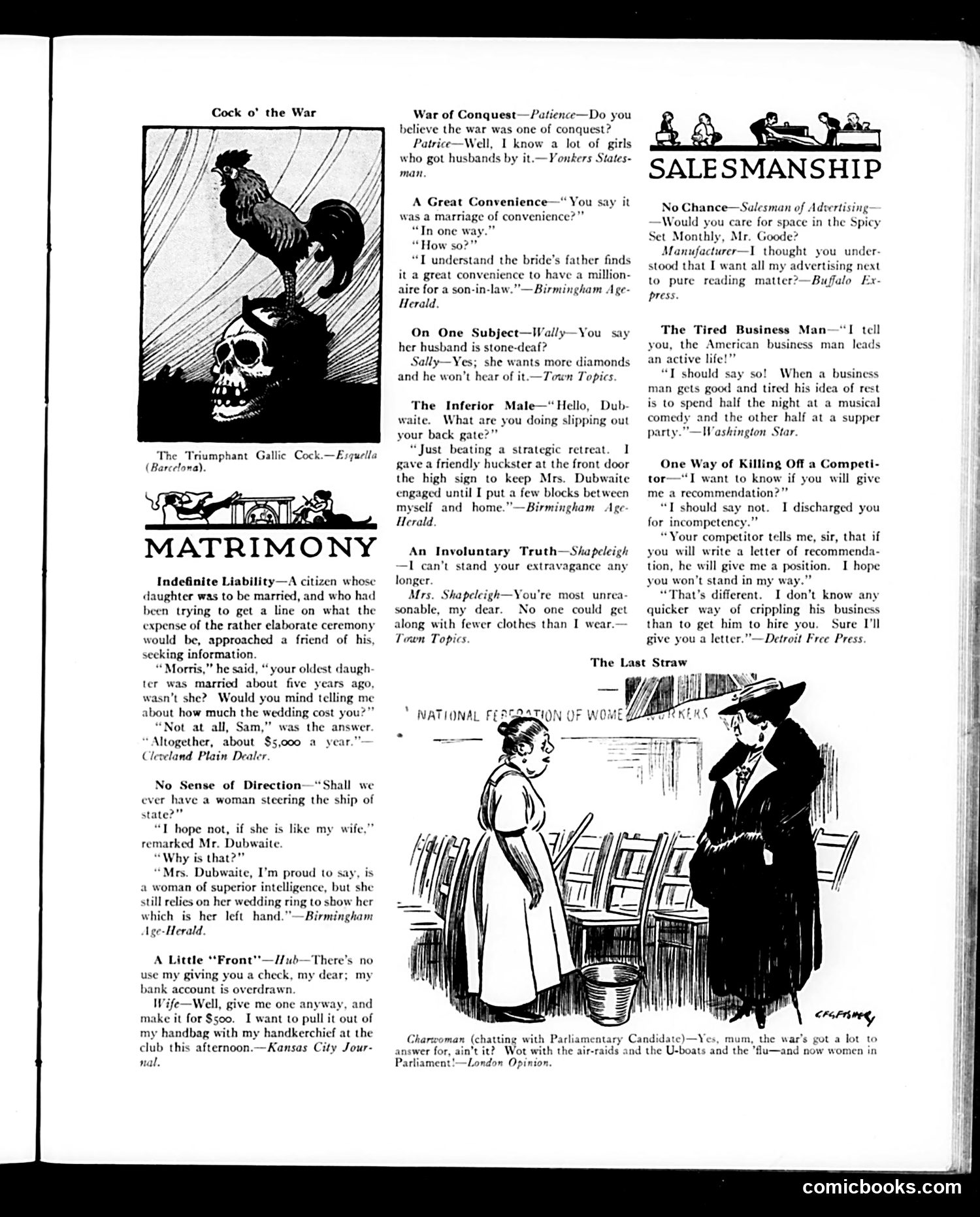
This page from the satirical magazine **Judge** contains humor focused on three themes: marriage/matrimony, salesmanship, and wartime. **The Matrimony section** mocks marriage expenses and gender dynamics. Jokes depict wives as extravagant spenders, husbands as henpecked or financially trapped, and women as poor at practical matters (the "left hand" joke). One joke references a "marriage of convenience" where a bride's father benefits from marrying her to a millionaire—satirizing transactional marriage among the wealthy. **The Salesmanship section** critiques business advertising practices and labor relations, including a dark joke where firing an employee ruins a competitor by forcing them to hire an incompetent person. **The War reference** (bottom) appears to be a British cartoon about wartime concerns: air-raids, U-boats, influenza, and now women in Parliament—suggesting contemporary anxiety about social upheaval during WWI. The overall tone reflects early 20th-century American attitudes: cynicism about marriage, class-consciousness, and wartime uncertainty.
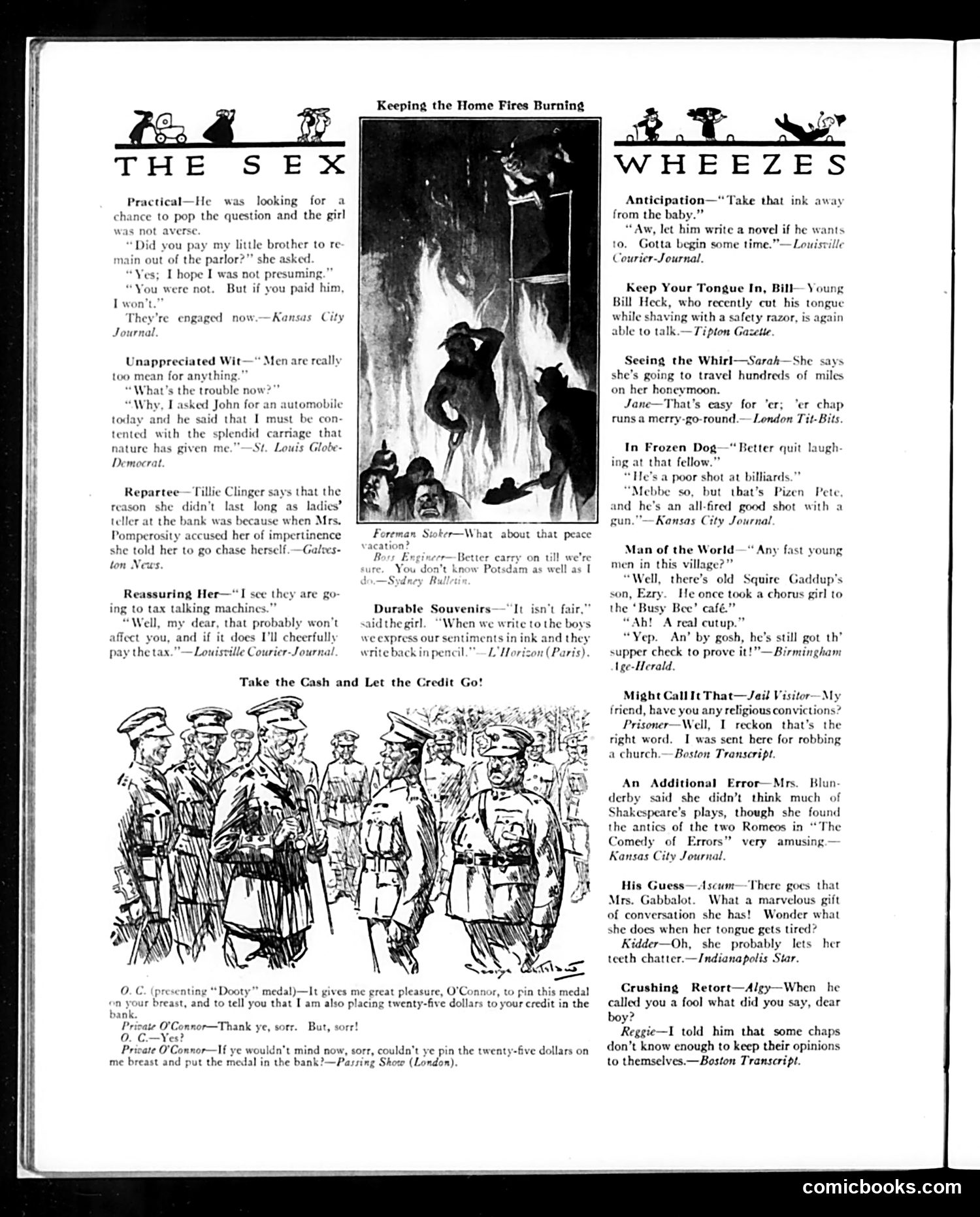
This page from *Judge* contains satirical humor typical of early 20th-century American comic magazines. The central illustration depicts soldiers in military uniforms, captioned "Take the Cash and Let the Credit Go!" — likely referencing wartime financial schemes or profiteering, a common satirical target during WWI era. The surrounding "Wheezes" (short jokes) mock everyday domestic situations: men refusing to buy automobiles for wives, bank tellers talking back to customers, couples negotiating honeymoon expenses. One joke plays on a child writing a "novel" with ink—contemporary satire of literary pretension. The page also includes a dialogue between an Irish soldier ("O'Connor") and an officer about pinning a medal—satirizing military bureaucracy and the absurdity of awarding medals while simultaneously expecting financial contributions. Overall, the page reflects pre-war American humor: domestic gender dynamics, class commentary, and gentle mockery of authority and pretension. The jokes assume readers familiar with contemporary social conventions around courtship, marriage, and military service.
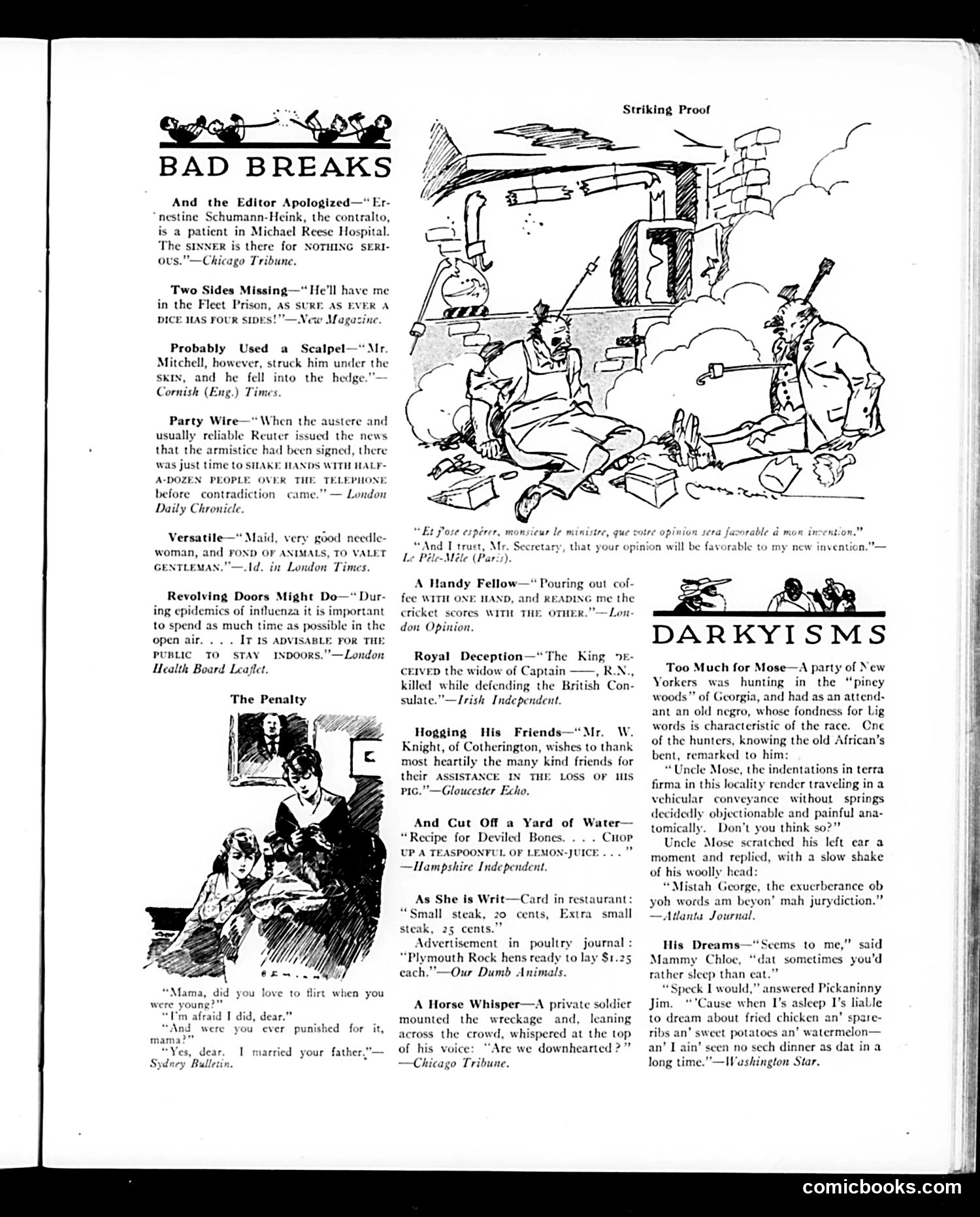
This Judge magazine page features two sections of satirical humor: **"Bad Breaks"** collects brief, ironic news items—editorial corrections, prison escapes, telephone mishaps—finding dark comedy in unfortunate situations. **"Darkyisms"** presents racist dialect humor attributed to African American characters, a common but deeply offensive feature of early 20th-century publications. The sketches show Black figures in stereotypical situations (hunting, conversation) using exaggerated speech patterns. The accompanying illustration shows an electrical accident scene with workers, labeled "Striking Proof," using a pun on electrical terminology. This content reflects Judge's satirical approach to contemporary news and social commentary, though the racial material is now recognized as dehumanizing propaganda characteristic of that era.
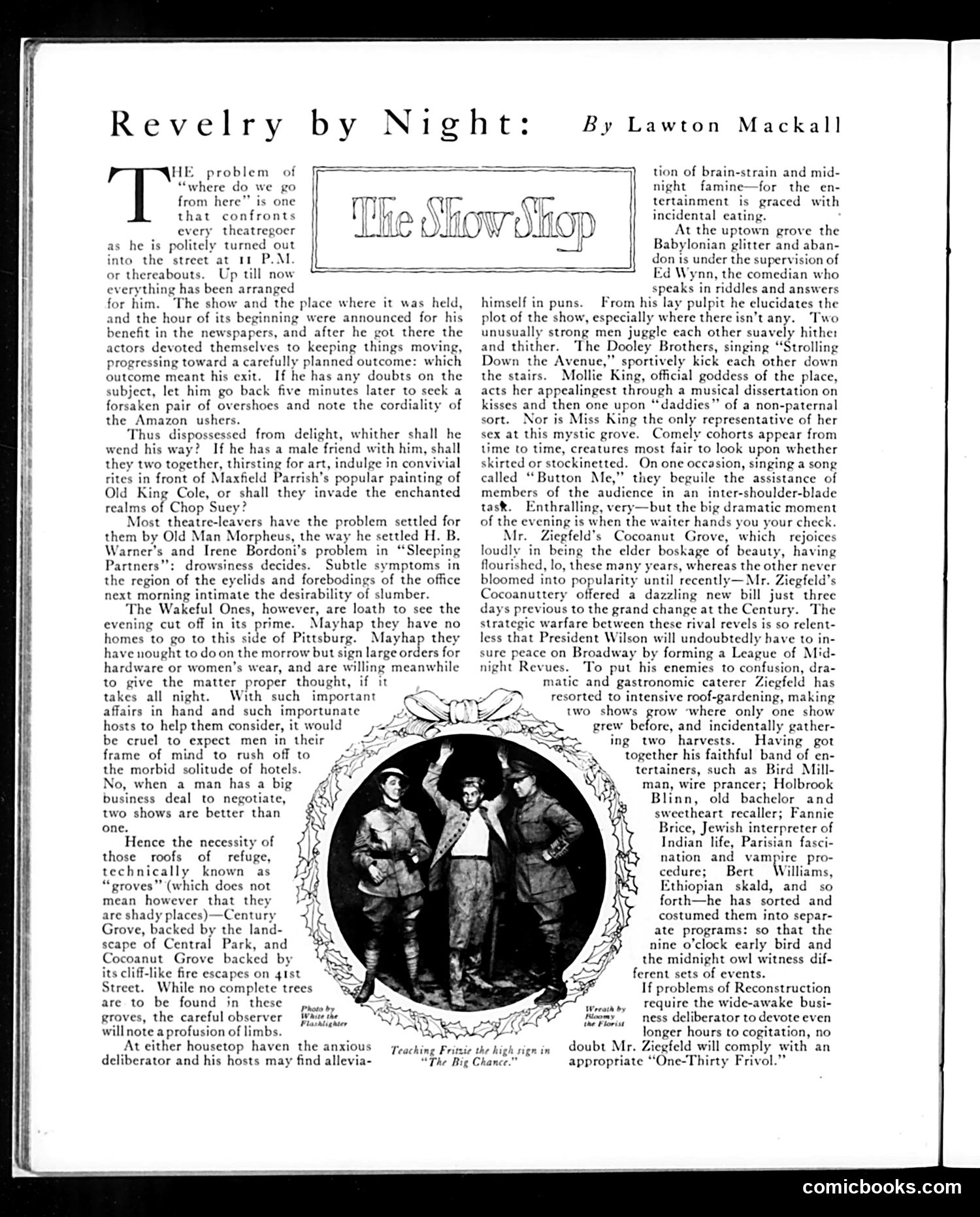
This article by Lawton Mackall satirizes the problem facing theatergoers after evening shows end around 1 P.M. (likely midnight in modern terms). Once ejected from theaters, patrons face the question: where to go next? The piece humorously catalogs options, including visits to restaurants or nightclubs. It focuses on two rooftop "groves"—Century Grove and Cocoanut Grove—as refuges for those unwilling to leave the entertainment district. These venues featured performers like Ed Wynn (a comedian known for puns) and Mollie King, offering dinner, music, and dancing. The satire's punchline arrives when "the waiter hands you your check"—suggesting that even at these late-night establishments, the evening's true dramatic climax is the bill. The article gently mocks both the theater industry's relentless scheduling and patrons' compulsive need for continued entertainment and spending, even at midnight hours.
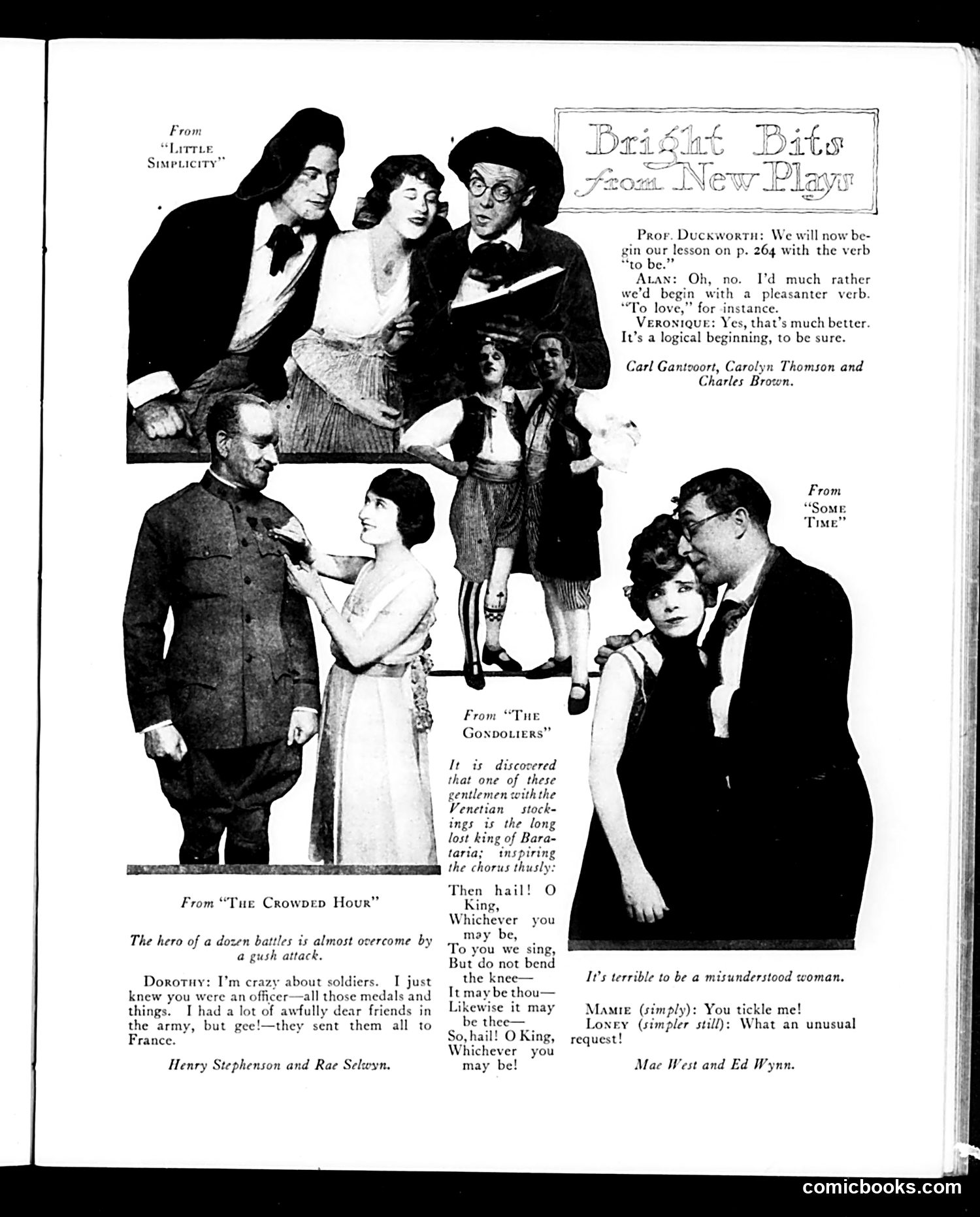
This page showcases theatrical humor from contemporary Broadway productions circa the 1920s. The content consists of brief comedic exchanges from four different plays, presented with accompanying photographs of the actors. The humor relies on wordplay and character-driven comedy typical of the era: - "Little Simplicity" features students trying to steer a language lesson toward romance rather than grammar - "The Crowded Hour" plays on a soldier's embarrassment at emotional reactions - "The Gondoliers" (likely Gilbert & Sullivan) mocks confusion over identity and royal protocol with absurdist dialogue - The final exchange with Mae West and Ed Wynn centers on flirtation and double entendre These aren't political cartoons but rather entertainment gossip featuring recognizable stage actors of the period. The "satire" is gentle—poking fun at theatrical conventions and romantic entanglements rather than social issues. The page functions as promotional material for Broadway productions, capitalizing on readers' interest in stage personalities and theatrical anecdotes.
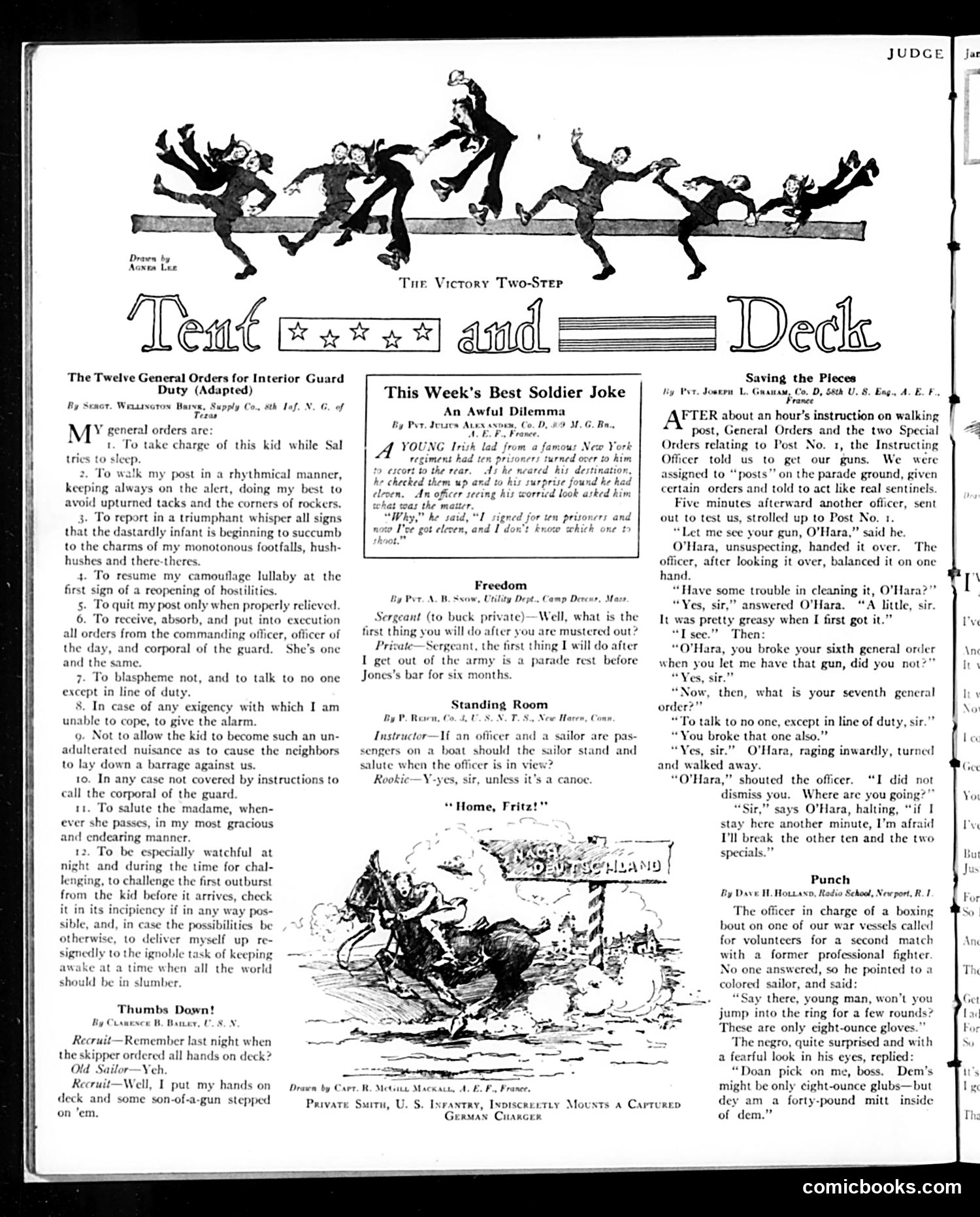
This page collects humorous military anecdotes and parodies from World War I, written by soldiers. The top illustration, "The Victory Two-Step," shows soldiers dancing—likely satirizing military marching drills or the contrast between wartime severity and home-front frivolity. The main content parodies military regulations through absurdist humor. "The Twelve General Orders for Interior Guard Duty (Adapted)" mockingly reframes guard duty as babysitting—the soldier must keep a crying infant asleep while maintaining military discipline. This satirizes the tedium and contradictions of military life during wartime. Other jokes mock army bureaucracy and recruit ignorance. A sailor fails to salute properly in a canoe; a soldier loses his gun to a testing officer and gets chewed out for breaking protocol. The humor targets both military absurdity and soldiers' confusion navigating rigid regulations. The illustration "Private Smith Indiscreetly Mounts a Captured German Charger" depicts a captured horse, likely humorous about soldiers' mishaps with war spoils. Overall, the page provides enlisted men's comedic perspectives on WWI military life—the mundane frustrations beneath patriotic duty.
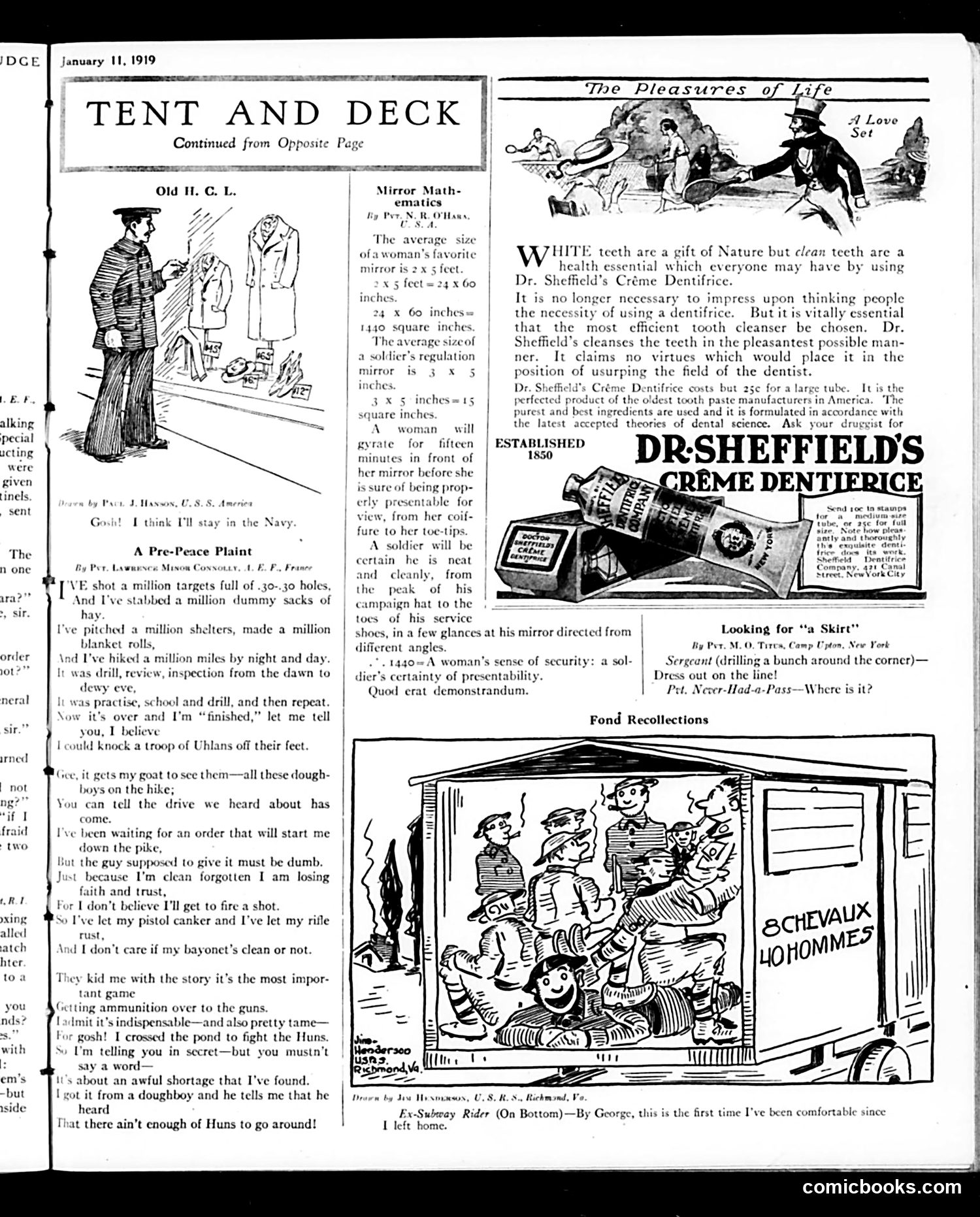
This page mixes **WWI soldier humor** with advertisements. The main comic content includes: **"A Pre-Peace Plant"** (poem): A disillusioned soldier reflects on military training—drilling, marching, building shelters—then expresses frustration that he won't see combat before the war ends. The satire targets the absurdity of intensive preparation without purpose. His cynicism about lost faith, rusted rifle, and uncleaned bayonet mocks both military discipline and his own apathy. **Mirror Mathematics & Soldier Vanity**: A cartoon and math puzzle joke about soldiers obsessively checking mirrors, equating a woman's mirror time (15 minutes) with a soldier's need for presentability and "certainty of presentability"—satirizing masculine vanity and military grooming standards. **"Ex-Subway Rider"** (bottom cartoon): A soldier in a cramped military transport says it's the first time he's been comfortable since leaving home—dark humor about civilian subway conditions versus wartime discomfort. The **Dr. Sheffield's Crème Dentifrice advertisement** occupies significant space, typical of Judge's revenue model. All content reflects the **January 1919 timeframe** (war ending), capturing soldiers' mixed feelings about demobilization and return to civilian life.
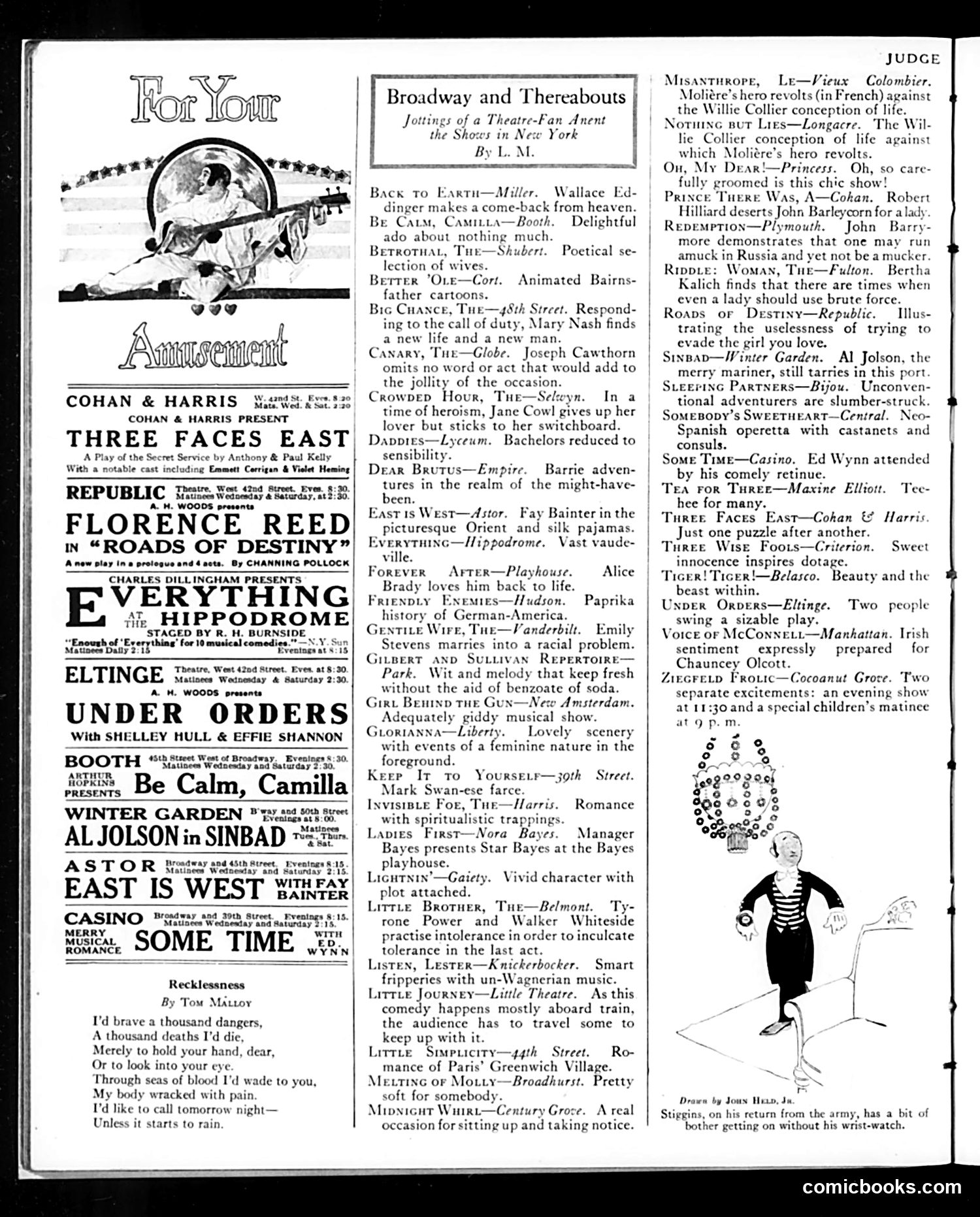
This is primarily a **theater advertising and review page** from Judge magazine, featuring Broadway show listings and brief critiques by "L.M." The page showcases **1910s-1920s theatrical productions** with advertisements for popular entertainments like Al Jolson in *Sinbad* and Florence Reed in *Roads of Destiny*. The cartoon illustration shows a **skeleton figure in formal dress**, drawn by Joan Baez Jr., with the caption about a soldier returning from war who won't go out without his wristwatch—likely a **WWI-era joke** about soldiers' concerns with practical matters over romantic notions. The theater reviews employ **witty, cynical commentary**: praising Wallace Eddinger's comeback in *Back to Earth*, noting *Be Calm, Camilla* as "delightful ado about nothing much," and sarcastically describing *Little Simplicity* as "pretty soft for somebody." The page's humor relies on **knowing Broadway audiences**—sophisticated urban readers familiar with these shows, actors, and theatrical trends. The small poem at bottom uses **anti-romantic irony**: a lover willing to die for someone, "Unless it starts to rain"—mocking sentimental theatrical conventions.
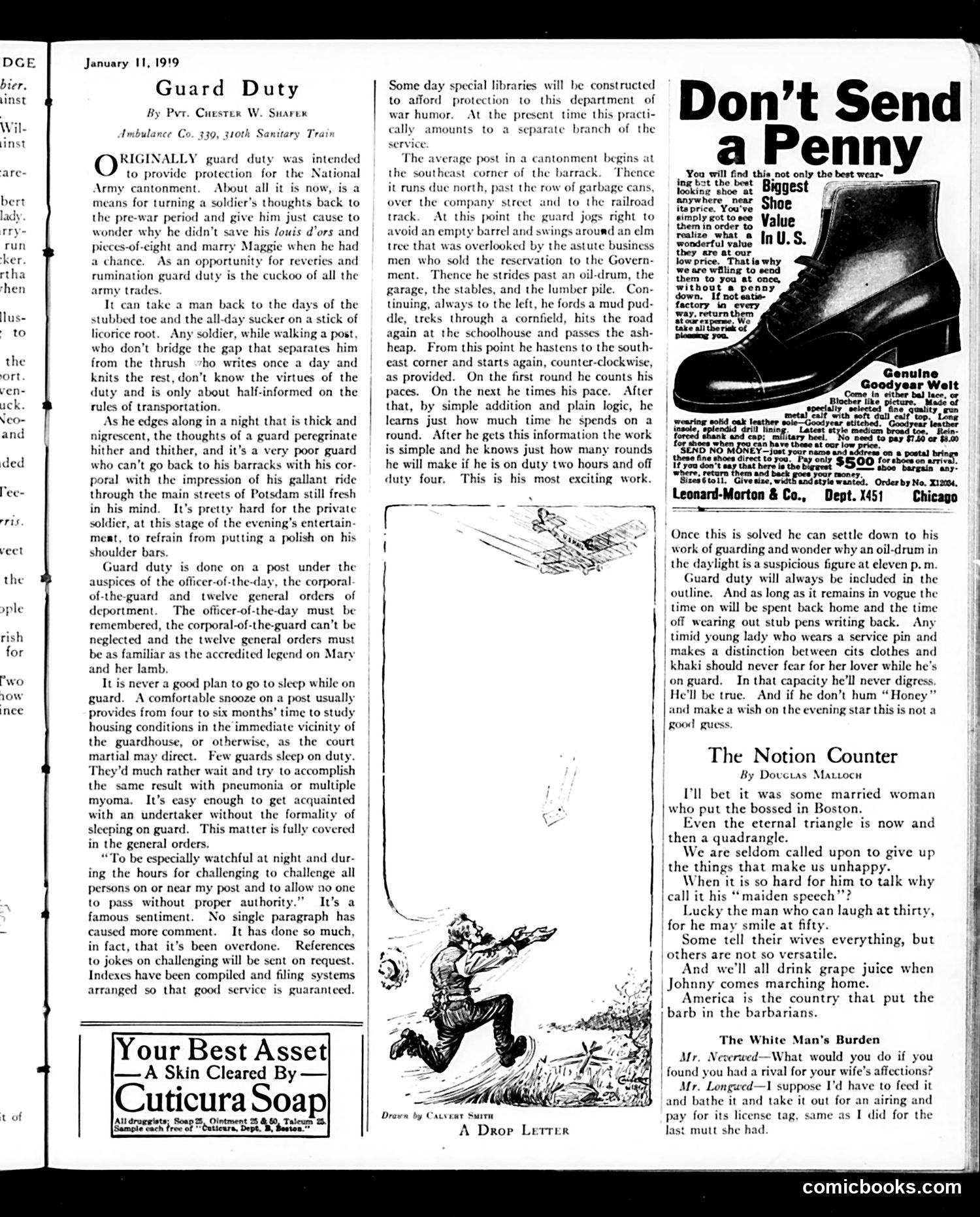
This page contains a first-person essay by Pvt. Chester W. Shafer describing the tedium of guard duty at an Army cantonment during World War I. The piece humorously portrays how soldiers on nighttime patrol mentally escape through daydreams and nostalgia—remembering pre-war romances, childhood pleasures, and European adventures. The satire targets the monotony and absurdity of military protocol: guards must memorize twelve general orders, march repetitive routes past mundane obstacles (garbage cans, barrels, elm trees), and remain vigilant against the constant threat of court-martial for sleeping. The essay's real joke is that guard duty serves no practical purpose except "turning a soldier's thoughts back to the pre-war period"—a commentary on the disconnect between military bureaucracy and actual wartime necessity. The accompanying cartoons ("A Drop Letter," "The Notion Counter") provide lighter social humor unrelated to the guard duty essay. Period advertisements for shoe polish and soap fill remaining space.
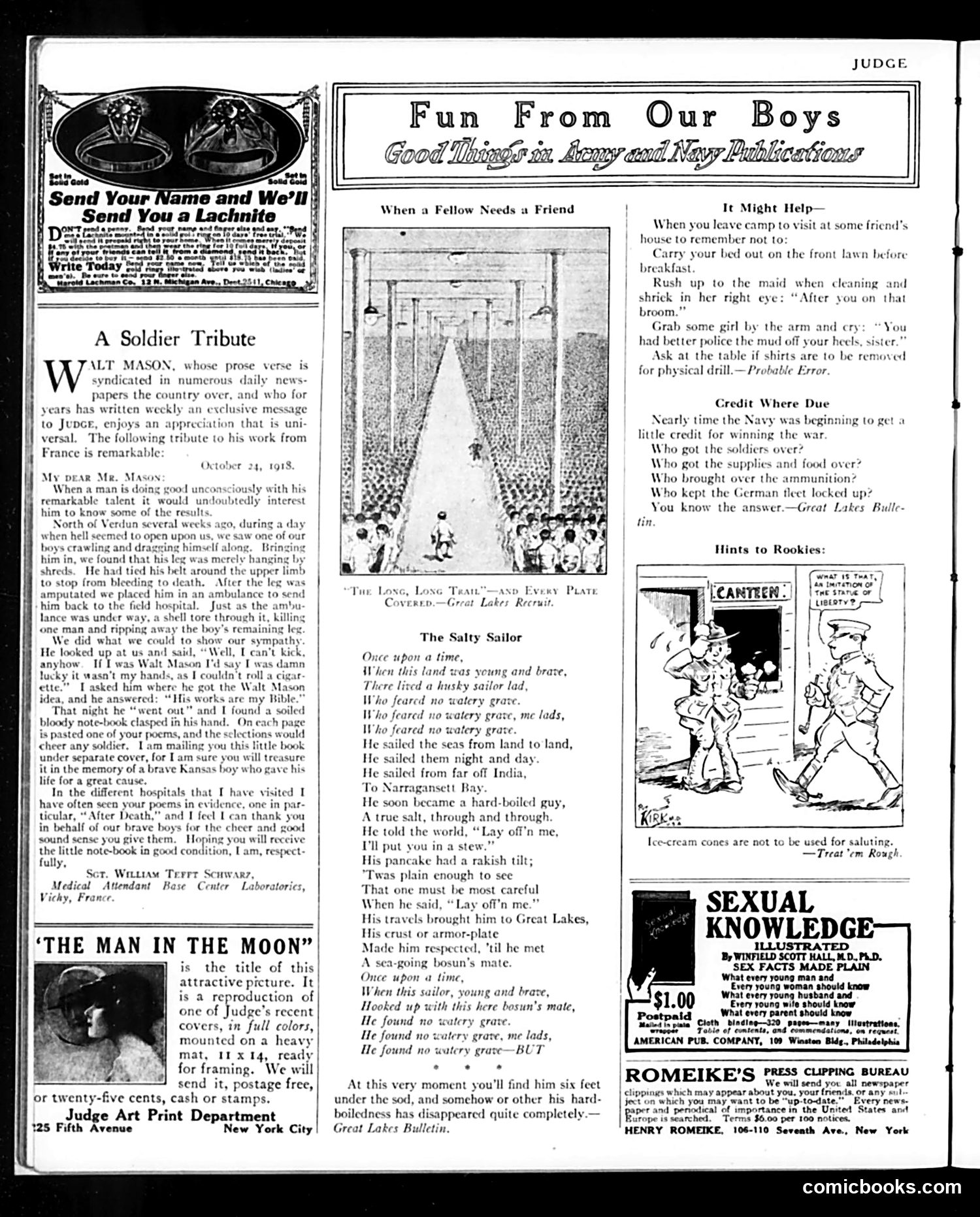
This page contains WWI-era humor and commentary aimed at military personnel. **Main Content:** The "Fun From Our Boys" section offers satirical etiquette tips for soldiers visiting homes on leave—poking fun at their rough manners (dragging mud, startling maids, grabbing girls). **"A Soldier Tribute"** reprints a heartfelt letter from a French medic praising writer Walt Mason's patriotic verse for comforting wounded soldiers. This shifts tone from satire to genuine appreciation of morale-boosting war literature. **"The Salty Sailor"** is a humorous poem about a stereotypical tough naval character using exaggerated language and dialect. **Additional elements** include vintage advertisements (for a lackluster product and a controversial "Sexual Knowledge" book) typical of Judge's revenue model. The page reflects 1918 attitudes: supporting troops through humor, celebrating military sacrifice, and mixing entertainment with commerce—all aimed at readers already invested in the war effort.
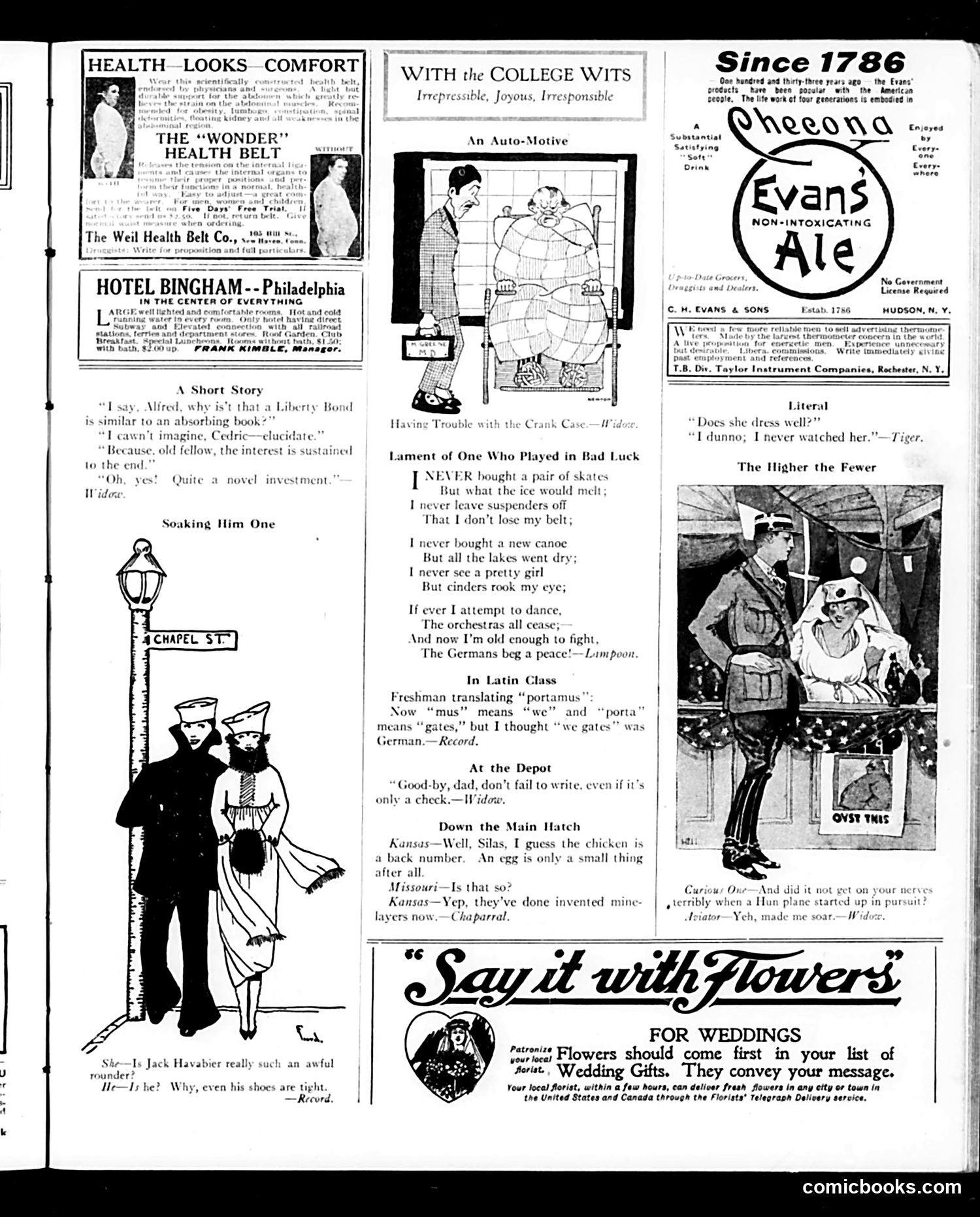
This page contains primarily **advertising and light humor** rather than political satire. The content includes: **Advertisements:** Health belts, hotels, and Evans' Ale dominate the page—typical of early 20th-century magazines. **Humor pieces:** Brief jokes and verses on college life, romance, and WWI-era themes. Notable is "Lament of One Who Played in Bad Luck," a poem listing misfortunes (skates melting, lakes drying up, orchestras stopping when he dances), culminating in a joke about being old enough to fight Germans who now "beg a peace"—likely referencing WWI's conclusion (suggesting publication circa 1918). **Cartoons:** "Soaking Him One" shows a sailor and woman, likely a recruitment or wartime dating joke. "Having Trouble with the Crank Case" depicts an automotive mishap. "The Higher the Fewer" appears to show a pilot or aviator scene. The page reflects early 20th-century concerns: WWI, consumer products, and college/dating humor. The overall tone is light and commercial rather than biting political commentary.
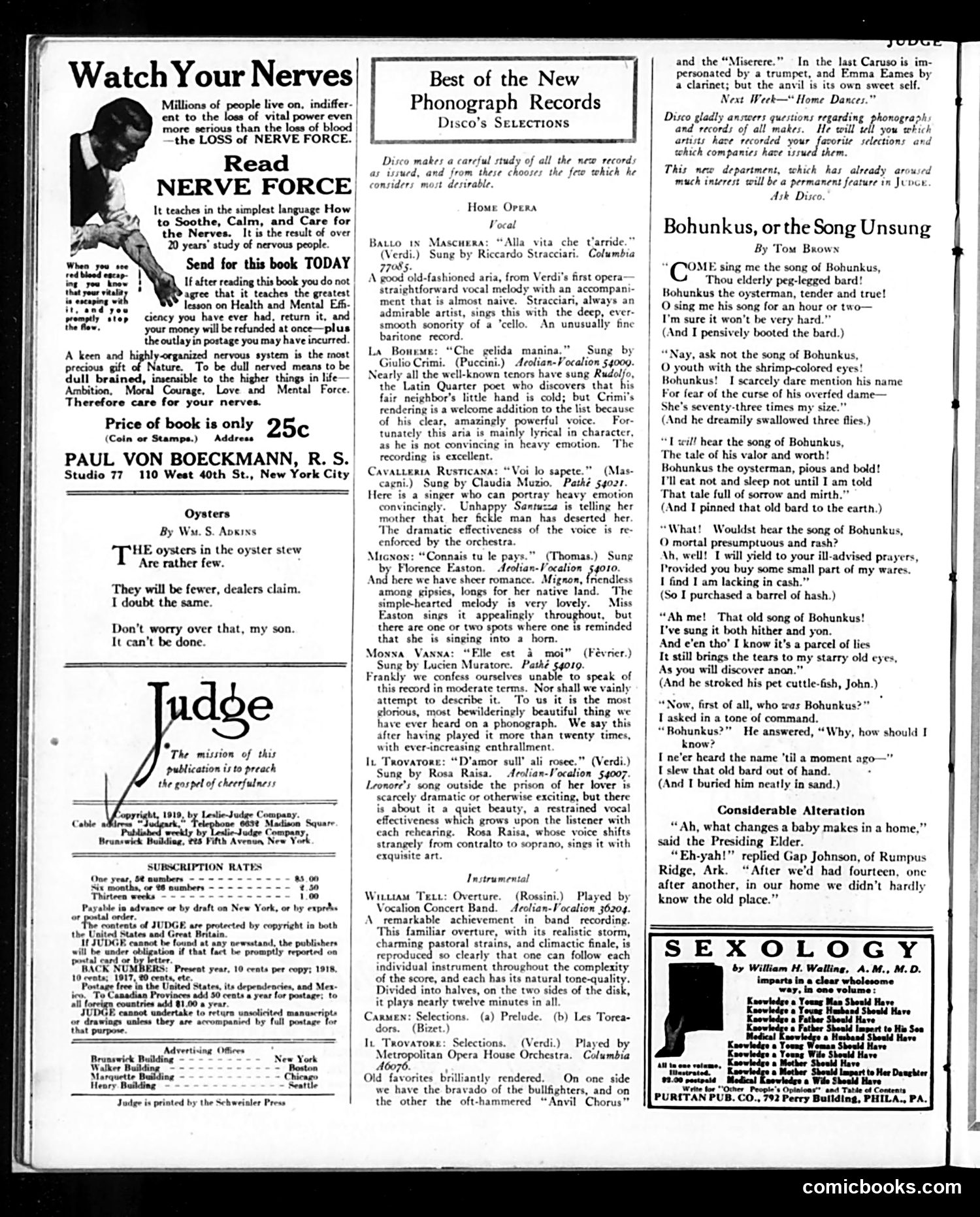
This page is primarily **advertising and record reviews**, not political satire. The dominant content includes: 1. **"Watch Your Nerves" advertisement** (left column): A self-help book promoting "nerve force" as a health commodity—reflecting early 20th-century pseudoscience about nervous exhaustion, a concern among urban, middle-class Americans. 2. **"Oysters" poem** (bottom left): A brief humorous verse about oyster scarcity, with the reassuring conclusion "It can't be done"—likely commenting on wartime or post-war supply anxieties. 3. **Phonograph record reviews** (right side): Detailed critiques of operatic recordings from various labels, reflecting Judge's target audience of cultured, affluent readers interested in classical music and home entertainment technology. 4. **"Bohunkus" poem** (right column): A satirical piece about an "unsung" folk song, written in dialect. The page reflects **1919 consumer culture** and Judge's positioning as a magazine for educated, affluent urbanites interested in health fads, classical culture, and modern technology.
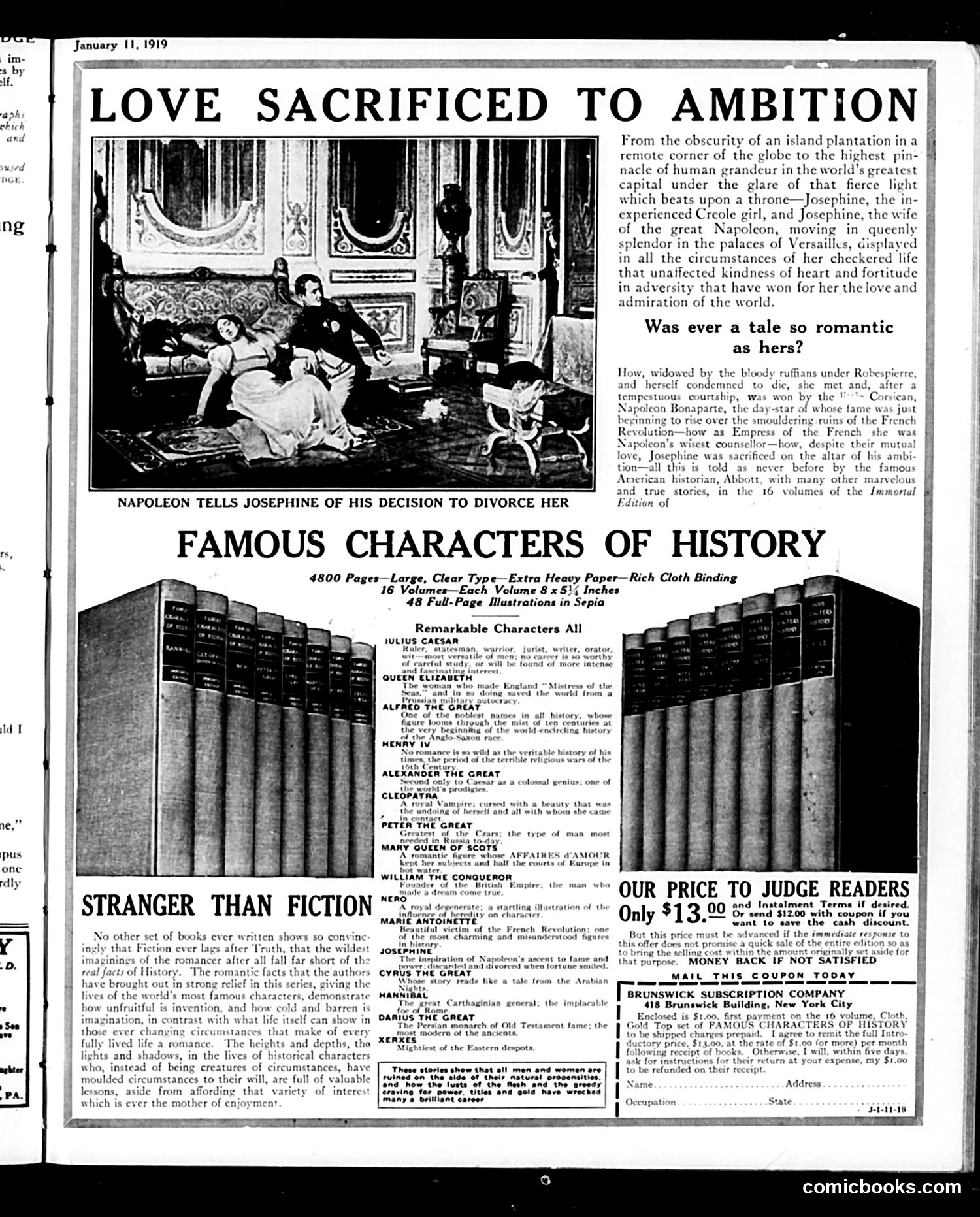
This page is primarily **advertising** for a 16-volume encyclopedia called "Famous Characters of History," using Napoleon and Josephine as the featured historical example. The main illustration depicts **Napoleon informing Josephine of his decision to divorce her**—a historically accurate event (1809). The accompanying text romanticizes their relationship while emphasizing the tragedy: Josephine, rising from obscurity to become Empress of France, is ultimately sacrificed to Napoleon's political ambition (he needed to marry an Austrian princess for dynastic reasons). The ad below exploits this emotional narrative to sell the encyclopedia, claiming it contains "stranger than fiction" stories of famous historical figures—Julius Caesar, Queen Elizabeth, Cleopatra, and others. The appeal is to readers seeking dramatic biographical content presented as serious history. The satire is implicit: Judge is gently mocking the melodramatic way popular histories package historical figures as romantic narratives to drive book sales, turning human tragedy into commercial entertainment.
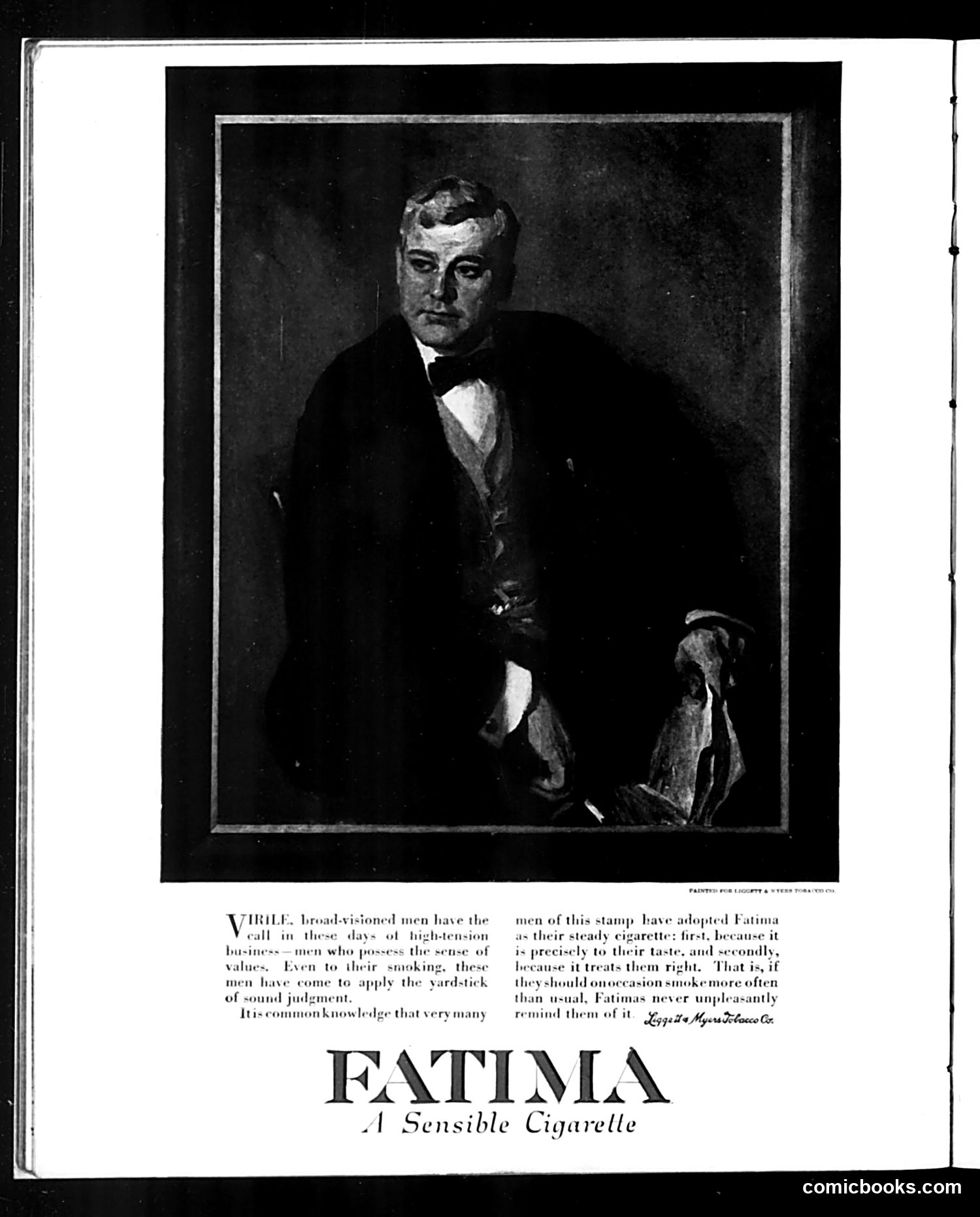
This is a **Fatima cigarette advertisement**, not a political cartoon. The page features a formal portrait of an unidentified well-dressed man in evening wear holding a cigarette, positioned as aspirational imagery for the product. The accompanying text appeals to "broad-visioned men" of "high-tension business" who possess "sound judgment," claiming that discerning smokers have adopted Fatima cigarettes because the brand suits their taste and "treats them right." The ad suggests occasional smoking of Fatima is acceptable for sophisticated men. This represents **early 20th-century advertising strategy**—marketing cigarettes by associating them with masculine success, refinement, and good judgment, while downplaying health concerns through euphemisms about "sensibility."