
Judge, 1919-01-11 · page 22 of 32
Judge — January 11, 1919 — page 22: what you’re looking at
What you’re looking at
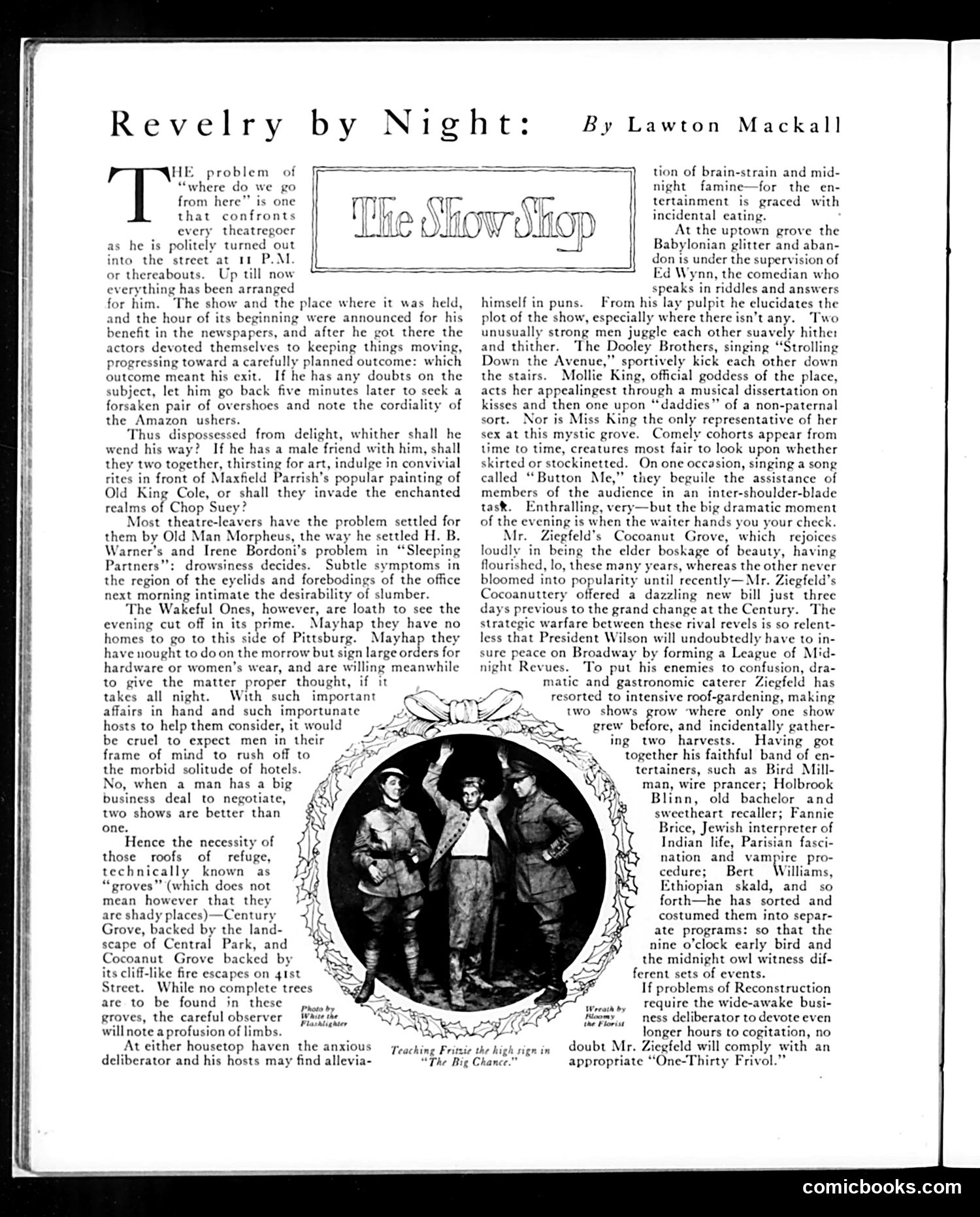
This article by Lawton Mackall satirizes the problem facing theatergoers after evening shows end around 1 P.M. (likely midnight in modern terms). Once ejected from theaters, patrons face the question: where to go next? The piece humorously catalogs options, including visits to restaurants or nightclubs. It focuses on two rooftop "groves"—Century Grove and Cocoanut Grove—as refuges for those unwilling to leave the entertainment district. These venues featured performers like Ed Wynn (a comedian known for puns) and Mollie King, offering dinner, music, and dancing. The satire's punchline arrives when "the waiter hands you your check"—suggesting that even at these late-night establishments, the evening's true dramatic climax is the bill. The article gently mocks both the theater industry's relentless scheduling and patrons' compulsive need for continued entertainment and spending, even at midnight hours.
📄 Transcribed text from this page (OCR, searchable)
Machine-transcribed from the original scan — historical spelling and the odd misread are preserved.
Rev Iry by Night Mackall By Lawton HE problem of “where do we go from here”’ is one that confronts every theatregoer as he is politely turned out into the street at 1 P.M tion of brain-strain and mid- night famine—for the en- tertainment is graced with incidental eating. At the uptown grove the Babylonian glitter and aban- don is under the supervision of or thereabouts. Up till now everything has been arranged for him. The show and the place where it was held, and the hour of its beginning were announced for his benefit in the newspapers, and after he got there the actors devoted themselves to keeping things moving, progressing toward a carefully planned outcome: which outcome meant his exit. If he has any doubts on the subject, let him go back five minutes later to seck a forsaken pair of overshoes and note the cordiality of the Amazon ushers. Thus dispossessed from delight, whither shall he wend his way? If he has a male friend with him, shall they two together, thirsting for art, indulge in convivial rites in front of Maxfield Parrish’s popular painting of Old King Cole, or shall they invade the enchanted realms of Chop Suey? Most theatre-leavers have the problem settled for them by Old Man Morpheus, the way he settled H. B. Warner’s and Irene Bordoni’s problem in “Sleeping Partners”: drowsiness decides. Subtle symptoms in the region of the eyclids and forebodings of the office next morning intimate the desirability of slumber. The Wakeful Ones, however, are loath to see the evening cut off in its prime. Mayhap they have no homes to go to this side of Pittsburg. Mayhap they have nought to do on the morrow but sign large orders for hardware or women’s wear, and are willing meanwhile to give the matter proper thought, if it takes all night. With such important < affairs in hand and such importunate hosts to help them consider, it would be cruel to expect men in their frame of mind to rush off to the morbid solitude of hotels. No, when a man has a big business deal to negotiate, two shows are better than one. Hence the necessity of Photo by Warte the Flashlighter those roofs of refuge, 4 technically known as eR “groves” (which does not We mean however that they }% are shady places)—Century Ue Grove, backed by the land- 4, NI scape of Central Park, and Cocoanut Grove backed by its cliff-like fire escapes on 41st Street. While no complete trees are to be found in these groves, the careful observer will note a profusion of limbs. At either housetop haven the anxious deliberator and his hosts may find allevia- “The Big Chance. Ed Wynn, the comedian who speaks in riddles and answers himself in puns. From his lay pulpit he elucidates the plot of the show, especially where there isn’t any. Two unusually strong men juggle each other suavely hither and thither. The Dooley Brothers, singing “Strolling Down the Avenue,” sportively kick each other down the stairs. Mollie King, official goddess of the place, acts her appealingest through a musical dissertation on kisses and then one upon “daddies” of a non-paternal sort. Nor is Miss King the only representative of her sex at this mystic grove. Comely cohorts appear from time to time, creatures most fair to look upon whether skirted or stockinetted. On one occasion, singing a song called “Button Me,” they beguile the assistance of members of the audience in an inter-shoulder-blade task. Enthralling, very—but the big dramatic moment of the evening is when the waiter hands you your check. Mr. gfeld’s Cocoanut Grove, which rejoices loudly in being the elder boskage of beauty, having flourished, lo, these many years, whereas the other never bloomed into popularity until recently—Mr. Ziegfeld’s Cocoanuttery offered a dazzling new bill just three days previous to the grand change at the Century. The strategic warfare between these rival revels is so relent- less that President Wilson will undoubtedly have to in- sure peace on Broadway by forming a League of Mid- night Revues. To put his enemies to confusion, dra- matic and gastronomic caterer Ziegfeld has resorted to intensive roof-gardening, making two shows grow ‘where only one show grew before, and incidentally gather- ing two harvests. Having got together his faithful band of en- tertainers, such as Bird Mill- man, wire prancer; Holbrook Blinn, old bachelor and sweetheart recaller; Fannie Brice, Jewish interpreter of Indian life, Parisian fasci- nation and vampire pro- cedure; Bert Williams, Ethiopian skald, and so forth—he has sorted and costumed them into separ- ate programs: so that the nine o'clock early bird and the midnight owl witness dif- ferent sets of events. If problems of Reconstruction require the wide-awake busi- ness deliberator to devote even longer hours to cogitation, no doubt Mr. Ziegfeld will comply with an appropriate “One-Thirty Frivol.” comicbooks.com