
Judge, 1919-01-11 · page 5 of 32
Judge — January 11, 1919 — page 5: what you’re looking at
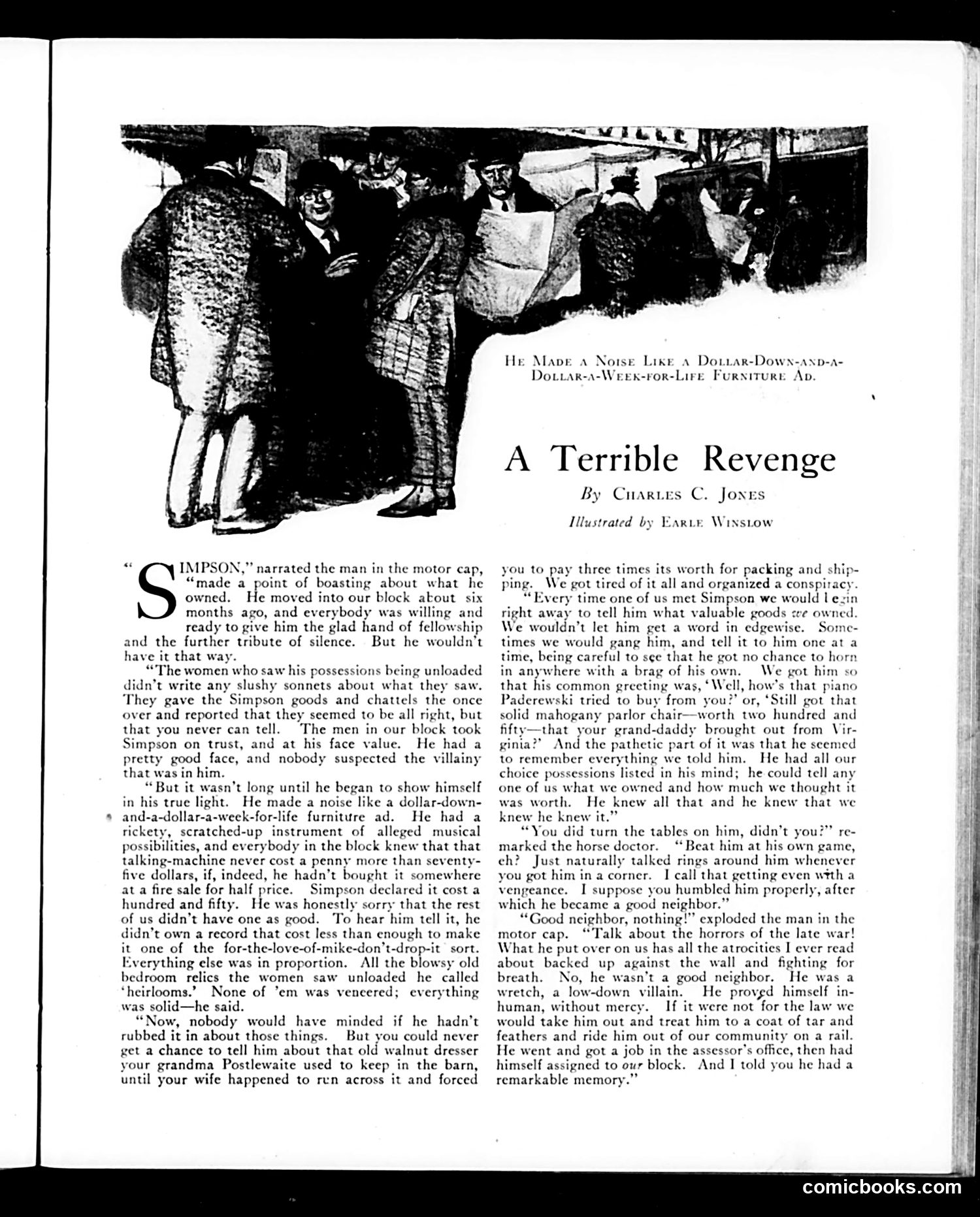
What you’re looking at
This page contains a short story rather than a political cartoon. The narrative satirizes a petty, vindictive neighbor named Simpson who made noise like a "dollar-down-and-a-dollar-a-week-for-life furniture ad." The satire targets Simpson's boastful materialism and ostentatious display of possessions. The narrator and neighbors take revenge by systematically humiliating him—confronting him about his hypocrisy, spreading rumors about his character, and ultimately forcing him from the community by treating him as a disreputable neighbor. The piece appears to mock both conspicuous consumption and the social power of collective community judgment to ostracize those deemed morally unfit—reflecting early-20th-century concerns about commercialism and social propriety.
📄 Transcribed text from this page (OCR, searchable)
Machine-transcribed from the original scan — historical spelling and the odd misread are preserved.
“ IMPSON,” narrated the man in the motor cap, “made a point of boasting about what he owned. He moved into our block akout six months ago, and everybody was willing and ready to give him the glad hand of fellowship and the further tribute of silence. But he wouldn't have it that way. “The women who saw his possessions being unloaded didn’t write any slushy sonnets about what they saw. They gave the Simpson goods and chattels the once over and reported that they seemed to be all right, but that you never can tell. The men in our block took Simpson on trust, and at his face value. He had a pretty good face, and nobody suspected the villainy that was in him. “But it wasn’t long until he began to show himself in his true light. He made a noise like a dollar-down- and-a-dollar-a-week-for-life furniture ad. He had a rickety, scratched-up instrument of alleged musical possibilities, and everybody in the block knew that that talking-machine never cost a penny more than seventy- five dollars, if, indeed, he hadn’t bought it somewhere ata fire sale for half price. Simpson declared it cost a hundred and fifty. He was honestly sorry that the rest of us didn’t have one as good. To hear him tell it, he didn’t own a record that cost less than enough to make it one of the for-the-love-of-mike-don’t-drop-it sort. Everything else was in proportion. All the blowsy old bedroom relics the women saw unloaded he called ‘heirlooms.’ None of ‘em was veneered; everything was solid—he said. ow, nobody would have minded if he hadn't rubbed it in about those things. But you could never get a chance to tell him about that old walnut dresser your grandma Postlewaite used to keep in the barn, until your wife happened to ren across it and forced A Doitar-Down-axpd-a- Ab. Mabe a Notse Like Dotiar-a-Week-ror-Lire Furniturt He A Terrible Revenge By Cnarres C. Jones Illustrated by Eartre Winstow you to pay three times its worth for packing and ship- ping. We got tired of it all and organized a conspiracy. “Every time one of us met Simpson we would lezin right away to tell him what valuable goods sve owned. We wouldn’t let him get a word in edgewise. Sc times we would gang him, and tell it to him one time, being careful to sge that he got no chance to horn in anywhere with a brag of his own. We got him so that his common greeting was, ‘Well, how’s that piano Paderewski tried to buy from you?’ or, ‘Still got that solid mahogany parlor chair—worth two hundred and fifty—that your grand-daddy brought out from Vir- ginia?’ And the pathetic part of it was that he seemed to remember everything we told him. He had all our choice possessions listed in his mind; he could tell any one of us what we owned and how much we thought it was worth. He knew all that and he knew that we knew he knew it.” “You did turn the tables on him, didn’t you?” re- marked the horse doctor. “Beat him at his own game, ch? Just naturally talked rings around him whenever you got him ina corner. I call that getting even with vengeance. I suppose you humbled him properly, after which he became a good neighbor.” “Good neighbor, nothing!” exploded the man in the motor cap. “Talk about the horrors of the late war! What he put over on us has all the atrocities I ever read about backed up against the wall and fighting for breath. No, he wasn’t a good neighbor. He was a wretch, a low-down villain. He provgd himself in- human, without mercy. If it were not for the law we would take him out and treat him to a coat of tar and feathers and ride him out of our community on a rail. He went and got a job in the assessor's office, then had himself assigned to our block. And I told you he had a remarkable memory.” comicbooks.com