
Judge, 1919-01-11 · page 11 of 32
Judge — January 11, 1919 — page 11: what you’re looking at
What you’re looking at
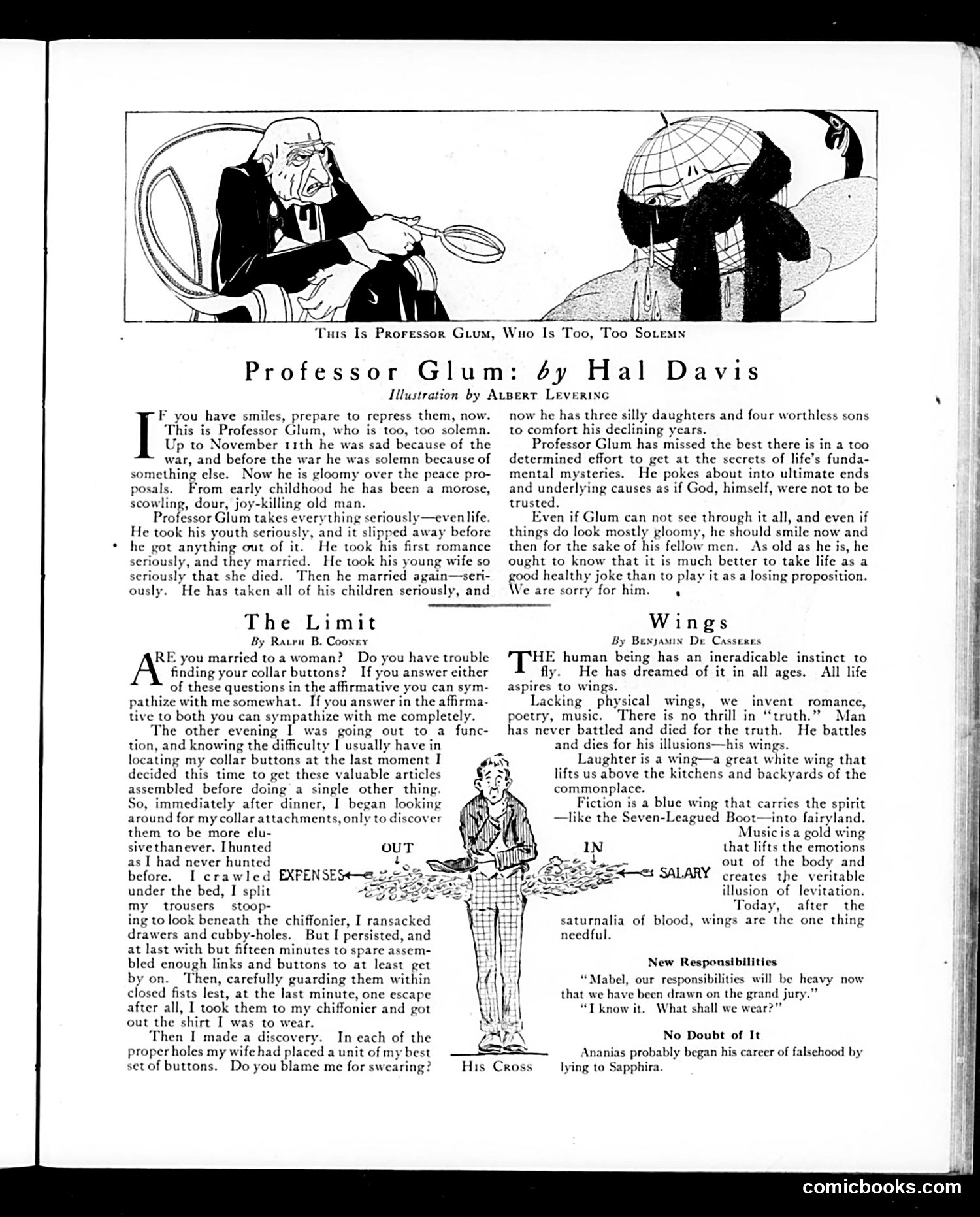
This page contains three separate humor pieces typical of early 20th-century satirical magazines: **"Professor Glum"** is a character sketch mocking an excessively solemn man who takes everything—youth, romance, marriage, children—so seriously that he extracts no joy from life. The satire suggests that excessive solemnity is self-defeating; even post-WWI pessimism shouldn't prevent smiling. **"The Limit"** is a domestic humor piece about a husband's frustration finding collar buttons, only to discover his wife had helpfully placed them in his shirt holes beforehand—a comedic commentary on marital misunderstandings. **"Wings"** is a philosophical essay (not strictly humorous) arguing that humans need "wings"—metaphorical escapes like romance, fiction, laughter, and music—especially needed after the carnage of WWI ("saturnalia of blood"). The small illustration shows a woman in a voting booth, paired with a caption about grand jury duty and fashion concerns—light social satire about women's new civic responsibilities.
📄 Transcribed text from this page (OCR, searchable)
Machine-transcribed from the original scan — historical spelling and the odd misread are preserved.
Tuts Is Proressor Gium, ‘oo Son Wuo Is Too, T Professor Glum: 4y Hal Davis Illustration by AtBeRT LevERING F you have smiles, prepare to repress them, now. This is Professor Glum, who is too, too solemn. Up to November 11th he was sad because of the war, and before the war he was solemn because of something else. Now he is gloomy over the peace pro- posals. From early childhood he has been a morose, scowling, dour, joy-killing old man. Professor Glum takes everything seriously —even life. He took his youth seriously, and it slipped away before he got anything out of it. He took his first romance seriously, and they married. He took his young wife so seriously that she died. Then he married again—seri- ously. He has taken all of his children seriously, and The Limit A By Raeu B. Cooxry E you married toa woman? Do you have trouble finding your collar buttons? If you answer either of these questions in the affirmative you can sym- pathize with me somewhat. If you answer in the affirma- tive to both you can sympathize with me completely. The other evening I was going out to a func- tion, and knowing the difficulty I usually have in locating my collar buttons at the last moment I decided this time to get these valuable articles assembled before doing a single other thing. So, immediately after dinner, I began looking around for my collar attachments, only to discover them to be more elu- sivethanever. I hunted as I had never hunted before. I crawled under the bed, I split my trousers stoop- ing to look beneath the chiffonier, I ransacked drawers and cubby-holes. But I persisted, and at last with but fifteen minutes to spare assem- bled enough links and buttons to at least get by on. Then, carefully guarding them within closed fists lest, at the last minute, one escape after all, | took them to my chiffonier and got out the shirt I was to wear. Then I made a discovery. In each of the proper holes my wife had placed a unit of my be setof buttons. Do you blame me for swearin ay His Cross now he has three silly daughters and four worthless sons to comfort his declining years. Professor Glum has missed the best there is in a too determined effort to get at the secrets of life’s funda- mental mysteries. He pokes about into ultimate ends and underlying causes as if God, himself, were not to be trusted. Even if Glum can not see through it all, and even if things do look mostly gloomy, he should smile now and then for the sake of his fellow men. As old as he is, he ought to know that it is much better to take life as a good healthy joke than to play it as a losing proposition. We are sorry for him. . Wings By Bexyamin De Casseres THE human being has an ineradicable instinct to fly. He has dreamed of it in all ages. All life aspires to wings. Lacking physical wings, we invent romance, poetry, music. There is no thrill in “truth.” Man has never battled and died for the truth. He battles and dies for his illusions—his wings Laughter is a wing—a great white wing that lifts us above the kitchens and backyards of the commonplace. Fiction is a blue wing that carries the spirit —like the Seven-Leagued Boot—into fairyland. Music isa gold wing that lifts the emotions out of the body and creates the veritable illusion of levitation. Today, after the saturnalia of blood, wings are the one thing needful. New Responsibilities “Mabel, our responsibilities will be heavy now that we have been drawn on the grand jury.” “T know it. What shall we wear?” No Doubt of It Ananias probably began his career of falsehood by lying to Sapphira comicbooks.com