
A complete issue · 32 pages · 1918
Judge — October 19, 1918
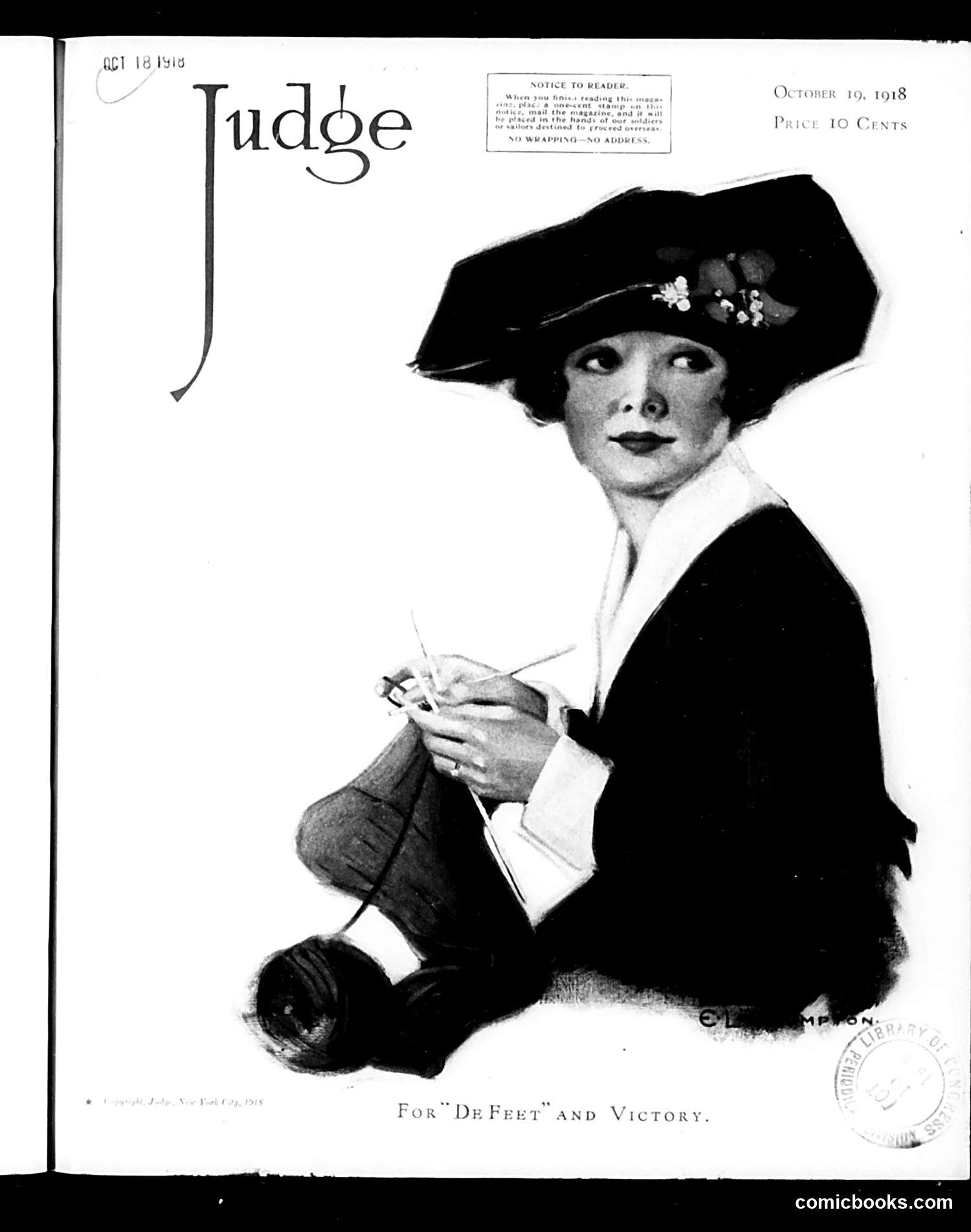
This October 1918 Judge magazine cover presents a woman knitting, titled "For 'De Feet' and Victory." The pun plays on "defeat" and "de feet" (the feet being knitted), referencing both World War I and the domestic war effort. The image depicts women's contributions to WWI through knitting campaigns—civilians produced socks, scarves, and other garments for soldiers. The fashionable hat and elegant presentation suggest this is aspirational imagery promoting women's patriotic duty. Published just weeks before the November 1918 armistice, this reflects the period when Americans expected imminent victory. The satire likely mocks the dual meaning of "defeating" enemies through both military action and home-front knitting efforts, portraying civilian contributions as equally vital to victory.
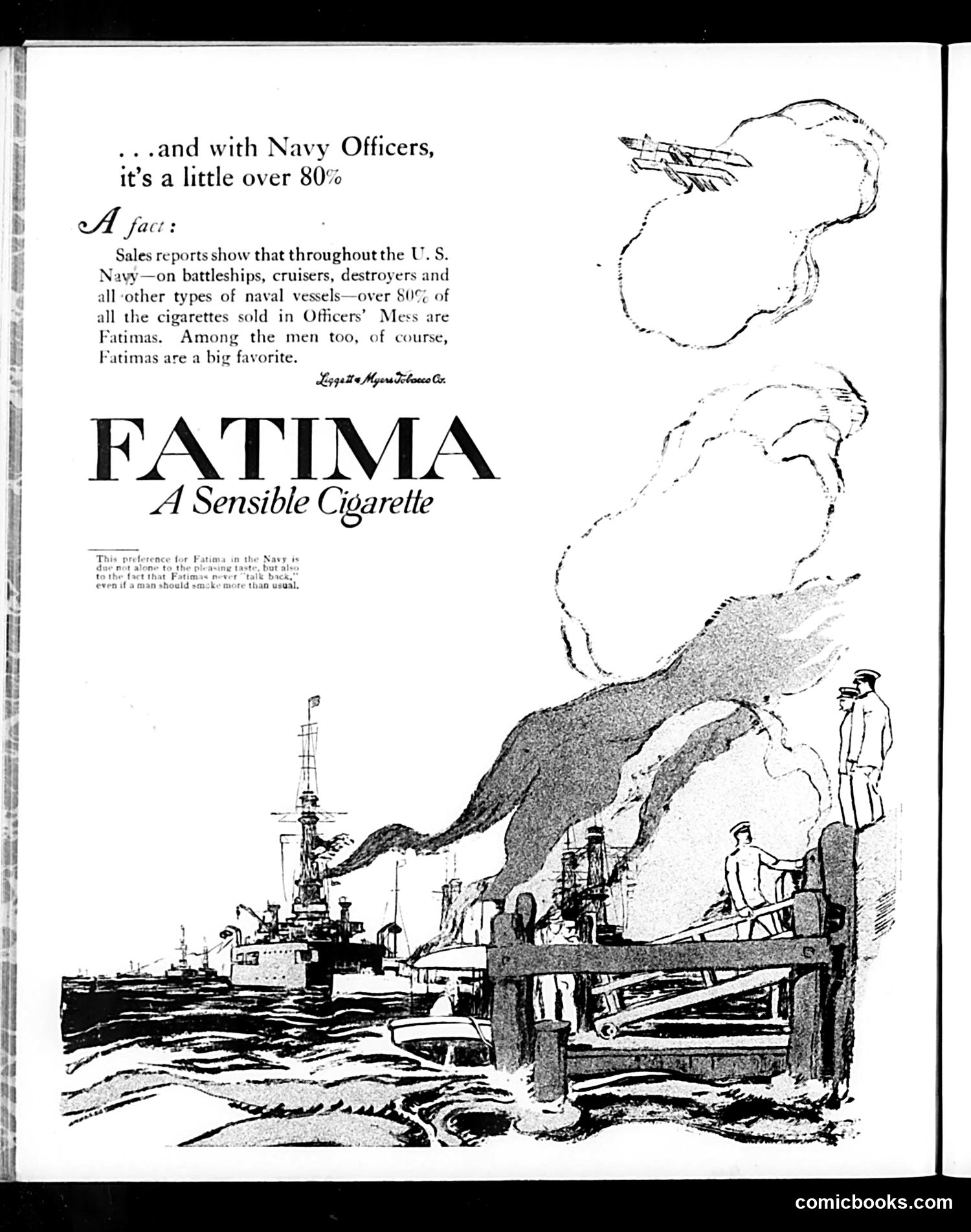
This is primarily a **cigarette advertisement**, not political satire. The ad promotes Fatima brand cigarettes as "A Sensible Cigarette," targeting military audiences—specifically U.S. Navy personnel. The text claims sales data showing that over 80% of cigarettes sold in Officers' Messes aboard naval vessels are Fatimas, and that the brand is popular among enlisted men too. The illustration depicts a naval vessel and shore scene with sailors, emphasizing the cigarette's appeal to military life. The floating imagery above suggests smoke or the product's reach. This represents early 20th-century tobacco marketing that freely advertised cigarettes without health warnings, and directly targeted military consumers as a desirable demographic. The "sensible" framing is marketing language with no ironic intent.
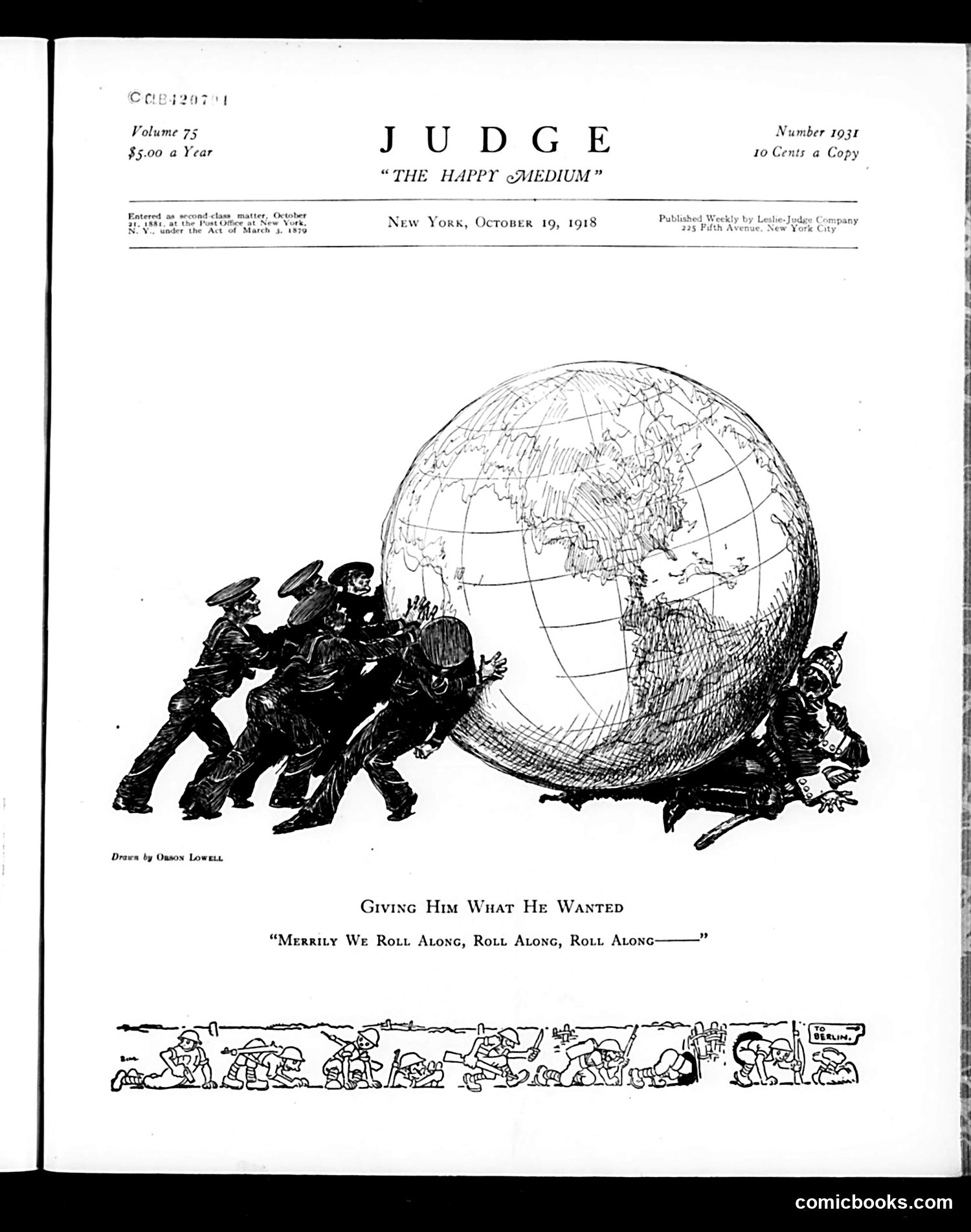
This satirical cover depicts soldiers pushing a large globe labeled with world geography. The caption "Giving Him What He Wanted" paired with "Merrily We Roll Along, Roll Along, Roll Along" suggests commentary on World War I's conclusion—the U.S. entered the war in 1917, and October 1918 preceded the November armistice. The soldiers appear to be "rolling" the world toward an enemy figure (likely the German Kaiser), sarcastically suggesting they're delivering exactly what he desired through warfare. The cartoon critiques how the war itself became a self-perpetuating mechanism. The small comic strip below provides lighter relief but its specific content is unclear in this image quality. The artwork is credited to Uda Lowell.
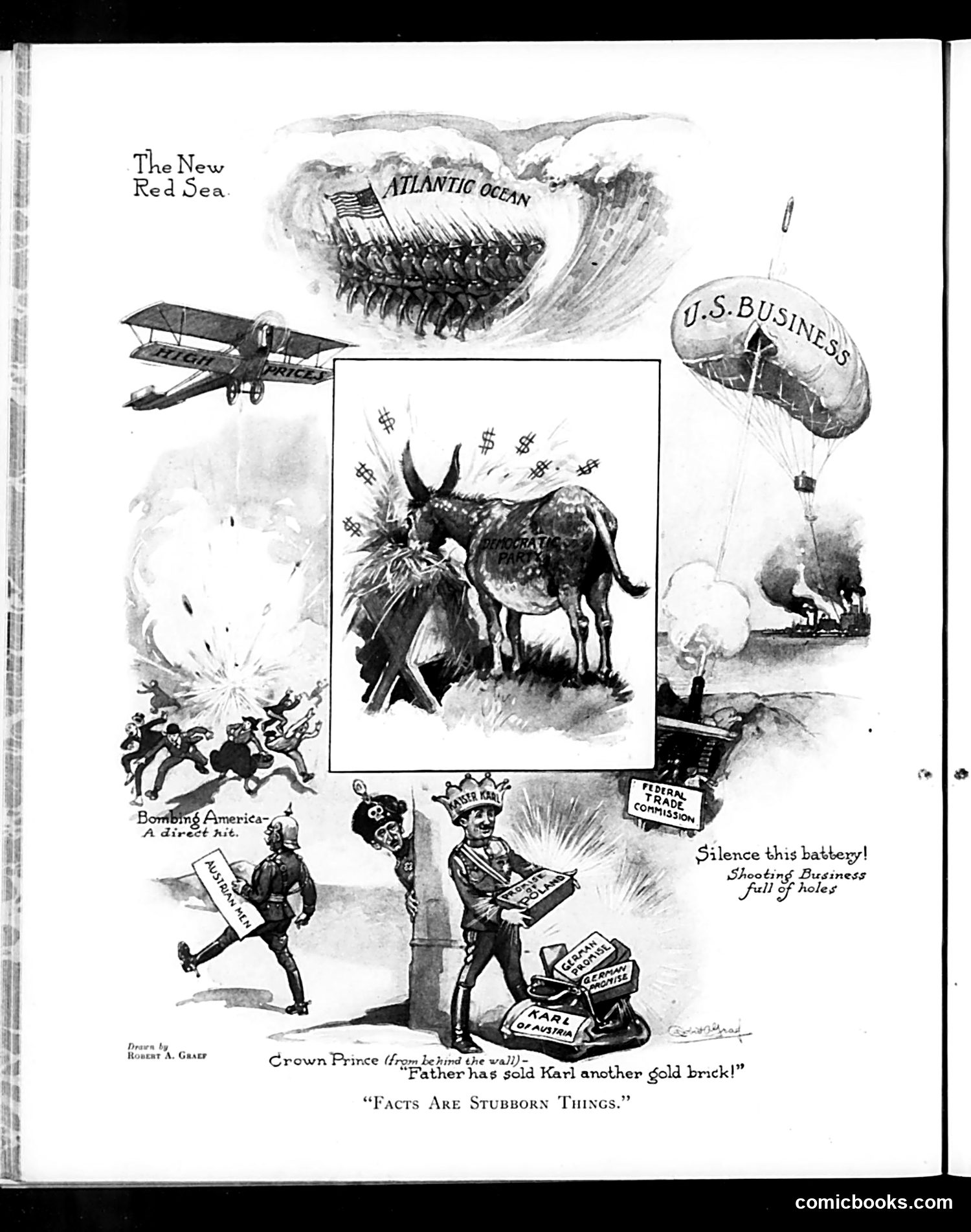
This satirical cartoon, drawn by Robert A. Graef, critiques American business and foreign policy circa World War I era. The central image shows a donkey (representing stubborn business interests) surrounded by dollar signs, satirizing profit-driven commerce during wartime. Surrounding vignettes reference various threats: aerial bombing, the "Federal Trade Commission," and a "U.S. Business" balloon under fire. The bottom panel mocks "Crown Prince" (likely German leadership) and Karl, possibly referencing German industrialists or political figures involved in wartime commerce. The title "Facts Are Stubborn Things" suggests the cartoon argues that despite propaganda or official statements, American business continued profiting from conflict. The "New Red Sea" likely alludes to bloodshed while businesses pursued financial gain, criticizing the perceived disconnect between battlefield casualties and corporate interests.
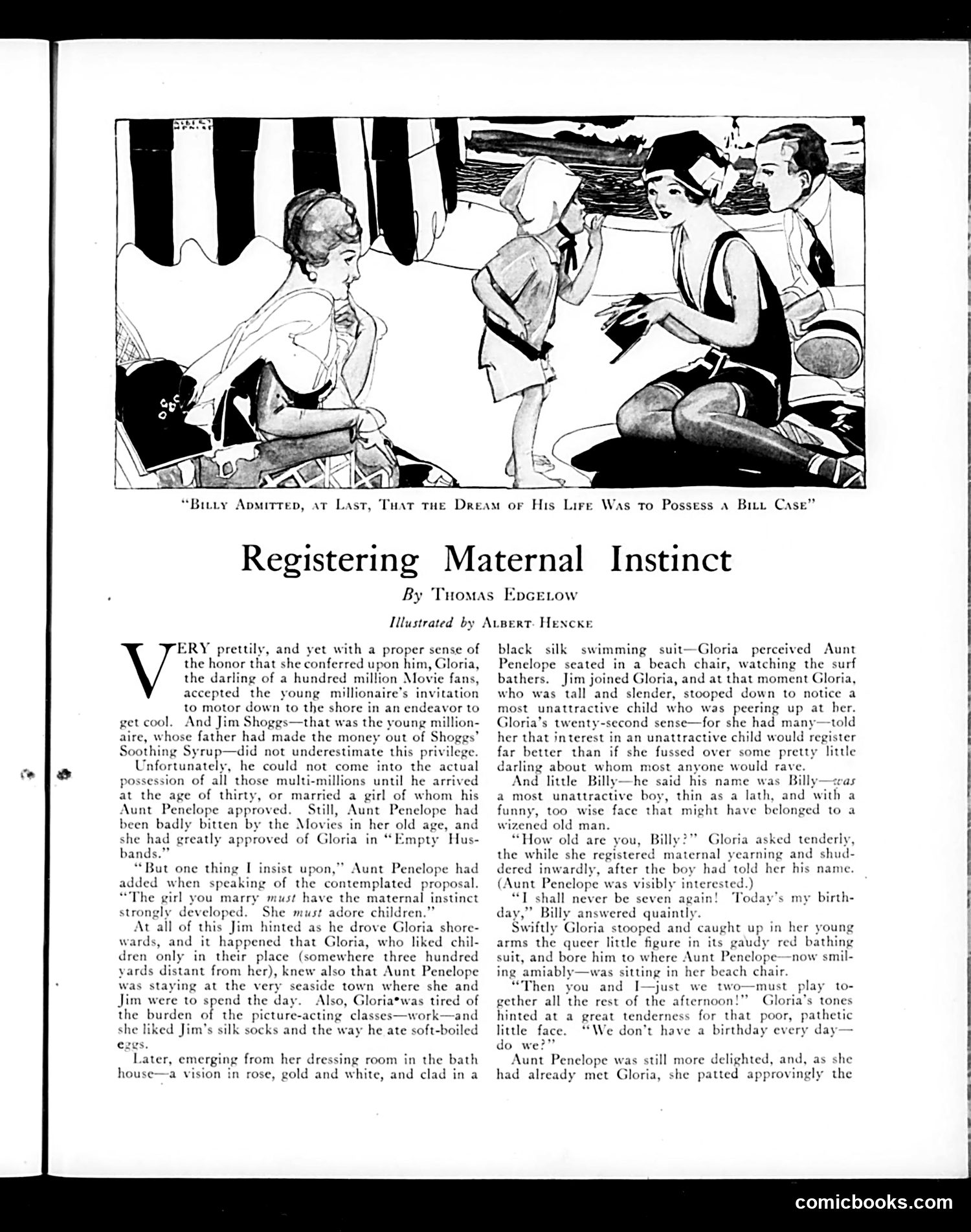
This illustrated story by Thomas Edgelow satirizes early 20th-century attitudes about motherhood and child-rearing among the wealthy. The narrative centers on Gloria, a vain society woman, who discovers an unattractive child named Billy at the beach. When Billy expresses loneliness on his birthday, Gloria's "maternal instinct" suddenly awakens—but the satire suggests this is performative rather than genuine. The joke targets how privileged women like Gloria adopt fashionable sentiments about motherhood as social performance. Her sudden interest in the homely child registers as calculated benevolence rather than authentic care. The illustration shows Gloria among beach society figures, emphasizing the public, display-oriented nature of her newfound maternal feeling. The satire questions whether such impulses reflect genuine compassion or merely social posturing.
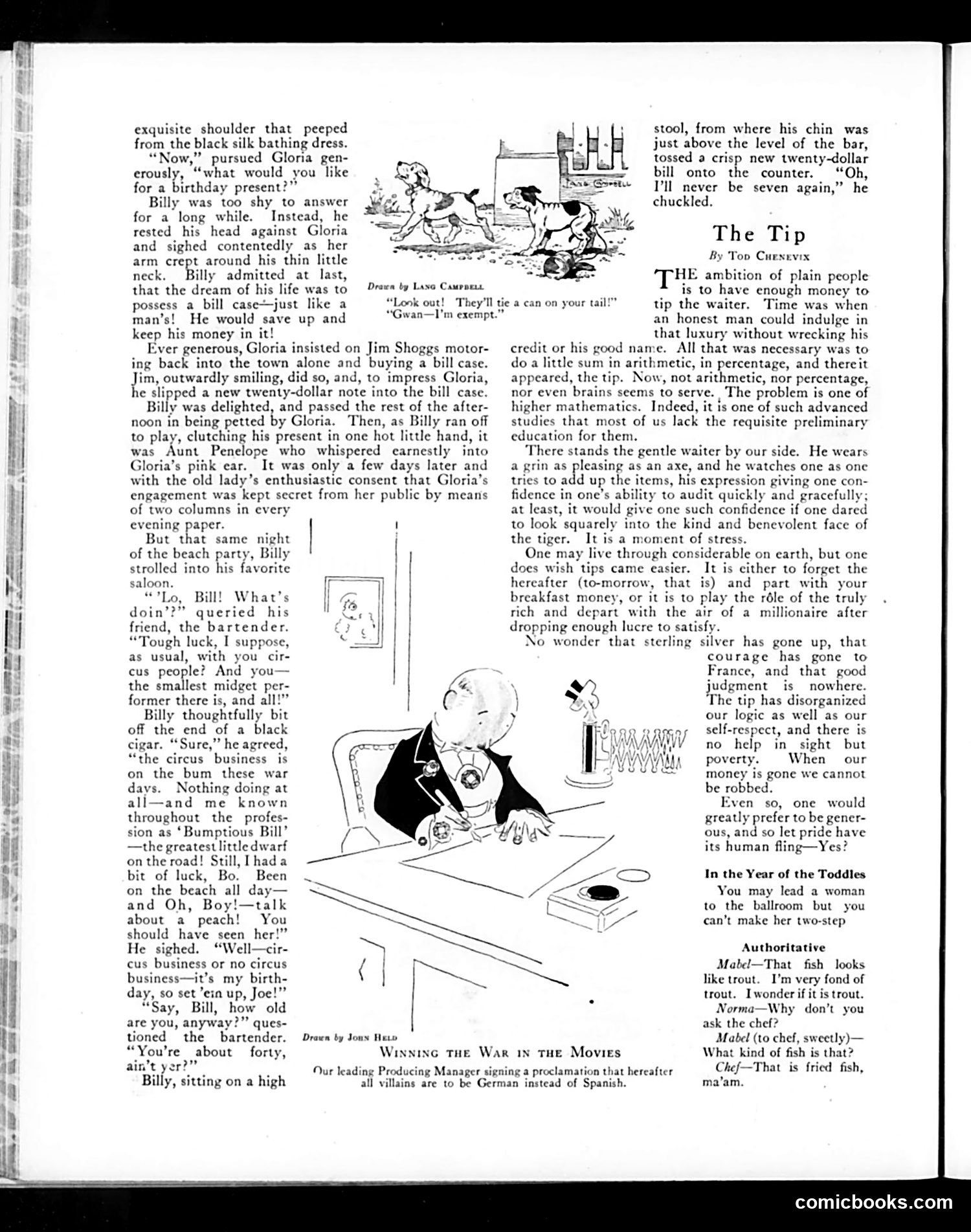
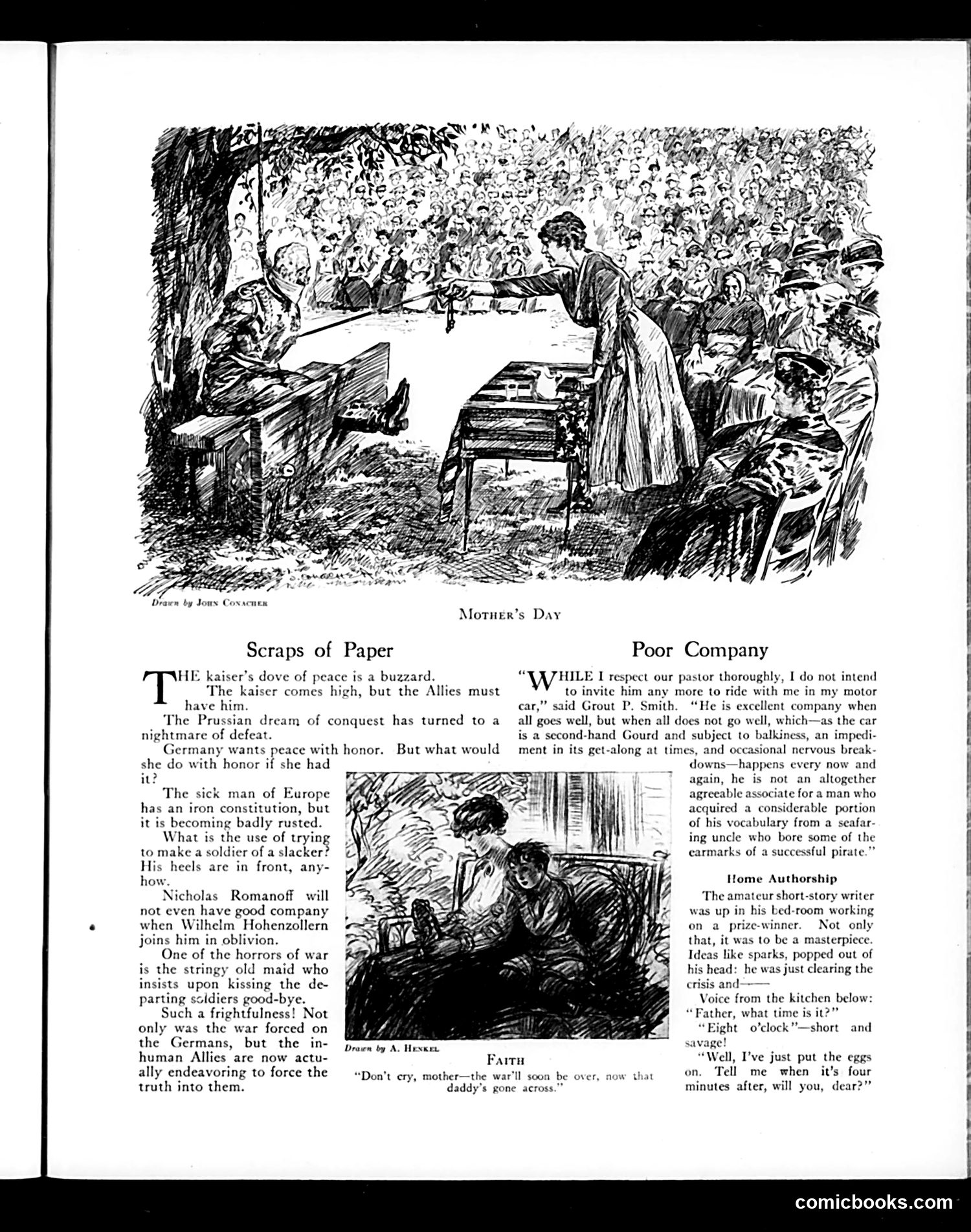
This wartime satirical page (likely WWI-era, given references to Kaiser Wilhelm and Nicholas Romanoff) contains three distinct pieces: **"Scraps of Paper"** attacks German leadership through bitter political commentary. The "kaiser's dove of peace is a buzzard" metaphor mocks peace proposals as insincere. References to "Prussian dream of conquest" turned to "nightmare" and Germany wanting "peace with honor" sarcastically suggest Germany's military collapse and moral bankruptcy. The jabs at "Nicholas Romanoff" and "Wilhelm Hohenzollern" joining "in oblivion" predict both leaders' downfalls. **"Poor Company"** is a social joke: a man refuses to invite his pastor to ride in his secondhand car because the unreliable vehicle's breakdowns would expose his colorful (profane) vocabulary—apparently learned from a disreputable uncle. **"Faith"** depicts domestic wartime humor: a wife interrupts her husband's creative writing with kitchen demands, deflating his artistic pretensions. The overarching theme: American home-front attitudes during WWI, mixing anti-German sentiment with gentle domestic comedy.
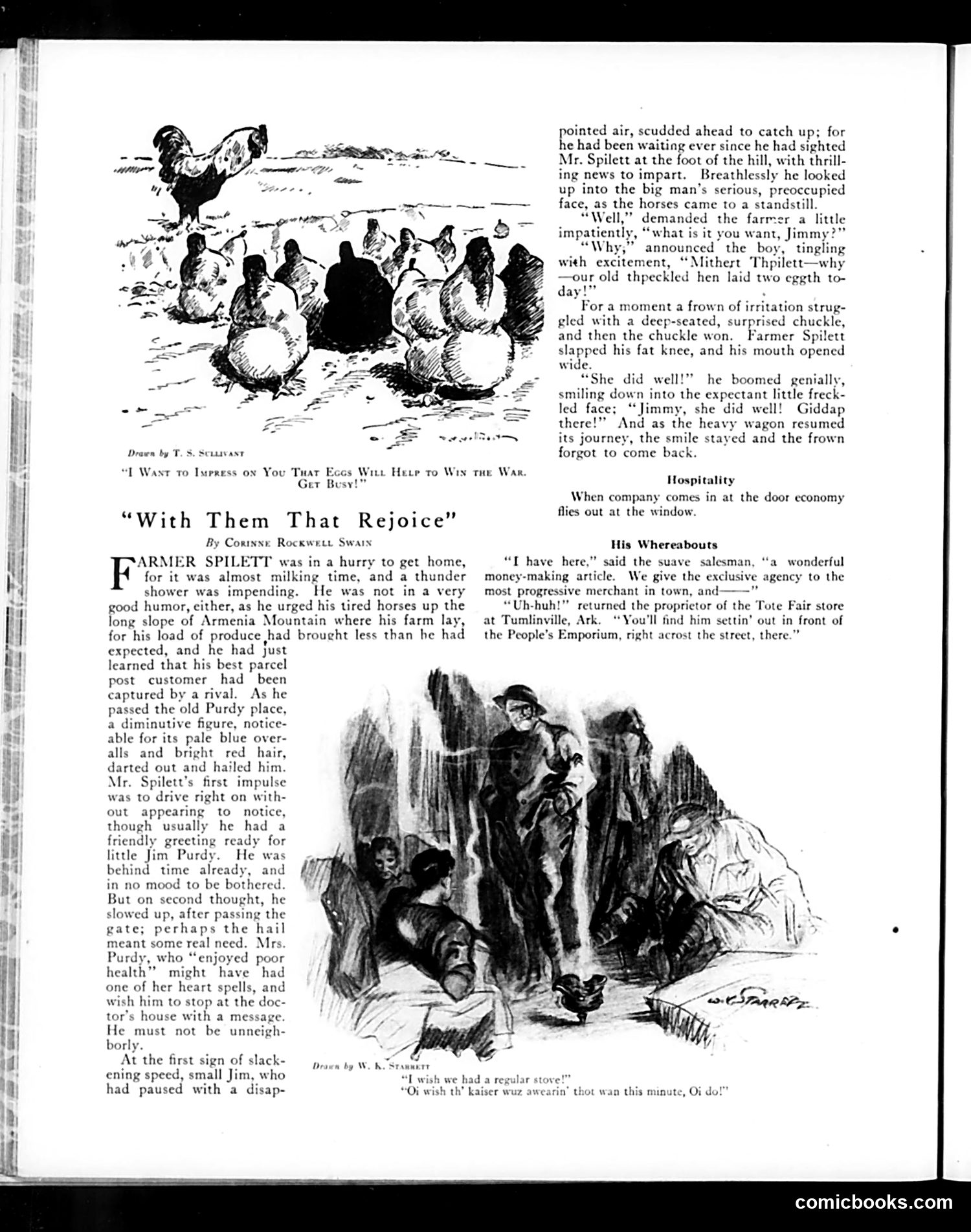
This story by Corinne Rockwell Swain uses a sentimental domestic scene to make a wartime point. Farmer Spilett, hurried and frustrated after poor market sales, is stopped by young Jim Purdy with trivial news: their neighbor's hen laid two eggs. Initially annoyed, Spilett's irritation dissolves into genuine joy at the child's simple enthusiasm. The title and moral are clear: during wartime (implied by the WWI-era references in other page content), Americans should find happiness in small domestic victories and share in others' simple joys rather than dwelling on losses and hardship. The story advocates emotional resilience and community solidarity during national crisis—"rejoicing with them that rejoice" regardless of broader economic or military troubles. It's prescriptive wartime sentiment: maintain morale through shared human warmth.
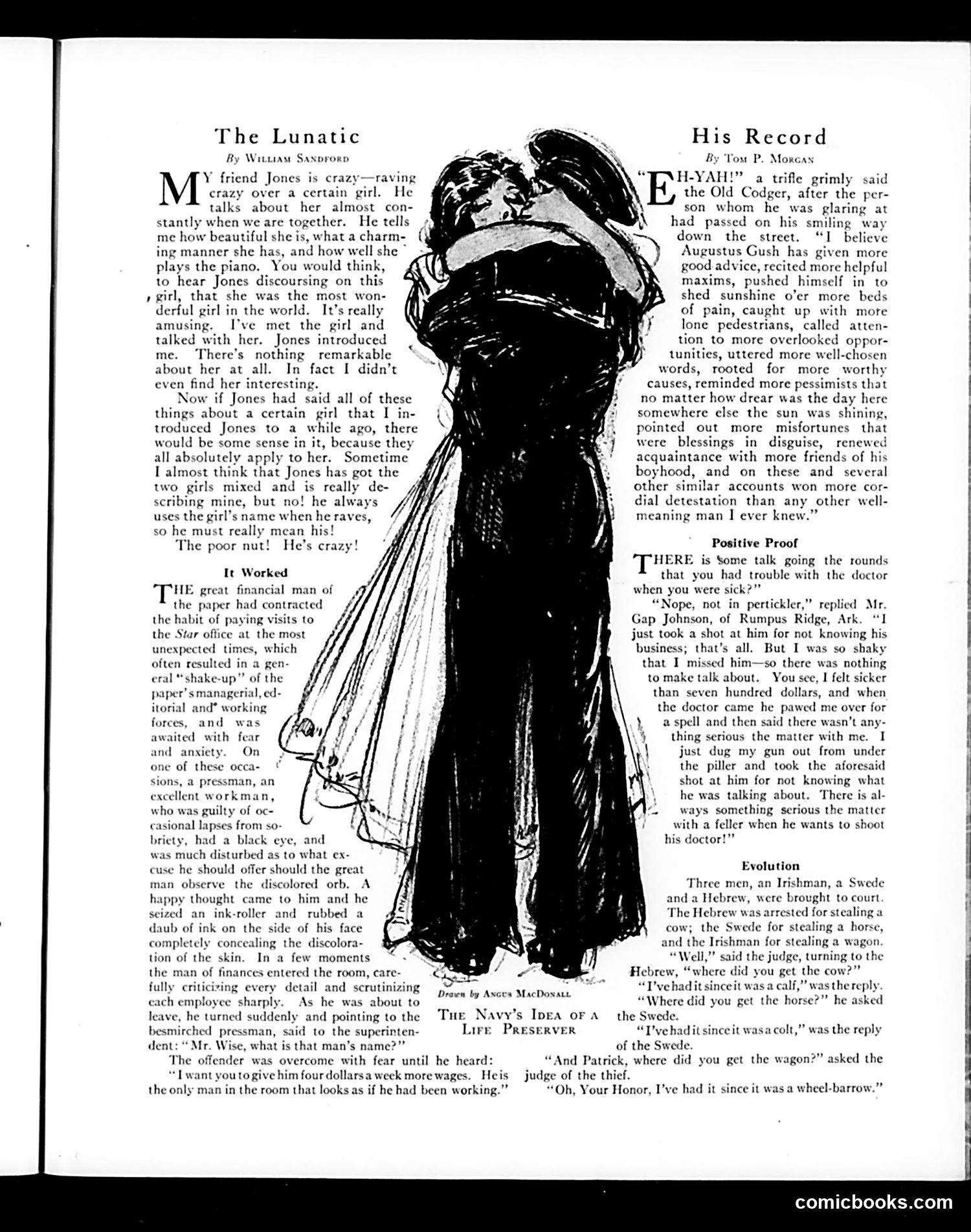
This page from *Judge* magazine contains three satirical stories: **"His Record"** mocks Augustus Gush, an insufferably well-meaning person who constantly gives unsolicited advice and platitudes. The satire targets those who self-righteously insert themselves into others' lives under the guise of helpfulness—the type who's universally disliked despite genuinely trying to be good. **"The Lunatic"** humorously explores selective perception in romance: Jones raves about an ordinary girl he's infatuated with while ignoring the narrator's actually beautiful friend. The joke is that infatuation blinds people to objective reality. **"It Worked"** depicts a hungover pressman covering a black eye with ink to fool his intimidating boss during an inspection. The humor lies in workplace anxiety and the quick deception that succeeds. **"Positive Proof"** and **"Evolution"** (fragments) appear to continue on another page. The first shows a backwoods man shooting his doctor for incompetence; the second sets up a courthouse scene involving men of different ethnicities accused of theft. The illustration shows a woman in profile, captioned "The Navy's Idea of a Life Preserver"—likely satirizing outdated naval safety equipment or gender stereotypes.
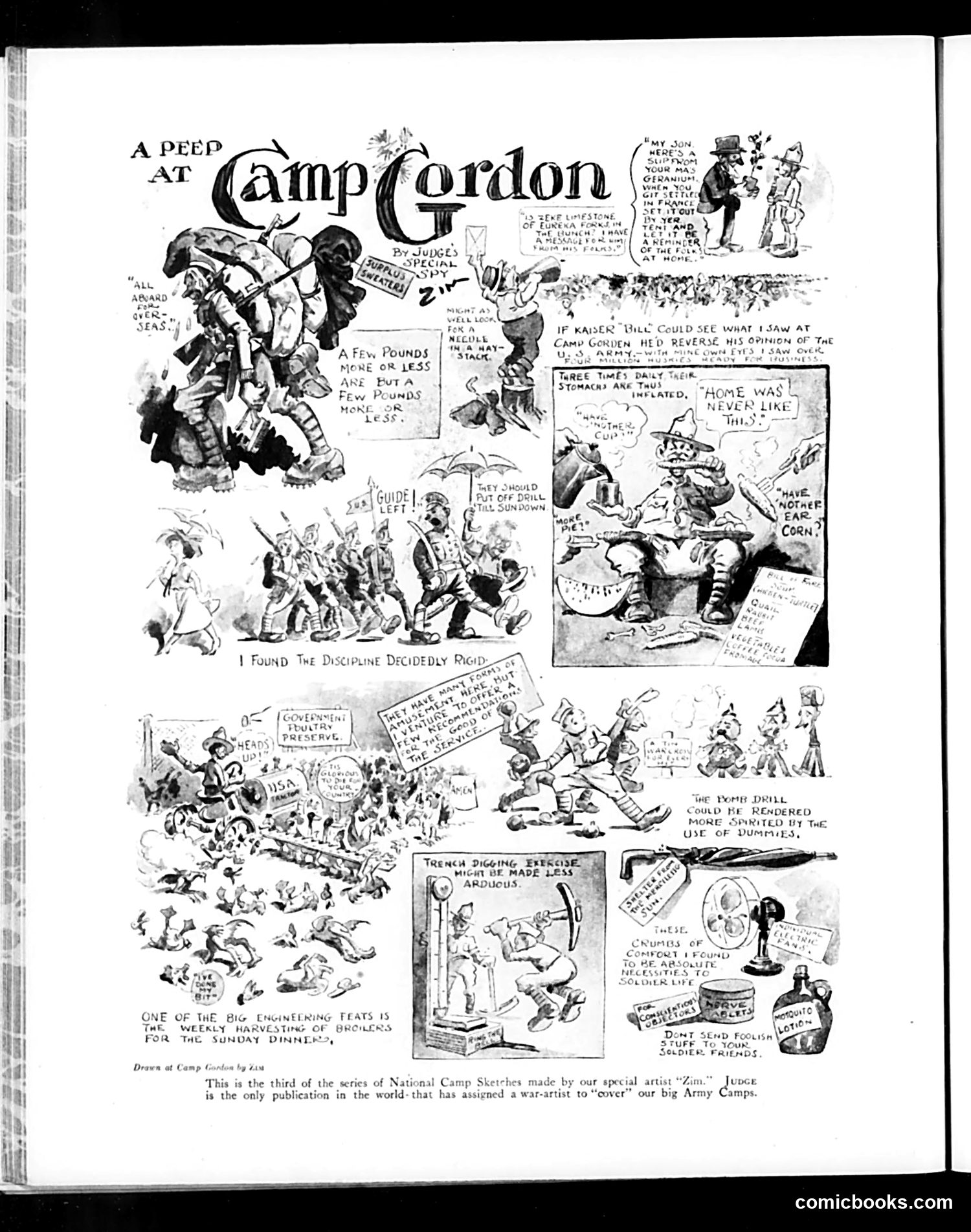
This is a World War I-era satirical cartoon series by artist Zim, depicting life at Camp Gordon (a U.S. Army training facility). The page mocks both military conditions and American attitudes through interconnected vignettes: **Key satire targets:** - **Kaiser Wilhelm II** is referenced as someone who'd be surprised by American soldiers' resilience despite poor camp conditions - **Food complaints**: Soldiers' stomachs are "inflated" three times daily; the "weekly harvesting of broilers for Sunday dinner" jokes about inadequate provisions - **Training absurdities**: Soldiers practice with "dummies" for "Dope Drill"; trench-digging exercises are "arduous" - **Homesickness**: A soldier says "home was never like this" - **Supply shortages**: Comfort items are "absolute necessities" **The satire's point**: American troops endure hardship stoically while the homefront sends insufficient care packages. It's gentle patriotic mockery—reassuring readers that soldiers persist despite uncomfortable conditions, while implying military logistics need improvement.
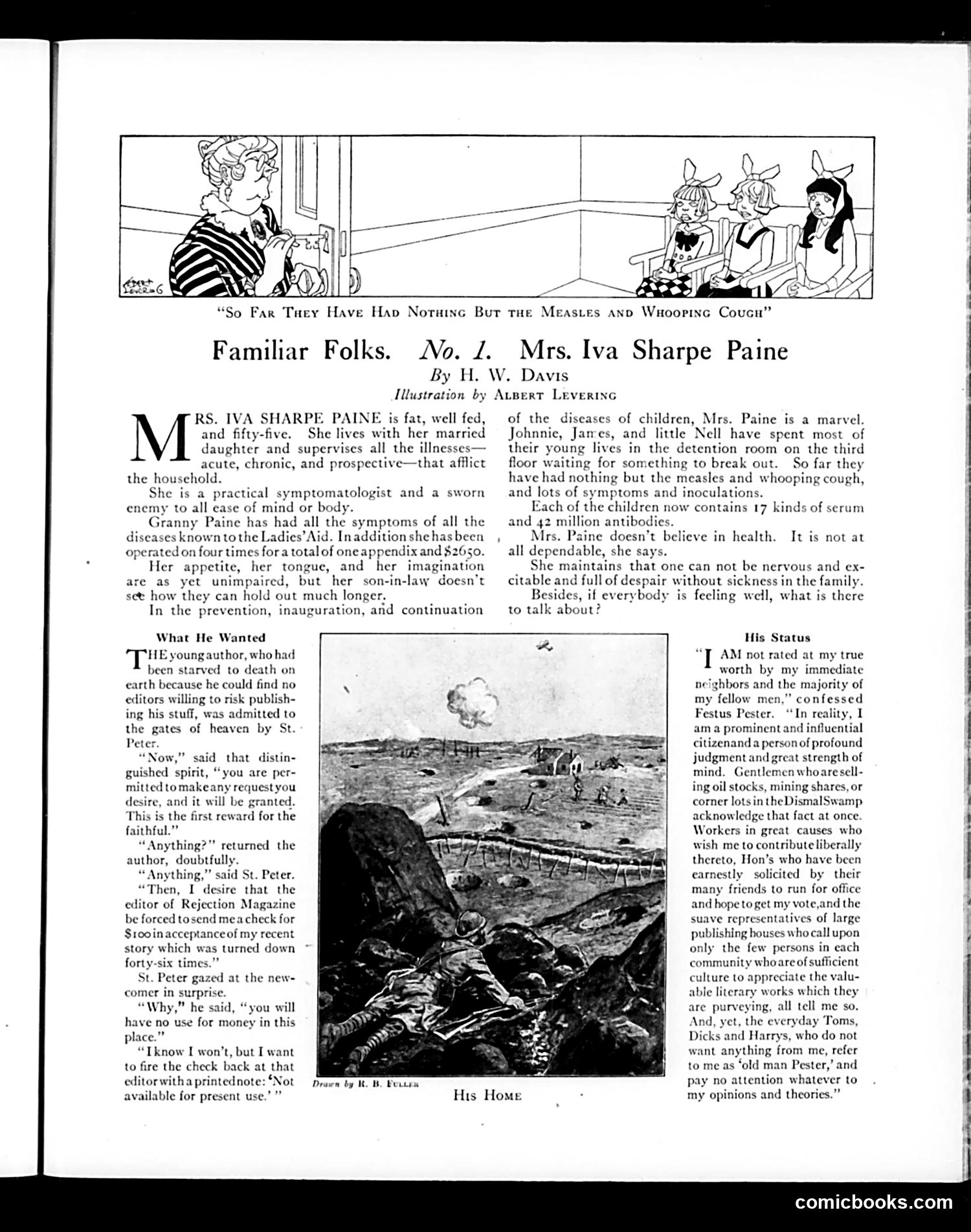
This page presents three satirical character sketches typical of early-20th-century American humor magazines. **Mrs. Iva Sharpe Paine** (top): A hypochondriac matriarch who obsesses over illness. The satire targets her and similar "granny" figures who dominate households by constantly diagnosing ailments—real and imaginary. She's had multiple surgeries (costing $2650, a substantial sum), yet remains convinced good health is suspicious. Her children remain confined awaiting "something to break out." The joke: she creates anxiety and sickness through worry rather than preventing it. **The Young Author** (middle): A struggling writer rejected 46 times finally reaches heaven, where St. Peter grants any wish. He demands the rejecting editor send him a $1,100 acceptance check—specifically to mock the editor by returning it. The satire mocks both the author's petty spite and the publishing world's callousness toward struggling writers. **Festus Pester** (right): A man convinced of his own importance and influence—stock-promoters and publishers value him—yet ordinary people dismiss him as "old man Pester." The satire ridicules self-important men who mistake transactional flattery for genuine respect.
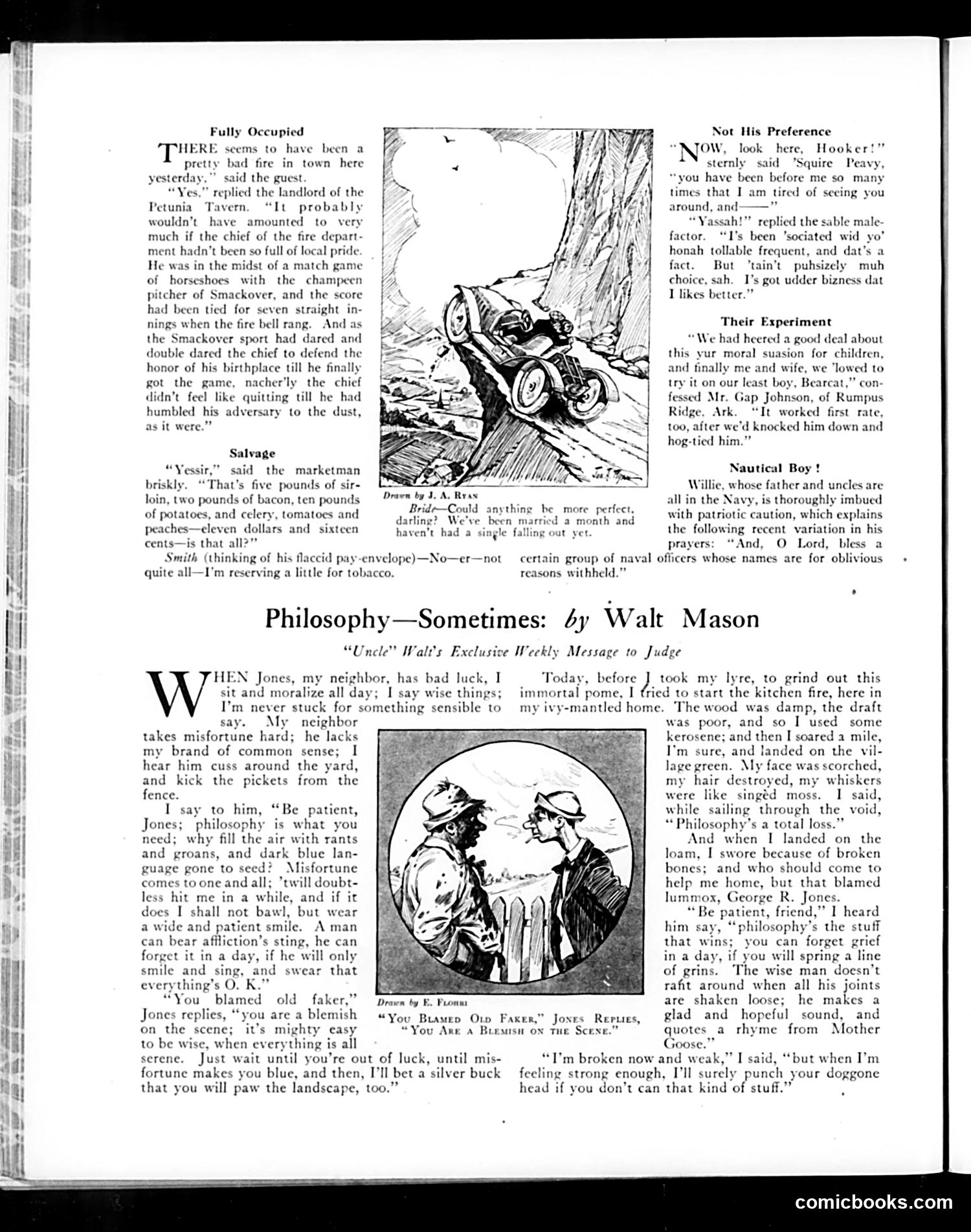
This page contains three humor pieces typical of early 20th-century American satirical journalism: **"Fully Occupied"** presents a fire chief choosing a horseshoe game over responding to a town fire—satirizing small-town vanity and misplaced priorities. **"Not His Preference"** depicts a Black servant (drawn in period stereotypical style) expressing reluctant acceptance of repeated encounters with his employer, playing on class and racial dynamics of the era. **Walt Mason's "Philosophy—Sometimes"** is an ironic narrative poem: the narrator preaches patience and philosophical acceptance of misfortune to his struggling neighbor Jones, then immediately experiences disaster himself (a failed attempt to heat his home with kerosene results in injury), undermining his own advice. The satire targets hypocritical moralizing—particularly the tendency to lecture others while failing to follow one's own wisdom. The cartoons use working-class and rural settings to mock pretension, poor judgment, and self-righteousness, which were recurring targets in *Judge's* satirical content.
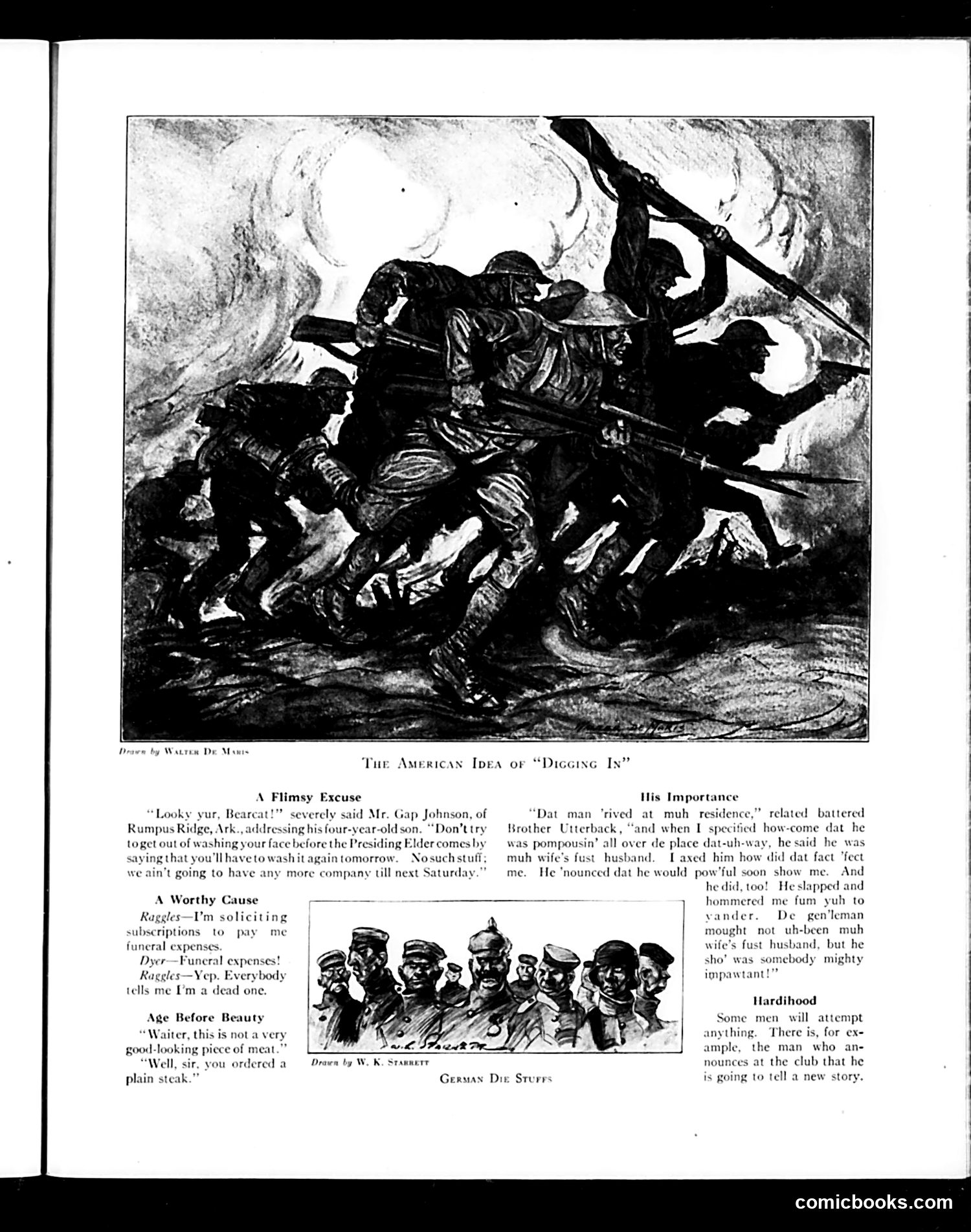
This Judge magazine page contains three separate humor pieces using dialect and social satire: **Main cartoon (top):** "The American Idea of 'Digging In'" depicts soldiers in combat, illustrating the phrase's dual meaning—both literal (digging trenches) and figurative (persisting stubbornly). The art is by Walter De Maris. **Three brief jokes below:** - **"A Flimsy Excuse"**: Rural dialect humor about a father criticizing his son for avoiding washing before the Presiding Elder's visit - **"A Worthy Cause"**: A man solicits funeral subscriptions, joking he's "a dead one"—meaning socially ruined - **"Age Before Beauty"**: A diner complains about his steak; the waiter quips the complaint suits the customer, not the meat **"His Importance" and "Hardihood"** are brief anecdotes using African American vernacular and club gossip. The satire relies on period conventions: rustic dialect humor, class-based jokes, and observational comedy about masculine social behavior. The overall tone is lighthearted, though the dialect presentation reflects outdated racial stereotyping common to early 20th-century American humor magazines.
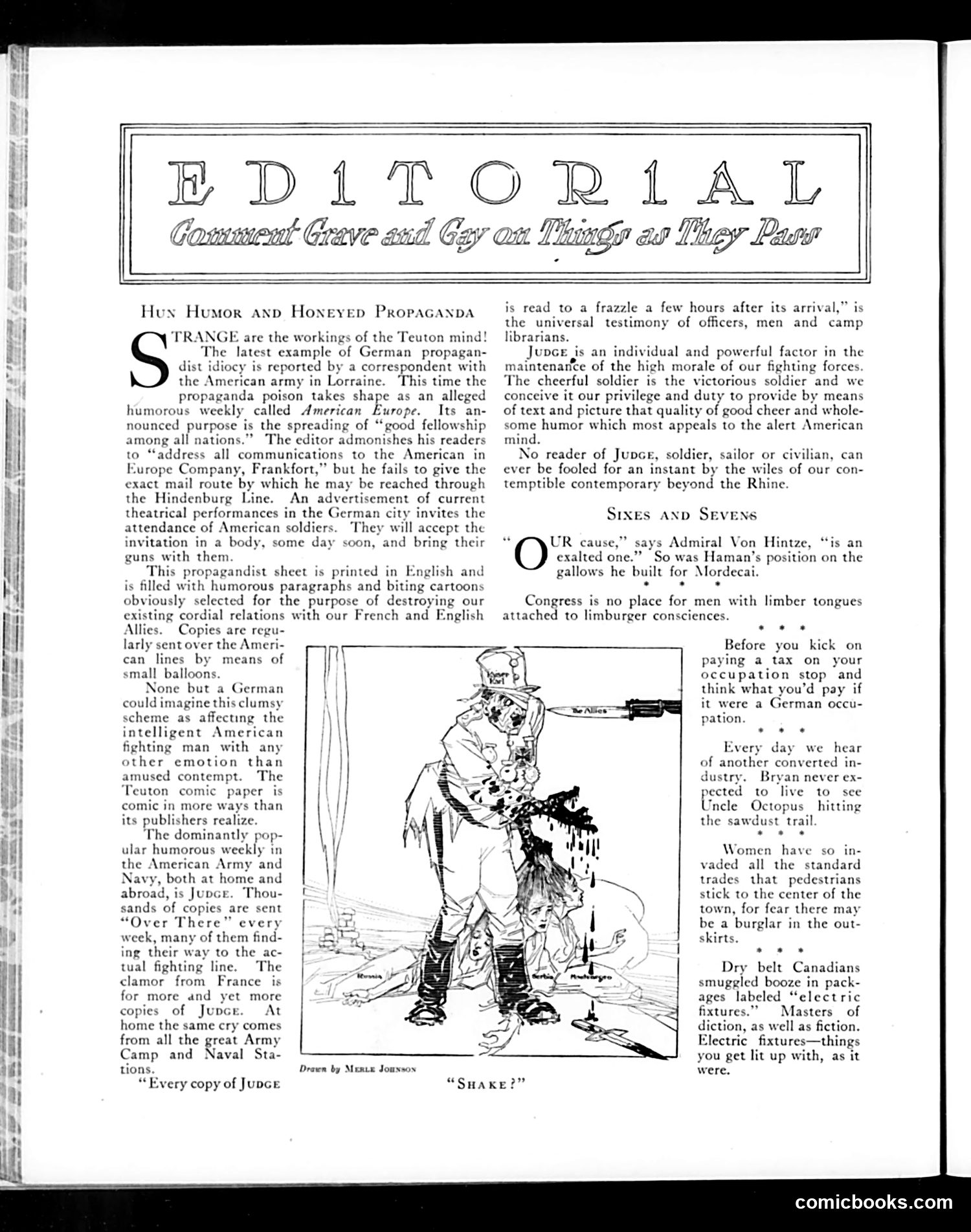
This editorial attacks German propaganda efforts targeting American soldiers in France during World War I. The main target is a fake German publication called *American Europe*, designed to sow discord between American forces and their French and English allies through "humorous" cartoons and articles. The central cartoon (drawn byMerle Johnson) depicts a German soldier or propagandist figure covered in filth and decay, labeled "Shake?"—suggesting the Germans are offering a handshake while being fundamentally corrupt. The editorial contrasts this clumsy German propaganda with *Judge* magazine itself, which it positions as genuine morale-booster for American troops. The piece asserts that American soldiers are too intelligent to be fooled by such obvious manipulation. The sidebar jokes mock German leadership (Admiral Von Hintze) and American war-profiteering, while critiquing Congressional hypocrisy. The overall message: German propaganda is contemptible and ineffective against American fighting men.
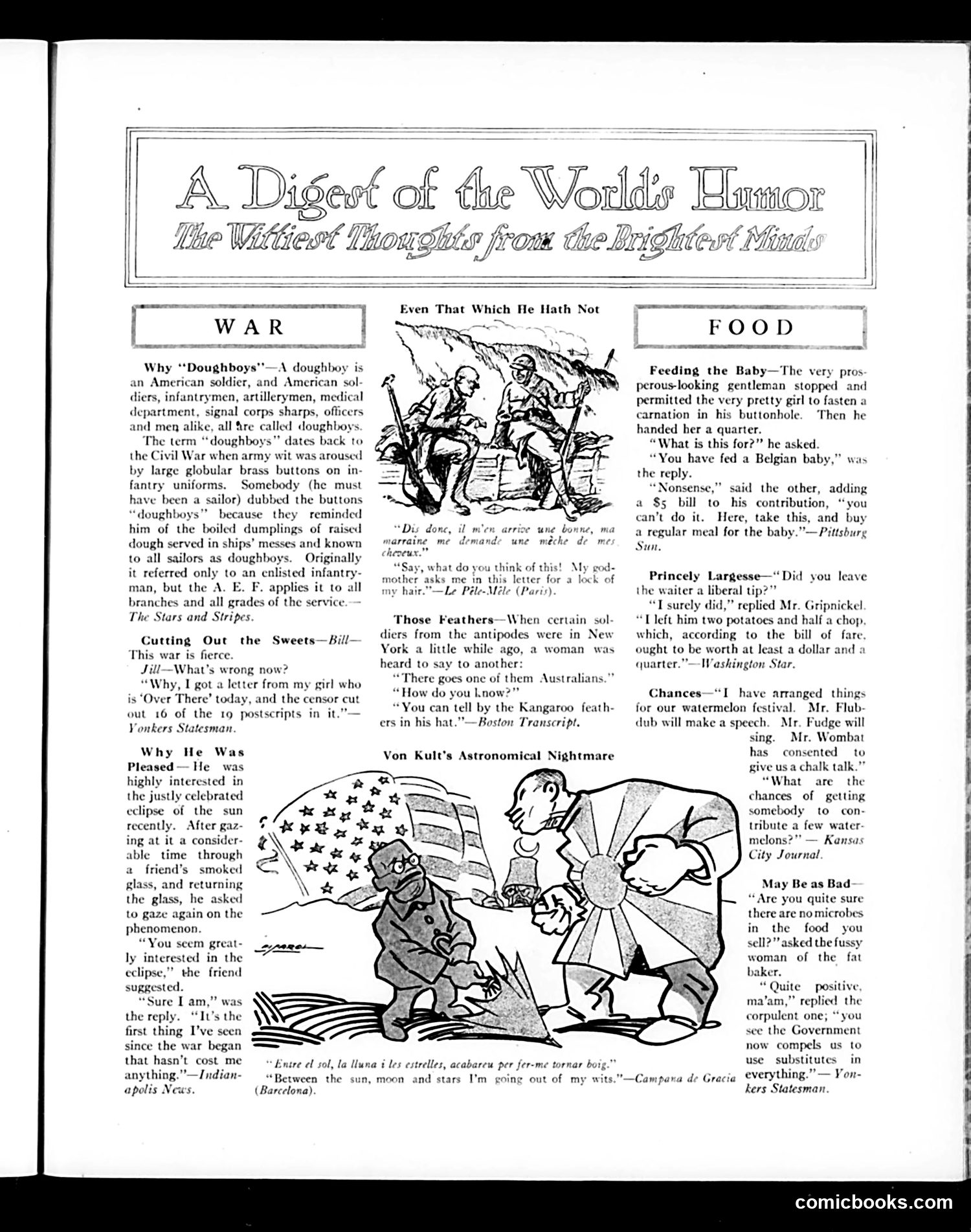
This page collects wartime jokes and satirical items from WWI era. Key content: **"Why 'Doughboys'"** explains American soldiers' nickname originated from Civil War brass buttons resembling boiled dumplings served on ships. **"Cutting Out the Sweets"** jokes about military censorship removing romantic postcripts from letters home. **The Eclipse item** satirizes a man pleased the eclipse is "the first thing I've seen since the war began that hasn't cost me anything"—mocking wartime inflation and expenses. **"Those Feathers"** pokes fun at identifying Australian soldiers by kangaroo feathers in hats. **"Von Kult's Astronomical Nightmare"** (cartoon) shows someone confused by celestial navigation during wartime. **Food section** contains jokes about food rationing, Belgian relief charity, meager restaurant portions, and government-mandated food substitutes—reflecting WWI-era shortages and austerity measures affecting civilians and service members alike.
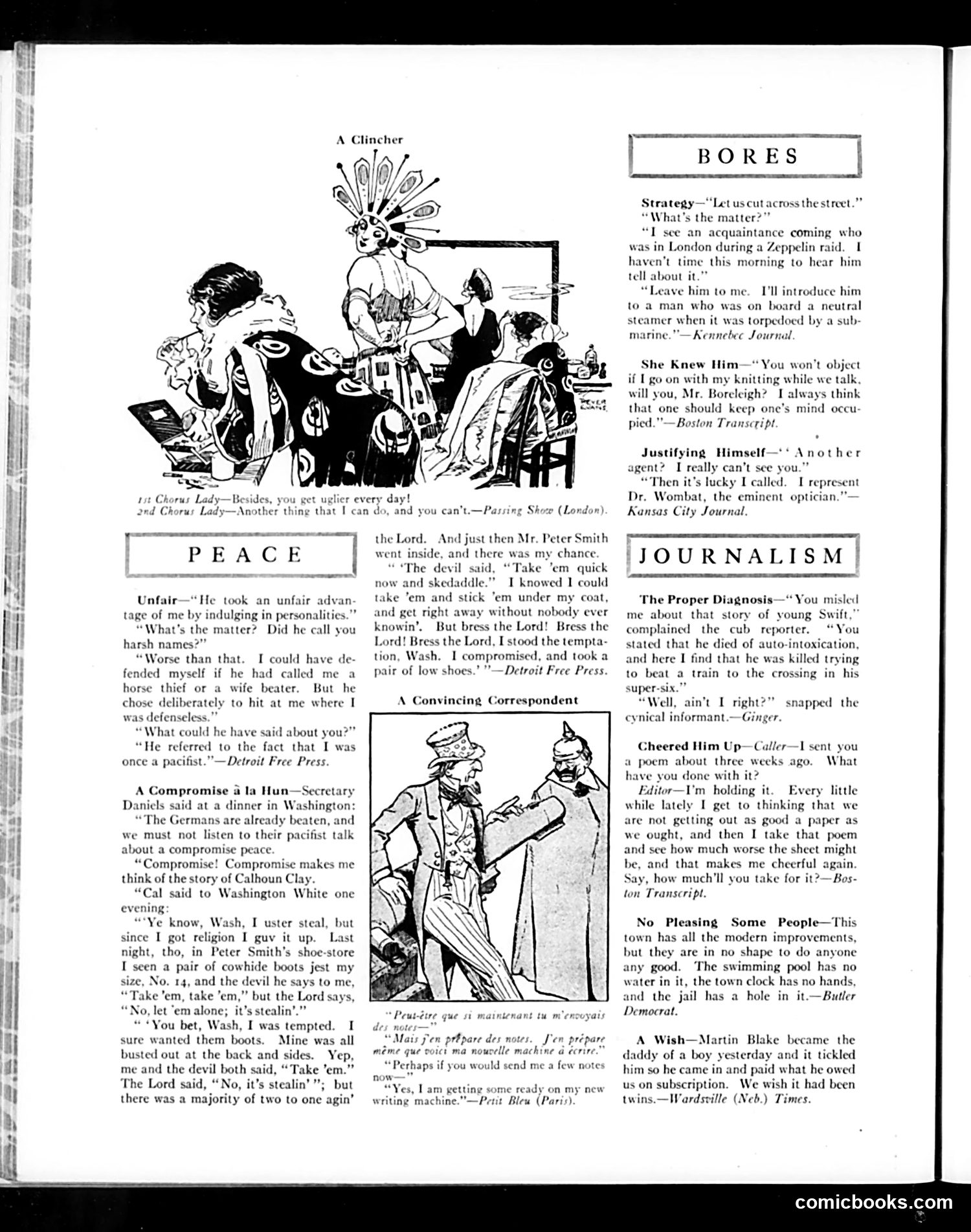
This page from *Judge* magazine contains satirical commentary on World War I-era American society and politics, organized into three sections: **"Peace"** mocks pacifists and compromise. The Calhoun Clay anecdote ridicules those claiming moral principle while actually compromising—Clay "compromises" by stealing cheap shoes instead of expensive boots, framing it as virtue. Secretary Daniels's comments suggest America shouldn't negotiate with Germany. **"Bores"** presents social humor: people avoiding acquaintances who won't stop talking about their wartime experiences (Zeppelin raids, submarine attacks). The satire targets those obsessed with recounting their brush with danger. **"Journalism"** gently mocks newspaper editors and reporters. One editor admits a poem's badness actually improves the paper by comparison; another reporter misdiagnosed a death as "auto-intoxication" when it was a train accident. The central cartoon depicts an elaborate woman ("A Clincher"), likely satirizing fashionable excess or pretension during wartime austerity. These pieces reflect American anxiety about war, social respectability, and press reliability circa 1917-1918.
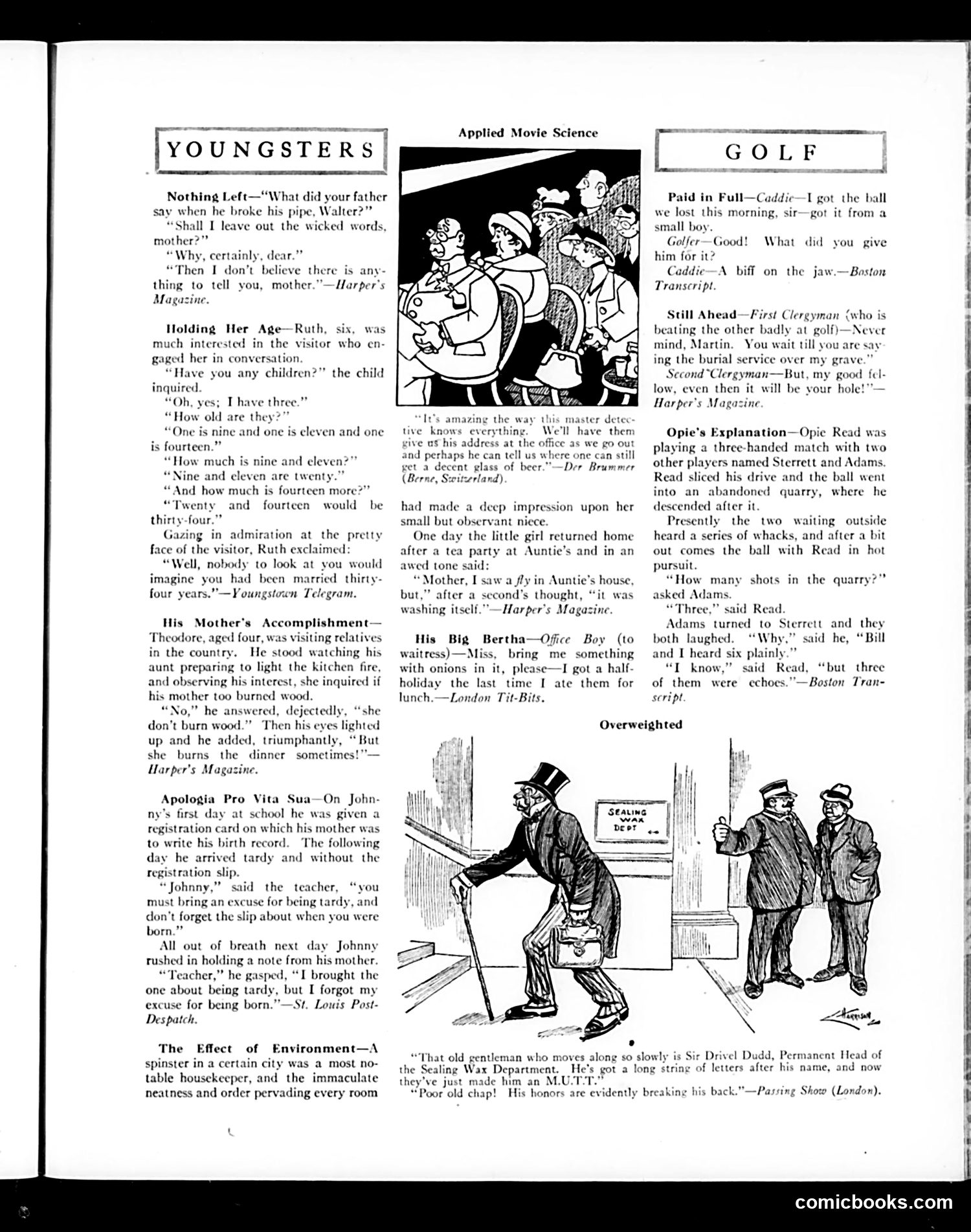
This page from Judge contains humorous anecdotes about children's logic and adults' foibles, typical of early-20th-century American humor magazines. The **"Youngsters"** section features innocent jokes: a child repeating his father's curse words, a six-year-old calculating a visitor's age based on marriage duration, and a boy confused about needing an "excuse for being born." The **"Golf"** section satirizes golfers and clergy. One joke depicts two clergymen competing at golf; the second smugly suggests the first will eventually conduct his burial service. Another involves a golfer explaining that some of his quarry shots were merely echoes—absurd rationalization typical of golf humor. The **"Overweighted"** cartoon (bottom right) shows a portly gentleman at a "Sealing Wax" department, mocked as "Sir Drivel Dadd" whose honors are "breaking his back"—gentle satire about dignity undermined by excessive weight. Overall, the humor relies on children's innocent misunderstandings, adults' self-deception, and physical comedy—sensibilities that differ markedly from modern comedy.
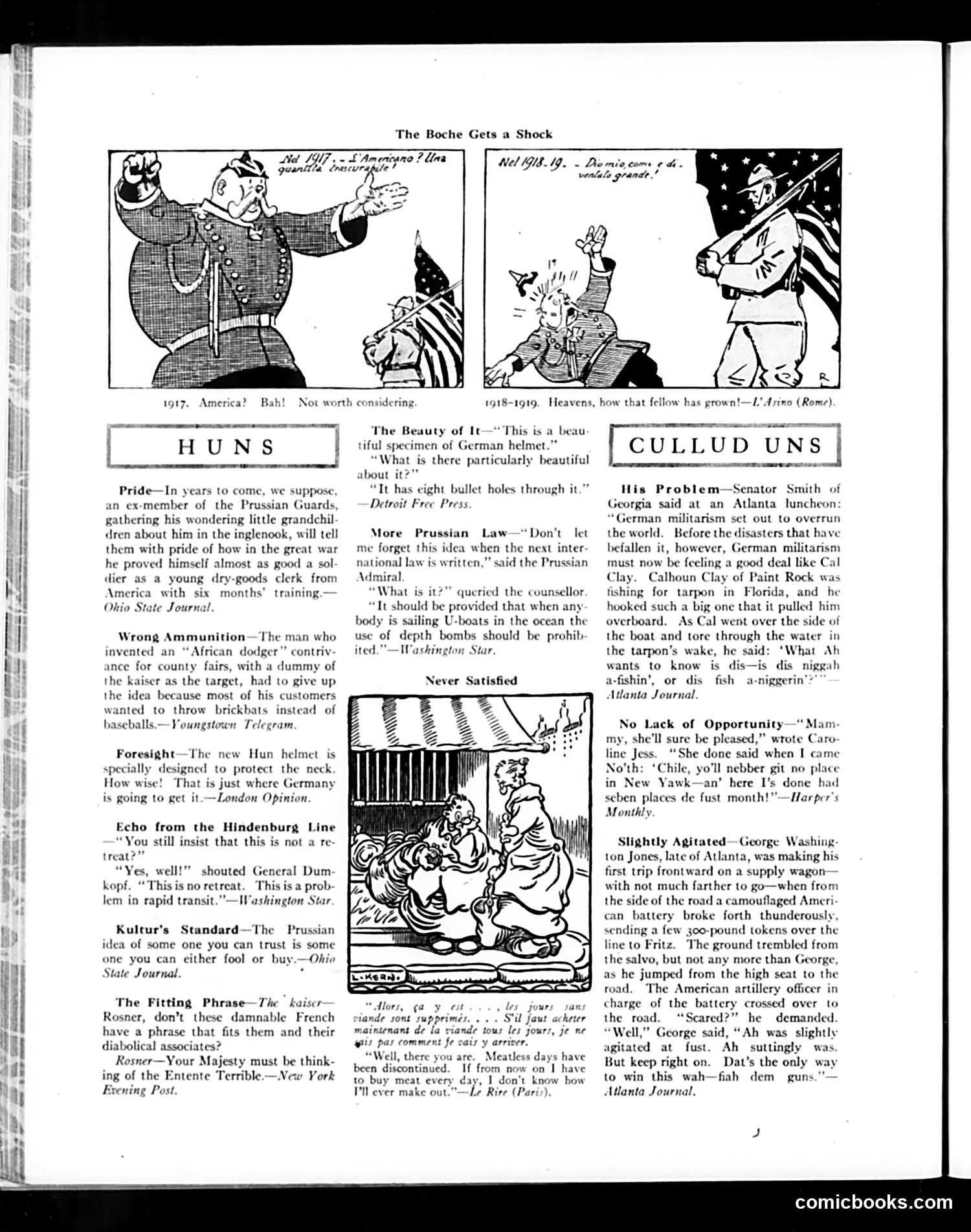
This Judge magazine page from 1917-1919 satirizes German military leadership during WWI's final years. The top cartoons show Kaiser Wilhelm's shock at America's unexpected military capability—contrasting his 1917 dismissal ("America? Bah! Not worth considering") with his 1918-1919 realization that American soldiers have grown formidable. The accompanying brief jokes mock German culture and military doctrine: their helmet design, U-boat tactics, Prussian "honor," and General Hindenburg's failed defensive strategies. One quip jokes that throwing bricks rather than baseballs at a Kaiser dummy target indicates Americans' fighting spirit. The page also includes lighter domestic humor about American soldiers and rationing. The cartoons and text collectively celebrate American military prowess while mocking German militarism as both brutal and ultimately ineffectual against American determination. The message: Germany fatally underestimated its American adversary.
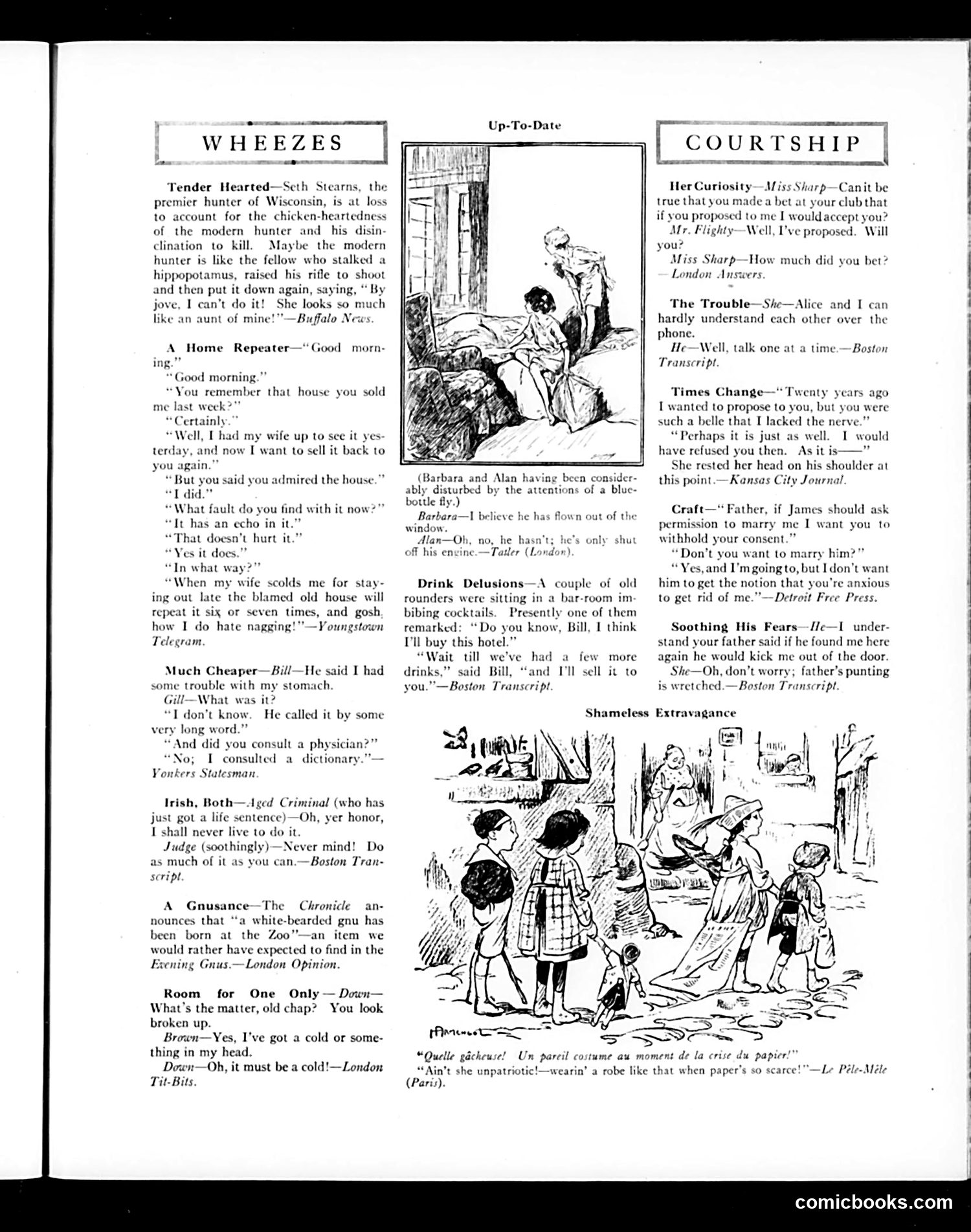
This page from Judge magazine contains humorous short anecdotes and one cartoon, typical of early 20th-century American satirical humor. **The Cartoons/Jokes:** The main content consists of brief jokes on topics like hunting, real estate, romance, and courtship. These are simple observational humor with punchlines relying on wordplay or domestic situations—a man wanting to resell a house because his wife's nagging echoes in it; a drunk planning to buy a hotel after more drinks. **The Illustration:** The "Shameless Extravagance" cartoon depicts children in ragged clothes, apparently during wartime paper shortages. A French caption criticizes a child wearing a paper costume as unpatriotic when paper is scarce. This reflects WWI-era rationing concerns in France. **Overall Purpose:** This page demonstrates Judge's mix of light domestic satire, puns, and international commentary—appealing to middle-class readers with relatable scenarios about marriage, business dealings, and current events. The humor is gentle rather than politically pointed.
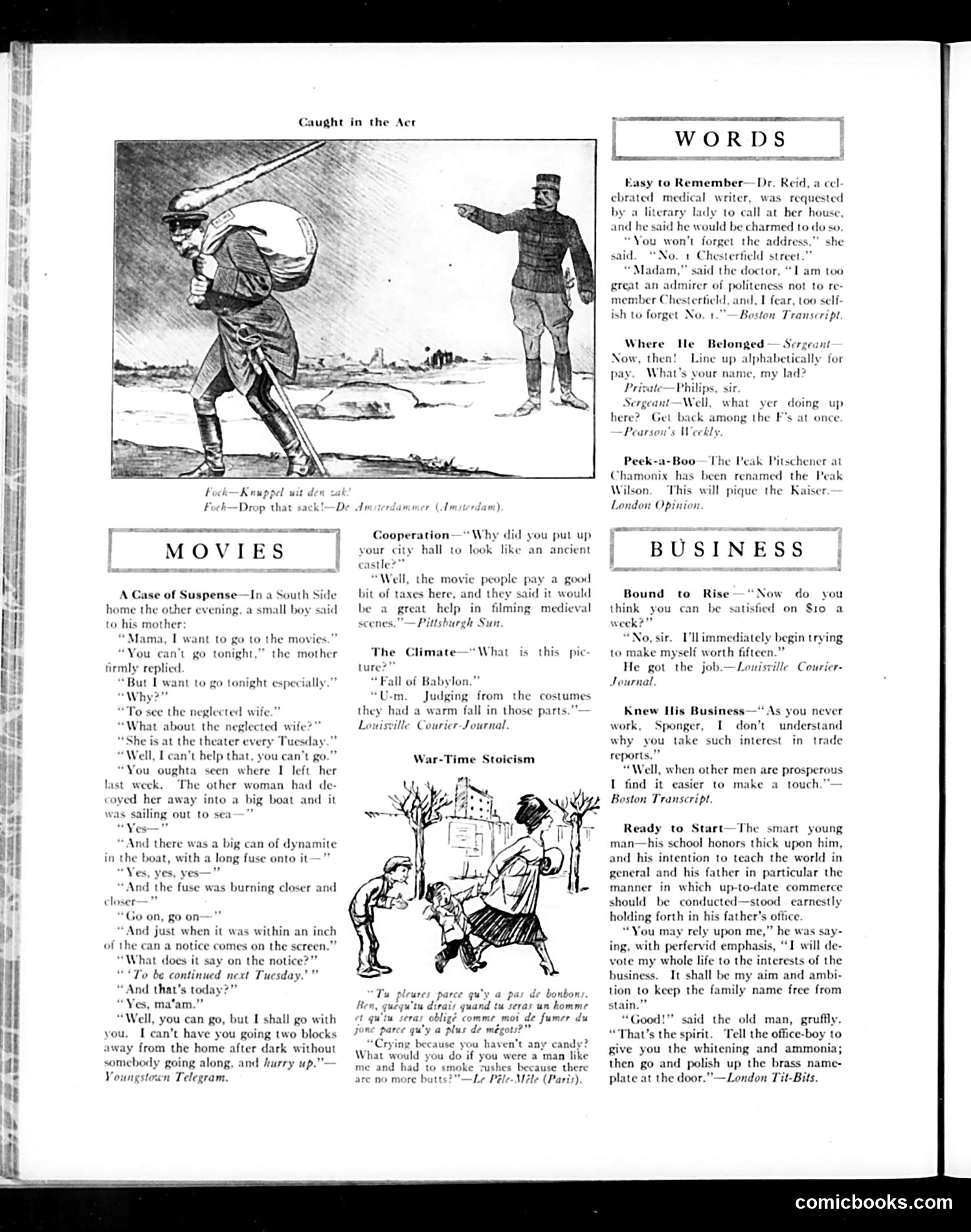
This page contains humorous anecdotes rather than political cartoons. The main content includes: **"A Case of Suspense"** satirizes movie-going culture, particularly the popularity of melodramatic serials. A mother reluctantly allows her son to see a film after he describes the cliffhanger ending of a "neglected wife" story—the humor lies in how cinema suspense captivates audiences across ages. **"War-Time Stoicism"** (French caption) references wartime deprivation, showing a parent teaching a child to endure hardship without complaint, using cigarette butts as an example—likely WWI-era commentary on rationing and sacrifice. The remaining items are brief comedic one-liners about everyday life: a doctor remembering an address through politeness, military alphabetization, renaming a mountain after Wilson (possibly President Woodrow Wilson), and business anecdotes about ambition and networking. The page reflects early 20th-century concerns: cinema's social impact, wartime conditions, and workplace humor.
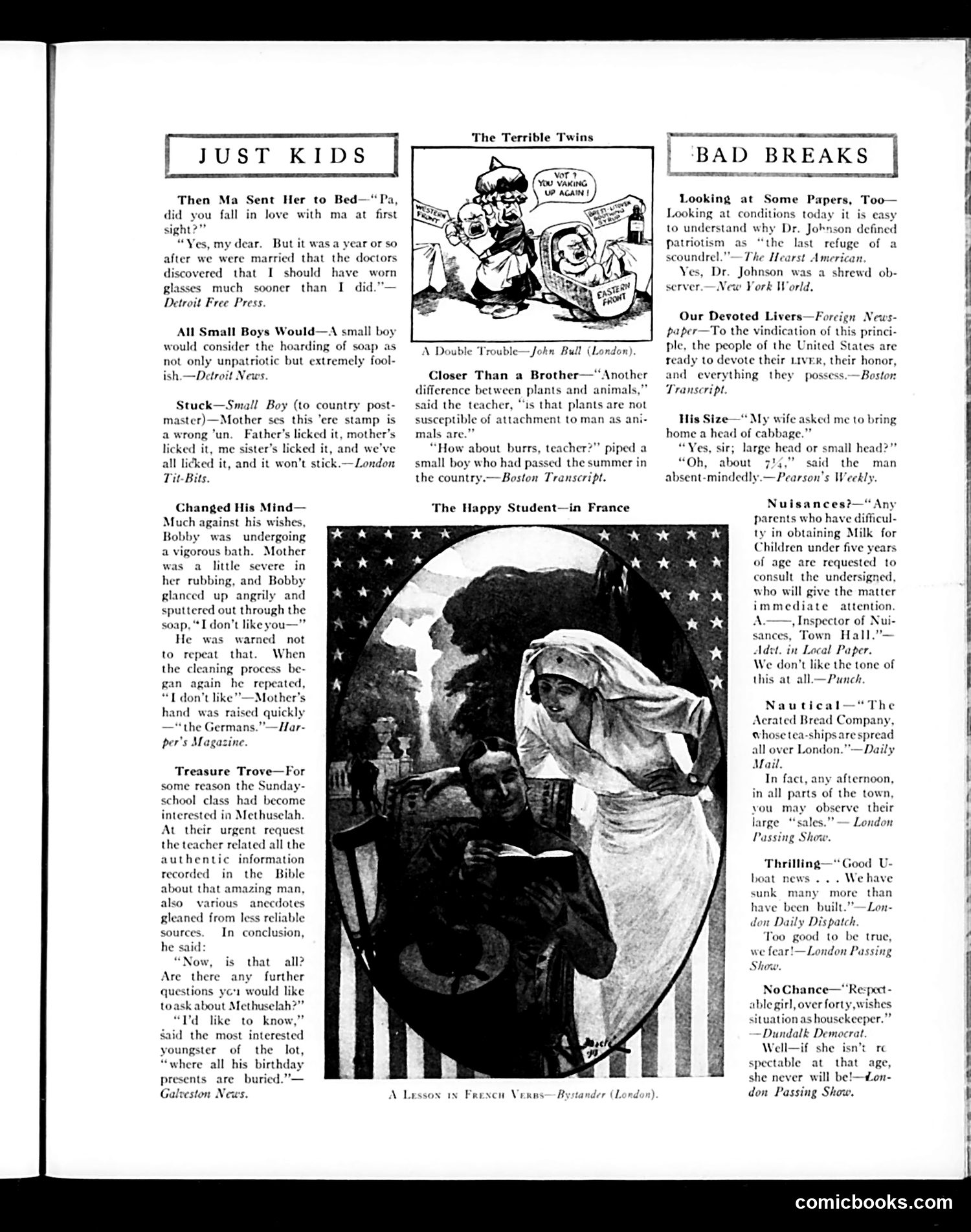
This page from Judge contains humor sections rather than political cartoons. The content reflects **World War I-era American attitudes** (likely 1915-1918): **"The Terrible Twins" cartoon** (center) depicts **John Bull** (Britain personified) with what appears to be a troublemaking figure—likely referencing Allied partnership tensions or domestic British problems during wartime. **"Just Kids"** anecdotes are lighthearted children's humor, though one notably ends with a child praising "the Germans"—likely satirizing unexpected patriotic sentiment or wartime propaganda's reach into households. **"Bad Breaks"** contains newspaper clipping satire, including a joke about "Devoted Livers" where a mishearing transforms "devote their LIVES" into "devote their LIVERS"—playing on wartime patriotic rhetoric. **"The Happy Student in France"** appears to show a figure studying, possibly commentary on American students abroad during wartime. The overall tone uses domestic humor to gently mock patriotic excess, media reporting, and wartime social disruptions—typical of Judge's satirical approach during this period.
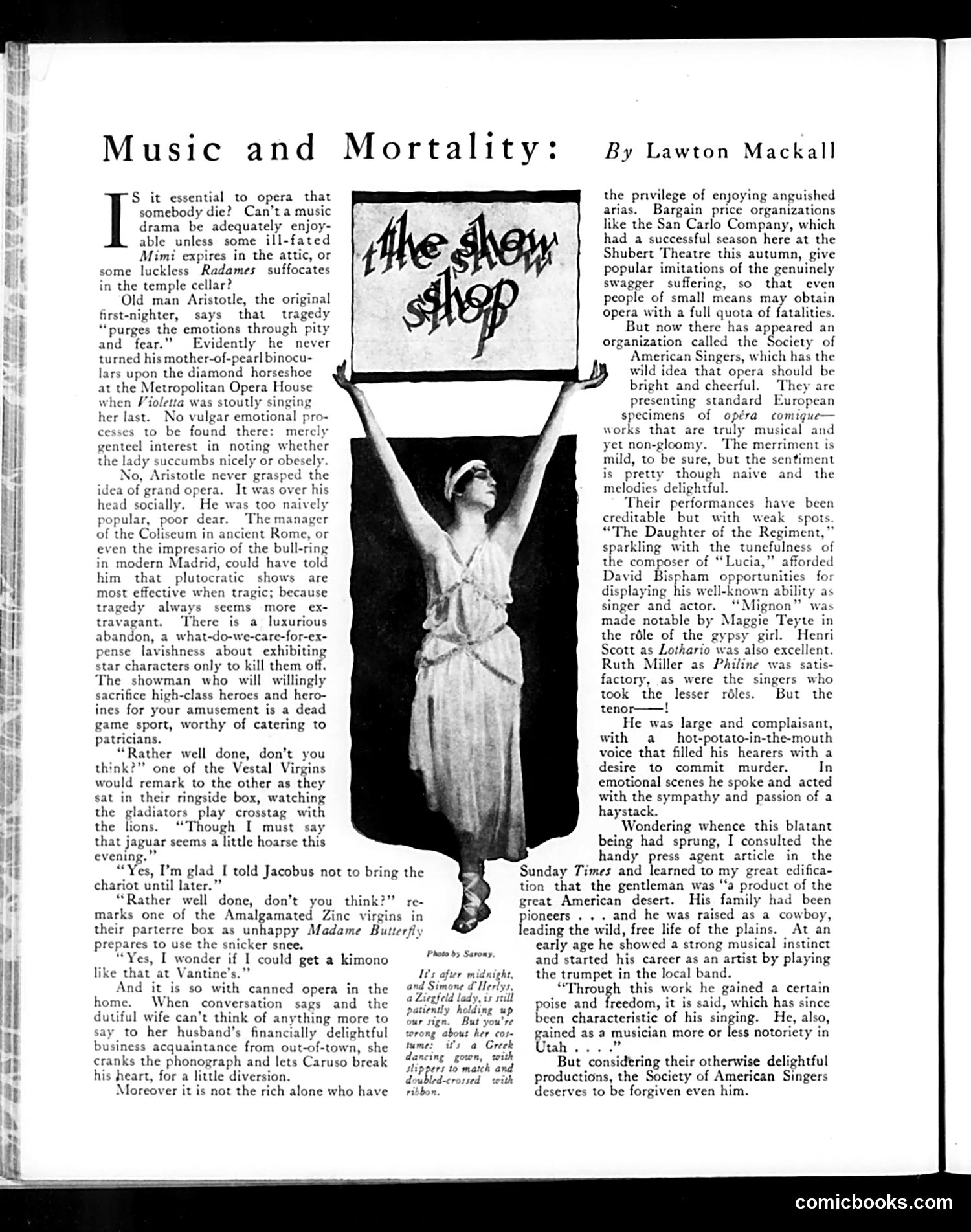
This article satirizes opera audiences' morbid fascination with death on stage. Mackall argues that wealthy patrons enjoy opera *because* characters die tragically—not despite it—comparing modern opera-goers to Roman audiences watching gladiators fight lions. He notes the wealthy find it delightfully wasteful to "sacrifice high-class heroes" for entertainment. The central joke critiques the "Society of American Singers," a new organization attempting to stage cheerful comic operas instead of tragic ones. Mackall finds this radical: audiences expect operatic suffering. He reviews their productions with backhanded praise, noting weak performances while acknowledging the concept itself—that opera needn't kill everyone—is genuinely novel. The cartoon image shows a performer in classical dress, illustrating the operatic subject matter discussed.
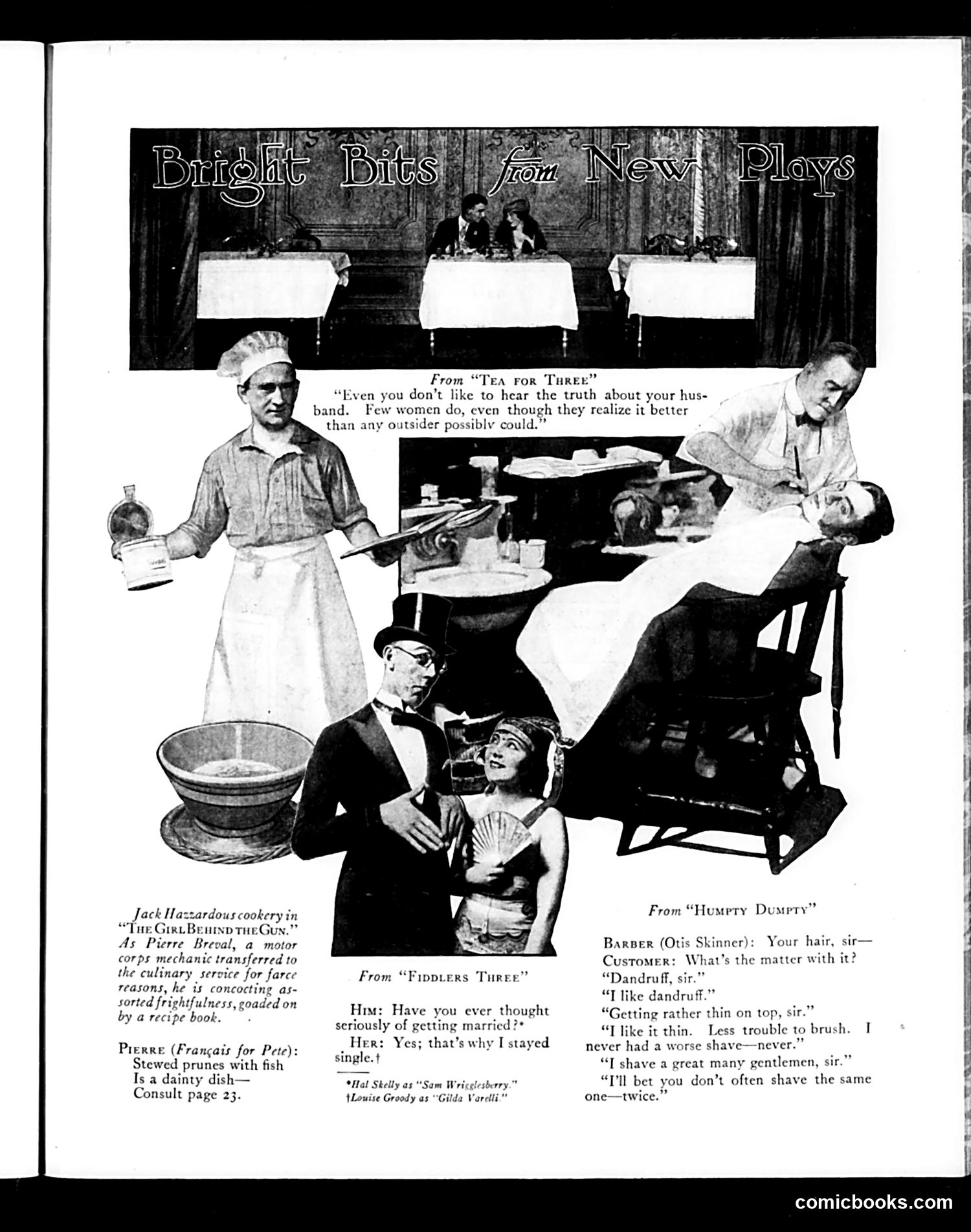
This page excerpts humorous dialogue and scenes from contemporary theatrical productions, presented as entertainment snippets for Judge magazine readers. The content includes: - **"Tea for Three"**: A cynical observation about women accepting domestic truths about unfaithful husbands - **"Fiddlers Three"**: A joke about marriage avoidance - **"The Girl Behind the Gun"**: Visual humor showing a French soldier (Pierre) attempting military cooking with absurd results—combining fish and prunes per a recipe, satirizing wartime food shortages or incompetent provisioning - **"Humpty Dumpty"**: A barber-customer exchange trading insults about thinning hair, dandruff, and poor shaving results—standard vaudeville-style banter These appear aimed at readers familiar with 1920s stage productions and comedians like Hal Skelley and Otis Skinner. The humor relies on contemporary theatrical references and domestic/personal grooming comedy typical of the era.
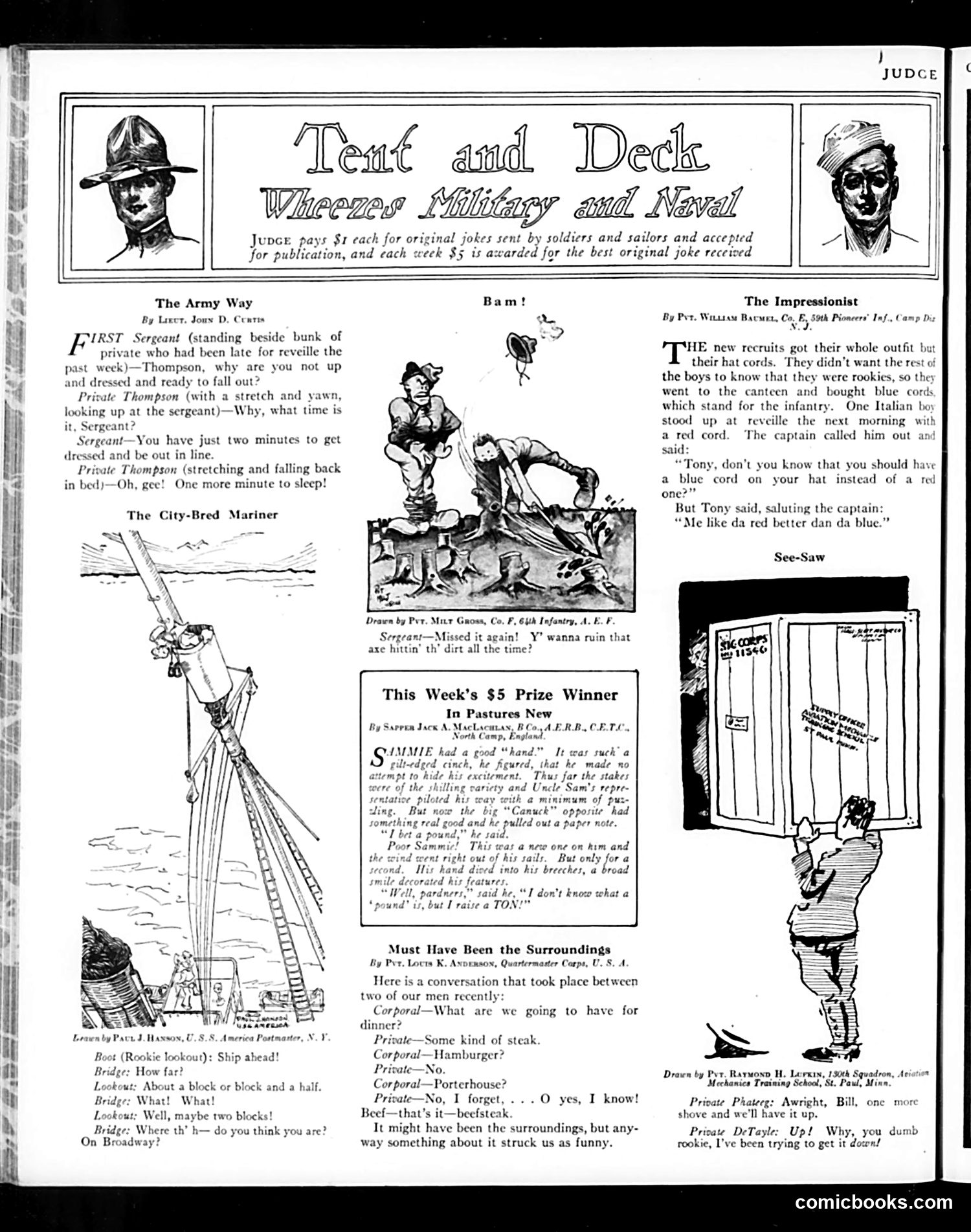
This page collects soldiers' and sailors' jokes submitted to Judge's contest (paying $1 per joke, $5 weekly prize). The humor targets military recruits and their cultural unfamiliarity with service life. **Key jokes:** - **"The Army Way"**: A groggy private asks for more sleep when ordered to dress in two minutes—mocking new recruits' difficulty adjusting to military discipline. - **"The Impressionist"**: An Italian recruit, unaware that blue cords signify infantry, wears a red cord instead. When corrected, he insists he "like da red better"—ethnic humor playing on language barriers and rookie ignorance. - **"The City-Bred Mariner"**: A landlubber confuses nautical distances ("a block or two blocks"), treating the sea like city streets—mocking urban recruits' incompetence in military contexts. - **Other sketches**: Similar themes of confused recruits misunderstanding military terminology or procedures. The page satirizes the gap between civilian and military life, with humor aimed at rookies' naïveté rather than officers or policy.
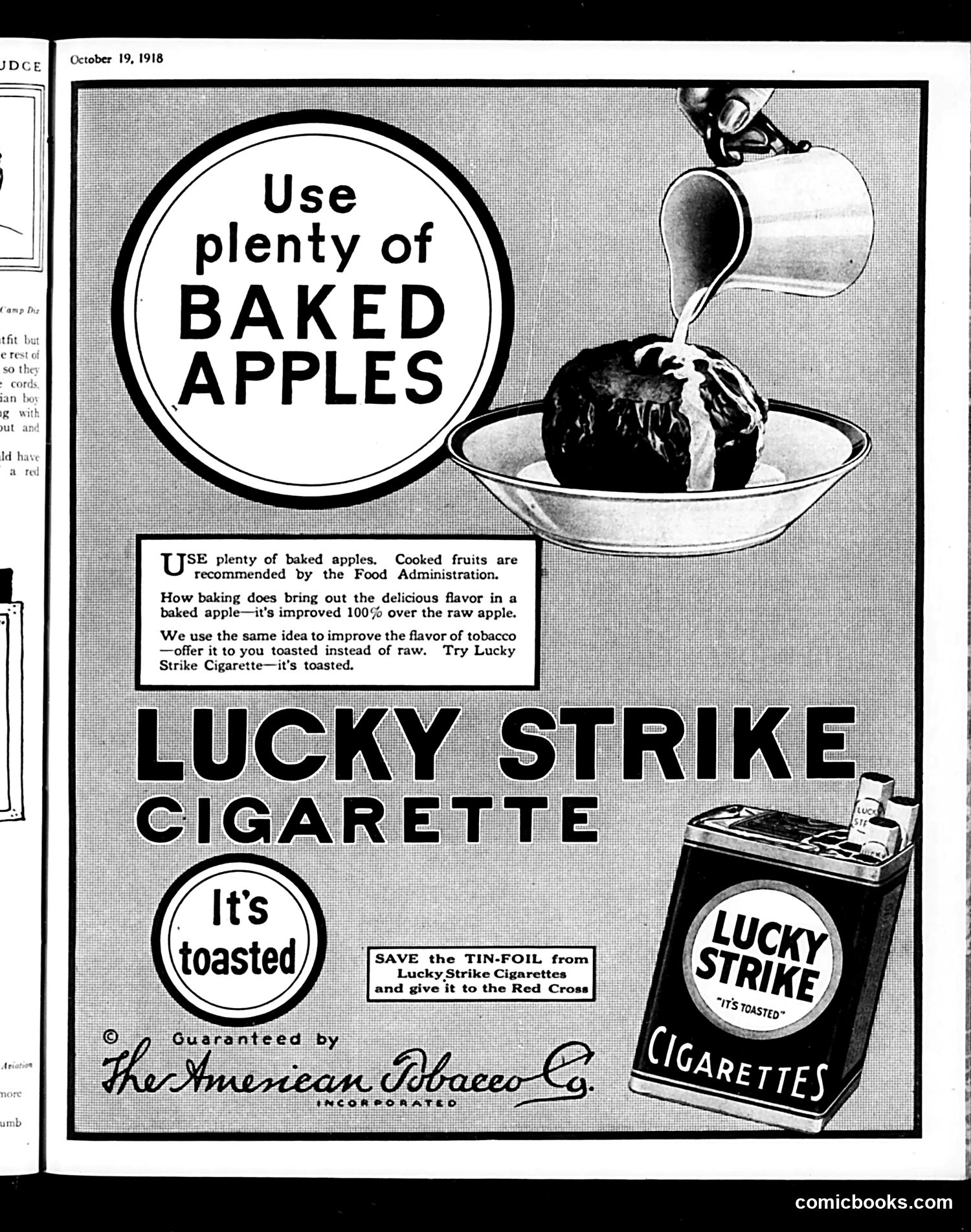
This is a Lucky Strike cigarette advertisement from October 1918, appearing during World War I's final weeks. The ad uses wartime rationing messaging to promote cigarettes by drawing a parallel between the Food Administration's recommendation to use baked apples (improved flavor through cooking) and Lucky Strike's "toasted" tobacco process. The advertisement exploits patriotic sentiment by suggesting tin-foil collection from cigarette packages supports the Red Cross war effort. This is primarily a commercial advertisement rather than political satire, though it cleverly co-opts official government health guidance and wartime charity appeals to market cigarettes as both a flavor improvement and patriotic purchase. The comparison of cooking apples to toasting tobacco is the central marketing metaphor.
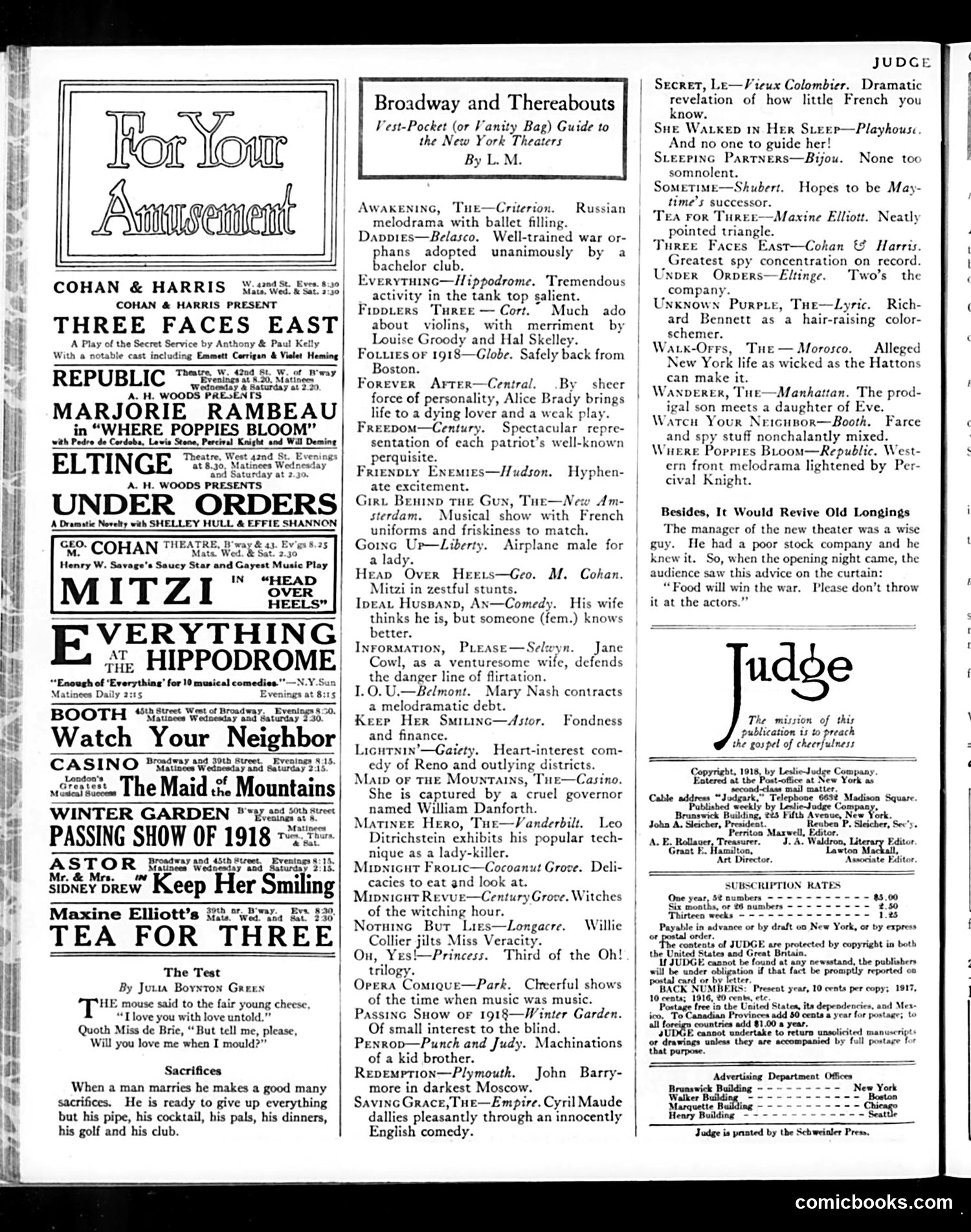
This is primarily a **theater listings and advertising page** from Judge magazine, not a political cartoon page. The bulk of the content comprises Broadway theater advertisements and brief critical descriptions of current New York productions. The small satirical content appears in "The Test" poem and "Sacrifices" section at bottom left. These are mild social humor pieces—the cheese joke is a pun, while "Sacrifices" gently mocks newlywed men who claim to give up everything but stubbornly retain pipe-smoking, cocktails, golf, and clubbing. This reflects early 20th-century gender dynamics and marital stereotypes. The page's primary purpose is **commercial**: promoting theaters and performances (many feature performers like Mitzi, George M. Cohan, and John Barrymore). The theatrical reviews use witty, condensed descriptions to entice readers—notable is the Iraq War-era reference to "tank top salient" at the Hippodrome's "Everything," suggesting WWI military concerns influenced entertainment choices circa 1918.
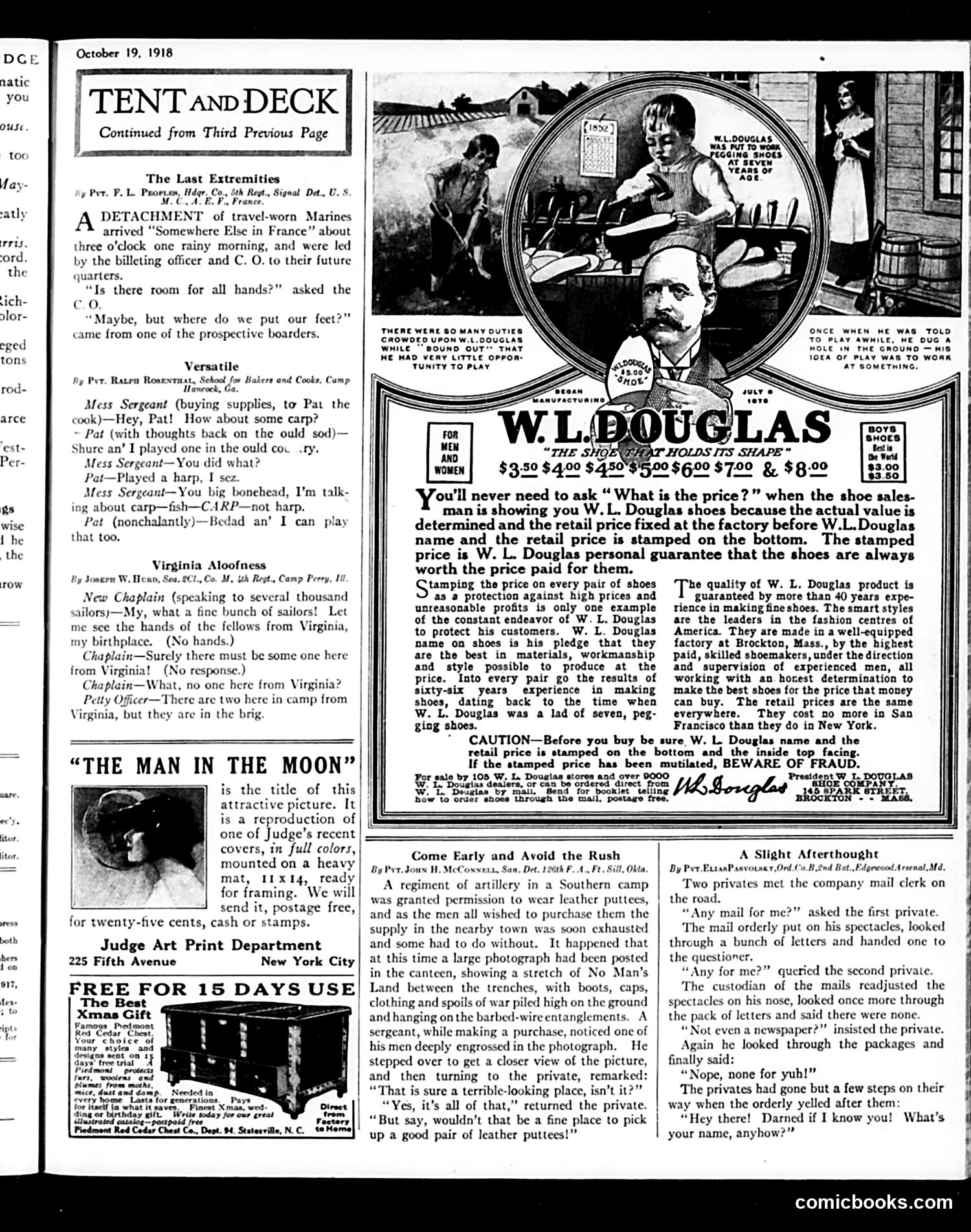
This is primarily an **advertising and humor page** from Judge magazine (October 19, 1918), published during World War I. **The Content:** The page features three brief military humor pieces about soldiers' experiences in France and training camps—jokes about billeting quarters, a cook's confusion between "carp" (fish) and "harp" (instrument), and Virginia sailors in the brig. **The Major Element:** A large **W.L. Douglas shoe advertisement** dominates the right side. The ad emphasizes the company's 66-year history and quality control, featuring a biographical circular inset showing Douglas as a boy working, implying his work ethic built his shoe empire. The advertisement stresses that retail prices are stamped on shoe bottoms, protecting consumers against fraud and price-gouging. **The Satire:** The "Man in the Moon" illustration on the left appears unrelated to the page's primary content—it's merely promoting a Judge art print for sale. This page reflects WWI-era military life humor combined with consumer-protection messaging (price stamping was a notable business practice of the era).
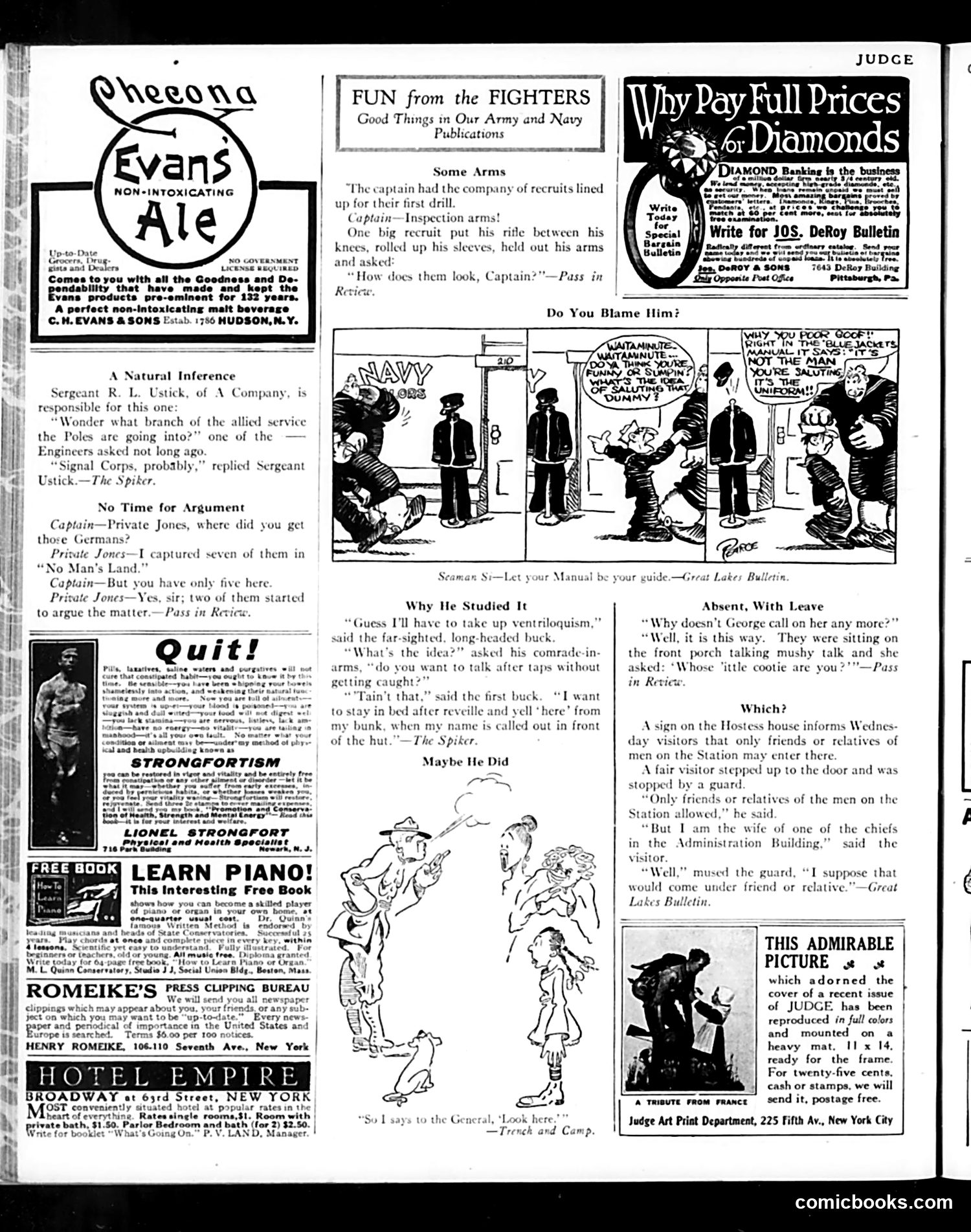
This page is primarily **WWI-era military humor** mixed with period advertisements. The main cartoon feature, "Do You Blame Him?" depicts Navy recruits engaging in comedic dialogue about military life and regulations—likely satirizing the gap between military discipline and soldiers' practical concerns. The numbered humor sections ("Some Arms," "A Natural Inference," "No Time for Argument," etc.) are brief anecdotes mocking recruit ignorance and military absurdities. One joke about capturing Germans who "started to argue" plays on ethnic stereotypes. Another about "ventriloquism" satirizes the difficulty of covert communication under strict military rules. The cartoons and jokes collectively mock recruits' incompetence, military bureaucracy, and wartime social disruptions (the "Absent, With Leave" section jokes about romantic complications caused by military service). The advertisements—for non-alcoholic ale, piano lessons, health products, and hotels—represent typical magazine monetization of the era, unrelated to the satirical content. The overall tone reflects American homefront attitudes during WWI, using gentle ridicule of military life and soldiers' struggles to entertain civilian readers.
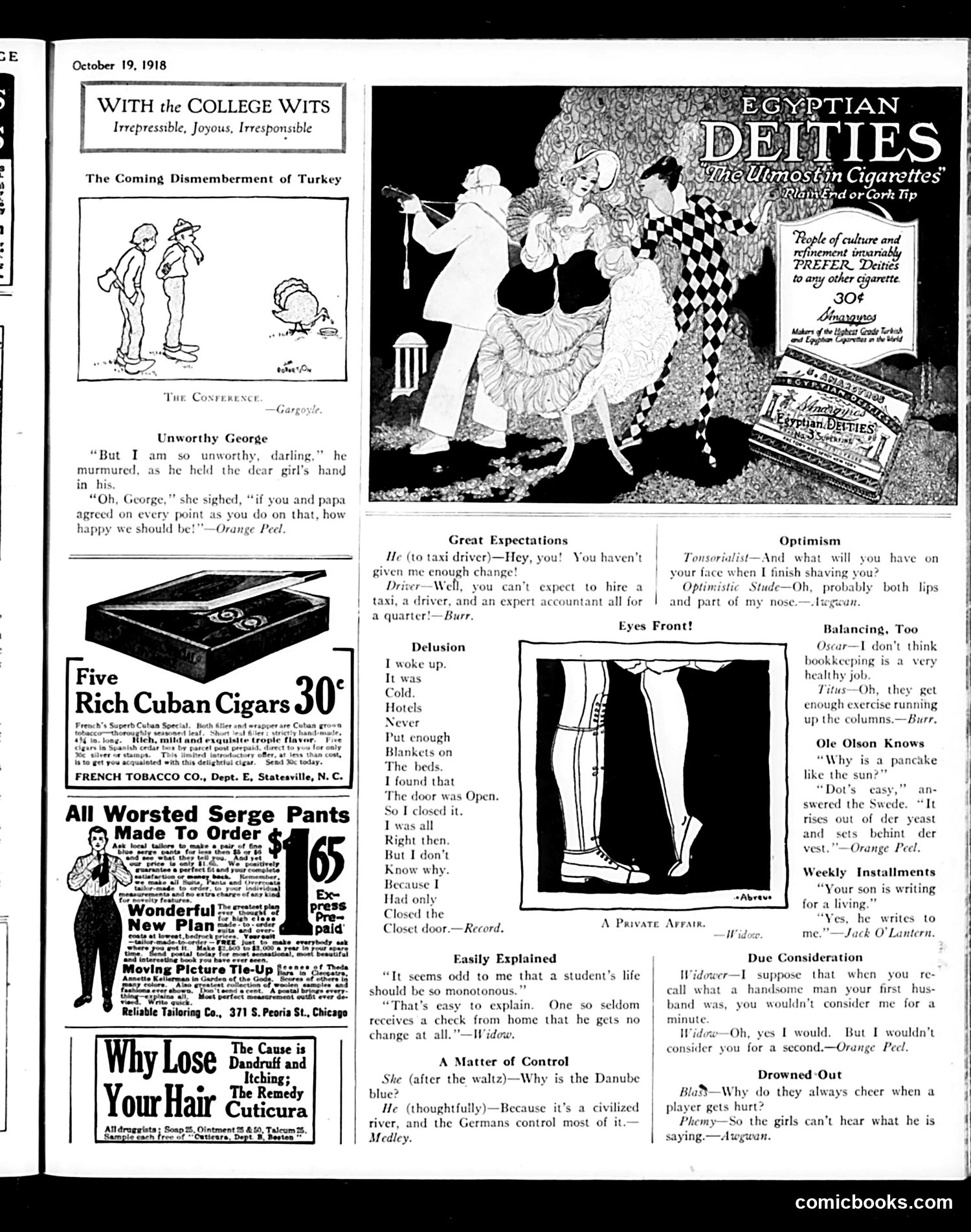
This page is primarily **advertising and humor columns** rather than political satire. The main cartoon addresses WWI's current moment: "The Coming Dismemberment of Turkey" shows two figures discussing the Ottoman Empire's collapse—a timely reference, as Turkey was actively losing territory in 1918 as the war ended. The bulk of the page contains "College Wits"—brief, punny humor pieces typical of Judge's format. Notable examples include jokes about student poverty ("One so seldom receives a check from home"), romance ("Unworthy George"), and a topical quip about German control of the Danube River, reflecting ongoing WWI preoccupations. The remaining content is **period advertisements**: Cuban cigars, tailored pants, and patent medicines (dandruff cure, hair loss remedy). The page captures how American magazines blended current events commentary with light entertainment and commercial messaging during the final weeks of World War I.
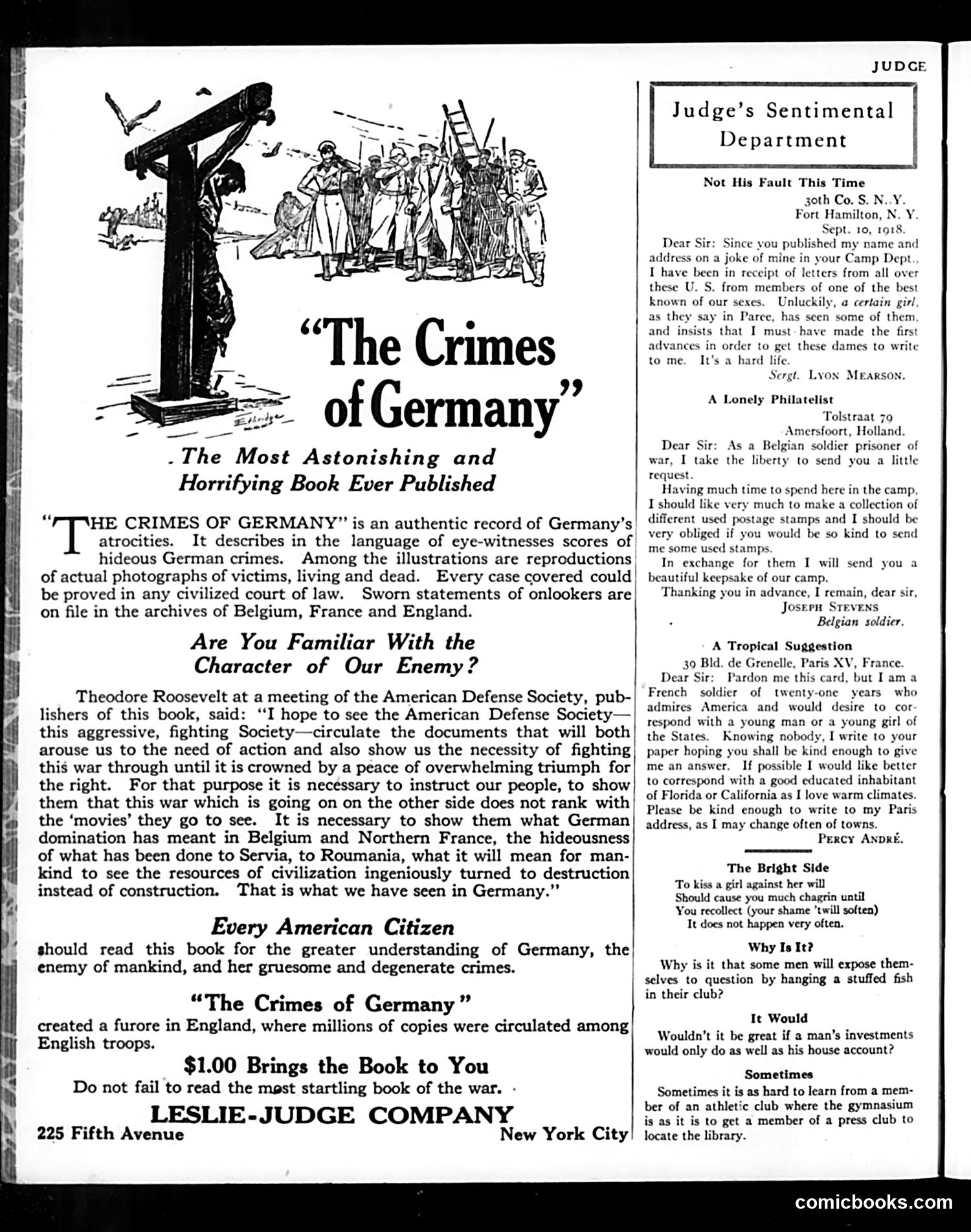
This page advertises a 1918 wartime propaganda book documenting alleged German atrocities in Belgium, France, and Serbia during World War I. The left side features a large crucifixion imagery suggesting Christian martyrdom, paired with soldiers—visual rhetoric equating German actions with ultimate evil. Theodore Roosevelt's quoted endorsement emphasizes the book's purpose: to convince American civilians that the distant European war merits their commitment by graphically exposing German conduct. The appeal to "every American citizen" reflects U.S. wartime information campaigns meant to maintain public support. The right side presents "Judge's Sentimental Department"—lighthearted reader letters offering comic relief, including soldiers' romantic solicitations. This editorial juxtaposition—grave atrocity documentation alongside humorous personal correspondence—was typical of Judge magazine's satirical approach, using humor to humanize soldiers while the advertisements promoted serious war messaging.
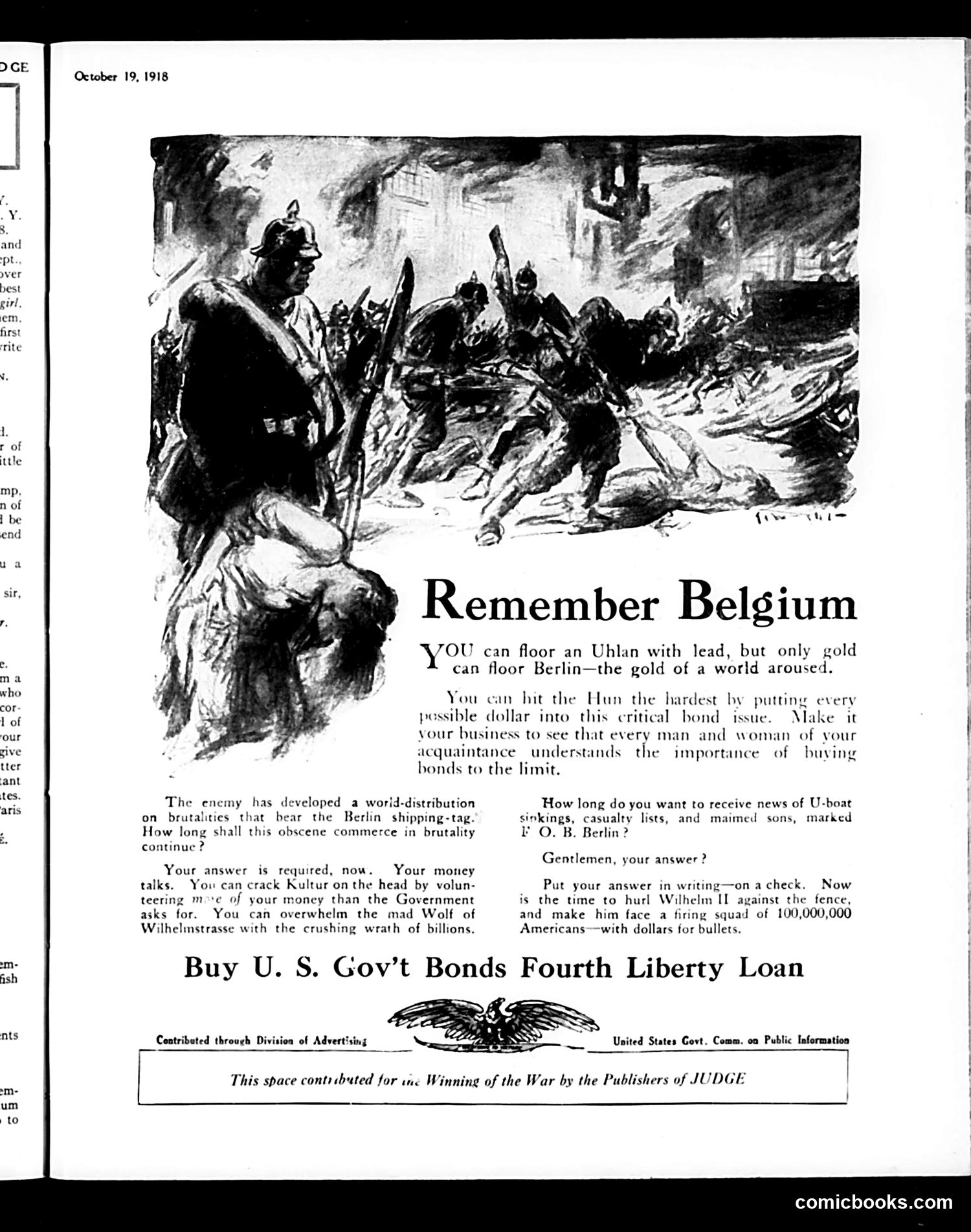
This is a wartime propaganda advertisement urging Americans to purchase Fourth Liberty Loan bonds. Published just weeks before WWI's armistice, it references **Belgium's actual suffering**: German forces had brutalized Belgium early in the war, including civilian massacres and destruction—atrocities widely publicized in Allied propaganda. The imagery depicts a German soldier (likely an "Uhlan"—German cavalry) overlooking devastated Belgian civilians and ruins. The text appeals to Americans' moral outrage and patriotic duty, using inflammatory language ("mad Wolf of Wilhelmstrasse," referring to Kaiser Wilhelm II's government). The core pitch: only American money ("gold") can defeat Germany's militarism. Citizens are shamed into contributing beyond what the government requests, framed as firing bullets at the enemy through financial sacrifice. This reflects typical WWI American propaganda: demonizing Germany, invoking atrocity stories, and conflating financial contribution with moral righteousness and military victory.
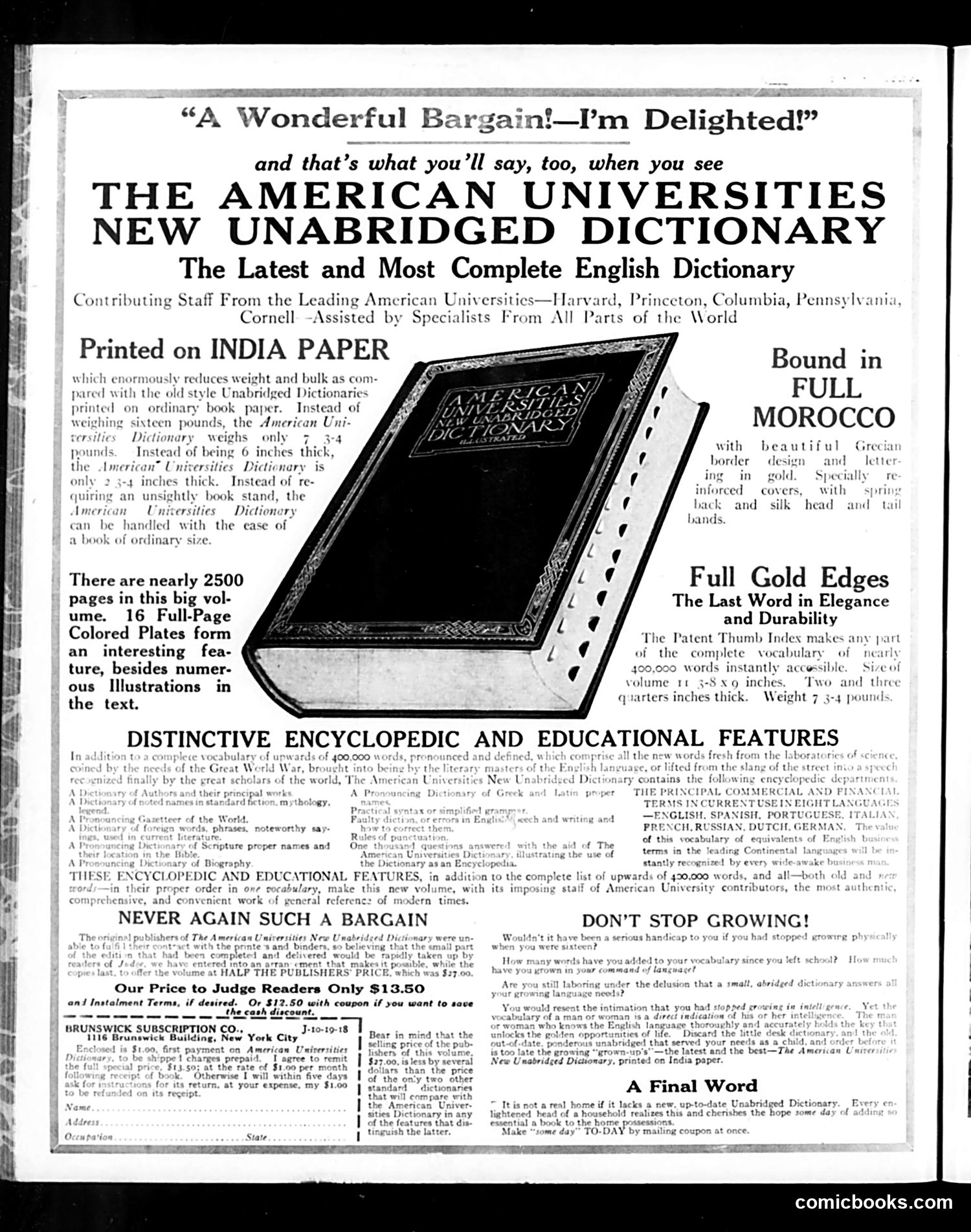
This page is **primarily an advertisement**, not a cartoon or satirical content. It promotes the "American Universities New Unabridged Dictionary" published by the Brunswick Subscription Company. The page uses a testimonial-style headline ("A Wonderful Bargain!—I'm Delighted!") to sell the dictionary to Judge magazine readers. The advertisement emphasizes the book's practical features: lightweight India paper binding, nearly 2,500 pages, full Morocco leather binding with gold edges, and a patent thumb index. The pricing strategy targets Judge's audience specifically—offering a special reader's price of $13.50 or $12.50 with a coupon, cheaper than comparable dictionaries. The ad claims contributions from major universities (Harvard, Princeton, Columbia, Pennsylvania, Cornell) to establish authority. There is **no visible political satire or cartoon content** on this page—it's a straightforward commercial advertisement typical of magazine publishing in the early 20th century.