
Judge, 1918-10-19 · page 22 of 32
Judge — October 19, 1918 — page 22: what you’re looking at
What you’re looking at
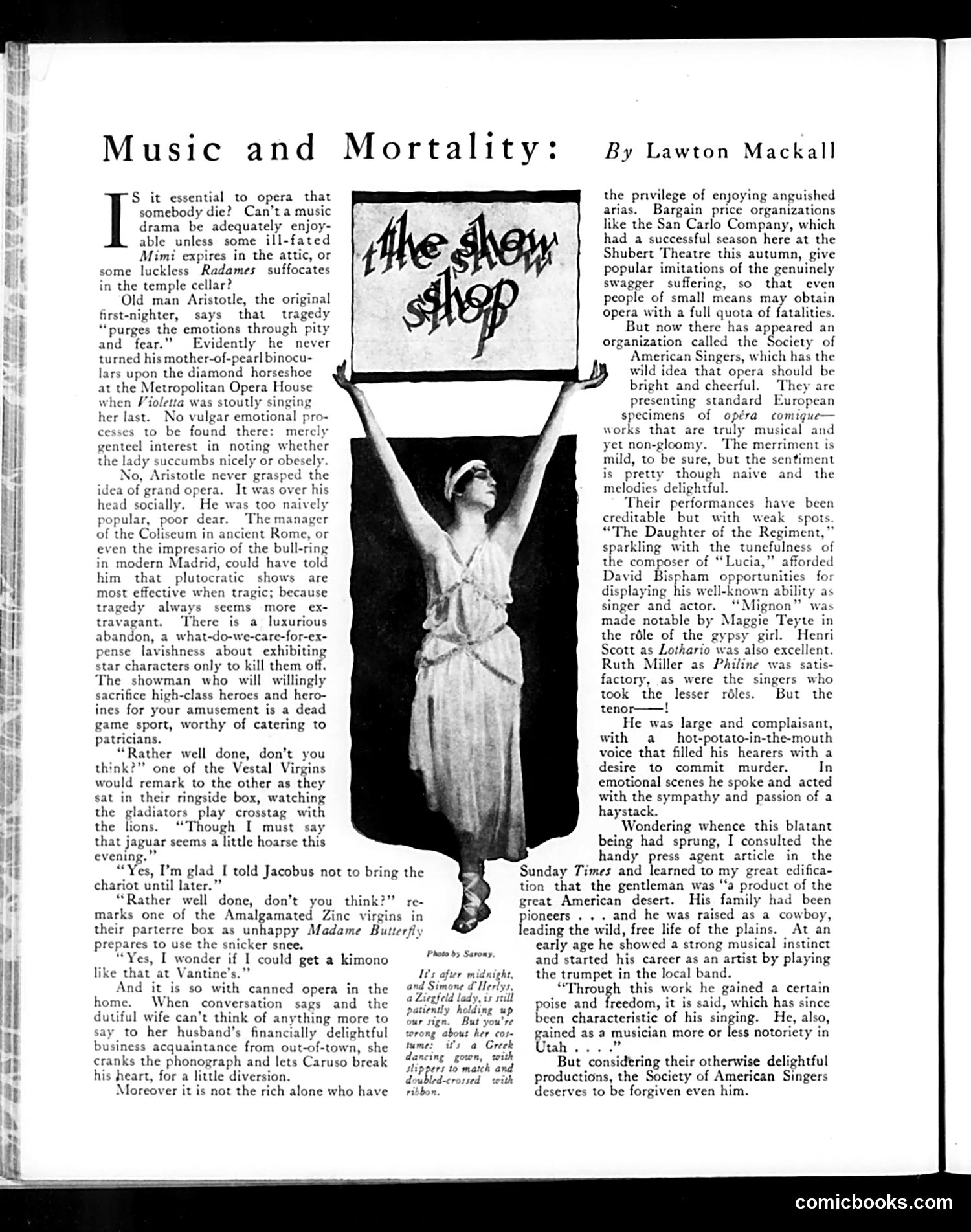
This article satirizes opera audiences' morbid fascination with death on stage. Mackall argues that wealthy patrons enjoy opera *because* characters die tragically—not despite it—comparing modern opera-goers to Roman audiences watching gladiators fight lions. He notes the wealthy find it delightfully wasteful to "sacrifice high-class heroes" for entertainment. The central joke critiques the "Society of American Singers," a new organization attempting to stage cheerful comic operas instead of tragic ones. Mackall finds this radical: audiences expect operatic suffering. He reviews their productions with backhanded praise, noting weak performances while acknowledging the concept itself—that opera needn't kill everyone—is genuinely novel. The cartoon image shows a performer in classical dress, illustrating the operatic subject matter discussed.
📄 Transcribed text from this page (OCR, searchable)
Machine-transcribed from the original scan — historical spelling and the odd misread are preserved.
j Music and Mortality: By Lawton Mackall Ril S it essential to opera that somebody die? Can’t a music drama be adequately enjoy- able unless some ill-fated Mimi expires in the attic, or ' some luckless Radames suffocates 7 in the temple cellar? Old man Aristotle, the original . first- nighter, says that tragedy 5 “purges the emotions through pity and fear.” Evidently he never turned his mother-of-pearl binocu- lars upon the diamond horseshoe at the Metropolitan Opera House when Violetta was stoutly singing her last. No vulgar emotional pro- cesses to be found there: merely genteel interest in noting whether the lady succumbs nicely or obesely. No, Aristotle never grasped the idea of grand of It was over his h socially. He was too naively popular, poor dear. The manager of the Coliseum in ancient Rome, or even the impresario of the bull-ring in modern Madrid, could have told him that plutocratic shows are most effective when tragic; because tragedy always seems more ex- travagant. There is a luxurious abandon, a what-do-we-care-for-ex- pense lavishness about exhibiting star characters only to kill them off. The showman who will willingly - sacrifice high-class heroes and hero- / ines for your amusement is a dead game sport, worthy of catering to patricians. “Rather well done, don’t you think?” one of the Vestal Virgins would remark to the other as they sat in their ringside box, watching the gladiators play crosstag with the lions. ‘Though I must say that j Jaguar seems a little hoarse this evenin; chariot until later.” ‘ “Rather well done, don’t you think marks one of the Amalgamated Zinc virgins in 1 their parterre box as unhappy Madame Butterfly prepares to use the snicker snee. “Yes, I wonder if I could get a kimono j like that at Vantine’s.” ; And it is so with canned opera in the home. When conversation sags and the dutiful wife can’t think of anything more to say to her husband's financially delightful | business acquaintance from out-of-town, she } cranks the phonograph and lets Caruso break ‘ his heart, for a little diversion. Moreover it is not the rich alone who have “Yes, I’m glad I told Jacobus not to bring the Photo by Saromy. It's afer mid. ght. par sem ng about her cos- tume: it's a Greek dancing gown, swith slippers to maich and doubled-crossed ribbon the privilege of enjoying anguished arias. Bargain price organizations like the San Carlo Company, which had a successful season here at the Shubert Theatre this autumn, give popular imitations of the genuinely swagger suffering, so that even people of small means may obtain opera with a full quota of fatalities. But now there has appeared an organization called the Society of American Singers, which has the wild idea that opera should be bright and cheerful. They are presenting standard European specimens of opéra comigue— works that are truly musical and yet non-gloomy. The merriment is mild, to be sure, but the sentiment is pretty though naive and the melodies delightful. Their performances have been creditable but with weak spots. “The Daughter of the Regiment,” sparkling with the tuncfulness of the composer of “Lucia,” afforded David Bispham opportunities for displaying his well-known ability as singer and actor. ‘‘Mignon” was made notable by Maggie Teyte in the réle of the gypsy girl. Henri Scott as Lothario was also excellent. Ruth Miller as Philine was satis- factory, as were the singers who took the lesser réles. But the tenor——! He was large and complaisant, with a hot-potato-in-the-mouth voice that filled his hearers with a desire to commit murder. In emotional scenes he spoke and acted with the sympathy and passion of a haystack. Wondering whence this blatant being had sprung, I consulted the handy press agent article in the Sunday Times and learned to my great edifica- tion that the gentleman was “‘a product of the great American desert. His family had been pioneers . . . and he was raised as a cowboy, leading the wild, free life of the plains. At an early age he showed a strong musical instinct and started his career as an artist by playing the trumpet in the local band. “Through this work he gained a certain poise and freedom, it is said, which has since been characteristic of his singing. He, also, gained as a musician more or less notoriety in Utah . But ‘considering their otherwise delightful productions, the Society of American Singers deserves to be forgiven even him. comicbooks.com