
A complete issue · 32 pages · 1918
Judge — August 17, 1918
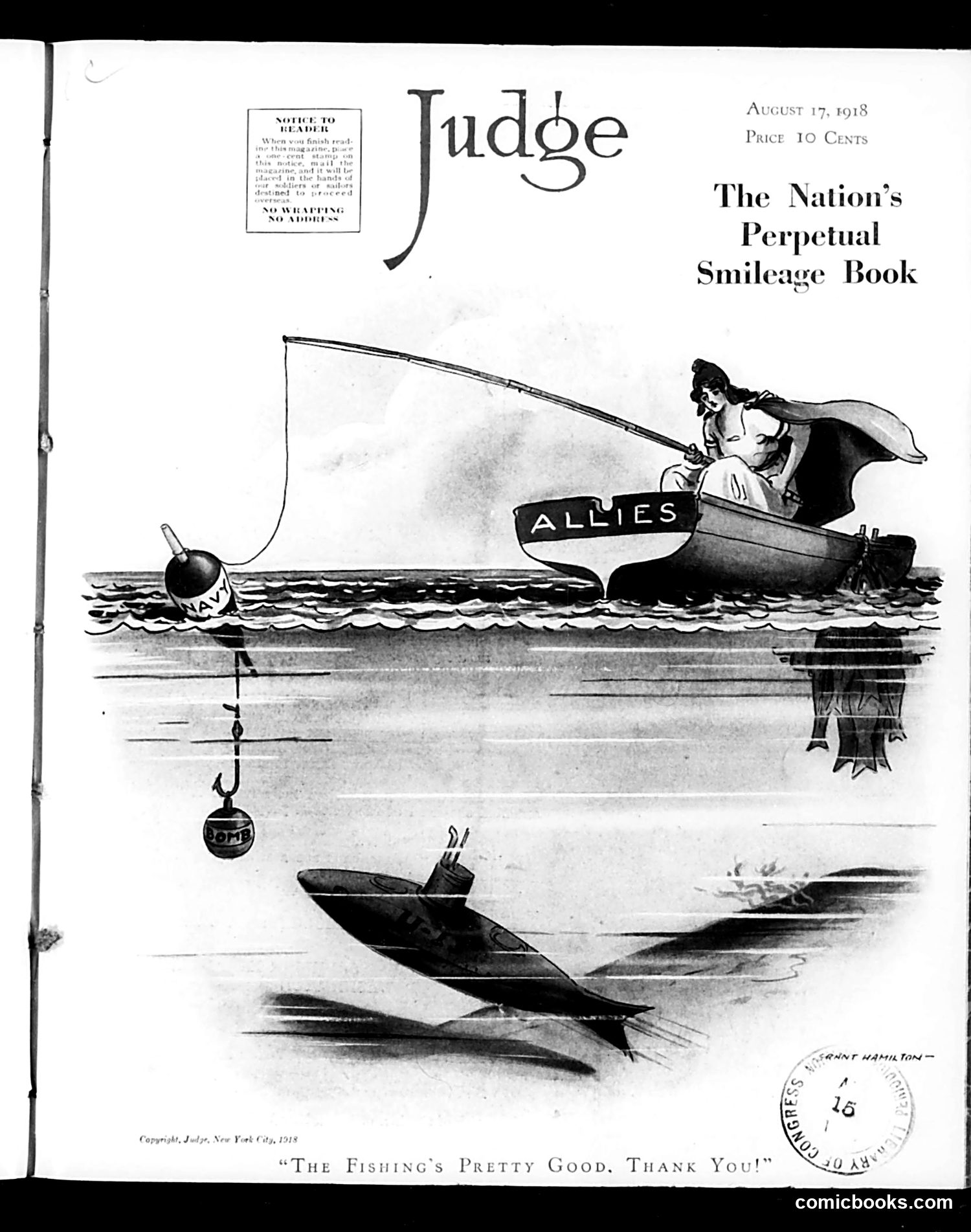
This is the August 17, 1918 cover of *Judge* magazine, dated during World War I's final months. The cartoon depicts an allegorical fishing scene titled "The Fishing's Pretty Good, Thank You!" A figure labeled "ALLIES" sits in a boat with a fishing rod, successfully catching what appear to be enemy vessels or submarines below the water's surface. A naval mine floats nearby. The satire celebrates Allied military success in submarine warfare and naval combat against Central Powers enemies. The subtitle "The Nation's Perpetual Smileage Book" suggests *Judge's* role as humorous commentary on current events. This is triumphalist wartime propaganda, mocking enemy losses while reassuring American readers of Allied superiority as World War I neared its November 1918 conclusion.
This is a World War I-era public service advertisement (not a cartoon) promoting War Savings Stamps. The piece sarcastically critiques American consumer frivolity by presenting three examples of thoughtless spending: buying an unnecessary hat, ordering extra taxi rides, and overeating. The advertisement then pivots to shame this behavior, contrasting Americans' casual wastefulness with soldiers dying in the trenches ("Picardy mud"). It argues Americans aren't selfish—merely thoughtless—and urges them to redirect discretionary spending into war bonds at 4½% interest instead. The National War Savings Committee sponsored this message through Judge magazine, using guilt and patriotic duty to encourage financial sacrifice for the war effort. The tone is deliberately harsh to motivate behavioral change.
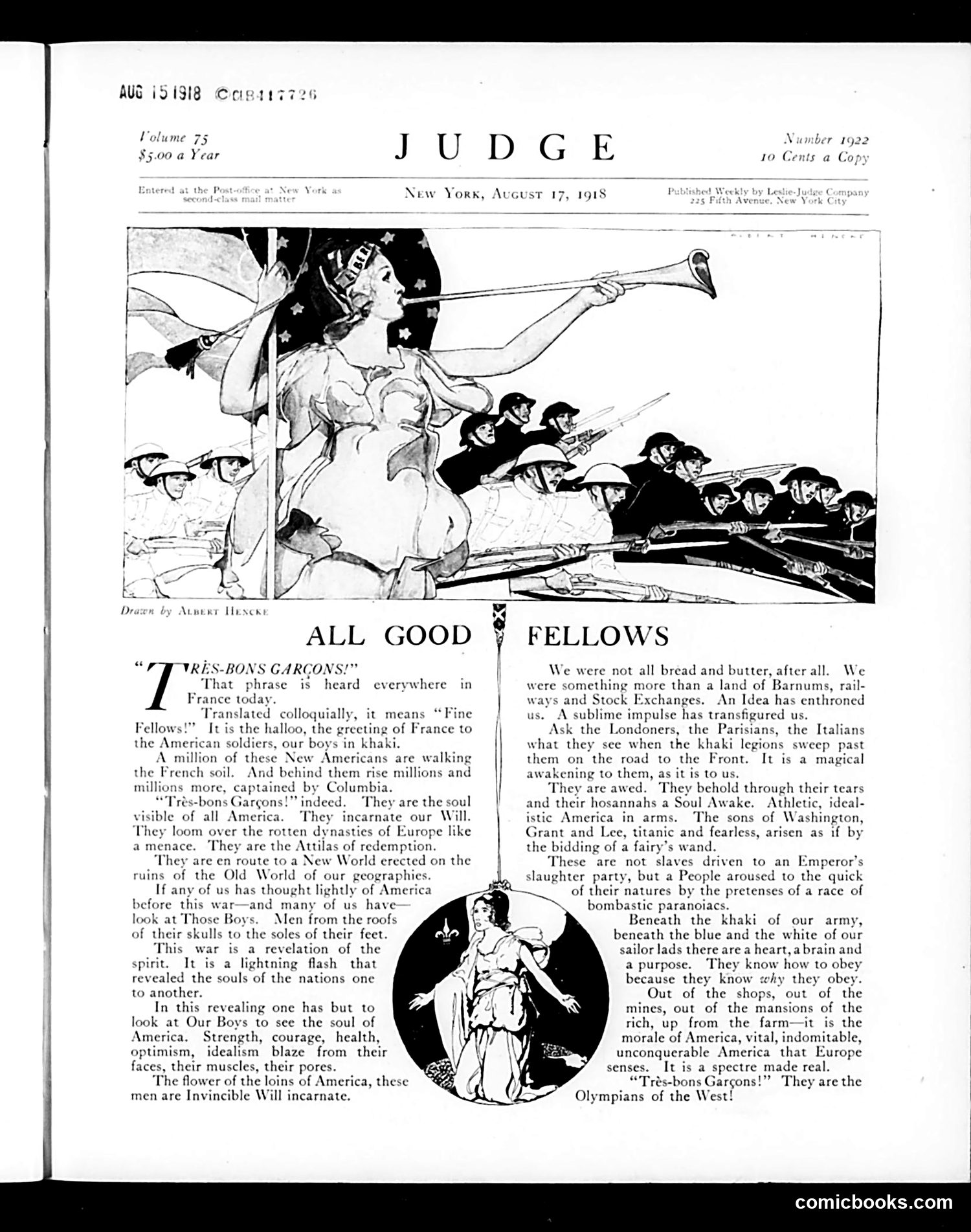
This page celebrates American soldiers in World War I through allegorical imagery. The top illustration depicts Liberty (a classical female figure with a trumpet) inspiring soldiers advancing into battle with rifles and bayonets fixed. The accompanying text, "All Good Fellows," uses the French phrase "Très-bons Garçons!" ("fine fellows") to praise American troops. It characterizes them as embodying American ideals—strength, courage, health, and optimism—drawn from diverse backgrounds (shops, mines, farms, mansions). The rhetoric romanticizes military service, portraying soldiers as noble "Olympians of the West" who represent America's moral superiority over Europe. Published during the final months of WWI, this represents wartime propaganda celebrating American intervention and soldier sacrifice.
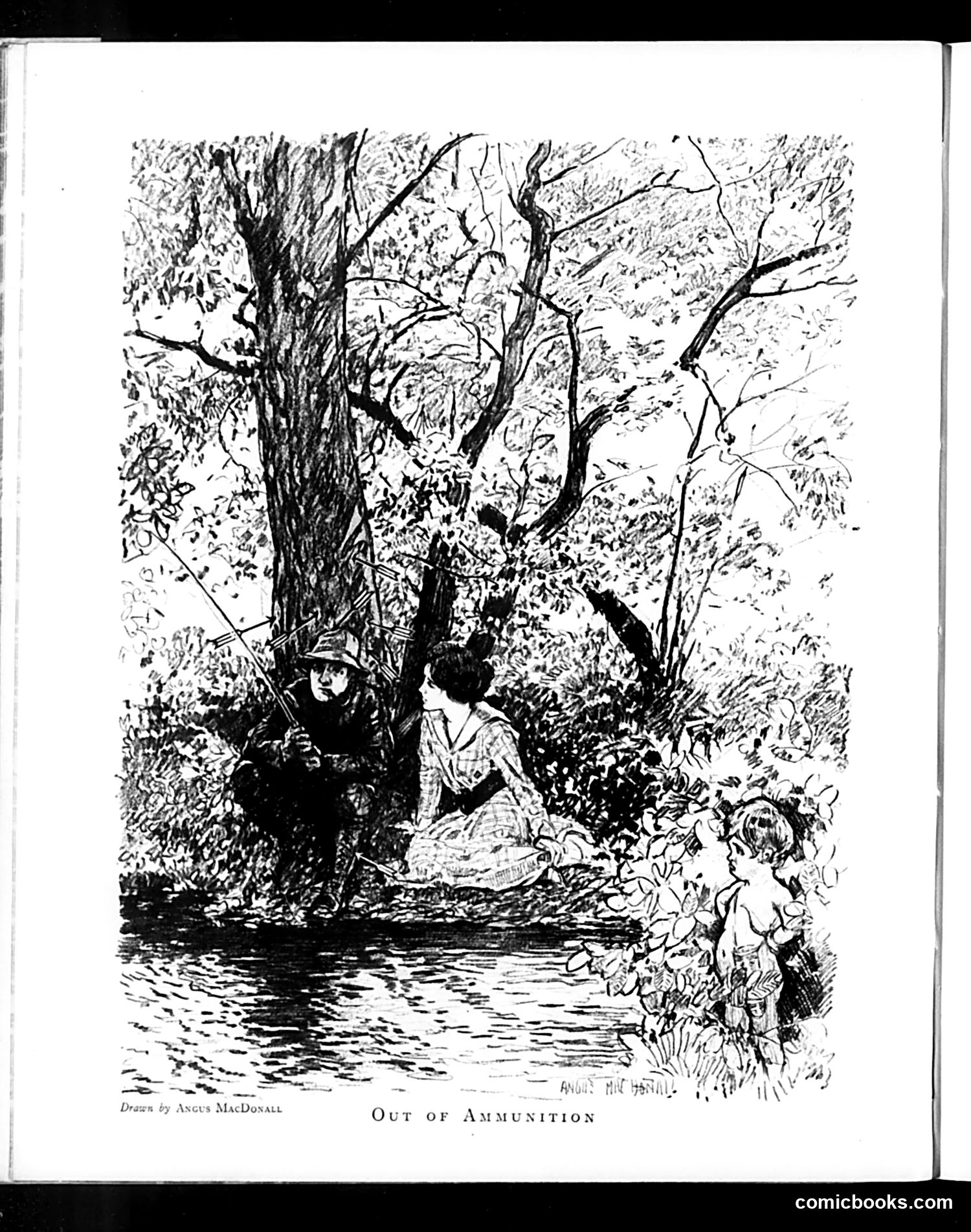
This illustration by Angus MacDonald depicts a romantic or domestic scene rather than explicit political satire. The image shows figures by a stream beneath large trees—a woman in light dress seated centrally, a man in dark clothing to the left, and a child on the right among foliage. The title "Out of Ammunition" is ambiguous without additional context. It may reference a contemporary political or social debate about resource depletion, military readiness, or metaphorically "running out" of something—possibly relating to early 20th-century concerns about conservation or preparedness. The pastoral setting contrasts with the martial language of the title, creating potential ironic commentary, though the specific target remains unclear from the image alone.
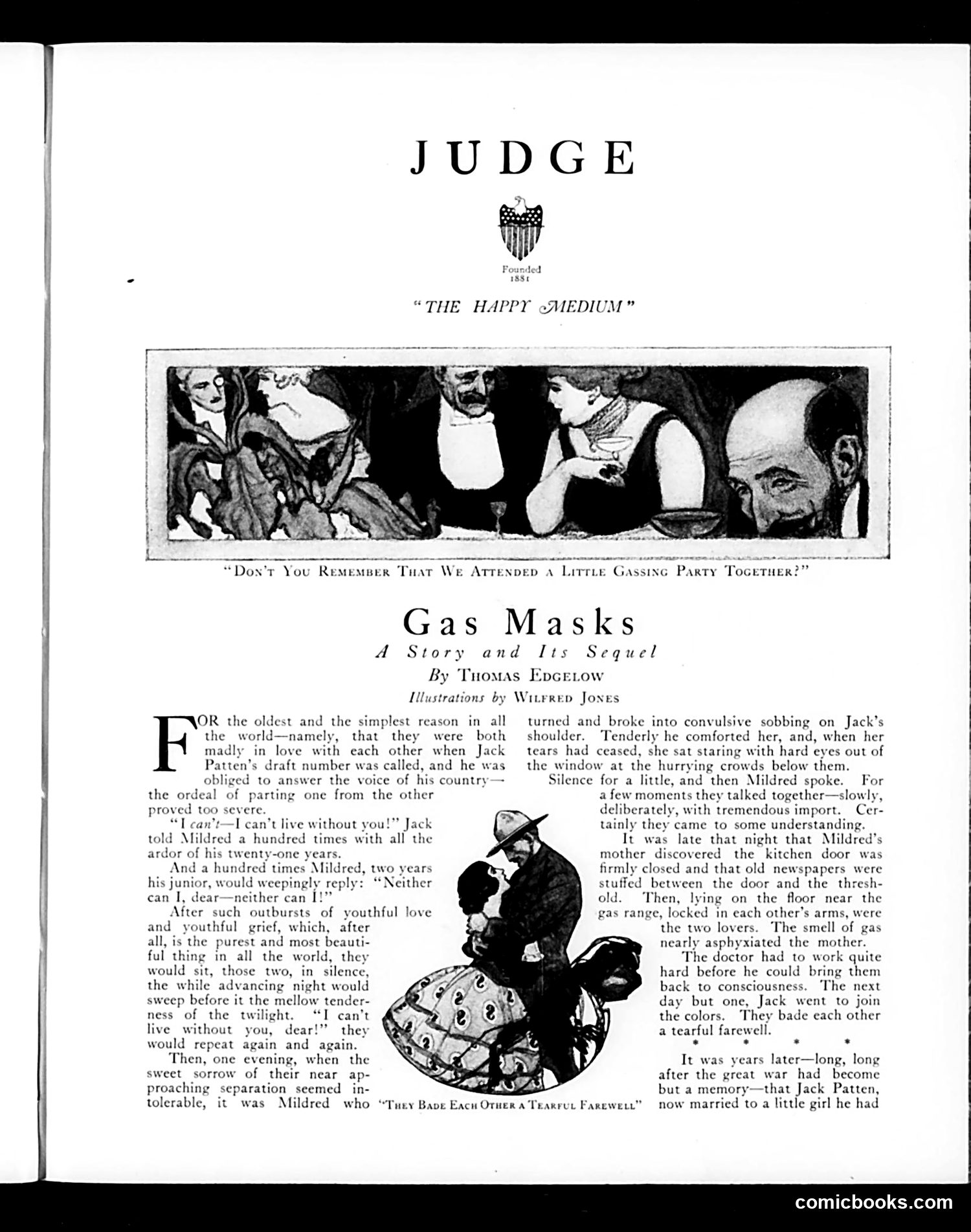
This page from *Judge* magazine presents "Gas Masks: A Story and Its Sequel" by Thomas Edgelow, illustrated by Wilfred Jones. The content is a wartime narrative about two lovers, Jack Patten and Mildred, separated by World War I. The top illustration shows a "gassing party" (a social gathering), while the main narrative illustration depicts Jack and Mildred's tearful farewell. The story references the actual horror of chemical weapons used in WWI—specifically poison gas attacks. The "happy medium" subtitle appears ironic given the tragic wartime separation theme. The narrative follows their forced parting and subsequent reunion after the war, when Jack marries another woman. This is sentimental wartime fiction emphasizing the personal costs of conflict, not political satire.
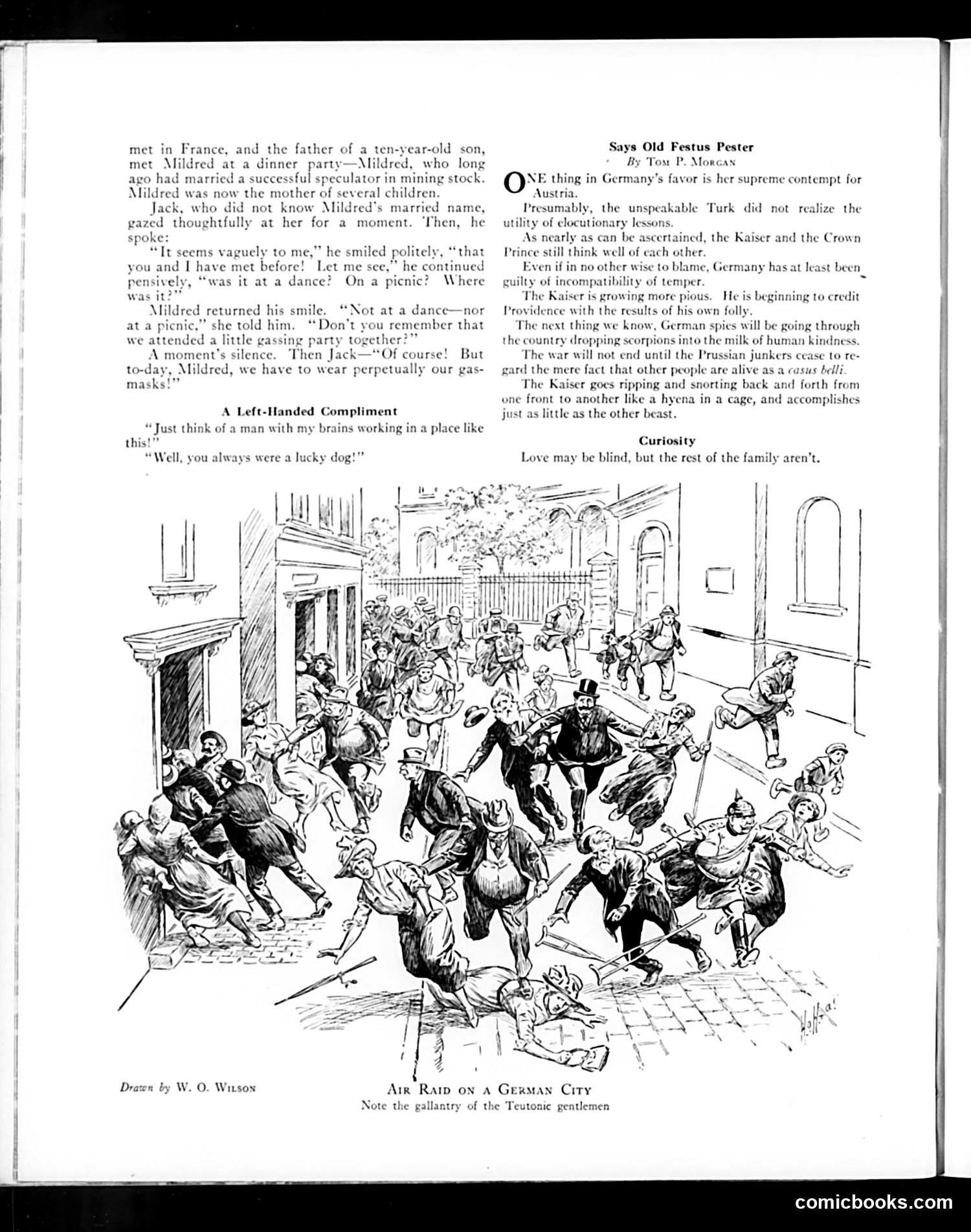
This page from Judge magazine contains satirical commentary on World War I. The main cartoon, "Air Raid on a German City," drawn by W. O. Wilson, depicts German civilians in panic during an aerial bombardment. The caption notes "the gallantry of the Teutonic gentlemen"—a sarcastic jab suggesting German military conduct contradicts their claimed civilized status. The accompanying text sections ("Says Old Festus Pester," "A Left-Handed Compliment," and "Curiosity") offer biting commentary on German-Austrian relations and Kaiser Wilhelm's leadership. The satire emphasizes themes of German militarism, incompetence, and hypocrisy—common American propaganda during WWI, when Judge positioned itself against German aggression and in favor of Allied causes.
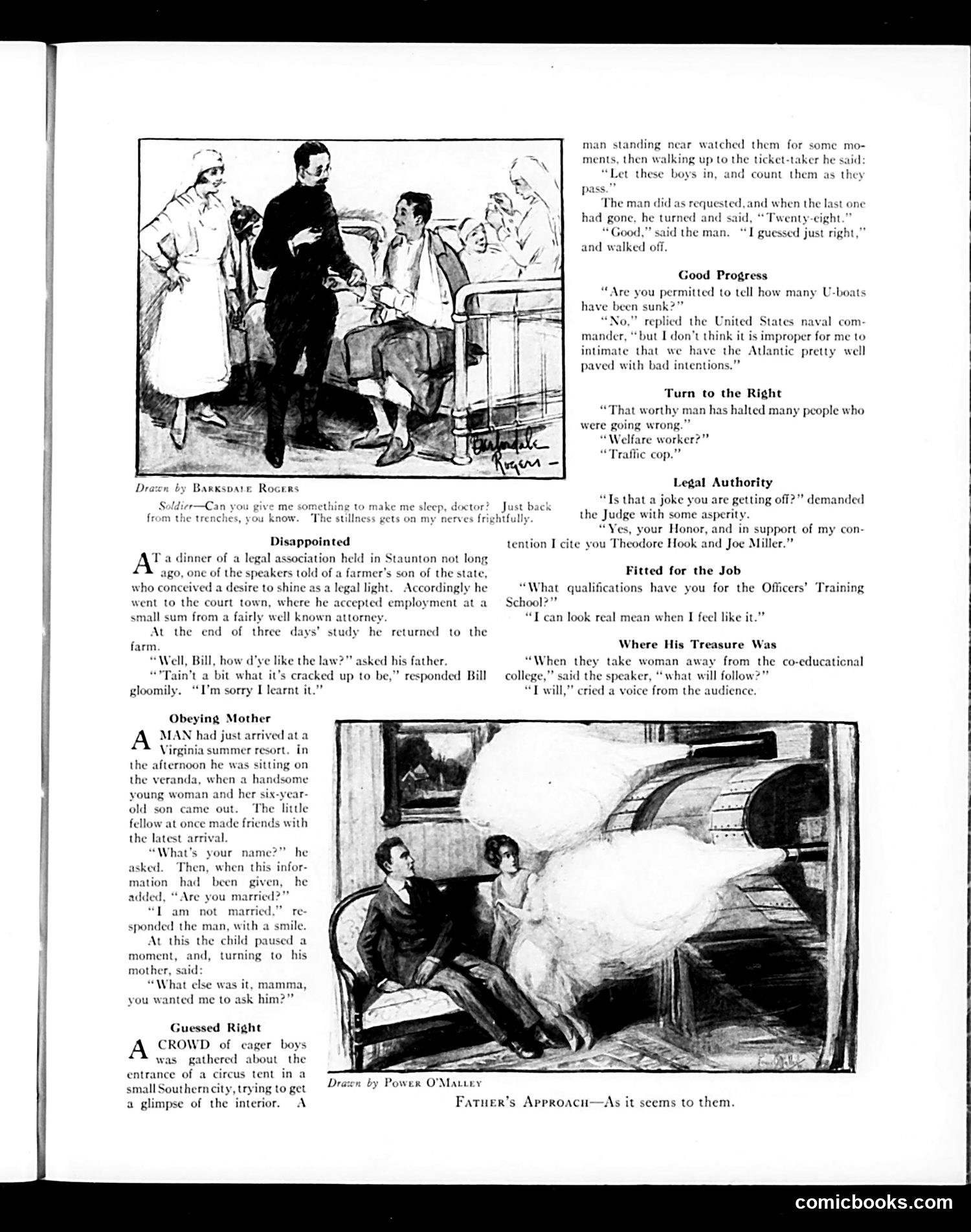
This page contains multiple short humorous anecdotes typical of early 20th-century American satirical magazines: **"Disappointed"** mocks a farmer's son who abandons legal studies after three days, finding the profession disappointing—satirizing naive ambition. **"Obeying Mother"** depicts a child coached by his mother to ask a stranger if he's married, then follow up with "what else did you want me to ask?"—satirizing matchmaking mothers and social awkwardness. **"Guessed Right"** shows a man using circus boys to count attendance, then claiming he "guessed" the number—gentle satire on clever manipulation. The remaining shorts include WWI-era content (U-boat references), commentary on welfare workers/traffic enforcement, and concerns about co-education's impact on young women—reflecting period anxieties about changing social institutions and gender roles. The cartoons by Barksdale Rogers and Power O'Malley illustrate these brief jokes meant to provoke knowing chuckles from Judge's educated readership.
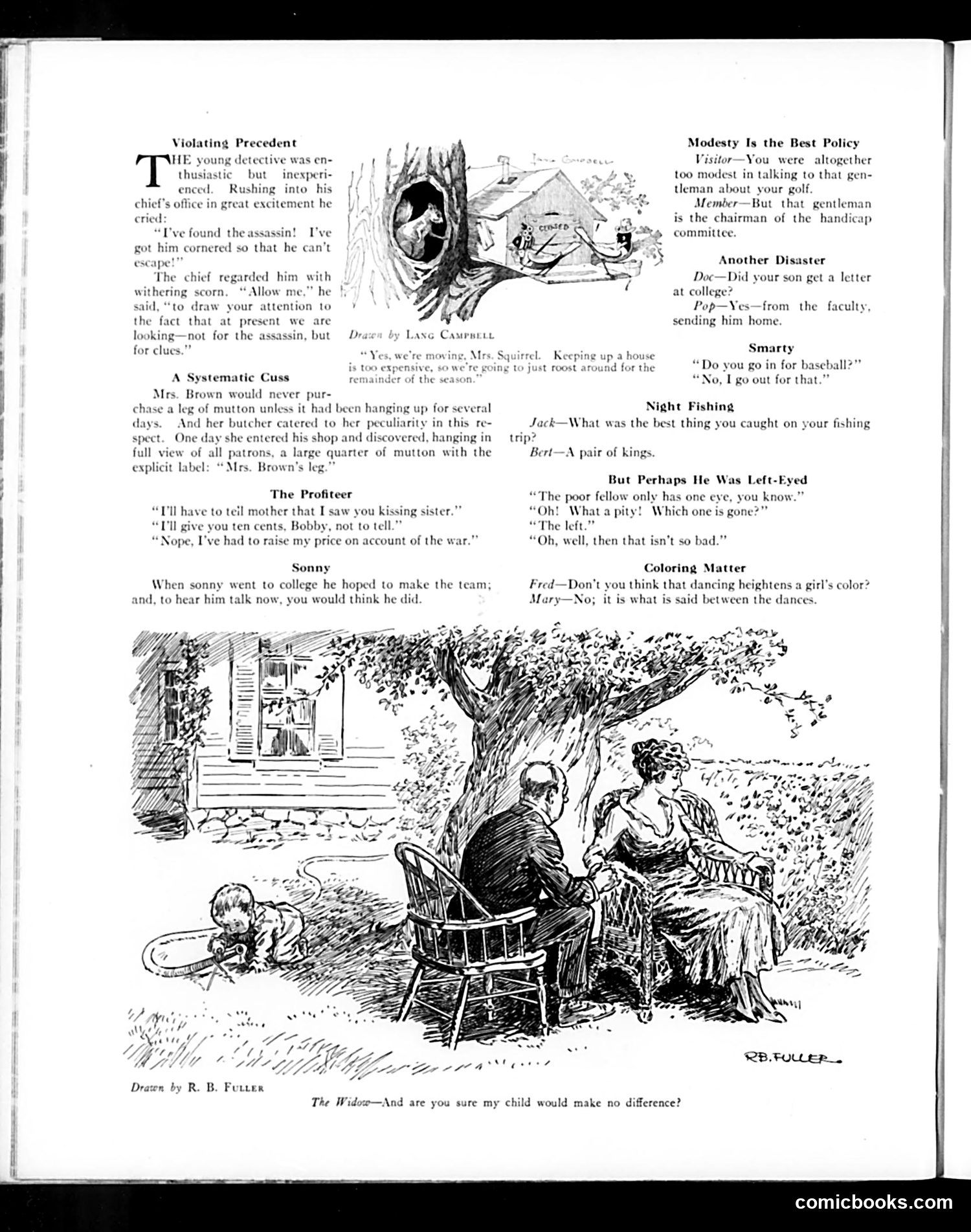
This page contains multiple short jokes and two illustrated cartoons from an early 20th-century American satirical magazine. The top cartoon mocks detective work, with a police chief rebuking an inexperienced detective for catching a suspect rather than following proper investigative procedure—a joke about bureaucratic rigidity. The bottom cartoon by R.B. Fuller shows a widow asking a man if her child would make "no difference" to him, likely a marriage-proposal scene where she's testing his commitment. The text sections are brief humorous anecdotes touching on wartime profiteering (a boy extorting his brother, then raising prices "on account of the war"), butcher shop humor, college disappointments, and social awkwardness (the golfer's modesty before the handicap committee chairman). The "Coloring Matter" joke plays on the double meaning of "color"—physical appearance versus rumors spread during social dancing. These are typical light satirical humor of the period, aimed at middle-class readers.
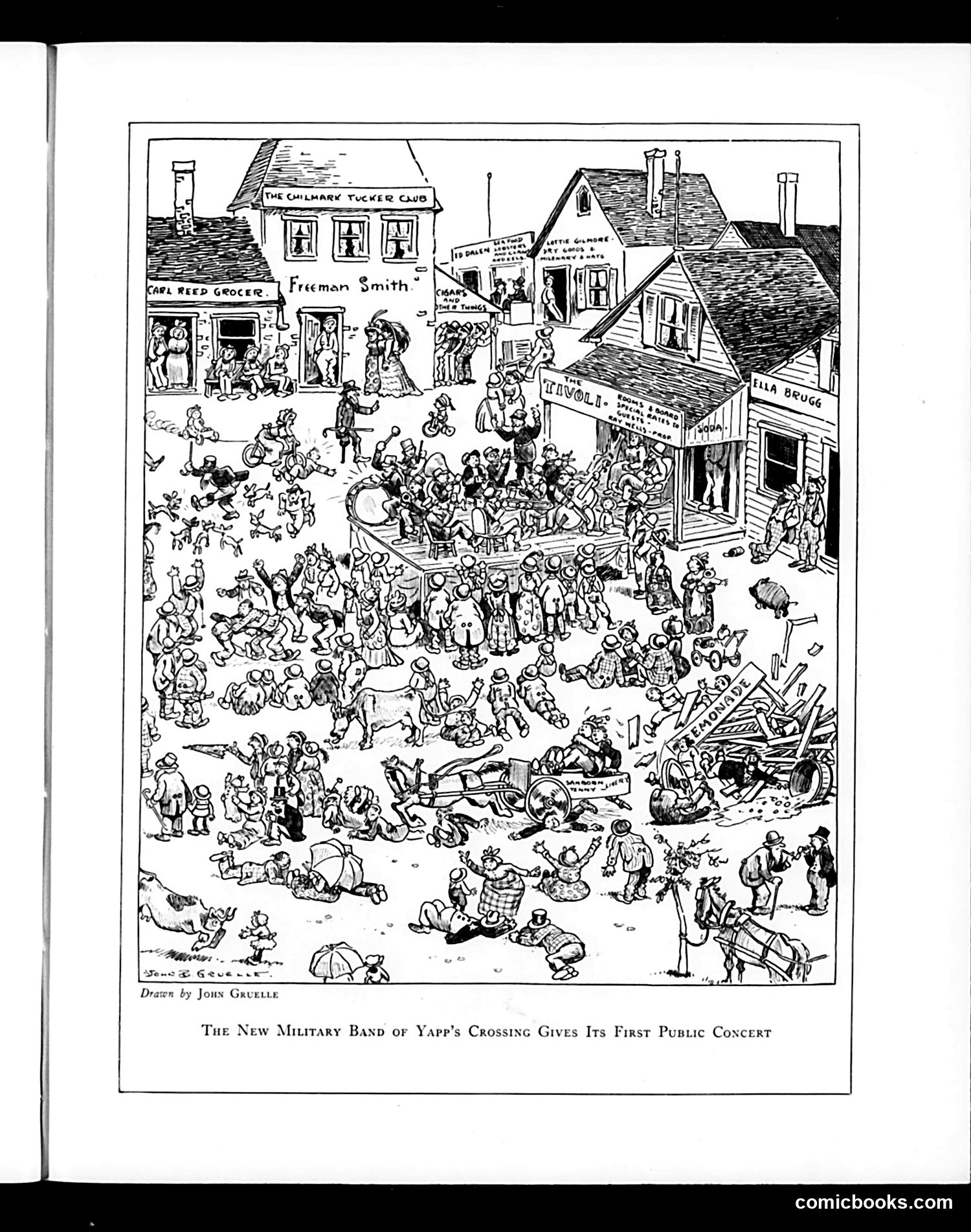
This is a chaotic street scene drawn by John Gruelle depicting "The New Military Band of Yapp's Crossing Gives Its First Public Concert." The illustration satirizes a small-town band performance gone hilariously wrong. The packed crowd of townspeople—adults and children—surrounds what appears to be an amateur musical group, with visible chaos: people on bicycles, someone with a drum, scattered instruments, and general pandemonium. Visible storefronts include "Cap Reid Grocer," "The Chilmark Tucker Club," and "Ila Drugg" (likely "Ila Drugg" pharmacy). The satire mocks the earnest but disorganized efforts of a provincial town attempting cultural sophistication, resulting in comedic disorder. This reflects Judge magazine's typical humor ridiculing small-town American life and pretension.
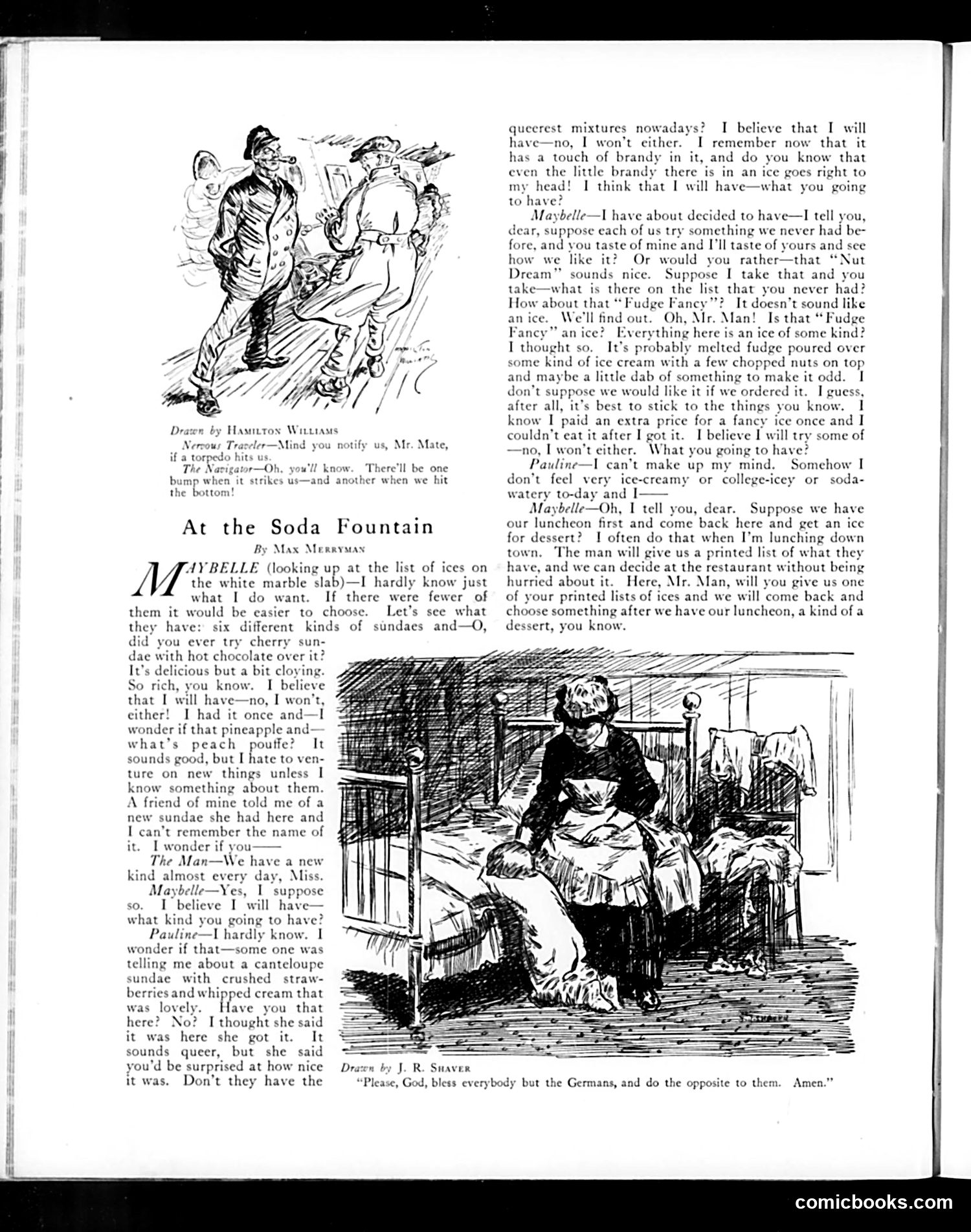
This is a humorous dialogue (not political satire) by Max Mearystax depicting two young women, Maybelle and Pauline, unable to decide what ice cream or sundae to order at a soda fountain despite the clerk's offerings. The joke centers on their indecision: they vacillate endlessly, worry about trying unfamiliar flavors, ask repeated questions, and ultimately decide to leave and return later with a printed menu. The satire targets early 20th-century consumer culture and female decision-making—the abundance of choices paradoxically makes selection harder. There's gentle mockery of women's perceived tendency toward indecision and concern with fashion in their consumption habits. The unrelated caption at page bottom referencing Germans appears disconnected and likely reflects WWI-era anti-German sentiment common in Judge magazine during that period, though its connection to this story is unclear.
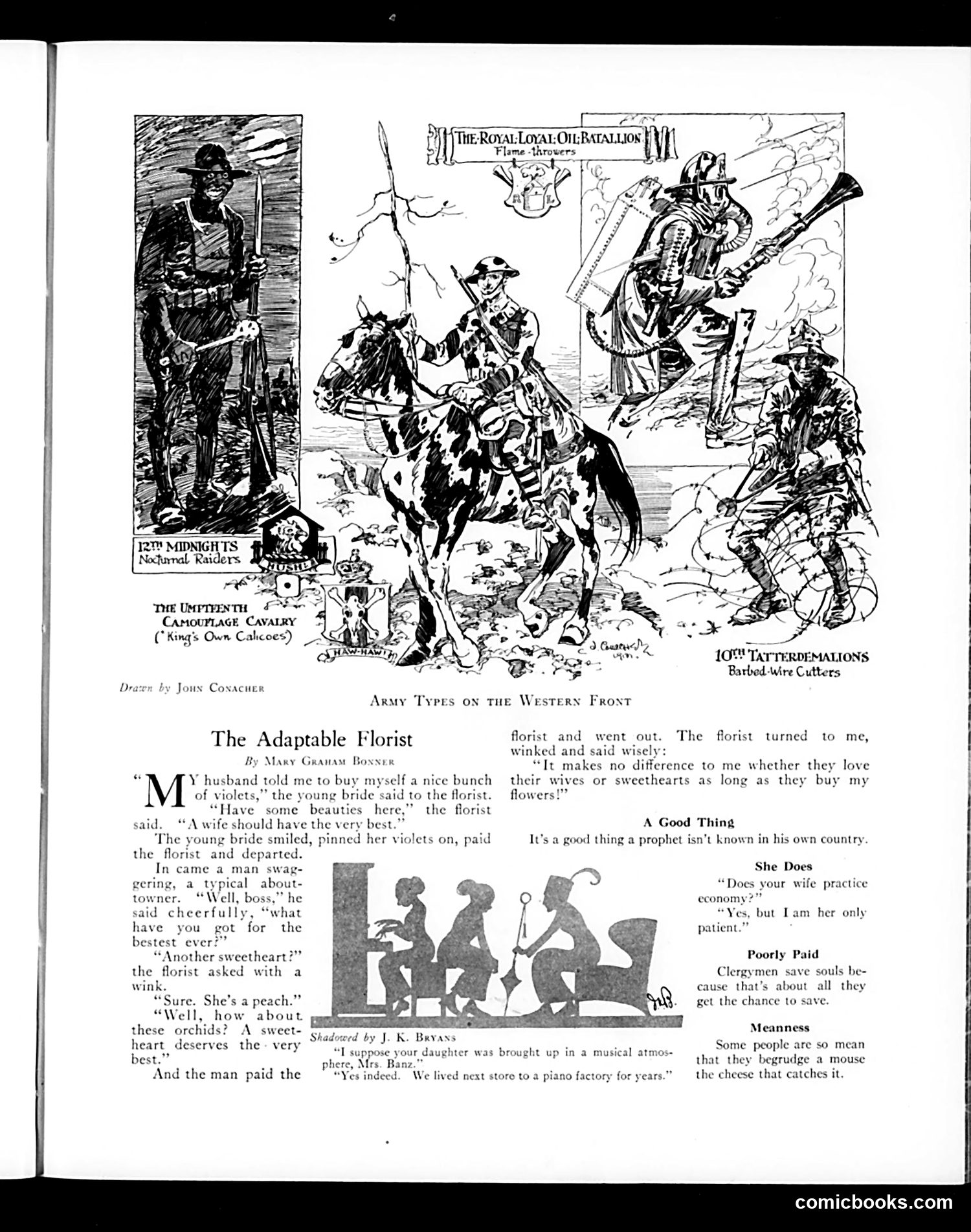
The top illustration by John Conachar shows British military units during World War I, labeled with their actual names (12th Midnights Nocturnal Raiders, Camouflage Cavalry, etc.). This appears to be straightforward military documentation rather than satire. "The Adaptable Florist" by Mary Graham Bonner is a humorous short story about a pragmatic florist. A bride buys violets for herself, then a man buys expensive orchids for "another sweetheart"—a romantic rival. The florist's wisdom: he doesn't judge his customers' moral choices; he profits from their sentiments regardless. The accompanying jokes mock clergymen's low pay, wives' economizing, and meanness. The overall message: business thrives on human nature, whether noble or foolish.
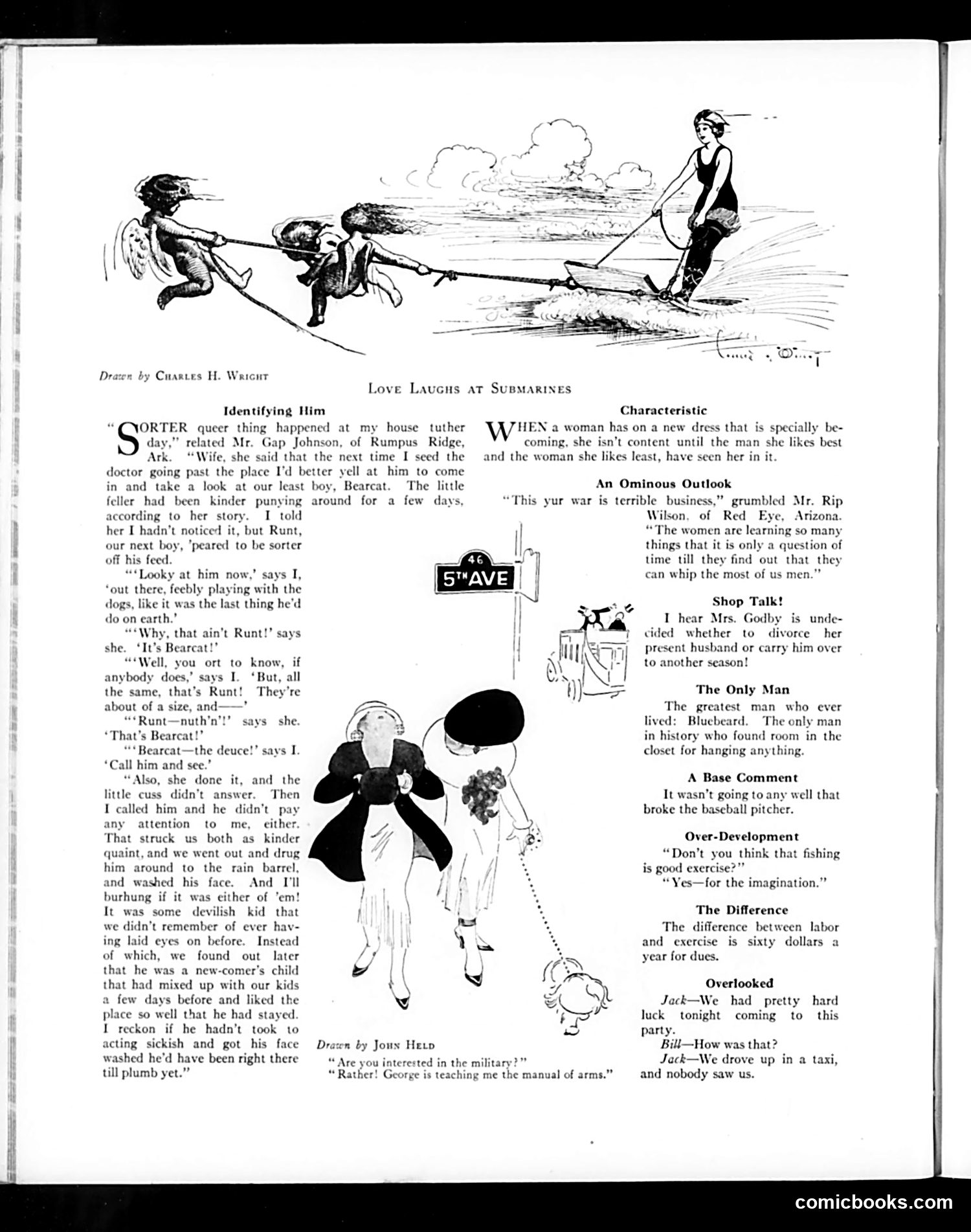
This humorous story satirizes rural simplicity and parental inattention. A farmer cannot distinguish his own son "Runt" from a neighbor's child "Bearcat" who has been visiting. The boy has become so integrated into their household that the father fails to recognize him even when the child acts sickly. Only after washing the boy's face do they realize their error—a stranger has essentially moved in unnoticed. The joke targets the father's obliviousness and suggests how casually children could blend into rural communities. It reflects early 20th-century attitudes about country life as less organized or observant than urban society. The page also contains brief satirical notes about contemporary subjects: women learning military skills during wartime (suggesting anxiety about gender roles), and commentary on wealth and social pretense—typical of *Judge* magazine's social humor.
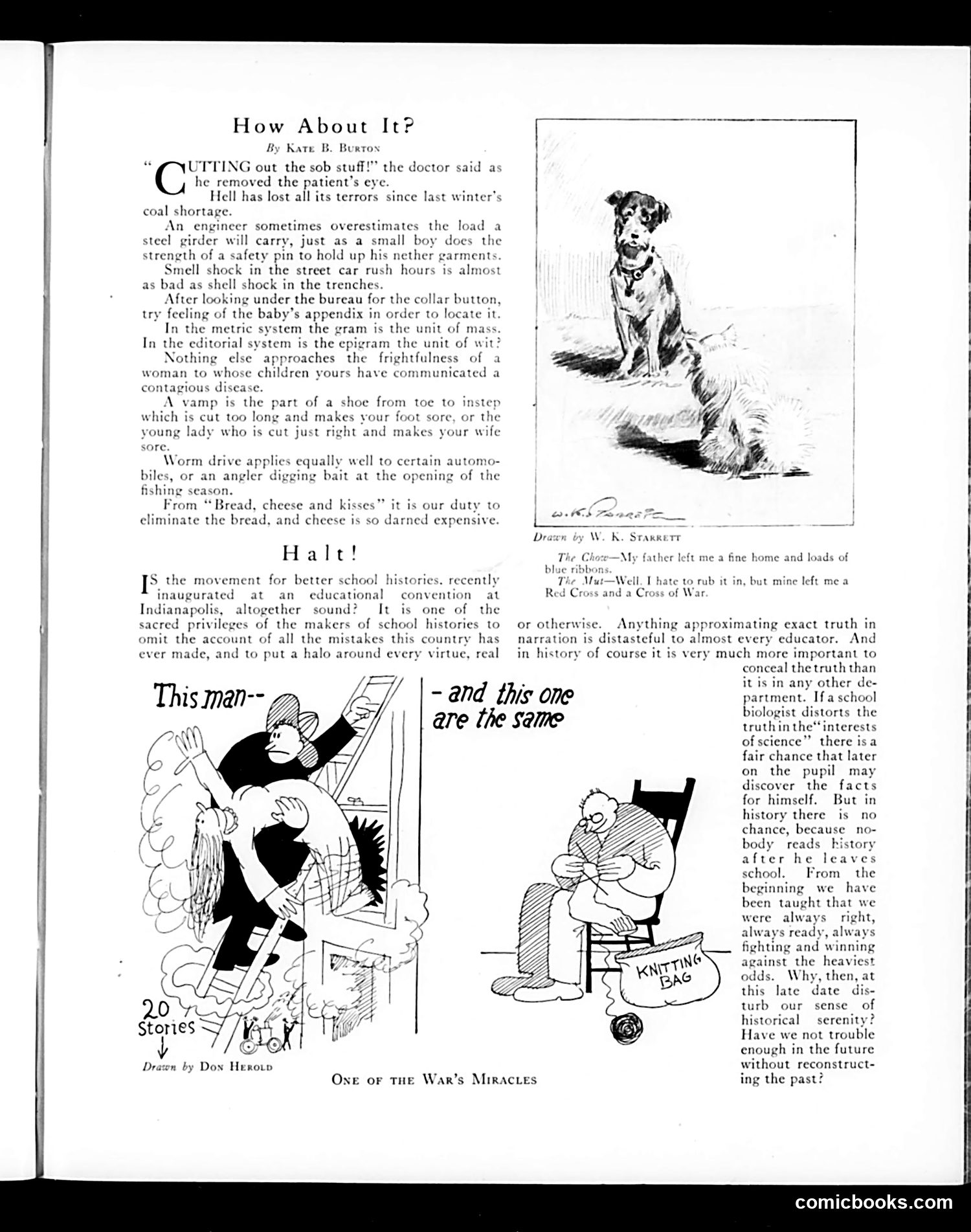
This page combines humorous aphorisms with satirical commentary on American war narratives. The top section presents witty observations about everyday life (medical procedures, metric systems, marital frustrations). The "Halt!" section critiques a movement for more honest school history textbooks, advocating instead for patriotic mythology. The author argues that Americans have always been taught they were "always right, always ready, always fighting and winning against the heaviest odds"—and questions why this comfortable national narrative should be disrupted with factual accuracy. The cartoon by Dox Herold, "One of the War's Miracles," depicts a figure (likely representing American pride or nationalism) surrounded by stacked "20 Stories" of official accounts, suggesting the towering fictional narratives built around wartime events. The message is ironic: the author defends historical distortion as preferable to uncomfortable truth—a critique of American educational jingoism, likely written during or shortly after World War I.
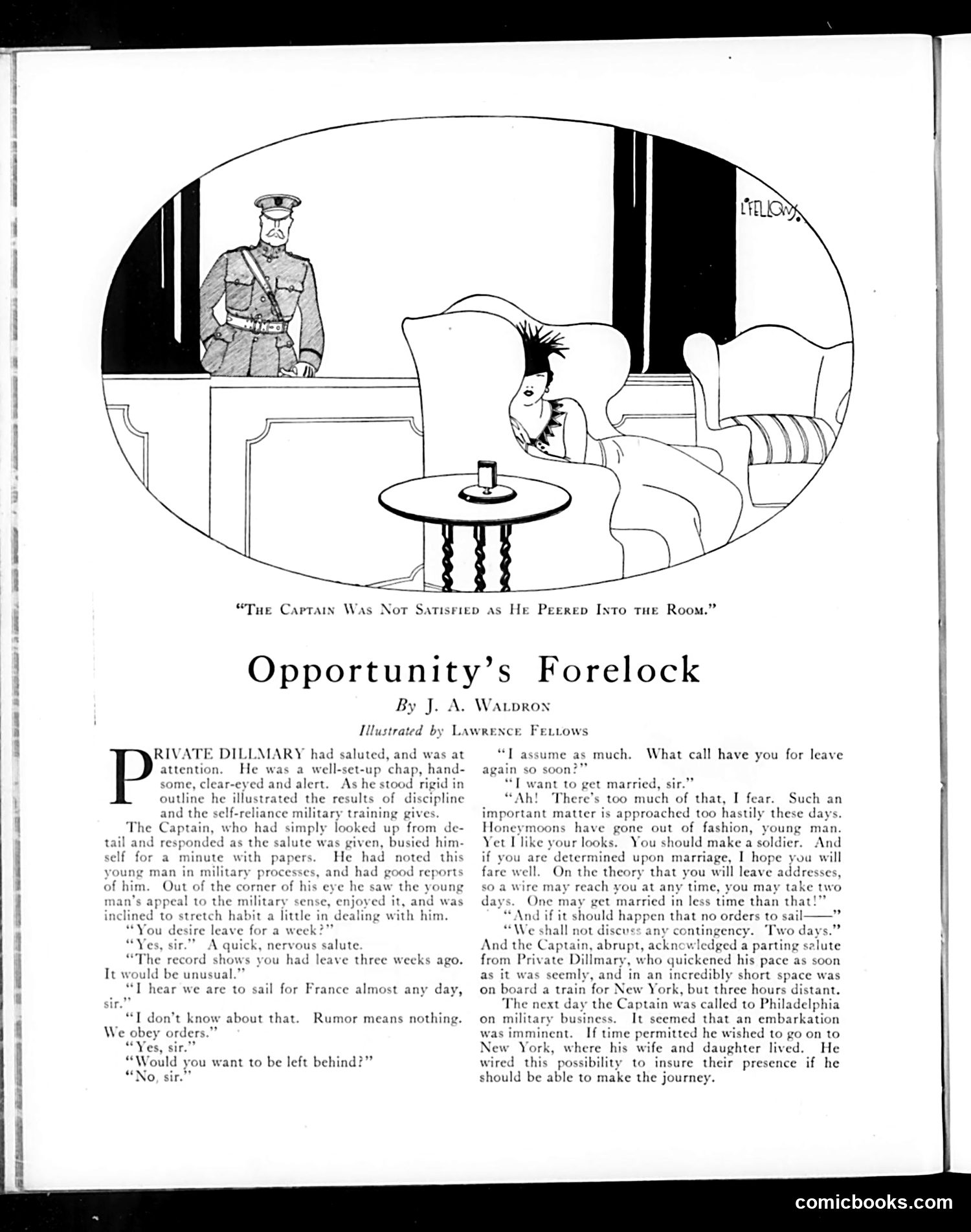
This is a short story rather than a political cartoon, illustrated by Lawrence Fellows. It depicts a military scene where Private Dillmary requests leave from his Captain to get married. The Captain, initially stern, grants him two days—seemingly reluctant but ultimately sympathetic to the young soldier's appeal. The narrative illustrates early 20th-century military discipline and social attitudes. The story's title, "Opportunity's Forelock," suggests seizing the moment. The ironic setup: the Captain grants leave based on military principle (not discussing contingencies), unaware he himself will soon travel to New York—where the private is heading—creating potential for an unexpected encounter. The satire targets military rigidity and romance during wartime (references to sailing for France suggest WWI era), exploring tension between institutional discipline and human desire. The Captain's dismissal of hasty marriages contrasts with his own family ties, hinting at hypocrisy or life's unpredictability.
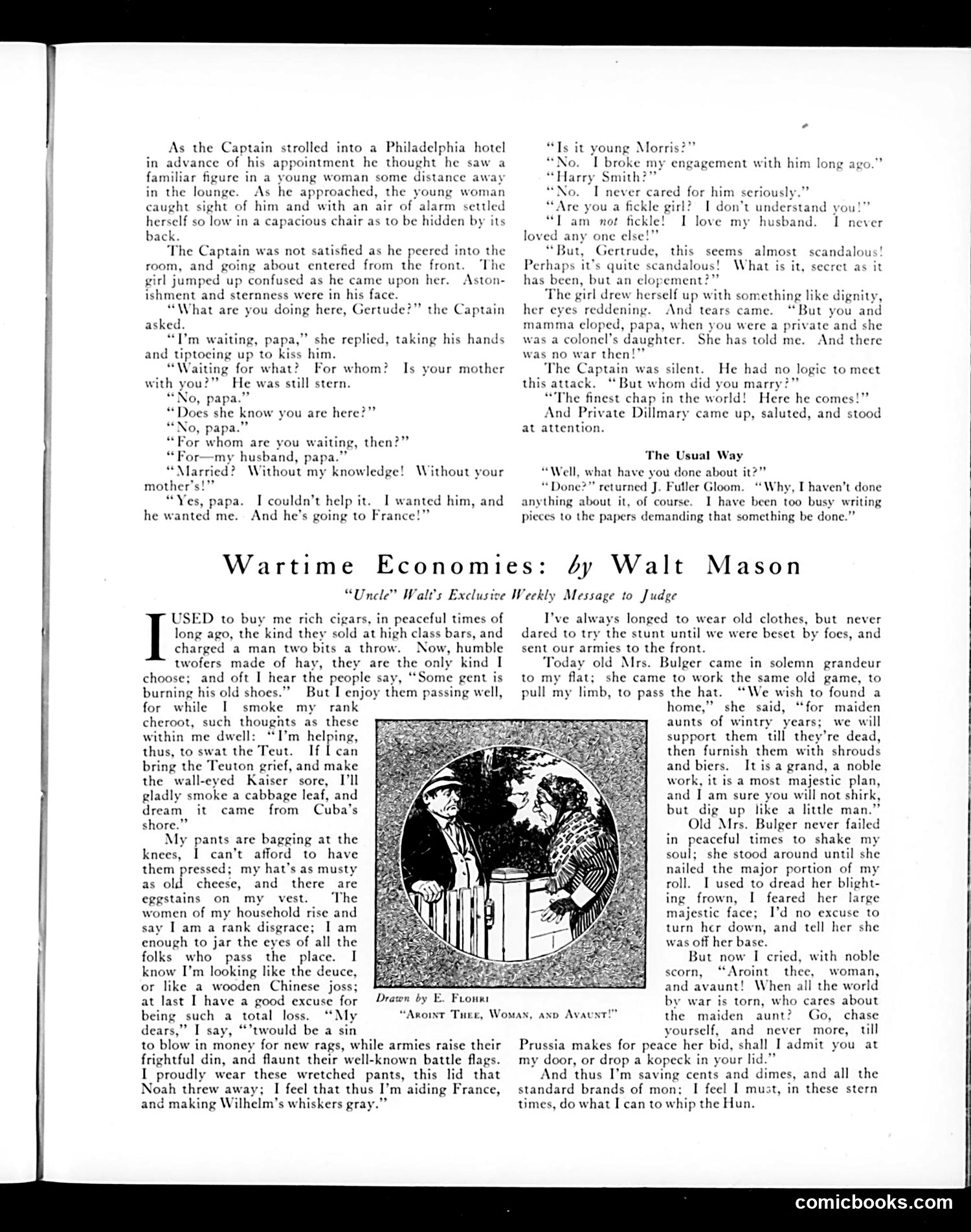
This page contains two distinct pieces of WWI-era American satire: **Top Story ("The Captain"):** A domestic drama where a military captain discovers his daughter Gertrude has eloped without permission. She defends herself by pointing out her parents did the same—her mother was a colonel's daughter, her father a private. The satire critiques the hypocrisy of older generations imposing strict rules on younger ones during wartime, while having broken those same rules themselves. **"Wartime Economies" by Walt Mason:** A humorous column about wartime sacrifice. Mason adopts an exaggerated persona of shabby appearance—wearing cheap cigars, bagging pants, stained vest, and old hat—claiming these sacrifices help defeat Germany ("the Teut," "Wilhelm"). The satire mocks Americans who make performative displays of wartime austerity while demanding others do more, as shown in "The Usual Way" snippet where someone complains about problems without actually addressing them. Both pieces use WWI's domestic disruptions as satirical subjects.
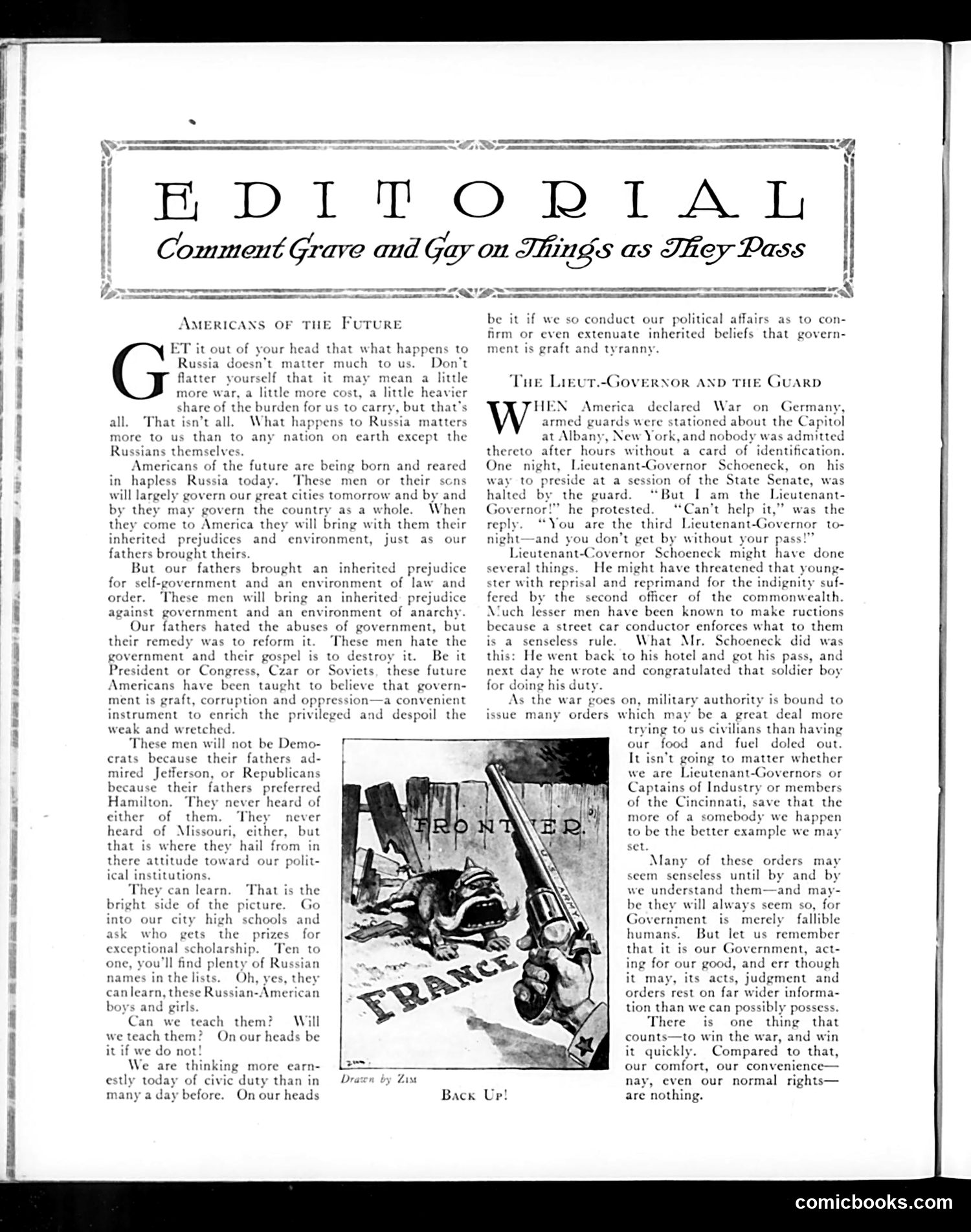
This editorial page contains two pieces of wartime commentary: **"Americans of the Future"** warns that Russian immigrants—fleeing a government they view as corrupt tyranny—will bring anti-government prejudices to America. The author argues these future Americans, unlike earlier immigrants who valued self-governance, will teach their children that all government is graft. The piece urges Americans to conduct civic affairs honorably to avoid confirming these inherited suspicions. **"The Lieut.-Governor and the Guard"** praises New York Lieutenant-Governor Schoeneck for accepting a security guard's refusal of entry during wartime, despite his rank. Rather than demanding deference, Schoeneck retrieved his pass and later congratulated the soldier. The piece uses this anecdote to argue that during wartime, civilians—even important ones—must accept military authority without complaint for the war effort's sake. Both editorials promote wartime sacrifice and cooperation with authority, reflecting Judge's pro-war stance during America's WWI involvement.
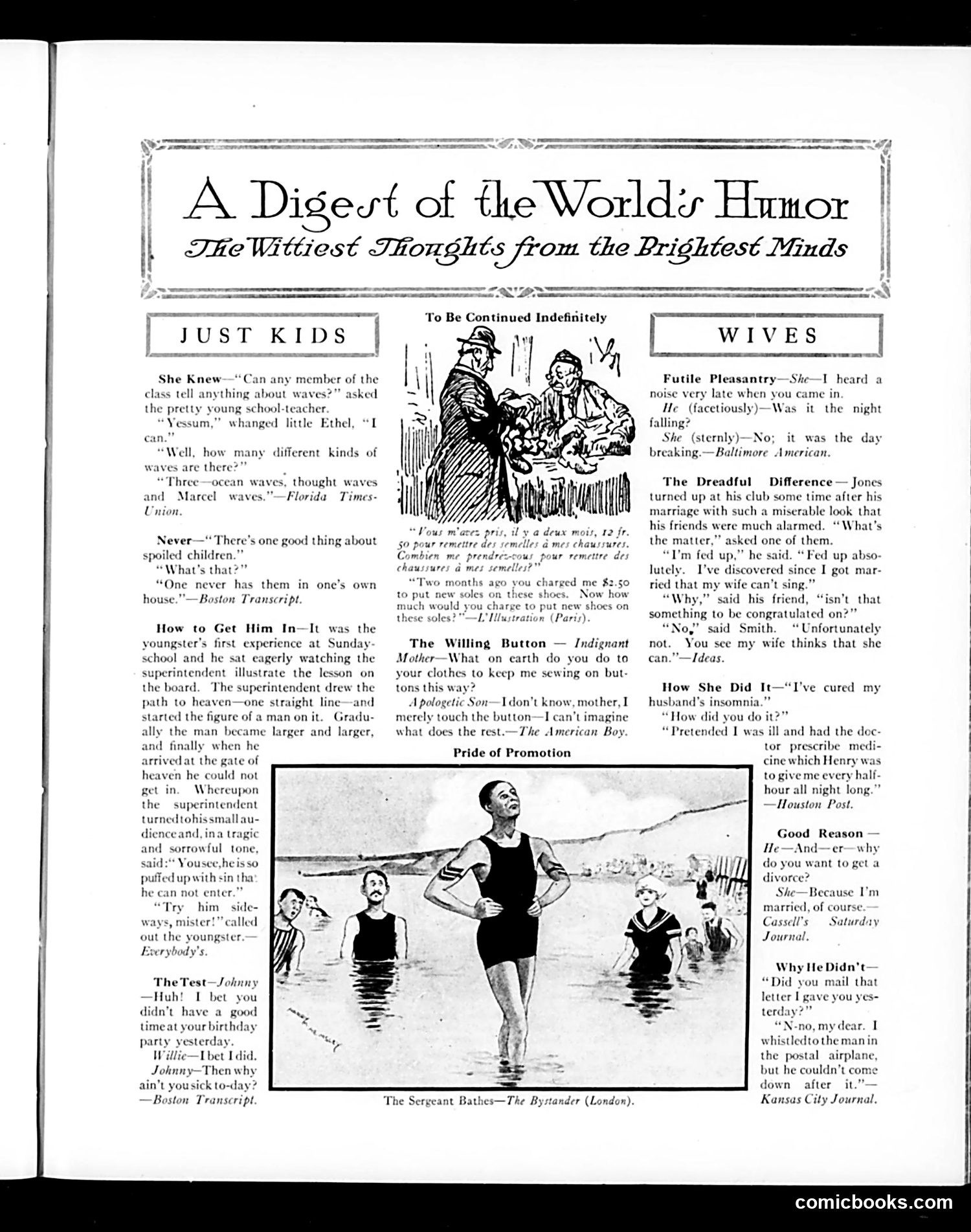
This page collects brief humorous anecdotes organized by category: "Just Kids," "Wives," and "Pride of Promotion." The humor reflects early 20th-century domestic and social attitudes. The "Just Kids" section features children's innocent misunderstandings—a girl confusing ocean waves with Marcel waves (a fashionable hairstyle), or a boy suggesting the superintendent try fitting a man into heaven "sideways." The "Wives" section satirizes marriage through wives' nagging (sewing buttons), marital discord, and wives' delusions—particularly the joke about a wife who "thinks she can sing" when she cannot, treated as a marital tragedy worth celebrating. The central cartoon ("The Sergeant Bathes") shows a muscular man swimming while smaller figures remain in shallow water, likely mocking military pride or physical vanity. Overall, the page reflects period stereotypes about children, wives' perceived foolishness, and marriage as inherently frustrating for husbands.
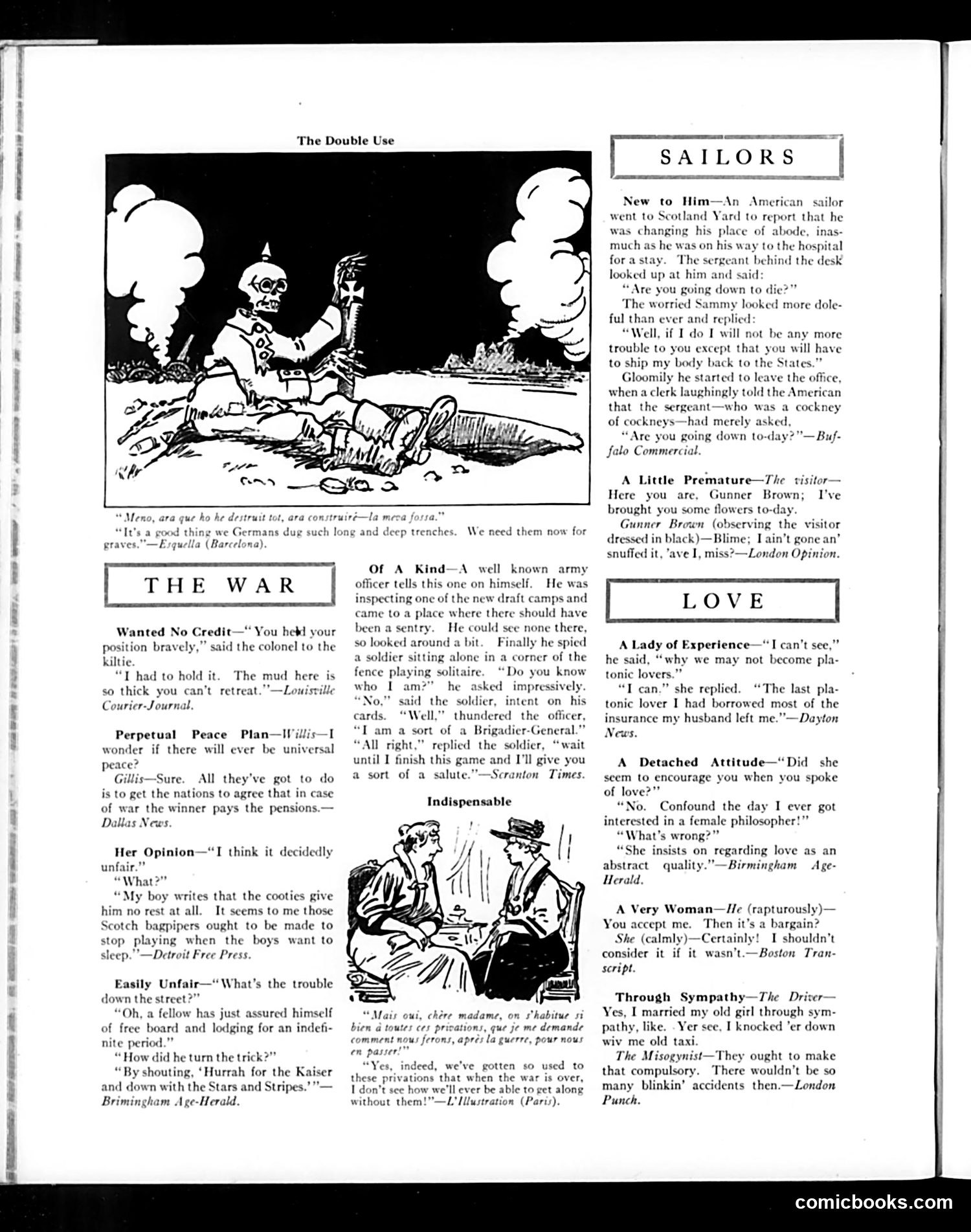
This page collects wartime humor and social commentary, likely from WWI era. **"The Double Use"** cartoon (top) depicts a skeletal Death figure presiding over a trench—referencing the brutal stalemate warfare and massive casualties of trench combat. **"The War" section** contains jokes mocking military absurdities: a soldier unable to retreat because mud is too thick; a proposal that war losers pay pensions (satirizing the financial burden of conflict); and a draftee's ignorance of military hierarchy, humorously refusing a proper salute to a self-proclaimed "Brigadier-General." **"Sailors"** features dialect humor about American soldiers abroad encountering British slang. **"Love"** offers domestic comedy: women portrayed as mercenary or philosophically detached from romance; a man marrying out of pity; husbands sympathizing with wives' traffic accidents. The overall tone reflects American public attitudes during WWI—combining dark humor about combat, mockery of military pomposity, and traditional gender stereotypes presented as light entertainment for middle-class readers.
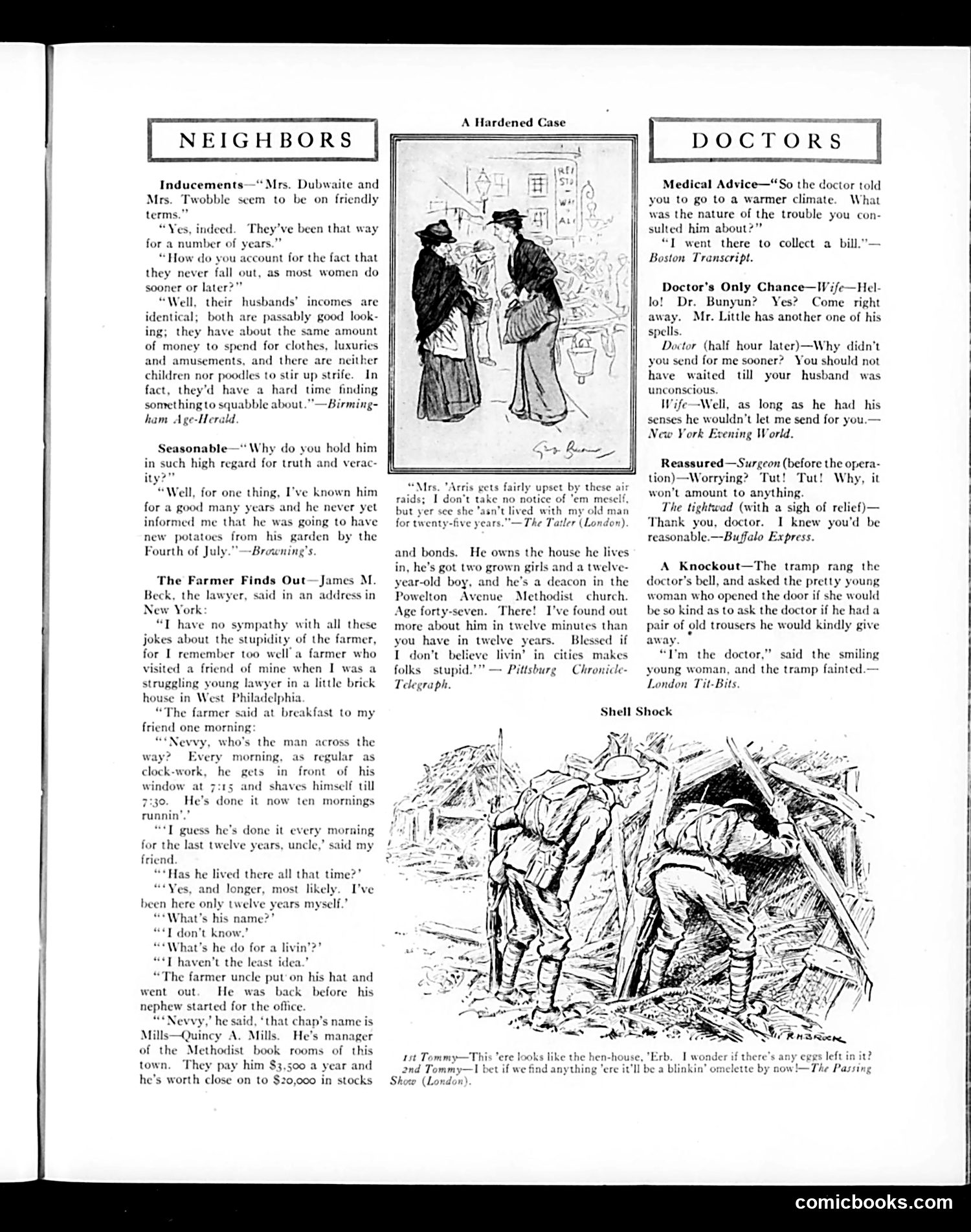
This page from *Judge* magazine contains humorous anecdotal pieces satirizing American social behavior, organized by topic. **"Neighbors"** mocks assumptions about female friendships by revealing two women never quarrel simply because their husbands earn identical incomes and they're similarly matched in appearance and resources—suggesting women's friendships depend entirely on economic equality and material circumstances, not genuine affection. **"The Farmer Finds Out"** inverts the "stupid farmer" stereotype: a rural visitor, dismissed as unsophisticated, uses simple direct observation to learn a city neighbor's full life details (employment, wealth, family, religion) in minutes—information the city-dweller never bothered discovering despite twelve years' proximity. It satirizes urban indifference and the assumption that rural people are less intelligent than urban dwellers. **"Doctors"** comprises three brief jokes: one about a doctor more interested in bill collection than health; another about a timid husband avoiding medical care; and a tramp's shock discovering his benefactor is a woman doctor (playing on period surprise that women practiced medicine). The cartoons illustrate these anecdotes with period-appropriate illustrations.
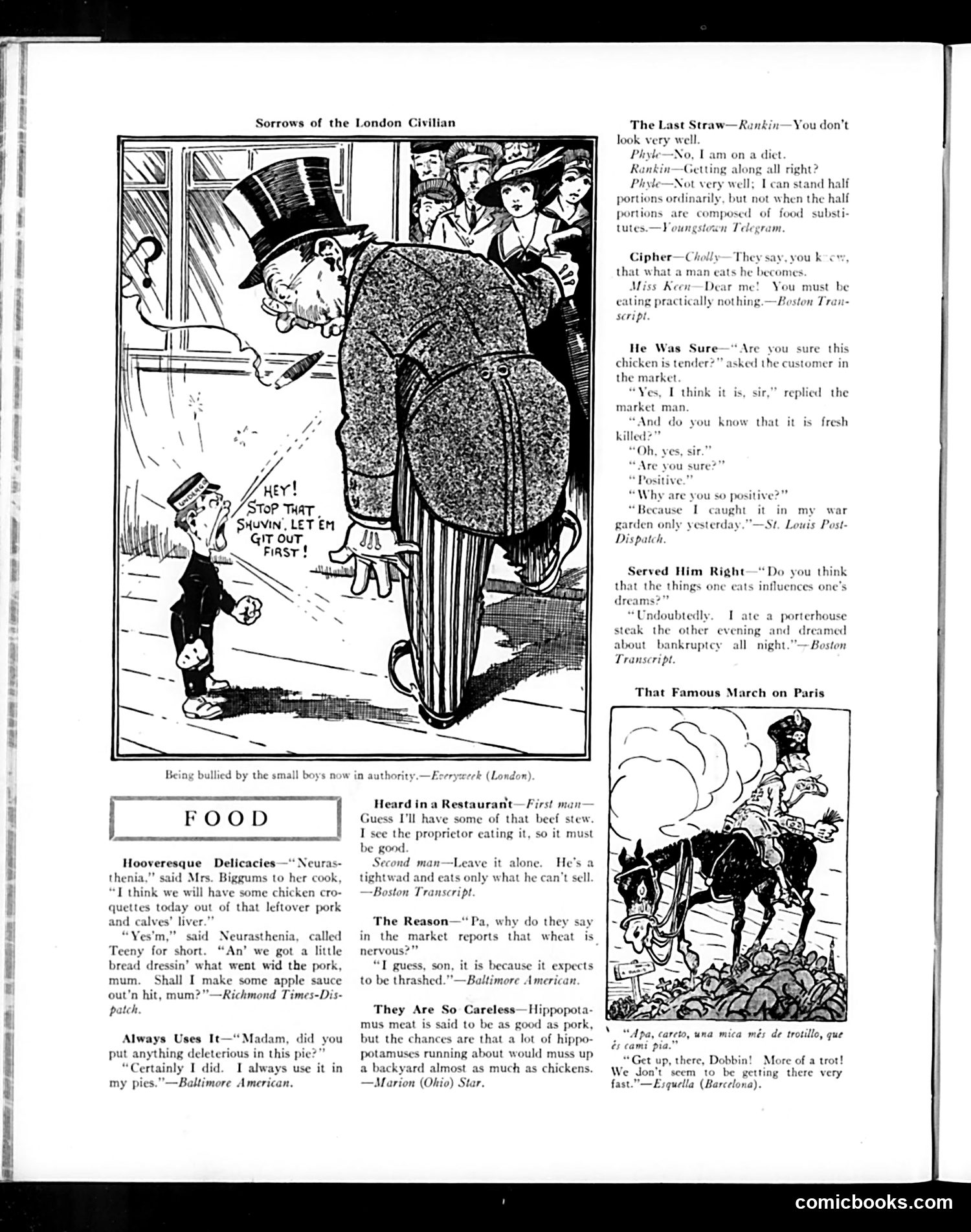
This page satirizes **food scarcity and rationing during World War I**, likely from 1917-1918 when Britain faced severe shortages. The main cartoon depicts a large civilian being bullied by small boys "in authority"—a metaphor for wartime rationing restrictions imposed on ordinary people by government officials. The "FOOD" section collects jokes about food substitution and degradation. References to "Hooveresque Delicacies" allude to Herbert Hoover's Food Administration, which promoted conservation. Jokes mock: - Eating inedible substitutes (pork masquerading as chicken) - Market men selling questionable meat - People eating whatever's available, however poor quality The "That Famous March on Paris" cartoon appears to mock slow military progress, possibly the stalled Western Front. Overall, the page uses humor to air civilian frustrations with wartime deprivation and the bureaucratic control of food supplies—a pointed social criticism dressed in comedy.
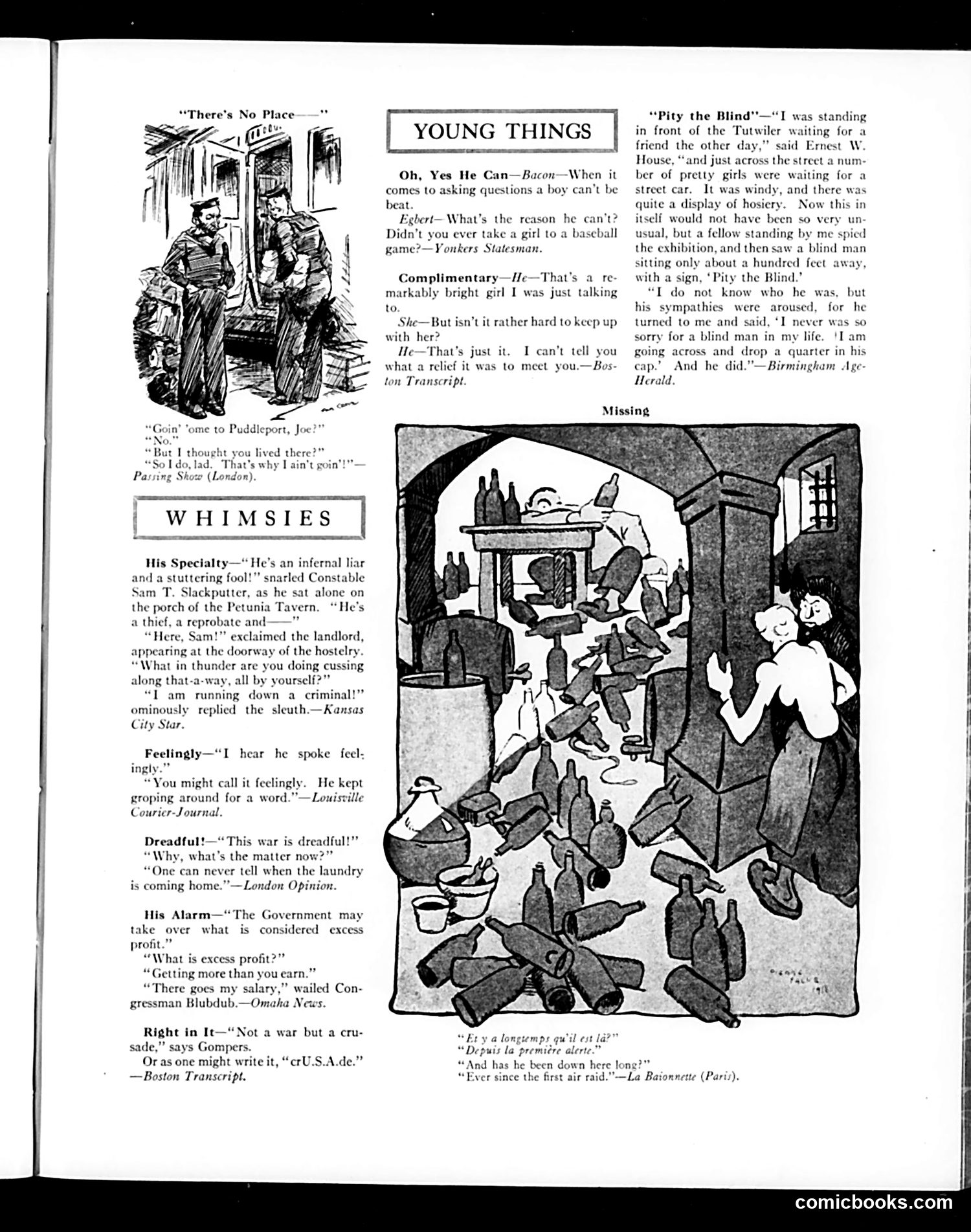
This page contains humorous short jokes and a cartoon, typical of Judge's satirical format. **The "Missing" Cartoon** depicts a WWI-era cellar scene with numerous wine bottles scattered about, a man at a table, and a woman gesturing—illustrating a French joke about someone who has been in the cellar "since the first air raid." The humor lies in the implication that he's been down there drinking rather than sheltering from danger. **The Short Jokes** include: - References to WWI ("This war is dreadful!") with domestic complaints about laundry delays - A dig at Congressman Blubdub regarding "excess profits"—topical wartime taxation debates - Labor leader Gompers' characterization of the war as a "crusade" rather than war (possibly critiquing his pacifist stance or rhetoric) - Light romantic/courtship humor in "Young Things" **Overall Context**: This reflects American civilian life during WWI, with jokes about government overreach, labor politics, wartime anxieties, and the European conflict's peripheral impact on American society.
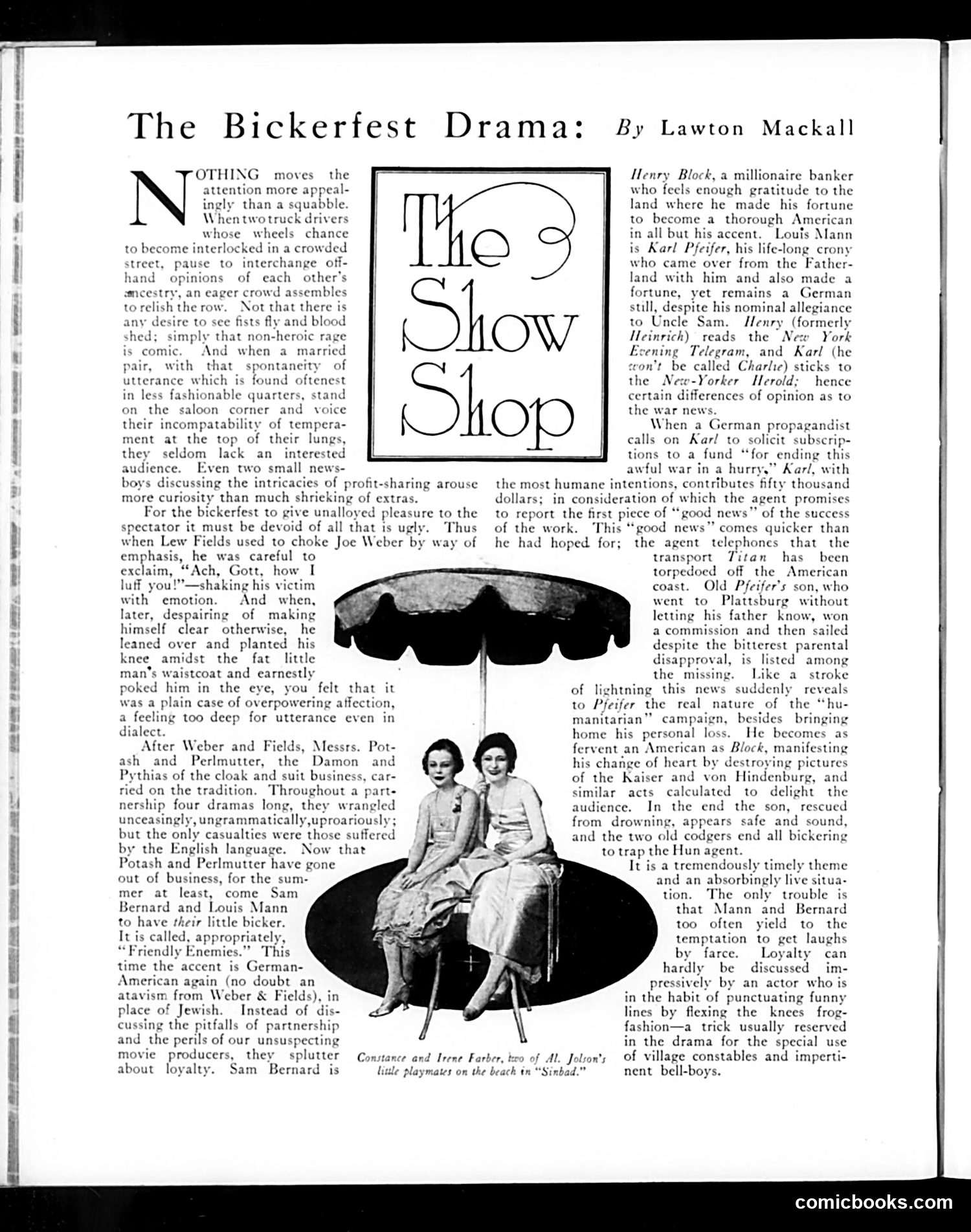
This article discusses "Friendly Enemies," a theatrical comedy by Lawton Mackall featuring Sam Bernard and Louis Mann. The piece traces a theatrical tradition of comedic "bickering" acts—from Weber & Fields through Potash and Perlmutter—now adapted with German-American characters rather than Jewish ones. The plot centers on Henry Block and Karl Pfeifer, wealthy immigrants. When a German propagandist persuades Pfeifer to donate $50,000 to end "the war" (WWI), Pfeifer learns the "good news" is that a ship was torpedoed—revealing the propaganda's pro-German agenda. The tragedy intensifies when Pfeifer discovers his own son, serving in the American military, was lost in that attack. This transforms Pfeifer from a duped sympathizer into a committed American patriot. The satire targets German-American dual loyalty during WWI and exposes German propaganda operations in America, while celebrating immigrant assimilation through personal tragedy and national awakening.
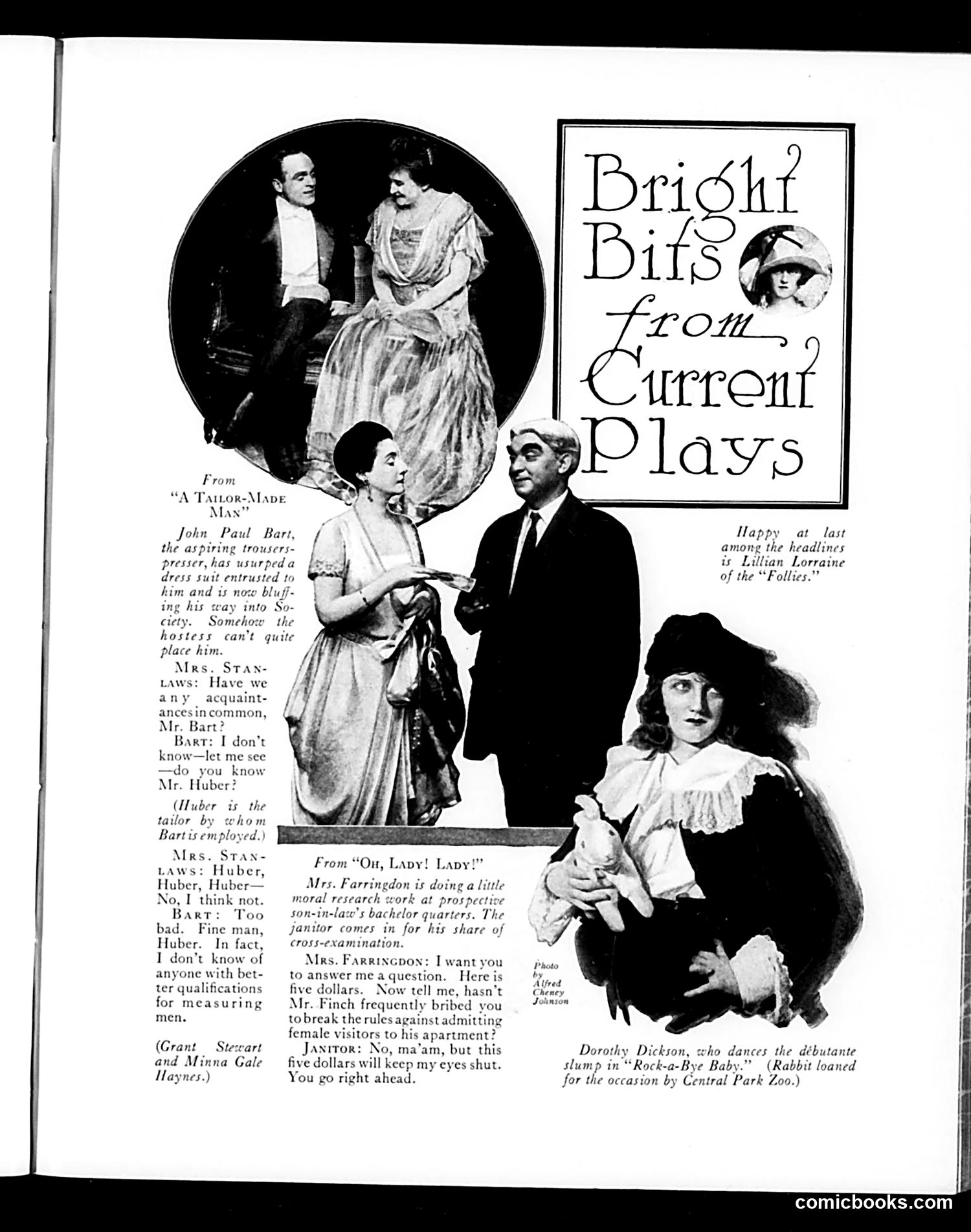
This page presents humorous scenarios extracted from Broadway comedies of the era. **"A Tailor-Made Man"**: A working-class pants-presser (John Paul Bart) fraudulently infiltrates high society by wearing a borrowed dress suit. The joke—visible in the circular scene—is that he's impersonating a gentleman while Mrs. Stan-Laws tries to place him socially. His desperate name-dropping of "Mr. Huber" (his actual tailor-employer) exposes his pretense. The satire mocks both social climbing and the superficiality of "society," where appearance and bluffing substitute for actual breeding. **"Oh, Lady! Lady!"**: A woman pays a janitor five dollars to overlook rule-breaking visits to a bachelor's apartment. The joke is transactional corruption of propriety—morality literally has a price. **Lower right**: A caption about dancer Dorothy Dickson includes a humorous note that the rabbit she holds was "loaned for the occasion by Central Park Zoo," suggesting absurdist theatrical spectacle.
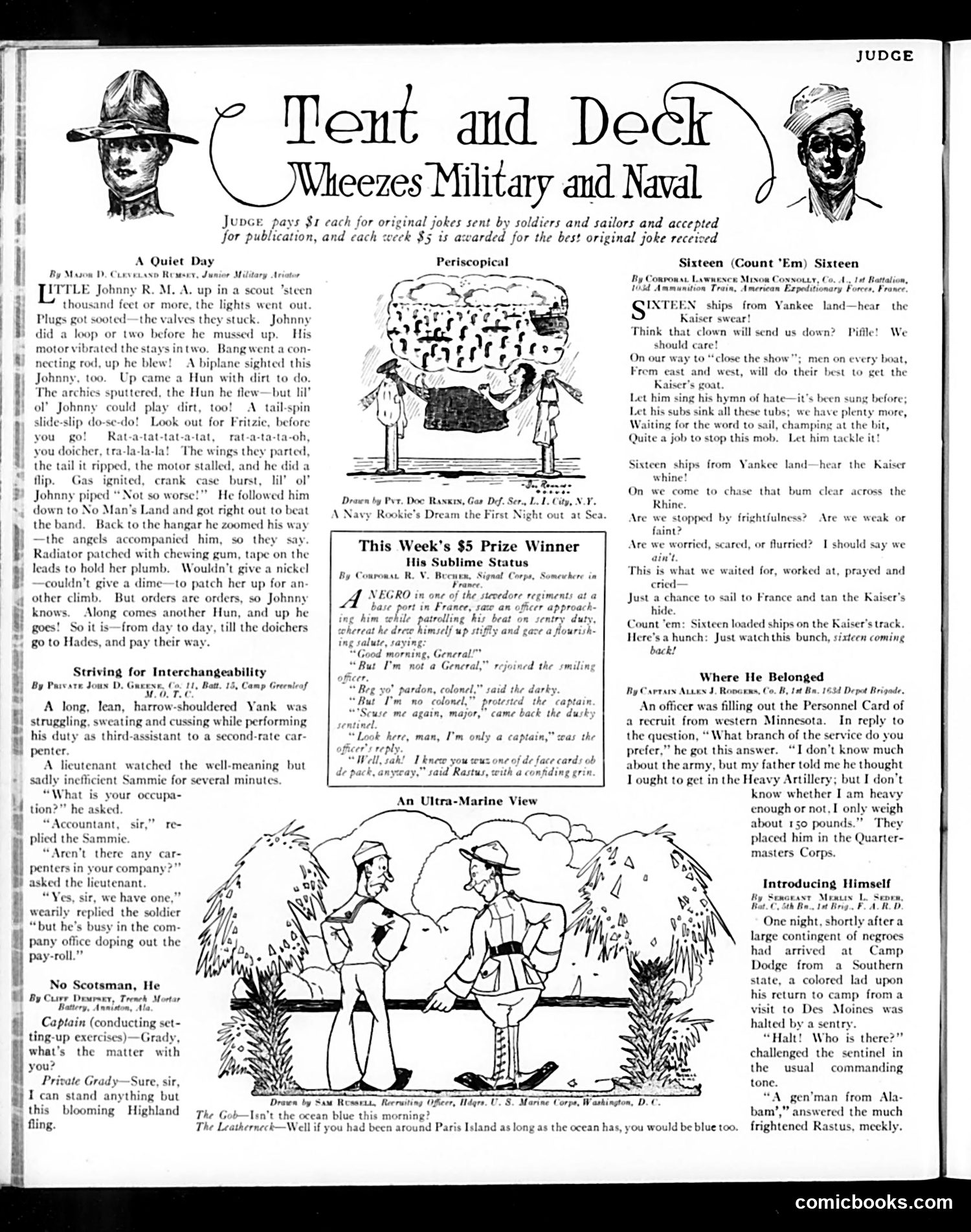
This page collects short humorous anecdotes and cartoons about American soldiers and sailors, likely from World War I (references to "Huns," trenches, and France suggest the 1917-1918 period). The jokes reflect military life: a pilot's engine failure and combat with German aircraft ("Huns"); an accountant forced to do carpentry because the actual carpenter does office work; a Highland soldier complaining about endless exercises; and a Black soldier in a stevedore regiment saluting an officer while calling him "General" (the humor apparently lying in military rank confusion). The cartoons are simple line drawings depicting typical soldier scenarios. The "$5 Prize Winner" celebrates a Black serviceman, while "Sixteen Ships" expresses patriotic confidence about naval operations against Germany ("the Kaiser"). The overall tone is lighthearted morale-boosting content aimed at a domestic audience, normalizing military service through accessible humor.
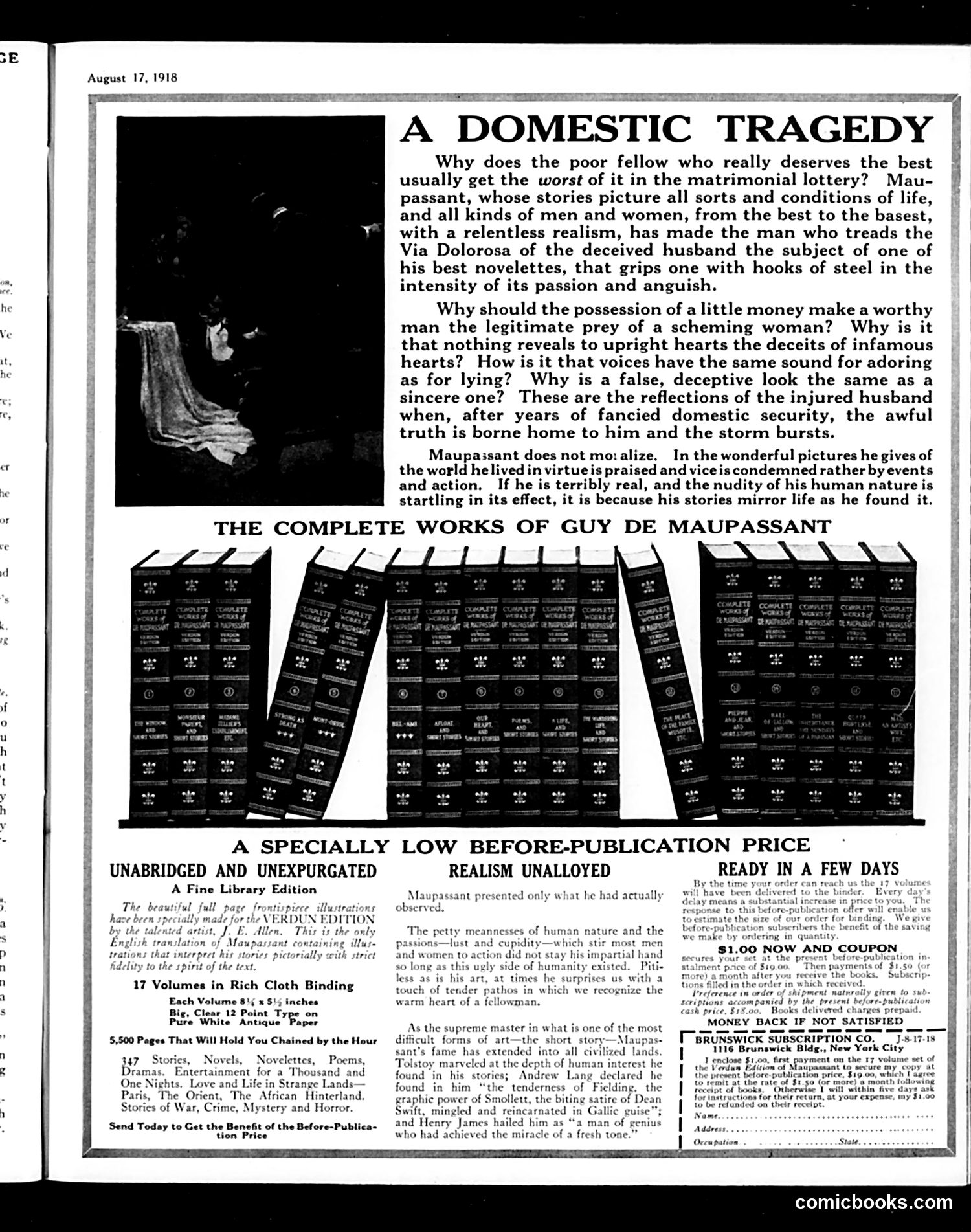
This page is primarily **advertising**, not satire or political commentary. It's a before-publication sales pitch for a 17-volume complete works of Guy de Maupassant (the 19th-century French short-story writer). The small image at top left appears to be a **domestic scene** illustrating one of Maupassant's stories about marital infidelity—the "deceived husband" theme mentioned in the text. The dramatic language emphasizes how Maupassant's fiction explores human moral weakness and deception "with relentless realism." The bulk of the page showcases **book spines** to convey the collection's scope: 347 stories across 5,500 pages, featuring tales of "Love and Life in Strange Lands," war, crime, mystery, and horror. The marketing angle targets educated readers seeking serious literature: unabridged, unexpurgated texts in fine cloth binding at a "specially low before-publication price" of $19 rather than higher retail cost. A subscription coupon invites immediate purchase. There is no satire here—this is a straightforward (if flowery) commercial appeal to the Judge magazine's upscale readership.
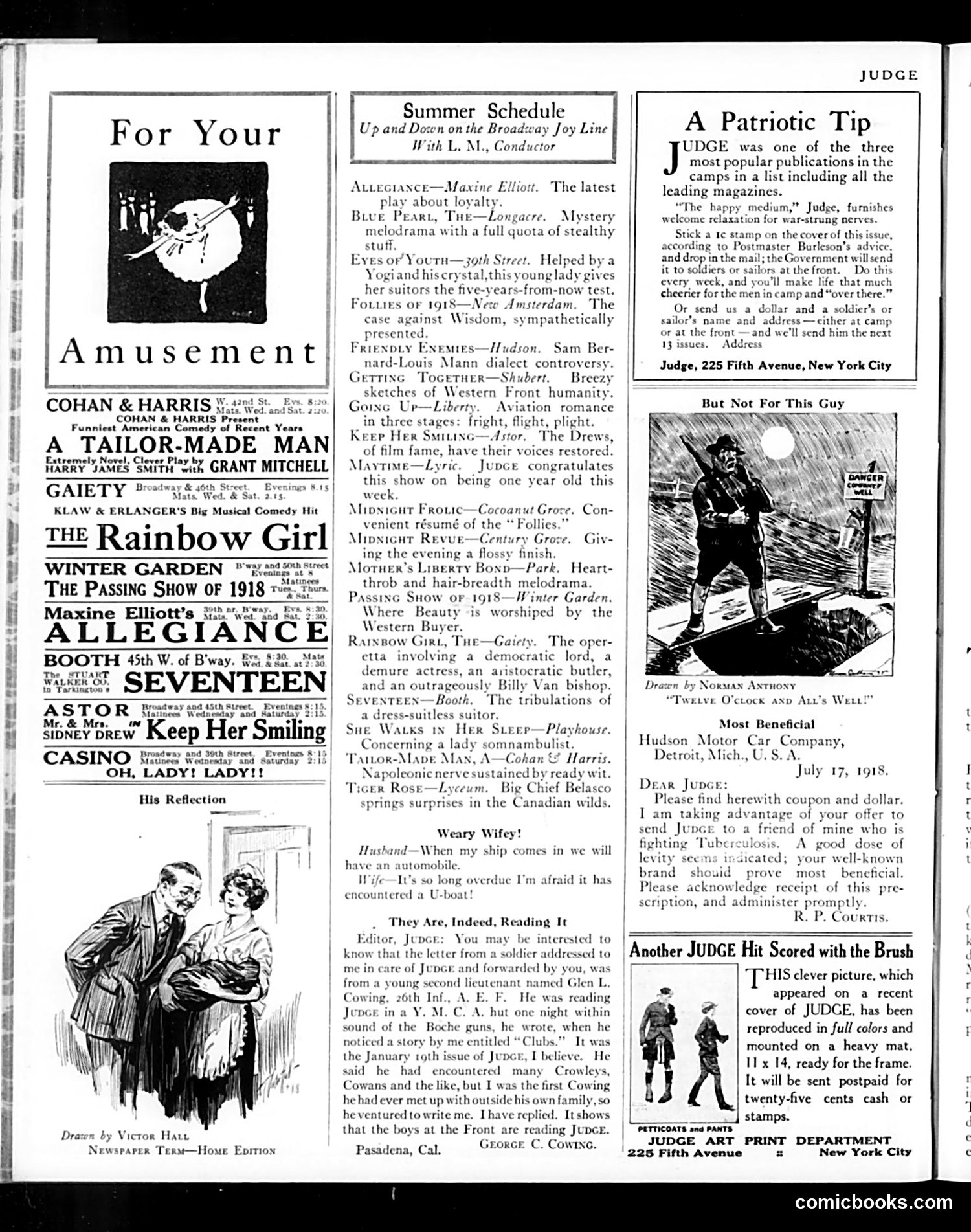
This page is primarily **advertisements for Broadway theaters and Judge magazine subscriptions** from July 1918, with one editorial "Patriotic Tip." The main satirical content is the **patriotic campaign** encouraging readers to subscribe to Judge and mail copies to soldiers fighting in World War I. Judge positions itself as morale-boosting entertainment for troops, asking civilians to fund subscriptions for servicemen at the front. There's one reader letter praising Judge's "levity" as therapeutic for a friend fighting tuberculosis—suggesting the magazine saw itself as providing psychological relief during wartime. The page reflects 1918 America's integration of commercial entertainment with wartime patriotism: popular magazines marketed themselves as crucial to soldier morale and national effort. The heavy promotion in this issue suggests Judge was capitalizing on patriotic sentiment while genuinely (or strategically) supporting troops.
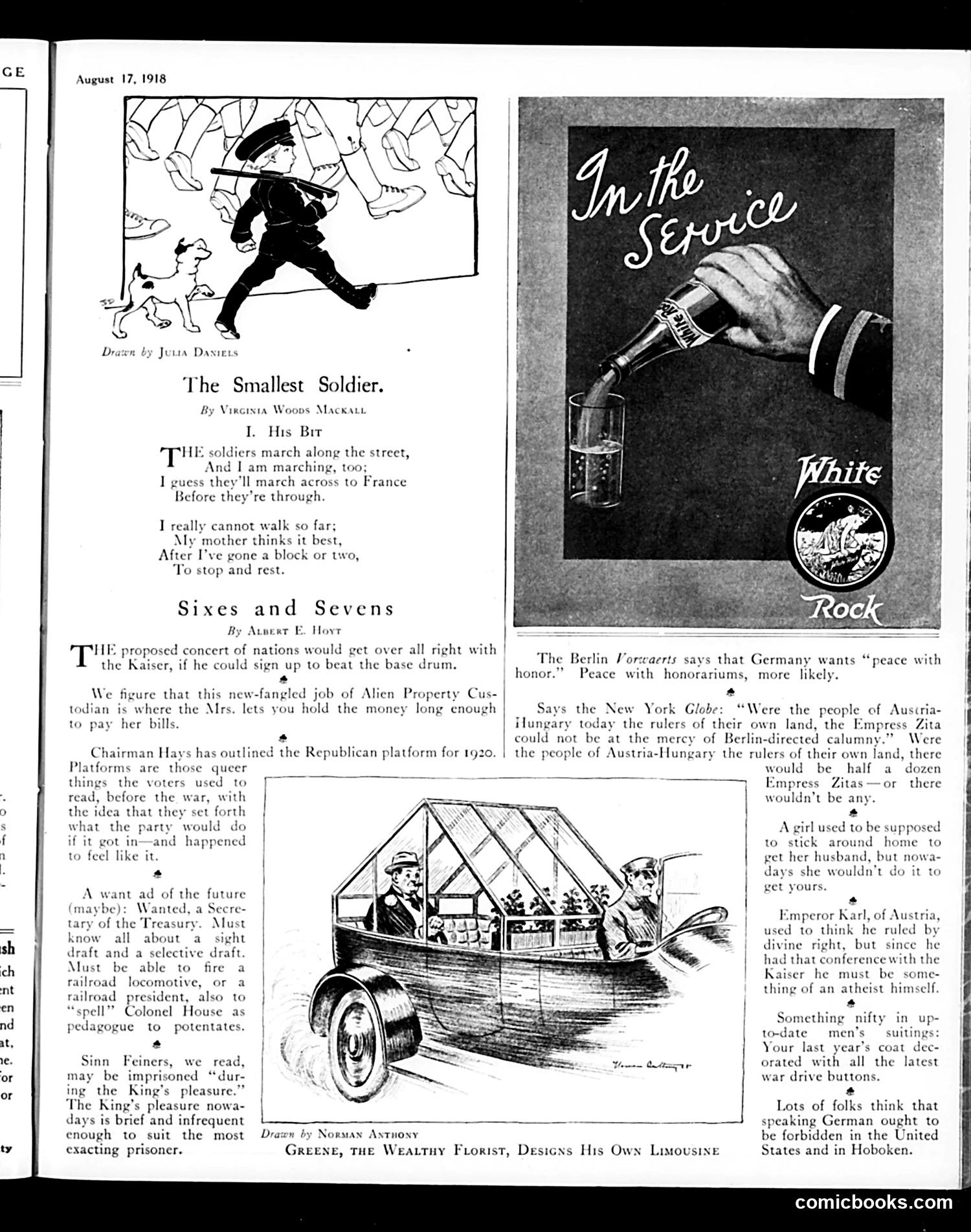
This page contains several brief satirical pieces commenting on WWI and American politics, published just months before the armistice. **"The Smallest Soldier"** depicts a child marching with soldiers heading to France, humorously unable to keep pace—satire on American mobilization and civilian participation in the war effort. **"Sixes and Sevens"** offers political quips: mocking Germany's peace negotiations as seeking financial reparations rather than honor; questioning Austria-Hungary's rulers (Empress Zita and Emperor Karl) as Berlin-controlled puppets; and criticizing the new Alien Property Custodian position as giving wives control of husbands' money. **Greene's limousine cartoon** (drawn by Norman Anthony) appears to satirize wealthy florists profiting during wartime by designing luxury vehicles. The column on the right critiques German language use in America and references **Sinn Féin** (Irish nationalist movement), reflecting period anxieties about foreign influence and dissent on the home front. Context: this was published during the final, intensifying phase of American involvement in WWI.
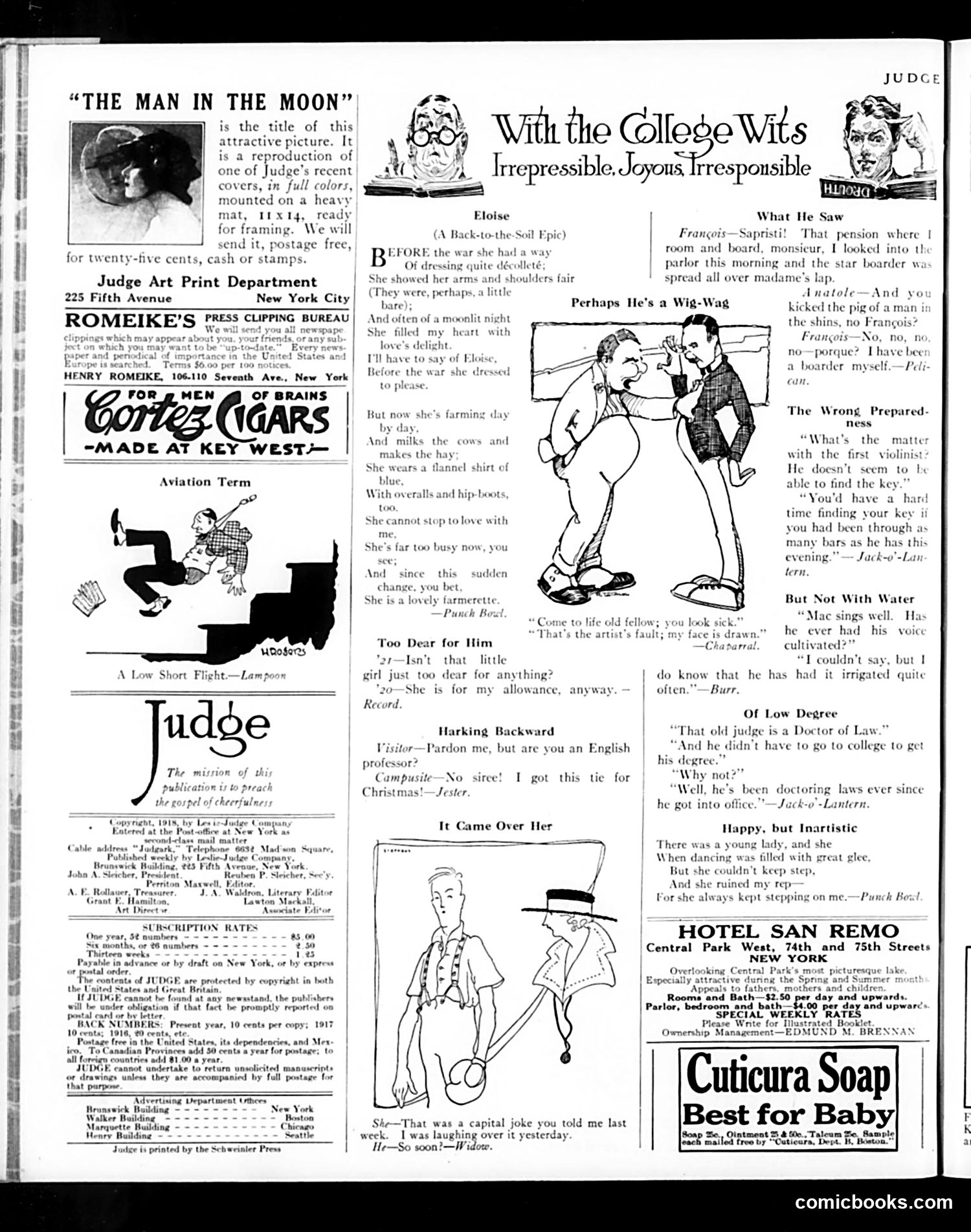
This page from Judge presents satirical humor aimed at educated young people and college students circa 1918. The main content features short comedic pieces labeled "With the College Wits"—witty dialogue jokes typical of the era's humor publications. The sketches mock college life and courtship. "Eloise" contrasts a woman's pre-war fashionable appearance with her current agricultural work outfit, playing on wartime labor changes. Other pieces joke about dating ("Too Dear for Him"), professorial pretense ("Harking Backward"), and romantic mishaps ("Perhaps He's a Wig-Wag"). The humor relies on wordplay, double meanings, and brief satirical observations about class, romance, and social pretension—staples of Judge's sophisticated audience. The surrounding advertisements (Cortez Cigars, Hotel San Remo, Cuticura Soap) indicate the magazine's affluent readership. The page reflects 1910s attitudes toward gender roles, romance, and educational status.
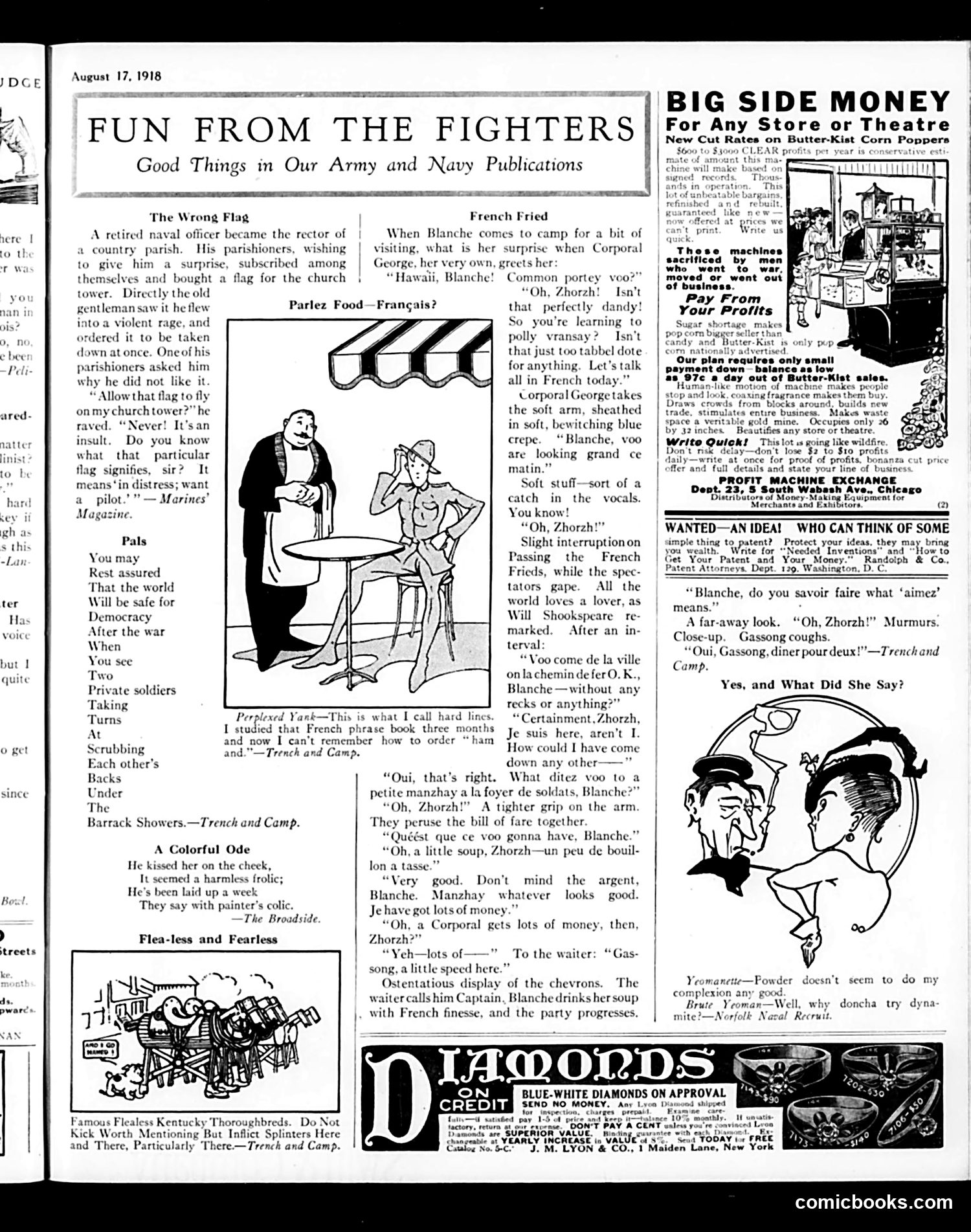
This August 1918 *Judge* page contains light military humor from World War I. The main cartoon "French Fried" depicts an American soldier (Corporal George) attempting to impress his visiting girlfriend (Blanche) by speaking broken French—a comedy of mangled pronunciation and cultural pretension. The joke targets soldiers' superficial attempts at sophistication and the awkwardness of wartime romance, with Blanche playing along despite George's terrible French accent. The surrounding short pieces mock army life: a naval officer rejecting a church flag because its nautical signal means "distress," soldiers attempting French phrases from phrase books, and cavalry horses causing splinters. These are gentle satires of military incompetence and cultural confusion rather than serious social critique. The advertising on the right (popcorn machines, diamonds) is typical of the era's magazine monetization.
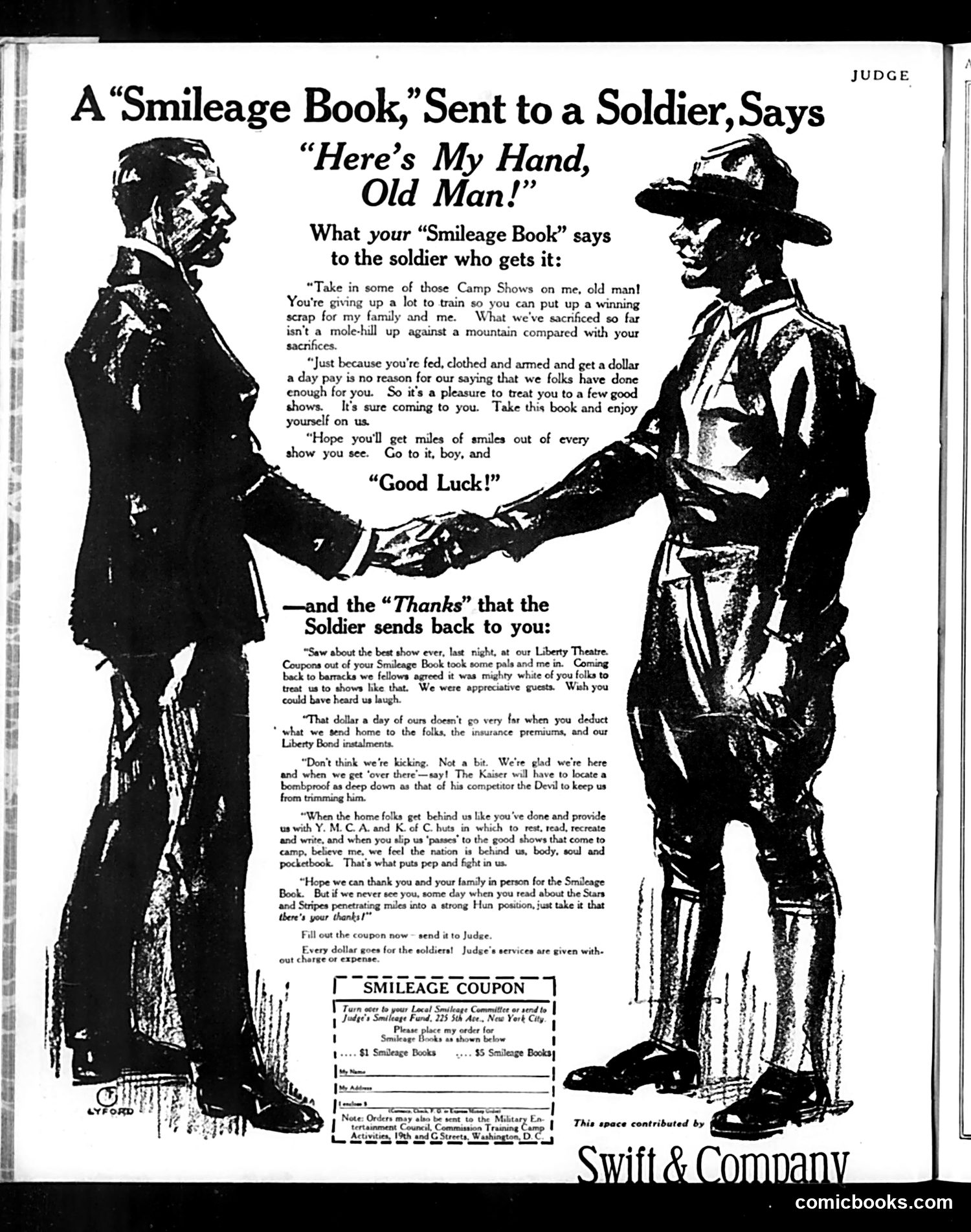
This is a WWI-era fundraising advertisement promoting "Smileage Books"—coupon booklets that civilians could purchase to provide free entertainment passes to soldiers in training camps. The cartoon depicts a handshake between a well-dressed civilian (left) and a uniformed soldier (right), representing the civilian-military partnership. The text frames this as a moral obligation: civilians have sacrificed little compared to soldiers, so providing entertainment is both patriotic duty and gratitude. The soldier's response letter emphasizes morale-boosting and national unity—entertainment helps soldiers feel supported by the home front, strengthening their resolve to fight. The references to Y.M.C.A., Knights of Columbus huts, and Liberty Bonds situate this within broader WWI mobilization efforts. This page functions as advertising copy encouraging readers to fund soldiers' recreation, positioning entertainment access as essential to military readiness and national defense.
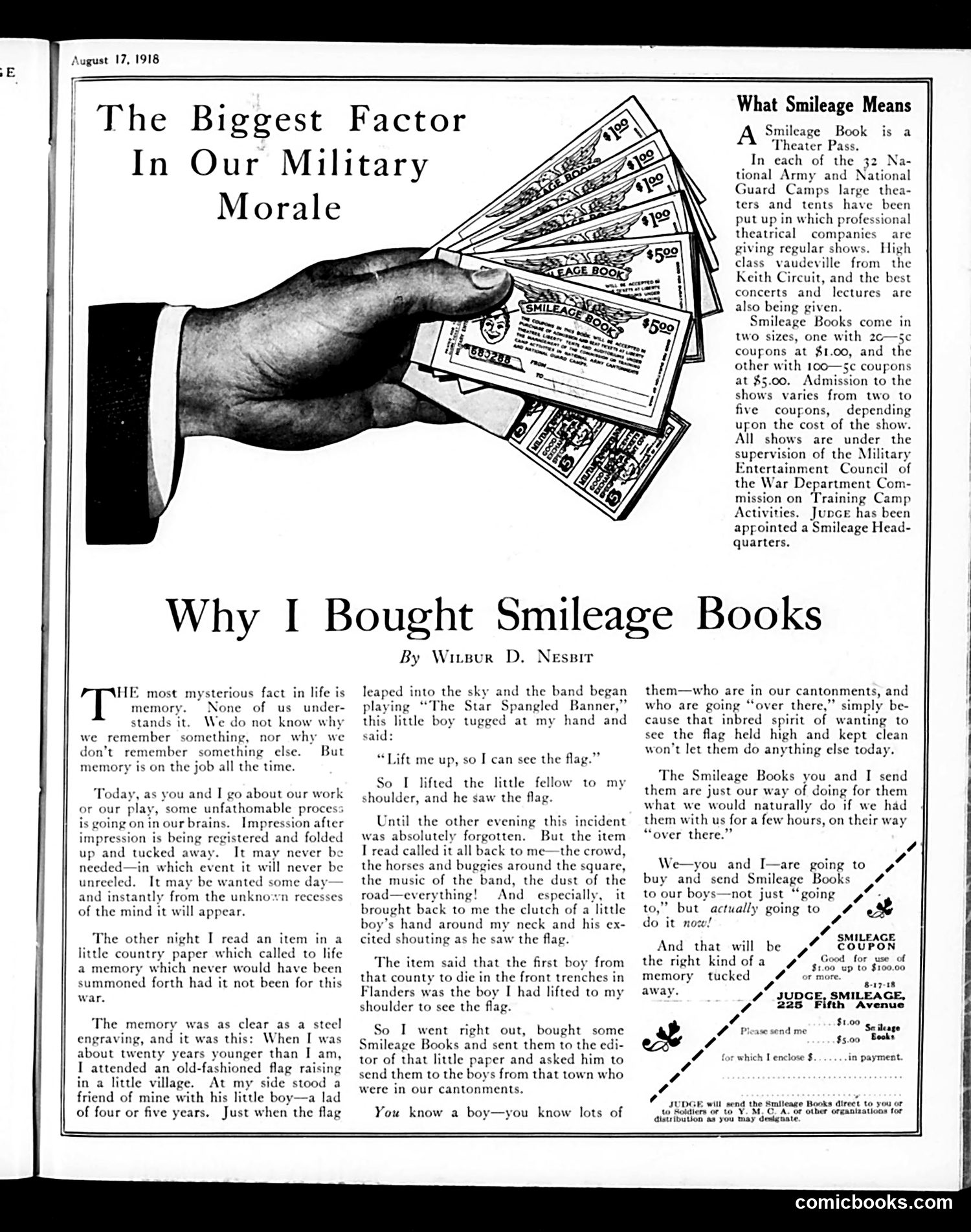
This is a WWI-era advertisement (August 1918) disguised as sentimental editorial content. The piece uses emotional nostalgia to sell "Smileage Books"—theater passes for soldiers in training camps. **The Setup:** Author Wilbur D. Nesbit recounts how reading a newspaper item triggered a childhood memory of lifting a boy to see a flag at a village ceremony. That same boy, the story claims, was the first from that county killed in the trenches in France. **The Sales Pitch:** This manufactured emotional connection justifies buying Smileage Books as a patriotic duty—a way to provide entertainment and morale to soldiers who might soon die, just like that boy. The image of a hand holding fanned theater tickets reinforces the product. **The Reality:** This is propaganda masquerading as heartfelt testimony. The coincidence strains credibility, but the emotional manipulation was designed to move readers to purchase these entertainment vouchers, positioning the product as a patriotic obligation rather than a commercial transaction.
This is primarily a **product advertisement** rather than political satire. It promotes Faultless brand pajamas and night shirts made by E. Rosenfeld & Co. (Baltimore and New York). The illustration shows two men in business attire examining garments in what appears to be a factory or manufacturing setting, with a worker visible in the background. The ad emphasizes quality and reliability—"Faultless, since 1881"—suggesting the company's long manufacturing history. The tagline "The NIGHTwear of a Nation!" uses patriotic language common in early 20th-century advertising to position the product as quintessentially American. The small text box explains the Faultless brand name signifies reliability and fair manufacturing practices. There is no apparent political cartoon or satire on this page—it's straightforward commercial advertising typical of Judge magazine's revenue model.