
Judge, 1918-08-17 · page 22 of 32
Judge — August 17, 1918 — page 22: what you’re looking at
What you’re looking at
This article discusses "Friendly Enemies," a theatrical comedy by Lawton Mackall featuring Sam Bernard and Louis Mann. The piece traces a theatrical tradition of comedic "bickering" acts—from Weber & Fields through Potash and Perlmutter—now adapted with German-American characters rather than Jewish ones. The plot centers on Henry Block and Karl Pfeifer, wealthy immigrants. When a German propagandist persuades Pfeifer to donate $50,000 to end "the war" (WWI), Pfeifer learns the "good news" is that a ship was torpedoed—revealing the propaganda's pro-German agenda. The tragedy intensifies when Pfeifer discovers his own son, serving in the American military, was lost in that attack. This transforms Pfeifer from a duped sympathizer into a committed American patriot. The satire targets German-American dual loyalty during WWI and exposes German propaganda operations in America, while celebrating immigrant assimilation through personal tragedy and national awakening.
📄 Transcribed text from this page (OCR, searchable)
Machine-transcribed from the original scan — historical spelling and the odd misread are preserved.
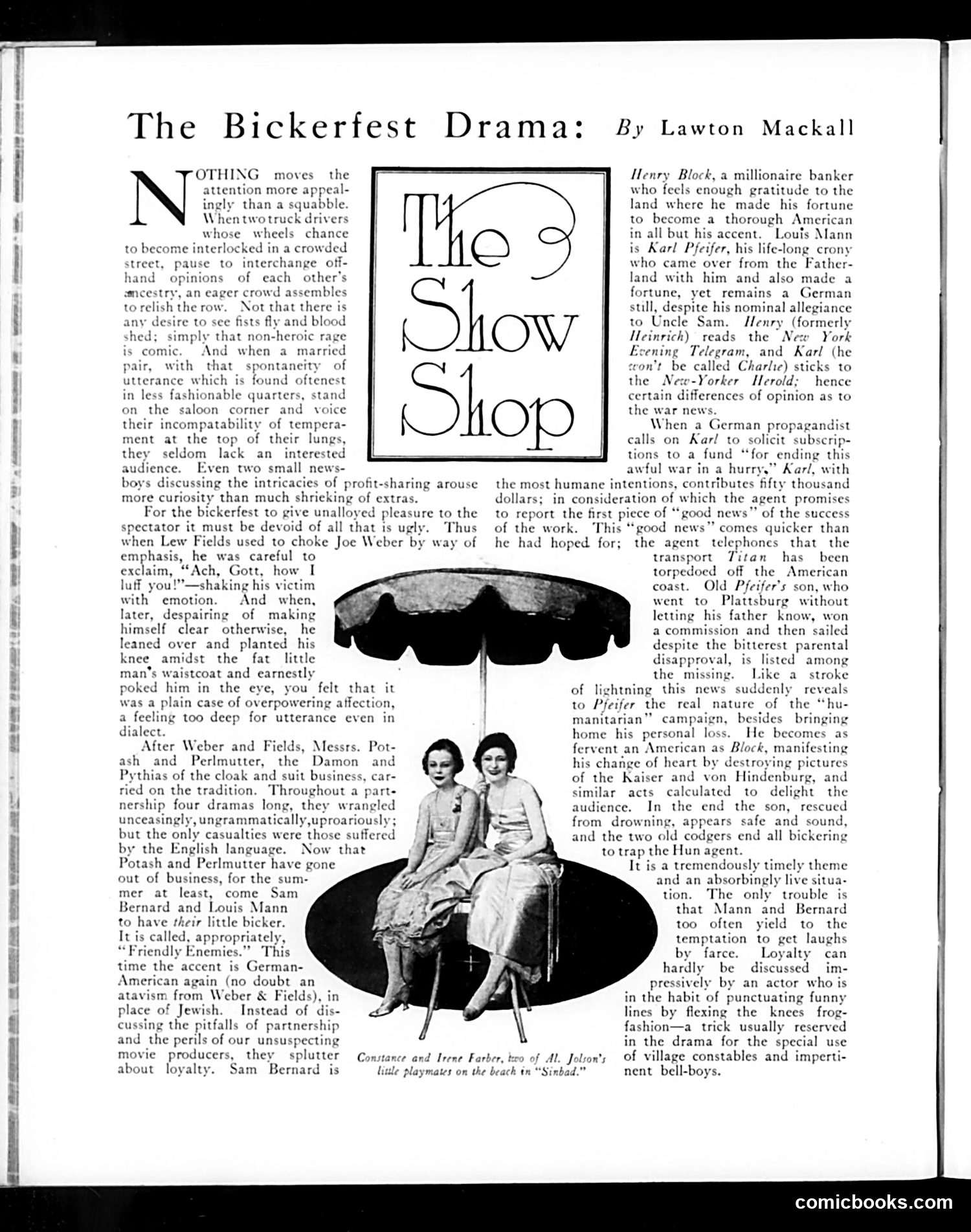
oro we — t 2 8 The Bickerfest Drama: OTHING moves the ttention more appeal- y than a squabble. When twotruck drivers whose wheels chance me interlocked in a crowded to interchange off- nd’ opinions of each other's smeestry, an eager crowd assembles to relish the row. Not that there is ire to see fists fly and blood ed; simply that non-heroic rage is comic. And when a married with that spontaneity of utterance which is found oftenest in less fashionable quarters, stand on the saloon corner and voice their incompatability of tempera- ment at the top of their lungs, they seldom lack an i ested audience. Even two small news- boys discussing the intricacies of profit-sharing arouse more curiosity than much shrieking of extras. For the bickerfest to give unalloyed pleasure to the spectator it must be devoid of all that is ugly. Thus when Lew Fields used to choke Joe Weber by way of emphasis, he was careful to exclaim, “Ach, Gott, how I luff you!”"—shaking his victim with emotion. And when, later, despairing of making himself clear otherwise, he leaned over and planted his knee amidst the fat little man’s waistcoat and earnestly poked him in the eye, you felt that it was a plain case of overpowering affection, a feeling too deep for utterance even in dialect. After Weber and Fields, Messrs. Pot- ash and Perlmutter, the Damon and > Pythias of the cloak and suit business, car- = > ried on the tradition. Throughout a part- nership four dramas long, they wrangled unceasingly, ungrammatically,uproariously; but the only casualties were those suffered by the English language. Now that Potash and Perlmutter have gone out of business, for the sum- mer at least, come Sam Sernard and Louis Mann to have their little bicker. It is called, appropriately. “Friendly Enemies.” This time the accent is German- American again (no doubt an atavism from Weber & Fields), in place of Jewish. Instead of dis- cussing the pitfalls of partnership d the perils of our unsuspecting movie producers, they splutter about loyalty. Sam Bernard is to bec: street, pa’ ny ¢ ce and Irene F laymates on the beack tn By Lawton Mackall Henry Block, a millionaire banker who feels enough gratitude to the land where he made his fortune to become a thorough American in all but his accent. Louts Mann is Karl Pfeifer, his life-long crony who came over from the Father- land with him and also made a i fortune, yet remains a German sull, despite his nominal allegiance to Uncle Sam. Henry (formerly Heinrich) reads the York Evening Telegram, and Karl (he ccon’t be called Charlie) sticks to the New-Yorker Herold; hence certain differences of opinion as to the war news. When a German propagandist calls on Karl to solicit subscrip- ] tions to a fund “for ending this | awful war in a hurry,” Karl, with the most humane intentions, contributes fifty thousand dollars; in consideration of which the agent promises to report the first piece of “good news” of the success of the work. This “good news” comes quicker than he had hoped for; the agent telephones that the transport Titan has been torpedoed off the American coast. Old Pfeifer’s son, who went to Plattsburg without | letting his father know, won a commission and then sailed despite the bitterest parental disapproval, is listed among the missi Like a stroke of lightning this news suddenly reveals to Pfeifer the real nature of the “hu- manitarian” campaign, besides bringing home his personal loss. He becomes as fervent an American as Block, manifesting his change of heart by destroying pictures of the Kaiser and von Hindenburg, and similar acts calculated to delight the audience. In the end the son, rescued from drowning, appears safe and sound, and the two old codgers end all bickering j to trap the Hun agent. It is a tremendously timely theme and an absorbingly live situa- tion. The only trouble is that Mann and Bernard too often yield to the temptation to get laughs by farce. Loyalty can hardly be discussed im- pressively by an actor who is in the habit of punctuating funny lines by flexing the knees frog- fashion—a trick usually reserved in the drama for the special use of village constables and imperti- nent bell-boy ¢ comicbooks.com