
Judge, 1918-08-17 · page 20 of 32
Judge — August 17, 1918 — page 20: what you’re looking at
What you’re looking at
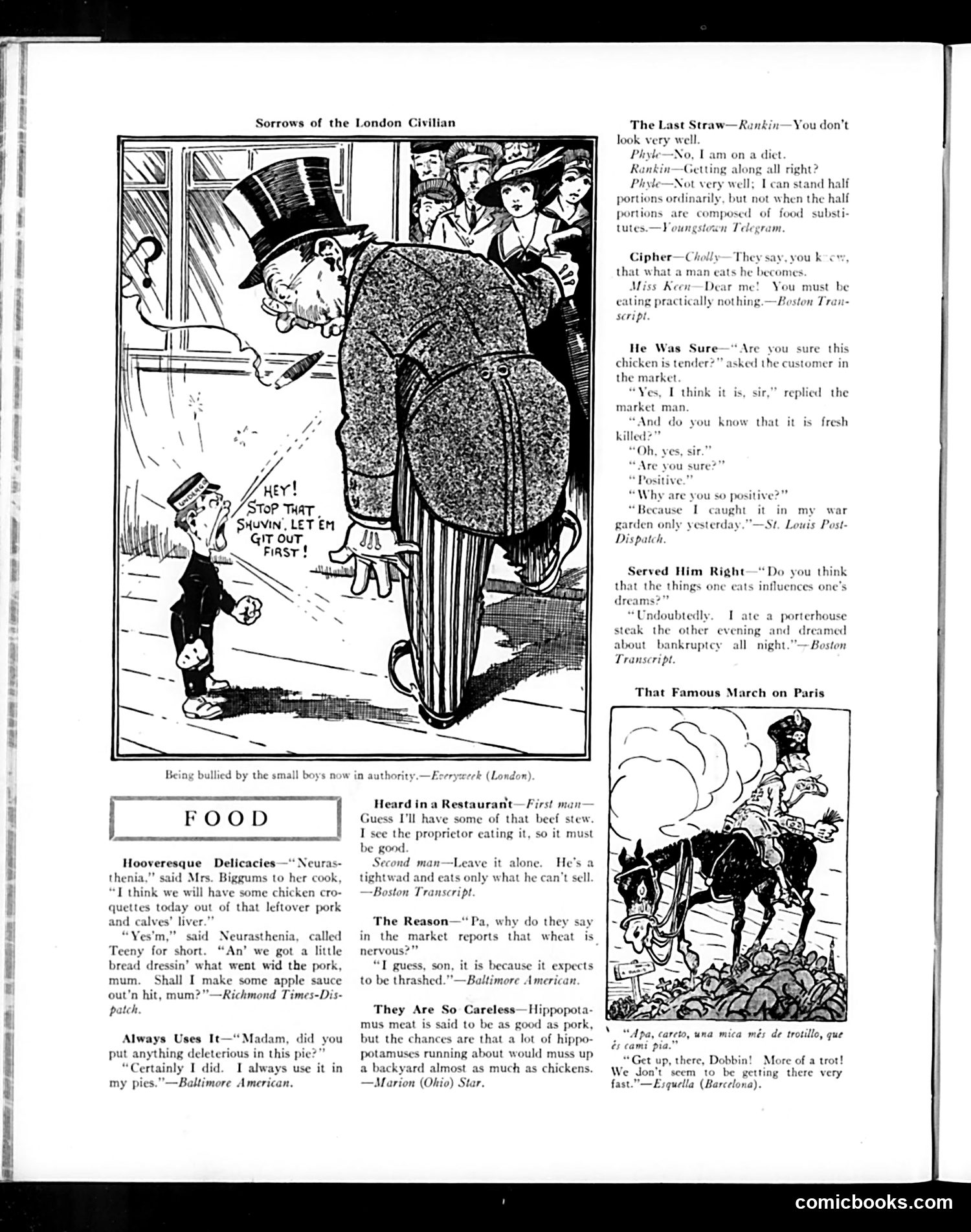
This page satirizes **food scarcity and rationing during World War I**, likely from 1917-1918 when Britain faced severe shortages. The main cartoon depicts a large civilian being bullied by small boys "in authority"—a metaphor for wartime rationing restrictions imposed on ordinary people by government officials. The "FOOD" section collects jokes about food substitution and degradation. References to "Hooveresque Delicacies" allude to Herbert Hoover's Food Administration, which promoted conservation. Jokes mock: - Eating inedible substitutes (pork masquerading as chicken) - Market men selling questionable meat - People eating whatever's available, however poor quality The "That Famous March on Paris" cartoon appears to mock slow military progress, possibly the stalled Western Front. Overall, the page uses humor to air civilian frustrations with wartime deprivation and the bureaucratic control of food supplies—a pointed social criticism dressed in comedy.
📄 Transcribed text from this page (OCR, searchable)
Machine-transcribed from the original scan — historical spelling and the odd misread are preserved.
—a a ie renee mane ore wear r a a am are Ae Bly ions. Sorrows of the London Civilian Being bullied by the small boys now in authority.—Ereryweek (London). FOOD | Hooveresque Delicacies —‘* Neuras- thenia,”’ said Mrs. Biggums to her cook, “I think we will have some chicken cro- quettes today out of that leftover pork and calves’ liver.”” “Yes'm,” said Neurasthenia, called , for short. “An’ we got a little bread dressin’ what went wid the pork, mum. Shall I make some apple sauce out’n hit, mum?”—Richmond Times-Dis- patch Always Uses It—“Madam, did you put anything deleterious in this pie “Certainly I did. I always use it in my pies." —Baltimore American. Heard in a Restaurant—First man— Guess I'll have some of that beef stew. I see the proprictor eating it, so it must be good. Second man—Leave it alone. He's a tightwad and eats only what he can’t sell —Boston Transcript. The Reason—“ Pa, why do they say in the market reports that wheat is nervous? “T guess, son, it is because it expects to be thrashed.""—Baltimore American They Are So Careless—Hippopota- mus meat is said to be as good as pork, but the chances are that a lot of hippo- potamuses running about would muss up a backyard almost as much as chickens. —Marion (Ohio) Star. The Last Straw—Runkin—You don't look very well Phyle—No, 1 am on a dict Rankin—Getting along all right? Phyte very well; I can stand half portions ordinarily, but not when the half portions are comp. food substi- tutes.—Voungstown They say, you k-ow, Cipher—C that what a man eats he becomes. Miss Keen—Dear me! You must be eating practically nothing.—Boston Tran- script He Was Sure—“ Are you sure this chicken is tender?” asked the customer in the market “Yes, [ think it is, sir,” replied the market man. “And do you know that it is. fresh killed?" “Oh, yes, sir.” “Are you sure?” * Positive.” “Why are you so positive?” “Because 1 caught it in my war garden only yesterday.”"—St. Louis Post- Dispatch. Served Him Right—"Do you think that the things one eats influences one’s dream “Undoubtedly. I ate a porterhouse steak the other evening and dreamed about bankruptcy all night.’"—Boston Transcript. That Famous March on Paris \ nica més de trotillo, que “Apa, Carcto, una és cami pia.” “Get up, there, Dob More of a trot! We don't seem ‘to be getting there very fast.”—Esquella (Barcelona). comicbooks.com