
Judge, 1918-08-17 · page 5 of 32
Judge — August 17, 1918 — page 5: what you’re looking at
What you’re looking at
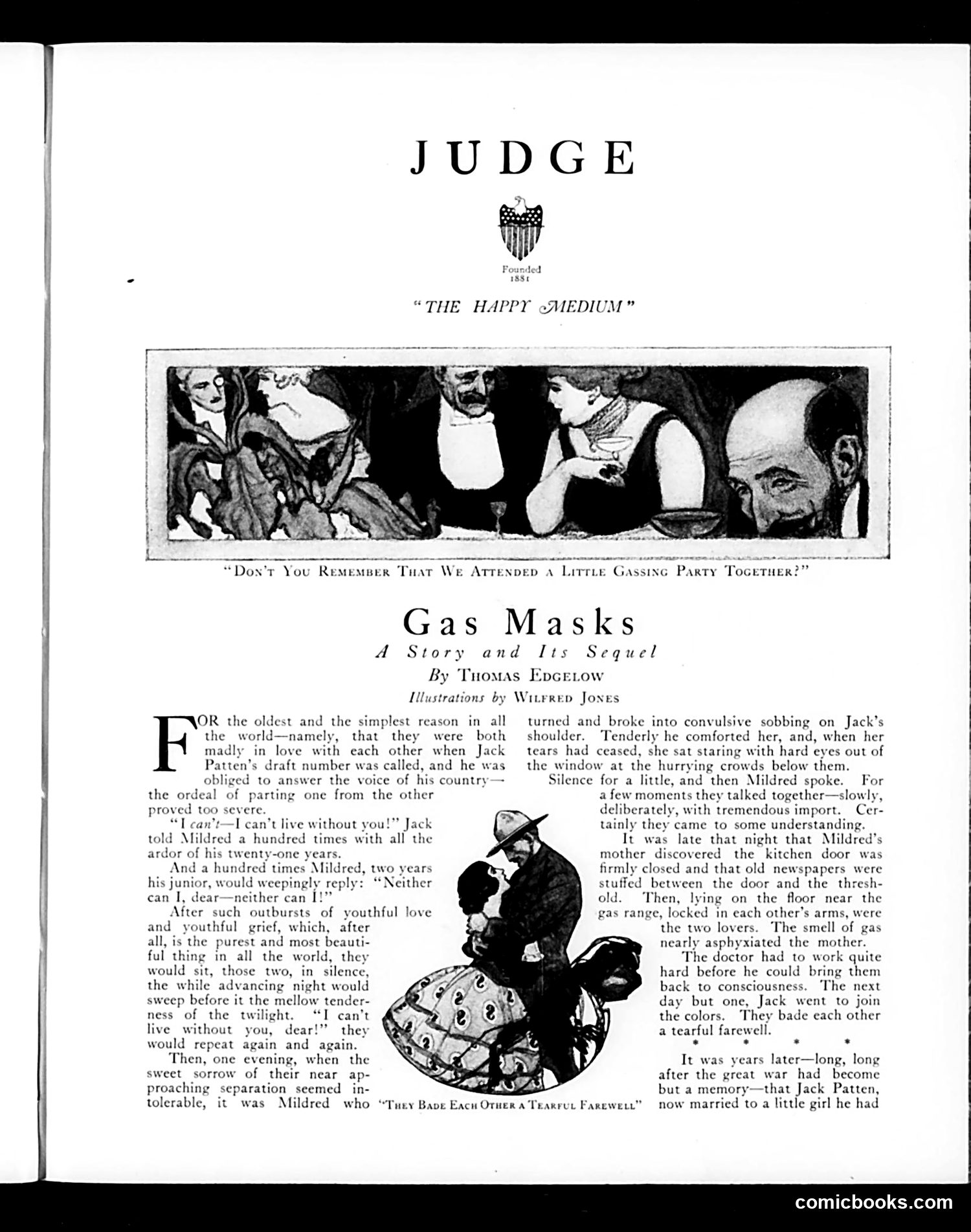
This page from *Judge* magazine presents "Gas Masks: A Story and Its Sequel" by Thomas Edgelow, illustrated by Wilfred Jones. The content is a wartime narrative about two lovers, Jack Patten and Mildred, separated by World War I. The top illustration shows a "gassing party" (a social gathering), while the main narrative illustration depicts Jack and Mildred's tearful farewell. The story references the actual horror of chemical weapons used in WWI—specifically poison gas attacks. The "happy medium" subtitle appears ironic given the tragic wartime separation theme. The narrative follows their forced parting and subsequent reunion after the war, when Jack marries another woman. This is sentimental wartime fiction emphasizing the personal costs of conflict, not political satire.
📄 Transcribed text from this page (OCR, searchable)
Machine-transcribed from the original scan — historical spelling and the odd misread are preserved.
“Dox’t You Rememper Tuat We Atrenvep A Litrie Gassing Party Tocetue | | Gas Masks | A Story and Its Sequel By Tuomas EpcEe.ow Illustrations by Witerep Jones OR the oldest and the simplest reason in all turned and broke into convulsive sobbing on Jack’s the world—namely, that they were both shoulder. Tenderly he comforted her, and, when her madly in love with each other when Jack tears had ceased, she sat staring with hard eyes out of Patten’s draft number was called, and he was the window at the hurrying crowds below them. obliged to answer the voice of his country— Silence for a little, and then Mildred spoke. For the ordeal of parting one from the other afew moments they talked together—slowly, deliberately, with tremendous import. Cer- tainly they came to some understanding. It was late that night that Mildred’s mother discovered the kitchen door was firmly closed and that old newspapers were stuffed between the door and the thresh- old. Then, lying on the floor near the gas range, locked in each other’s arms, were the two lovers. The smell of gas nearly asphyxiated the mother. The doctor had to work quite hard before he could bring them back to consciousness. The next day but one, Jack went to join the colors. They bade each other a tearful farewell. . . * * proved too severe. “Tcan’t—I can’t live without you! told Mildred a hundred times with all the ardor of his twenty-one years. And a hundred times Mildred, two years his junior, would weepingly reply: “Neither | can I, dear—neither can I!” \ After such outbursts of youthful love and youthful grief, which, after all, is the purest and most beauti- ful thing in all the world, they {| would sit, those two, in silence, the while advancing night would sweep before it the mellow tender- ness of the twilight. “I can’t live without you, dear!” they would repeat again and again. j Then, one evening, when the sweet sorrow of their near ap- after the great war had become proaching separation seemed _in- but a memory—that Jack Patten, tolerable, it was Mildred who “Tuey Bave Eacu Oruer a Teareut Farewetr” now married to a little girl he had It was years later—long, long comicbooks.com