
A complete issue · 28 pages · 1917
Judge — November 24, 1917
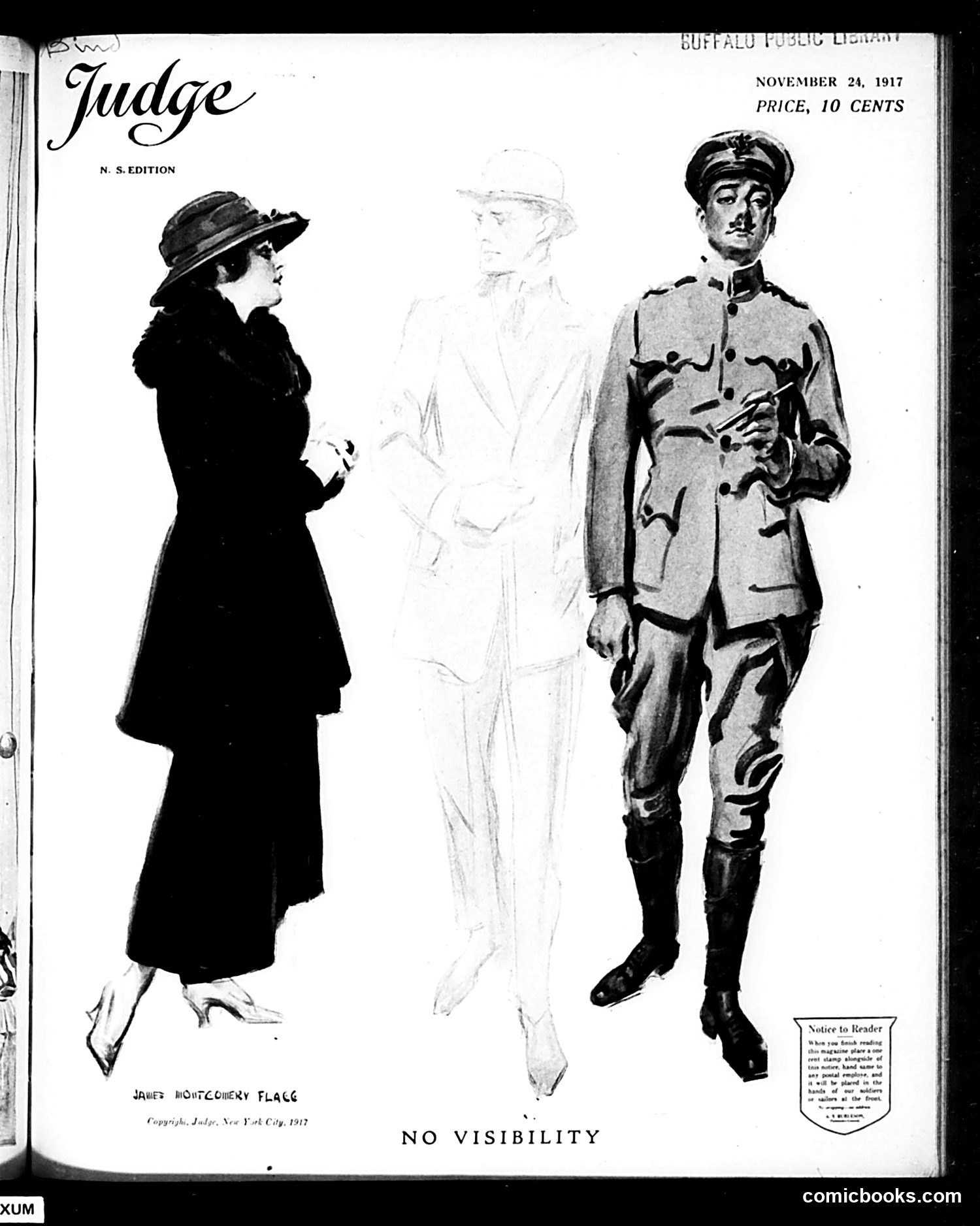
This cartoon by James Montgomery Flagg satirizes military camouflage during World War I. The image shows three figures: a woman in civilian dress (left), a barely-visible sketched soldier (center), and a fully-rendered soldier in uniform (right). The title "NO VISIBILITY" is the joke's key. The satire appears to critique either ineffective camouflage uniforms or, more likely, the invisibility of soldiers' sacrifices to the civilian public. The woman—representing American civilians—cannot "see" or fully comprehend the middle soldier's experience, while the uniformed soldier on the right remains visible and present. Published during America's WWI involvement, this likely comments on civilian disconnection from wartime realities.

This is primarily a **product advertisement**, not political satire or editorial cartoon. It advertises Nujol, a laxative product made by Standard Oil Company (New Jersey), marketed for constipation relief. The ad's humor lies in wordplay: it claims the "healthiest habit in the world" is "functioning at the same time every day"—a euphemistic reference to regular bowel movements. The phrase "regular as clockwork" reinforces this bathroom humor. The ad promises users can discontinue regular Nujol use while retaining the "habit" of regularity itself—suggesting the product trains the body's natural function. The illustration shows Nujol bottles and packaging. This represents early 20th-century advertising's casual approach to promoting digestive products with suggestive humor.
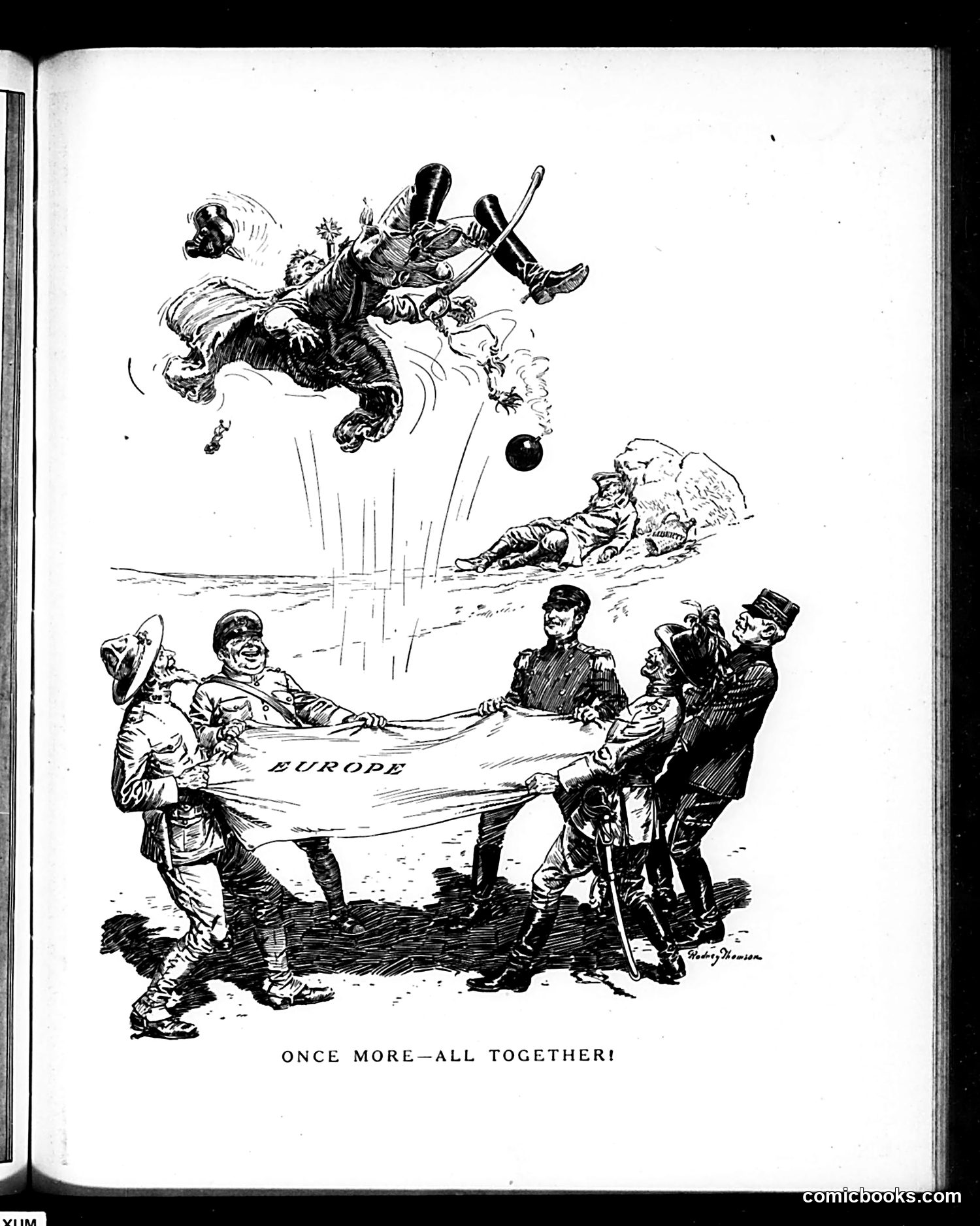
This is a satirical cartoon titled "Once More—All Together!" depicting European powers holding a cloth labeled "EUROPE" while chaos erupts above them. The figures appear to represent different European nations or their leaders, drawn in military dress of the early 20th century. The cartoon suggests these powers are attempting to cooperatively manage Europe (holding the cloth together), while war or conflict (depicted by the explosive figure and cannon fire above) threatens to tear everything apart. The satire critiques the inability or unwillingness of European leaders to prevent warfare despite their supposed coordination. The specific historical context—likely WWI period based on the style—shows Judge magazine mocking European diplomatic efforts as futile against the forces of war pulling the continent apart.
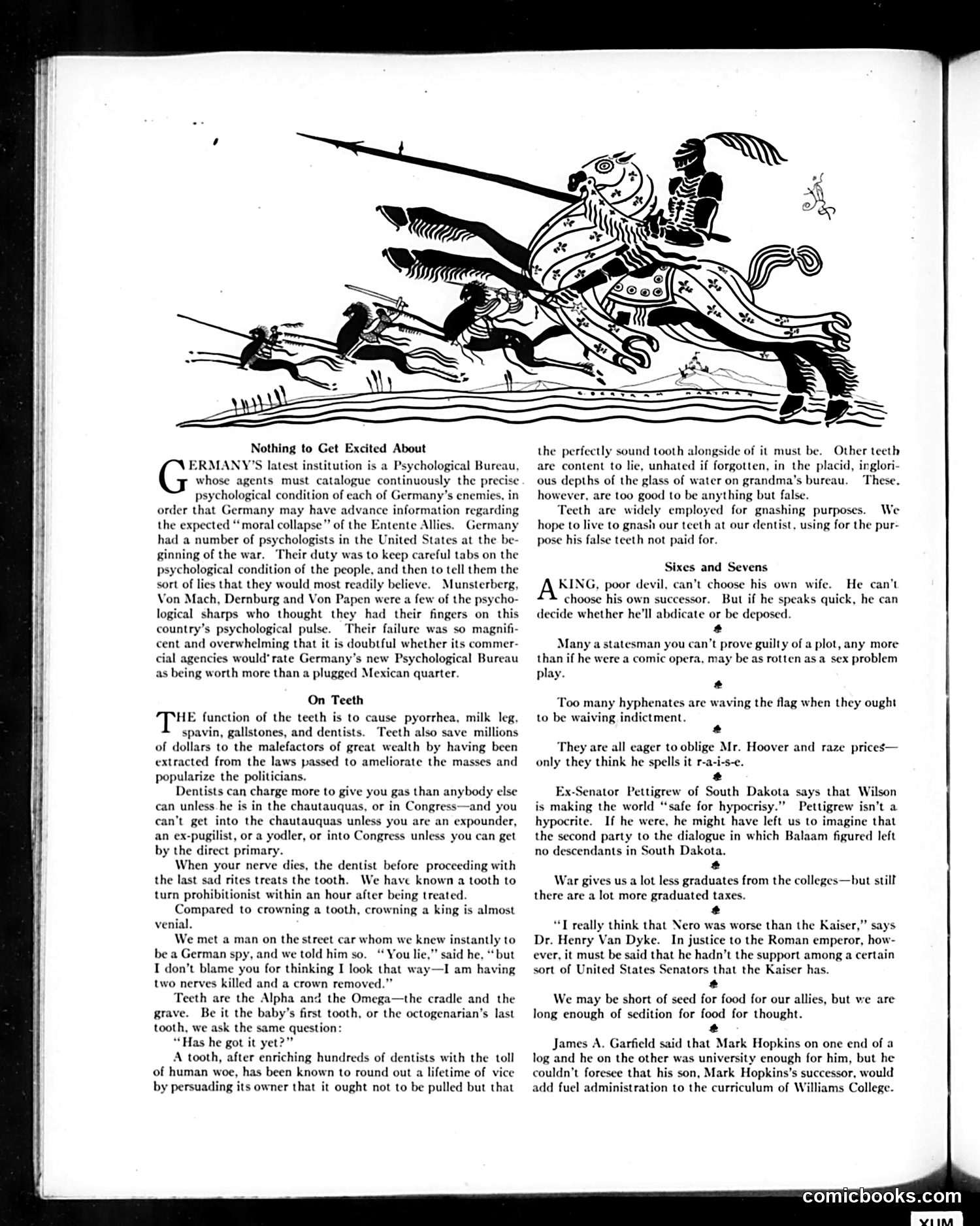
**The Cartoon:** The top illustration depicts an ornate, heavily-decorated figure (likely representing Germany or German militarism) mounted on a dragon-like creature, wielding a long spear, while smaller figures below appear to be running or fleeing in distress. **The Context:** The text discusses Germany's "Psychological Bureau" and psychologists monitoring the nation's "moral collapse." This references WWI-era American skepticism about German intelligence operations and psychological manipulation of their population. **The Satire:** The piece mocks Germany's alleged reliance on psychological tactics and espionage while suggesting their military aggression is based on false morale-boosting propaganda rather than genuine strength. The grotesque mounted figure embodies this criticism—appearing powerful but ultimately built on deception and psychological manipulation rather than substance. The overall message satirizes Germany's wartime information control and population management.
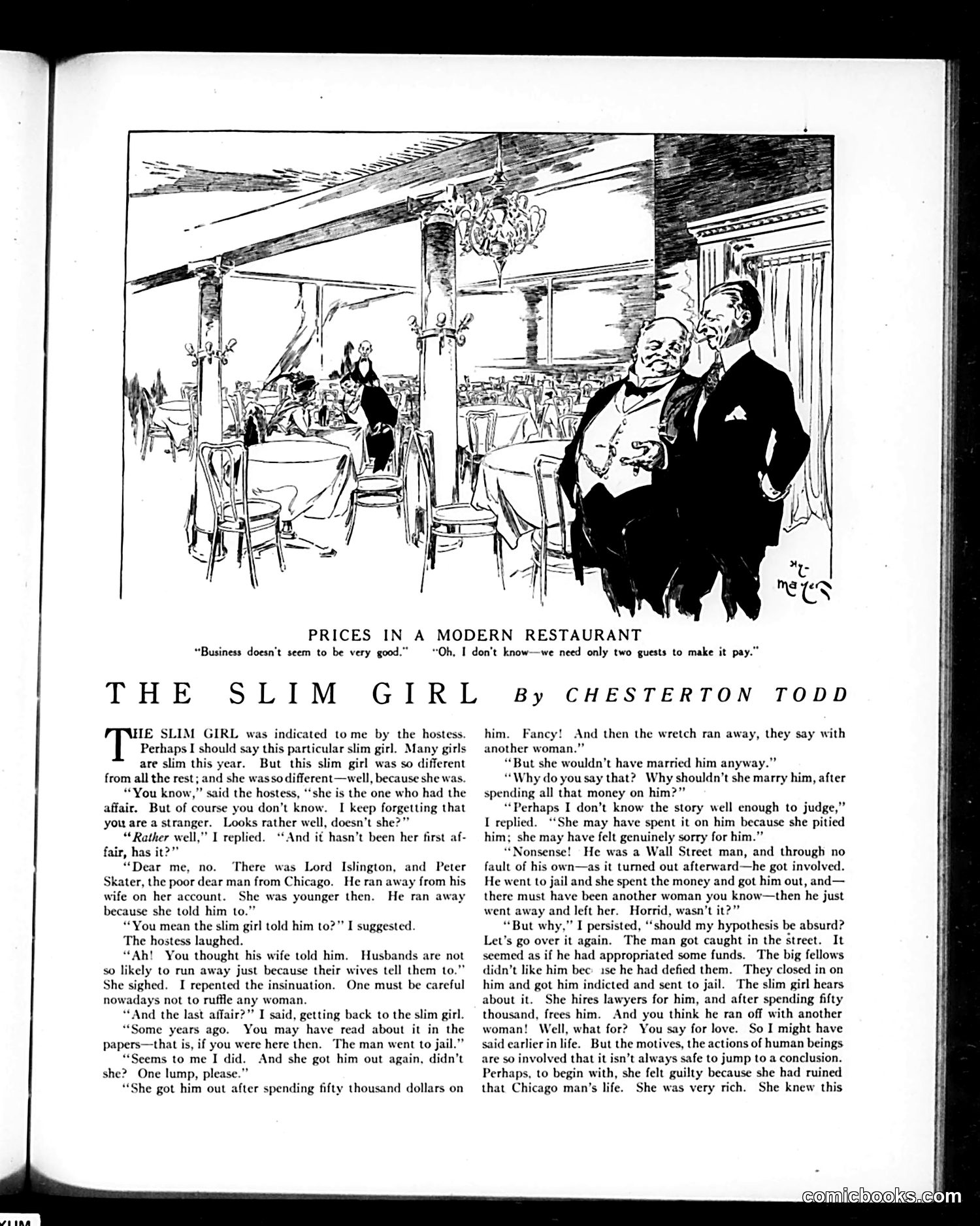
The cartoon at top illustrates the accompanying short story about a woman nicknamed "the slim girl" who had an affair with a married man named Lord Islington. The narrative describes how she helped him escape financial ruin by spending fifty thousand dollars to get him out of jail after he was imprisoned for embezzlement. The satirical point targets wealthy society's moral contradictions: despite the woman's questionable ethics in enabling his crime, she's portrayed sympathetically because she "felt genuinely sorry for him." The cartoon's caption—"Business doesn't seem to be very good"/"Oh, I don't know—we need only two guests to make it pay"—sarcastically comments on restaurant economics during apparent economic hardship, possibly referencing post-WWI financial difficulties.
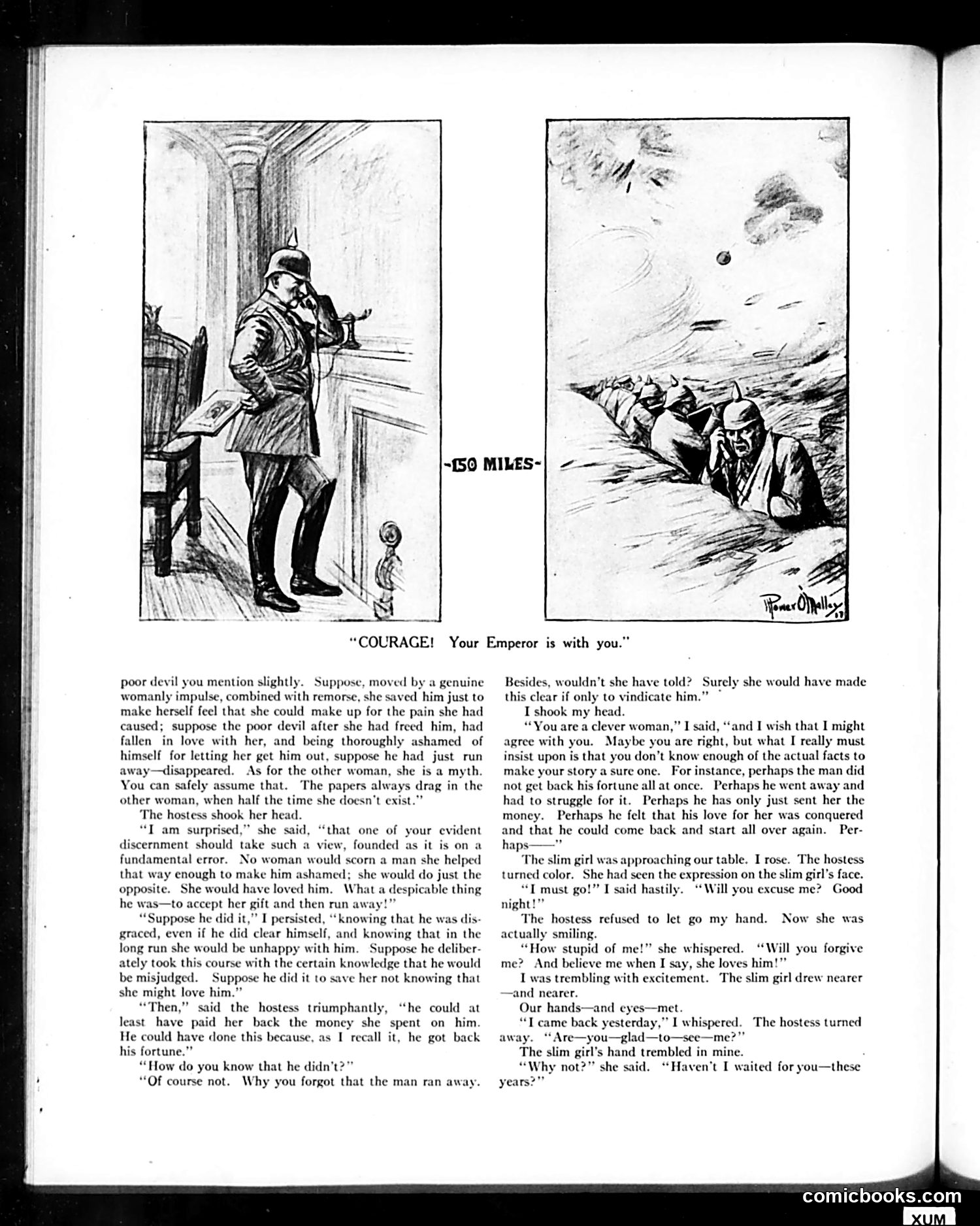
The page presents a narrative story illustrated with two panels. The left panel shows a military officer at a desk, appearing to give orders or encouragement. The right panel depicts soldiers in combat, labeled "150 MILES" apart, suggesting distance or separation. The caption reads "COURAGE! Your Emperor is with you"—a propagandistic rallying cry meant to inspire distant troops. The accompanying text discusses whether a man might abandon his position to help a woman, debating honor, duty, and sacrifice. The story ultimately focuses on a romantic reconciliation between a "slim girl" and a returning soldier, with emotional dialogue about forgiveness and love. The satire appears to mock militaristic propaganda that invokes the emperor's presence to motivate soldiers while they face actual danger—contrasting grand rhetoric with intimate human concerns and romantic sentiment.
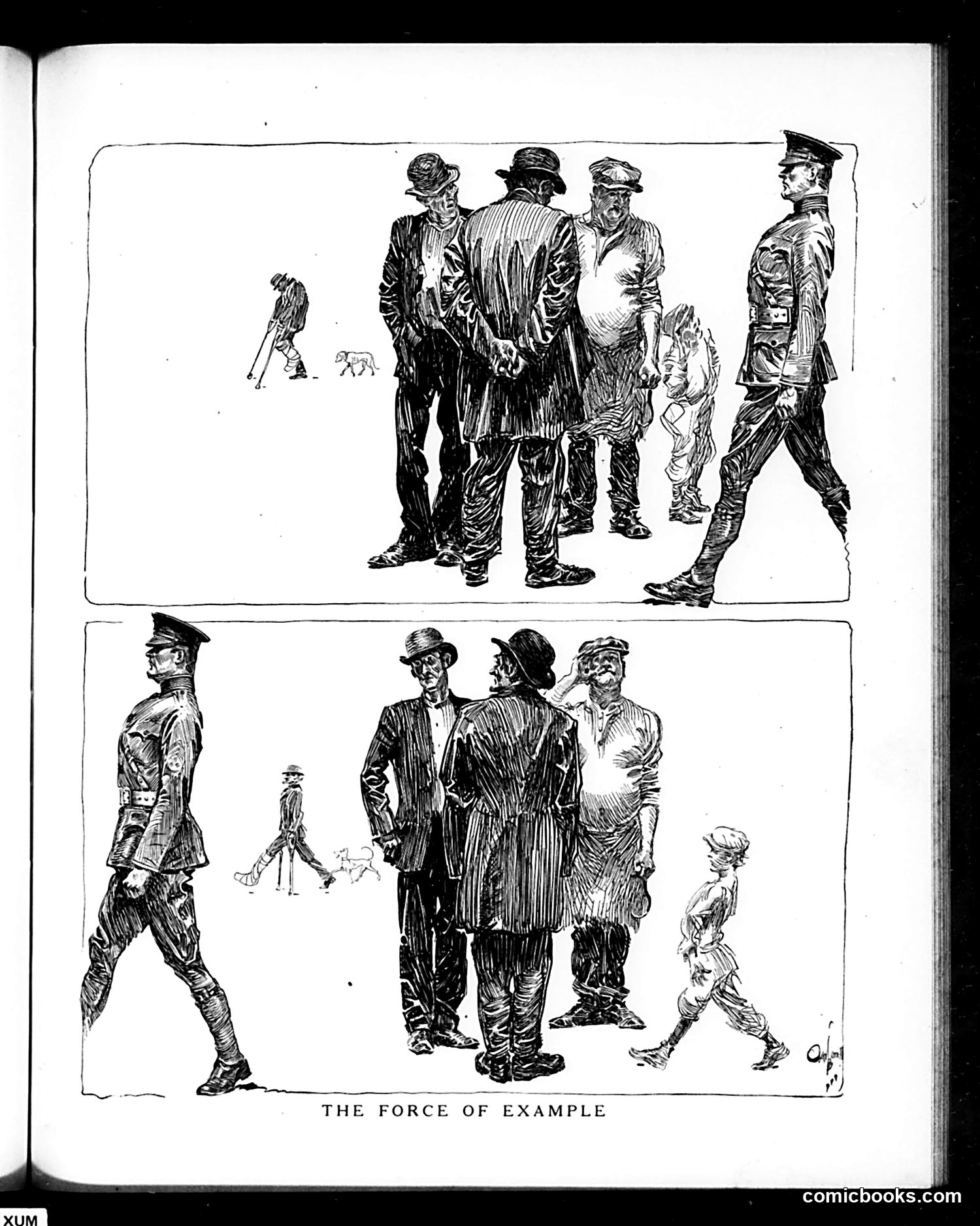
This cartoon depicts military authority influencing civilian behavior through hierarchical example. The top panel shows military officers (identifiable by uniforms and insignia) interacting with civilians in what appears to be an authoritative setting. The bottom panel contrasts this with a military officer walking alone while civilians—including children—mimic his posture and gait, suggesting they unconsciously adopt his bearing and mannerisms. The satire critiques how military culture permeates civilian society through imitation rather than explicit instruction. The title "The Force of Example" ironically suggests that power operates not through direct command but through passive social modeling. This likely reflects early 20th-century American concerns about militarism's cultural influence during a period of military expansion or war preparation.
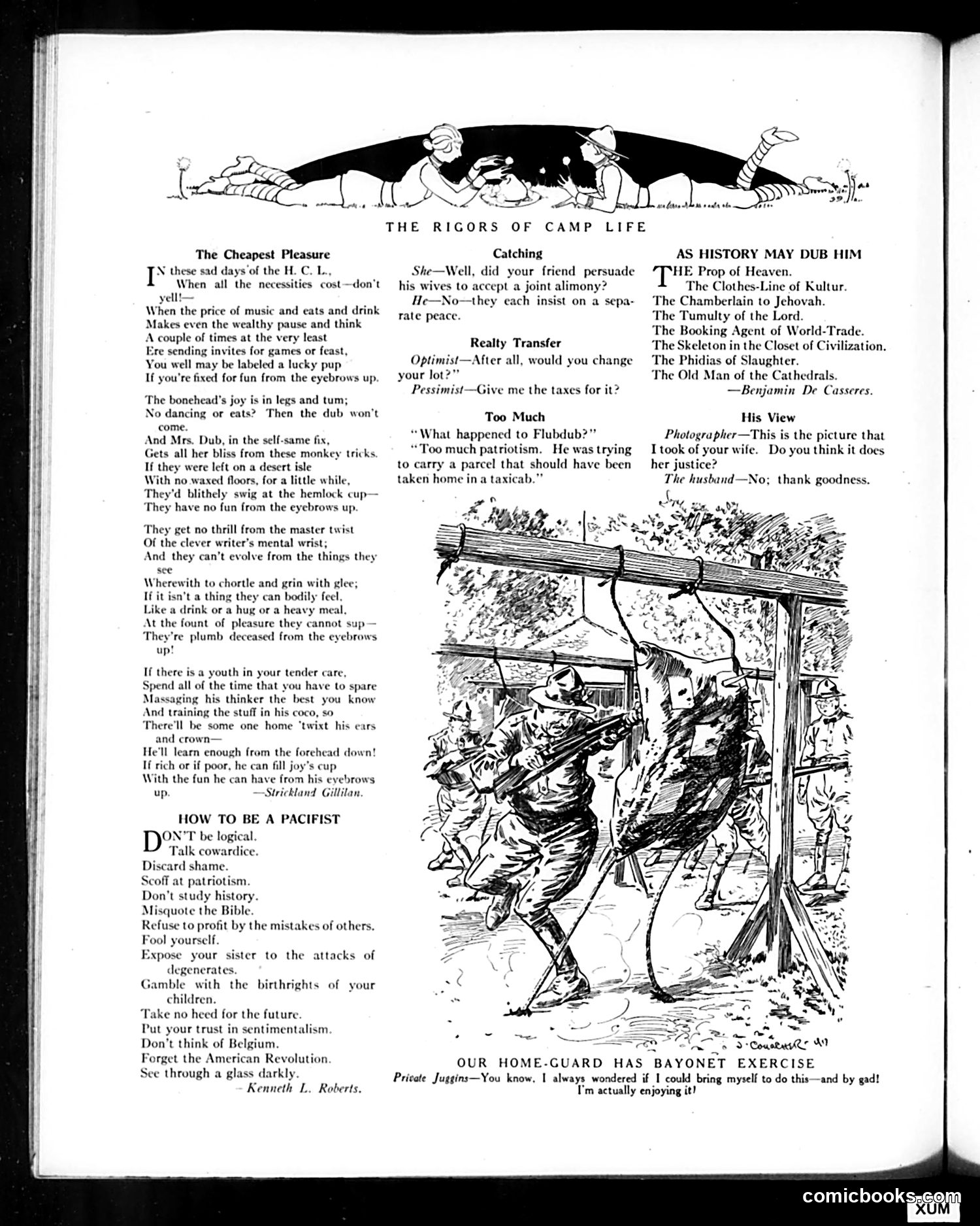
This page contains satirical commentary on early 20th-century American social and political issues, likely from the World War I era (suggested by references to Belgium and pacifism). **Main Cartoons:** 1. **"The Cheapest Pleasure"** (Strickland Gillilan): Satirizes people of limited intellect who derive joy only from physical sensations—eating, drinking, dancing—rather than mental or cultural pursuits. The phrase "fun from the eyebrows up" means intellectual enjoyment. 2. **"How to Be a Pacifist"** (Kenneth L. Roberts): A biting attack on pacifists, listing cynical steps to abandon patriotism. References to Belgium (occupied in WWI) and mocking the pacifist position as cowardly and naive. This reflects pro-war sentiment common in American publications of this period. 3. **Bottom illustration**: Shows soldiers in bayonet exercise, captioned humorously to suggest reluctant military participation has become enjoyable. The page reflects wartime anxieties about patriotism, intellectualism, and national commitment.
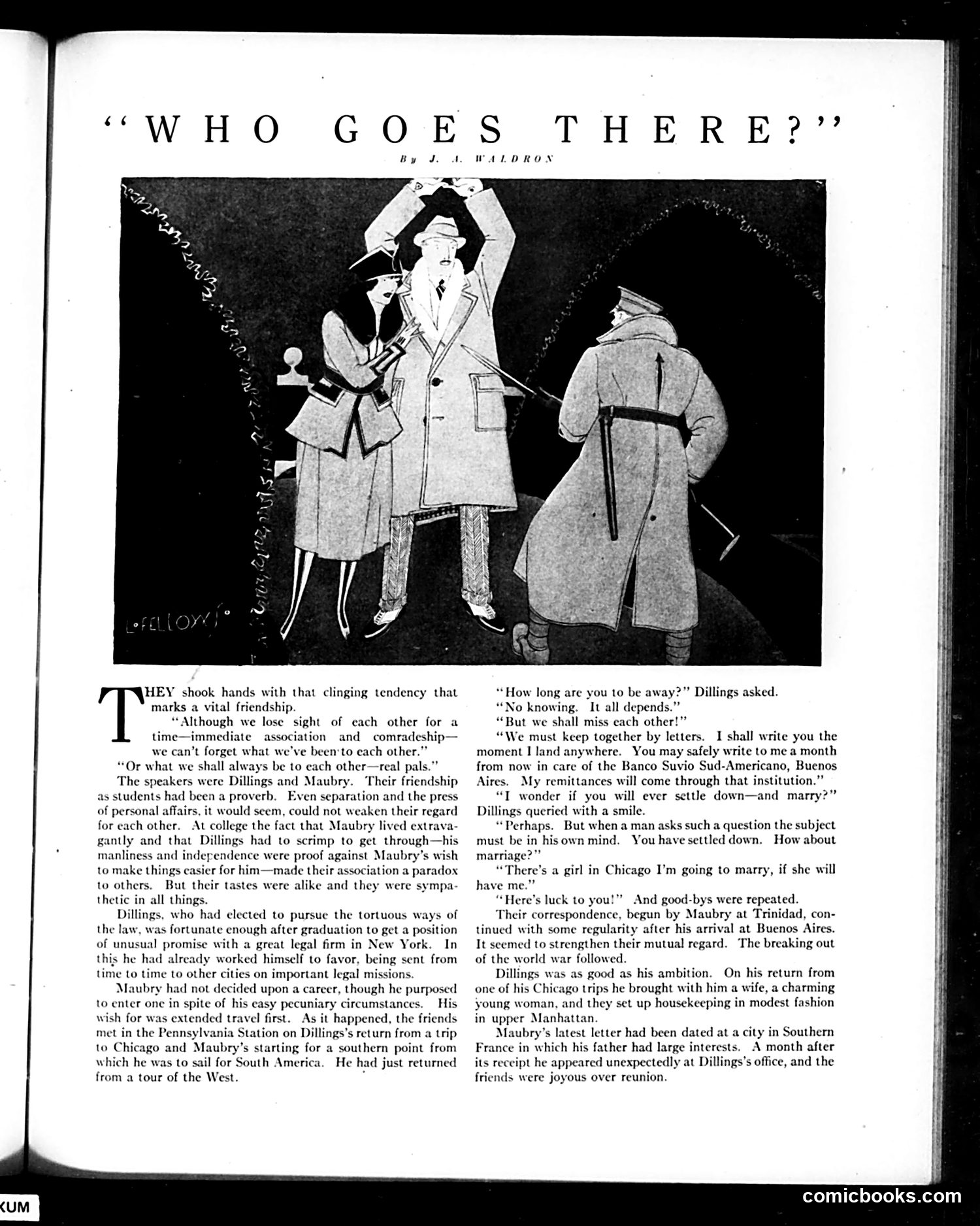
This is a sentimental story illustration rather than satire. It depicts two college friends—Dillings and Maubry—saying goodbye at Pennsylvania Station. Dillings, now a successful New York lawyer, is settling into domestic life with a Chicago fiancée. Maubry, wealthy but undecided about his future, is departing for South America. The narrative emphasizes their enduring friendship despite different circumstances: Dillings had to scrimp through college while Maubry was wealthy, yet they remained "sympathetic in all things." The story celebrates male friendship and honor ("real pals"), showing how correspondence sustains their bond despite separation and the interruption of World War I. The tone is nostalgic and earnest—typical Judge content mixing melodrama with middle-class values about loyalty and manly virtue.
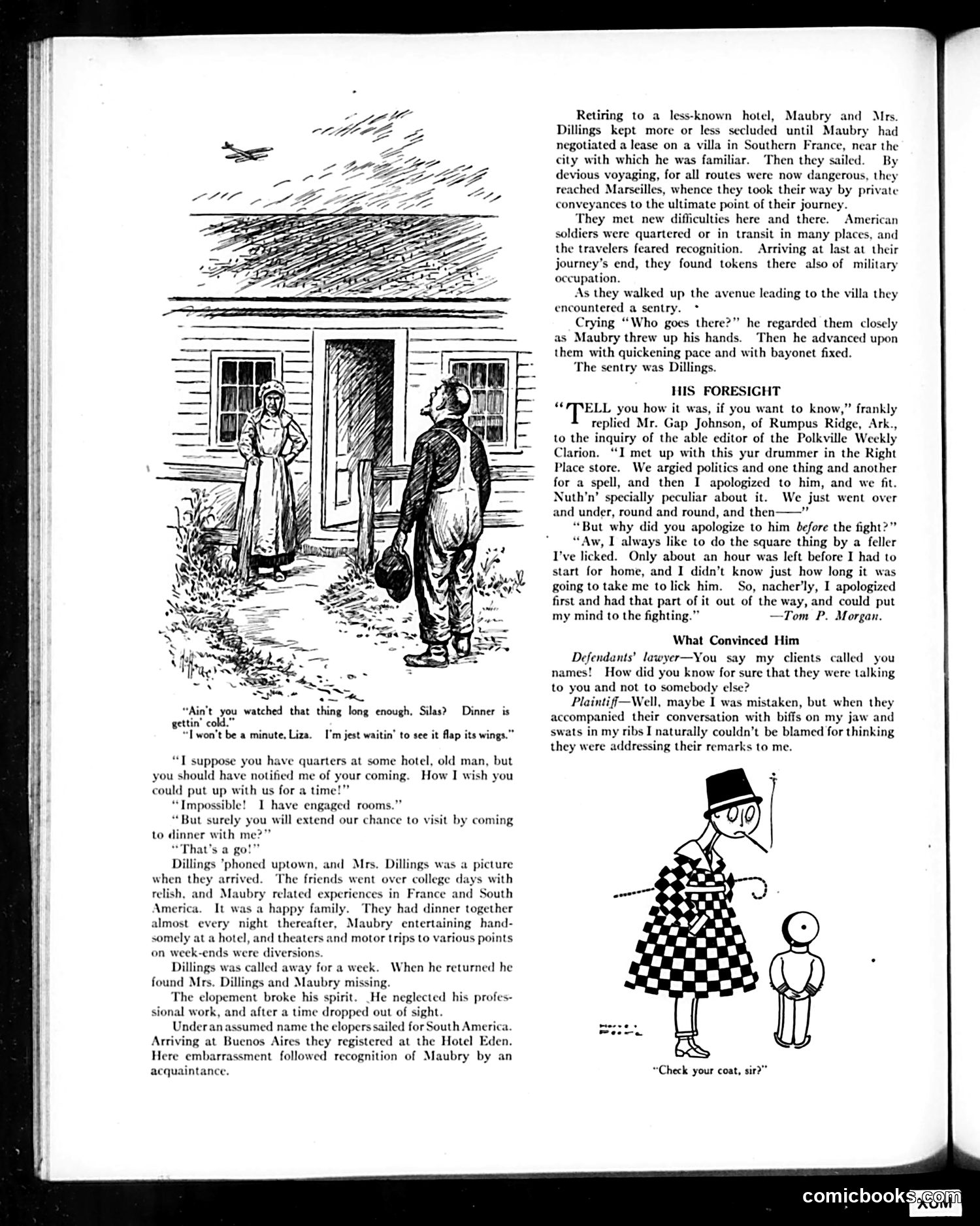
This page contains **two separate humorous stories**, not political cartoons: **Main narrative (top):** A dramatic tale of infidelity interrupted by wartime. Maubry and Mrs. Dillings flee post-WWI France after an affair, but encounter a sentry at their villa destination—who turns out to be Mr. Dillings himself, the betrayed husband. The irony: they've run directly into him. **"His Foresight" (middle):** A rural humor piece about Gap Johnson of Arkansas, who fights a drummer (traveling salesman) but apologizes *before* the fight to "do the square thing"—giving himself time to beat the man before leaving for home. The joke is his backwards frontier logic. **"What Convinced Him" (bottom):** A courtroom joke where a plaintiff insists defendants were addressing *him* during a fight because they accompanied their insults with actual physical blows ("biffs on my jaw"). **The small cartoon (right):** Unrelated domestic scene with unclear caption. These are **light comedic pieces**, not satire of contemporary politics. The magazine mixed serialized stories with short jokes and illustrations.
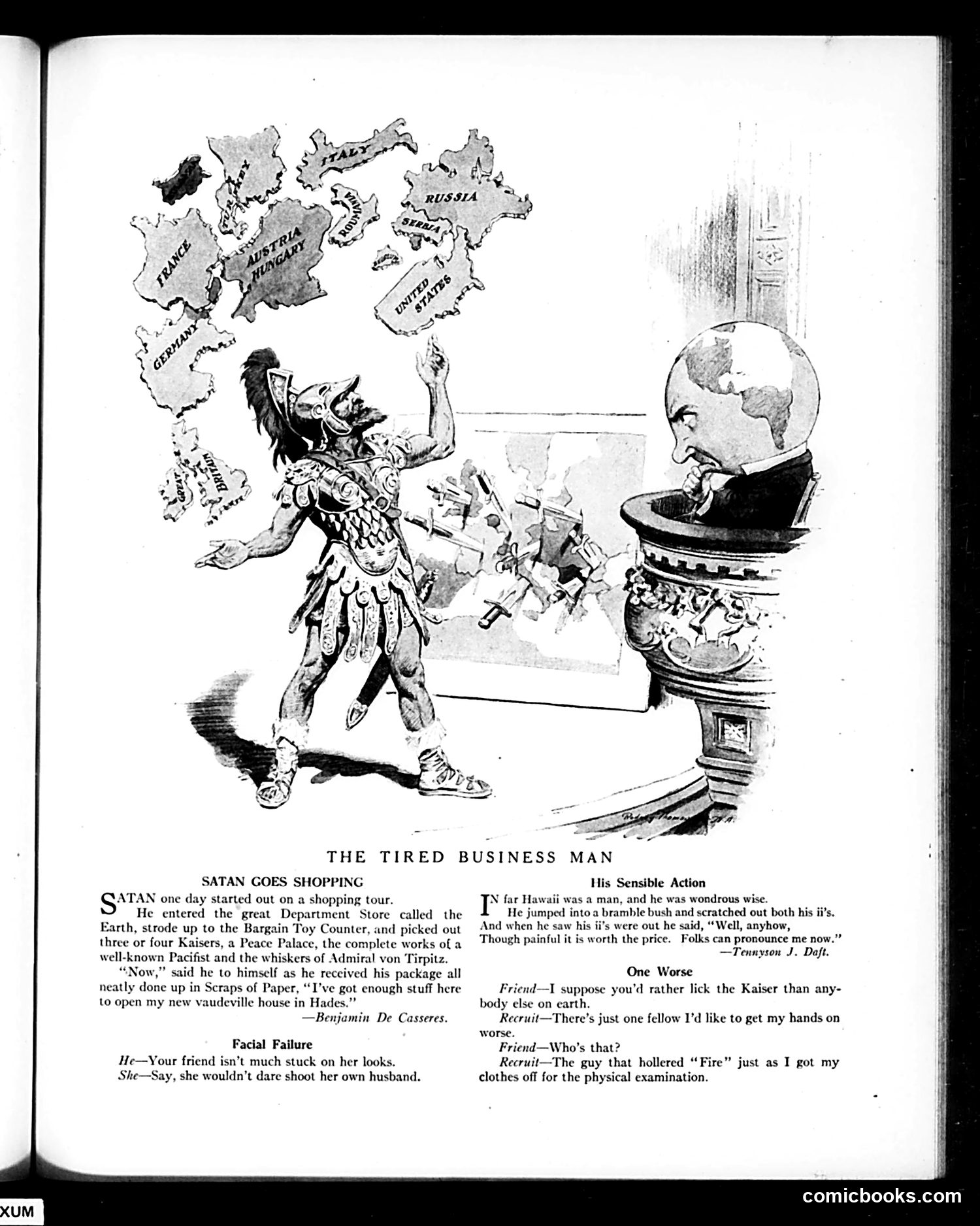
**The Main Cartoon: "Satan Goes Shopping"** This is a WWI-era satirical piece depicting Satan as a shopper at "Earth's Department Store," selecting destructive items: multiple Kaisers (German Emperor Wilhelm II), a Peace Palace, pacifist writings, and Admiral von Tirpitz's whiskers. The joke: Satan plans to open a vaudeville house in Hell using these purchases—implying that militarism, false peace efforts, and German leadership are inherently hellish and entertaining only to the devil. **Historical Context:** The references to "Kaisers," "Peace Palace," and "Scraps of Paper" (likely referencing treaty violations) indicate this is anti-German propaganda from World War I. The cartoon mocks both German aggression and pacifists who oppose the war effort, suggesting both serve evil. **Additional Jokes:** The three short humor pieces below are unrelated vaudeville-style quips about marriage, Hawaiian spelling, and military embarrassment—typical of Judge magazine's miscellaneous comedy sections.
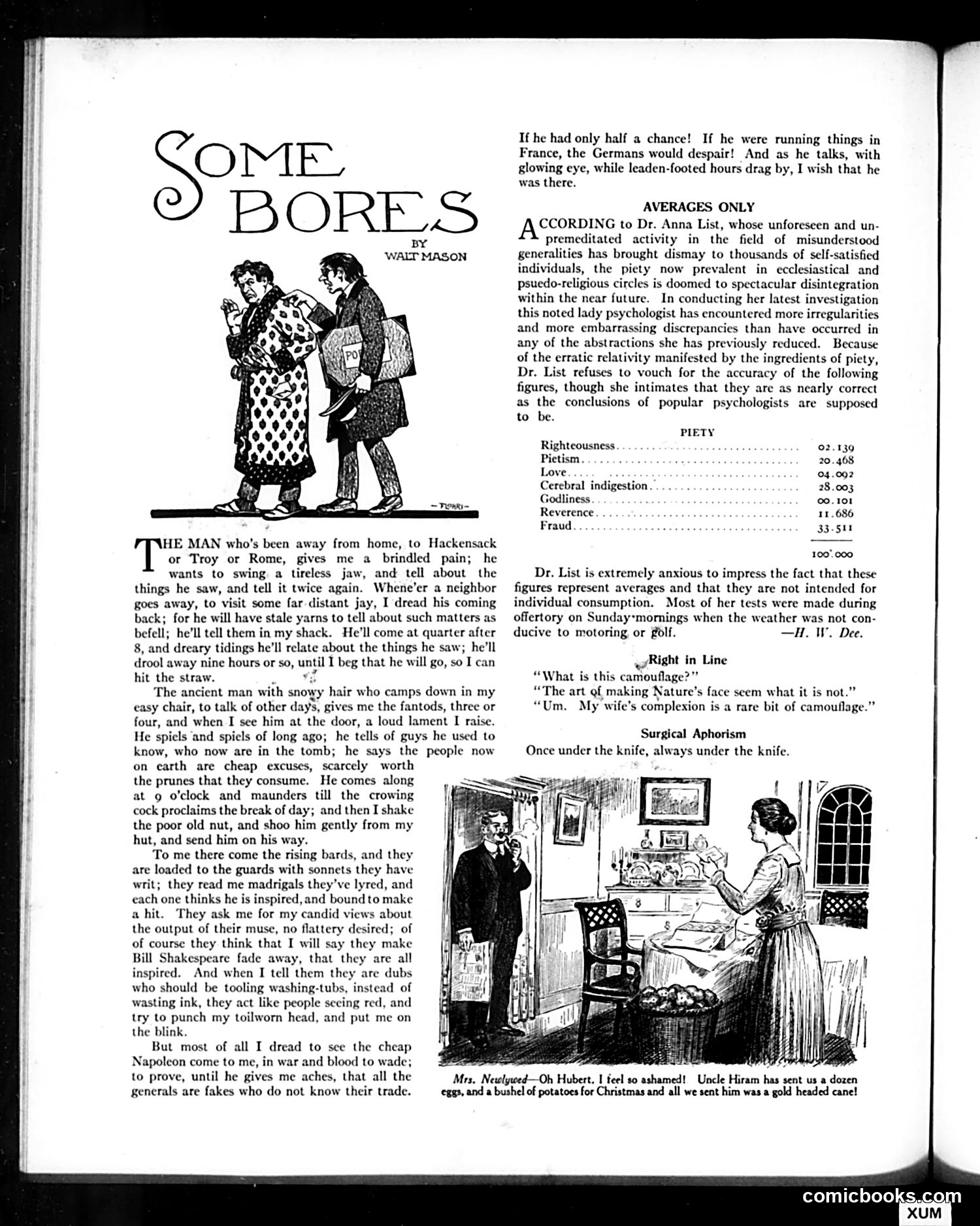
This page satirizes tedious social visitors through Mason's poem. The narrator complains about three types of tiresome guests: travelers who endlessly recount trips (to distant places like Hackensack), elderly men who reminisce about the past until dawn, and aspiring poets who demand praise for their mediocre work and become violent when criticized. The accompanying cartoon mocks pseudo-scientific psychology. "Dr. Anna List" ridicules fashionable psychologists who reduce complex human qualities to absurd numerical averages—claiming "piety" breaks down into measurable percentages including "fraud" (33.511%) and "cerebral indigestion" (28.003%). The satire targets both the pretension of popular psychology and the hypocrisy of institutional religion, suggesting piety contains more dishonesty than righteousness. The lower cartoon shows embarrassed newlyweds ashamed their gift (a cane) was inadequate compared to the lavish hamper their relative sent.
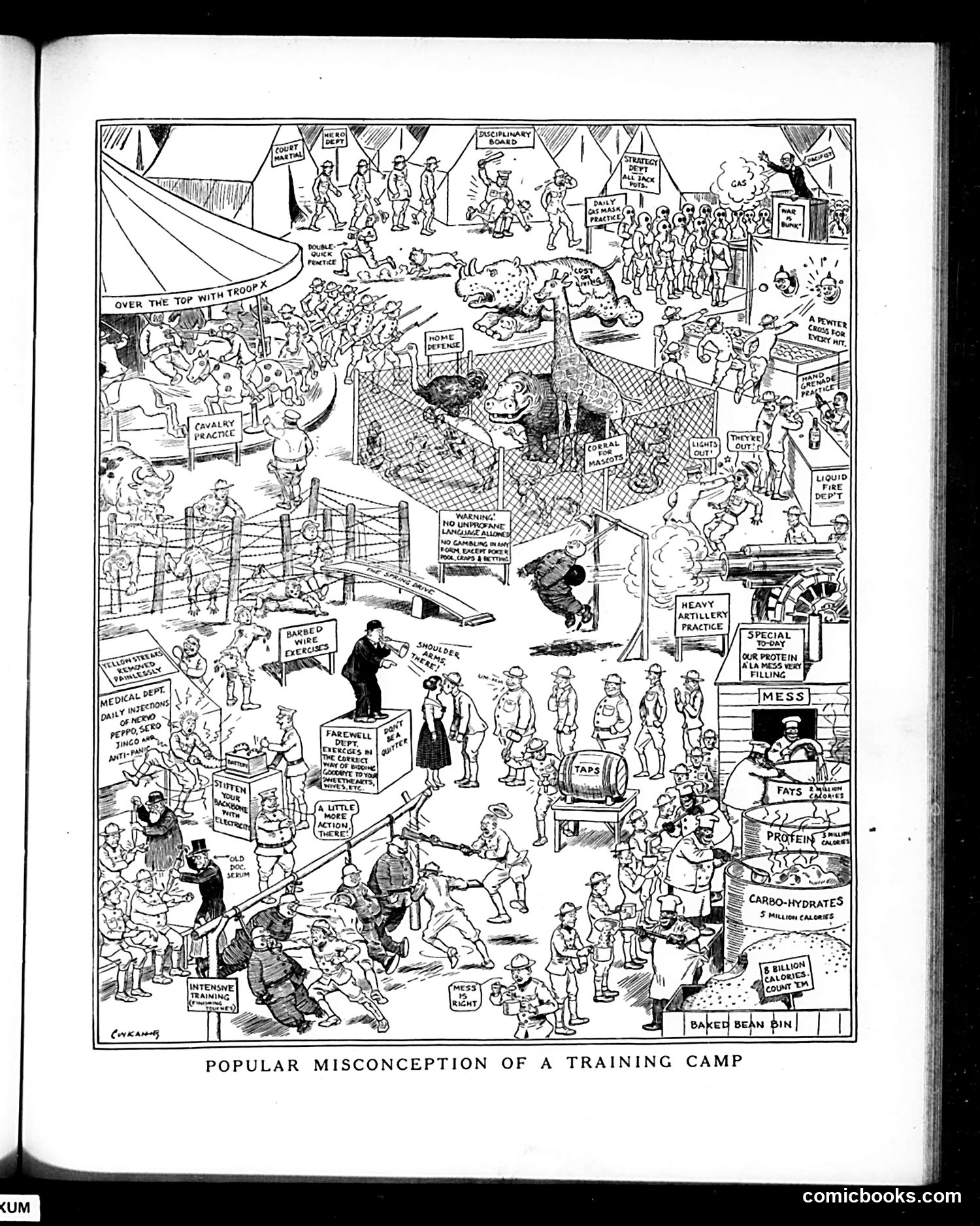
This satirical illustration depicts a chaotic military training camp that contradicts public expectations. The cartoon shows soldiers engaged in various recreational and leisure activities—cavalry practice, mess hall dining, sleeping, entertainment—rather than rigorous combat training. Labels identify specific areas like "Barred Wire Exercises," "Intensive Training," and "Farewell Dinner," but the actual scenes depict relaxation and socializing. The satire targets public misconceptions about military camp life, suggesting civilians imagined harsh, grueling conditions when camps actually allowed considerable downtime and comfort. This likely responds to WWI-era discussions about American military preparedness or contemporary debates about soldier welfare. The dense, busy composition humorously emphasizes the gap between propaganda and reality regarding military training rigor.
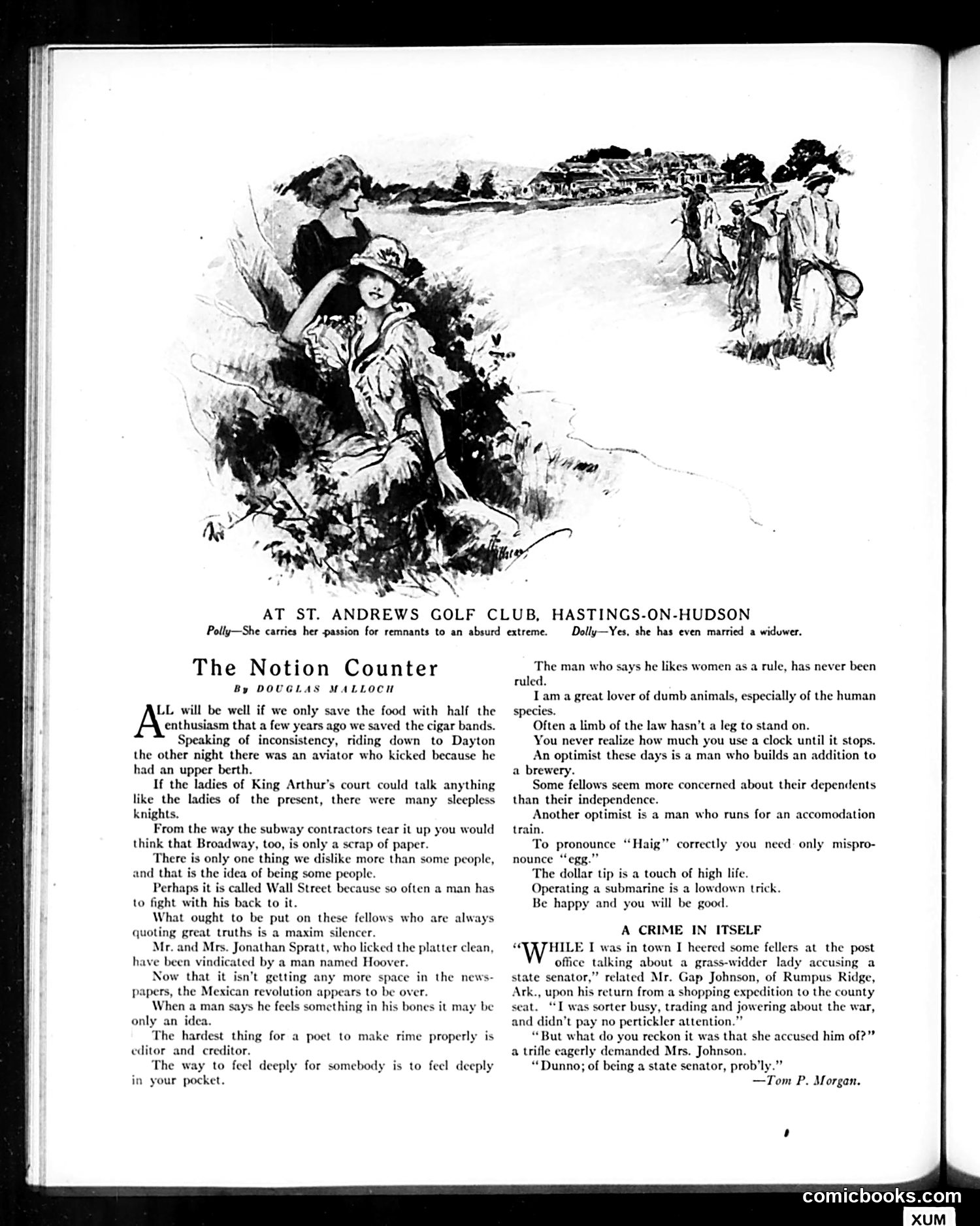
**The Cartoon:** The top illustration depicts a woman and child at a golf club, with the caption joking that the woman carries her passion for collecting remnants (fabric scraps) to an "absurd extreme"—she's even married a widower, suggesting she collects people like fabric. **"The Notion Counter":** This is a collection of one-liners and satirical quips by Douglas Malloch, typical of Judge's format. Key targets include: - **Food conservation** (referencing wartime rationing) - **Subway construction** chaos in New York - **Wall Street** financial struggles - **Mexican Revolution** (now deemed "over" and no longer newsworthy) - **Herbert Hoover** (likely referencing his food conservation efforts) - **Optimism about breweries** (mocking Prohibition-era absurdity) **"A Crime in Itself":** A rural dialect story where Mr. Gap Johnson reports a woman accused a state senator of "being a state senator, prob'ly"—satirizing political corruption as so endemic that mere office-holding is itself criminal. The page reflects 1910s-20s American concerns: WWI rationing, Prohibition, political graft, and New York urban chaos.
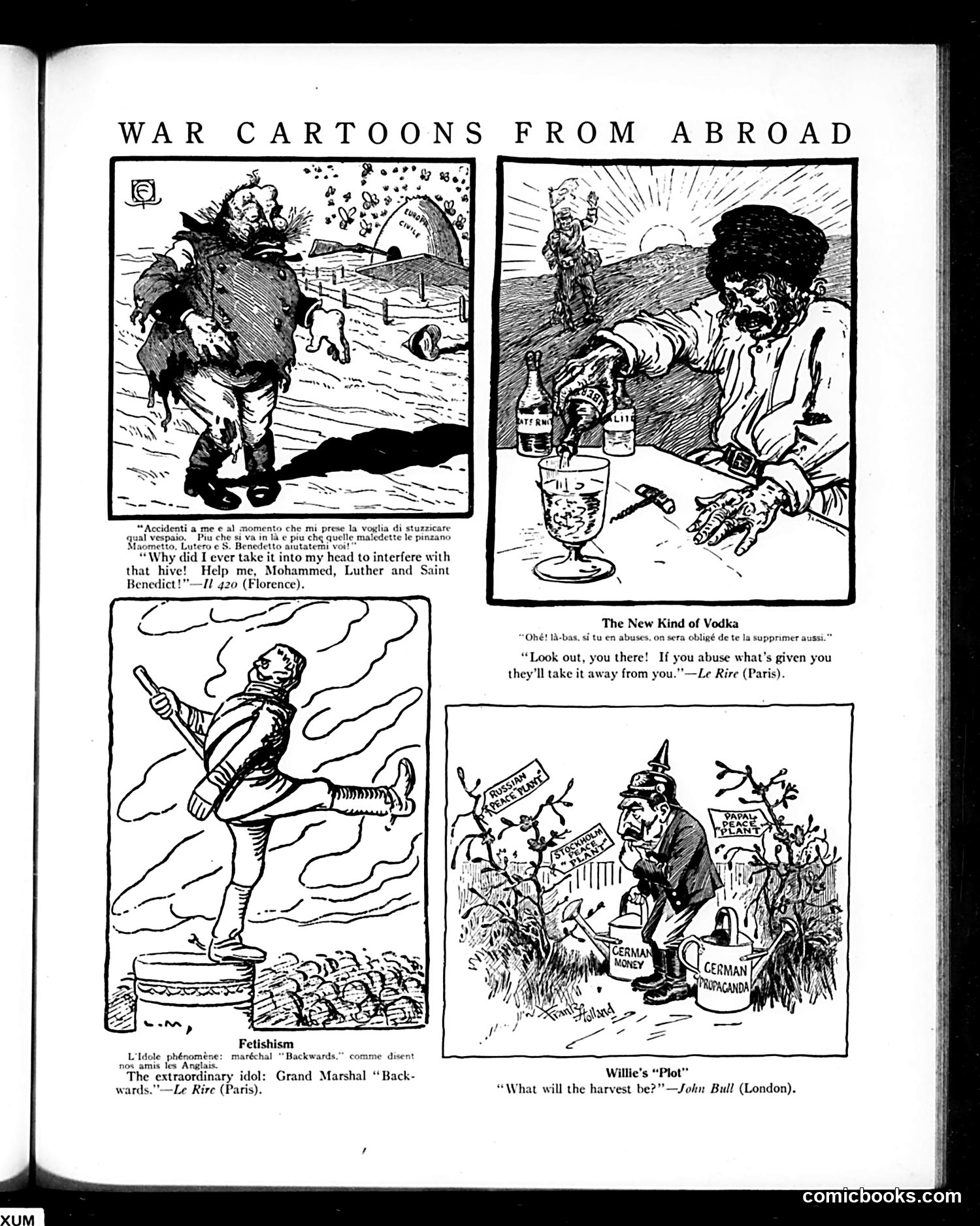
This page collects anti-German satirical cartoons from European publications during World War I. The top-right cartoon, "The New Kind of Vodka," appears to mock German use of alcohol or intoxication as propaganda or morale-boosting. The bottom-left "Fetishism" cartoon caricatures a German military leader (likely a general) marching "backwards"—suggesting Germany's military strategy or leadership is moving in reverse or failing. The bottom-right "Willie's Plot" depicts what appears to be a German figure (possibly the Kaiser, referred to as "Willie") planting seeds of propaganda or discord, with the caption questioning what harvest will result—implying Germany's actions will backfire with destructive consequences. These cartoons express Allied skepticism about German military competence and warn of propaganda's dangers, using exaggeration and symbolism typical of WWI-era political satire.
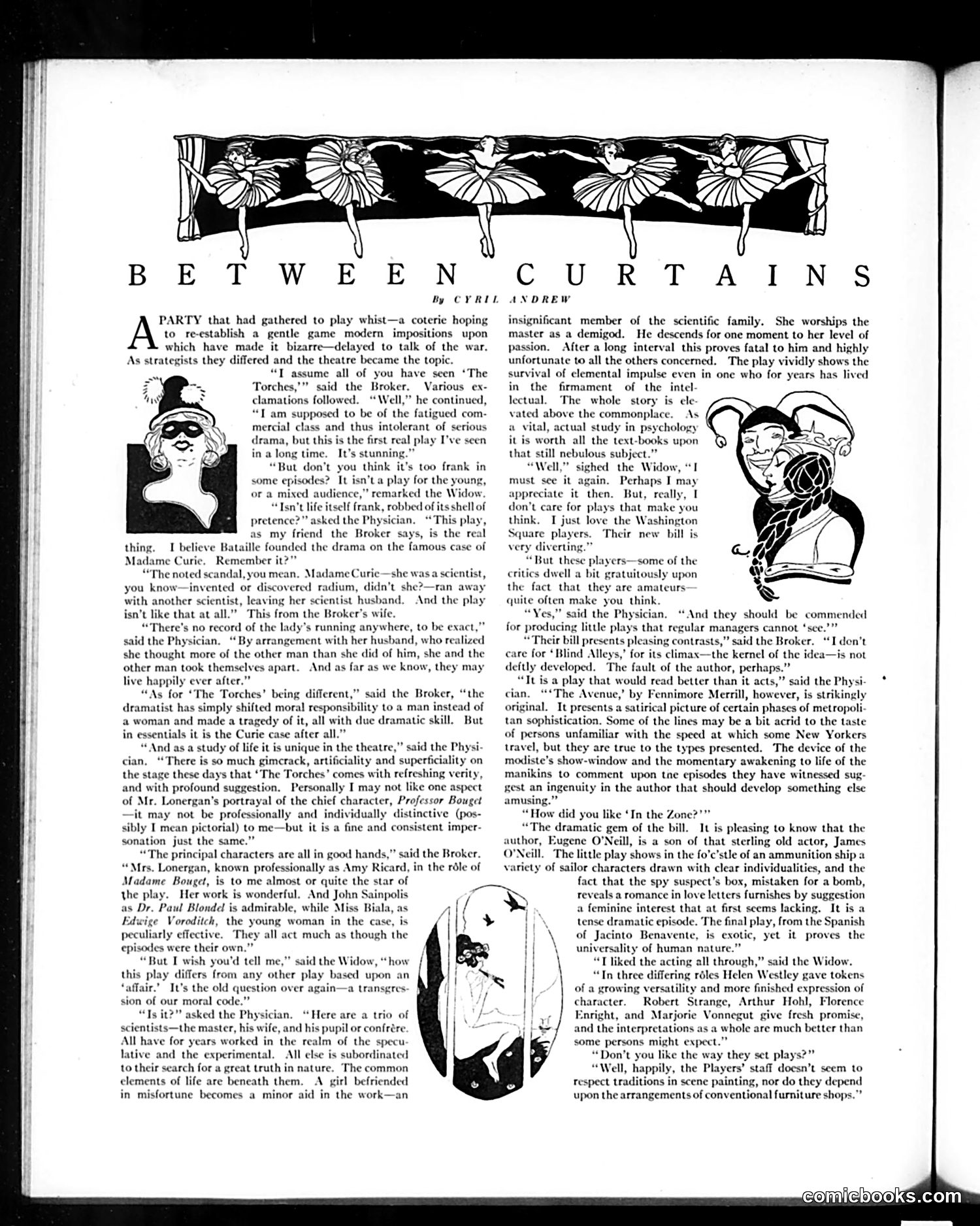
This page discusses contemporary theater, specifically a play called *The Torches*. A group of socialites debate whether the drama is appropriate and artistically valid. The central satire targets bourgeois hypocrisy: a "fatigued commercial class" Broker claims to appreciate serious drama while others (the Widow) worry it's "too frank" for mixed audiences. The Physician defends the play's realism, noting life itself is frank. The play itself appears based on the Madame Curie scandal—a scientist who left her husband for a colleague. The satirical point: the characters discuss whether shifting genders in the moral transgression (male instead of female protagonist) makes it fundamentally different. It doesn't, the Physician implies. The illustrations show caricatured socialites in period dress. The satire mocks genteel society's squeamishness about mature themes while simultaneously celebrating "art," revealing their actual discomfort with unflinching reality.
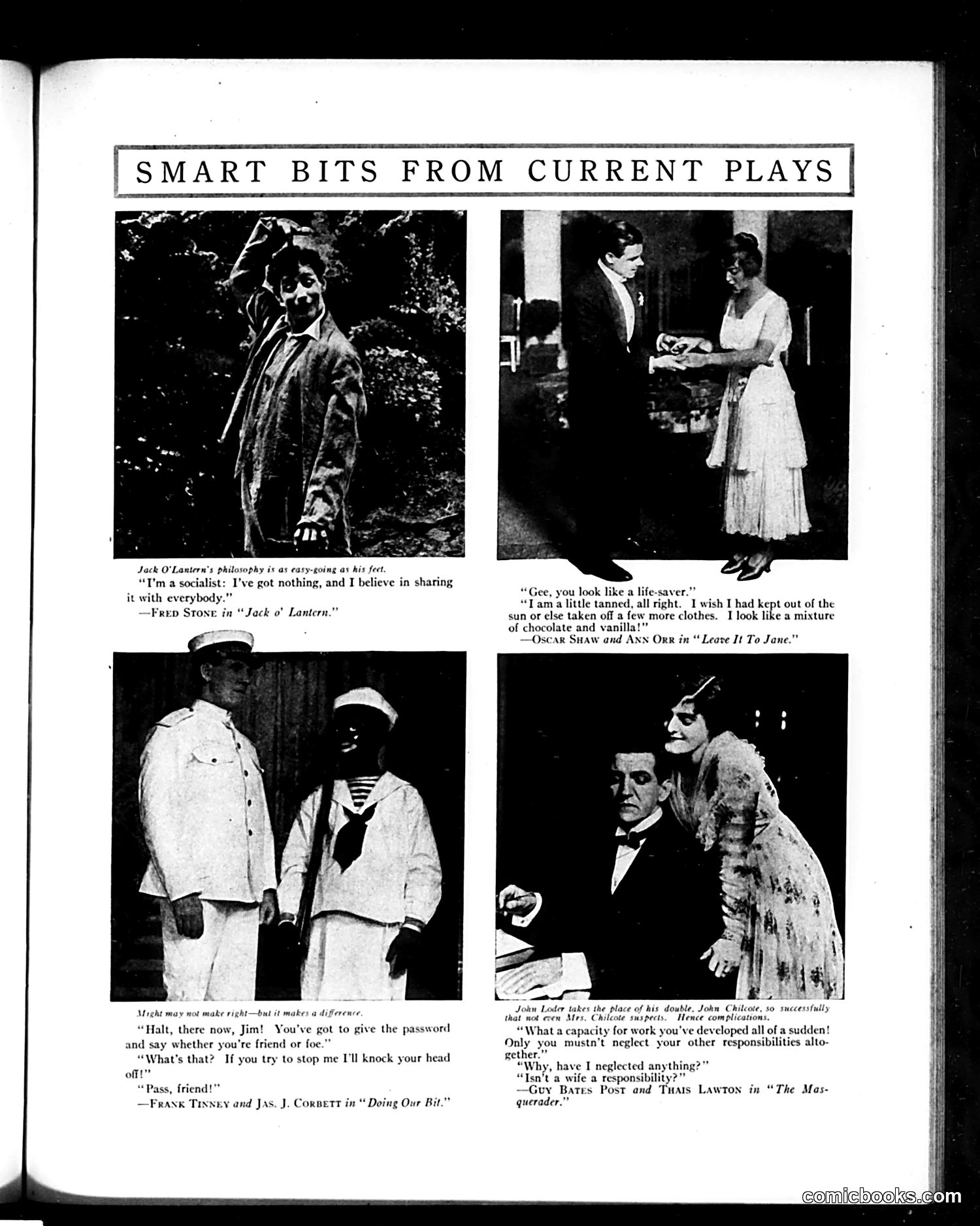
This page presents humorous quotes from four Broadway productions, each illustrating comedic character moments. "Jack o' Lantern" features a socialist character's ironic philosophy about having nothing to share. "Doing Our Bit" shows a sentry accepting a bluffer's aggression as a "password" — likely satirizing wartime security theater during WWI (the play's title suggests patriotic duty). "Leave It to Jane" contains light banter about sun-tanning. "The Masquerader" presents a domestic comedy about a wife confronting her husband's work obsession, with the punchline that marriage itself is a responsibility he's neglected. These are typical of Judge magazine's theatrical humor column: short, snappy jokes extracted from popular stage productions, designed to entertain readers with clever wordplay and relatable domestic/social scenarios rather than heavy satire.
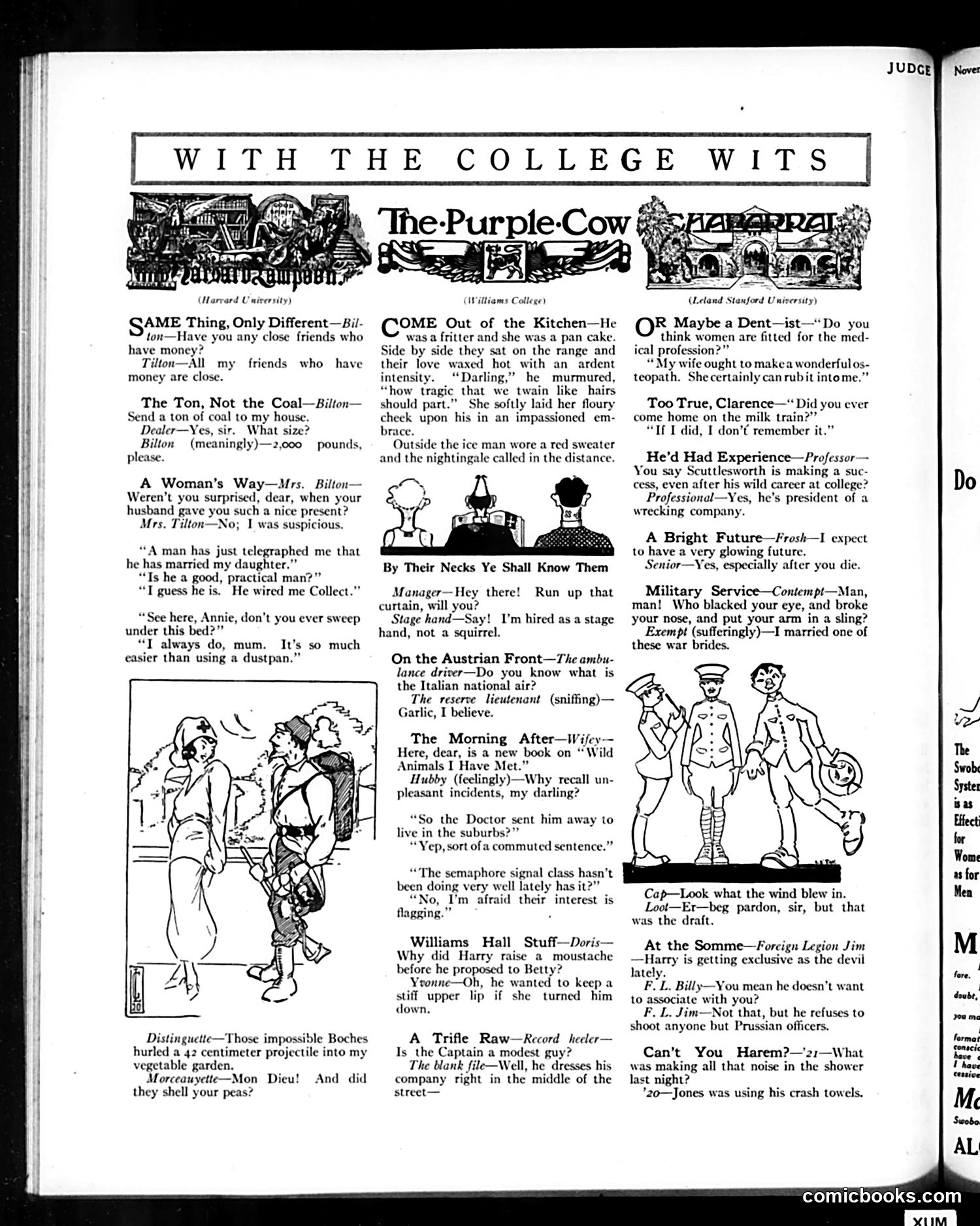
This page collects brief satirical jokes and comic observations attributed to different American colleges (Harvard, Williams, Leland Stanford). The humor targets familiar subjects: cheap wealthy people who only befriend the rich, marital misunderstandings, domestic servants, and college life. Several jokes reference World War I, then ongoing: remarks about German artillery ("42 centimeter projectile"), Austrian military incompetence (confusing garlic with Italian national music), and "war brides" causing domestic chaos. One joke mocks a soldier who insists on shooting only Prussians, suggesting overly-particular patriotism. The humor is gentle undergraduate satire—puns on "fritter" and "pancake," wordplay about "crash towels." Nothing appears overtly political. Rather, these represent typical American college humor of the WWI era: domestic comedy, military references, and mild social observation aimed at educated readers familiar with university life.
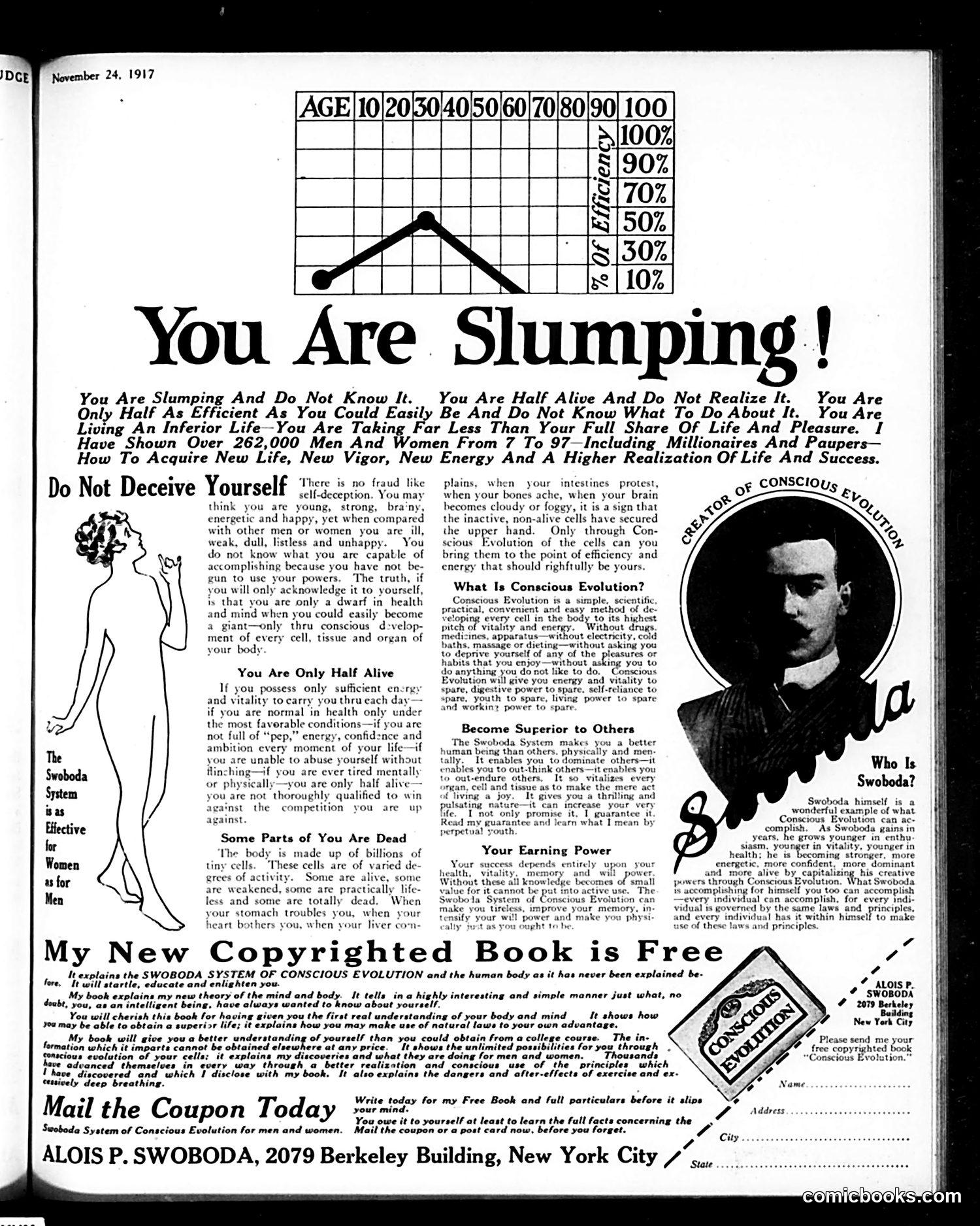
This page is primarily a **pseudoscientific health advertisement**, not satire. It promotes "Swoboda's System of Conscious Evolution"—a dubious self-improvement scheme claiming to unlock hidden human potential through undefined cellular manipulation. The rhetoric is typical of early 20th-century quack medicine: vague health claims ("You Are Slumping!"), pseudointellectual language ("conscious evolution of cells"), and appeals to competitive anxiety and masculine vigor. The graph showing efficiency peaks around age 40, and the illustration of an apparently lethargic woman reinforce period assumptions about vitality and gender. Published November 1917 (during WWI), the emphasis on acquiring "new vigor" and "energy" may subtly appeal to wartime concerns about national strength, though the advertisement's primary target appears to be individual health insecurity rather than patriotic obligation. The coupon invitation and free-book offer were standard direct-marketing tactics for such schemes.
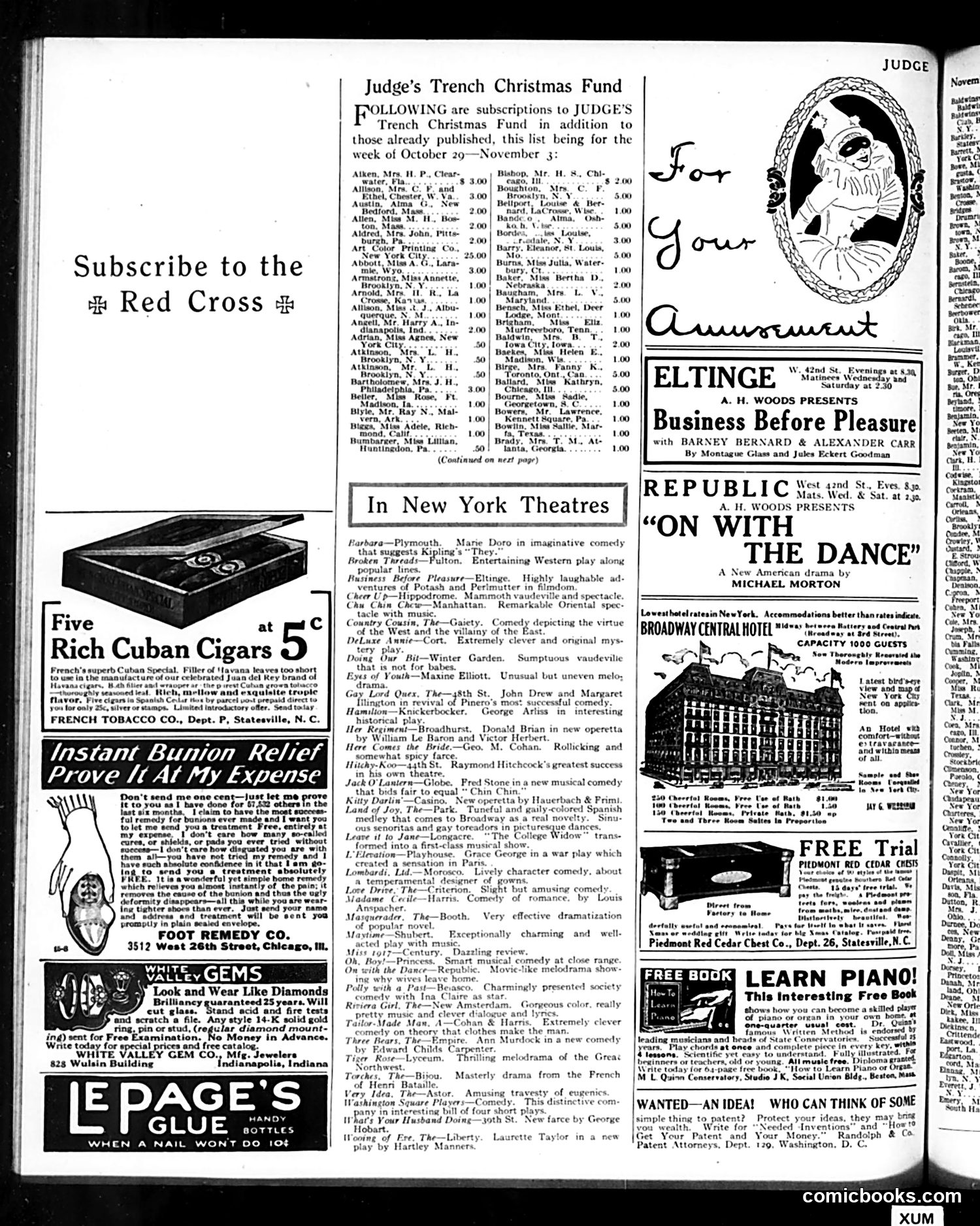
This page is primarily **advertising and subscription lists**, not satire or political commentary. The main content is: **Judge's Trench Christmas Fund**: A fundraising list showing donations for Christmas relief packages to American soldiers in WWI trenches. Subscription names and amounts fill the center column. **Advertisements** dominate the page—patent medicine ads (bunion relief, foot remedy), gem dealers, cigars, glue, and theatrical listings. These reflect early-20th-century commercial culture. **Theater notices** briefly describe Broadway productions. The only potentially satirical element is implicit: the **Red Cross subscription appeal** and war relief efforts appear alongside frivolous consumer goods advertising, creating an unintended contrast between wartime sacrifice and peacetime commercialism—though this seems accidental rather than intentional satire.
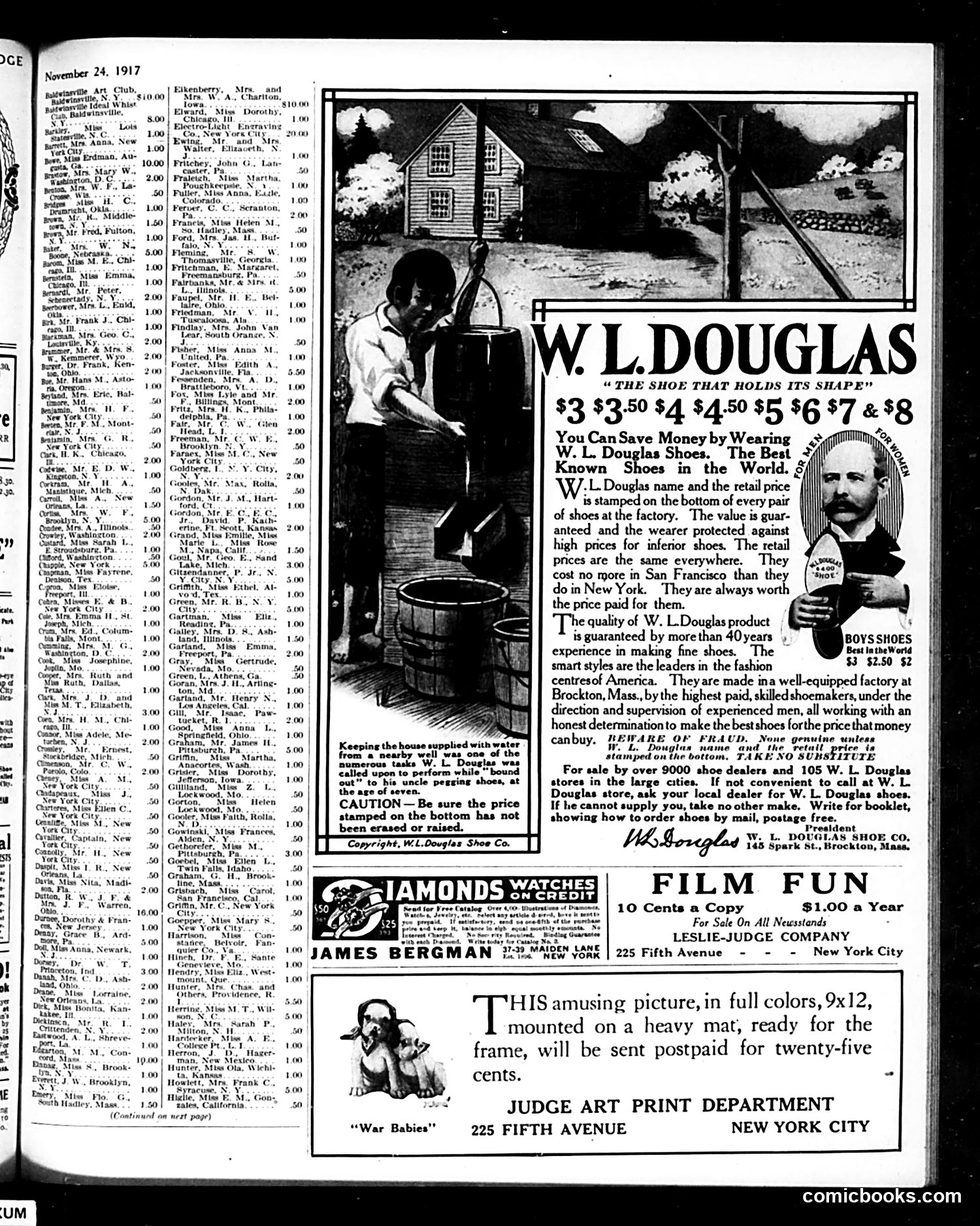
This page is primarily **advertising**, not editorial content or satire. The dominant feature is a large **W.L. Douglas Shoes advertisement** showing a man at a workbench crafting shoes, with imagery of homes and rural scenes above. The ad emphasizes that W.L. Douglas shoes are affordable ($3-$8), standardized in price nationwide, and made by skilled workers in Brockton, Massachusetts. It includes a warning against fraud—customers should verify the price stamped on the shoe's bottom hasn't been altered, reflecting concerns about counterfeit or misrepresented goods. Below are smaller ads for **Jamonds Watches** (sold on credit), **Film Fun** magazine, and a **Judge Art Print** of "War Babies" available for 25 cents. The left side contains what appears to be a subscription or membership list with names and locations, likely unrelated to the advertisements. This is a commercial page with minimal satirical content.
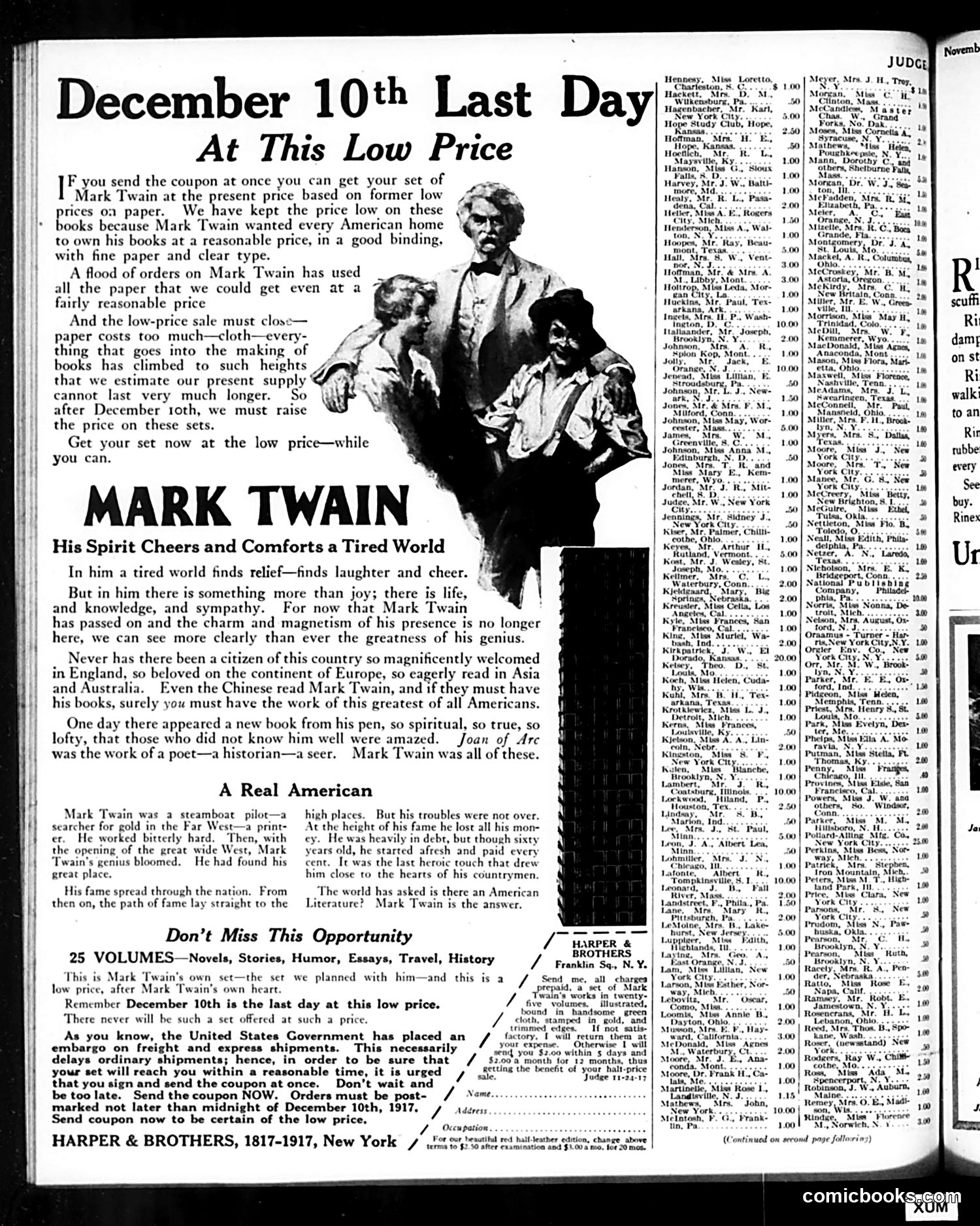
This is primarily a **sales advertisement** for a 25-volume Mark Twain collection by Harper & Brothers, disguised within Judge magazine's editorial framework. The page commemorates Mark Twain (who died in 1910), presenting him as "the greatest of all Americans" whose work brought "laughter and cheer" to a "tired world." The text emphasizes his international acclaim and his rags-to-riches-to-rags-to-riches biography (steamboat pilot, prospector, writer; later financial ruin and redemption through hard work). **The sales pitch:** The December 10th deadline creates urgency. Rising paper and production costs allegedly force a price increase after that date. This leverages both patriotic sentiment (owning Twain's works is an American duty) and World War I–era paper shortages (mentioned as government embargo on freight) to pressure immediate purchase. The "cartoon" is essentially the portrait of Twain himself—not satirical, but heroic, positioning him as an irreplaceable national treasure whose literary works modern readers cannot afford to miss.
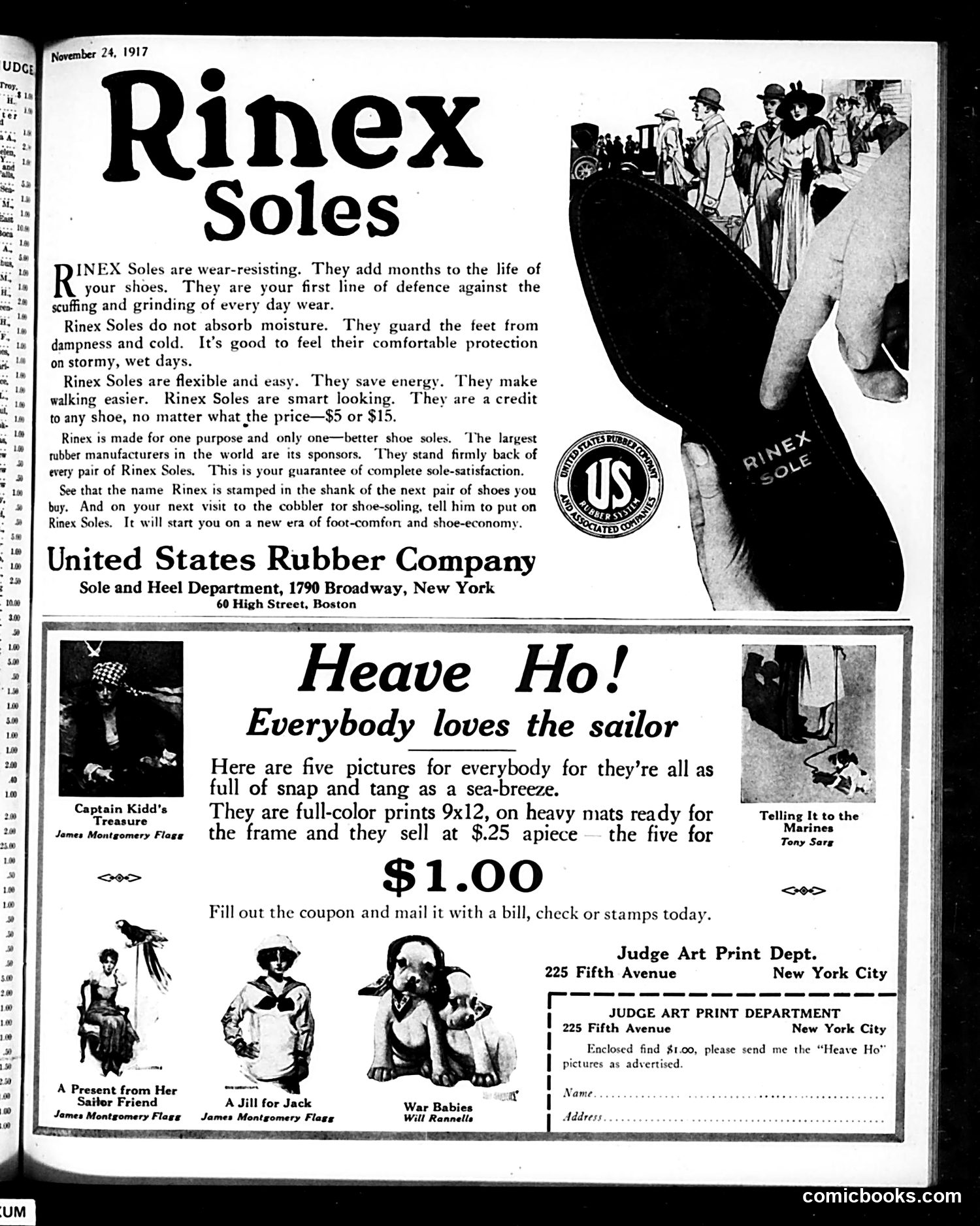
This *Judge* magazine page (November 24, 1917) contains two unrelated advertisements. **Top:** A Rinex shoe-sole advertisement emphasizing durability and comfort—typical early 20th-century product marketing with no satirical content. **Bottom:** A "Heave Ho!" print offer featuring five sailor-themed illustrations by James Montgomery Flagg and Will Ranells, priced at $1.00 for the set. The timing is significant: November 1917 places this during America's active WWI involvement (entered April 1917). The "everybody loves the sailor" appeal reflects wartime patriotism and public affection for military personnel. The images—"Captain Kidd's Treasure," "A Present from Her Sailor Friend," "A Jill for Jack," "Telling It to the Marines," and "War Babies"—capitalize on contemporary nautical and military sentiment. This is straightforward commercial patriotism rather than satire: selling nostalgia and wartime emotion to consumers.
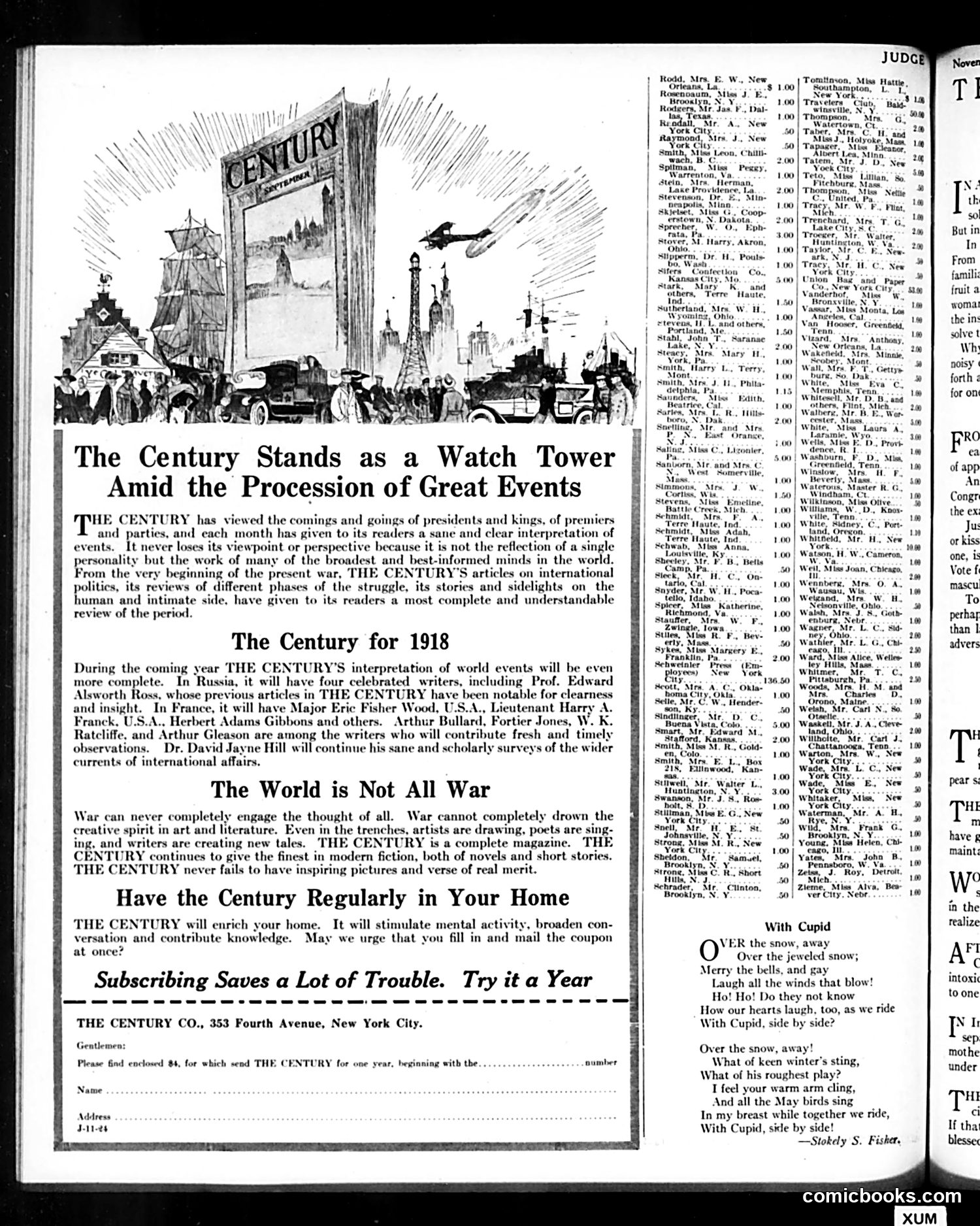
This page is primarily **advertising and subscription promotion** for *The Century* magazine, not a political cartoon. The illustrated header shows a towering "CENTURY" billboard overlooking a cityscape with crowds, airplanes, and industrial imagery—visualizing the magazine's claim to serve as a "watch tower" observing major world events. The text promotes *The Century's* 1918 coverage, emphasizing its access to notable war correspondents and international affairs experts (Edward Alsworth Ross on Russia, Eric Fisher Wood on France, etc.). It argues the magazine provides balanced perspective on World War I while also publishing quality fiction and poetry—asserting that "the world is not all war." The bulk of the page consists of subscription coupons and a **subscriber list** with names and addresses, representing successful promotional response. This reflects how 1918 magazines used promotional satire publications like *Judge* to reach educated audiences interested in serious journalism about the ongoing war.
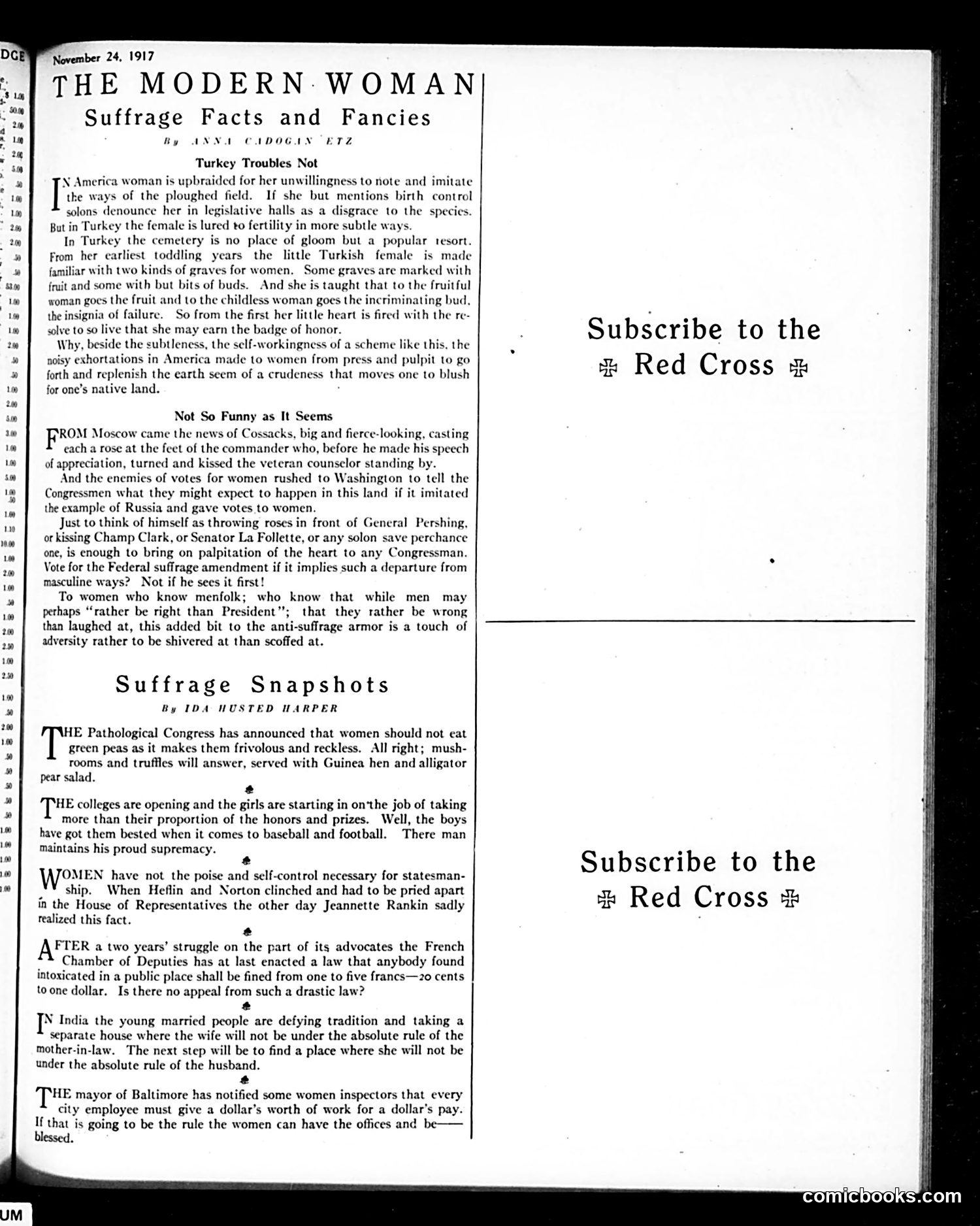
This November 1917 satirical page opposes women's suffrage through mock-serious arguments. The main article by Anna Cadogan Utz ridicules anti-suffrage claims about women's "unfitness" for voting. It uses absurd examples: Turkey supposedly encourages fertility through cemetery symbolism (graves marked with fruit for fertile women, buds for childless ones), presented as subtly manipulative compared to America's "crude" exhortations. A second section mocks fears that granting women votes will lead to "Russian-style" behavior—Cossacks throwing roses and kissing commanders. The author sarcastically notes congressmen fear women voters might display such "unmanly" emotional displays. "Suffrage Snapshots" by Ida Husted Harper employs pointed irony: opponents claim women lack judgment (shouldn't eat peas—too frivolous) yet boys still dominate sports; women lack "poise" for statesmanship despite men fighting on the House floor; France's new public intoxication law seems absurdly harsh. The satire exposes the contradictory, irrational logic of anti-suffrage arguments, ultimately supporting women's voting rights through ridicule of opponents' positions.
This page is primarily **advertisements and filler content** rather than editorial material. The main elements are: **Advertisements:** - White Rock mineral water and Buckskin tires (left column) - Romeike's Press Clipping Bureau (a media monitoring service) - Cortez cigars and Red Cross subscription appeals **"Stories with Smiles" section:** Brief humorous anecdotes with no political content—just gentle wordplay and social humor about grammar lessons, rival sausage-makers' competitive signs, and Lord Northcliffe (a prominent British newspaper magnate) declining an interview. **Announcement:** Next week's issue will be a Christmas number featuring illustrations by popular artists like James Montgomery Flagg. **No political satire or caricature is present.** This appears to be a standard magazine page from November 24, 1917, mixing commercial notices with light entertainment—typical filler for the era's periodicals.
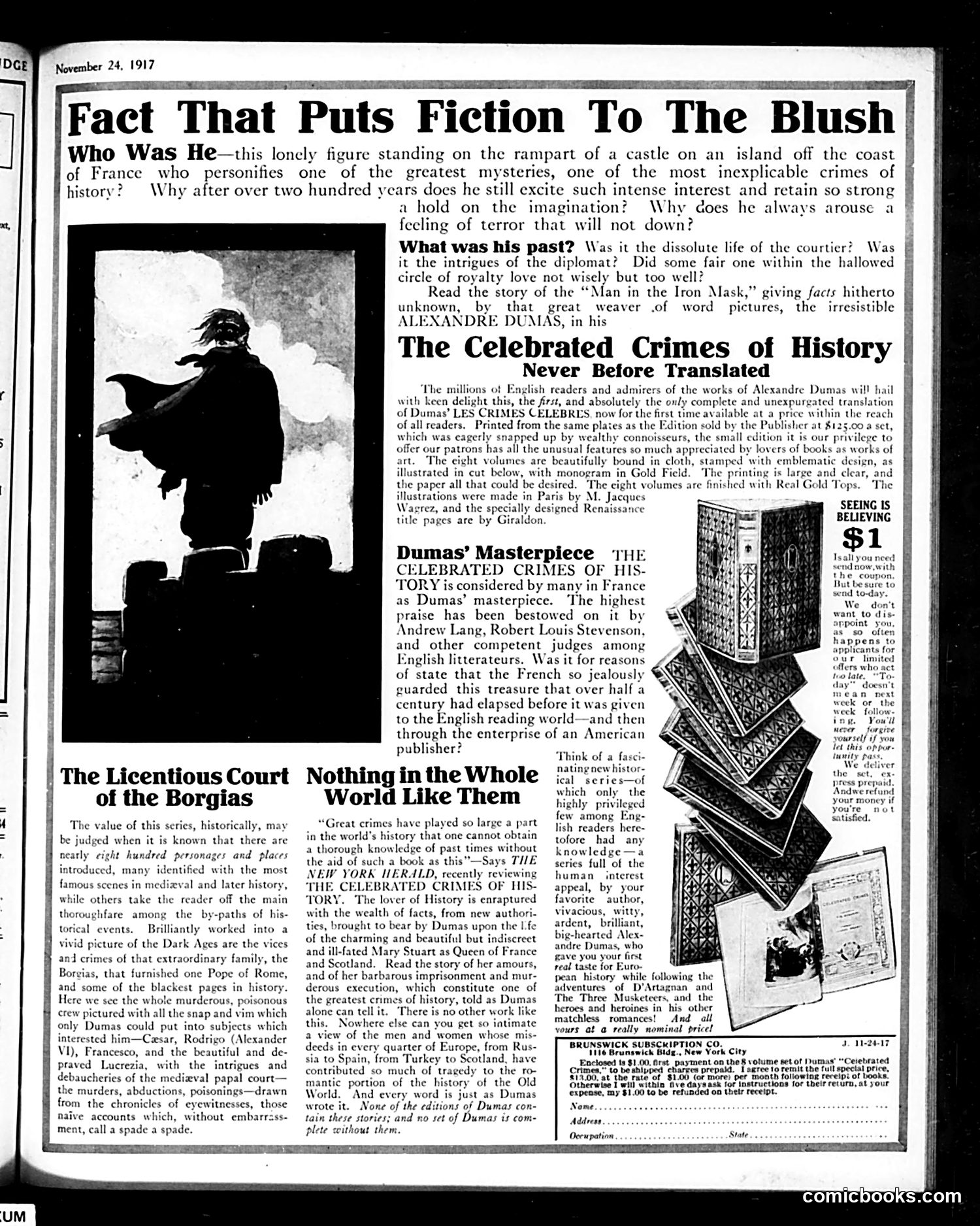
This is primarily a **book advertisement**, not political satire. The page promotes a new English translation of Alexandre Dumas' *Celebrated Crimes of History*, marketed as the "first...complete and unexpurgated" edition. The dramatic silhouette image depicts **the Man in the Iron Mask**—Dumas' famous fictional prisoner—to hook readers with mystery and intrigue. The rhetorical questions ("Who Was He?") echo Dumas' own storytelling technique. The ad emphasizes the book's prestige: it was previously sold only to "wealthy connoisseurs" at $125; this edition makes it affordable. It name-drops prestigious endorsers (Andrew Lang, Robert Louis Stevenson) to establish credibility. The page also advertises Dumas' account of the **Borgias**—the infamous Renaissance family known for murder and poison—as another selling point. The overall appeal is to readers hungry for historical crime narratives more sensational than fiction itself.
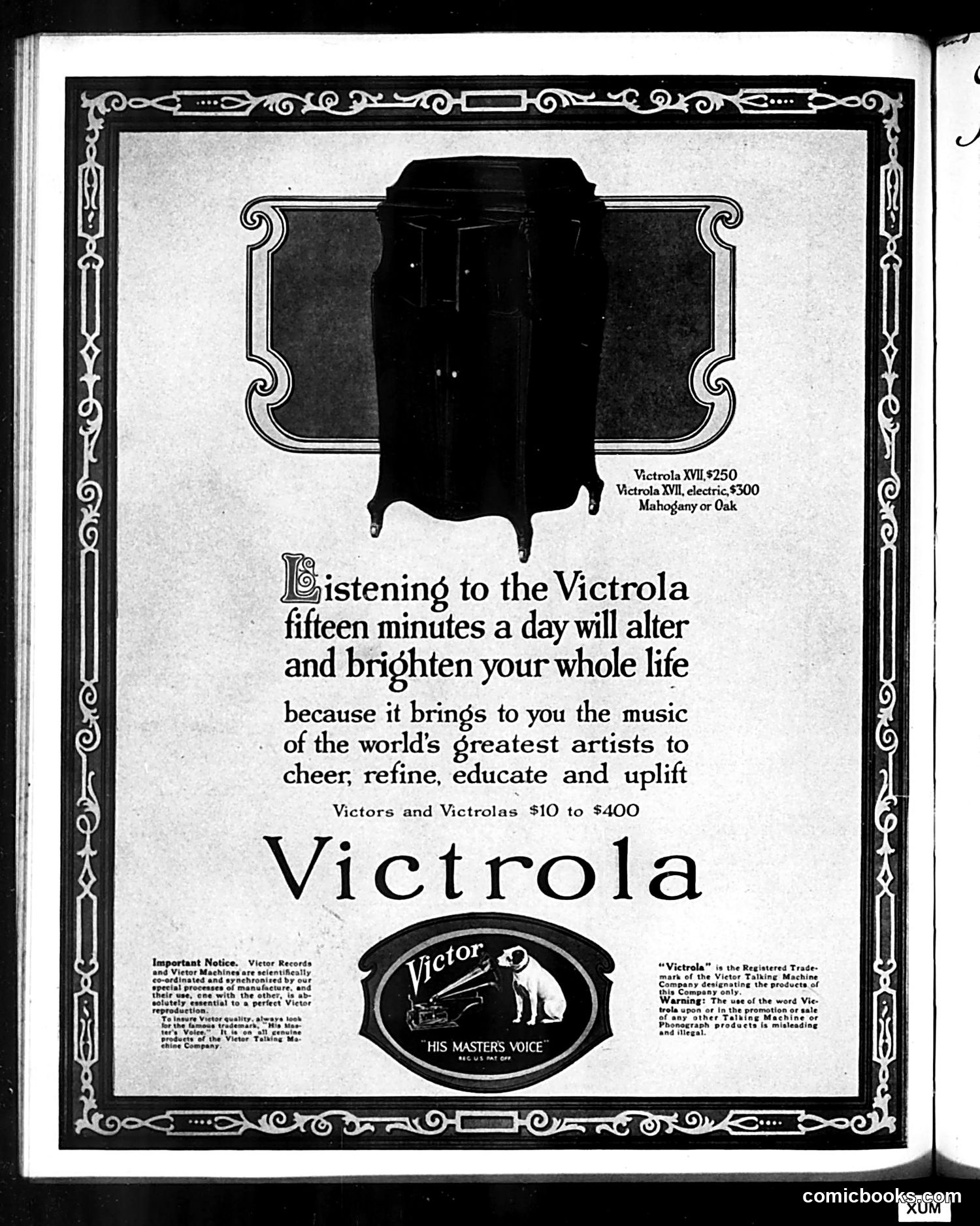
This is a **full-page advertisement**, not a political cartoon. It promotes the Victrola, an early phonograph/record player manufactured by the Victor Talking Machine Company. The ad features an ornate cabinet model and appeals to middle-class consumers with claims that listening just 15 minutes daily will "alter and brighten your whole life" by providing access to great artists' music for "cheer, refine, educate and uplift." The language reflects early 20th-century marketing rhetoric emphasizing self-improvement through consumer goods. Prices ranged from $10–$400, positioning the product across economic classes. The iconic Victor logo ("His Master's Voice") appears at bottom. This demonstrates how *Judge* magazine included advertising alongside satirical content.