
Judge, 1917-11-24 · page 4 of 28
Judge — November 24, 1917 — page 4: what you’re looking at
What you’re looking at
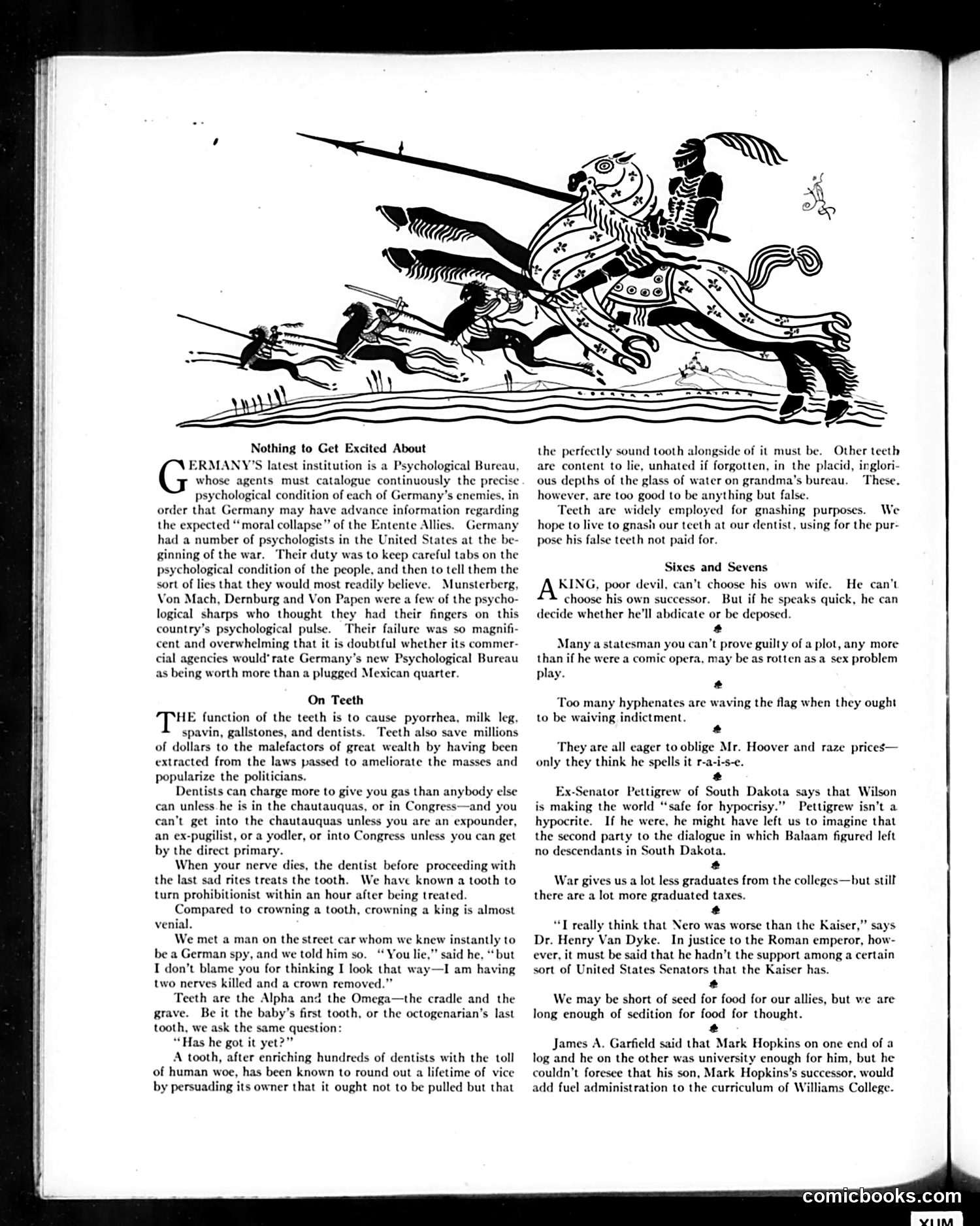
**The Cartoon:** The top illustration depicts an ornate, heavily-decorated figure (likely representing Germany or German militarism) mounted on a dragon-like creature, wielding a long spear, while smaller figures below appear to be running or fleeing in distress. **The Context:** The text discusses Germany's "Psychological Bureau" and psychologists monitoring the nation's "moral collapse." This references WWI-era American skepticism about German intelligence operations and psychological manipulation of their population. **The Satire:** The piece mocks Germany's alleged reliance on psychological tactics and espionage while suggesting their military aggression is based on false morale-boosting propaganda rather than genuine strength. The grotesque mounted figure embodies this criticism—appearing powerful but ultimately built on deception and psychological manipulation rather than substance. The overall message satirizes Germany's wartime information control and population management.
📄 Transcribed text from this page (OCR, searchable)
Machine-transcribed from the original scan — historical spelling and the odd misread are preserved.
Nothing to Get Excited About ERMANY’S latest institution is a Psychological Bureau, (; whose agents must catalogue continuously the precise psychological condition of each of Germany’s enemies, in order that Germany may have advance information regarding the expected “moral collapse” of the Entente Allies. Germany had a number of psychologists in the United States at the be- ginning of the war. Their duty was to keep careful tabs on the psychological condition of the people, and then to tell them the sort of lies that they would most readily believe. Munsterberg, Von Mach, Dernburg and Von Papen were a few of the psycho- logical sharps who thought they had their fingers on this country’s psychological pulse. Their failure was so magnifi- cent and overwhelming that it is doubtful whether its commer- cial agencies would’ rate Germany’s new Psychological Bureau as being worth more than a plugged Mexican quarter. On Teeth HE function of the teeth is to cause pyorrhea, milk leg, spavin, gallstones, and dentists. Teeth also save millions of dollars to the malefactors of great wealth by having been extracted from the laws passed to ameliorate the masses and popularize the politicians. Dentists can charge more to give you gas than anybody else can unless he is in the chautauquas, or in Congress—and you can't get into the chautauquas unless you are an expounder, an ex-pugilist, or a yodler, or into Congress unless you can get by the direct primary. When your nerve dies, the dentist before proceeding with the last sad rites treats the tooth. We have known a tooth to turn prohibitionist within an hour after being treated. Compared to crowning a tooth, crowning a king is almost venial. We met a man on the street car whom we knew instantly to be a German spy, and we told him so. “You lie,” said he, “but I don’t blame you for thinking I look that wa I am having two nerves killed and a crown removed.” Teeth are the Alpha and the Omega—the cradle and the grave. Be it the baby’s first tooth, or the octogenarian’s last tooth, we ask the same question: “Has he got it ye A tooth, after enriching hundreds of dentists with the toll of human woe, has been known to round out a lifetime of vice by persuading its owner that it ought not to be pulled but that Other teeth cid, inglori- These the perfectly sound tooth alongside of it must be. are content to lie, unhated if forgotten, in the pl: ous depths of the glass of water on grandma's bureau. however, are too good to be anything but false. Teeth are widely employed for gnashing purposes. We hope to live to gnash our teeth at our dentist, using for the pur- pose his false teeth not paid for. Sixes and Sevens KING, poor devil, can’t choose his own wife. He can't choose his own successor. But if he speaks quick, he can decide whether he'll abdicate or be deposed. 2 Man: tatesman you can’t prove guilty of a plot, any more than if he were a comic opera, may be as rotten as a sex problem play. * Too many hyphenates are waving the flag when they ought to be waiving indictment. They are all eager to oblige Mr. Hoover and raze prices— only they think he spells it r-a-i-s-e. 2 Ex-Senator Pettigrew of South Dakota says that Wilson is making the world “safe for hypocrisy.” Pettigrew isn't a hypocrite. If he were, he might have left us to imagine that the second party to the dialogue in which Balaam figured left no descendants in South Dakota. 2 War gives us a lot less graduates from the colleges—but still there are a lot more graduated taxes. 2 “T really think that Nero was worse than the Kaiser,” says Dr. Henry Van Dyke. In justice to the Roman emperor, how- ever, it must be said that he hadn’t the support among a certain sort of United States Senators that the Kaiser has. 2 We may be short of seed for food for our allies, but we are long enough of sedition for food for thought. 2 James A. Garfield said that Mark Hopkins on one end of a log and he on the other was university enough for him, but he couldn’t foresee that his son, Mark Hopkins’s successor, would add fuel administration to the curriculum of Williams College. comicbooks.com