
Judge, 1917-11-24 · page 6 of 28
Judge — November 24, 1917 — page 6: what you’re looking at
What you’re looking at
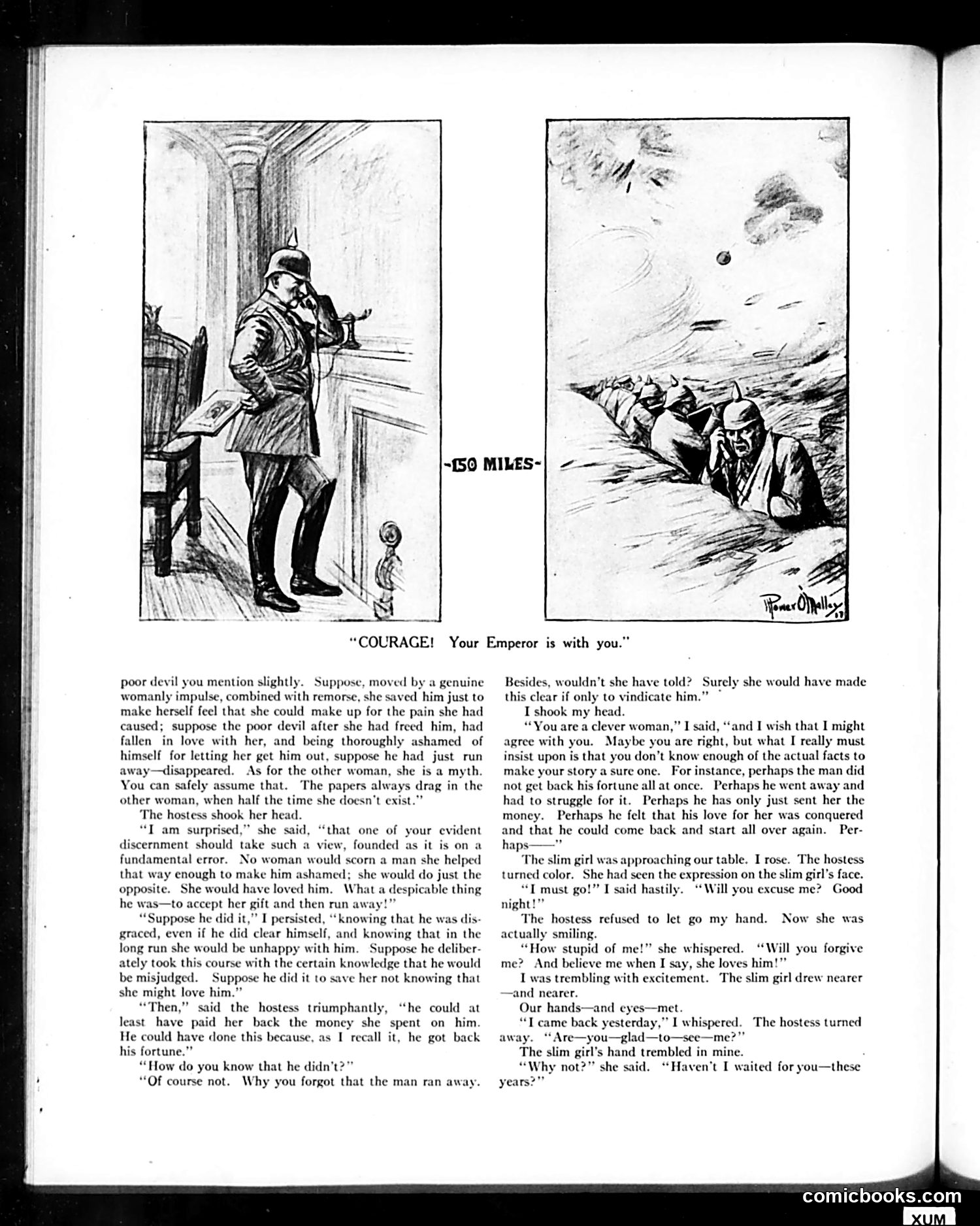
The page presents a narrative story illustrated with two panels. The left panel shows a military officer at a desk, appearing to give orders or encouragement. The right panel depicts soldiers in combat, labeled "150 MILES" apart, suggesting distance or separation. The caption reads "COURAGE! Your Emperor is with you"—a propagandistic rallying cry meant to inspire distant troops. The accompanying text discusses whether a man might abandon his position to help a woman, debating honor, duty, and sacrifice. The story ultimately focuses on a romantic reconciliation between a "slim girl" and a returning soldier, with emotional dialogue about forgiveness and love. The satire appears to mock militaristic propaganda that invokes the emperor's presence to motivate soldiers while they face actual danger—contrasting grand rhetoric with intimate human concerns and romantic sentiment.
📄 Transcribed text from this page (OCR, searchable)
Machine-transcribed from the original scan — historical spelling and the odd misread are preserved.
“COURAGE! Your Emperor is with you.” poor devil you mention slightly. Suppose, moved by womanly impulse, combined with remorse, she saved him just to make herself feel that she could make up for the pain she had caused; suppose the poor devil after she had freed him, had fallen in love with her, and being thoroughly ashamed of himself for letting her get him out, suppose he had just run away—disappeared. As for the other woman, she is a myth. You can safely assume that. The papers always drag in the other woman, when half the time she doesn’t exist.” ‘The hostess shook her head. “I am surprised,” she said, ‘that one of your evident discernment should take such a view, founded as it is on a fundamental error. No woman would scorn a man she helped that way enough to make him ashamed; she would do just the opposite. She would have loved him. What a despicable thing he was—to accept her gift and then run aw “Suppose he did it,” I persisted, “knowing that he was dis- graced, even if he did clear himself, and knowing that in the long run she would be unhappy with him. Suppose he deliber- ately took this course with the certain knowledge that he would be misjudged. Suppose he did it to save her not knowing that she might love him.” “Then,” said the hostess triumphantly, “he could at least have paid her back the money she spent on him. He could have done this because, as I recall it, he got back his fortune. “How do you know that he didn’t?” “Of course not. Why you forgot that the man ran away. es, wouldn’t she have told? Surely she would have made this clear if only to vindicate him.” * I shook my head. “You are a clever woman,” I said, “and I wish that I might agree with you. Maybe you are right, but what I really must insist upon is that you don’t know enough of the actual facts to ) sure one. For instance, perhaps the man did not get back his fortune all at once. Perhaps he went away and had to struggle for it. Perhaps he has only just sent her the money. Perhaps he felt that his love for her was conquered and that he could come back and start all over again. Per- haps The slim girl was approaching our table. I rose. The hostess turned color. She had seen the expression on the slim girl’s face. “T must go!” I said hastily. ‘Will you excuse me? Good The hostess refused to let go my hand. Now she was actually smiling. “How stupid of me!” she whispered. “Will you forgive me? And believe me when I say, she loves him!” I was trembling with excitement. The slim girl drew nearer -and nearer. Our hands—and cyes—met. “T came back yesterday,” I whispered. The hostess turned away. ‘‘Are—you—glad—to—see—me?” The slim girl’s hand trembled in min “Why not?” she said. ‘Haven't I waited for you—these years? comicbooks.com M