
Judge, 1917-11-24 · page 16 of 28
Judge — November 24, 1917 — page 16: what you’re looking at
What you’re looking at
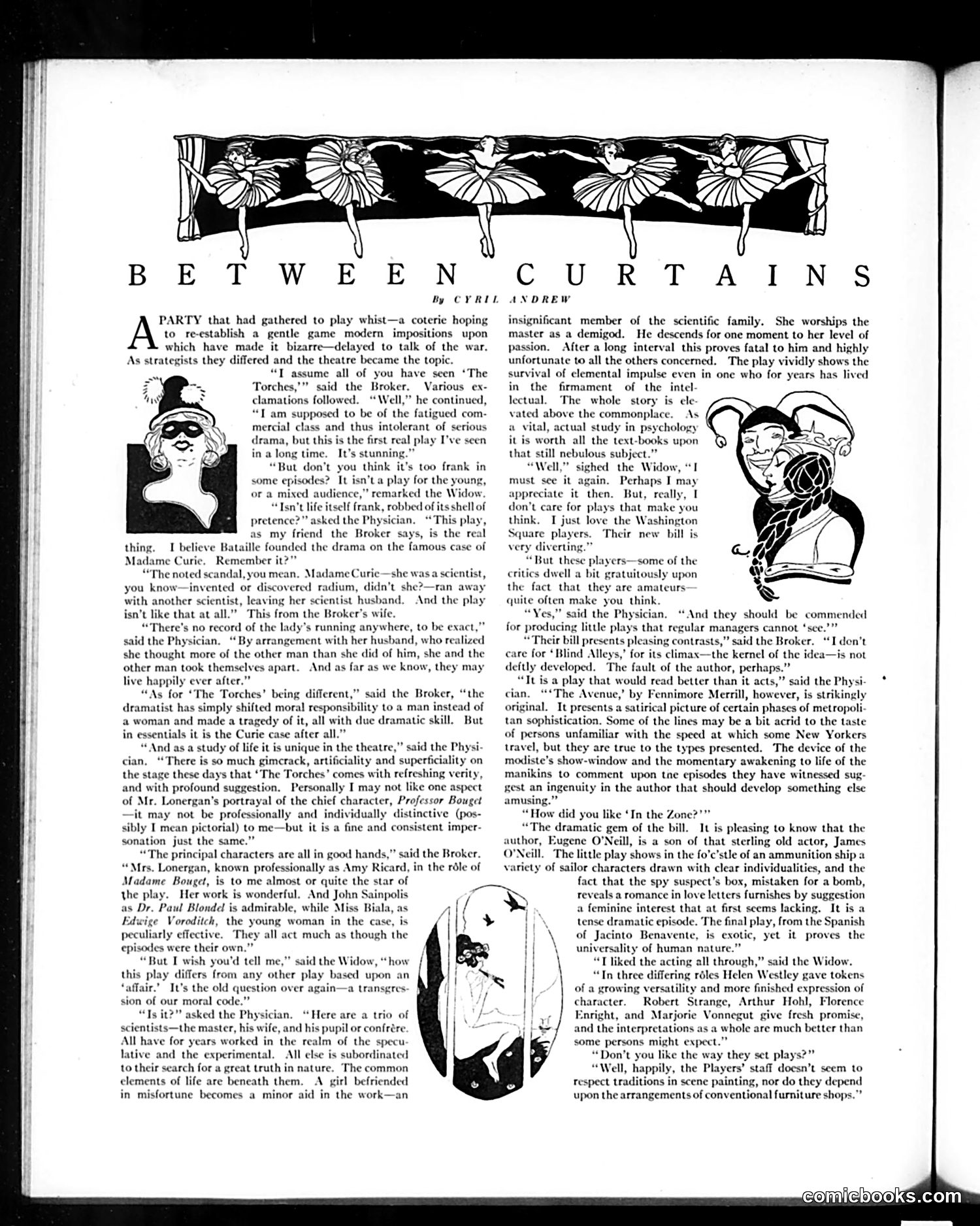
This page discusses contemporary theater, specifically a play called *The Torches*. A group of socialites debate whether the drama is appropriate and artistically valid. The central satire targets bourgeois hypocrisy: a "fatigued commercial class" Broker claims to appreciate serious drama while others (the Widow) worry it's "too frank" for mixed audiences. The Physician defends the play's realism, noting life itself is frank. The play itself appears based on the Madame Curie scandal—a scientist who left her husband for a colleague. The satirical point: the characters discuss whether shifting genders in the moral transgression (male instead of female protagonist) makes it fundamentally different. It doesn't, the Physician implies. The illustrations show caricatured socialites in period dress. The satire mocks genteel society's squeamishness about mature themes while simultaneously celebrating "art," revealing their actual discomfort with unflinching reality.
📄 Transcribed text from this page (OCR, searchable)
Machine-transcribed from the original scan — historical spelling and the odd misread are preserved.
to reestablish a gentle game modern impositions upon which have made it bizarre—delayed to talk of the war. As strategists they differed and the theatre became the topic “TI assume all of you have seen ‘The Torches,’ said the Broker. Various ex- clamations followed. “Well,” he continued, “Tam supposed to be of the fatigued com- mercial class and thus intolerant of serious drama, but this is the first real play I’ve seen in a long time. It’s stunning.” “But don’t you think it’s too frank in some episodes? It isn’t a play for the young, or a mixed audience,” remarked the Widow. “Isn't life itself frank, robbed of its shell of pretence?” asked the Physician. “This play, as my friend the Broker says, is the re thing. I believe Bataille founded the drama on the famous case of Madame Curie, Remember it?” “The noted scandal, you mean, Madame Curie—she was scientist, you know—invented or discovered radium, didn’t she?—ran aw with another scientist, leaving her scientist husband, And the play isn’t like that at all.” This from the Broker's wife. r no record of the lady’s running anywhere, to be exact said the Physician. “ By arrangement with her husband, who realized she thought more of the other man than she did of him, she and the other man took themselves apart. And as far as we know, they may live happily ever after.” “As for ‘The Torches’ being different,” said the Broker, “the dramatist has simply shifted moral responsibility to a man instead of a woman and made a tragedy of it, all with due dramatic skill. But in essentials it is the Curie case after all.” s a study of life it is unique in the th A PARTY that had gathered to play whi coterie hoping the stage these days that ‘The Torches’ comes with refreshing verity, and with profound suggestion. Personally I may not like one aspect of Mr. Lonergan’s portrayal of the chief character, Professor Bouget it may not be professionally and individually distinctive (pos- sibly I mean pictorial) to me—but it is a fine and consistent imper- sonation just the same.” “The principal characters are all in good hands,” said the Broker. “Mrs. Lonergan, known professionally as Amy Ricard, in the rdle of Madame Bouget, is to me almost or quite the star of the play. Her work is wonderful. And John Sainpolis as Dr. Paul Blondel is admirable, while Miss Biala, as Edwige Voroditch, the young woman in the case, peculiarly effective. They all act much as though the episodes were their own.” “But I wish you'd tell me,” said the Widow, “how this play differs from any other play based upon an ‘affair.’ It’s the old question over again—a transgres sion of our moral code,”” Is it?” asked the Physician. “Here are a trio of scientists—the master, his wife, and his pupil or confrére All have for years worked in the realm of the specu lative and the experimental. All else is subordinated to their search for a great truth in nature, The common elements of life are beneath them. A girl befriended in misfortune becomes a minor aid in the work—an By CYRIL SS ee 7] C U RT ATIN S ANDREW insignificant member of the scientific family. She worships the master as a demigod. He descends for one moment to her level of passion, After a long interval this proves fatal to him and highly unfortunate to all the others concerned. The play vividly shows the survival of clemental impulse even in one who for years has lived in the firmament of the intel- lectual. The whole story is ele- vated above the commonplace. As a vital, actual study in psychology it is worth all the text-books upon that still nebulous subject. “Well,” sighed the Widow, “I must see it again. Perhaps I may appreciate it then. But, really, I don’t care for plays that make you think. I just love the Washington Square players. Their new bill is very diverting. “But these ‘ers—some of the critics dwell a bit gratuitously upon the fact that they are amateurs quite often make you think. * said the Physician, “And they should be commended for producing little plays that regular managers cannot ‘sce.’ “Their bill presents pleasing contrasts,” said the Broket Hon't care for ‘Blind Alleys,’ for its climax—the kernel of the idea—is not deftly developed. The fault of the author, perhaps.” “It is a play that would read better than it acts,” said the Physi cian, “*The Avenue,’ by Fennimore Merrill, however, is strikingly original. It presents a satirical picture of certain phases of metropoli tan sophistication. Some of the lines may be a bit acrid to the taste of persons unfamiliar with the speed at which some New Yorkers travel, but they are true to the types presented. The device of the modist 's show-window and the momentary awakening to life of the to comment upon tne episodes they have witnessed sug- gest an i genuity in the author that should develop something else amusing. “How did you like ‘In the Zon “The dramatic gem of the bill. It is pleasing to know that the author, Eugene O'Neill, is a son of that sterling old actor, James O'Neill. The little play shows in the fo’e’stle of an ammunition ship a variety of sailor characters drawn with clear individualities, and the fact that the spy suspect’s box, mistaken for a bomb, reveals a romance in love letters furnishes by suggestion a feminine interest that at first seems lacking. It is a tense dramatic episode. The final play, from the Spanish of Jacinto Benavente, is exotic, yet it proves the universality of human nature. “T liked the acting all through,” said the Widow. “Tn three differing s Helen Westley gave tokens of a growing versatility and more finished expression of character. Robert Strange, Arthur Hohl, Florence Enright, and Marjorie Vonnegut give fresh promise, and the interpretations as a whole are much better than some persons might expect.” “Don’t you like the way they set plays?” “Well, happily, the Players’ staff doesn’t seem to respect traditions in scene painting, nor do they depend upon the arrangements of conventional furniture shops.””