
Judge, 1917-11-24 · page 9 of 28
Judge — November 24, 1917 — page 9: what you’re looking at
What you’re looking at
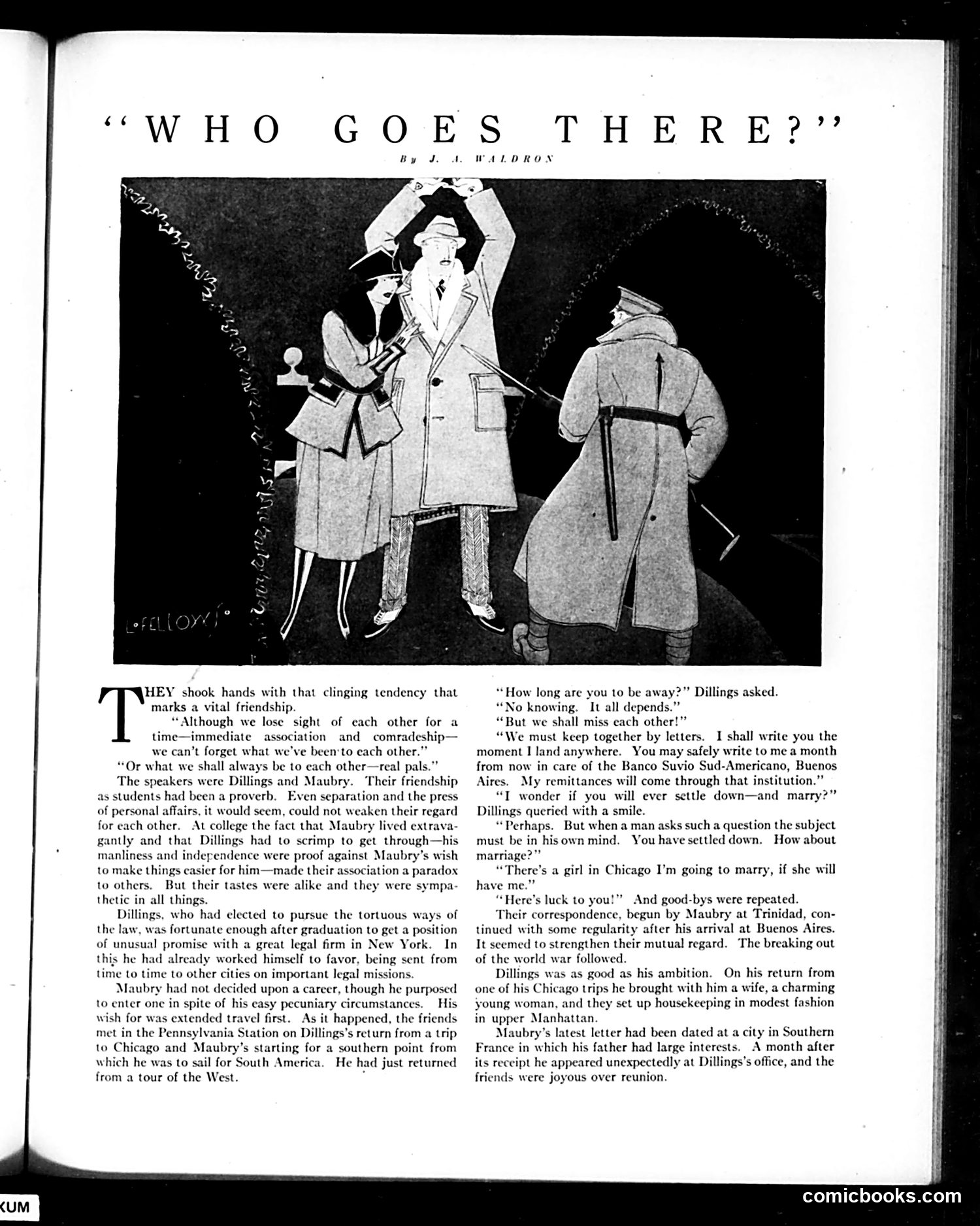
This is a sentimental story illustration rather than satire. It depicts two college friends—Dillings and Maubry—saying goodbye at Pennsylvania Station. Dillings, now a successful New York lawyer, is settling into domestic life with a Chicago fiancée. Maubry, wealthy but undecided about his future, is departing for South America. The narrative emphasizes their enduring friendship despite different circumstances: Dillings had to scrimp through college while Maubry was wealthy, yet they remained "sympathetic in all things." The story celebrates male friendship and honor ("real pals"), showing how correspondence sustains their bond despite separation and the interruption of World War I. The tone is nostalgic and earnest—typical Judge content mixing melodrama with middle-class values about loyalty and manly virtue.
📄 Transcribed text from this page (OCR, searchable)
Machine-transcribed from the original scan — historical spelling and the odd misread are preserved.
““WHO GOE HEY shook hands with that clinging tendency that marks a vital friendship. “Although we lose sight of each other for a time—immediate association and comradeship— we can’t forget what we've been‘to each other. “Or what we shall always be to each other—real pals.” The speakers were Dillings and Maubry. Their friendship as students had been a proverb. ion and the press of personal affairs, it would seem, could not weaken their regard for each other. At college the fact that Maubry lived extra’ gantly and that Dillings had to scrimp to get through— manliness and independence were proof against Maubry’ to make things casier for him—made their association a paradox to others. But their tastes were alike and they were sympa- thetic in all things. Dillings, who had elected to pursue the tortuous ways of the law, was fortunate enough after graduation to get a position of unusual promise with a great legal firm in New York. In this he had already worked himself to favor, being sent from time to time to other cities on important legal missions. Maubry had not decided upon a career, though he purposed to enter one in spite of his easy pecuniary circumstances. His wish for was extended travel first. As it happened, the friends met in the Pennsylvania Station on Dillings’s return from a trip to Chicago and Maubry’s starting for a southern point from which he was to sail for South America. He had just returned from a tour of the West. . S THERE?” WALDRON “How long are you to be away?” Dillings asked. “No knowing. It all depends.” “But we shall miss each other!” “We must keep together by letters. I shall write you the moment I land anywhere. You may safely write to me a month from now in care of the Banco Suvio Sud-Americano, Buenos Aires. My remittances will come through that institution.” “I wonder if you will ever settle down—and marry?” Dillings queried with a smile. “Perhaps. But when aman must be in hisown mind. You have settled down. marriage?” “There’s a girl in Chicago I’m going to marry, if she will have me.” “Here's luck to you!” And good-bys were repeated. Their correspondence, begun by Maubry at Trinidad, con- tinued with some regularity after his arrival at Buenos Aires. It seemed to strengthen their mutual regard. The breaking out of the world war followed. Dillings was as good as his ambition. On his return from one of his Chicago trips he brought with him a wife, a charming young woman, and they set up housekeeping in modest fashion in upper Manhattan. Maubry’s latest letter had been dated at a city in Southern France in which his father had large interests. A month after its receipt he appeared unexpectedly at Dillings’s office, and the friends were joyous over reunion. such a question the subject How about comicbooks.com