
Judge, 1917-11-24 · page 5 of 28
Judge — November 24, 1917 — page 5: what you’re looking at
What you’re looking at
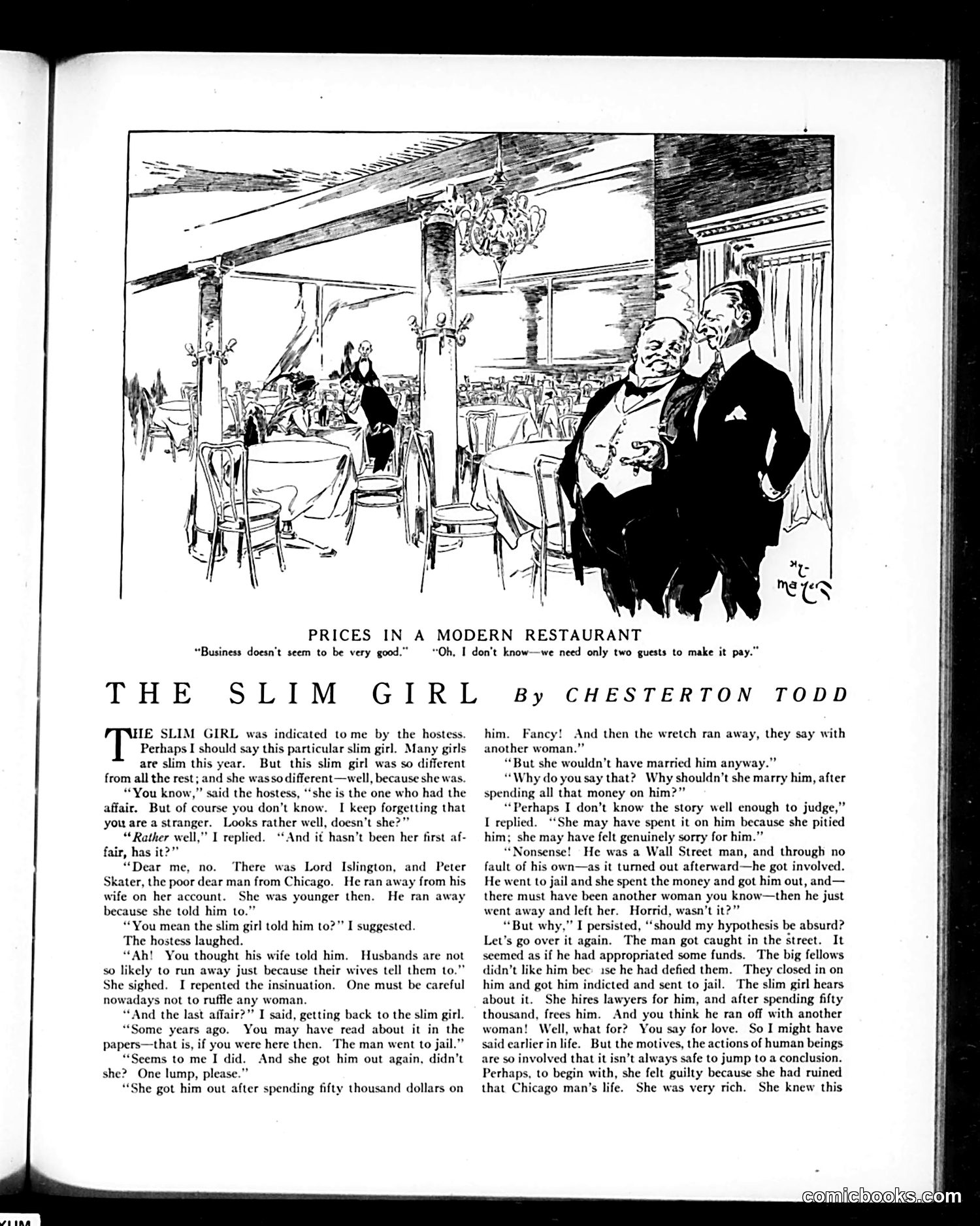
The cartoon at top illustrates the accompanying short story about a woman nicknamed "the slim girl" who had an affair with a married man named Lord Islington. The narrative describes how she helped him escape financial ruin by spending fifty thousand dollars to get him out of jail after he was imprisoned for embezzlement. The satirical point targets wealthy society's moral contradictions: despite the woman's questionable ethics in enabling his crime, she's portrayed sympathetically because she "felt genuinely sorry for him." The cartoon's caption—"Business doesn't seem to be very good"/"Oh, I don't know—we need only two guests to make it pay"—sarcastically comments on restaurant economics during apparent economic hardship, possibly referencing post-WWI financial difficulties.
📄 Transcribed text from this page (OCR, searchable)
Machine-transcribed from the original scan — historical spelling and the odd misread are preserved.
PRICES IN A MODERN RESTAURANT “Business doesn't seem to be very good.” THE SLIM GIRL Perhaps I should say this particular slim girl. Many girls T SLIM GIRL was indicated tome by the hostess. are slim this year. But this slim girl was so different flerent—well, because she was. he is the one who had the But of course you don’t know. I keep forgetting that you are a stranger. Looks rather well, doesn’t she?” “Rather well,” I replied. ‘And it hasn’t been her first af- fair, has it?” “Dear me, no. There was Lord Islington, and Peter Skater, the poor dear man from Chicago. He ran away from his wife on her account. She was younger then. He ran away because she told him to.” “You mean the slim girl told him to?” I suggested. The hostess laughed. “Ah! You thought his wife told him. Husbands are not so likely to run away just because their wives tell them to.” She sighed. I repented the insinuation. One must be careful nowadays not to ruffle any woman. “And the last affair?” I said, getting back to the slim girl. “Some ye ago. You may have read about it in the papers—that is, if you were here then. The man went to jail.” “Seems to me I did. And she got him out again, didn’t she? One lump, please.” “She got him out after spending fifty thousand dollars on from all the rest; and she wassodi “Oh, I don’t know—we need only two guests to make it pay.” By CHESTERTON TODD him. Fancy! And then the wretch ran away, they say with another woman.” “But she wouldn’t have married him anyway.” “Why do you say that? Why shouldn't she marry him, after spending all that money on him?” “Perhaps I don’t know the story well enough to judge,” I replied. ‘‘She may have spent it on him because she pitied him; she may have felt genuinely sorry for him.” “Nonsense! He was a Wall Street man, and through no fault of his own—as it turned out afterward—he got involved. He went to jail and she spent the money and got him out, and— there must have been another woman you know—then he just went away and left her. Horrid, wasn’t it?” “But why,” I persisted, “‘should my hypothesis be absurd? Let's go over it again. The man got caught in the street. It seemed as if he had appropriated some funds. The big fellows didn’t like him bec: 1se he had defied them. They closed in on him and got him indicted and sent to jail. The slim girl hears about it. She hires lawyers for him, and after spending fifty thousand, frees him. And you think he ran off with another woman! Well, what for? You say for love. So I might have said earlier in life. But the motives, the actions of human beings are so involved that it isn’t always safe to jump to a conclusion. Perhaps, to begin with, she felt guilty because she had ruined that Chicago man’s life. She was very rich. She knew this