
A complete issue · 28 pages · 1917
Judge — June 2, 1917
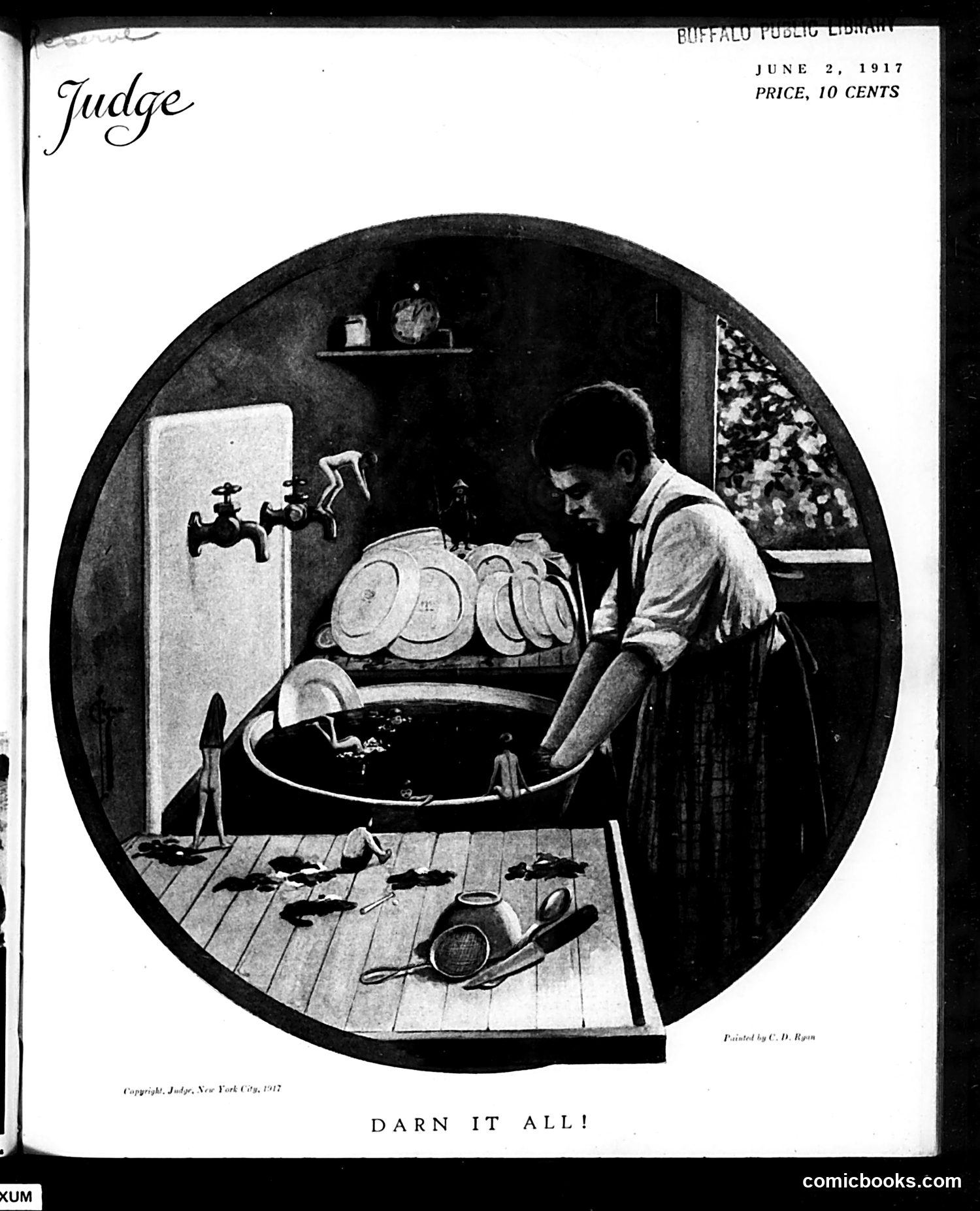
This cartoon depicts a woman doing domestic laundry work, washing dishes in a large tub while plates dry on a rack behind her. The title "Darn It All!" and scattered tools/implements on the floor suggest frustration with household duties. Published in 1917—the year America entered World War I—this likely comments on women's domestic burden during wartime. The crowded composition and the woman's apparent exasperation humorously convey the endless, repetitive nature of housework. The magazine may be satirizing either the constancy of women's domestic responsibilities despite wartime changes, or expressing sympathy for their situation. The exact satirical target remains somewhat ambiguous from the image alone.
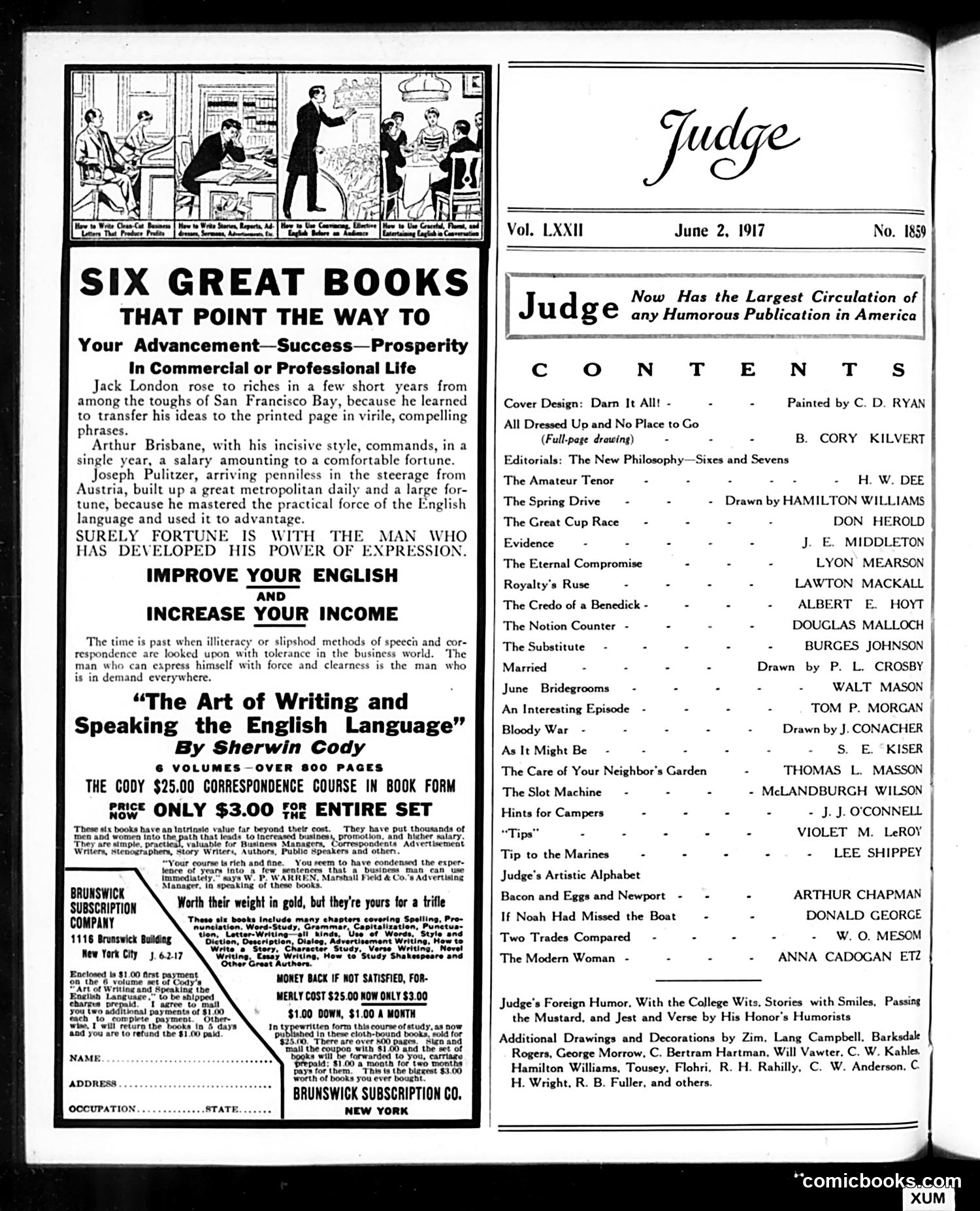
This is primarily a contents/masthead page for Judge magazine's June 2, 1917 issue, featuring advertorial and table of contents rather than political cartoons. The small cartoon strip at top left (labeled "Six Great Books") appears to show scenes of business success and self-improvement through reading—reflecting early 20th-century faith in educational advancement. The adjacent advertisement for "The Art of Writing and Speaking the English Language" by Sherwin Cody emphasizes that clear expression leads to professional success ("surely fortune is with the man who has developed his power of expression"). This reflects 1917-era assumptions about class mobility through self-education and communication skills. The overall page documents Judge's claim as "the largest circulation of any humorous publication in America."
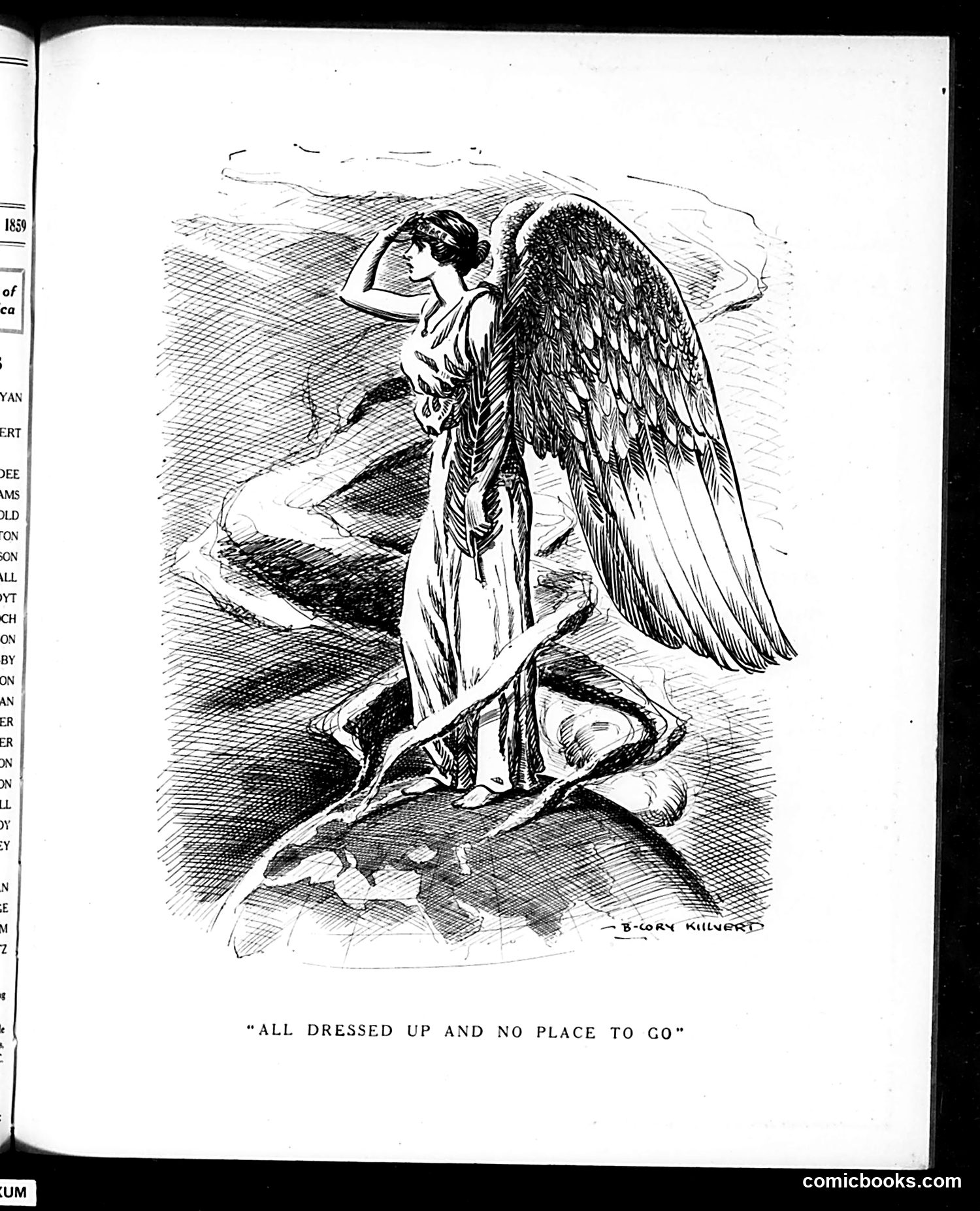
This sketch by B. Cory Kilvert depicts an winged female figure (likely representing Victory or Hope) sitting despondently on what appears to be a grave or battlefield, with bones visible beneath. The figure is "all dressed up"—wearing formal drapery and wings—yet has nowhere to go. The cartoon satirizes a specific historical moment, though the exact context isn't entirely clear from this page alone. It likely comments on a failed military campaign, abandoned diplomatic effort, or postponed event during the magazine's publication period. The ironic title suggests wasted preparation or squandered opportunity—a common Judge theme criticizing political mismanagement or broken promises. The classical allegorical figure emphasizes the gravity of whatever matter is being mocked.
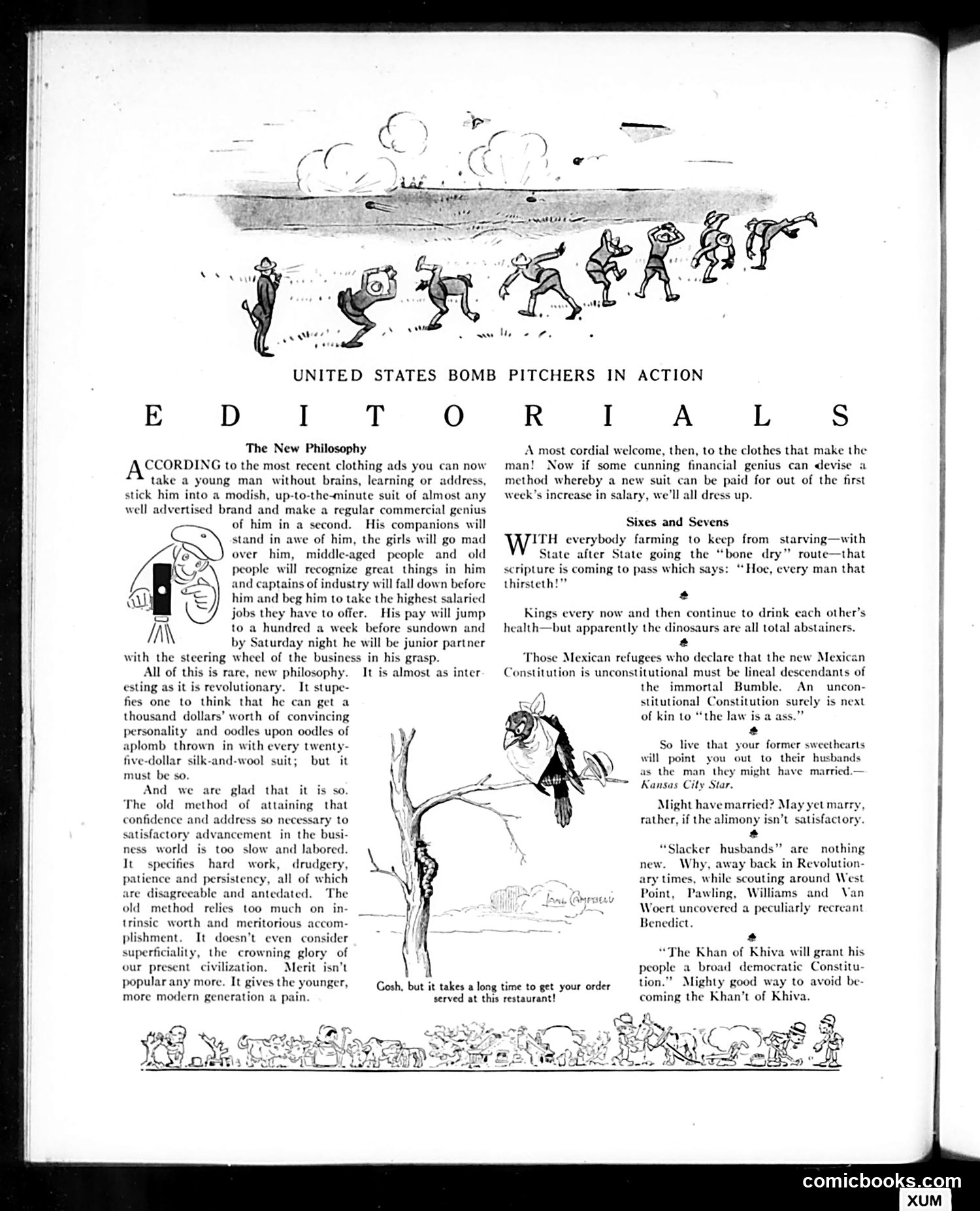
The top cartoon depicts "United States Bomb Pitchers in Action"—a sequence showing soldiers throwing grenades or explosives in battle, satirizing American military involvement (likely WWI-era, given the style). The "Editorials" section below mocks contemporary social trends: "The New Philosophy" ridicules the notion that young men without education or skills can become wealthy through modern commercial methods and personality alone—a critique of get-rich-quick schemes. "Sixes and Sevens" contains brief satirical quips about inflation, Mexican refugees post-revolution, marriage troubles, and international politics (Khan of Khiva reference suggests Central Asian colonial matters). The overall page represents Judge magazine's characteristic blend of visual political commentary and sharp editorial commentary on American society and foreign affairs.
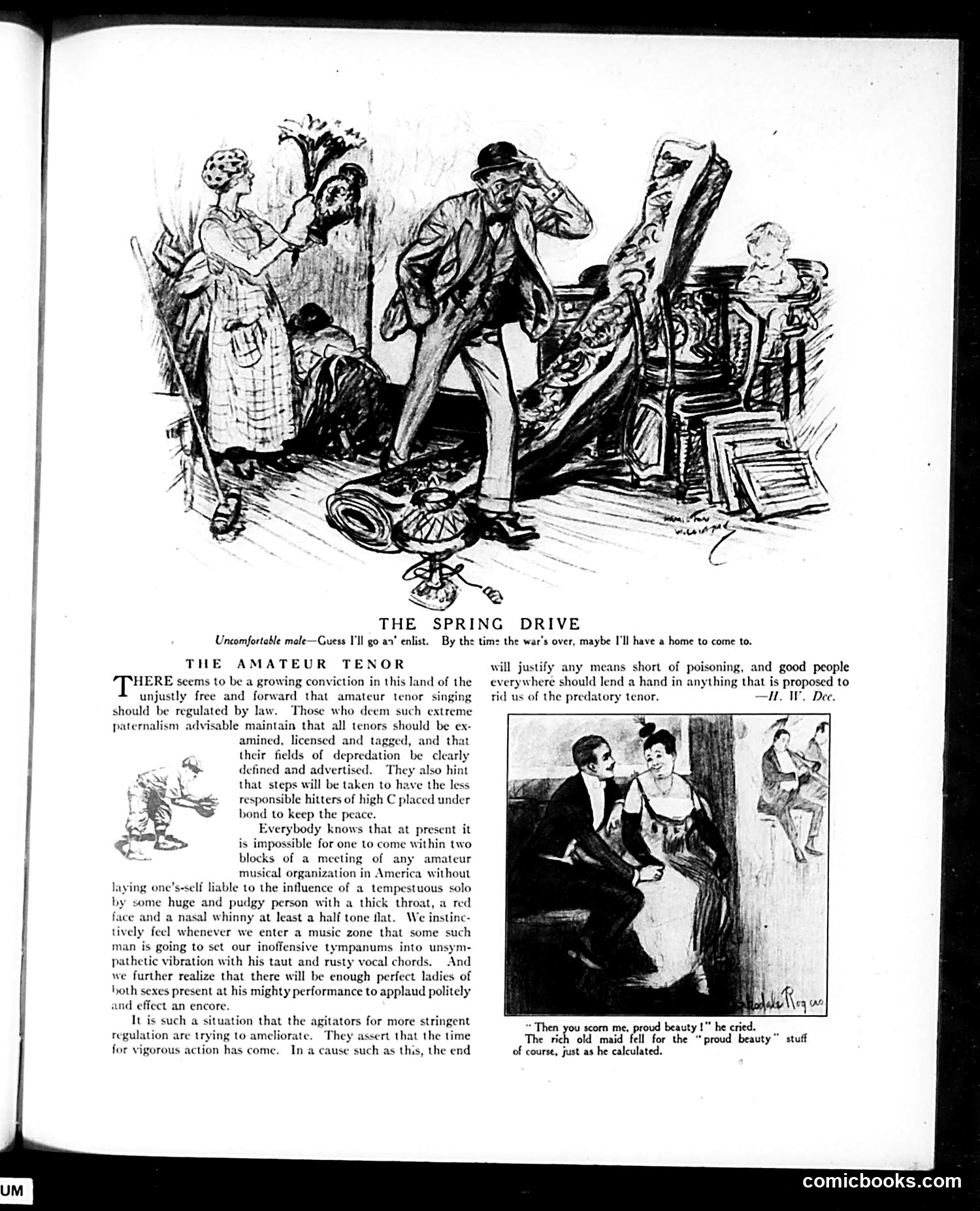
This Judge magazine page satirizes two social anxieties of the early 20th century: **"The Spring Drive"** (top cartoon): Depicts a man reluctantly being driven away by a woman, apparently against his wishes. The caption suggests conscription or forced military service—"By the time the war's over, maybe I'll have a home to come to." This likely references WWI-era draft concerns. **"The Amateur Tenor"** (bottom article and photo): Mocks amateur male singers in musical organizations, describing them as loud, obnoxious men with "thick throats" and "rusty vocal chords" who inflict themselves on audiences. The accompanying photo shows a smug man being called "proud beauty" by a woman, satirizing male vanity and women's (apparently false) flattery of mediocre performers. Both pieces reflect class anxiety and gender tensions in American society.
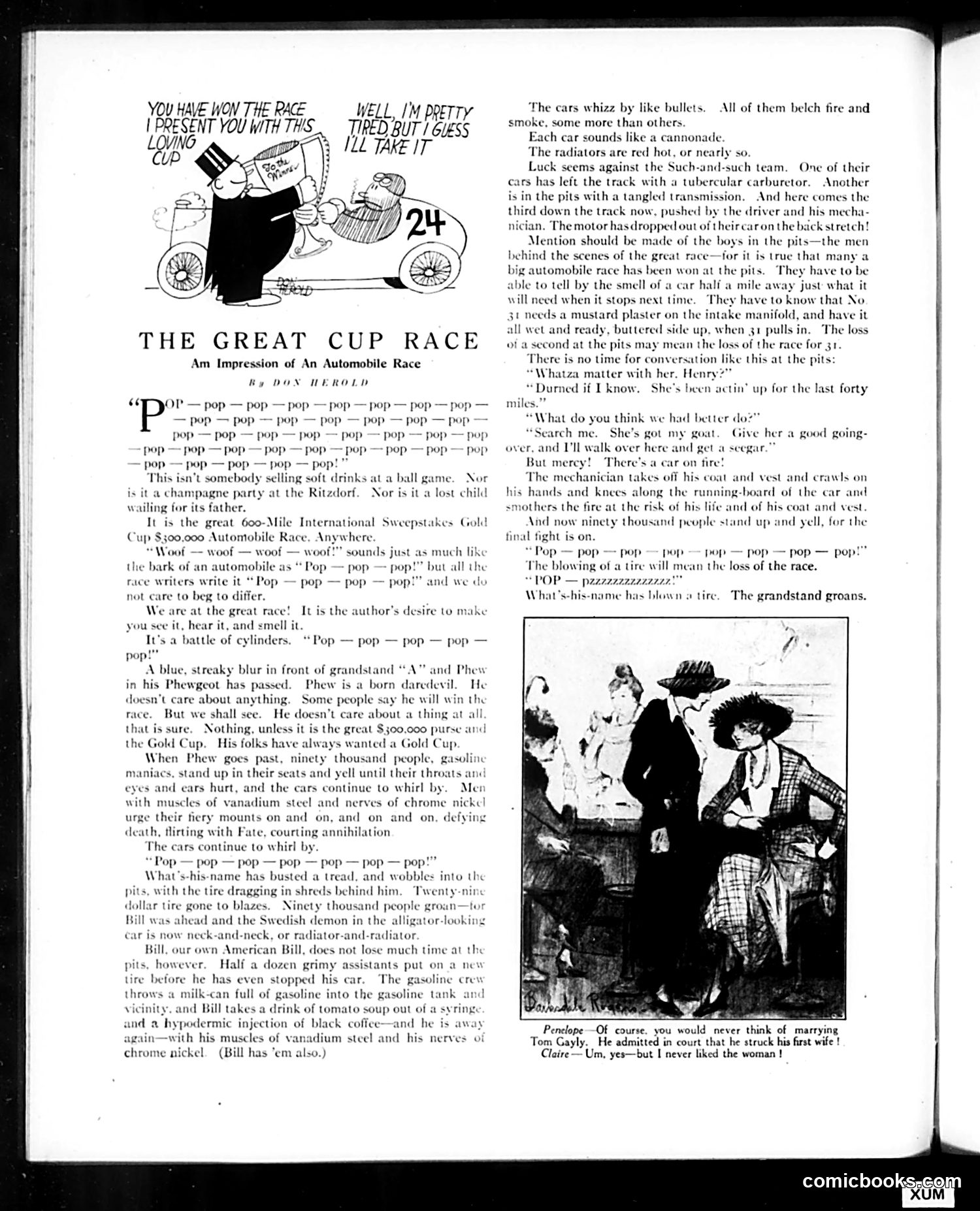
This page features a satirical story about an automobile race for the "$3,000,000 Gold Cup." The text uses onomatopoeia ("pop-pop-pop") to mock the sounds of racing engines and celebrates the spectacle of early 20th-century automobile racing. The satirical angle mocks both the mechanical drama (blown tires, engine failures) and the social spectacle—wealthy spectators, the danger treated as entertainment, and drivers as dare-devils. The accompanying photograph shows spectators in formal dress watching the race, emphasizing how automobile racing was both a modern sporting event and a display of wealth and leisure. The caption's dialogue about marriage suggests satirical commentary on social pretense among the racing crowd, typical of Judge's satirical approach to elite activities.
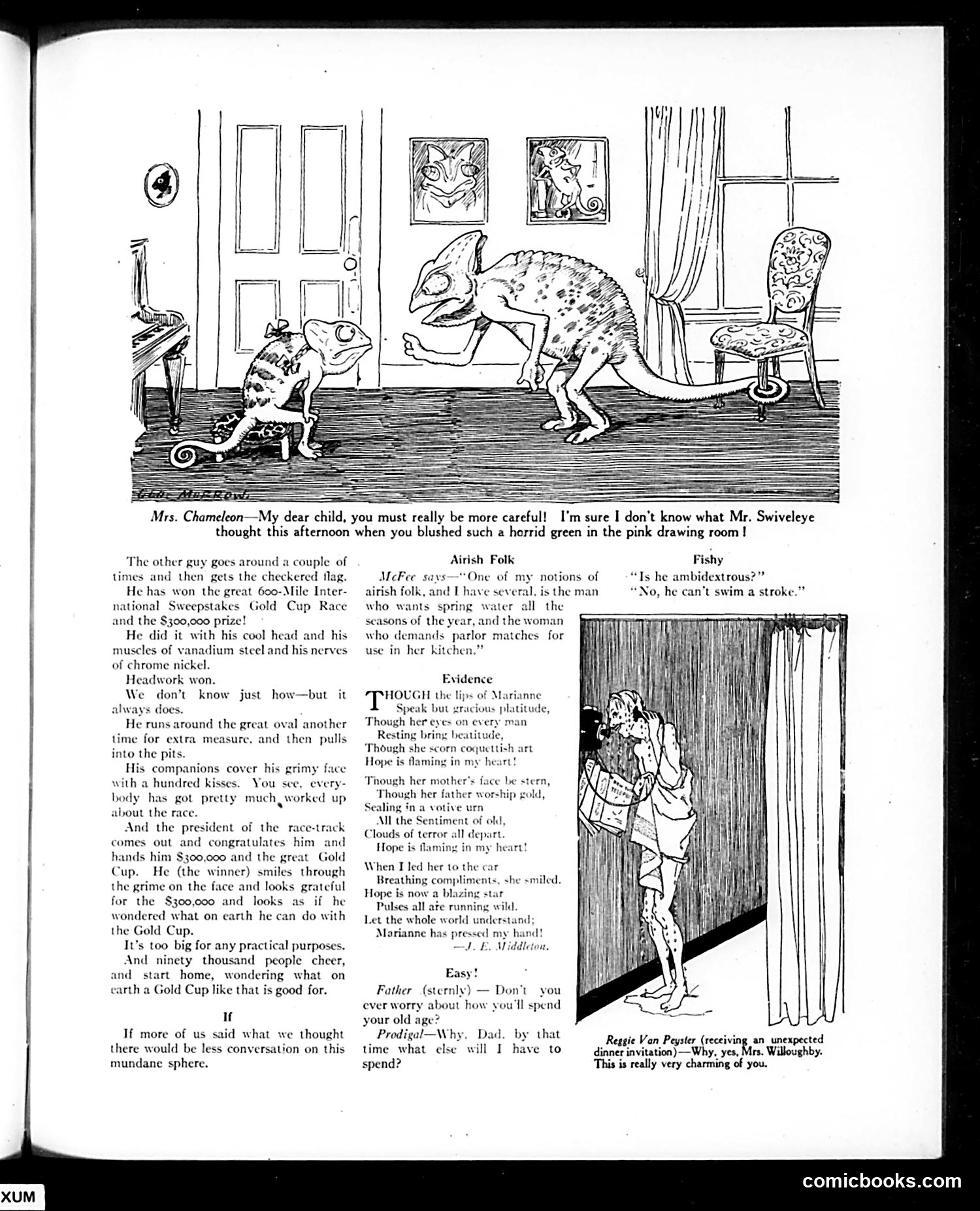
This page contains several unrelated humorous items typical of Judge magazine's satirical format: **Top Cartoon**: "Mrs. Chameleon" jokes about a socially awkward daughter who "blushed such a horrid green" in a pink drawing room—satirizing pretentious social anxiety among the wealthy about maintaining proper appearances. **"Airish Folk"**: Mocks affected upper-class affectations, particularly people with exaggerated preferences (spring water year-round, parlor matches for cooking). **"Evidence"** and **"Easy!"**: Sentimental poetry and a brief father-son joke about a prodigal son unconcerned with old age. **"Fishy"**: A short wordplay joke questioning whether someone is "ambidextrous" (meaning able to use both hands equally well, but misunderstood as swimming ability). **"Reggie Van Peyster"**: A society figure receiving an unexpected dinner invitation, using formal politeness while appearing slightly bewildered. The page reflects early 20th-century American satirical humor targeting upper-class social pretension and etiquette obsessions.
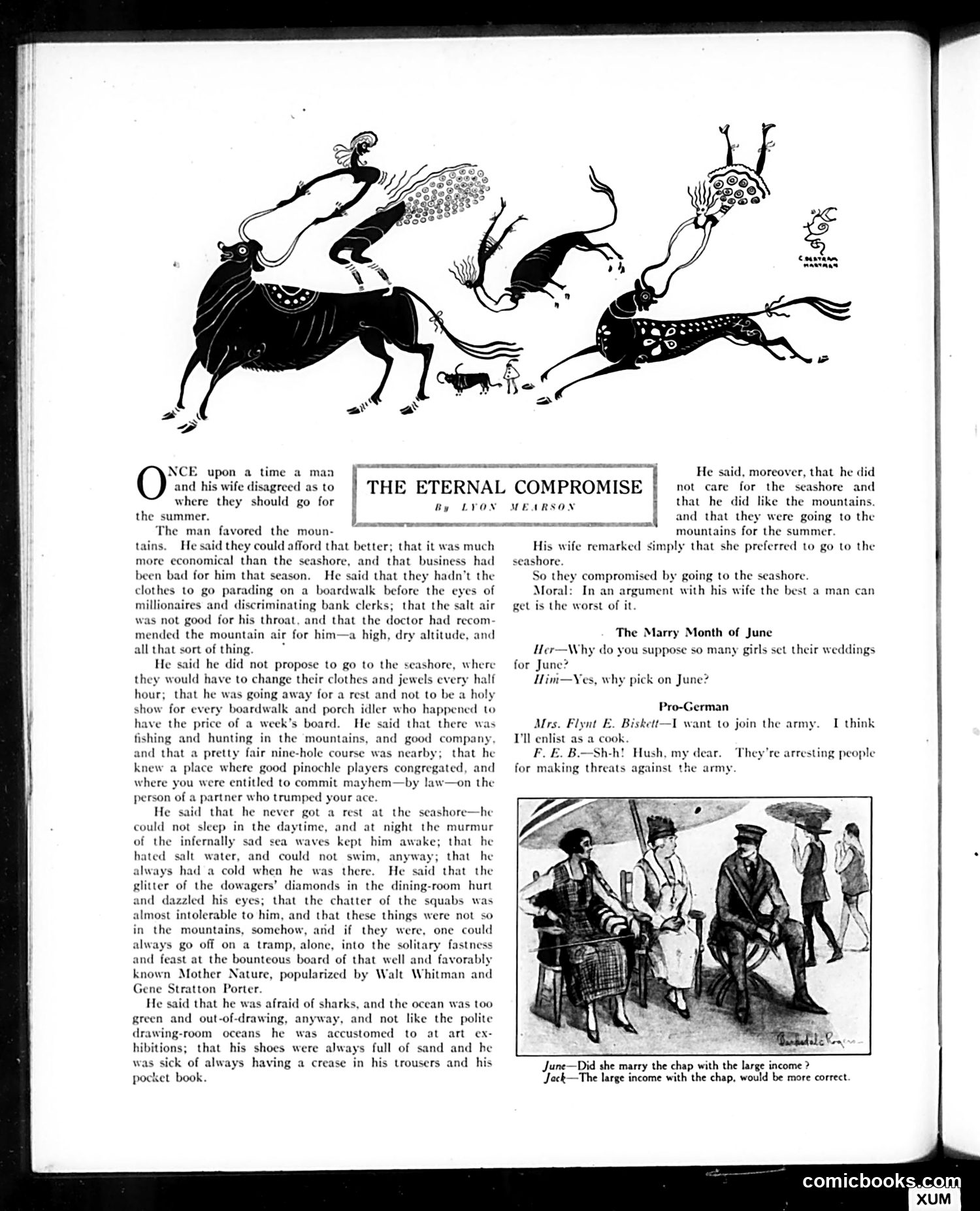
This domestic humor piece satirizes marital power dynamics. A husband exhaustively argues for a mountain vacation—citing economic sense, health benefits, privacy, and recreational opportunities—while his wife simply prefers the seashore. Despite his elaborate reasoning, they compromise by going to the seashore, the wife's choice. The satire's point: wives always win domestic arguments regardless of logic. The "moral" states that in spousal disputes, "the best a man can get is the worst of it"—suggesting husbands inevitably lose. The page also contains unrelated brief jokes about June weddings and a "Pro-German" exchange about military enlistment, likely referencing WWI-era concerns (the magazine's publication date remains unclear from this image alone). The decorative header illustration depicts fantastical figures, possibly representing compromise or conflicting desires visually.
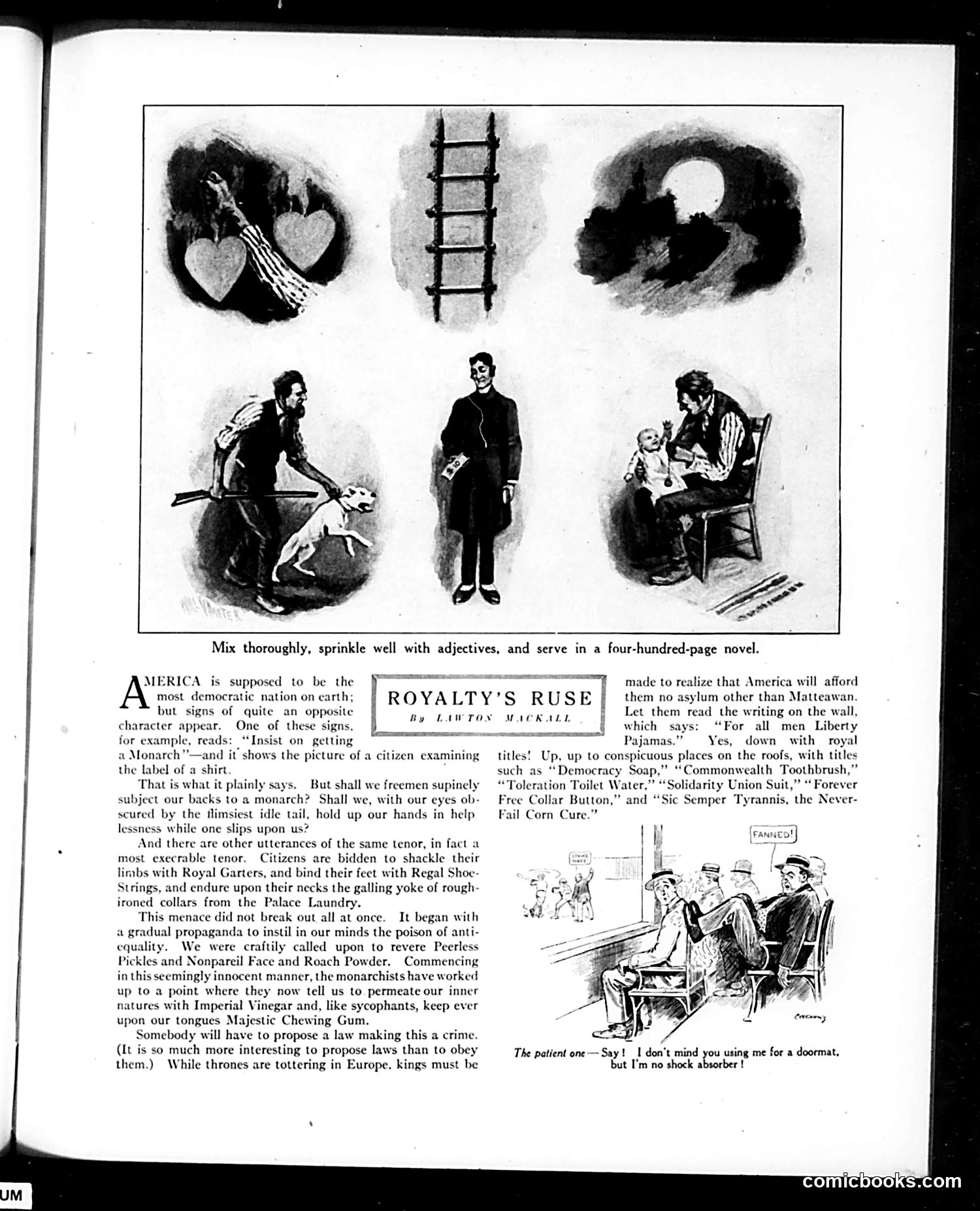
This satirical article mocks commercial product marketing that invokes royal imagery, seen as anti-democratic propaganda. The author argues that American companies—through brands like "Monarch" shirts, "Royal Garters," "Imperial Vinegar," and "Majestic Chewing Gum"—are subtly indoctrinating citizens to accept aristocracy, undermining American democratic values. The top illustrations appear to show various scenarios of this "monarchist" corruption: citizens adopting royal affectations, a ladder (possibly representing social climbing), and domestic scenes of submission to these commercial influences. The bottom cartoon is unrelated political humor about a patient being used as a doormat, commenting on tolerance versus exploitation. The satire's point: commercial branding exploits patriotic language ("Democracy Soap," "Liberty Pajamas") while simultaneously promoting monarchical values—a hypocritical contradiction at odds with American egalitarianism. The piece uses exaggeration to critique what it views as dangerous cultural messaging embedded in everyday consumer products.
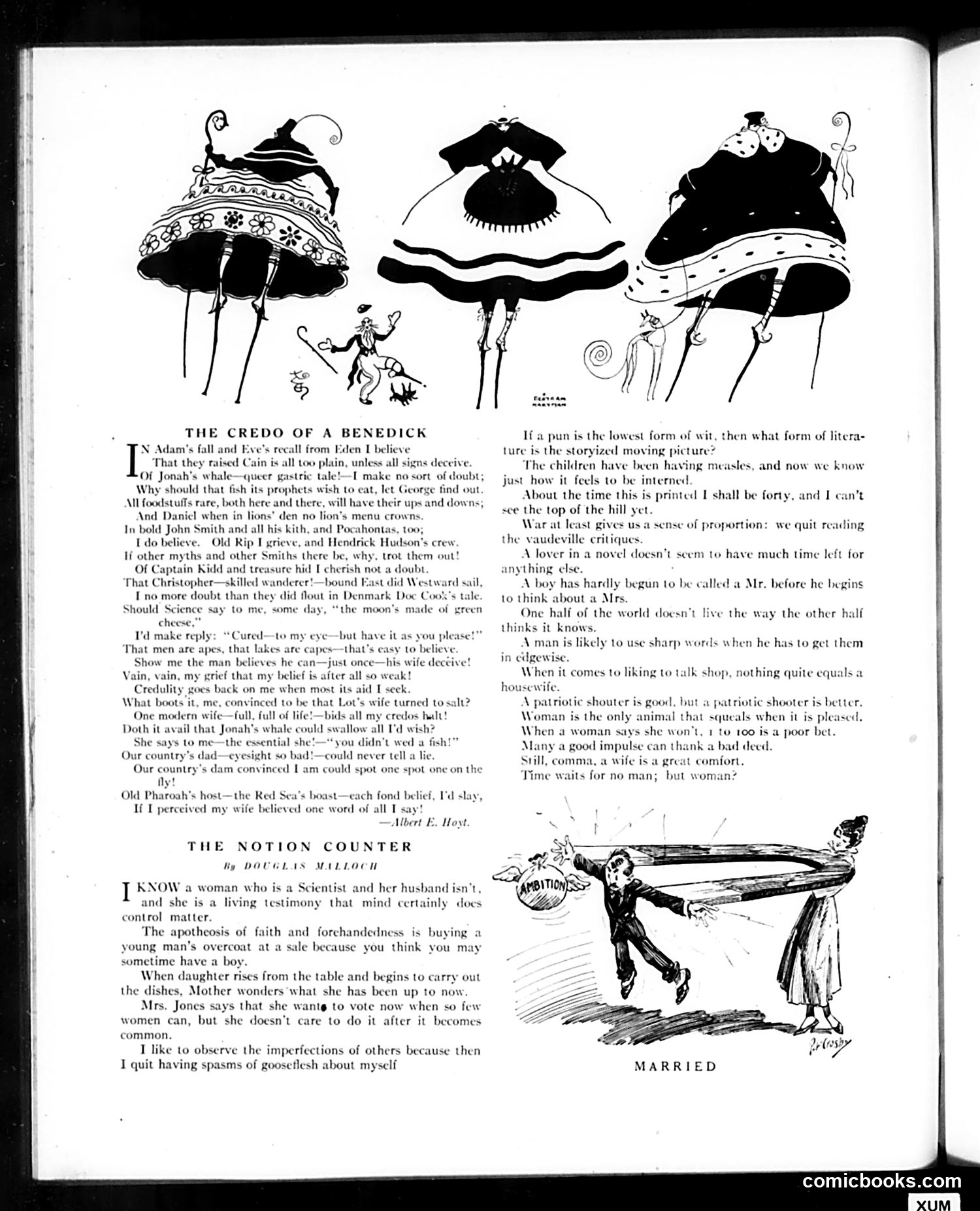
**Upper Section - "The Credo of a Benedick"** (poem by Albert E. Hoyt): This satirizes a newly married man ("Benedick" = bachelor turned husband) who claims he believes in Biblical miracles, historical legends, and scientific claims. However, his actual credulity breaks down completely when dealing with his wife. The joke: he'll accept any implausible story—Jonah's whale, Columbus, George Washington never lying—but flatly disbelieves anything his wife says or does. The point mocks both male gullibility regarding public myths and the fundamental distrust husbands harbor toward wives' honesty and motives. **Middle Section - "The Notion Counter"** (by Douglas Malloch): A collection of brief humorous observations about gender and society. Key items include skepticism about women voting ("doesn't care to do it after it becomes common"), observations about wives' deception, and the asymmetry between men and women's behavior. One notes war provides "sense of proportion." **Bottom Illustration - "Married"**: Shows a man apparently struggling with an enormous weight labeled "Ambition"—satirizing how marriage constrains male ambition and freedom. The page reflects early 20th-century attitudes: marital distrust, skepticism of women's equality, and marriage as burden.
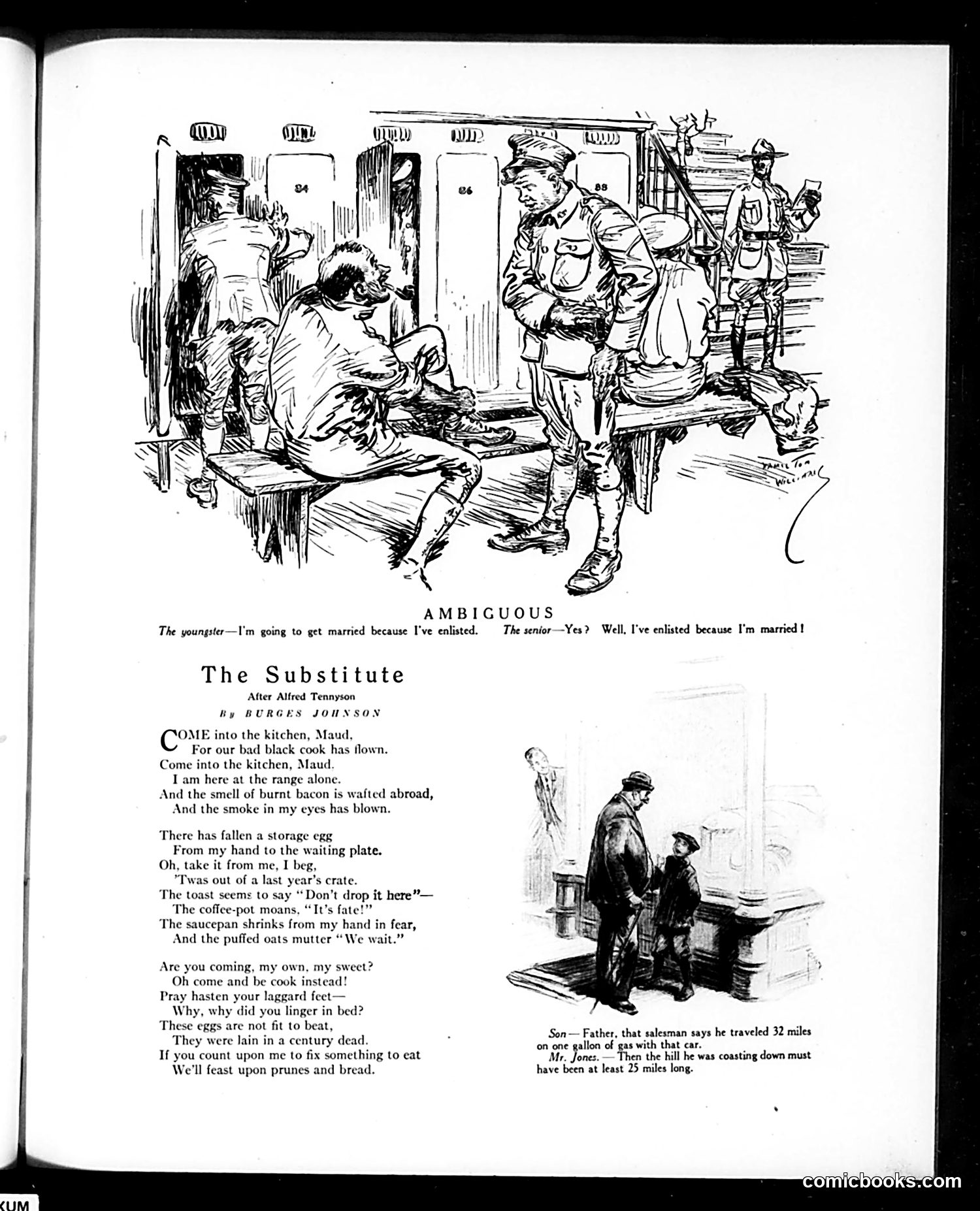
**Top Cartoon ("Ambiguous"):** A WWI-era joke playing on dual motivations for military enlistment. A young soldier claims he enlisted because he's married; an older soldier responds he enlisted *because* he's married—suggesting marriage is either an inspiration for patriotic duty or an escape from domestic life. The humor exploits the ambiguity of the phrase. **"The Substitute" Poem:** A parody of Tennyson's romantic poem "Maud," reimagined as domestic comedy. A husband, left alone in the kitchen after the cook quits, desperately pleads with his wife ("Maud") to return and cook. The poem mocks both the original's flowery romanticism and the helplessness of men facing housework—a common satirical trope of the era. **Bottom Cartoon:** A skeptical father dismisses a car salesman's claim of 32 miles-per-gallon fuel efficiency, sarcastically suggesting the car must have coasted down an impossibly long hill. This mocks exaggerated automotive advertising claims.
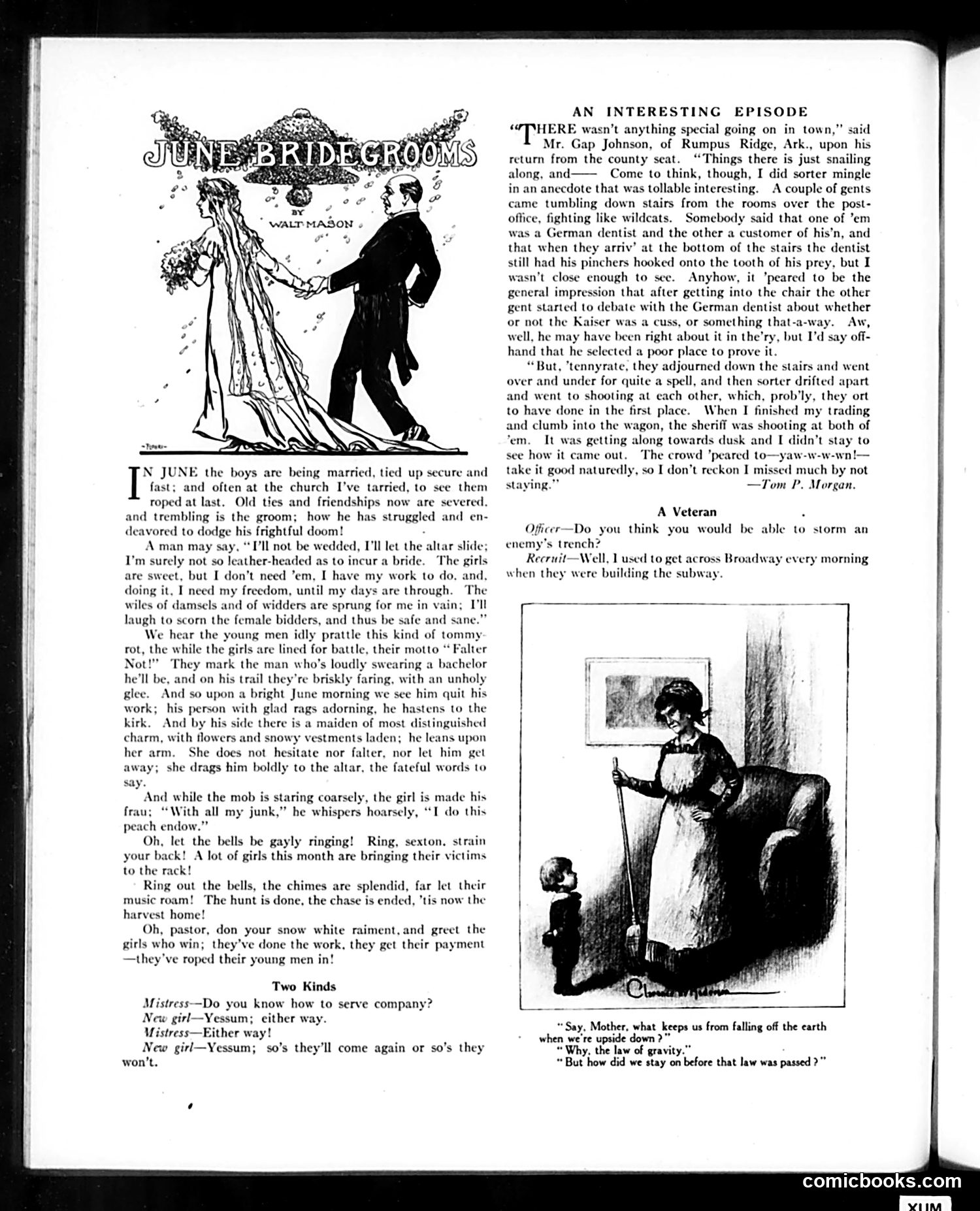
This page from *Judge* magazine contains satirical commentary on marriage and gender relations in early 20th-century America. **"June Bridegrooms"** (main feature): A humorous poem mocking men's futile resistance to marriage. The satire portrays women as predatory hunters ("lined for battle") who inevitably "rope" bachelor men into wedlock despite their protests of independence. The tone is lighthearted but reflects anxieties about female agency and changing social dynamics. **"An Interesting Episode"**: A comedic anecdote about a dentist and patient quarreling—apparently over whether the Kaiser (German emperor) is a "cuss"—that escalates into a chaotic brawl involving the sheriff. This likely references anti-German sentiment during or after World War I, satirizing how trivial arguments could spiral into violence. **The cartoon below** depicts a child asking his mother about gravity and planetary motion—a gentle joke about childhood curiosity and parental explanation. **"A Veteran"**: A brief joke about subway construction substituting for military trench experience. The page overall reflects period anxieties about gender roles, nationalism, and modernization through light satire.
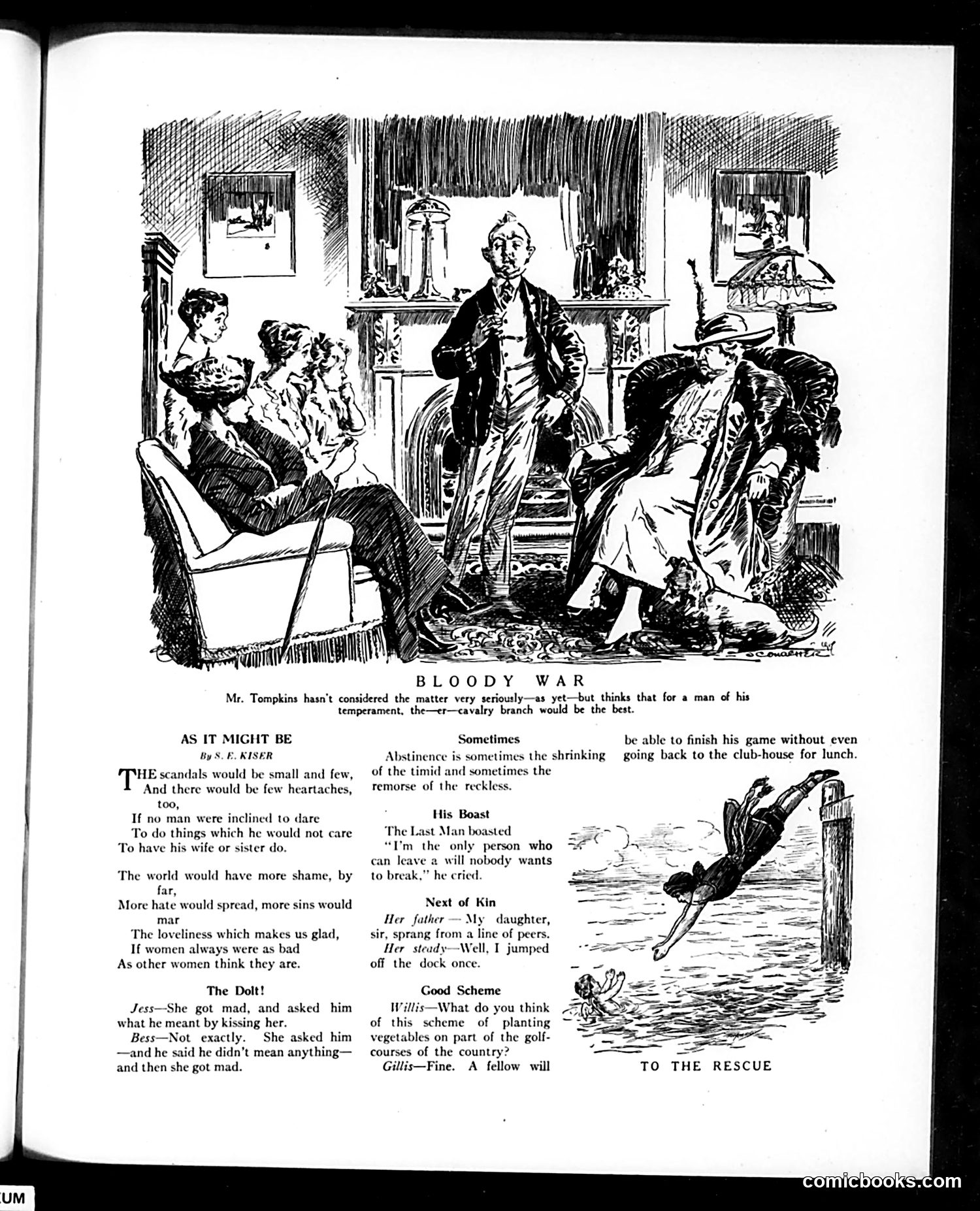
The main cartoon depicts a drawing room conversation about military service. "Mr. Tompkins," apparently a man of leisure and uncertain temperament, is being discussed by well-dressed socialites. The joke satirizes wealthy, idle men during wartime—the caption suggests cavalry would suit someone of his disposition, implying the cavalry branch requires less serious commitment than other military roles. This reflects early 20th-century class anxieties about whether privileged men would serve adequately in actual combat. The page also contains several short humor pieces mocking social pretense, romantic mishaps, and absurdity. These include jokes about infidelity, inheritance disputes, class pretension ("line of peers"), and a final gag about golf-course vegetable gardens during wartime shortages. Overall, the page satirizes upper-class indifference to serious matters—military duty and wartime sacrifices—through gentle ridicule of their social games and self-absorption.
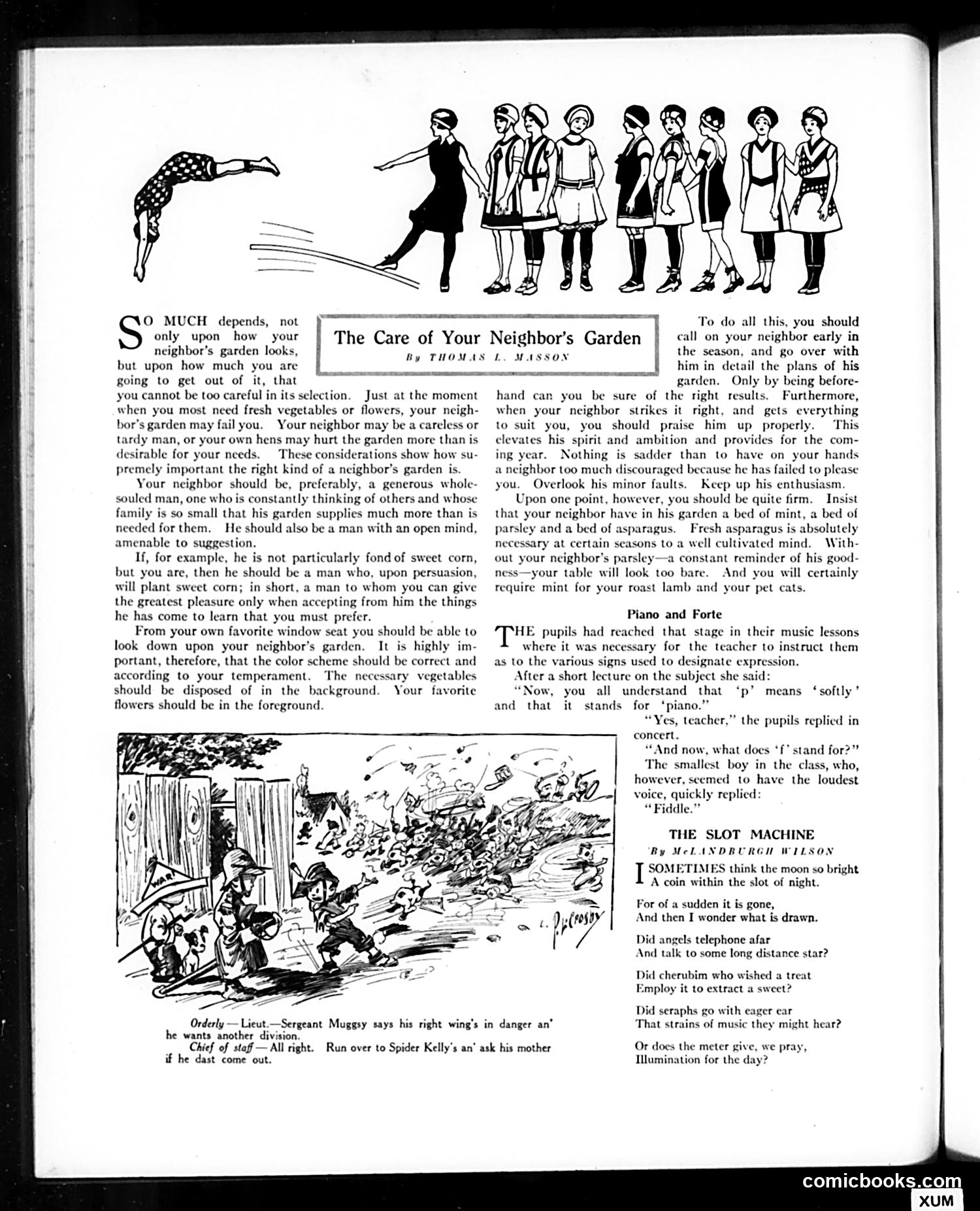
This article satirizes suburban social climbing and manipulative neighborliness. The author pretends to offer advice on selecting a neighbor based on garden productivity, but the satire is obvious: you should choose your neighbor *entirely* based on whether his garden benefits you. The piece mocks the self-centered entitlement of the writer, who expects neighbors to plant specific vegetables according to his preferences, maintain aesthetics from his favorite window seat, and constantly seek his approval. The humor lies in the brazen admission that neighborly relations are purely transactional—you praise your neighbor's efforts only to manipulate his "spirit and ambition." The accompanying cartoon (showing children and a military scene) appears unrelated to this article. The page also includes two brief humor pieces: "Piano and Forte" (a child misidentifies the musical notation "f" as "fiddle"), and "The Slot Machine," a whimsical poem about the moon.
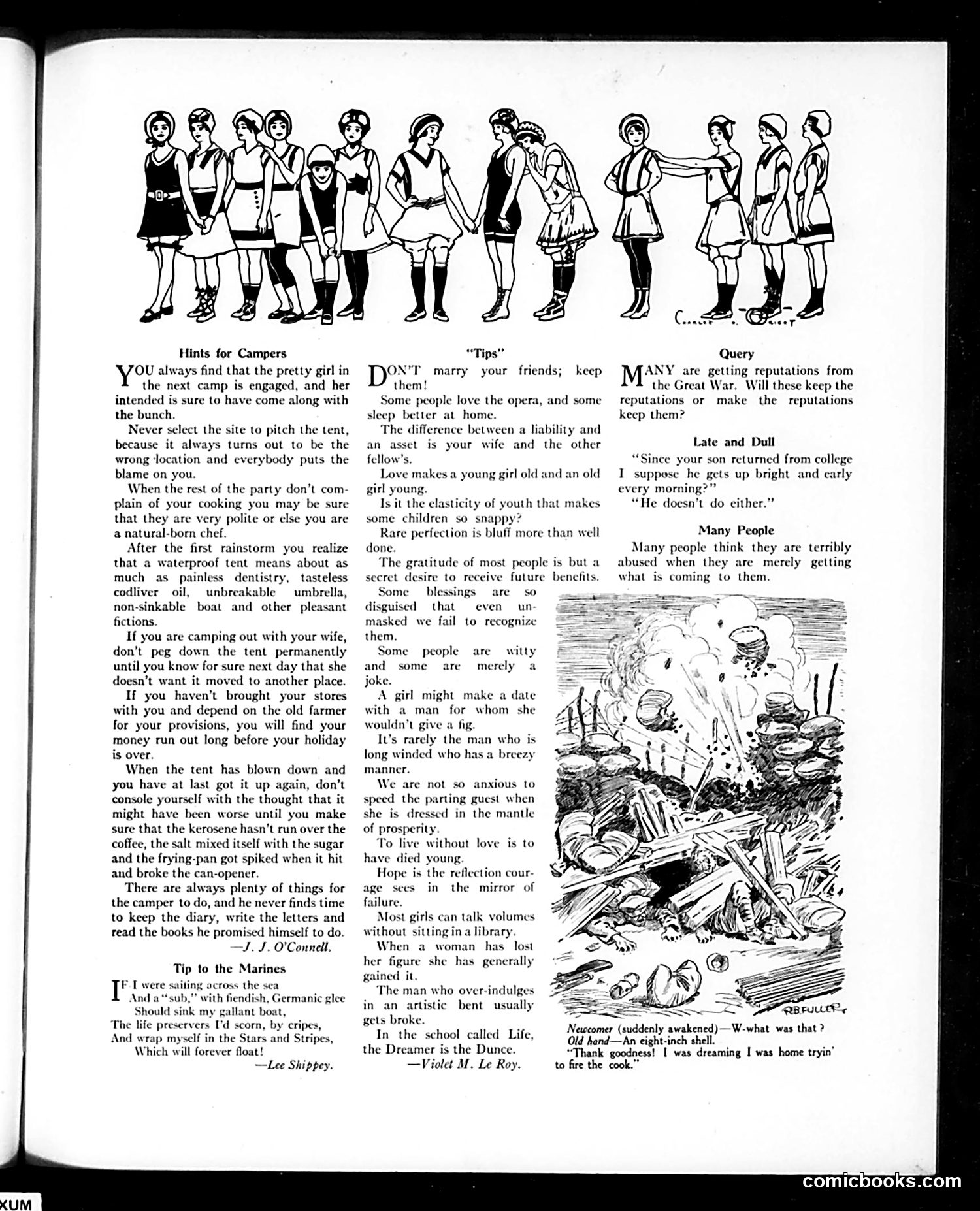
This page contains humor columns and short satirical pieces typical of Judge magazine's format. The main elements: **"Hints for Campers"** offers cynical observations about camping trips—warning that the pretty girl nearby is engaged, that selecting the tent site guarantees blame, and that "waterproof" tents leak like other false advertising (painless dentistry, unbreakable umbrellas). The humor mocks false expectations and marital tensions. **"Tip to the Marines"** is a patriotic poem by Lee Shippey, likely from the WWI era (reference to German submarines), joking that if sunk, the author would wrap himself in the American flag rather than use a life preserver—absurdist patriotic humor. **"Tips"** and other columns contain aphorisms mocking human nature: insincere gratitude, marriage dynamics, vanity, and social pretense. **The cartoon** shows soldiers in a trench receiving artillery fire. A newcomer, awakened by an explosion, mistakes an eight-inch shell for home, dreaming about firing their cook—dark WWI humor about the surreal horror of warfare. The page reflects early 20th-century American satirical humor targeting social conventions and wartime anxieties.
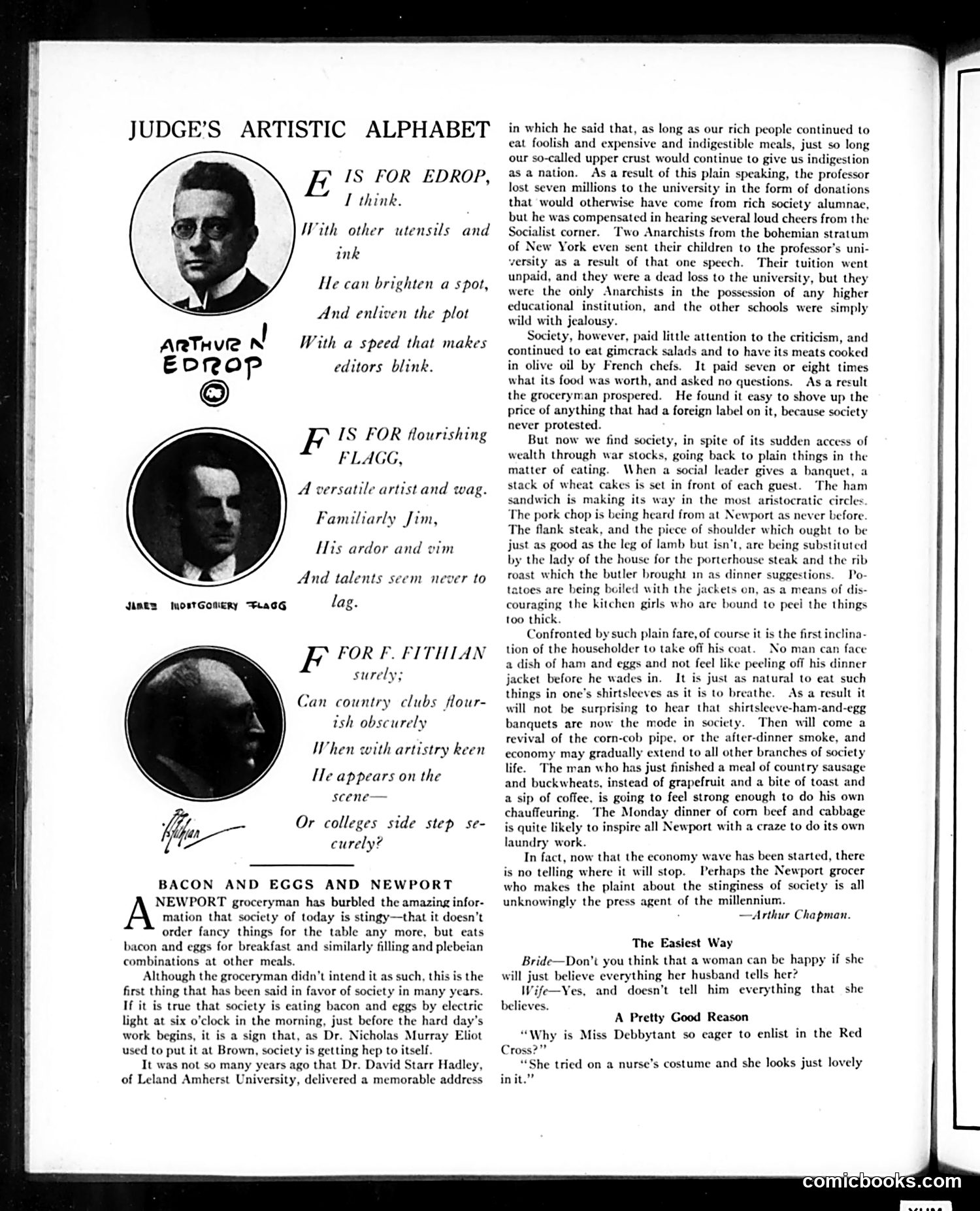
This page features caricatures of prominent illustrators and artists from Judge magazine itself, presented as an "artistic alphabet." The cartoons show **Arthur N. Edrop** and **James Montgomery Flagg** (identifiable by his signature), celebrated for their speed and skill enhancing the magazine's editorial content. The main article, "Bacon and Eggs and Newport," satirizes wealthy society's supposed economic restraint. It mocks the wealthy elite for finally eating plain, inexpensive foods (bacon, eggs, ham sandwiches) instead of fancy French cuisine—framing this as moral progress. The satire cuts both ways: praising their newfound thrift while suggesting their previous extravagance deserved criticism. The reference to a professor who lost university donations for criticizing rich donors' wasteful eating appears to be fictional hyperbole, used to highlight the conflict between morality and wealthy patronage. The tone suggests post-WWI economic anxiety and class tensions.
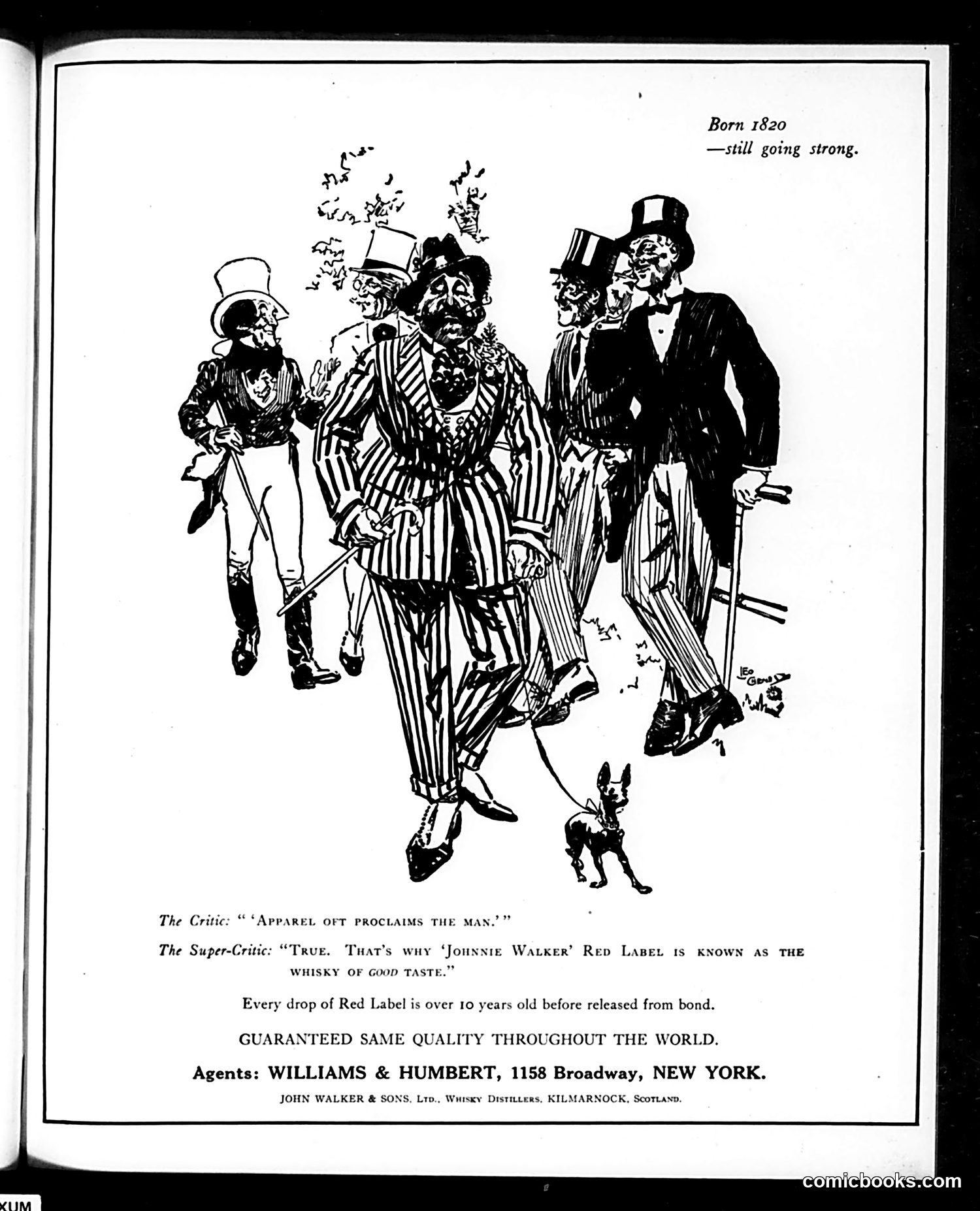
This is a Johnnie Walker whisky advertisement disguised as editorial cartoon satire. The illustration shows well-dressed gentlemen in top hats with a small dog, playing on the famous phrase "apparel oft proclaims the man." The joke positions Johnnie Walker Red Label as a marker of good taste and refinement—suggesting that quality whisky indicates a person's character and status, just as fine clothing does. The "Super-Critic" endorses this notion, linking the whisky brand to sophistication. The "Born 1820—still going strong" text establishes the product's longevity and reliability. The claim that every drop ages over 10 years before release emphasizes quality control and exclusivity. This appears in *Judge*, a satirical magazine, but functions primarily as paid advertising rather than genuine political or social commentary. The "cartoon" format lends credibility and entertainment value to what is essentially a branded message targeting affluent readers.
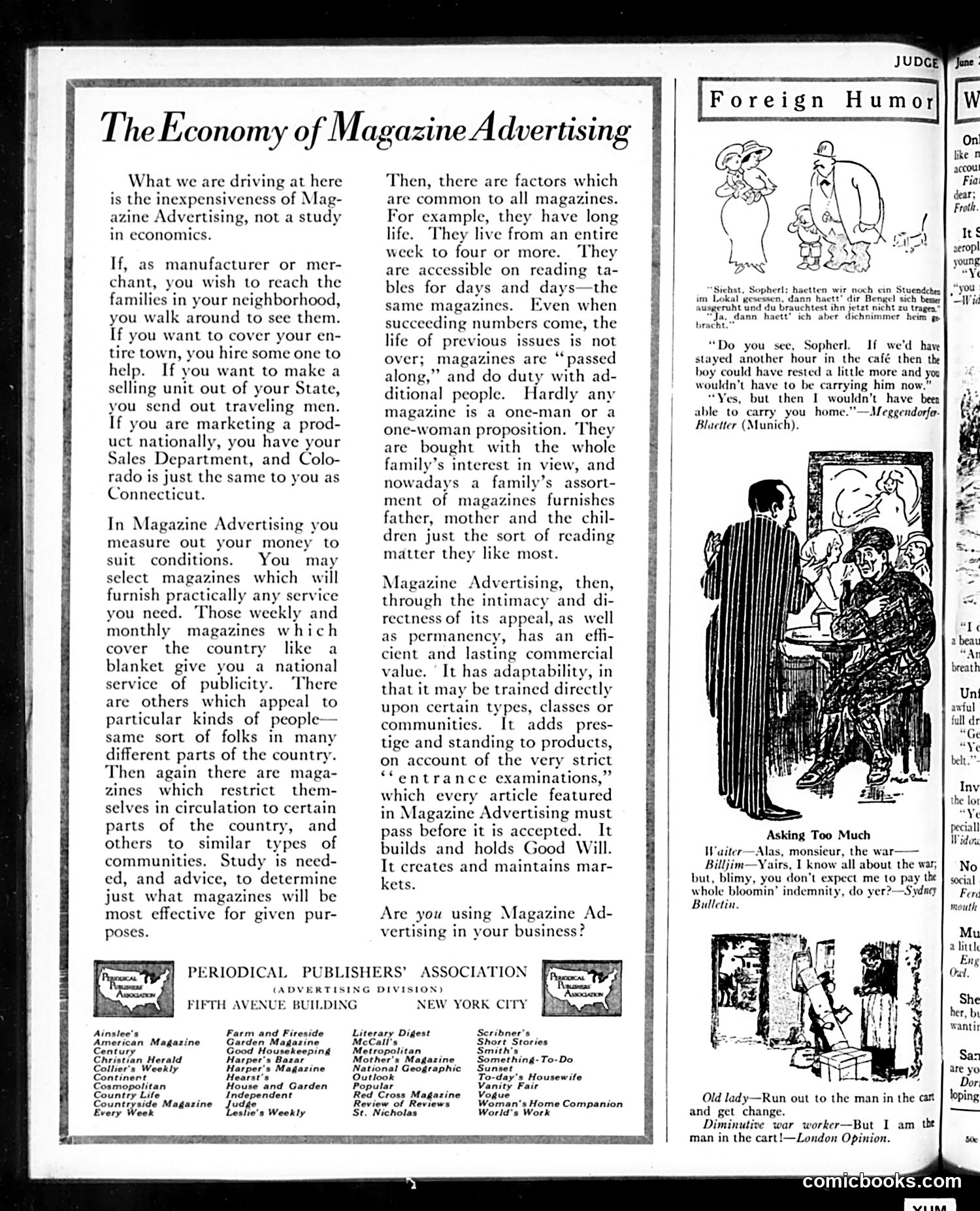
This page is primarily **advertising copy** for magazine advertising itself, published by the Periodical Publishers' Association. The left side is a lengthy sales pitch arguing that magazine advertising is cost-effective for businesses seeking to reach consumers. The right side contains unrelated **satirical cartoons**: 1. **"Asking Too Much"**: A waiter confronts a diner about war reparations. The joke plays on post-WWI tensions—the diner conflates the waiter's request for payment with demands for war indemnities, suggesting the financial burden of reparations felt absurd to ordinary people. 2. **German cartoons** (top): Appear to satirize domestic life and family dynamics, though the context is unclear without better translation. 3. **Bottom cartoon**: An elderly woman in a cart jokes about being "the man" while her husband rides—reversing gender roles for comedic effect. These cartoons are filler content typical of Judge magazine, unconnected to the advertising essay.
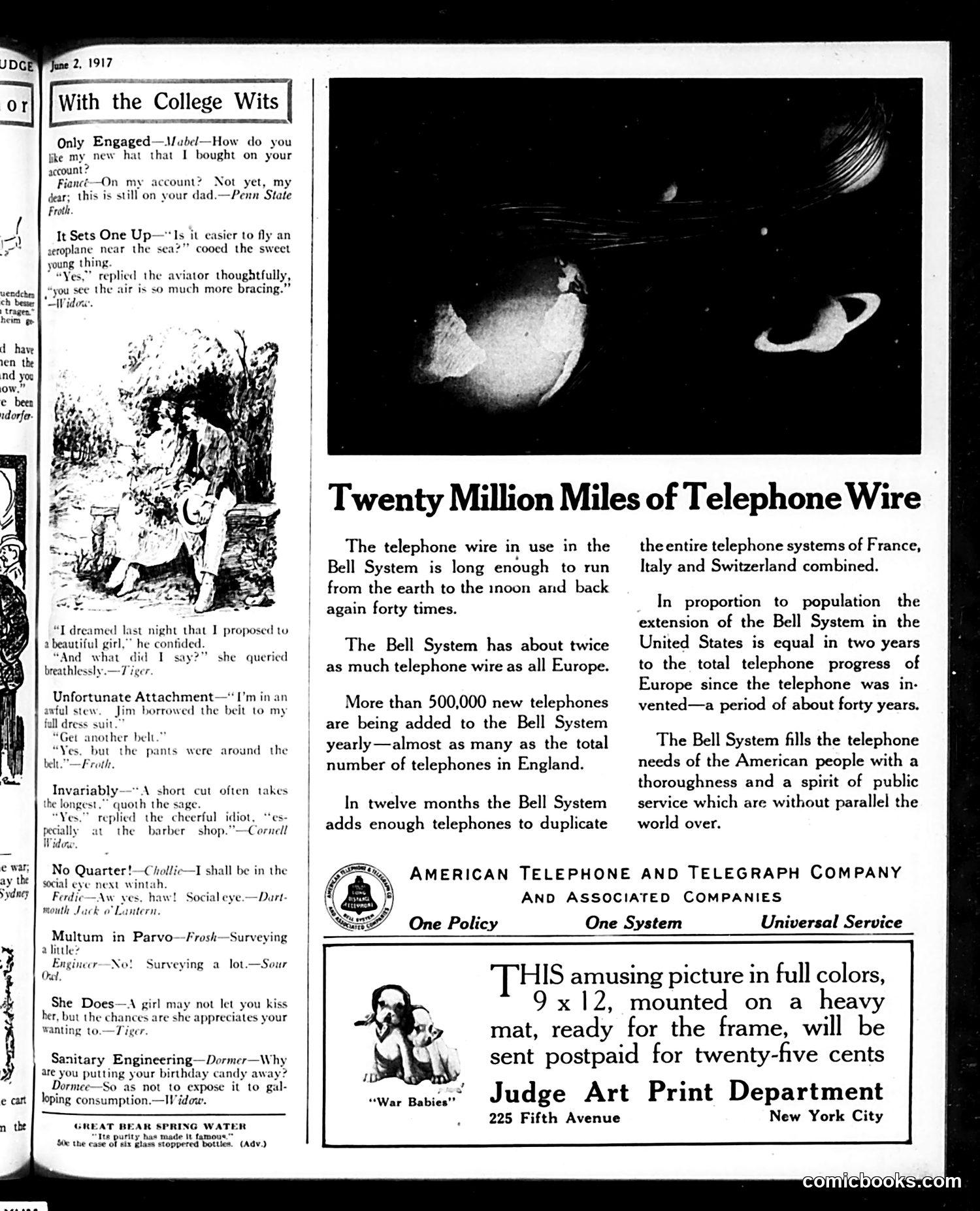
This page is primarily a humor section featuring brief college-themed jokes submitted by student publications (Penn State Froth, Cornell Widow, etc.), followed by an advertisement for the Bell Telephone System. **The humor section** presents lighthearted romantic and campus scenarios—engagements, courtship mishaps, borrowed dress suits—typical of college magazines. The jokes rely on wordplay and naive romantic situations rather than satire. **The advertisement** emphasizes American technological superiority, boasting that Bell System telephone wire extends 20 million miles—enough to reach the moon 40 times. It highlights that Americans are adding phones faster than entire European nations have accumulated in forty years. This nationalist messaging is notable given the 1917 date (U.S. entered WWI that year), framing telephone infrastructure as evidence of American industrial dominance. The accompanying illustration—"War Babies"—(visible but unclear in detail) appears to connect to wartime themes, though specifics are hard to determine from the image quality.
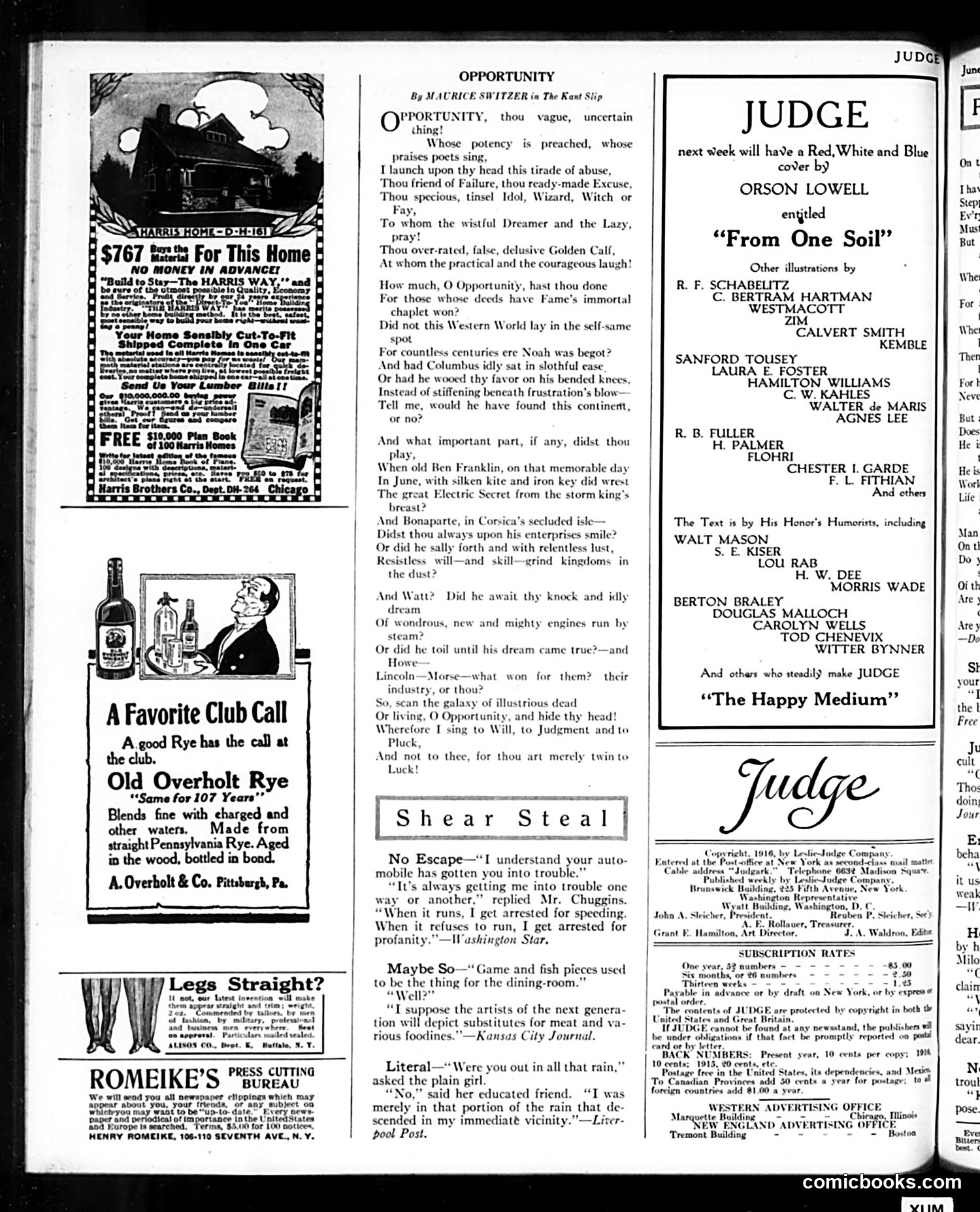
This page from *Judge* magazine consists primarily of **advertisements and promotional content** rather than satirical cartoons. The main elements are: **Advertisements:** - Harris home construction ("Build to Stay—The HARRIS WAY") - Old Overholt Rye whiskey ("A good Rye has the call at the club") - Romeike's press clipping service - A leg-straightening device **Editorial Content:** The centerpiece is Maurice Switzer's poem "Opportunity," which **satirizes the American ideal of opportunity** by arguing that success comes from personal effort, industry, and will—not from "Opportunity" itself. It references historical figures (Columbus, Franklin, Bonaparte, Watt, Lincoln, Morse) to demonstrate that their achievements resulted from hard work, not luck or circumstance. **Small humor items** like "Shear Steal" and "Maybe So" offer light social commentary about automobiles and artistic fashions. The page also advertises the magazine's upcoming cover and contributors, including Walt Mason and other humorists.
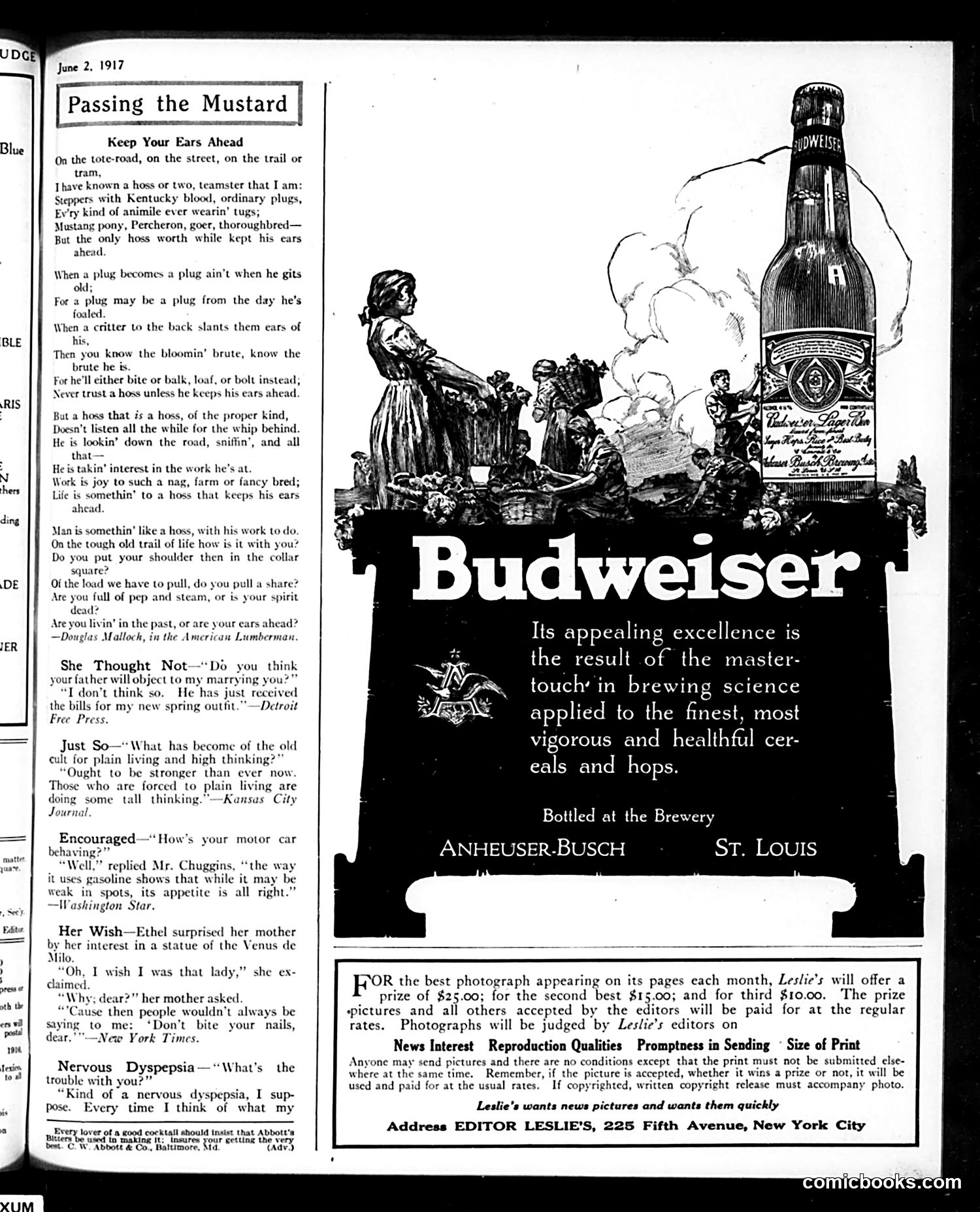
This page is primarily **advertising and humor columns**, not political satire. The main content includes: **"Keep Your Ears Ahead"** — A metaphorical poem by Douglas Malloch comparing horses to humans. The conceit: a good horse keeps its ears forward, attentive to work ahead, while a bad horse pins ears back, distracted or resistant. The poem applies this to workers/citizens: are you engaged and forward-looking, or stuck in the past with low morale? **Context:** Published in 1917 (U.S. entry into WWI), this likely encouraged patriotic engagement and productivity. **Supporting jokes** mock romantic folly, false economy ("plain living"), and nervous anxiety—typical light humor for the era. **The Budweiser advertisement** (ironic given Prohibition's approach in 1919) emphasizes brewing quality. The page is **not primarily satirical** but rather a mixed-content magazine format combining inspirational verse, short jokes, and commercial advertising typical of *Judge* magazine's era.
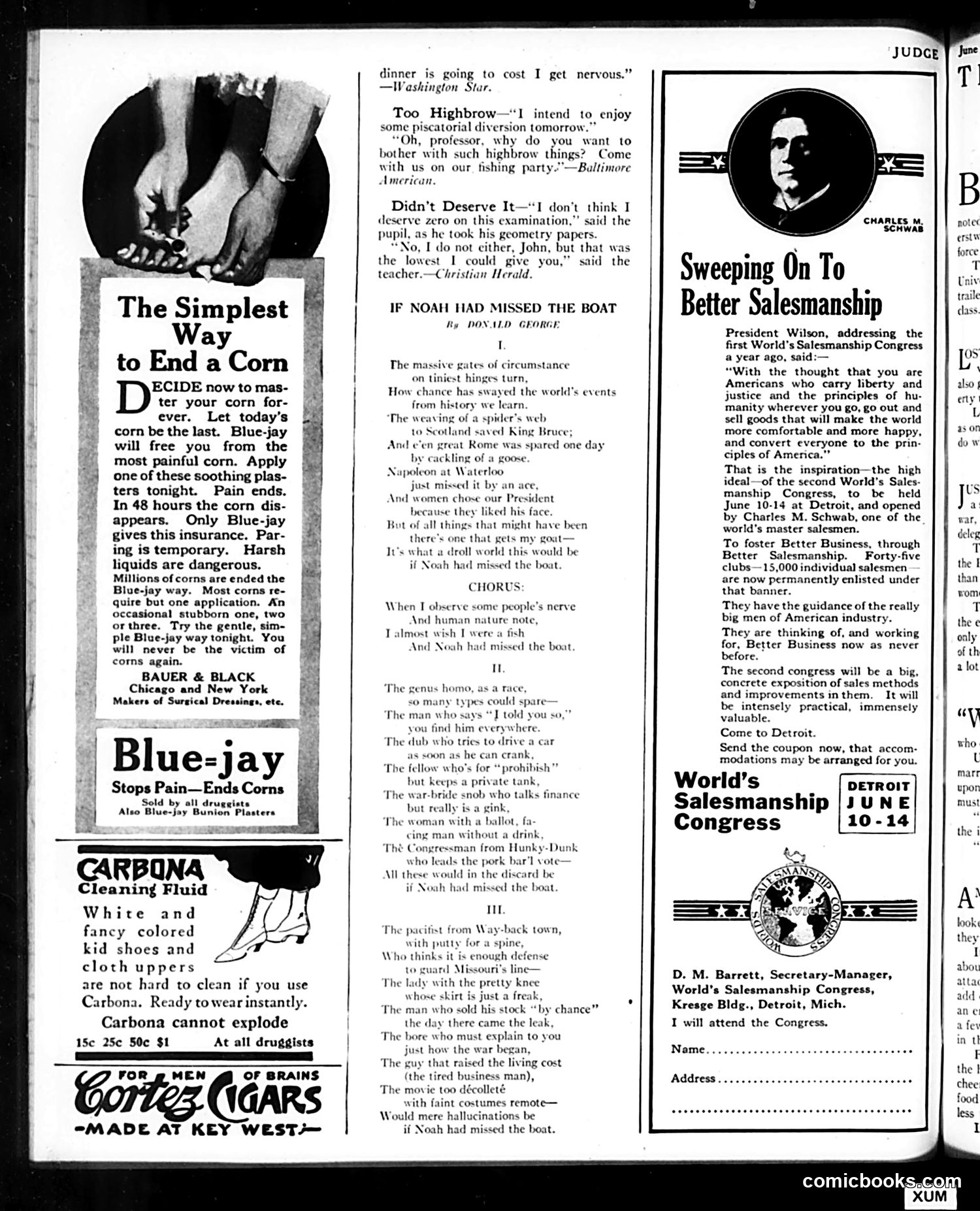
This page is primarily **advertisements and light humor** rather than political satire. The main content includes: **Advertisements**: Blue-jay corn plasters, Carbona cleaning fluid, and Cortez cigars dominate the layout with typical early 20th-century product claims. **Humor pieces**: Brief jokes about misunderstandings ("Too Highbrow" about fishing terminology, "Didn't Deserve It" about grades). **Main feature**: "If Noah Had Missed the Boat," a humorous poem satirizing contemporary American types—politicians, profiteers, pacifists, and women with revealing skirts. The joke: society would be better if certain people didn't exist. It reflects post-WWI skepticism toward politicians and social changes (women's hemlines, pacifism). **Right sidebar**: An advertisement for the World's Salesmanship Congress in Detroit, featuring steel magnate Charles M. Schwab and quoting President Wilson about selling American principles globally. The page reflects 1920s concerns: commercialism, women's changing roles, political corruption, and American exceptionalism.
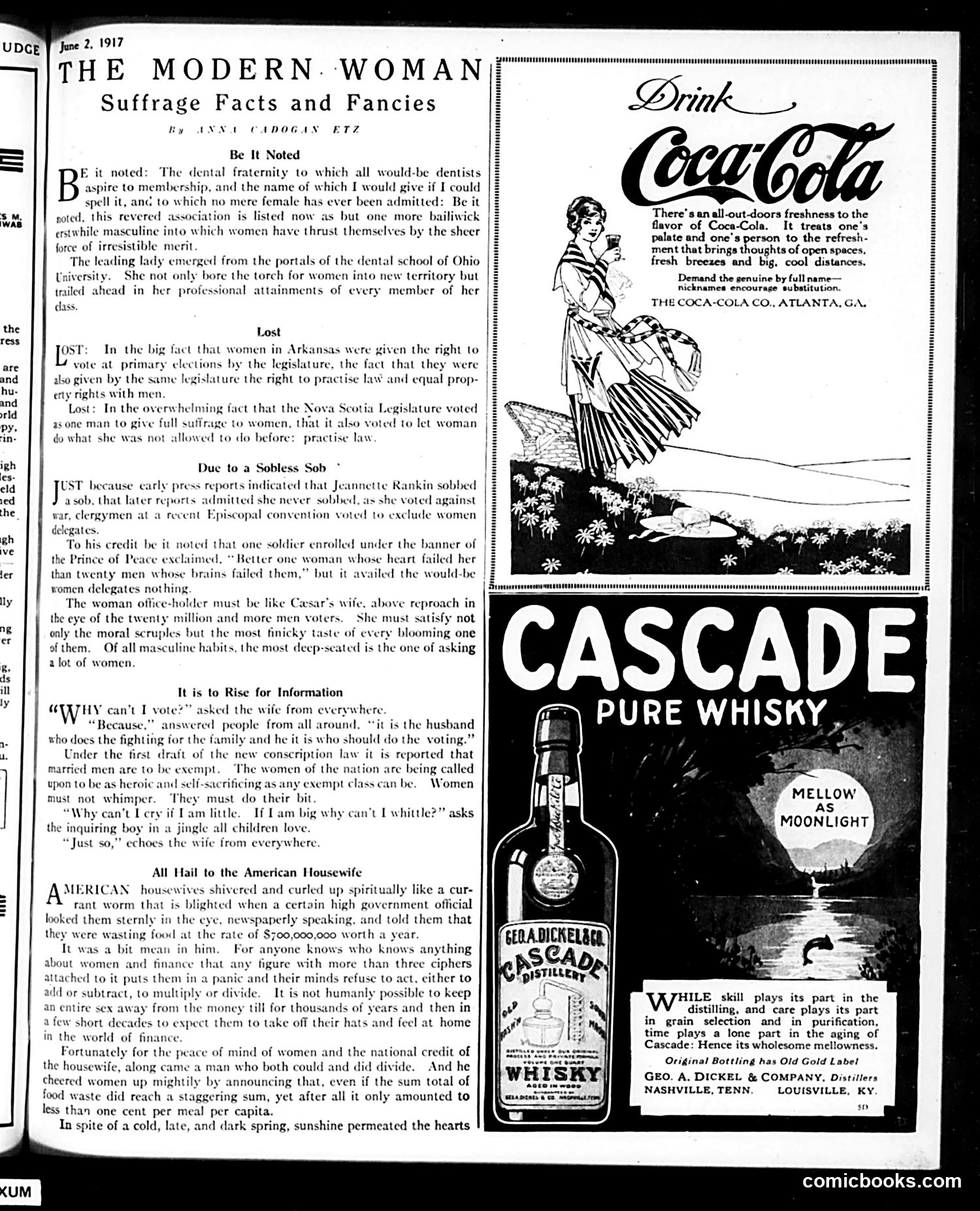
This June 1917 *Judge* article satirizes arguments *against* women's suffrage by listing absurd counterexamples. The author (Anna Cadogan Etz) presents "facts" showing women's competence: a woman dental graduate outperforming male classmates; Arkansas and Nova Scotia granting women voting AND legal practice rights simultaneously; and a soldier defending female delegates despite clergy opposition. The piece mocks the "logic" requiring women voters to be morally flawless while men face no such scrutiny—yet denying them votes because men "do the fighting." It highlights the contradiction: married men are exempt from the new draft, yet women are called to patriotic sacrifice without representation. The final section ridicules a government official shaming housewives about food waste while assuming women cannot understand large numbers—infantilizing them as incapable of financial reasoning, then patronizingly reassuring them the waste is "only" one cent per meal. The satire's point: suffrage opponents' arguments collapse under examination.
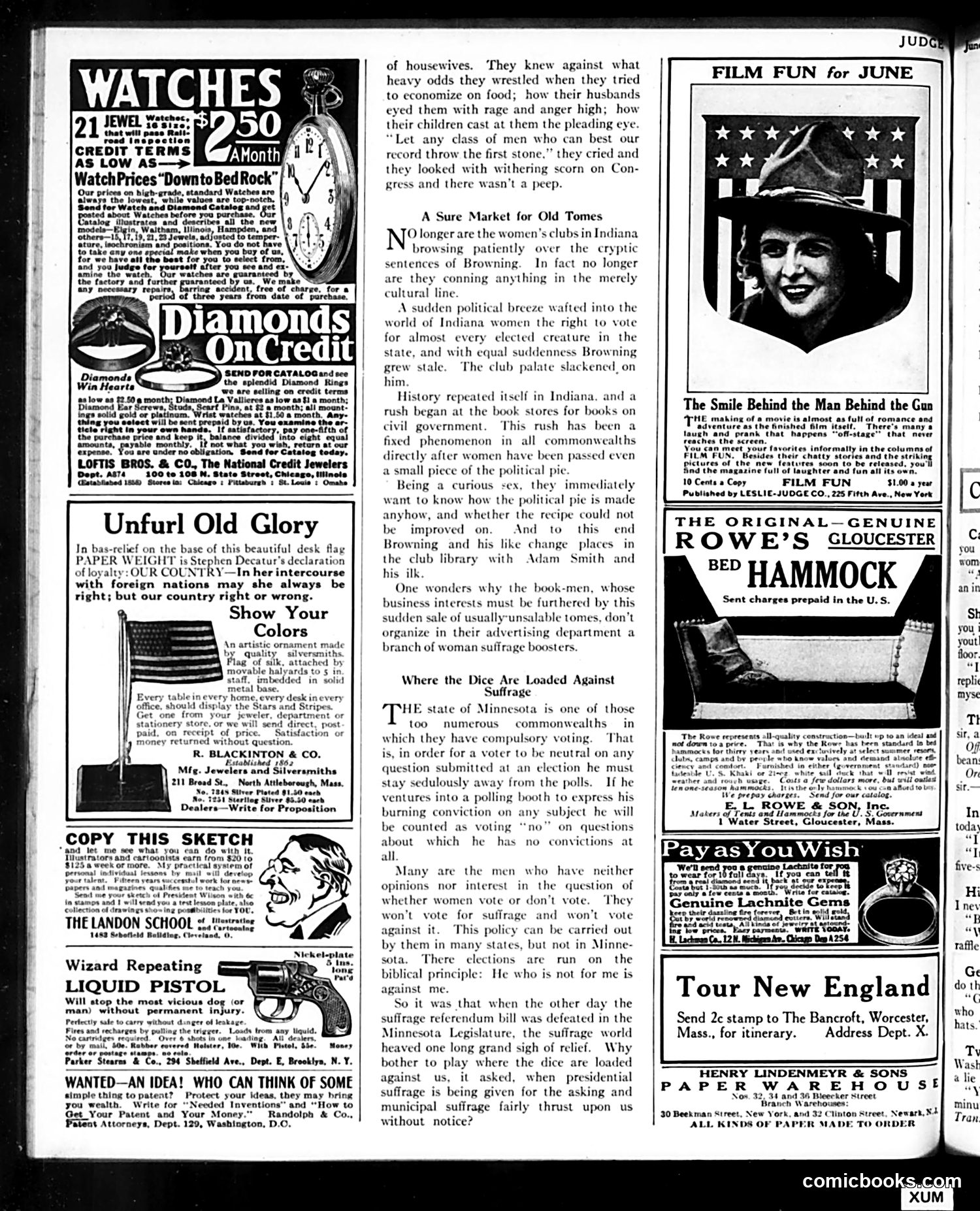
This page is primarily **advertisements and filler content** rather than political satire or comics requiring historical explanation. The main text article, "A Sure Market for Old Tomes," discusses how Indiana women's clubs abandoned literary pursuits (like Browning) after gaining voting rights, rushing instead to purchase civics and government books. This reflects early 20th-century commentary on women's suffrage—suggesting women's newfound political participation redirected their intellectual interests from cultural to civic matters. The tone appears gently satirical about this shift in priorities. The bulk of the page contains commercial ads for watches, diamonds, desk flags, and patent services—typical Judge magazine revenue sources. These lack satirical content and are straightforward sales pitches to readers. **No specific political figures or detailed cartoons requiring historical context are prominently featured** on this visible portion of the page.
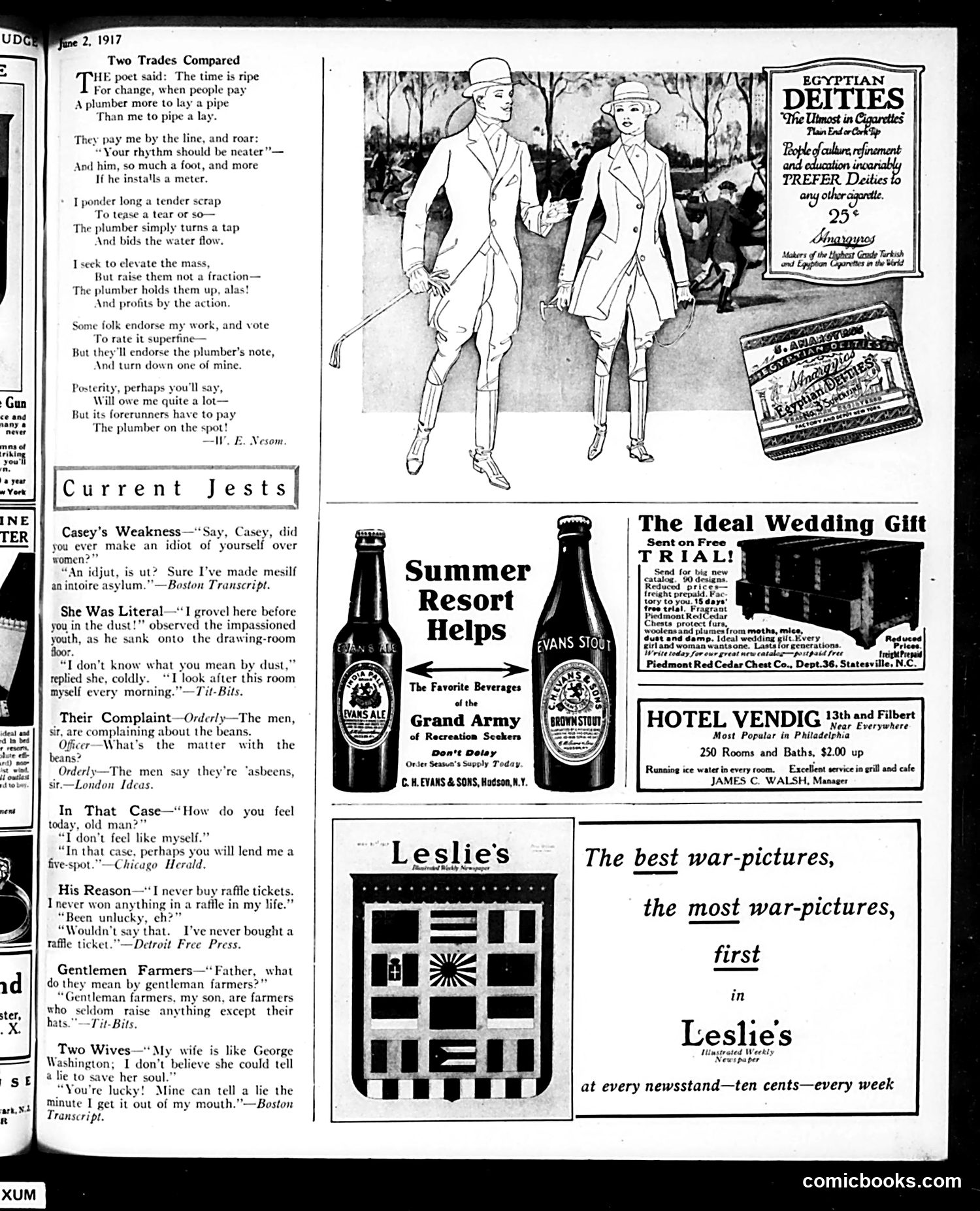
This poem satirizes the economic disparity between intellectual and manual labor in early 20th-century America. The poet speaker contrasts his struggling literary work—laboring over verses to "elevate the mass"—with a plumber's straightforward, profitable trade. The satire's point: society undervalues artistic labor while rewarding practical skills. The plumber "turns a tap / And bids the water flow," instantly earning money, while the poet "ponder[s] long" yet receives minimal payment and little public endorsement. Even posterity may remember the poet, but "its forerunners have to pay / The plumber on the spot." This reflects genuine 1917 anxieties about artists' viability in an increasingly commercial society—a common Judge magazine theme mocking both highbrow pretension and capitalism's indifference to culture.
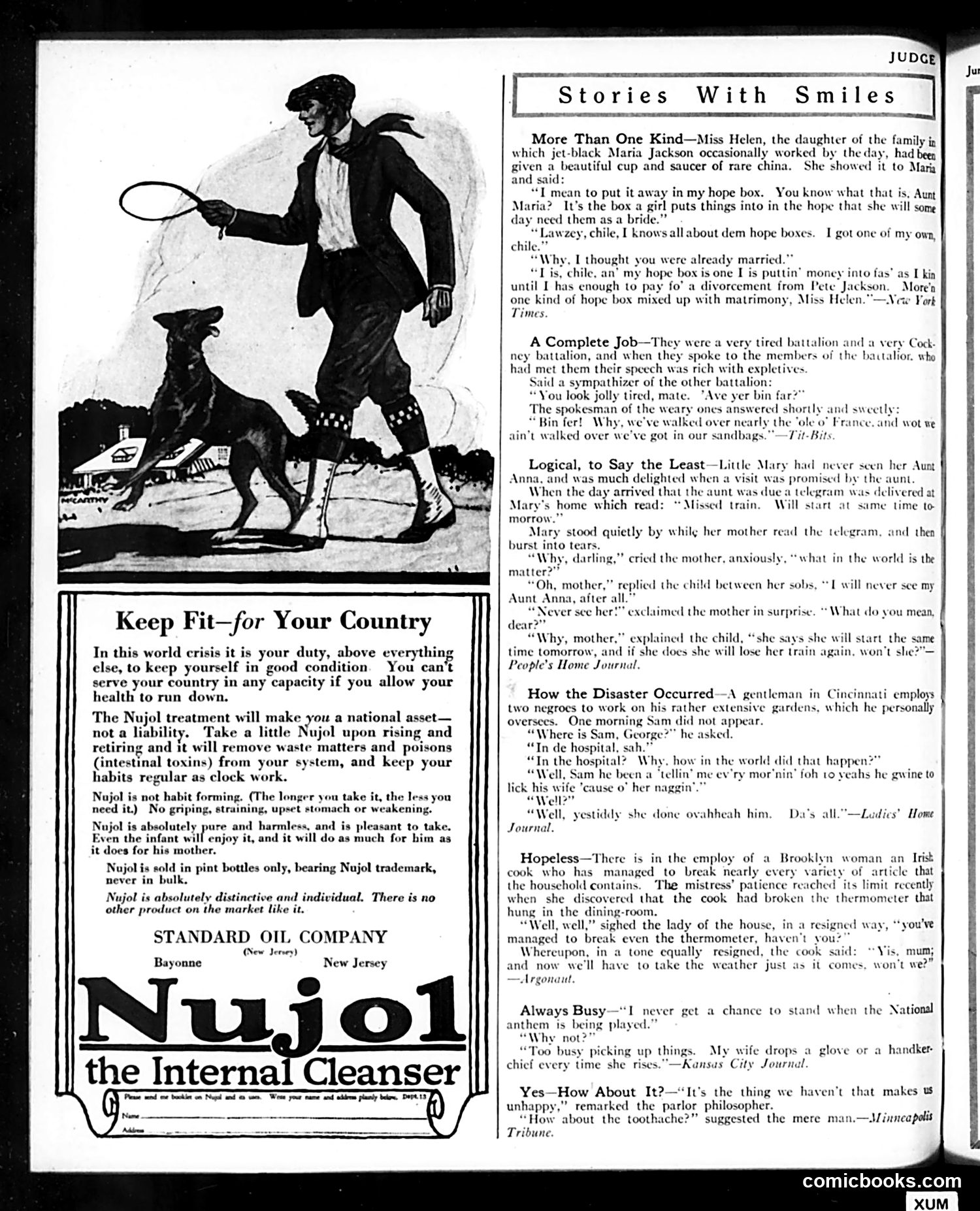
This page contains humorous anecdotes rather than political cartoons. The featured illustration shows a man in formal dress with a tennis racket, likely accompanying a now-illegible joke. The stories employ period stereotypes: **"More Than One Kind"** uses dialect humor featuring a Black domestic worker ("Aunt Maria") making a joke about her "hope box" being savings for divorce rather than marriage—subverting the genteel tradition discussed by her white employer's daughter. **"How the Disaster Occurred"** relies on racist caricature, depicting Black workers through exaggerated dialect ("yeahs," "gwine," "ovahheah") in a story about domestic violence played for laughs. **"Hopeless"** depicts an Irish cook as comically incompetent and accident-prone. These anecdotes reflect early 20th-century American humor that normalized ethnic and racial mockery. The page also includes a Nujol laxative advertisement framed as patriotic duty during wartime ("crisis").
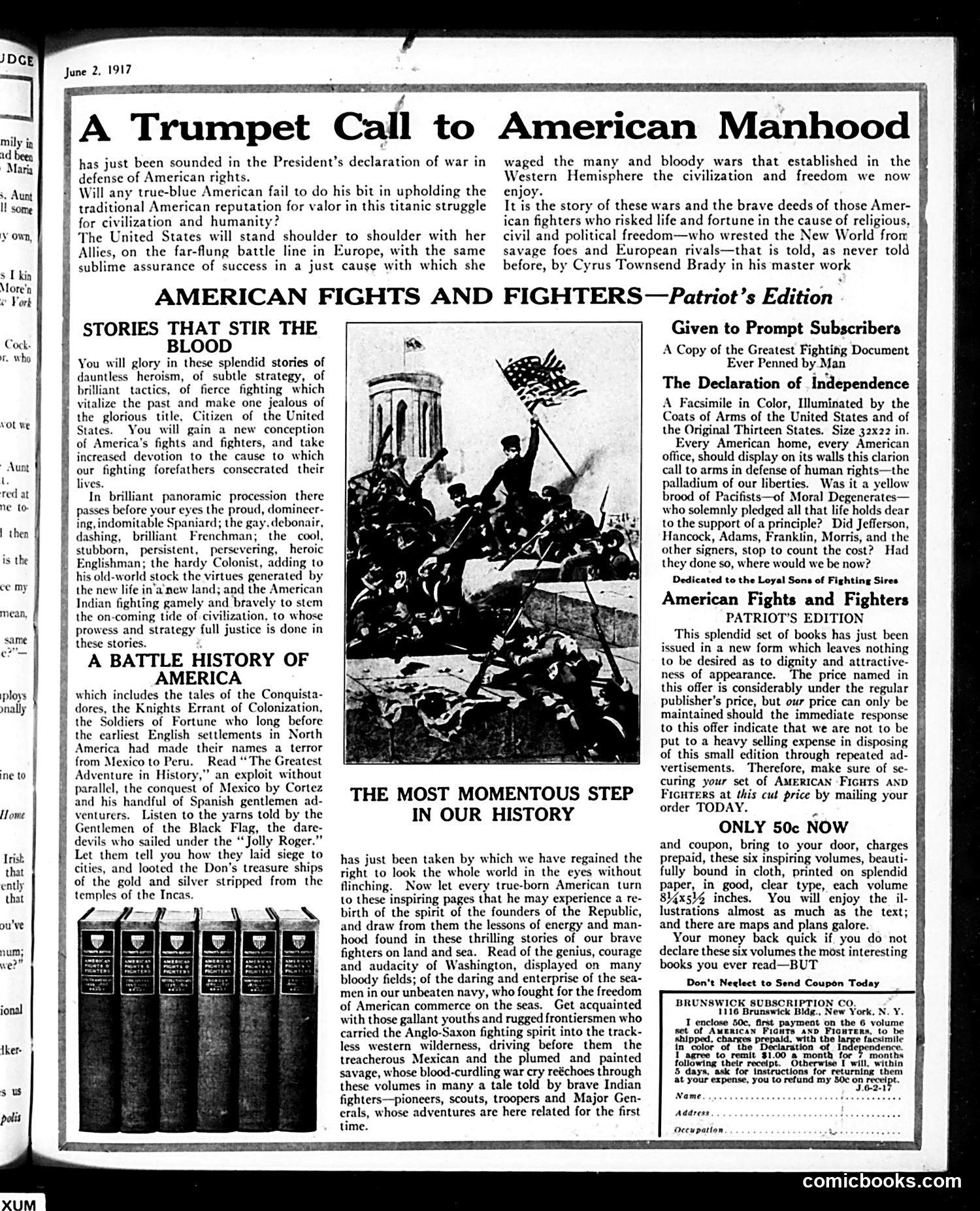
This is primarily a **full-page advertisement**, not satire. It promotes *American Fights and Fighters: Patriot's Edition* by Cyrus Townsend Brady, timed to President Wilson's recent WWI declaration. The central image depicts soldiers raising the American flag—a nationalist symbol invoking patriotic duty. The text frames U.S. entry into "the Great War" as a moral crusade, comparing it to America's historical conflicts (colonial wars, conquest of the West, naval battles). The pitch explicitly appeals to American manhood, urging readers to "do his bit" in this "titanic struggle for civilization and humanity." By linking WWI to romanticized frontier narratives and Revolutionary War heroism, the ad leverages historical mythology to justify current military engagement. This represents **wartime propaganda**—using patriotic rhetoric and historical narratives to mobilize public support for American intervention, marketed as a book purchase at 50 cents.
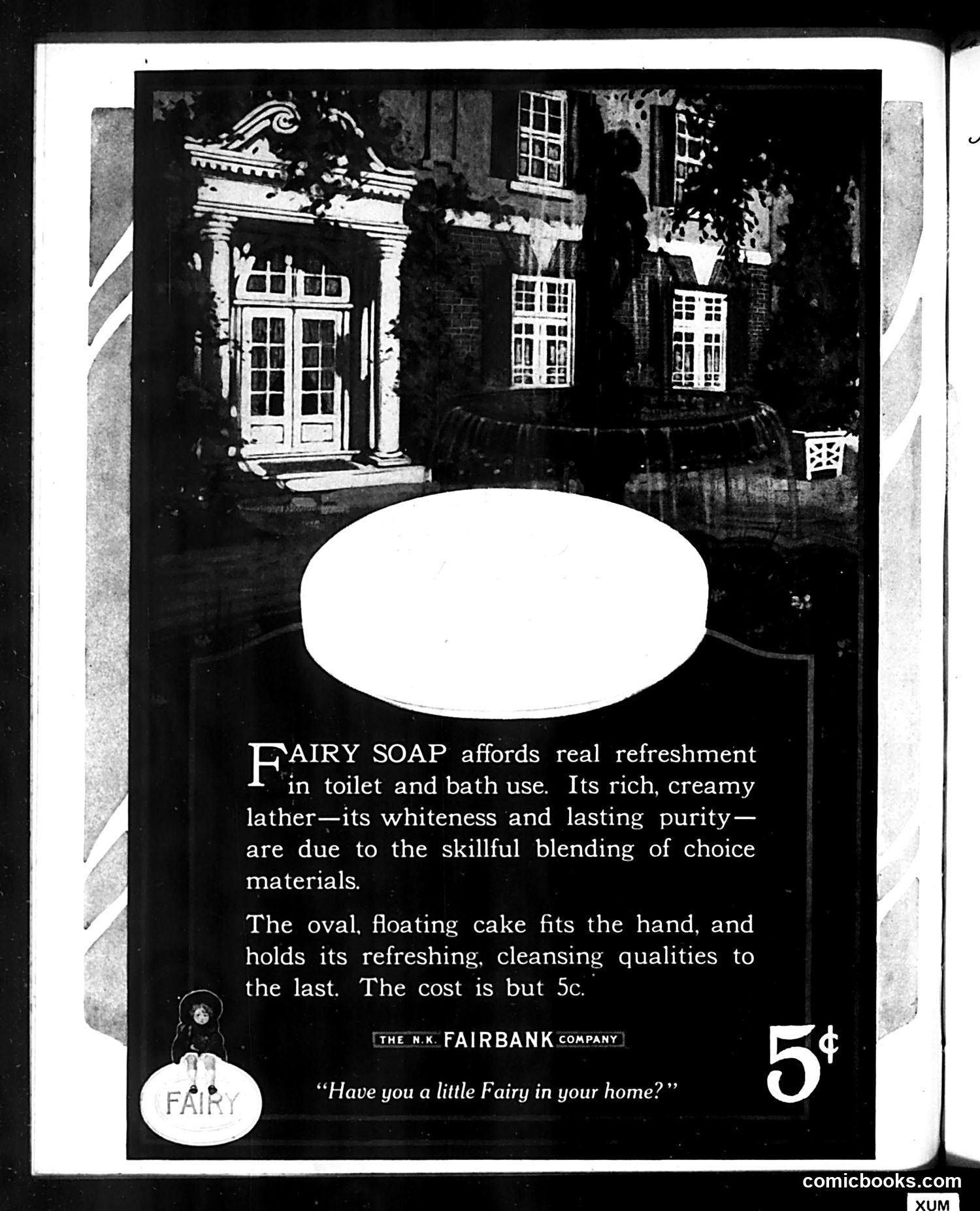
This is a **product advertisement**, not political satire. It's a full-page ad for Fairy Soap by the N.K. Fairbank Company, promoting the soap's qualities to early 20th-century consumers. The ad features an ornate mansion or building as a backdrop—likely meant to evoke elegance and refinement to appeal to middle-class buyers. The messaging emphasizes the soap's practical virtues: rich lather, whiteness, purity, and durability, culminating in the affordable price of 5¢. The slogan "Have you a little Fairy in your home?" uses the product name as a playful pitch, suggesting the soap brings magical cleansing powers to household use. The Fairy logo (visible lower left) shows a winged sprite figure. This represents typical early advertising strategy: associating an affordable consumer product with aspirational imagery and gentle humor to drive sales among working and middle-class households.