
Judge, 1917-06-02 · page 25 of 28
Judge — June 2, 1917 — page 25: what you’re looking at
What you’re looking at
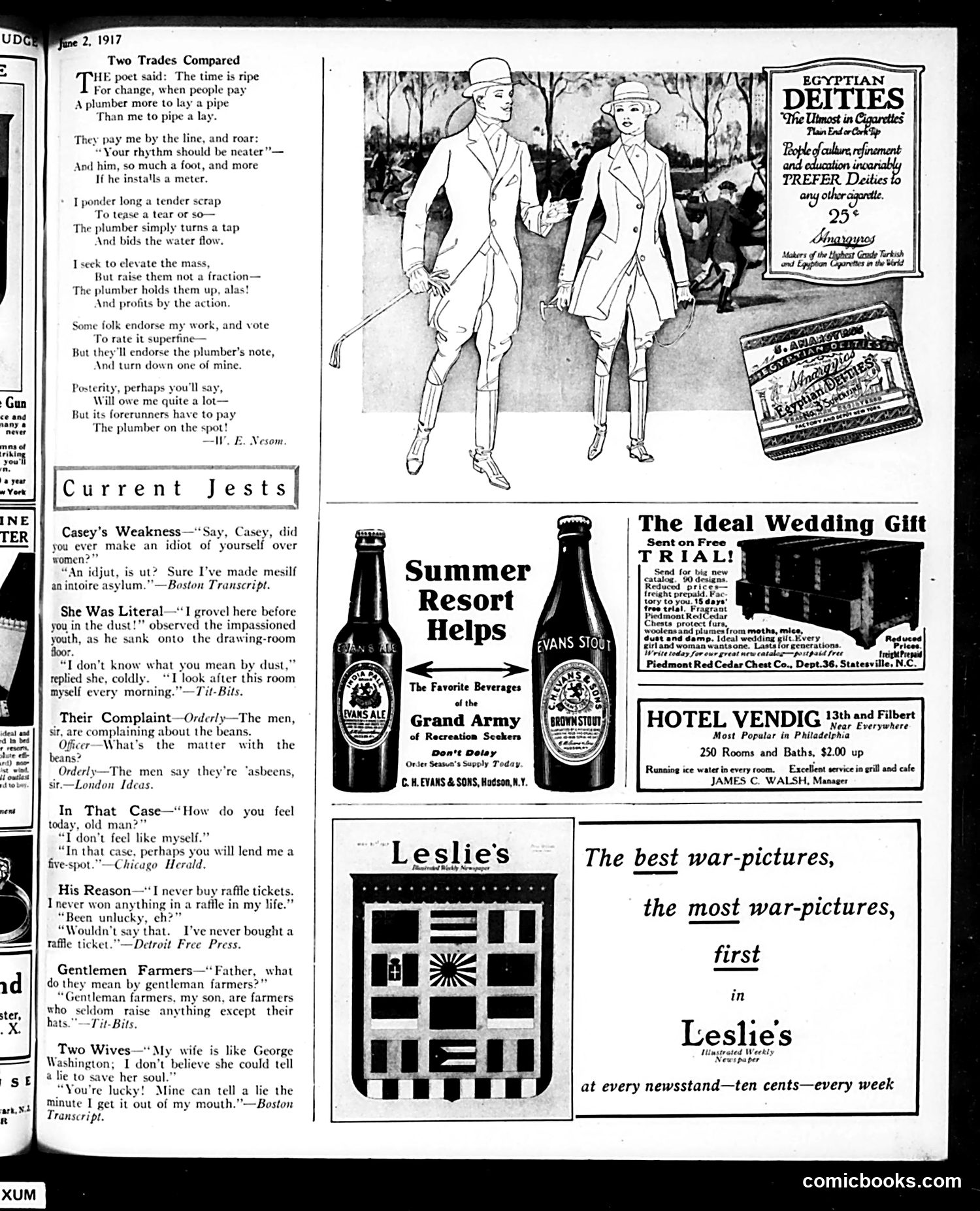
This poem satirizes the economic disparity between intellectual and manual labor in early 20th-century America. The poet speaker contrasts his struggling literary work—laboring over verses to "elevate the mass"—with a plumber's straightforward, profitable trade. The satire's point: society undervalues artistic labor while rewarding practical skills. The plumber "turns a tap / And bids the water flow," instantly earning money, while the poet "ponder[s] long" yet receives minimal payment and little public endorsement. Even posterity may remember the poet, but "its forerunners have to pay / The plumber on the spot." This reflects genuine 1917 anxieties about artists' viability in an increasingly commercial society—a common Judge magazine theme mocking both highbrow pretension and capitalism's indifference to culture.
📄 Transcribed text from this page (OCR, searchable)
Machine-transcribed from the original scan — historical spelling and the odd misread are preserved.
2, 1917 Two Trades Compared 1E poet said: The time is rij ‘ : - HE poet said: The time is ripe mn EGYPTIAN Ricca ware ce DEITIES Than me to pipe a lay. me OS “The Utmost in \ ‘ap They pay me by the line, and roar: i L . I. K ‘our rhythm should be neater”— ] ; B a oe rf And him, so much a foot, and more 7 keopied Iv he installs a meter. j , << TREFER Deities I ponder long a tender scrap To tease a tear or so— The plumber simply turns a tap And bids the water flow. Iseck to elevate the mass, But raise them not a fraction— The plumber holds them up, alas! And profits by the action, Some folk endorse my work, and vote To rate it superfine— But they'll endorse the plumber’s note, And turn down one of mine. Posterity, perhaps you'll say Will owe me quite a lot— But its forerunners have to pay The plumber on the spot! —W. E. Nesom Current Jests| Casey’s Weakness— y, Casey, did Sent on Free make an idiot of yourself over TRIAL! women? “An idjut, is ut? Sure I’ve made mesilf Sond for bie new An idjut de gait big new anintoire asylum.” —Boston Transcript. | steed pelcere . reaht prepa She Was Literal—‘I grovel here before meer f | tees telat Frage you in the dust!” observed the impassioned , elps q ci youth, as he sank onto the drawing-room g floor. ; great new catalee—portpaid free reight Pres I don’t know what you mean by dust,” Piedmont Red Cedar Chest Co., Dept.36, ‘Statesville NC. | replied she, coldly. “I look after this room myself every morning.” —Tit-Bits. The Favorite Beverages of the Their Complaint—Orderly—The men, HOTEL VENDIG 13th and Filbert sir, are complaining about the beans, of Recreation Scekers ‘Most Popular in Philadeiphia ie What's the matter with the péeteBeley a 250; Reon dad Bachar $200 ep Onier Seana's Seoply Today. il Runaing ice water in every room. Excellent service i gril and eafe Orderly: he men say they're ‘asbeens, ss sir—London Ideas. C. HLEVANS & SONS, Hodson, N.Y. JAMES C. WALSH, Manager In That Case—‘How do you feel today, old man?” I don’t feel like myself.” “In that case, perhaps you will lend me a * The best war-pictures, five-spot.”"—Chicago Herald. | His Reason—*I never buy raffle tic m never won anything in a raffle in my lif ‘es “Been unlucky, eh?” the most war-pictures, “Wouldn't say that. I’ve never bought a raffle ticket.” —Detroit Free Press. first Gentlemen Farmers—‘ Father, what do they mean by gentleman farmers?” “Gentleman farmers, my son, are farmers bees sel raise anything except. their ats. Ta in 7. Leslie's Two Wives—My wife is like George . Mingtrated Weekly Washington; I don’t believe she could tell Newsnet oul.” i °° Mine can tell a lie the at every newsstand—ten cents—every week minute I get it out of my mouth.”—Boston Transcript. comicbooks.com