
Judge, 1917-06-02 · page 16 of 28
Judge — June 2, 1917 — page 16: what you’re looking at
What you’re looking at
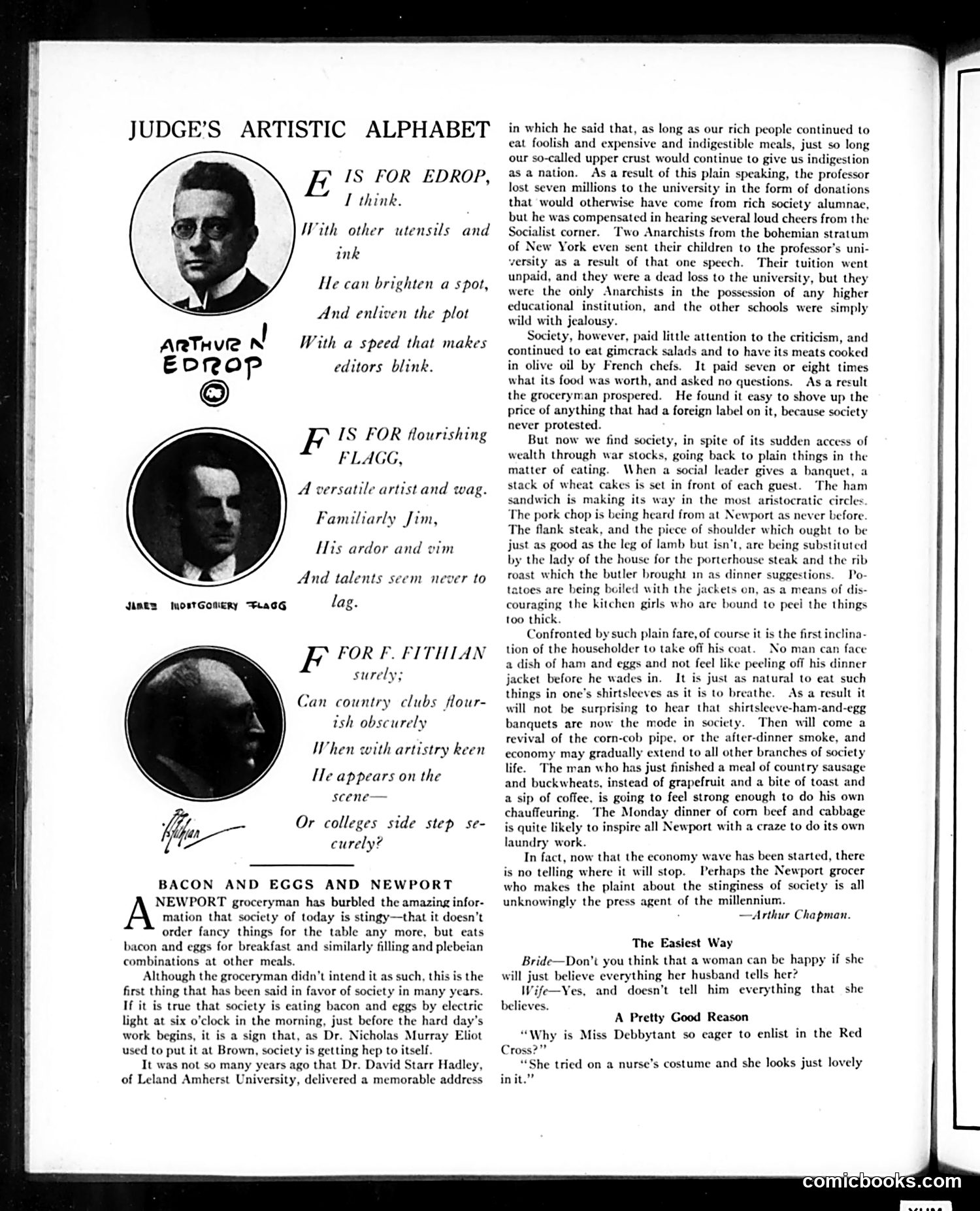
This page features caricatures of prominent illustrators and artists from Judge magazine itself, presented as an "artistic alphabet." The cartoons show **Arthur N. Edrop** and **James Montgomery Flagg** (identifiable by his signature), celebrated for their speed and skill enhancing the magazine's editorial content. The main article, "Bacon and Eggs and Newport," satirizes wealthy society's supposed economic restraint. It mocks the wealthy elite for finally eating plain, inexpensive foods (bacon, eggs, ham sandwiches) instead of fancy French cuisine—framing this as moral progress. The satire cuts both ways: praising their newfound thrift while suggesting their previous extravagance deserved criticism. The reference to a professor who lost university donations for criticizing rich donors' wasteful eating appears to be fictional hyperbole, used to highlight the conflict between morality and wealthy patronage. The tone suggests post-WWI economic anxiety and class tensions.
📄 Transcribed text from this page (OCR, searchable)
Machine-transcribed from the original scan — historical spelling and the odd misread are preserved.
JUDGE’S ARTISTIC ALPHABET ry’ IS FOR EDROP, I think. With other utensils and ink He can brighten a spot, And enliven the plot With a speed that makes editors blink. ArTrve N Eorop AMER MONTGOMERY FLacG fe — BACON AND EGGS AND NEWPORT NEWPORT groceryman has burbled the amazing infor- mation that society of today is stingy—that it doesn’t order fancy things for the table any more, but eats bacon and eggs for breakfast and similarly filling and plebeian combinations at other meals. Although the groceryman didn’t intend it as such, thi the first thing that has been said in favor of society in many years. If it is true that society is eating bacon and eggs by electric light at six o'clock in the morning, just before the hard day’s work begins, it is a sign that, as Dr. Nicholas Murray Eliot used to put it at Brown, society is getting hep to itself. It was not so many years ago that Dr. David Starr Hadley, of Leland Amherst University, delivered a memorable address pus FOR flourishing Fite G, A versatile artistand wag. Familiarly Jim, His ardor and vim And we nts seem never to FOR F. FITHL. surely; Can country clubs flour- tsh obscurely When with artistry keen Ile appears on the scene— Or colleges side step se- curely? in which he said that, as long as our rich people continued to eat foolish and expensive and indigestible meals, just so long our so-called upper crust would continue to give us indigestion as a nation. As a result of this plain speaking, the professor lost seven millions to the university in the form of donations that would otherwise have come from rich society alumnae but he was compensated in hearing several loud cheers from the Socialist corner. Two Anarchists from the bohemian stratum of New York even sent their children to the professor's uni- versity as a result of that one speech. Their tuition went unpaid, and they were a dead loss to the university, but they were the only Anarchists in the possession of any higher educational in: tion, and the other schools were simply wild with jealousy. Society, however, paid little attention to the criticism, and continued to eat gimcrack salads and to have its meats cooked in olive oil by French chefs. It paid seven or eight times what its food was worth, and asked no questions. As a result the groceryman prospered. He found it easy to shove up the price of anything that had a foreign label on it, because society never protested. But now we find society, in spite of its sudden access of wealth through war stocks, going back to plain things in the matter of cating. When a social leader gives a banquet, a stack of wheat cakes is set in front of each guest. The ham sandwich is making its way in the most aristocratic circles The pork chop is being heard from at Newport as never before. The flank steak, and the piece of shoulder which ought to be just as good as the leg of lamb but isn’t, are being substituted by the lady of the house for the porterhouse steak and the rib roast which the butler brought 1n as dinner suggestions. Po- tatoes are being boiled with the jackets on, as a means of dis- couraging the kitchen girls who are bound to peel the things too thick Confronted by such plain fare, of course it is the first inclina- tion of the householder to take off his c No man can face a dish of ham and eggs and not feel like peeling off his dinner jacket before he wades in. It is just as natural to eat such things in one’ irtsleeves as i to breathe. As a result it will not be surprising to hear that shirtsleeve-ham-and-egg banquets are now the mode in society. Then will come a revival of the corn-cob pipe, or the after-dinner smoke, and economy may gradually extend to all other branches of society life. The man who has just finished a meal of country sausage and buckwheats, instead of grapefruit and a bite of toast and a sip of coffee, is going to feel strong enough to do his own chauffeuring. The Monday dinner of corn beef and cabbage is quite likely to inspire all Newport with a craze to do its own laundry work. In fact, now that the economy wave has been started, there is no telling where it will stop. Perhaps the Newport grocer who makes the plaint about the stinginess of society is all unknowingly the press agent of the millennium. —Arthur Chapman. The Easiest Way Bride—Don’t you think that a woman can be happy if she will just believe everything her husband tells her? Wife—Yes, and doesn’t tell him everything that she believes. A Pretty Good Reason “Why is Miss Debbytant so eager to enlist in the Red Cross?” “She tried on a nurse’s costume and she looks just lovely init.”