
Judge, 1917-06-02 · page 14 of 28
Judge — June 2, 1917 — page 14: what you’re looking at
What you’re looking at
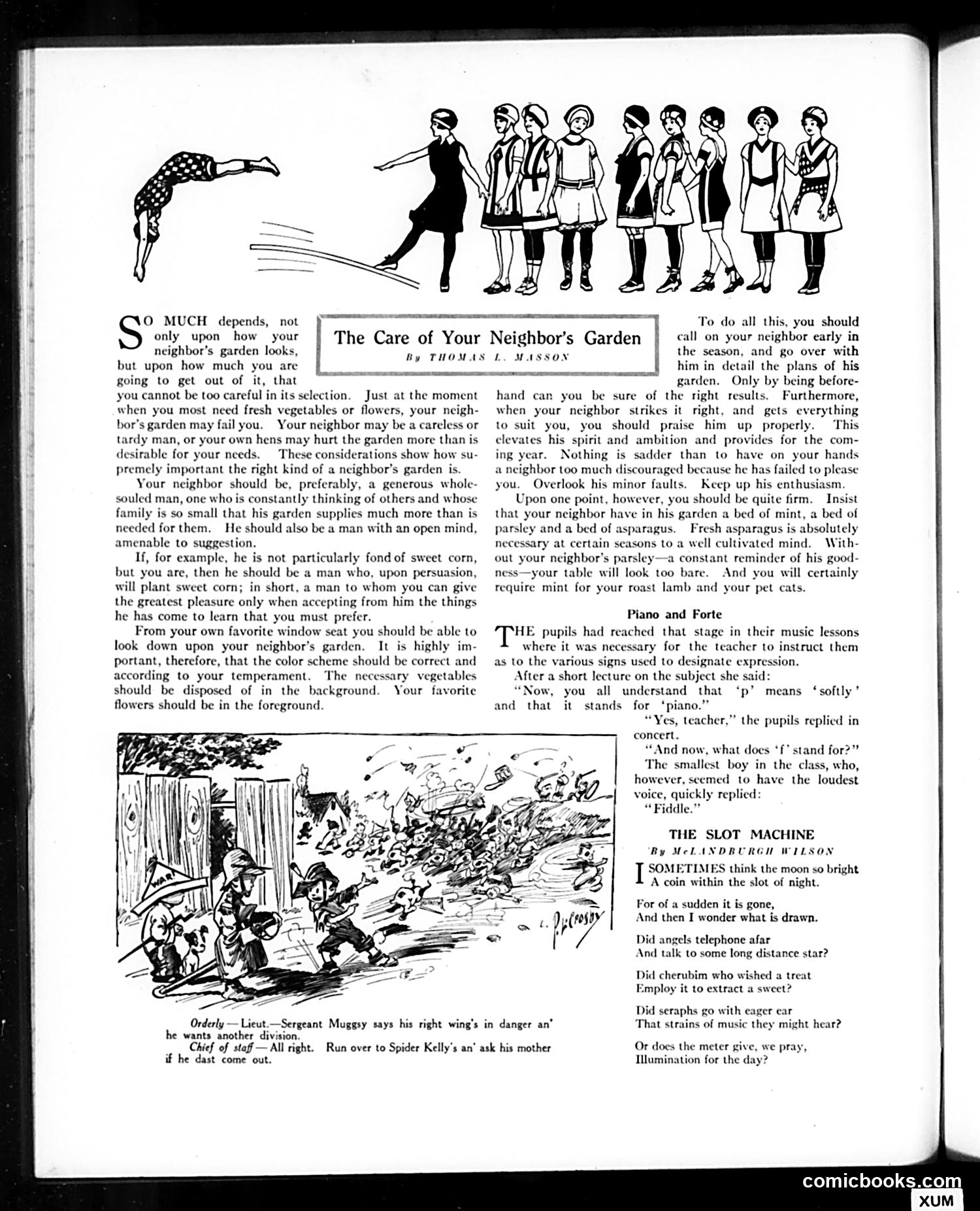
This article satirizes suburban social climbing and manipulative neighborliness. The author pretends to offer advice on selecting a neighbor based on garden productivity, but the satire is obvious: you should choose your neighbor *entirely* based on whether his garden benefits you. The piece mocks the self-centered entitlement of the writer, who expects neighbors to plant specific vegetables according to his preferences, maintain aesthetics from his favorite window seat, and constantly seek his approval. The humor lies in the brazen admission that neighborly relations are purely transactional—you praise your neighbor's efforts only to manipulate his "spirit and ambition." The accompanying cartoon (showing children and a military scene) appears unrelated to this article. The page also includes two brief humor pieces: "Piano and Forte" (a child misidentifies the musical notation "f" as "fiddle"), and "The Slot Machine," a whimsical poem about the moon.
📄 Transcribed text from this page (OCR, searchable)
Machine-transcribed from the original scan — historical spelling and the odd misread are preserved.
O MUCH depends, not only upon how your neighbor's garden looks, but upon how much you are going to get out of it, that you cannot be too careful in its selection. Just at the moment when you most need fresh vegetables or flowers, your neigh- bor’s garden may fail you. Your neighbor may be a careless or tardy man, or your own hens may hurt the garden more than is desirable for your needs. These considerations show how su- premely important the right kind of a neighbor’s garden is. Your neighbor should be, preferably, a generous whole- souled man, one who is constantly thinking of others and whose family is so small that his garden supplies much more than is needed for them. He should also be a man with an open mind, amenable to suggestion. If, for example, he is not particularly fond of sweet corn, but you are, then he should be a man who, upon persuasion, will plant sweet corn; in short, a man to whom you can give the greatest pleasure only when accepting from him the things he has come to learn that you must prefer. From your own favorite window seat you should be able to look down upon your neighbor’s garden. It is highly im- portant, therefore, that the color scheme should be correct and according to your temperament. The necessary vegetables should be disposed of in the background. Your favorite flowers should be in the foreground. Orderly — Lieut.—Sergeant Muggsy says his right wing's in danger an’ he wants another division. Chief of staff — All right. Run over to Spider Kelly's an’ ask his mother if he dast come out. The Care of Your Neighbor’s Garden By THOMAS To do all this, you should call on your neighbor early in the season, and go over with him in detail the plans of his garden. Only by being before- hand can you be sure of the right results. Furthermore, when your neighbor strikes it right, and gets everything to suit you, you should praise him up properly. This elevates his spirit and ambition and provides for the com- Nothing sadder than to have on your hands a neighbor too much discouraged because he has failed to please you. Overlook his minor faults. Keep up his enthusiasm Upon one point, however, you should be quite firm. Insist that your neighbor have in his garden a bed of mint, a bed of bed of asparagus. ‘sh asparagus is absolutely certain seasons to a well cultivated mind. With- out your neighbor’s parsley—a constant reminder of his good- ness—your table will look too bare. And you will certainly require mint for your roast lamb and your pet cats. L. MASSON Piano and Forte THE pupils had reached that stage in their music lessons where it was necessary for the teacher to instruct them as to the various signs used to designate expression. After a short lecture on the subject she said: “Now, you all understand that ‘p’ means ‘softly’ and that it stands for ‘piano. “Yes, teacher,” the pupils replied in concert. “And now, what does ‘f* stand for?” The smallest boy in the class, who, how ‘emed to have the loudest voice, quickly replied: “ Fiddle.” THE SLOT MACHINE By MeLANDBURGH WILSON SOMETIMES think the moon so bright A coin within the slot of night. For of a sudden it is gone, And then I wonder what is drawn. Did angels telephone afar And talk to some long distance star? Did cherubim who wished a treat Employ it to extract a sweet? Did seraphs go with eager That strains of music they might hear? Or does the meter give, we pray, Illumination for the day? comicbooks.com XUM