
A complete issue · 28 pages · 1917
Judge — April 7, 1917
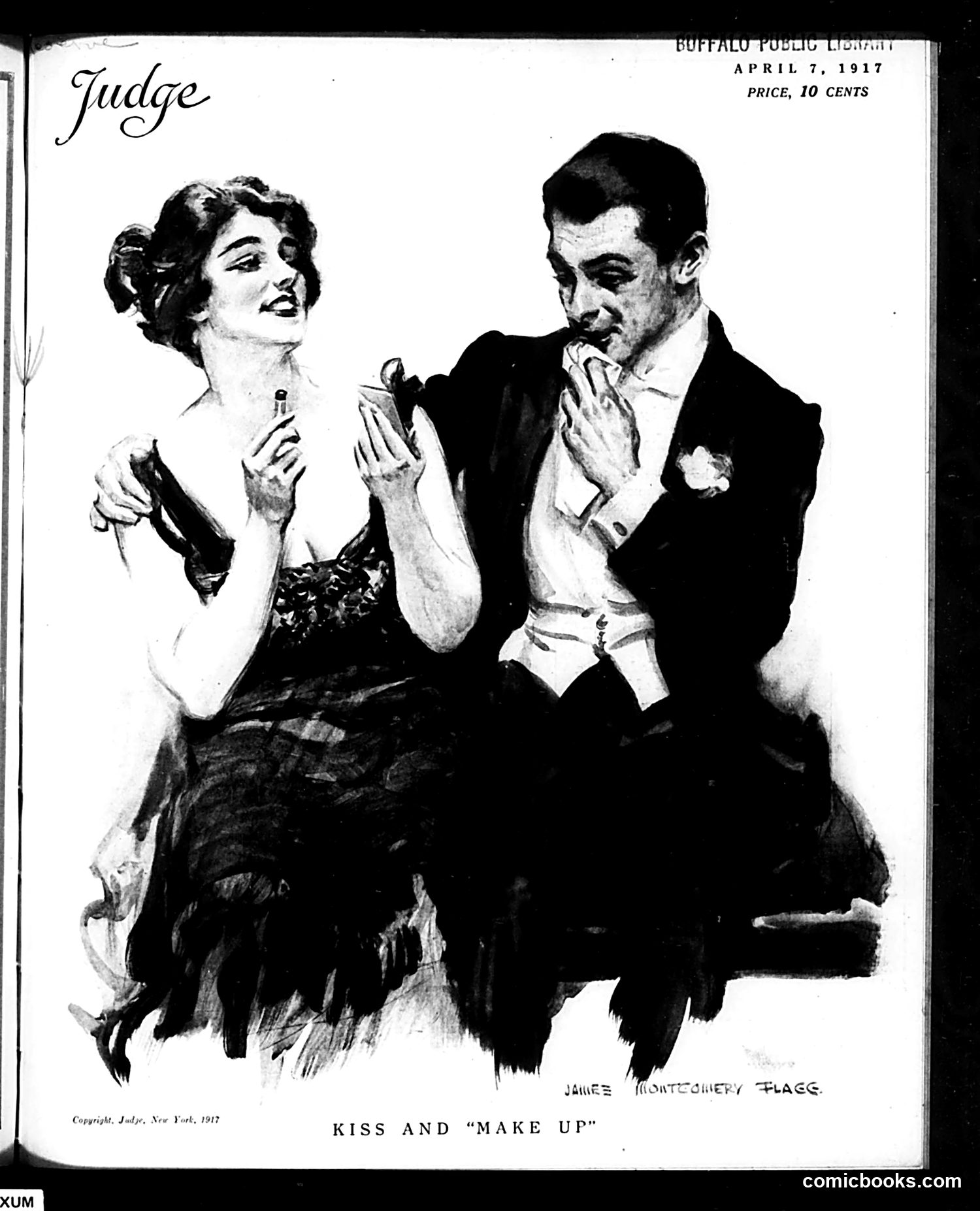
This Judge magazine cover from April 7, 1917 presents a satirical cartoon by James Montgomery Flagg depicting a couple engaged in reconciliation after a quarrel. The woman holds a bottle (likely cosmetics or perfume) while the man appears to be applying makeup or powder to his face—a reversal of typical gender roles that was meant to be humorous to 1917 audiences. The joke plays on the phrase "make up," which means both cosmetic application and reconciliation after an argument. By showing the man applying makeup, the cartoon mocks masculine vanity or suggests he's being feminized through the reconciliation process. This reflects early 20th-century attitudes about gender and appearance, using physical comedy to illustrate domestic dynamics.
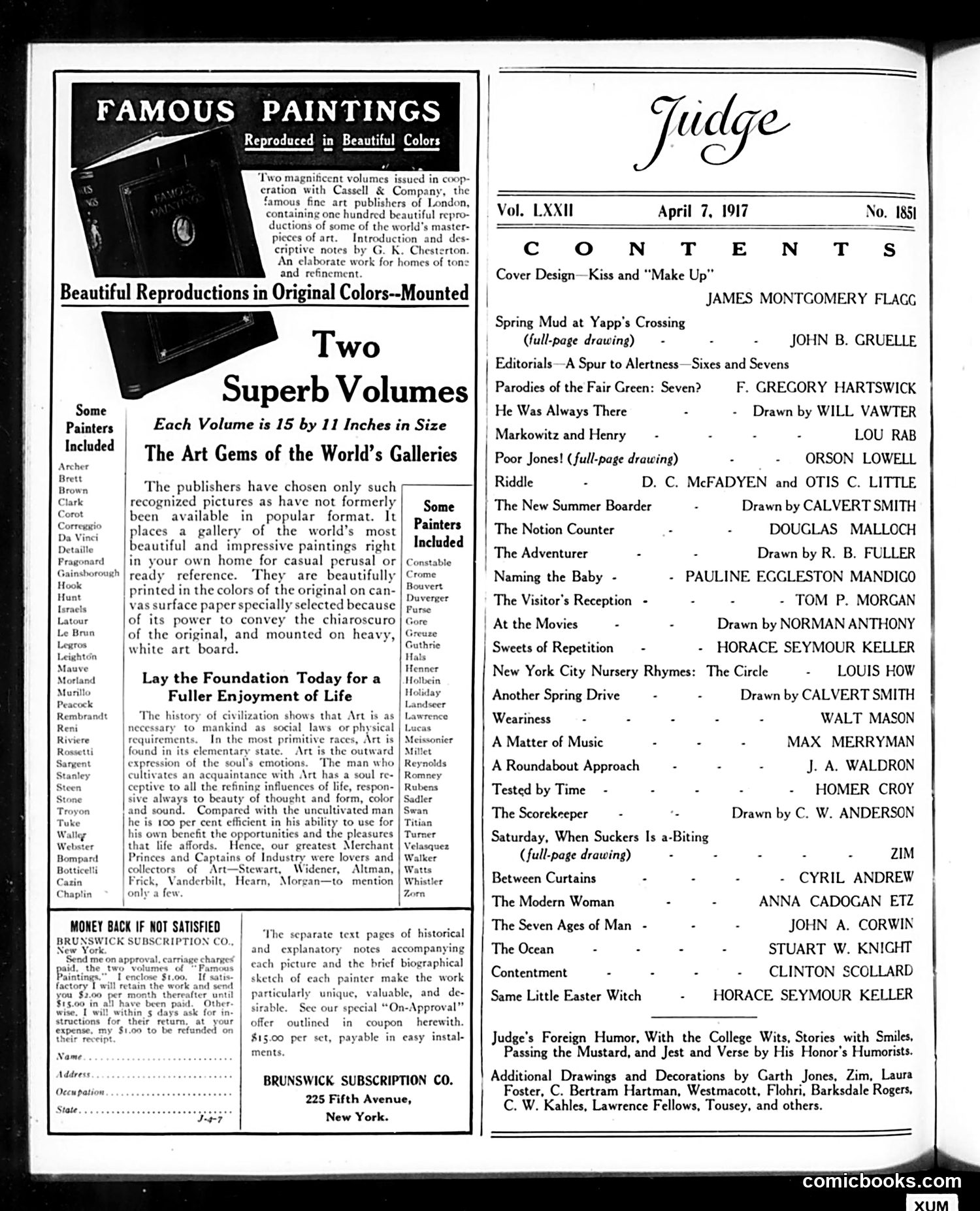
This is primarily a **contents/masthead page** rather than a cartoon page. It lists Judge's editorial features and illustrations for this issue, published during America's entry into World War I (April 1917). The page advertises the magazine's mix of humor, social commentary, and art reproductions. Notable content includes pieces on contemporary subjects like "The New Summer Boarder" and "New York City Nursery Rhymes." The left side promotes expensive art reproduction volumes (featuring painters like Da Vinci and Rembrandt), marketed to affluent readers as home decoration. This reflects Judge's target audience: educated, upper-class Americans interested in satirical commentary and fine art. The page itself contains no visible political cartoons—it functions as an index to the issue's contents.
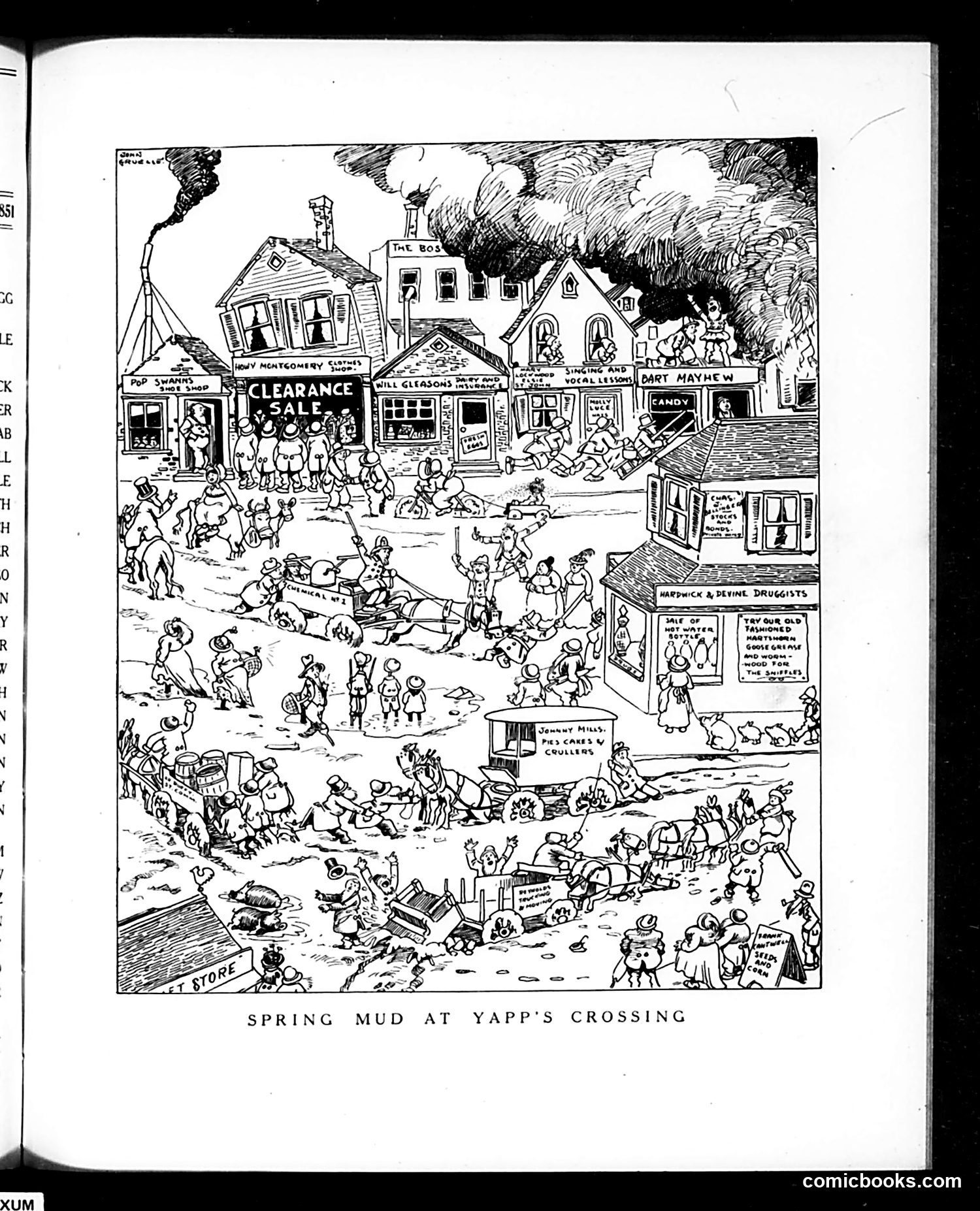
This satirical cartoon depicts a chaotic rural scene during spring thaw, when muddy roads became nearly impassable. The illustration shows a crowded crossroads settlement with shops (including a "Clearance Sale" and "Candy" store), where townspeople and their vehicles are mired in deep mud. Children play while adults struggle with carts and wagons stuck in the muck. The satire targets the universal American problem of seasonal road conditions—before modern infrastructure, spring mud made travel and commerce extremely difficult. "Yapp's Crossing" appears to be a fictional small-town location used to represent rural America generally. The cartoon humorously exaggerates the scene's chaos to mock the ongoing infrastructure challenges faced by rural communities and the messy reality of frontier or semi-developed areas.
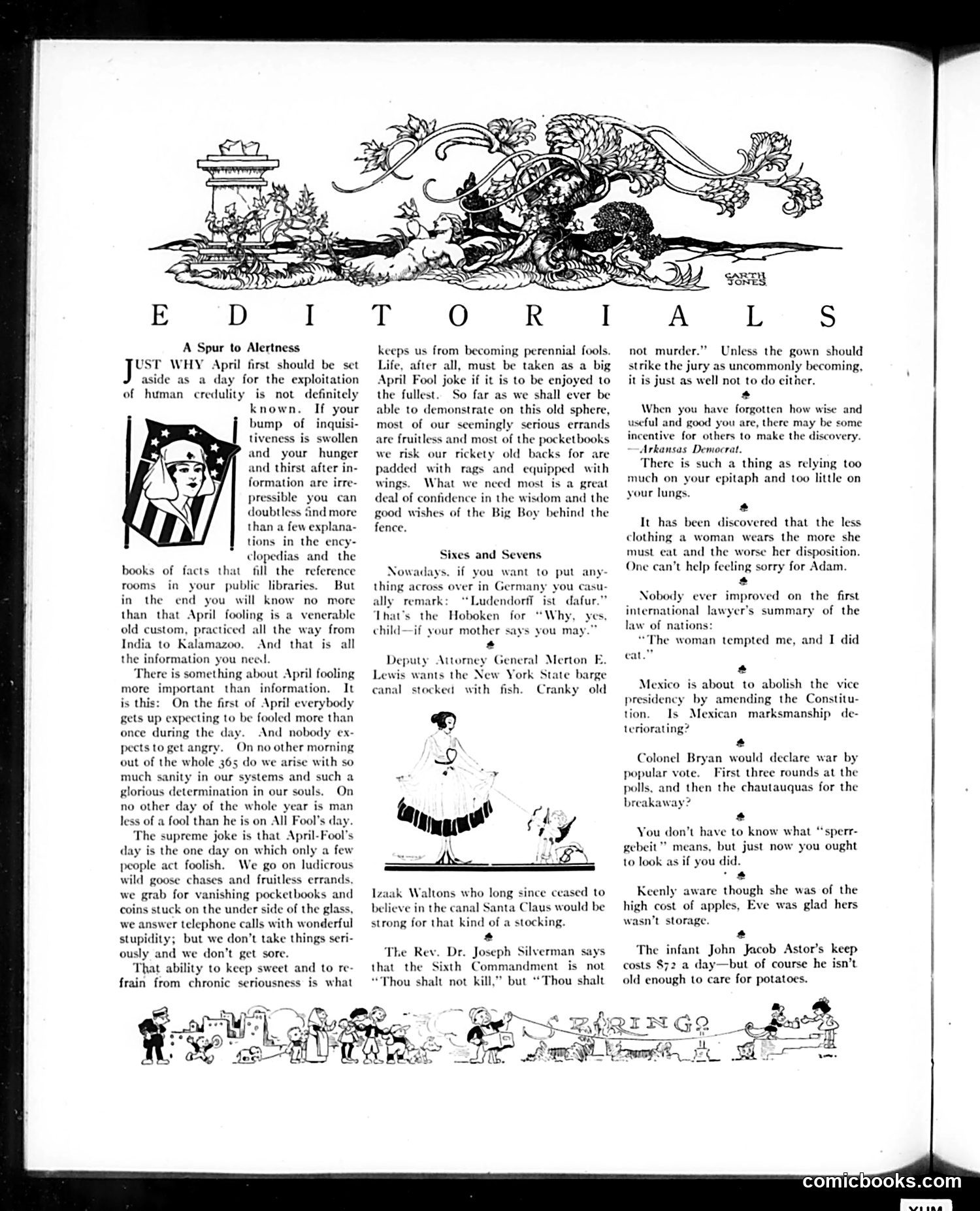
This "Editorials" page contains political humor and social commentary typical of early 20th-century satire. The main cartoon at top depicts a chaotic scene with classical figures—likely representing Wisdom, Justice, or similar allegorical concepts—in disarray, suggesting societal disorder or governmental chaos. The text pieces mock various contemporary targets: April Fools' Day foolishness, German customs ("Lüdendorff ist dafür"), Deputy Attorney General Merton E. Lewis's proposed fish regulations, Colonel Bryan's political ambitions, and Constitutional debates regarding Mexico's presidency. A prominent joke mocks women's fashion and eating habits. References to "spergebeil" (appears to be German slang) and biblical allusions ("Eve," "Adam") employ humor to critique contemporary society and politics. The page primarily satirizes governmental incompetence, political figures, and social pretensions rather than advertising.
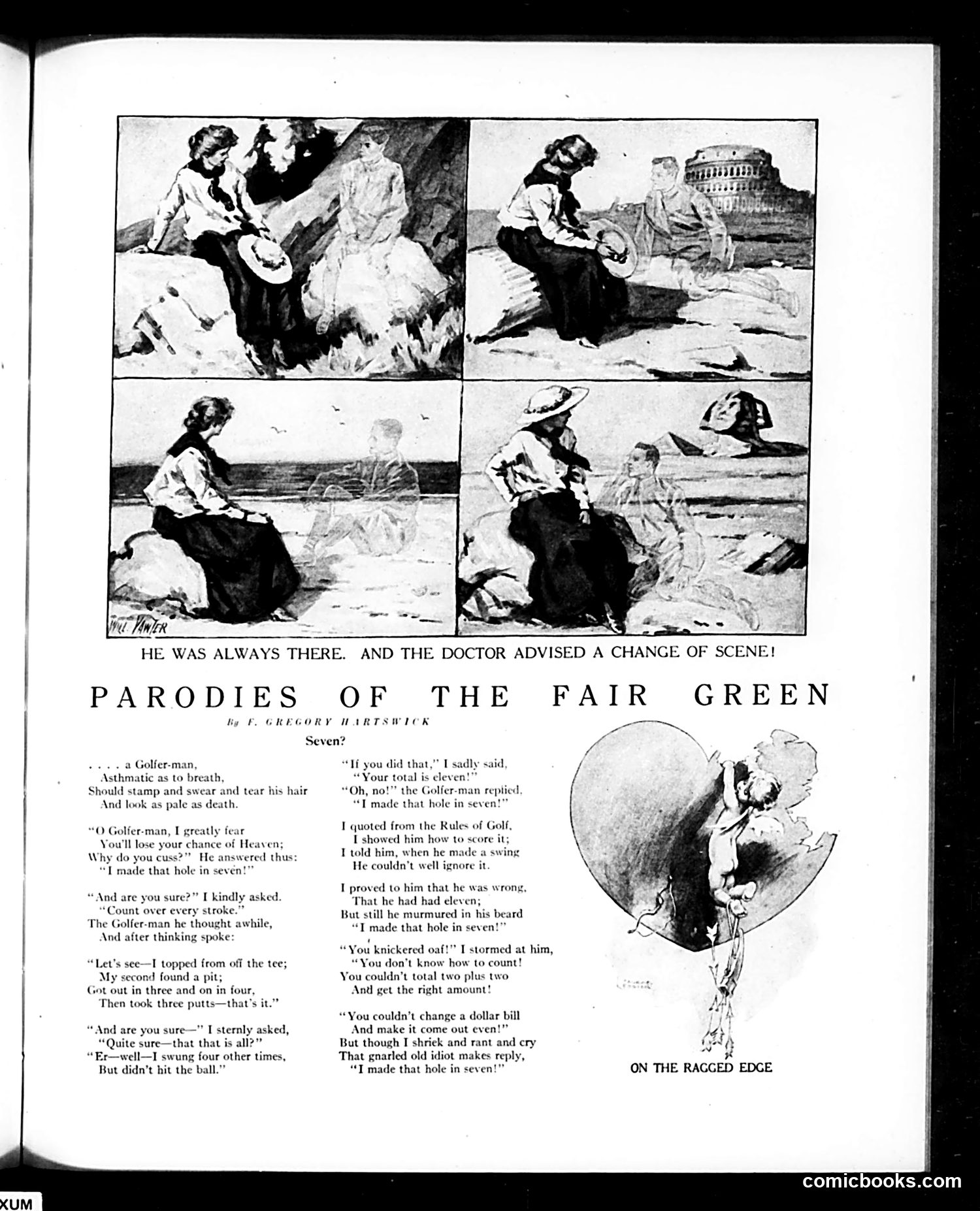
This page from *Judge* magazine contains humorous poetry mocking golf etiquette and a golfer's excuses. The four illustrated panels at top show a woman persistently appearing alongside a golfer in various scenic locations, captioned "HE WAS ALWAYS THERE. AND THE DOCTOR ADVISED A CHANGE OF SCENE!"—suggesting the golfer cannot escape an unwanted female companion despite traveling. The main poem "Seven?" satirizes a golfer making absurd excuses for poor play, repeatedly claiming "I made that hole in seven!" The accompanying illustration "ON THE RAGGED EDGE" shows a frustrated golfer. The satire targets golf culture's obsession with scores and players' tendency to fabricate explanations for bad performance, poking fun at the sport's pretentiousness and dishonesty among enthusiasts.
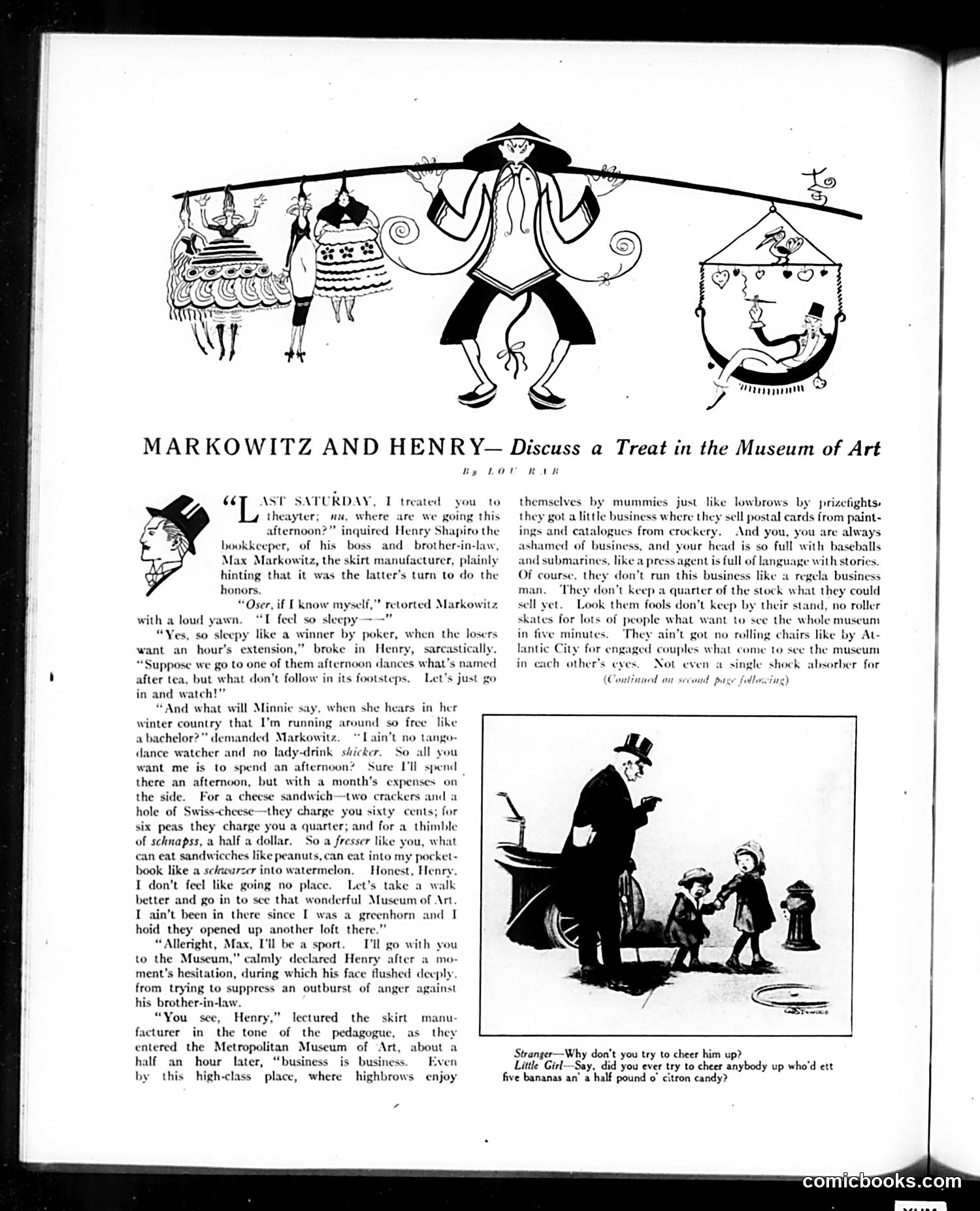
This satirical piece depicts a conversation between **Max Markowitz** (a skirt manufacturer) and **Henry Shapiro** about visiting the Metropolitan Museum of Art. The humor centers on class contrast and materialistic attitudes. Markowitz complains the museum is expensive and boring, preferring to spend money on food. Henry responds with mock-refined criticism, lecturing about the museum's business model and high costs—the satire suggesting wealthy businessmen view cultural institutions primarily through a commercial lens rather than artistic appreciation. The cartoon critiques early 20th-century American nouveaux riches who treat prestigious institutions as status symbols while remaining fundamentally indifferent to genuine art. The bottom illustration appears unrelated, showing a street scene with children and an adult.
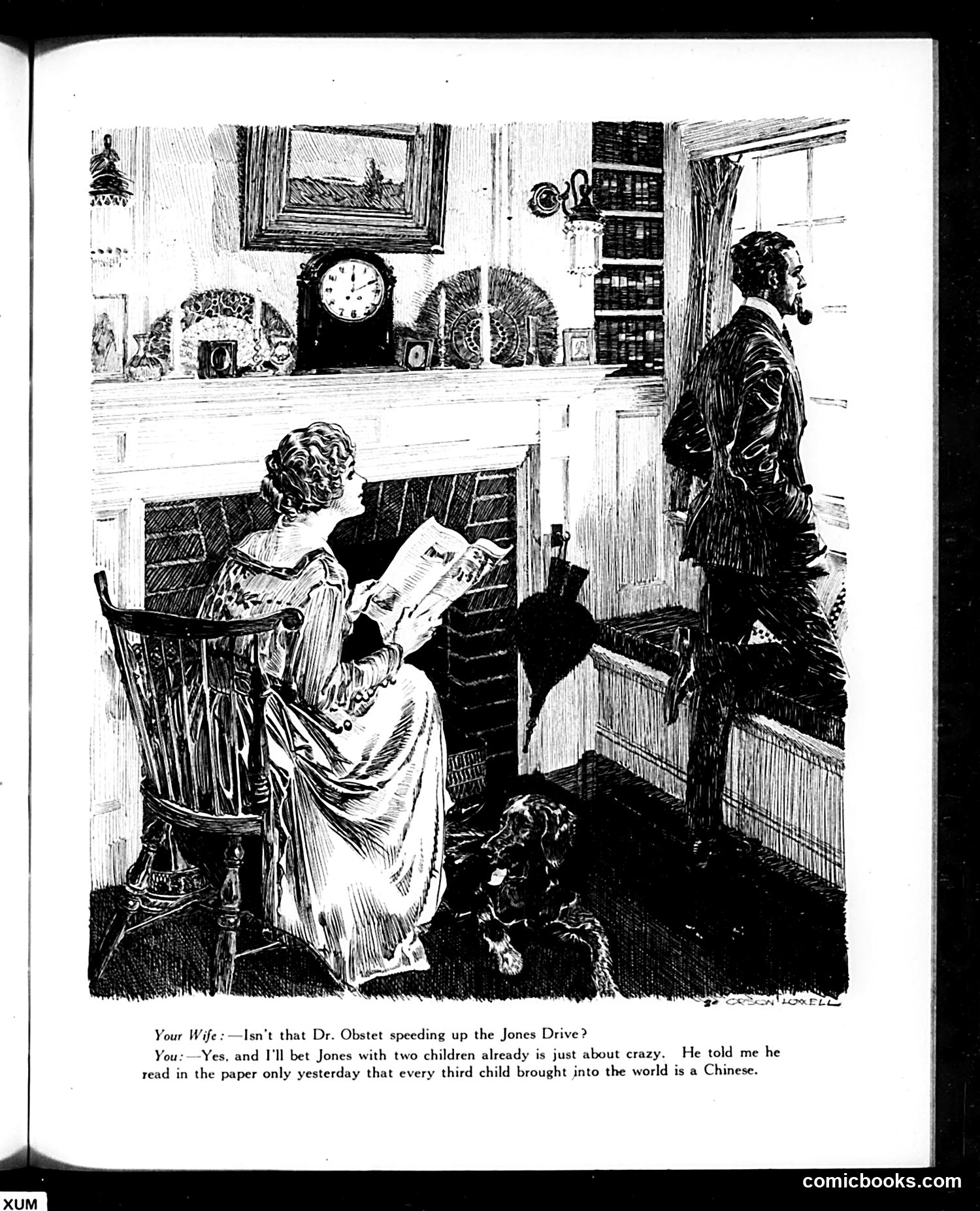
This satirical cartoon from *Judge* magazine mocks xenophobic anxiety about Chinese immigration and birth rates. The dialogue references a (likely fabricated or misinterpreted) newspaper claim that "every third child born is Chinese"—reflecting widespread early 20th-century fears about demographic change and Asian population growth. The husband's comment about Dr. Obstet (an obstetrician) visiting the Jones family implies Jones is anxious about having another child, fearing it might be Chinese due to this supposed statistical trend. The satire targets both the absurdity of this irrational fear and the racism underlying it. The cartoon ridicules how pseudoscientific claims could fuel immigration panic among ordinary Americans during a period of significant anti-Chinese sentiment and restrictive immigration policies.
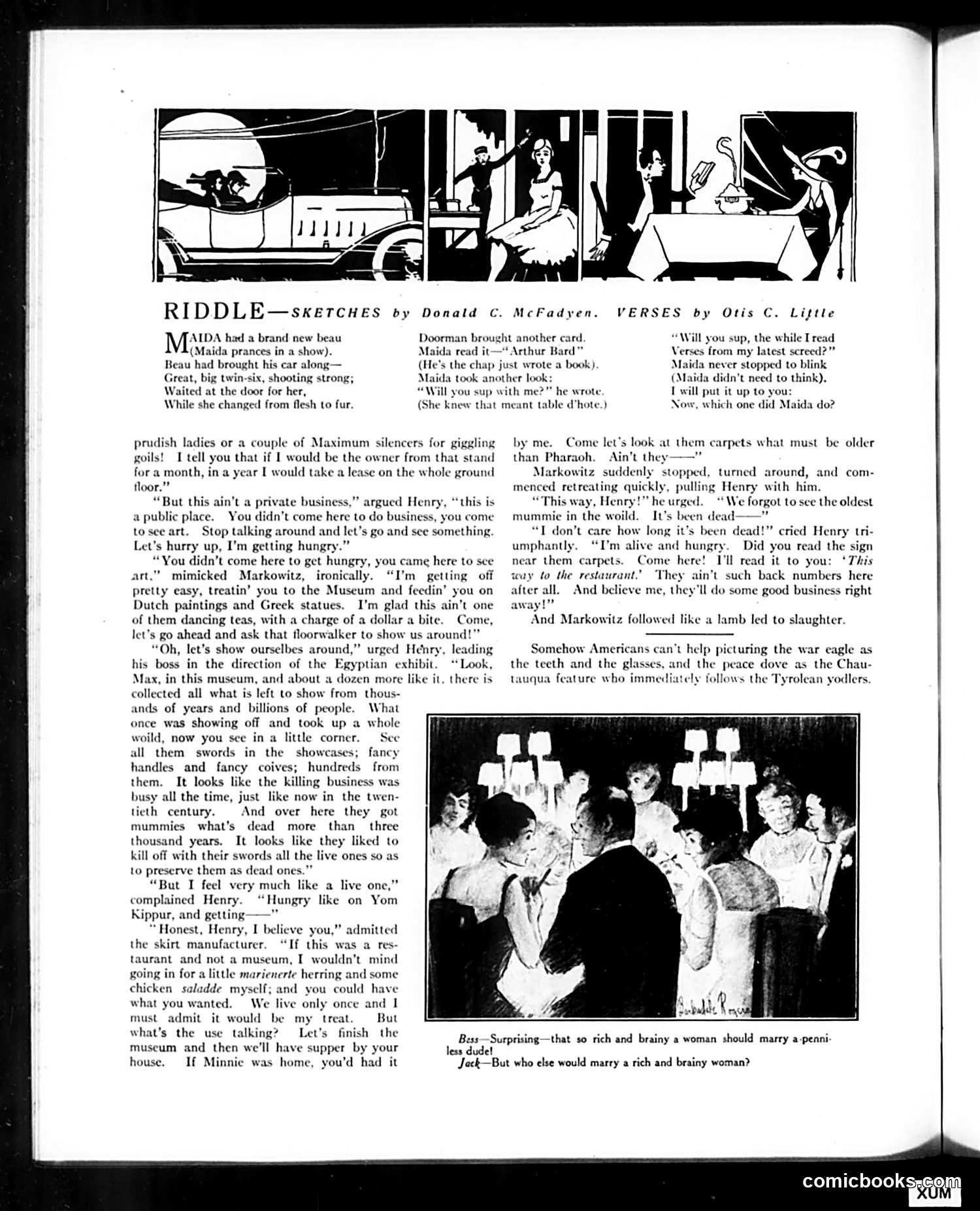
This is a two-part comic story. The top section shows a "riddle" about a woman named Maida choosing between two suitors—one offering to read her poetry at dinner, the other offering to take her to dinner. The joke's punchline (asking which option Maida chose) appears designed for reader participation. The longer narrative below depicts two characters—Henry (an employee) and Max Markowitz (a "skirt manufacturer"/businessman)—touring a museum. Henry makes cynical observations about ancient weapons and mummies, comparing historical violence to contemporary warfare. When Henry grows hungry, he and Markowitz spot a restaurant sign near the Egyptian exhibit. The satire mocks both pretentious museum culture and the gap between "high art" appreciation and basic human needs—Markowitz, despite his refined interests, follows Henry "like a lamb to slaughter" toward food. The final snippet jokes about Americans' stereotypical imagery of peace and war.
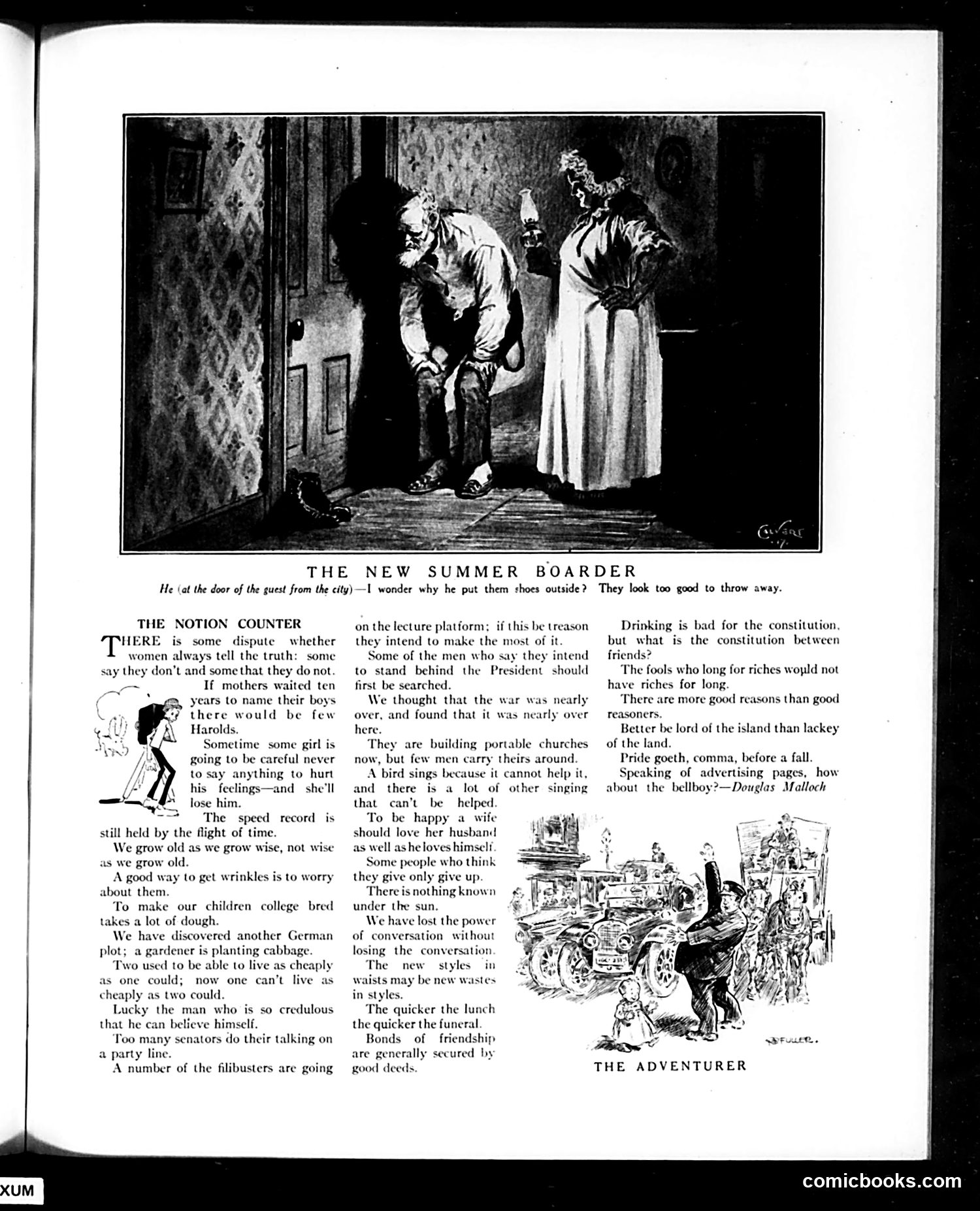
**"The New Summer Boarder"** (top cartoon): A rural homeowner is puzzled why a city guest left expensive shoes outside his door. The joke satirizes class differences and rural assumptions—the countryman thinks such fine shoes should be discarded, revealing both his lower economic status and the cultural gap between city visitors and rural hosts during the summer boarding season. **"The Notion Counter"** (left column): A collection of aphorisms and social commentary. Notable references include: jabs at WWI-era politicians ("men who intend to stand behind the President should first be searched"), mockery of lengthy Senate filibusters, and German-Americans planting gardens (likely a wartime xenophobic joke). The humor ranges from observations on gender, relationships, and aging to cynical takes on wealth and politics. **"The Adventurer"** (right): An illustration accompanying humorous commentary about luxury automobiles and leisure activities, contrasting with the page's other satirical content. The overall tone reflects post-WWI American satirical humor targeting politics, social pretension, and changing social norms.
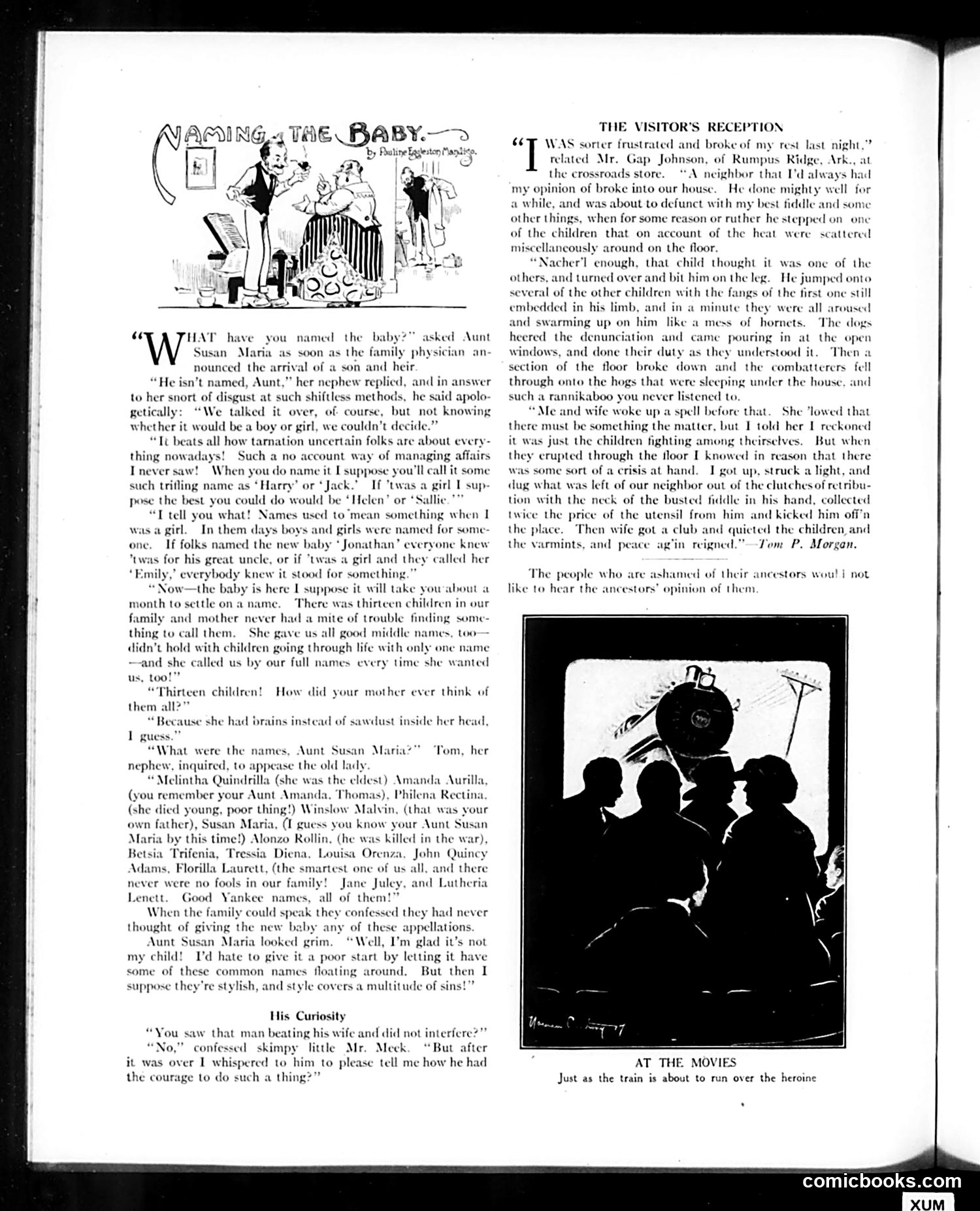
This page contains two satirical pieces typical of early-20th-century American humor: **"Naming the Baby"** mocks modern parental indecision through Aunt Susan Maria, who represents old-fashioned values. She nostalgically recalls her mother naming thirteen children with elaborate, formal names (Melintha Quindrilla, Alonzo Rollin, etc.—clearly meant to sound absurdly pretentious). The satire cuts both ways: it ridicules both the younger generation's inability to decide on names and the previous generation's overwrought naming conventions. The joke suggests that stylish modern parents choose "common names" despite claiming these supposedly reflect good character. **"His Curiosity"** is a brief joke about Mr. Meek, a henpecked man so timid that after witnessing domestic violence, his only concern is learning how the aggressor found courage—reinforcing the era's stock character of the emasculated husband. **"The Visitor's Reception"** (partially visible) describes a humorous frontier anecdote about a burglar encountering chaos in a crowded Arkansas household. These pieces reflect period attitudes about gender roles, regional stereotypes, and family life typical of Judge's satirical approach.
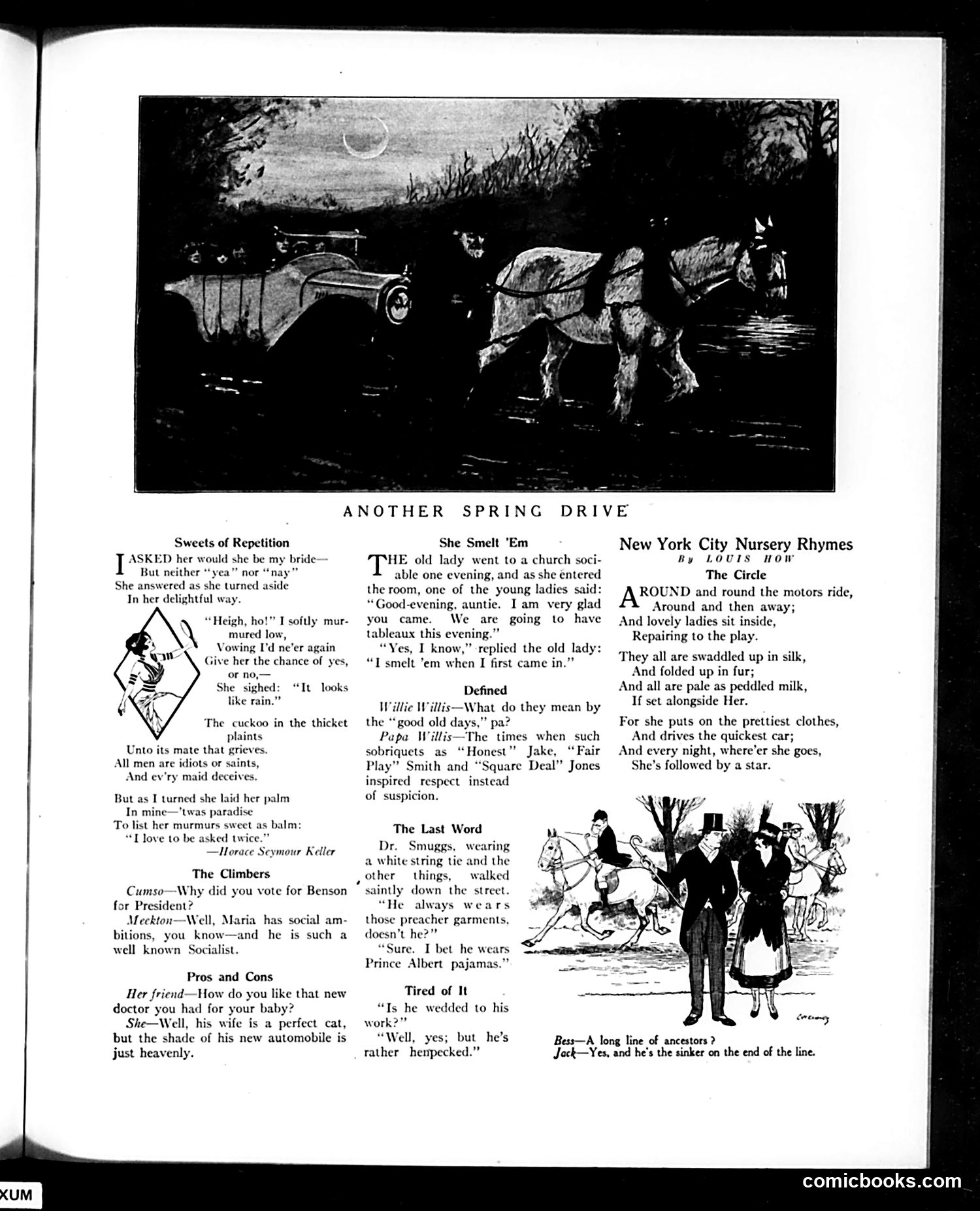
This page contains multiple short satirical pieces typical of early 20th-century humor magazines: **"Sweets of Repetition"** mocks romantic courtship—a man proposes repeatedly to an indifferent woman who responds with non-answers and weather observations, yet manipulates him by asking to be "asked twice." **"The Climbers"** satirizes social climbing: a voter supports a presidential candidate (Benson—unclear which one) solely because the candidate's wife, Maria, has "social ambitions." **"Pros and Cons"** ridicules shallow priorities: a woman dismisses her baby's doctor's difficult wife but praises his automobile's color. **Other brief jokes** mock pretension (a doctor wearing clerical garments), outdated morality ("good old days" when nicknames like "Honest Jake" meant something), and henpecked husbands. **"New York City Nursery Rhymes"** satirizes automobile culture and class distinctions—wealthy women in fancy cars versus "She," who surpasses them through mysterious appeal (followed "by a star"). The page reflects early automotive-age anxieties and gender/class satire typical of the era.
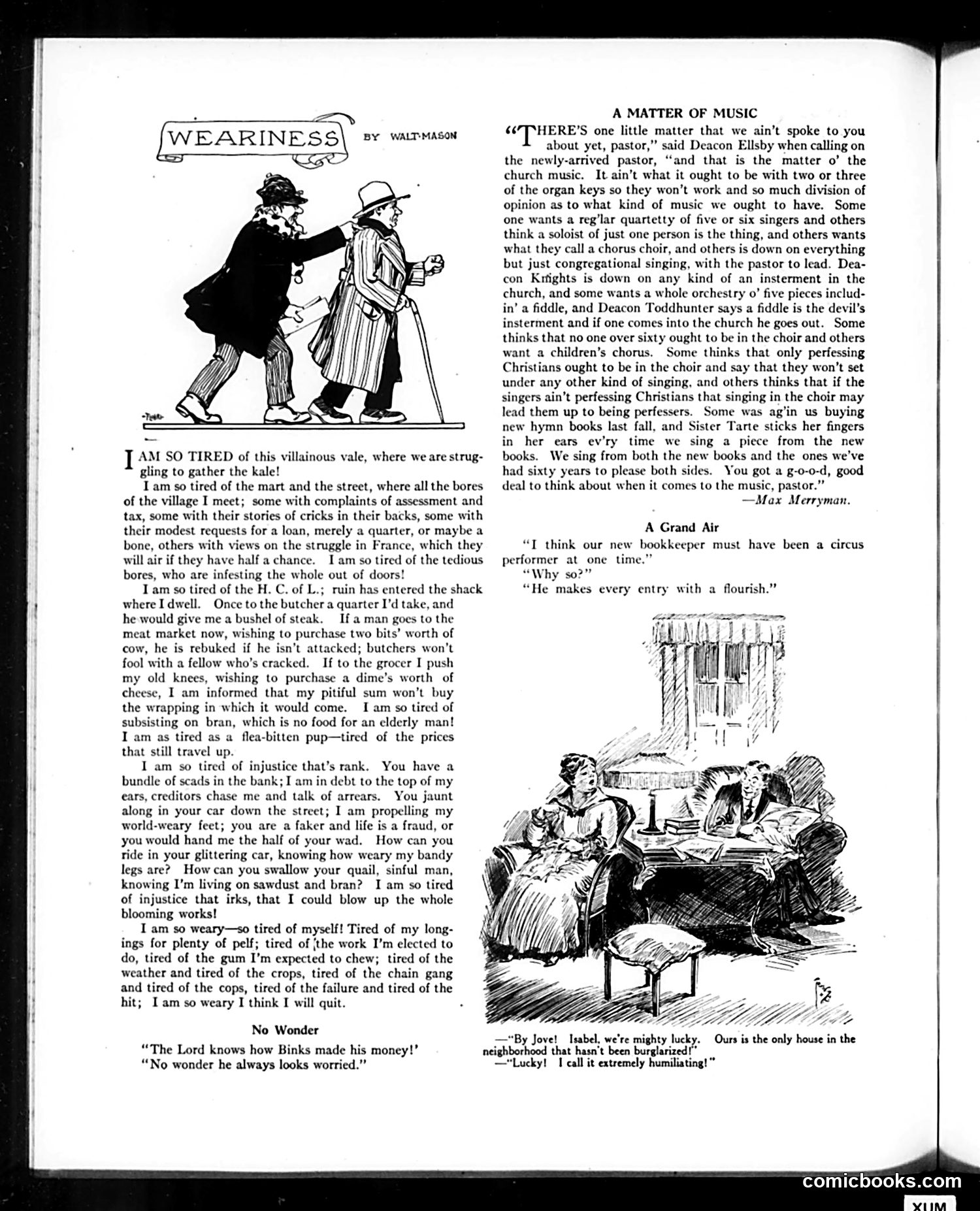
This page contains two satirical pieces typical of early 20th-century American humor: **"Weariness"** (left): A monologue by an exhausted working-class figure complaining about post-WWI hardships—specifically the "H.C. of L." (High Cost of Living). He contrasts his poverty with wealthy neighbors' luxuries, expressing frustration at inflation, debt, and social injustice. The satire targets economic inequality and the speaker's own resigned despair. **"A Matter of Music"** (right): Rural church members debate music practices with their new pastor. The humor lies in the petty sectarian divisions—disagreements over organs, soloists, choirs, instrumental music, and congregational singing. References like "Deacon Knights" opposing instruments and "Deacon Toddhunter" calling fiddles "the devil's instrument" mock fundamentalist rigidity and the absurd internal conflicts plaguing small-town churches. Both pieces use vernacular speech to satirize American social anxieties: economic hardship and religious parochialism.
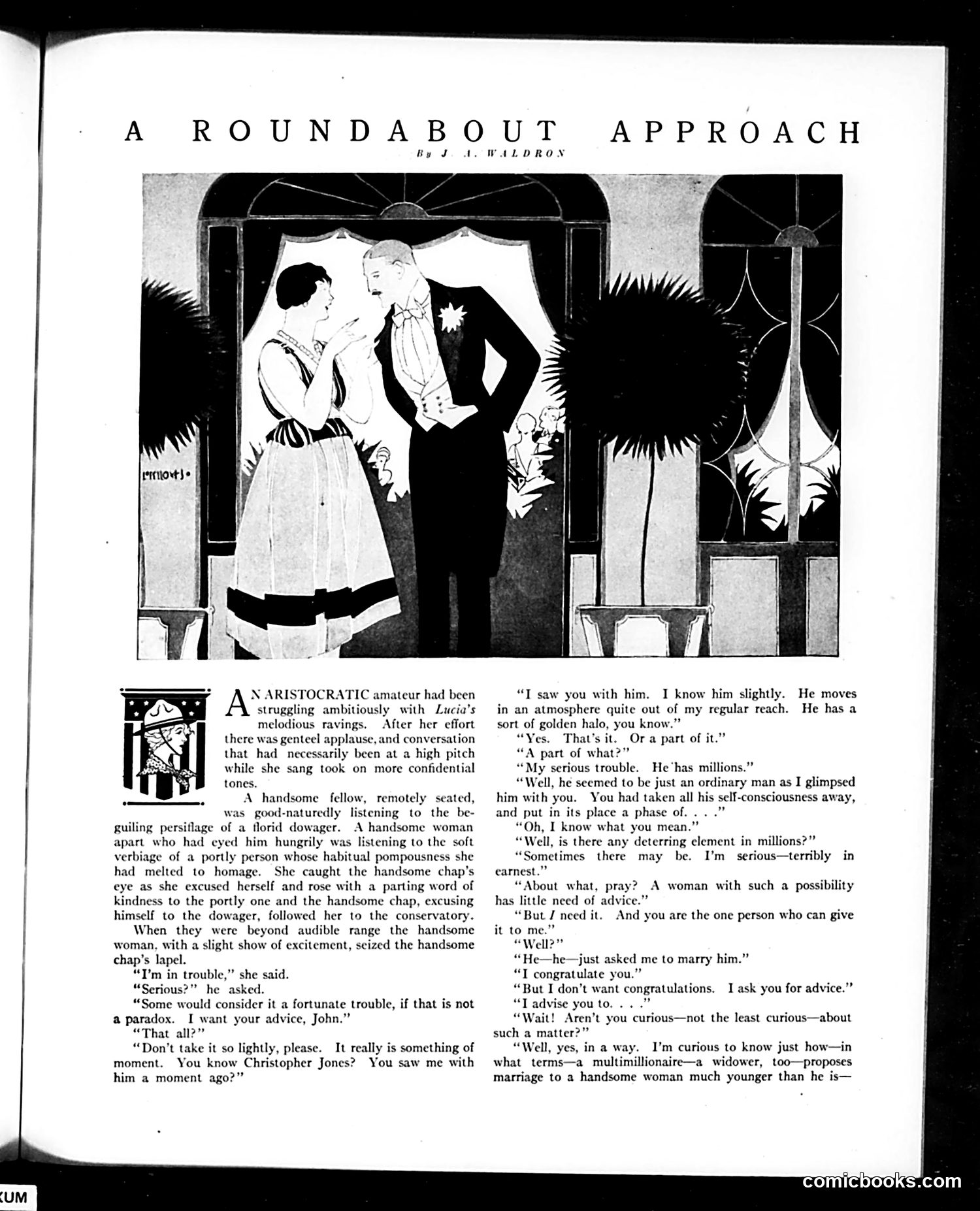
This is a romantic short story rather than political satire. The narrative depicts a scene from a high-society musical event where a handsome woman pulls aside a male acquaintance ("John") to seek romantic advice. The plot: She's been proposed to by Christopher Jones, a wealthy widower and multimillionaire who moves in exclusive social circles. She's conflicted—not because he lacks money or status, but because she needs counsel on the relationship itself. The satire targets **aristocratic pretension and social climbing**: The woman is excited by Jones's wealth (his "golden halo") yet wants to appear above mercenary considerations. John's skepticism—suggesting she needs no advice when marrying a rich man—highlights the transparency of her dilemma. The piece mocks how upper-class society navigates marriage, where wealth and status supposedly solve all problems, yet genuine emotional questions persist. The irony is that she seeks advice precisely *because* he's wealthy and powerful, undermining any claim this decision isn't materially motivated.
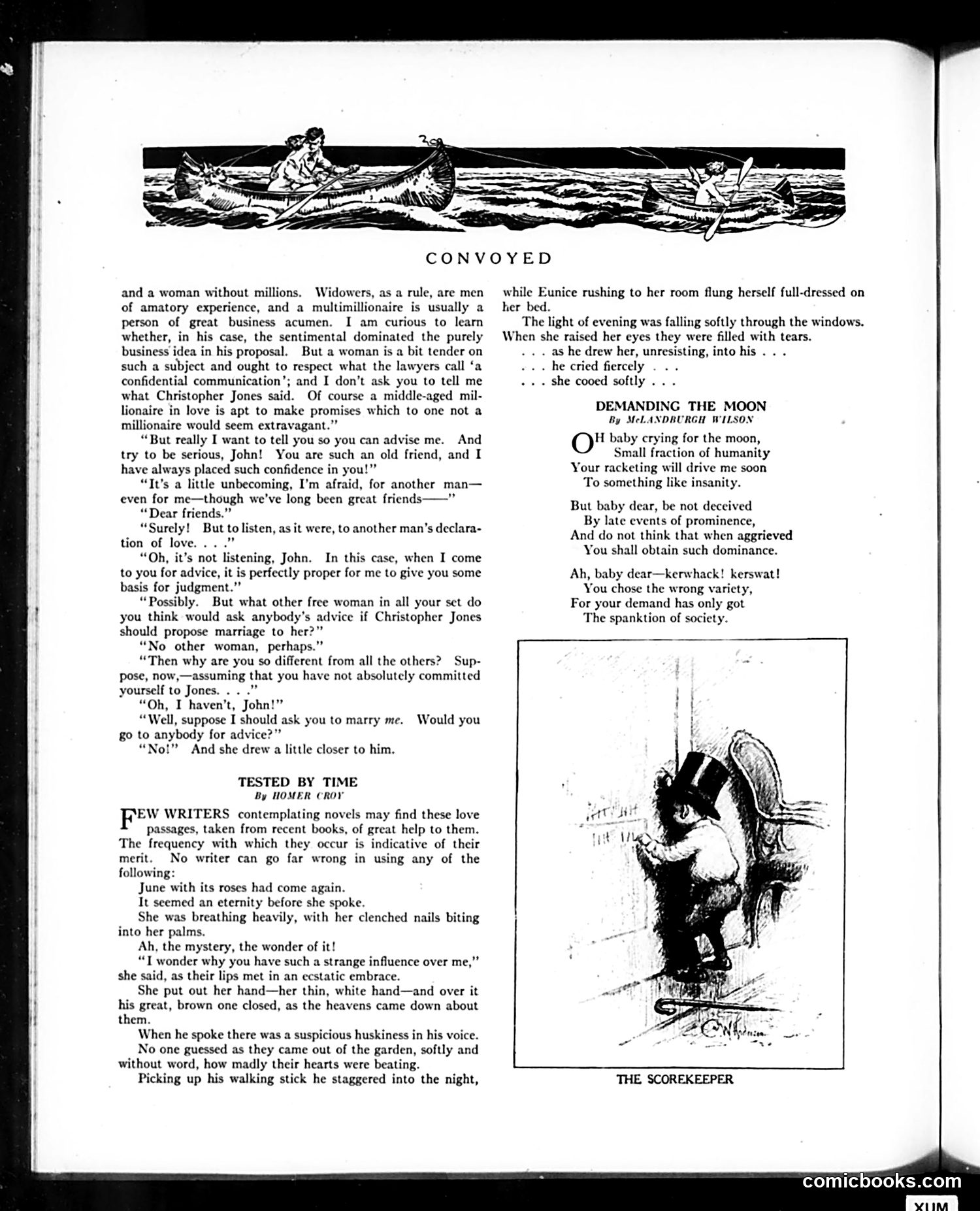
This page satirizes **clichéd romance writing**. The main text "Tested by Time" by Homer Croy mocks overworn literary devices in contemporary novels—repeated phrases like "June with its roses had come again," "ecstatic embrace," and "clenched nails biting into her palms." Croy argues that frequent use of such passages indicates poor merit, not quality. The prose excerpts above illustrate this criticism: they're melodramatic, purple, and formulaic depictions of romantic encounters and emotional responses. The poem "Demanding the Moon" (by McLandburgh Wilson) takes a different satirical angle, addressing someone (implied to be a woman or child) who makes unreasonable demands—"You chose the wrong variety, / For your demand has only got / The spanktion of society" (likely "spanking"). The illustration "The Scorekeeper" remains unclear without additional context. Together, these pieces mock both overwrought romantic literature and, possibly, unrealistic expectations in courtship.
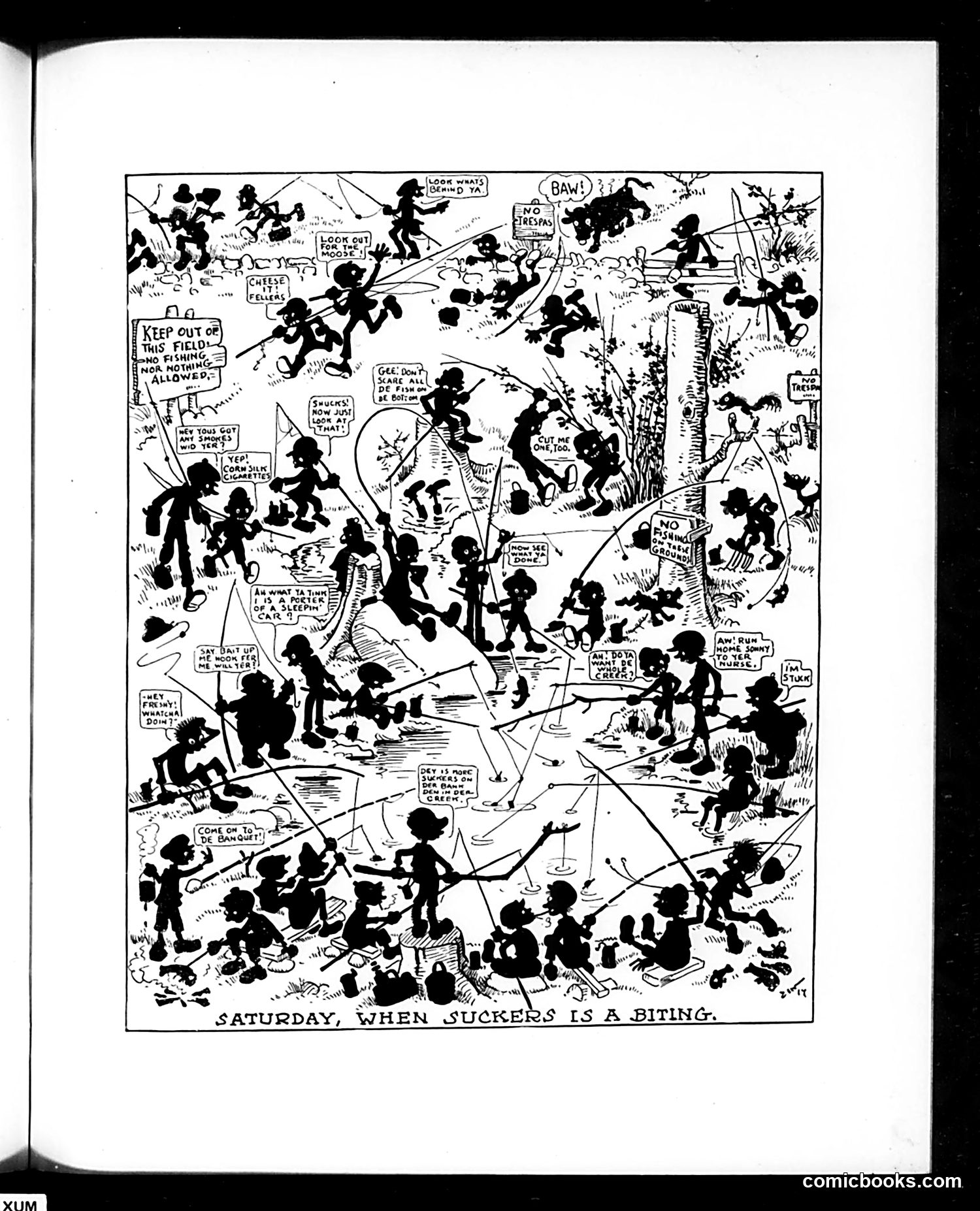
This is a chaotic scene depicting children's Saturday activities in what appears to be early 20th-century America. The title's wordplay on "suckers" (both lollipops and gullible people) frames the satire: children engaged in various mischievous pursuits—fighting, running, playing roughly, smoking, and general mayhem in a field or vacant lot. The cartoon satirizes unsupervised youth culture and the notion that Saturday freedom leads to destructive behavior. Multiple speech bubbles capture kids' dialogue about their antics. The "suckers" reference suggests the children are foolish or the adults who let them run wild are foolish. It's a commentary on childhood misbehavior, parental neglect, or social disorder among the working-class youth Judge's readers would recognize from urban or rural American life of that era.
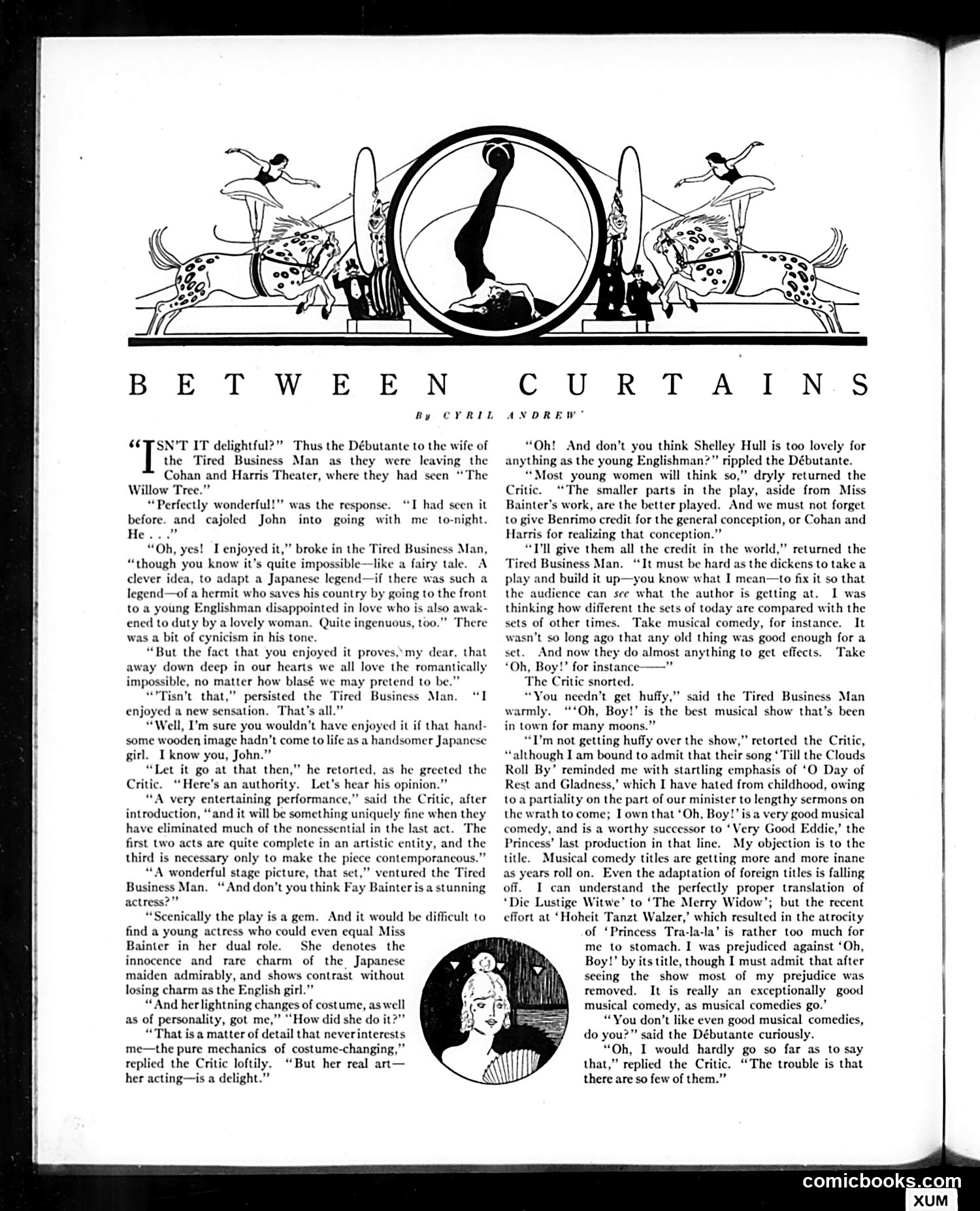
This is a theater review column featuring dialogue among three characters discussing "The Willow Tree," a play starring Fay Bainter at the Cohan and Harris Theater. The piece satirizes different theatergoer attitudes: The Tired Business Man represents practical skepticism about romantic plots, while the Critic embodies pretentious aesthetic judgment—dismissing crucial plot elements as "nonessential" and valuing abstract "art" over entertainment or technical craft. The Débutante represents shallow enthusiasm focused on actor attractiveness. The satire targets the Critic's snobbery, particularly when he scorns the popular musical "Oh, Boy!" The Tired Business Man's defense of it—that modern production design creates genuine theatrical value—suggests the author favors accessible entertainment and craft over elitist dismissal. This represents early 20th-century debates about theater's purpose: artistic purity versus popular entertainment.
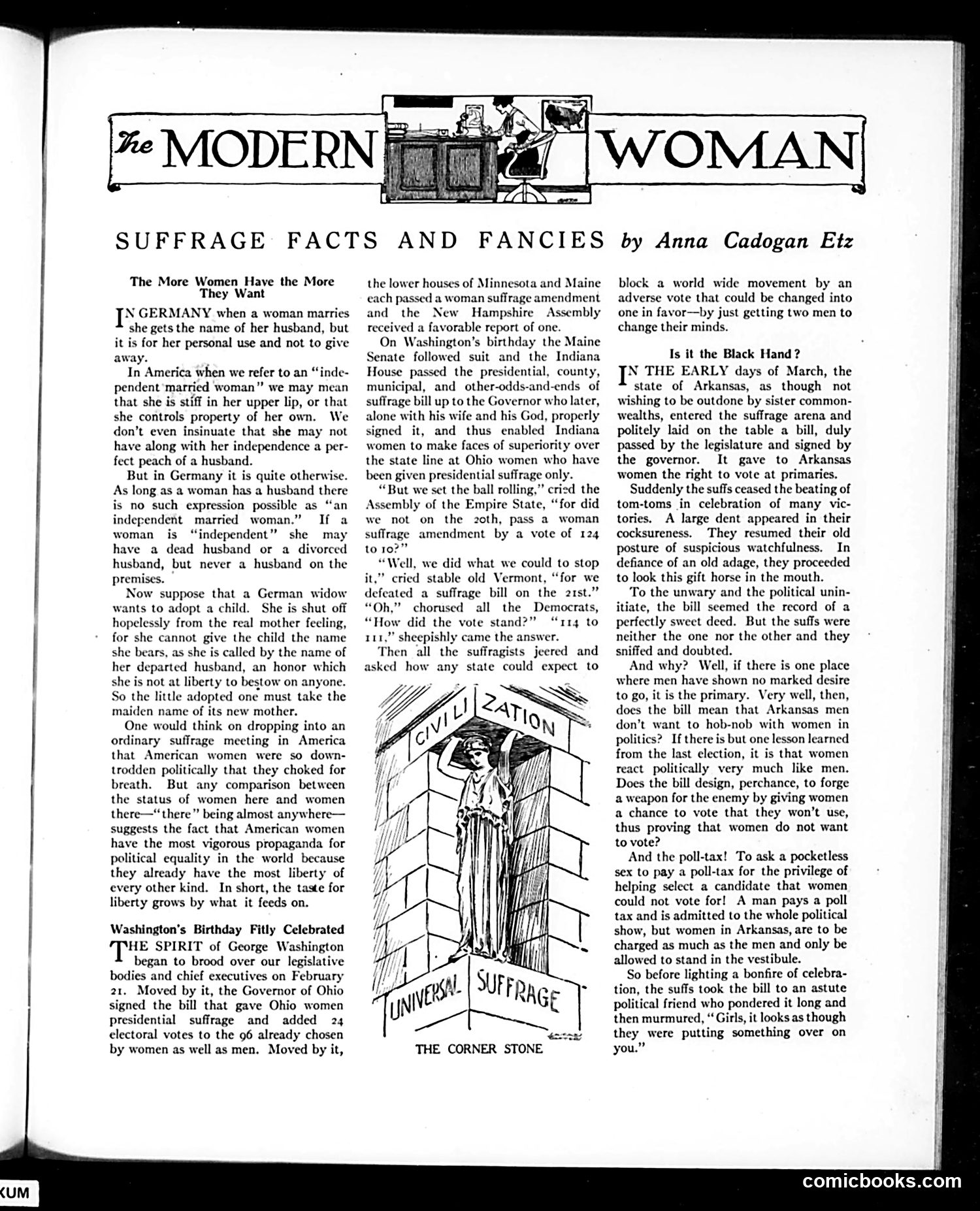
This page satirizes the women's suffrage movement through Anna Cadogan Etz's article comparing women's rights internationally and tracking recent American legislative victories. **The Main Cartoon** ("The Corner Stone") depicts Lady Liberty or Civilization as the foundation supporting "Universal Suffrage"—suggesting suffragists view women's voting rights as essential to democratic stability. **The Satire's Target**: Etz mocks suffragists' contradictory complaints. She argues American women already possess greater liberty than women elsewhere, yet complain most loudly about political inequality—hence their "vigorous propaganda." The article chronicles victories in Ohio, Indiana, Maine, New Hampshire, and New York while noting Vermont's defeat and Arkansas's quiet passage of primary voting rights, suggesting suffragists' enthusiasm wavers unpredictably. **The Implication**: Judge suggests suffragists' demands are exaggerated given women's existing freedoms, and that their movement lacks consistent principle—celebrating or condemning identical legislative outcomes based on partisan considerations.
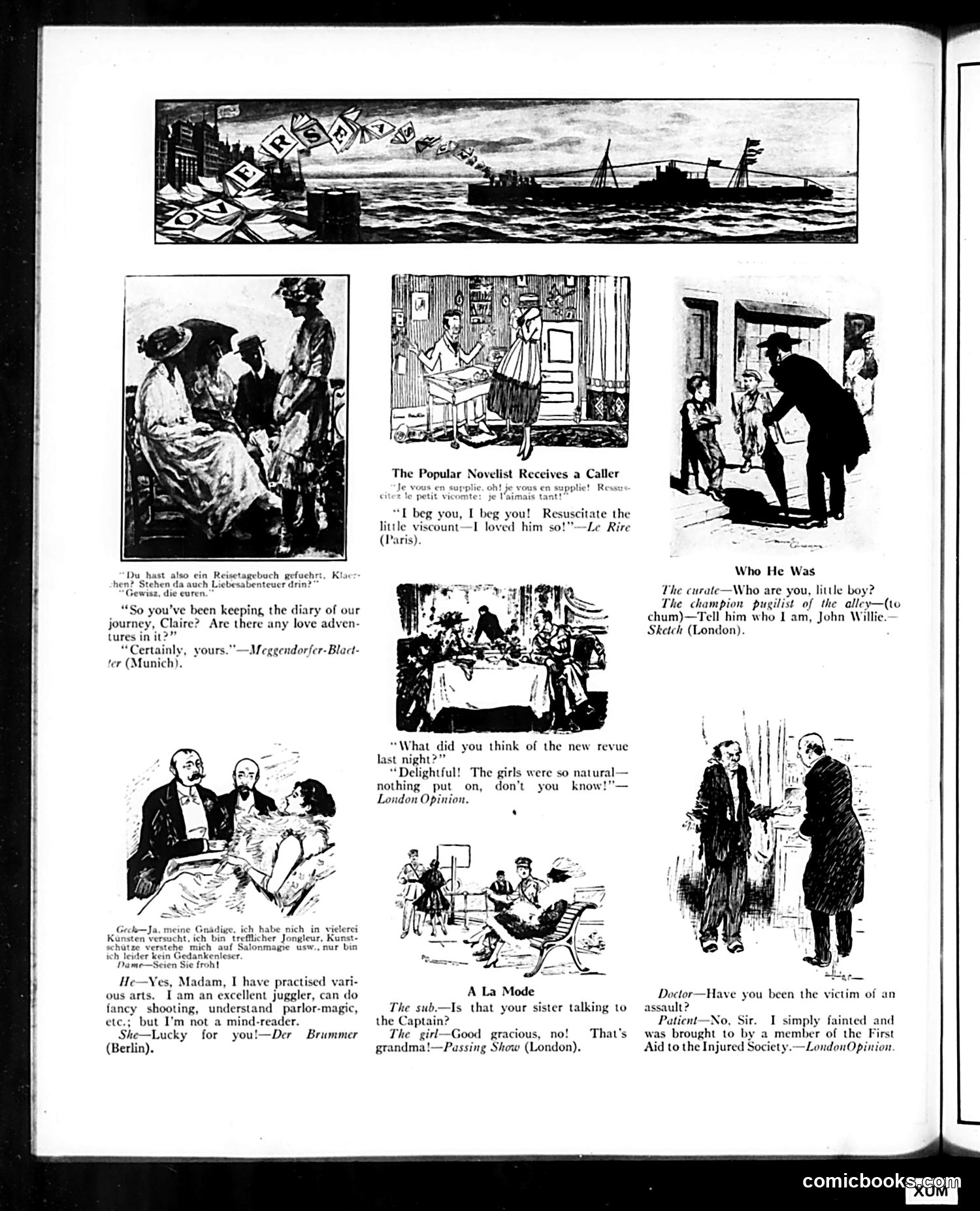
This page compiles short humorous vignettes from various European publications, arranged around a maritime header image. The jokes reflect early 20th-century social attitudes: **"The Popular Novelist Receives a Caller"** satirizes overwrought romantic fiction—a Parisian woman tearfully begs a writer to resurrect a beloved character ("the little viscount"), mocking the emotional excess of popular novels. **"Who He Was"** plays on class differences: a street urchin's friend introduces him to a clergyman as "John Willie," the neighborhood boxing champion—humor derived from the incongruity of rough working-class identity meeting religious authority. **"A La Mode"** jokes about deceptive femininity in high society—a woman denies her grandmother is "her sister," implying she presents herself as younger than reality. Other vignettes mock performers' pretensions and medical misunderstandings. The page reflects Judge's practice of republishing continental European humor, emphasizing social observation over political commentary.
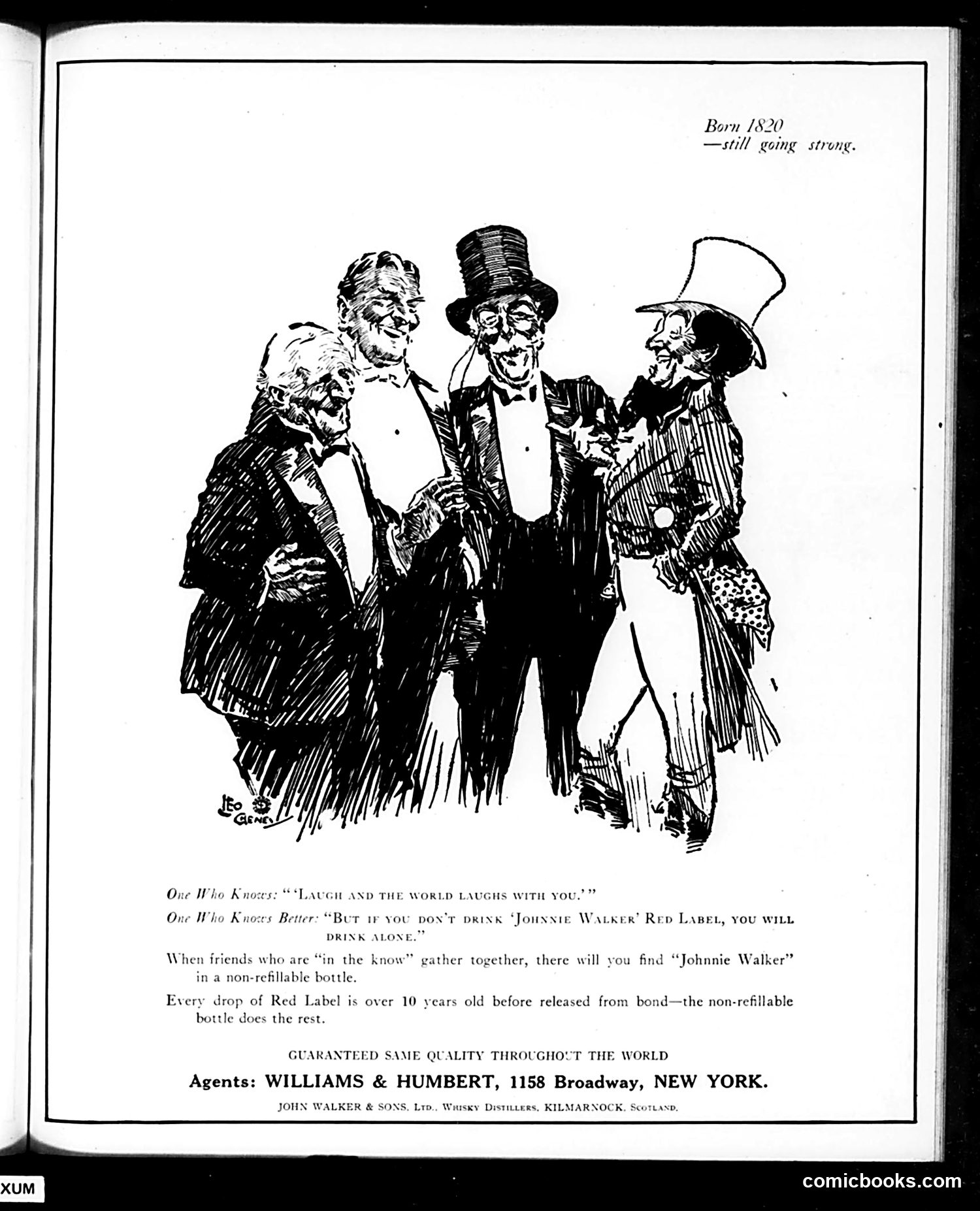
This is a **Johnnie Walker whisky advertisement**, not political satire. The cartoon depicts four well-dressed men in formal attire from around 1820 (the birth year referenced), suggesting the whisky's established heritage. The humor plays on a drinking joke: one character claims "laugh and the world laughs with you," but his friend corrects him—if you don't drink Johnnie Walker Red Label, "you will drink alone," implying the whisky is essential to social gatherings. The advertisement emphasizes that Red Label whisky is aged over 10 years before release and maintains consistent quality worldwide. The "non-refillable bottle" reference suggests the product's quality is guaranteed by its sealed packaging. The figures appear to be generic gentlemen representing the brand's long history and respectability rather than specific political or social caricatures. This is period advertising using humor to promote premium Scotch whisky to American consumers.
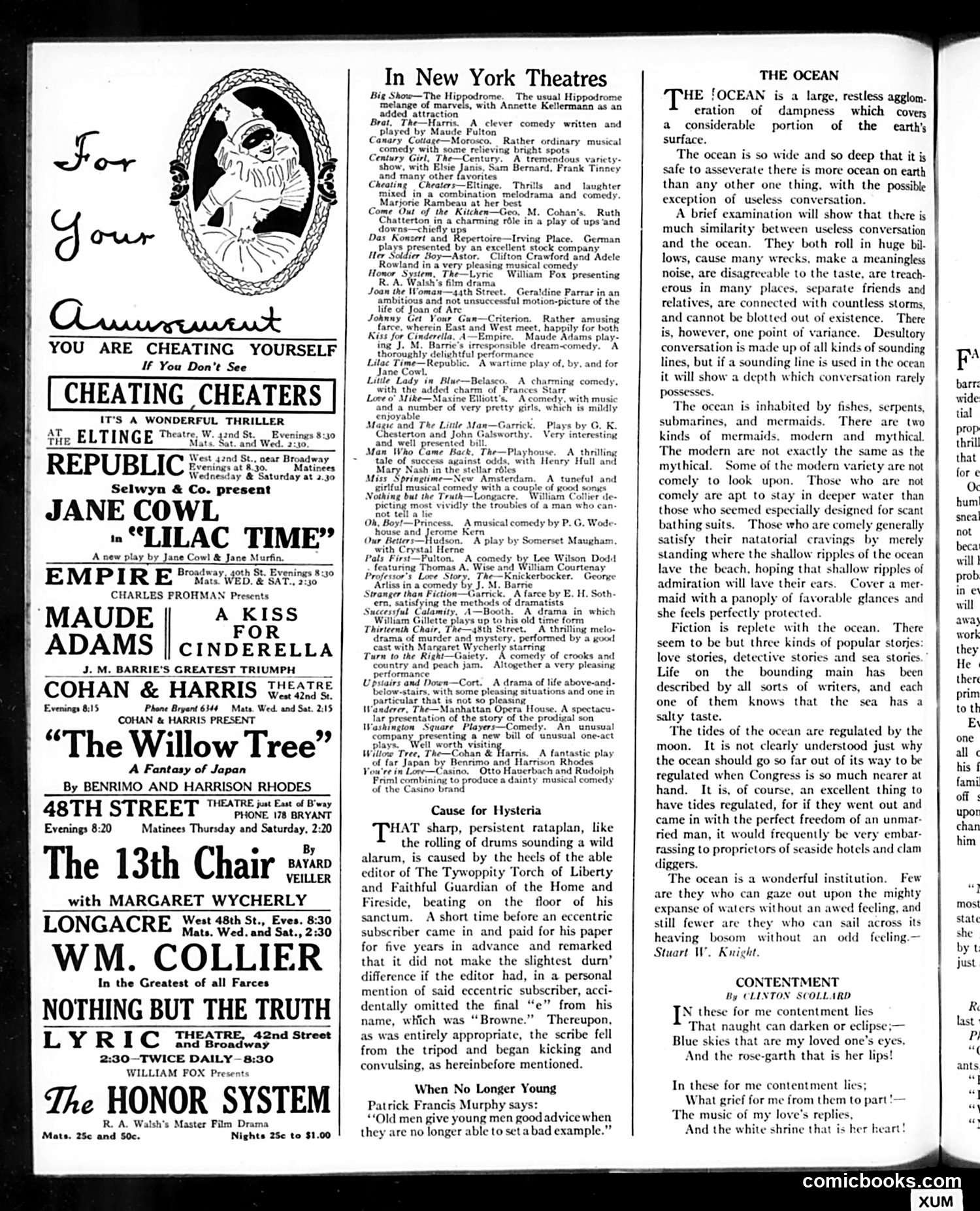
This page is primarily **theatrical advertising**, not political satire. It showcases New York Broadway theaters and current productions circa 1918-1920 (based on play titles and venues). The large illustrated header features a caricatured Santa Claus figure promoting "Cheating Cheaters," a melodrama playing at the Eltinge Theatre—the advertisement's visual anchor. The left column lists detailed theater advertisements for productions including Jane Cowl in "Lilac Time," Maude Adams in "A Kiss for Cinderella," and "The Willow Tree" (a Japan-set fantasy). The right side contains an unrelated essay titled "The Ocean," discussing maritime geography and marine life—standard editorial filler. **The satirical element** is modest: the headline "You Are Cheating Yourself If You Don't See Cheating Cheaters" uses the play's title as wordplay to mock readers missing this entertainment. This is essentially a **theater listings page with promotional artwork**, not a political cartoon or commentary.
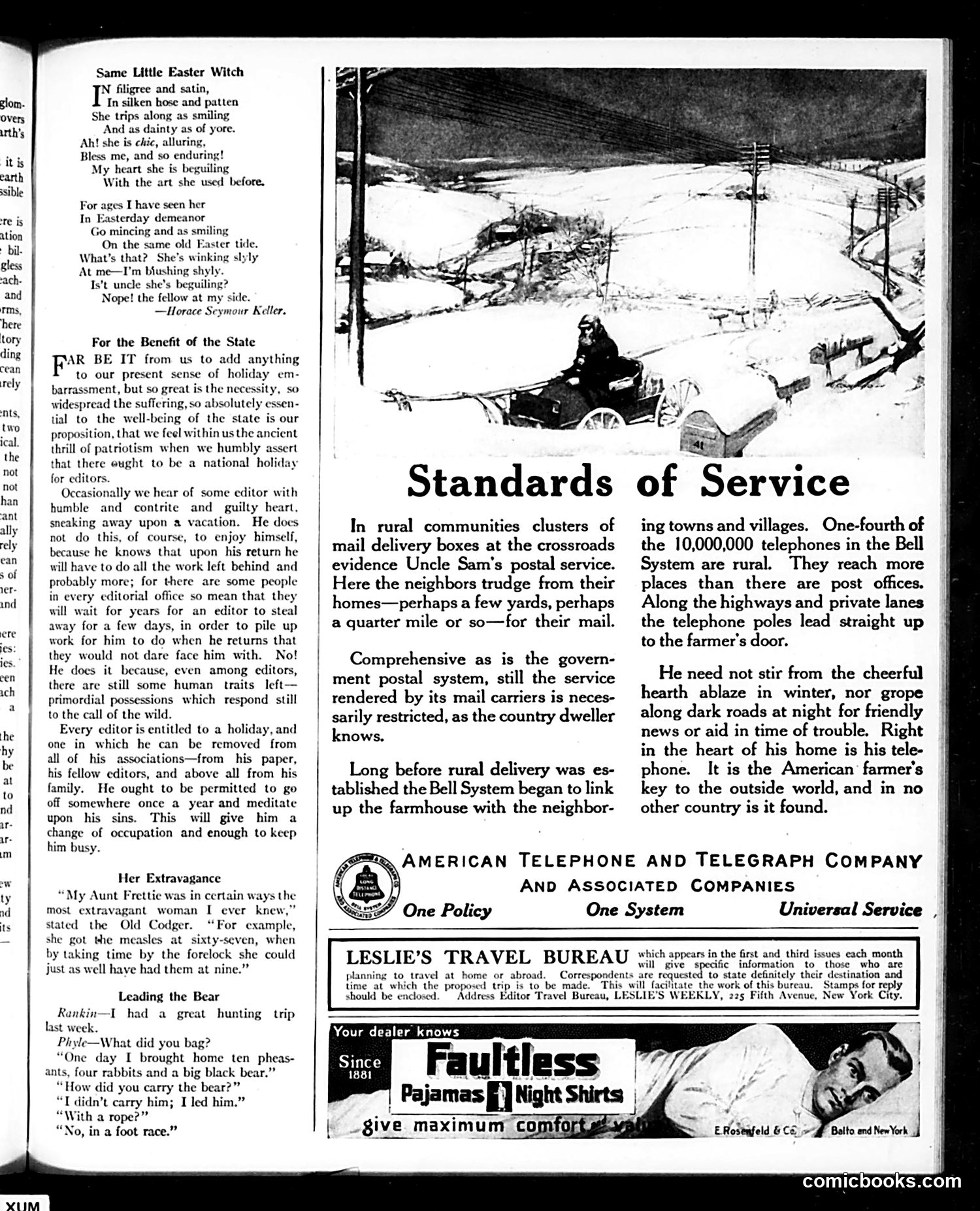
This page mixes poetry, humor columns, and corporate advertising. **Poems & Humor:** The "Easter Witch" poem depicts a flirtatious woman in spring finery charming men. A satirical editorial argues editors deserve a national holiday—not for rest, but because they work constantly, even returning from vacation to mountains of accumulated tasks. Brief jokes mock human folly: an aunt taking measles at sixteen to "get it over with," and a hunter who chased a bear on foot rather than using a rope. **Advertisement:** The dominant content is a Bell Telephone System ad promoting rural telephone service. It contrasts the postal service (requiring farmers to walk distances for mail) with the convenience of phones reaching directly to farmhouse doors. The ad positions the telephone as essential to American farm life and isolation-prevention—essentially corporate propaganda portraying the Bell System as vital infrastructure enabling rural participation in modern society.
This page is primarily **advertisements and light college humor** from Judge magazine (circa 1917, based on the masthead). The "With the College Wits" section contains brief, punchy jokes typical of college humor magazines of the era—mostly playing on romantic disappointment and courtship mishaps. For example, one joke involves a rejected suitor whose ex-girlfriend wants to keep his letters for "material" she can reuse; another plays on the double meaning of "spirits" at a séance. "The Atavistic Maid" is a longer comedic poem about a woman rejecting overly genteel courtship in favor of rough, "caveman" treatment—satirizing both romantic conventions AND emerging ideas about "primitive" desires. The title references evolutionary theory (atavism = reversion to primitive traits). The rest of the page consists of **period advertisements**: cough drops, golf balls, fake diamonds, a correspondence school, hotels, and a repeating pistol—typical commercial messaging for traveling salesmen (the magazine's target audience). **No major political satire is present on this visible page.**
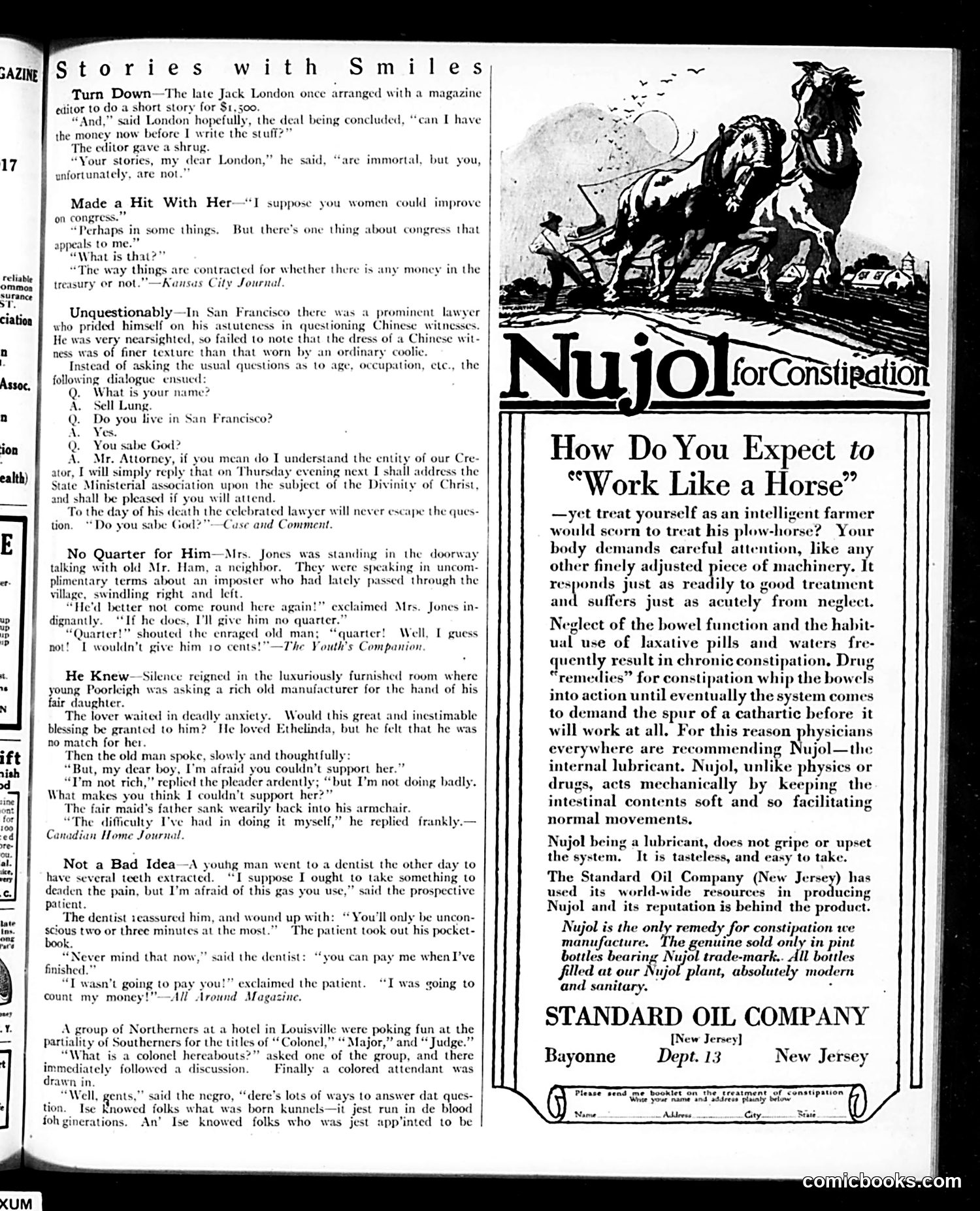
This page contains short humorous anecdotes ("Stories with Smiles") typical of early 20th-century American humor magazines, alongside a large **Nujol laxative advertisement**. The jokes mock various figures and situations: - **Jack London anecdote**: Satirizes a famous author's financial desperation—editors value his immortal work but not his immediate survival needs. - **Congressional joke**: Women critique Congress's fiscal irresponsibility (spending without checking treasury funds)—likely referencing Progressive Era budget debates. - **Chinese witness scene**: A nearsighted lawyer unknowingly questions a wealthy Chinese gentleman using crude stereotyping ("sabe God?"), exposing his prejudiced assumptions. - **"No Quarter" joke**: Wordplay on "quarter" (mercy vs. currency)—an old man so poor he can't even spare ten cents. - **Dentist joke**: Dark humor about unconsciousness and payment avoidance. The **dominant image** shows horses pulling a plow—illustrating the Nujol ad's analogy: treat your body like a farmer treats his plow-horse (with proper lubrication/maintenance). This reflects early pharmaceutical marketing's mechanistic view of human digestion.
This page is primarily **advertising** rather than editorial content or political satire. The main features are product advertisements: **"The Truth About Corns"** (left side): A testimonial ad for Blue-jay corn plasters, claiming a chemist proved the product eliminates corns in 48 hours. This is straightforward commercial copy, not satire. **"Take a Look at Yourself"** (center): Motivational verse encouraging self-reflection and humility—essentially inspirational advertising copy. **Other ads**: Typewriter sales, patent attorney services, and music lessons occupy the remaining space. The scattered editorial snippets ("Tradition Threatened," "Can't Dispute It," "The Sinecure") appear to be reprinted newspaper humor columns, not Judge's own satire. **No political cartoon is present on this page.** While Judge was a satirical magazine, this particular page functions as a commercial publication filled with period advertisements and filler material.
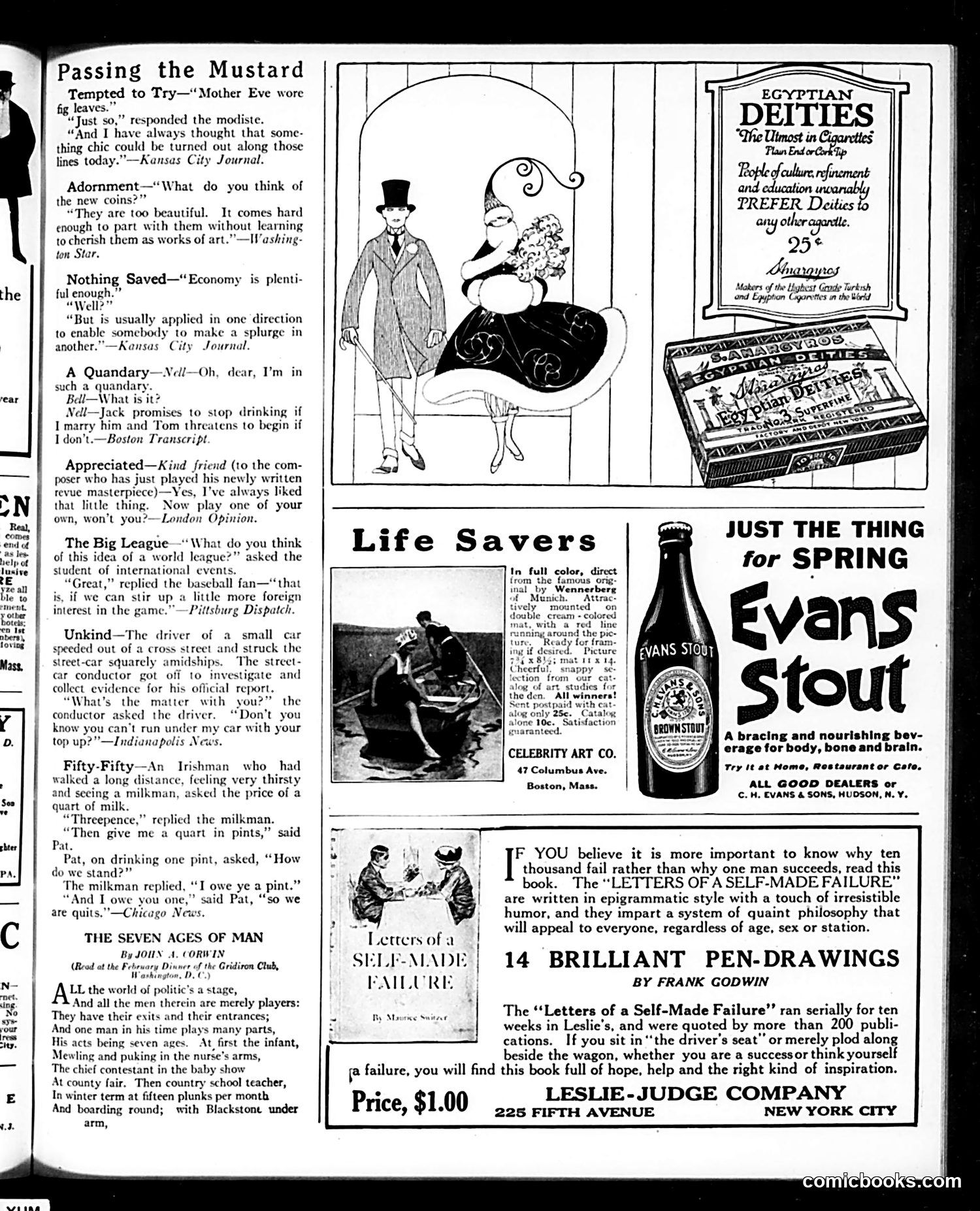
This page contains multiple humorous short anecdotes ("Passing the Mustard" section) satirizing everyday life and social pretensions. The central cartoon depicts a fashionable woman in an exaggerated pose with her escort, mocking contemporary fashion and social vanity—the woman's absurdly ornate hat and affected posture ridicule the era's extreme dress codes and artificiality. The anecdotes mock various targets: fashion designers' pretension, economic hypocrisy (people economizing in one area to splurge elsewhere), marriage dilemmas, and working-class Irish stereotypes. "The Seven Ages of Man" parodies Shakespeare's *As You Like It*, applying the literary framework to American politics and professional life instead. The page is primarily **advertising** for period products: Egyptian cigarettes, Evans Stout beer, and self-help book "Letters of a Self-Made Failure." This reflects Judge's commercial nature as a satirical weekly magazine balancing editorial content with revenue-generating advertisements.
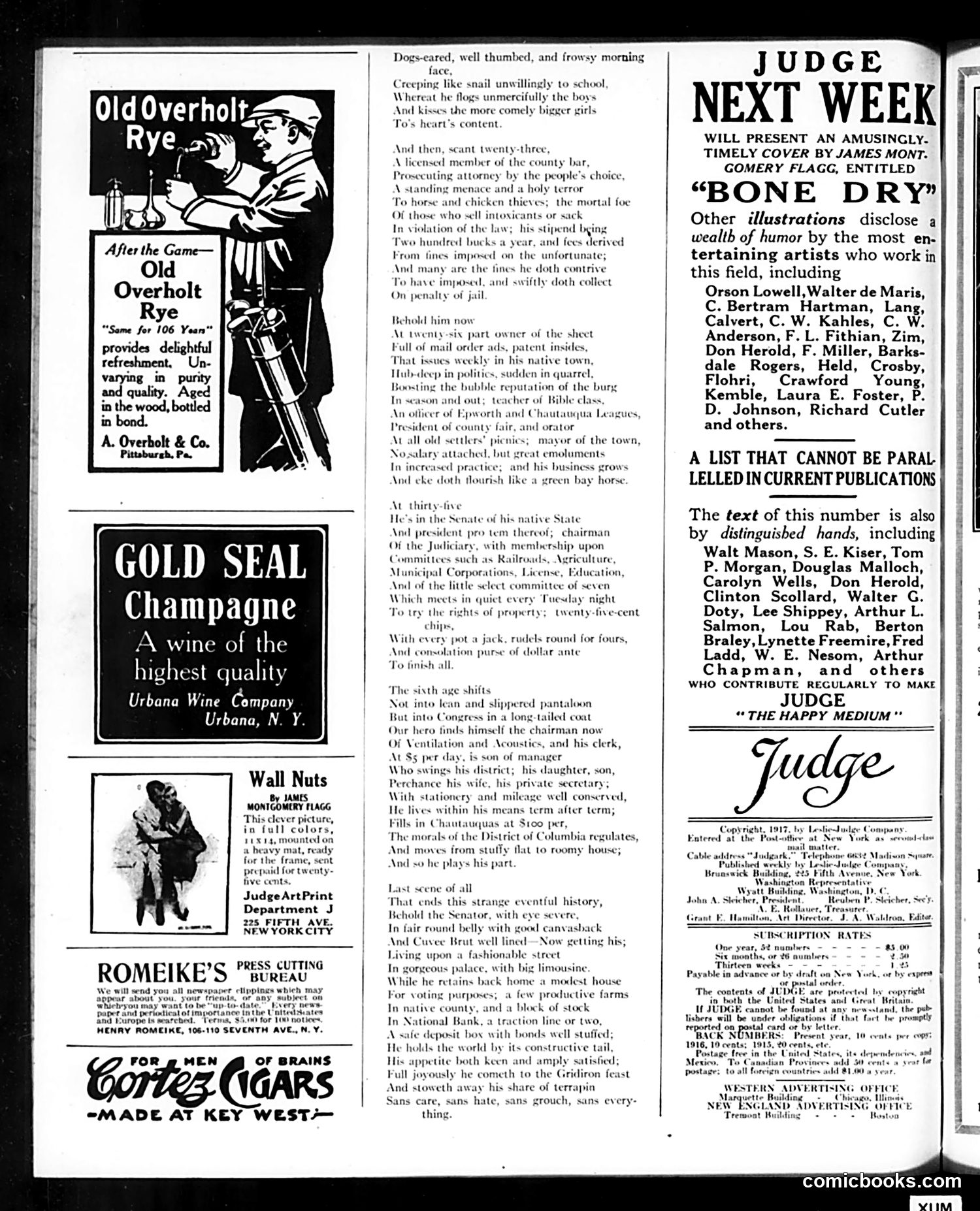
This page presents a poem (OCR indicates it's largely complete, though OCR errors are present) tracking the rise of a small-town American politician from schoolboy to wealthy U.S. Senator. **The Political Satire:** The poem traces his arc—brutal schoolteacher, young prosecutor abusing his office to collect fines on the poor, county journalist and political operator, state legislator, congressman manipulating committees for patronage (hiring family members), and finally a Senator living luxuriously while maintaining the fiction of modest hometown assets. **The Point:** This is a scathing critique of rural political corruption—how ambitious men climb the political ladder through abuse of minor offices, exploitation of the disadvantaged, nepotism, and self-enrichment disguised as public service. The final image of him feasting on expensive food (terrapin) while claiming personal modesty captures the hypocrisy. **Context:** Judge magazine regularly mocked political corruption and machine politics, especially at state and local levels. The specificity (Bible classes, county fairs, Chautauqua leagues) suggests this caricatures an actual politician type recognizable to 1917 readers.
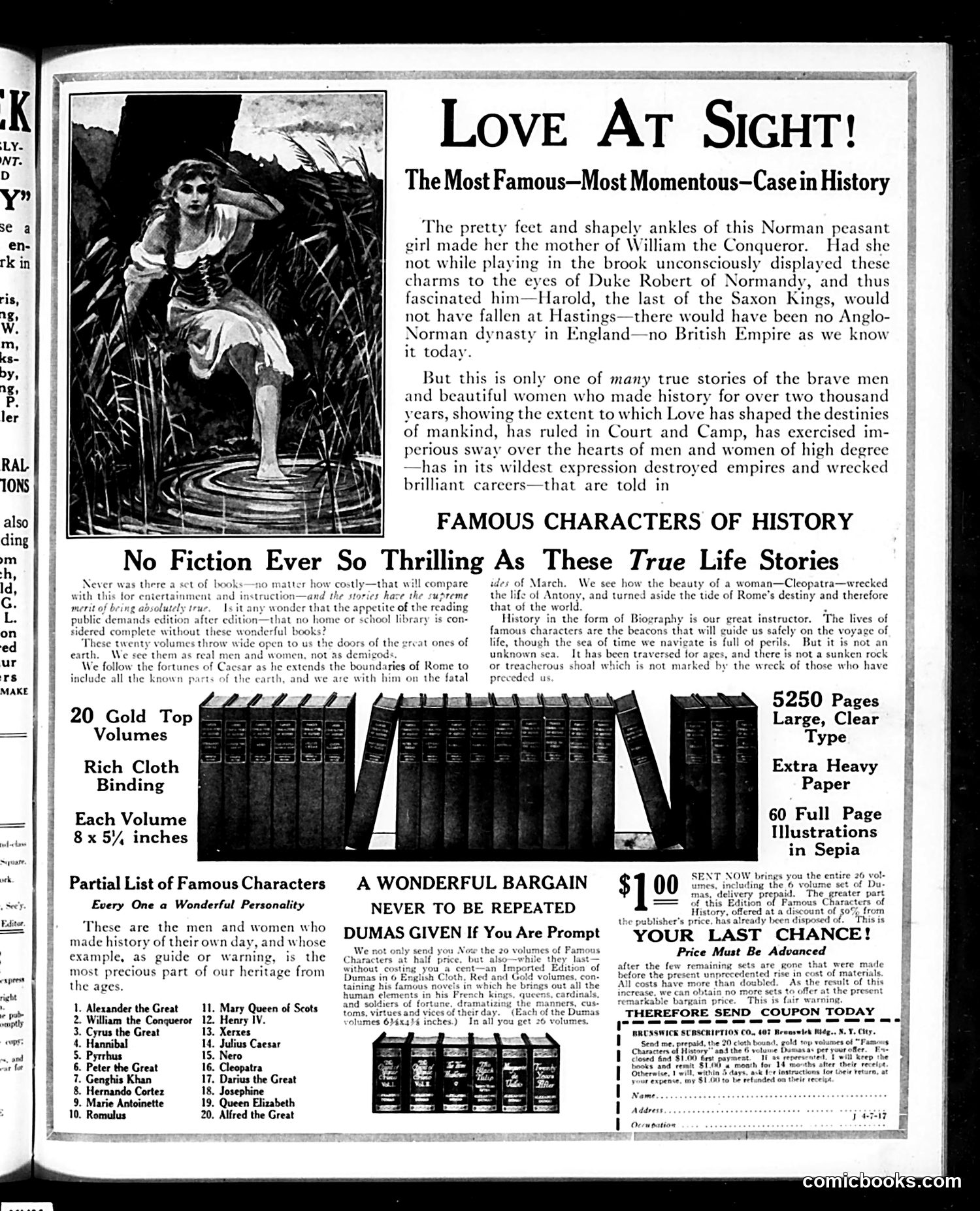
This page is primarily **advertising**, not satirical content. It promotes a 20-volume encyclopedia set titled "Famous Characters of History." The small illustration shows a Norman peasant woman displaying her ankles by a brook—referencing the historical legend that Duke Robert of Normandy was attracted to this woman, leading to William the Conqueror's birth and thus the Norman Conquest of England (1066). The ad uses this as a hook: "Love" literally changed world history. The sales pitch argues that true biographical stories are more thrilling than fiction, and that studying famous historical figures provides moral instruction. The listed characters span from Alexander the Great to Alfred the Great—figures presented as universally recognized exemplars of human greatness. For modern readers, the notable element is the **gender dynamic**: the opening emphasizes a woman's physical attractiveness as historically consequential, while the character list is predominantly male. This reflects early 20th-century attitudes about women's historical agency. The ad emphasizes urgency ("Your Last Chance!"), bulk purchasing (20 volumes), and quality production as justification for the $1.00 price point.

This is a vintage advertisement for Murad Turkish cigarettes, priced at 15 cents. The ad features a stylized black and white image of a woman's face in profile, smoking a cigarette, with geometric Art Deco design elements framing her features. The prominent text reads "THE TURKISH CIGARETTE" with what appears to be descriptive copy below (partially illegible in the OCR). The advertisement reflects early 20th-century marketing that associated Turkish cigarettes with exoticism and sophistication. The modernist aesthetic and the emphasis on "Turkish" origin were common selling points of the era, when such cigarettes were considered premium products. The price point and magazine placement indicate this was targeting middle-class consumers.