
Judge, 1917-04-07 · page 17 of 28
Judge — April 7, 1917 — page 17: what you’re looking at
What you’re looking at
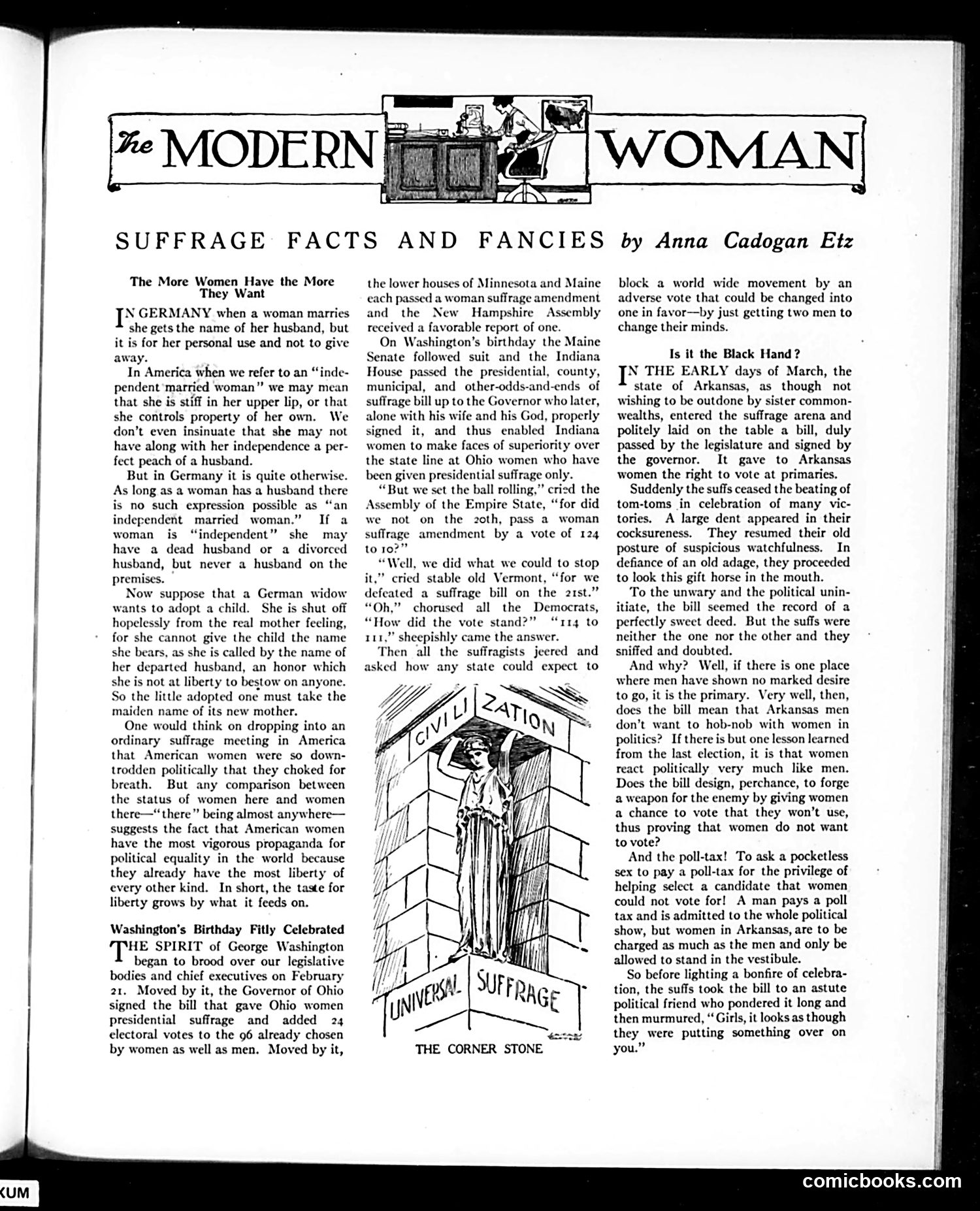
This page satirizes the women's suffrage movement through Anna Cadogan Etz's article comparing women's rights internationally and tracking recent American legislative victories. **The Main Cartoon** ("The Corner Stone") depicts Lady Liberty or Civilization as the foundation supporting "Universal Suffrage"—suggesting suffragists view women's voting rights as essential to democratic stability. **The Satire's Target**: Etz mocks suffragists' contradictory complaints. She argues American women already possess greater liberty than women elsewhere, yet complain most loudly about political inequality—hence their "vigorous propaganda." The article chronicles victories in Ohio, Indiana, Maine, New Hampshire, and New York while noting Vermont's defeat and Arkansas's quiet passage of primary voting rights, suggesting suffragists' enthusiasm wavers unpredictably. **The Implication**: Judge suggests suffragists' demands are exaggerated given women's existing freedoms, and that their movement lacks consistent principle—celebrating or condemning identical legislative outcomes based on partisan considerations.
📄 Transcribed text from this page (OCR, searchable)
Machine-transcribed from the original scan — historical spelling and the odd misread are preserved.
(UM %e MODERN SUFFRAGE FACTS AND FANCIES The More Women Have the More They Want N GERMANY when a woman marries she gets the name of her husband, but it is for her personal use and not to give away. ; In America when we refer to an “inde- pendent ‘married woman” we may mean that she is stiff in her upper lip, or that she controls property of her own. We don’t even insinuate that she may not have along with her independence a per- fect peach of a husband. But in Germany it is quite otherwise. As long as a woman has a husband there is no such expression possible as “an independent married woman.” If a woman is “independent” she may have a dead husband or a divorced husband, but never a husband on the premises. Now suppose that a German widow wants to adopt a child. She is shut off hopelessly from the real mother fecling, for she cannot give the child the name she bears, as she is called by the name of her departed husband, an honor which he is not at liberty to bestow on anyone. So the little adopted one must take the maiden name of its new mother. One would think on dropping into an ordinary suffrage meeting in America that American women were so down- trodden politically that they choked for breath. But any comparison between the status of women here and women there—“ there” being almost anywhere— suggests the fact that American women have the most vigorous propaganda for political equality in the world because they already have the most liberty of every other kind. In short, the taste for liberty grows by what it feeds on. Washington's Birthday Fitly Celebrated THE SPIRIT of George Washington began to brood over our legislative bodies and chief executives on February 21. Moved by it, the Governor of Ohio signed the bill that gave Ohio women presidential suffrage and added 24 electoral votes to the 96 already chosen by women as well as men. Moved by it, s of Minnesota and Maine woman sufirage amendment and the New Hampshire Assembly received orable report of one. On Washington's birthday the Maine Senate followed suit and the Indiana House passed the presidential, county, municipal, and other-odds-and-ends of suffrage bill up to the Governor who later, alone with his wife and his God, properly signed it, and thus enabled Indiana women to make faces of superiority over the state line at Ohio women who have been given presidential suffrage only. “But we set the ball rolling,” cried the Assembly of the Empire State, “for did we not on the 20th, pass a woman suffrage amendment by a vote of 124 to 10?” “Well, we did what we could to stop it,” cried stable old Vermont, “for we defeated a suffrage bill on the 21st.” “Oh,” chorused all the Democrats, “How did the vote stand?” “114 to 111,” sheepishly came the answer. Then all the suffragists jeered and asked how any state could expect to the lower hous each passed THE CORNER STONE by Anna Cadogan Etz block a world wide movement by an adverse vote that could be changed into one in favor—by just getting two men to change their minds. Is it the Black Hand ? N THE EARLY days of March, the state of Arkansas, as though not wishing to be outdone by sister common- wealths, entered the suffrage arena and politely laid on the table a bill, duly passed by the legislature and signed by the governor. It gave to Arkansas women the right to vote at primaries. Suddenly the suffs ceased the beating of tom-toms in celebration of many vic- tories. A large dent appeared in their cocksureness. They resumed their old posture of suspicious watchfulness. In defiance of an old adage, they proceeded to look this gift horse in the mouth. To the unwary and the political unin- itiate, the bill seemed the record of a perfectly sweet deed. But the suffs were neither the one nor the other and they sniffed and doubted. And why? Well, if there is one place where men have shown no marked desire to go, it is the primary. Very well, then, does the bill mean that Arkansas men don’t want to hob-nob with women in politics? If there is but one lesson learned from the last election, it is that women react politically very much like men. Does the bill design, perchance, to forge a weapon for the enemy by giving women a chance to vote that they won’t use, thus proving that women do not want to vote? And the poll-tax! To ask a pocketless sex to pay a poll-tax for the privilege of helping select a candidate that women could not vote for! A man pays a poll tax and is admitted to the whole political show, but women in Arkansas, are to be charged as much as the men and only be allowed to stand in the vestibule. So before lighting a bonfire of celebra- tion, the suffs took the bill to an astute political friend who pondered it long and then murmured, “ Girls, it looks as though they were putting something over on you.” comicbooks.com