
Judge, 1917-04-07 · page 12 of 28
Judge — April 7, 1917 — page 12: what you’re looking at
What you’re looking at
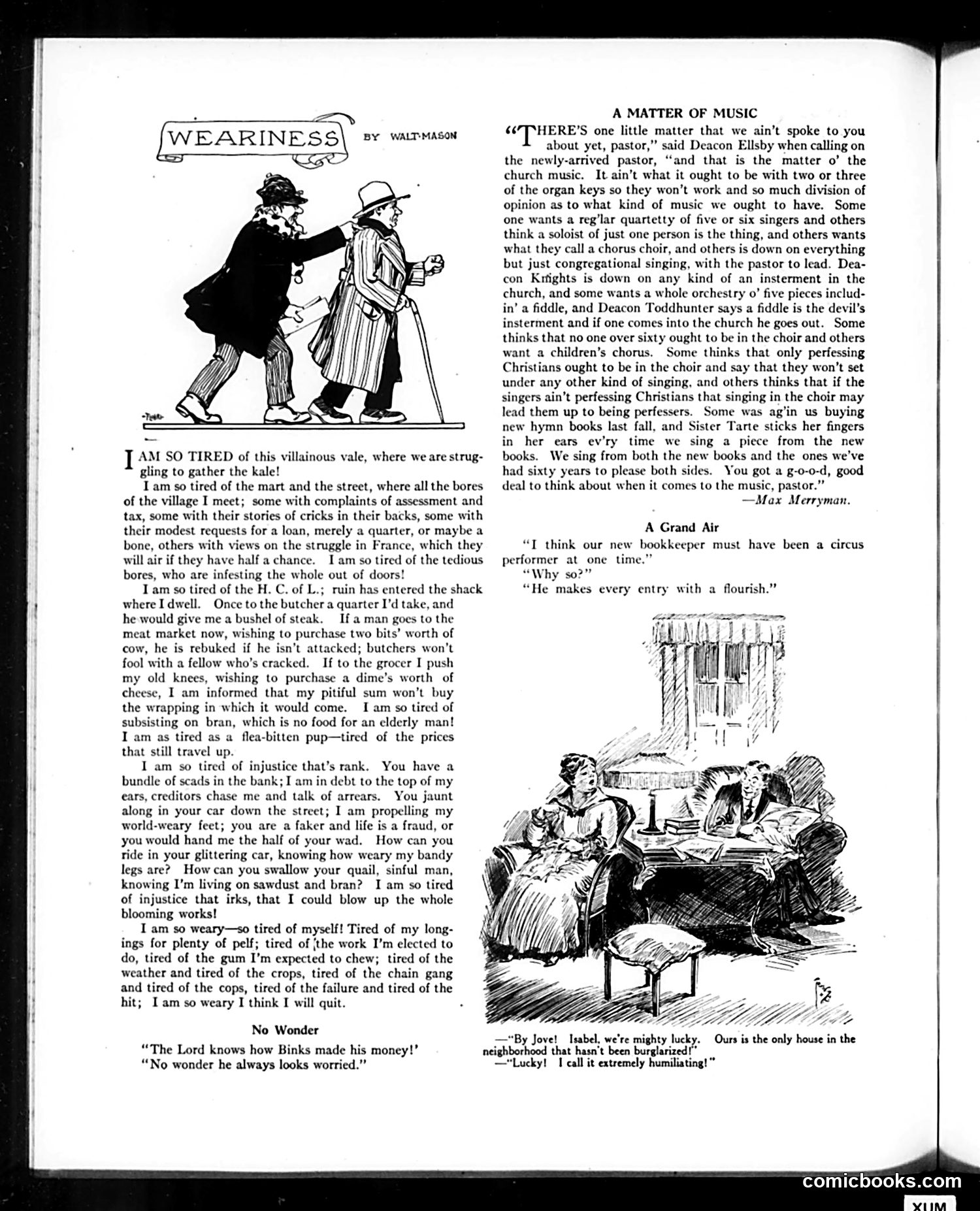
This page contains two satirical pieces typical of early 20th-century American humor: **"Weariness"** (left): A monologue by an exhausted working-class figure complaining about post-WWI hardships—specifically the "H.C. of L." (High Cost of Living). He contrasts his poverty with wealthy neighbors' luxuries, expressing frustration at inflation, debt, and social injustice. The satire targets economic inequality and the speaker's own resigned despair. **"A Matter of Music"** (right): Rural church members debate music practices with their new pastor. The humor lies in the petty sectarian divisions—disagreements over organs, soloists, choirs, instrumental music, and congregational singing. References like "Deacon Knights" opposing instruments and "Deacon Toddhunter" calling fiddles "the devil's instrument" mock fundamentalist rigidity and the absurd internal conflicts plaguing small-town churches. Both pieces use vernacular speech to satirize American social anxieties: economic hardship and religious parochialism.
📄 Transcribed text from this page (OCR, searchable)
Machine-transcribed from the original scan — historical spelling and the odd misread are preserved.
WEARINESS\ 8¥ watreason AM SO TIRED of this villainous vale, where we are strug- gling to gather the kale! I am so tired of the mart and the street, where all the bores of the village I meet; some with complaints of assessment and tax, some with their stories of cricks in their backs, some with their modest requests for a loan, merely a quarter, or maybe a bone, others with v on the struggle in France, which they will air if they have achance. I am so tired of the tedious bores, who are infesting the whole out of doors! 1am so tired of the H. C. of L.; ruin has entered the shack where I dwell. Once to the butcher a quarter I'd take, and he would give me a bushel of steak. If a man goes to the meat market now, wishing to purchase two bits’ worth of cow, he is rebuked if he isn’t attacked; butchers won't fool with a fellow who's cracked. If to the grocer I push my old knees, wishing to purchase a dime’s worth of cheese, I am informed that my pitiful sum won’t buy the wrapping in which it would come. I am so tired of subsisting on bran, which is no food for an elderly man! I am as tired as a flea-bitten pup—tired of the prices that still travel up. I am so tired of injustice that’s rank, You have a bundle of scads in the bank; I am in debt to the top of my ears, creditors chase me and talk of arrears. You jaunt along in your car down the street; I am propelling my world-weary feet; you are a faker and life is a fraud, or you would hand me the half of your wad. How can you ride in your glittering car, knowing how weary my bandy legs are? How can you swallow your quail, sinful man, knowing I’m living on sawdust and bran? I am so tired of injustice that irks, that I could blow up the whole blooming works! I am so weary—so tired of myself! Tired of my long- ings for plenty of pelf; tired of {the work I’m elected to do, tired of the gum I’m expected to chew; tired of the weather and tired of the crops, tired of the chain gang and tired of the cops, tired of the failure and tired of the hit; Iam so weary I think I will quit. No Wonder “The Lord knows how Binks made his money!’ “No wonder he always looks worried.” A MATTER OF MUSIC 667 HERE'S one little matter that we ain’t spoke to you about yet, pastor,” said Deacon Ellsby when calling on the newly-arrived pastor, “and that is the matter o’ the church music. It ain’t what it ought to be with two or three of the organ keys so they won’t work and so much division of opinion as to what kind of music we ought to have. Some one wants a reg’lar quartetty of five or six singers and others think a soloist of just one person is the thing, and others wants what they call a chorus choir, and others is down on everything but just congregational singing, with the pastor to lead. Dea- con Krfights is down on any kind of an insterment in the church, and some wants a whole orchestry o’ five pieces includ- in’ a fiddle, and Deacon Toddhunter says a fiddle is the devil’s insterment and if one comes into the church he goes out. Some thinks that no one over sixty ought to be in the choir and others want a children’s chorus. Some thinks that only perfessing Christians ought to be in the choir and say that they won't set under any other kind of singing, and others thinks that if the singers ain’t perfessing Christians that singing in the choir may lead them up to being perf s. Some was ag’in us buying new hymn books last fall, and Sister Tarte sticks her fingers in her ears ev'ry time we sing a piece from the new books. We sing from both the new books and the ones we've had sixty years to please both sides. You got a g-o-o-d, good deal to think about when it comes to the music, pastor.” —Max Merryman. A Grand Air “T think our new bookkeeper must have been a circus performer at one time.” “Why so?” “He makes every entry with a flourish.” 2 aa —"By Jove! Isabel, we're mighty lucky. Ours is the only house in the neighborhood that hasn't been burglarized!” —"Lucky! I call it extremely humiliating!” comicbooks.com WIM