
A complete issue · 28 pages · 1917
Judge — February 17, 1917
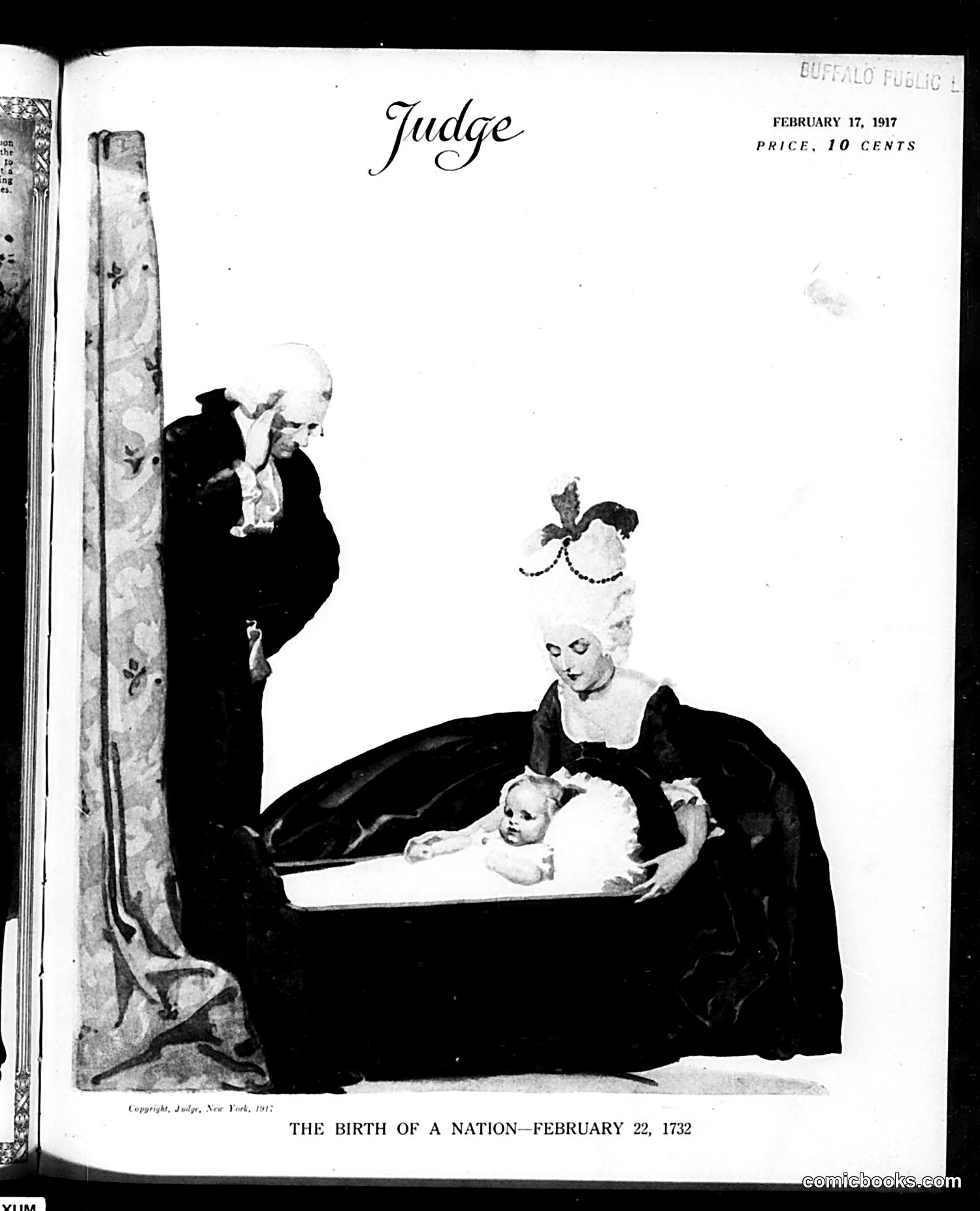
This cartoon satirizes the 1915 D.W. Griffith film *Birth of a Nation*, which depicted the Civil War and Reconstruction era. The image shows a woman (representing the nation) in a coffin-like cradle attended by two figures, one appearing distressed or observing from the side. The satire likely critiques the film's controversial glorification of the Confederacy and the Ku Klux Klan, presenting the "birth of a nation" as morbid or troubling rather than celebratory. The dated caption "February 22, 1732" appears ironic—likely referencing Washington's birthday to underscore the contradiction between American ideals and the film's white-supremacist narrative.
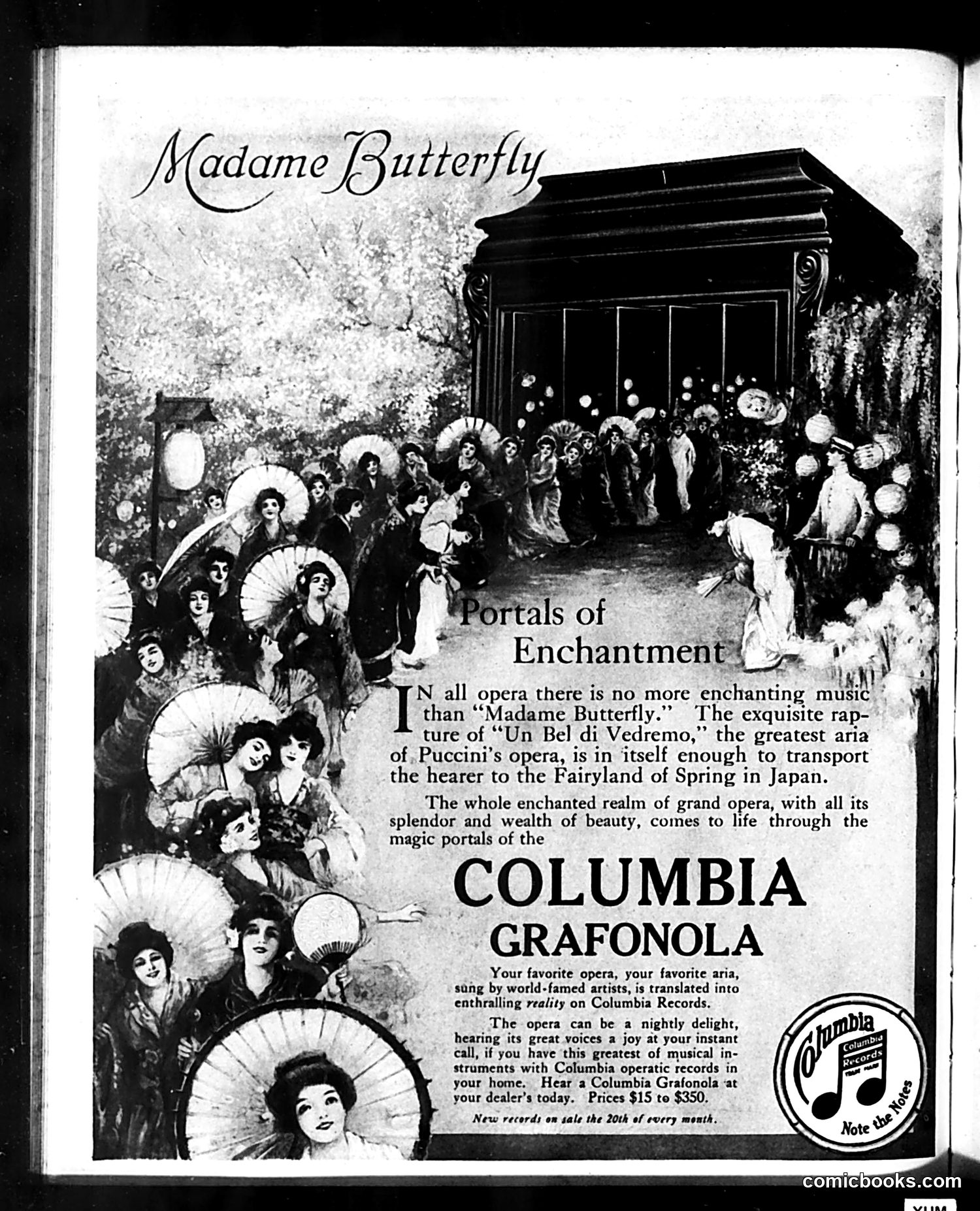
This page is primarily an **advertisement**, not satire or political commentary. It promotes Columbia Grafonola phonographs by advertising their recording of Puccini's opera "Madame Butterfly." The ad features an illustration of elegantly dressed figures with Japanese parasols, referencing the opera's Asian setting. The text emphasizes how the phonograph brings opera's "enchantment" and "splendor" into the home, targeting affluent buyers who could afford the $15-$350 price range (substantial sums in the early 20th century). The appeal is to cultural aspirations—owning both the opera recording and the "greatest of musical instruments" signals refined taste and wealth. The "Note the tone" logo emphasizes sound quality as a selling point for this emerging consumer technology.
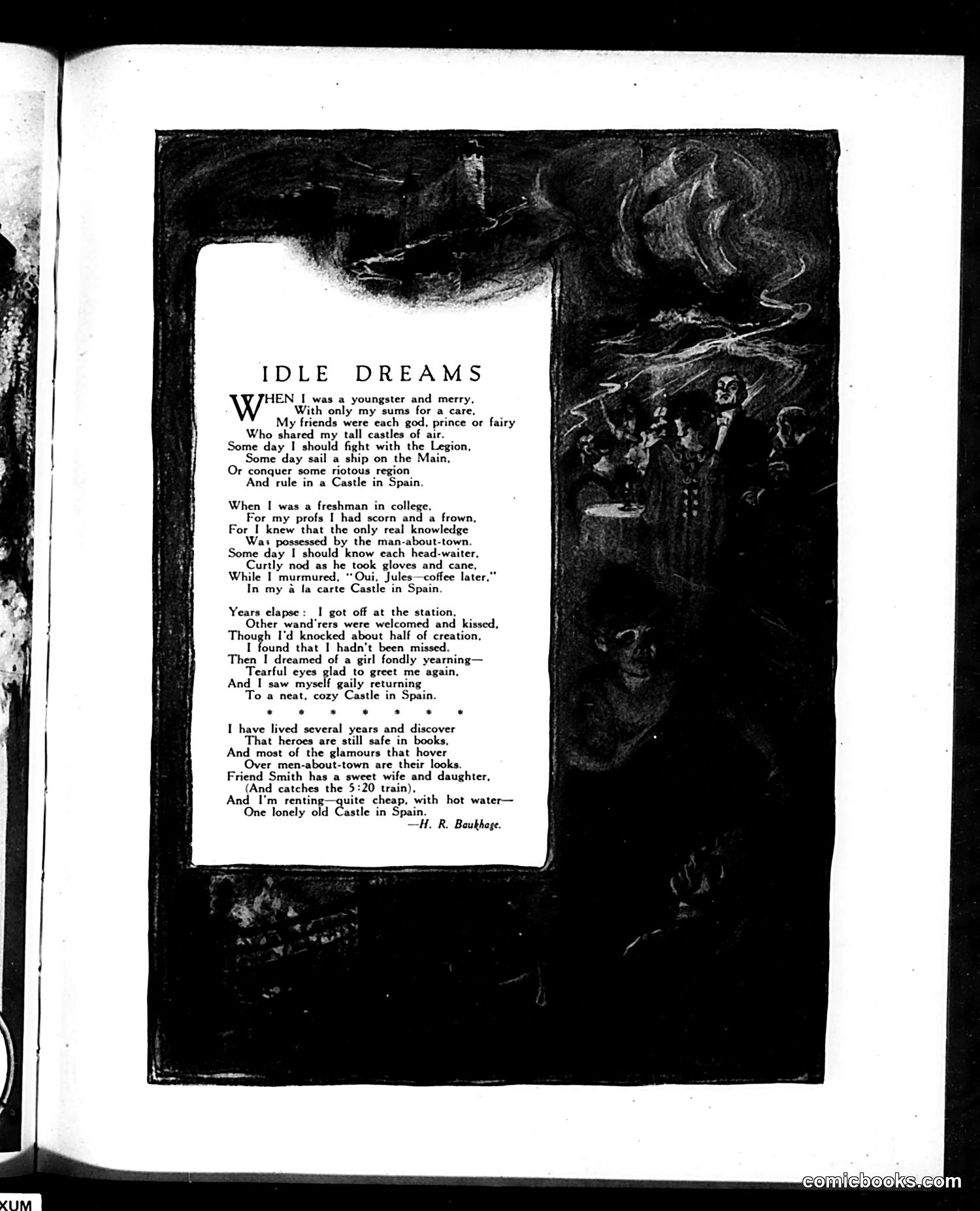
This page presents a nostalgic poem rather than a political cartoon. The text reflects on youthful ambitions versus adult reality: the speaker recalls childhood dreams of adventure (sailing ships, conquering castles in Spain), college aspirations of romance and status, and young adult wanderlust. The concluding stanza reveals disillusionment—heroes remain in books, romantic ideals fade, and the speaker now lives modestly as a renter in a small castle in Spain, catching cheap trains and living an ordinary life. The ornate dark border framing the poem suggests this is a satirical commentary on the gap between youthful fantasy and middle-class reality, likely resonating with Judge's educated readership experiencing similar disappointments during the early 20th century. The "Castle in Spain" becomes a metaphor for unfulfilled dreams.
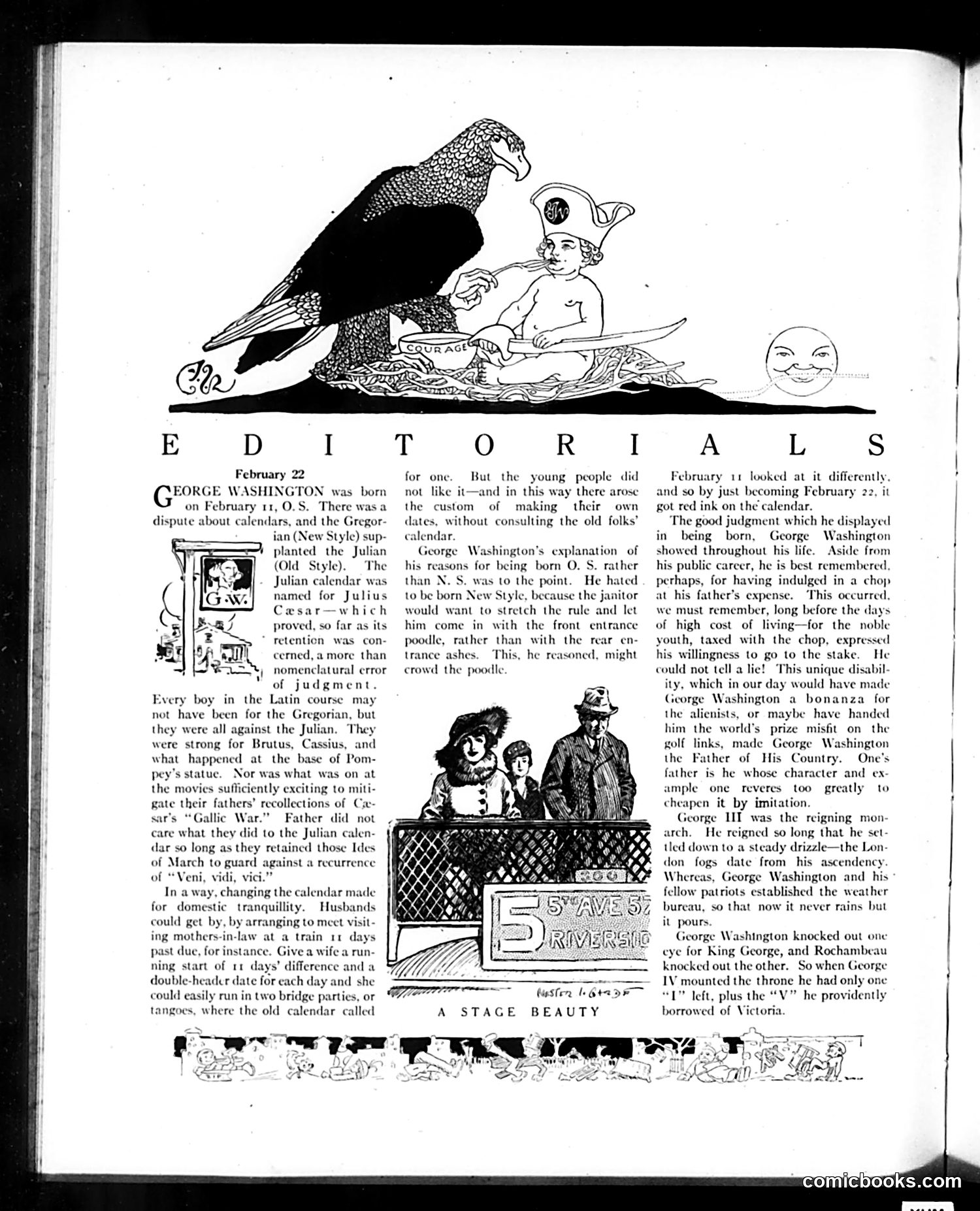
This editorials page celebrates George Washington's birthday (February 22). The text humorously discusses the calendar discrepancy between old and new style dates—Washington was born under the Julian calendar but Americans observed it under the Gregorian calendar. The top illustration shows an eagle and cherub, symbolizing American patriotism and Washington's legacy. "A Stage Beauty" (the captioned illustration) depicts what appears to be a theatrical scene with period costume, though its specific satirical point is unclear from the visible text. The page's main content is a tongue-in-cheek essay about Washington's character quirks—particularly his disability regarding truth-telling and his frankness that made him politically valuable despite social awkwardness. The satire gently mocks how Washington's flaws paradoxically made him exceptional as a national leader.
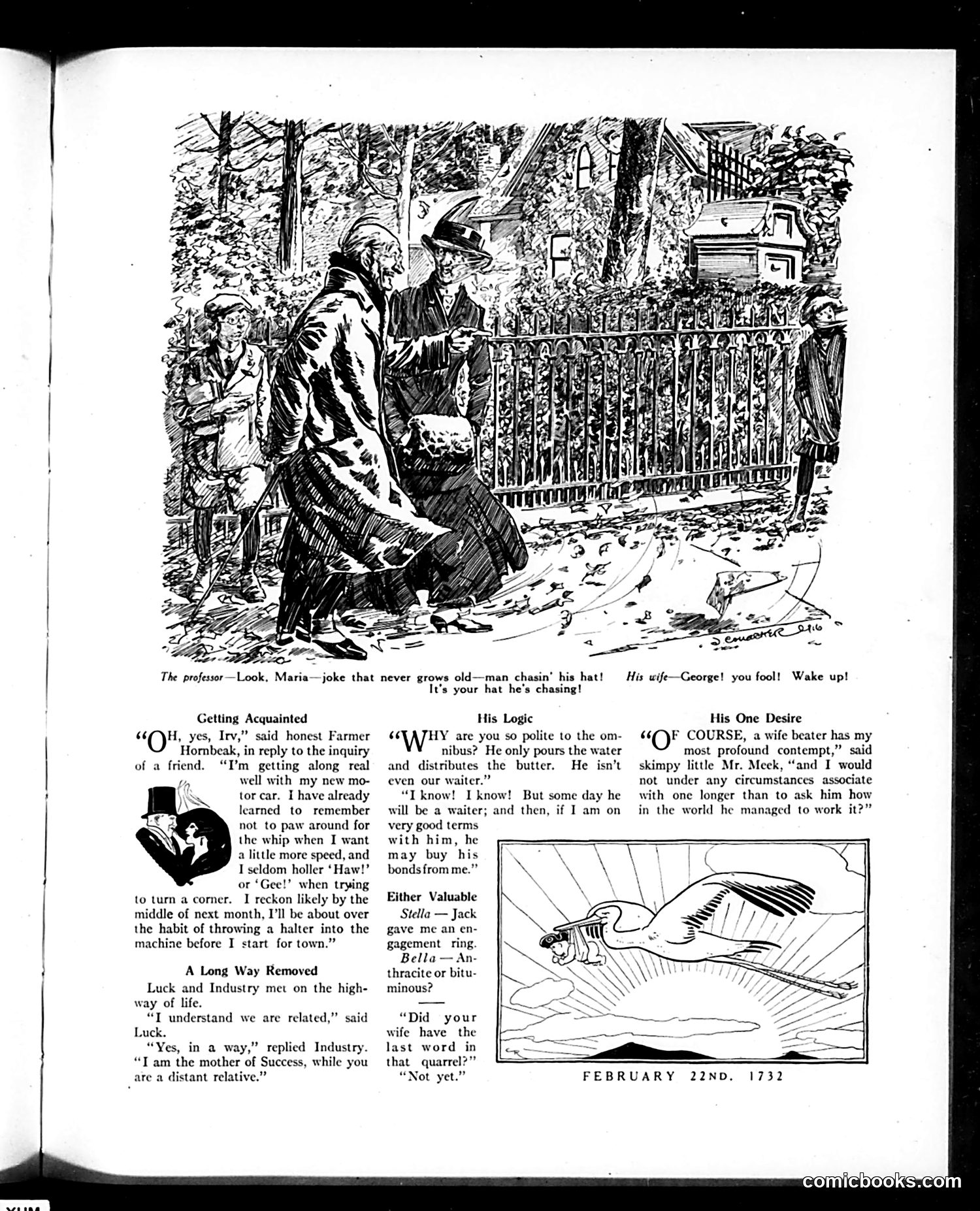
This page contains several short humorous sketches typical of Judge magazine's satirical format. **"Getting Acquainted"** presents a farmer boasting about his reckless driving habits—throwing the car into reverse without looking, rarely using brakes. The joke satirizes early automobile culture and reckless drivers who treated cars like horses. **"His Logic"** features dialogue about an omnibus (public transportation) driver's future prospects, suggesting working-class aspiration and social mobility anxieties. **"His One Desire"** jokes darkly about domestic abuse, with a wife-beater claiming his "profound ambition" is merely wanting a break from marriage. The bottom sketch ("A Long Way Removed") presents a brief exchange about distant relatives between "Luck" and "Industry," likely contrasting fortune versus hard work. The small illustration dated February 22, 1732 appears decorative rather than thematically connected.
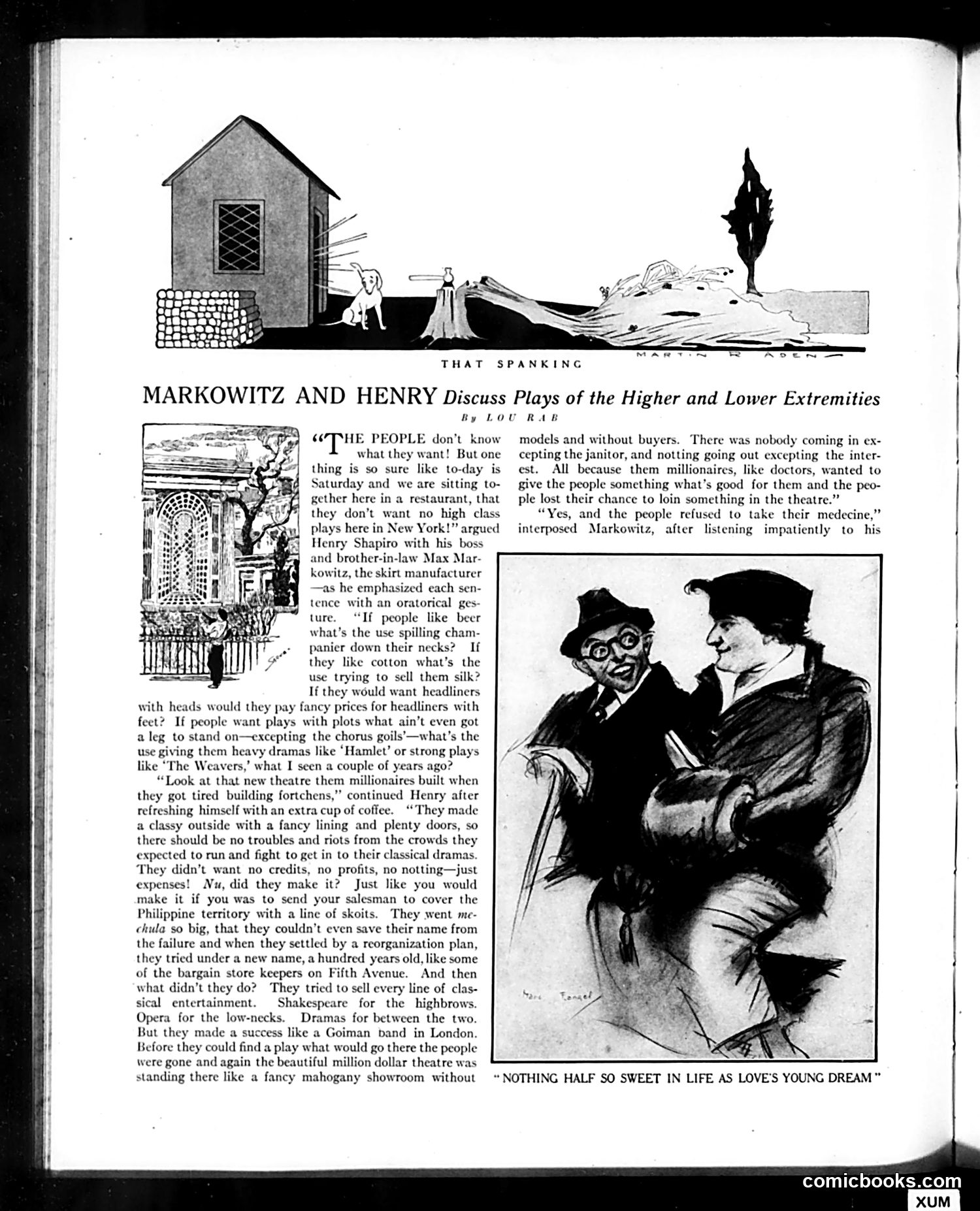
This page from *Judge* magazine features a discussion between two theatrical figures—likely Markowitz and Henry Shapiro (identified in the text as a skirt manufacturer and boss)—debating the commercial viability of serious drama. **The Satire's Point:** Henry argues that Broadway theaters built grand playhouses expecting to produce prestigious works like *Hamlet*, but failed because the business model was unsustainable. They couldn't attract audiences without gimmicks. He contrasts this with successful entertainment strategies: opera for wealthy patrons, dramas for middle-class audiences, and Shakespeare adaptations for mass appeal. **The Social Critique:** The satire mocks American theatrical commercialism—the impossibility of sustaining high art in a market-driven system. Theater owners couldn't survive on artistic merit alone; they needed profitable entertainment, ultimately resorting to lowbrow productions. The caption "Nothing Half So Sweet in Life as Love's Young Dream" appears ironic commentary on theatrical idealism versus market realities.
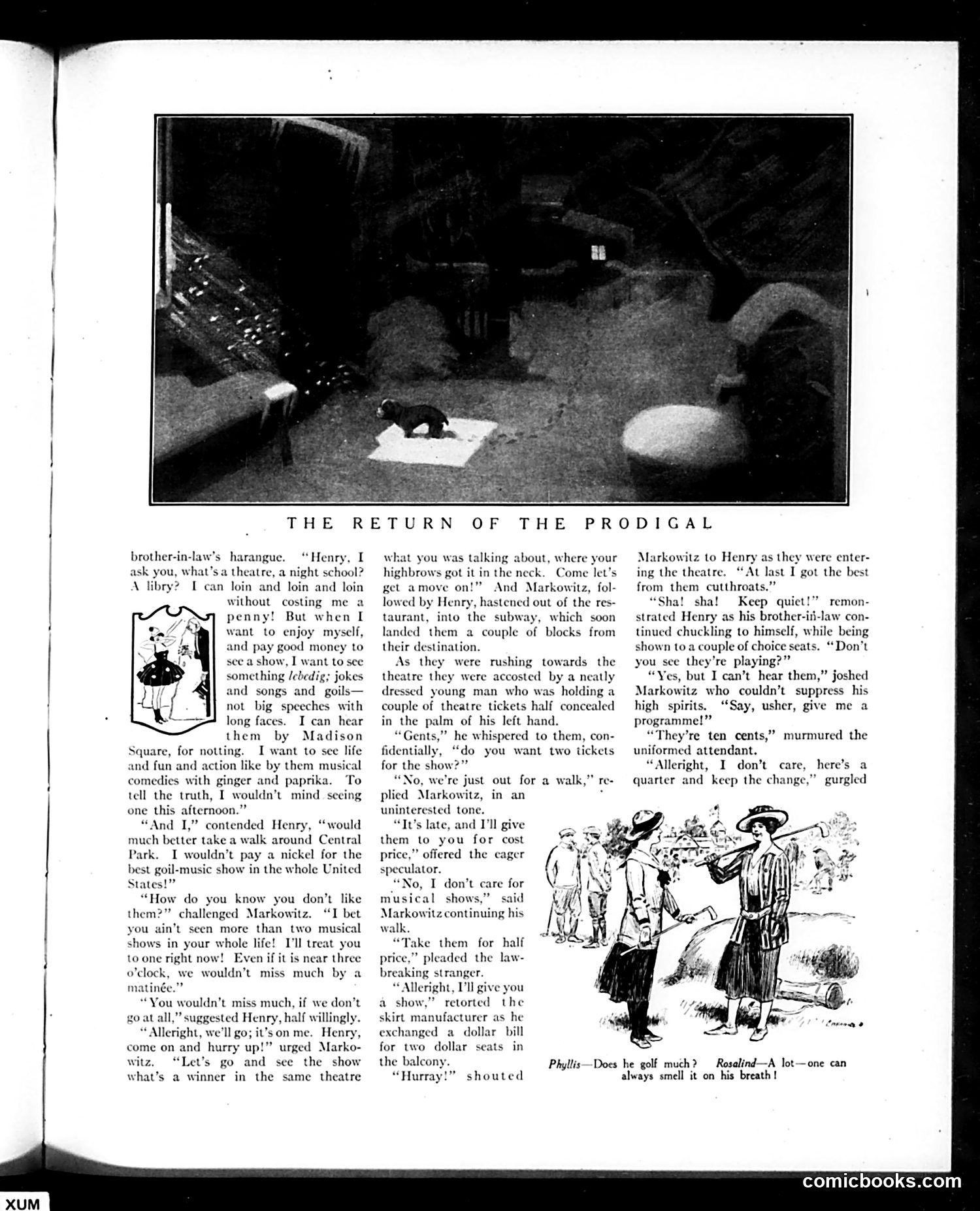
This is a satirical story about Jewish immigrants (Markowitz and Henry) arguing about entertainment values. Markowitz, a "skirt manufacturer" (garment industry worker), represents the nouveau riche who craves musical comedies and entertainment spectacle, while Henry advocates for free cultural pursuits like walks in Central Park. The humor targets Markowitz's conspicuous consumption and lack of sophistication: he grudgingly pays inflated prices from a scalper, tips lavishly at the theatre, and loudly enjoys himself during the show—violating genteel norms. The caption joke about golf-playing and breath appears unrelated, suggesting a separate cartoon. The satire reflects turn-of-century class anxieties about immigrants' spending habits and cultural assimilation, portraying Markowitz as the "prodigal" who wastefully throws money at entertainment rather than embrace restraint or self-improvement.
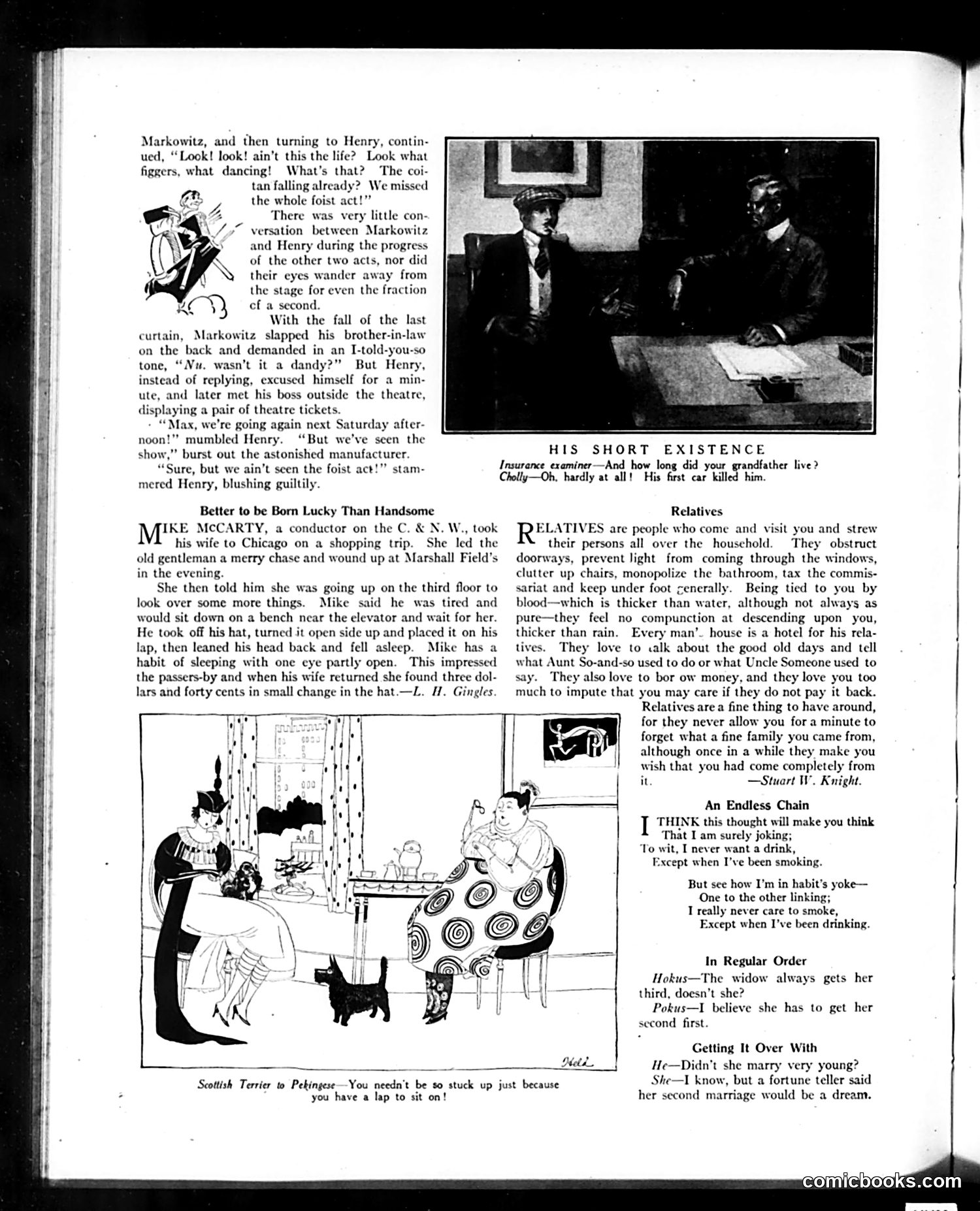
This page contains several short humor pieces typical of early 20th-century American satirical magazines: **"His Short Existence"**: A one-liner joke about an insurance examiner and a wealthy man ("Cholly") whose grandfather died in an automobile accident—satirizing the then-novel danger of motorcars to the elderly. **"Better to be Born Lucky Than Handsome"**: A anecdote about Mike McCarty, who fell asleep on a bench at Marshall Field's department store with his hat open on his lap. Passersby, apparently pitying his apparent poverty, dropped three dollars and forty cents in change—a gentle satire on both charitable impulses and sleeping in public. **"Relatives"**: An essay-style piece mocking relatives as household nuisances—people who visit uninvited, borrow money, obstruct spaces, and constantly remind you of family heritage while contributing nothing. The page also includes cartoons with captions about social behaviors and short comic verses about drinking and smoking habits. The humor relies on observational comedy about everyday middle-class life and social conventions of the era.
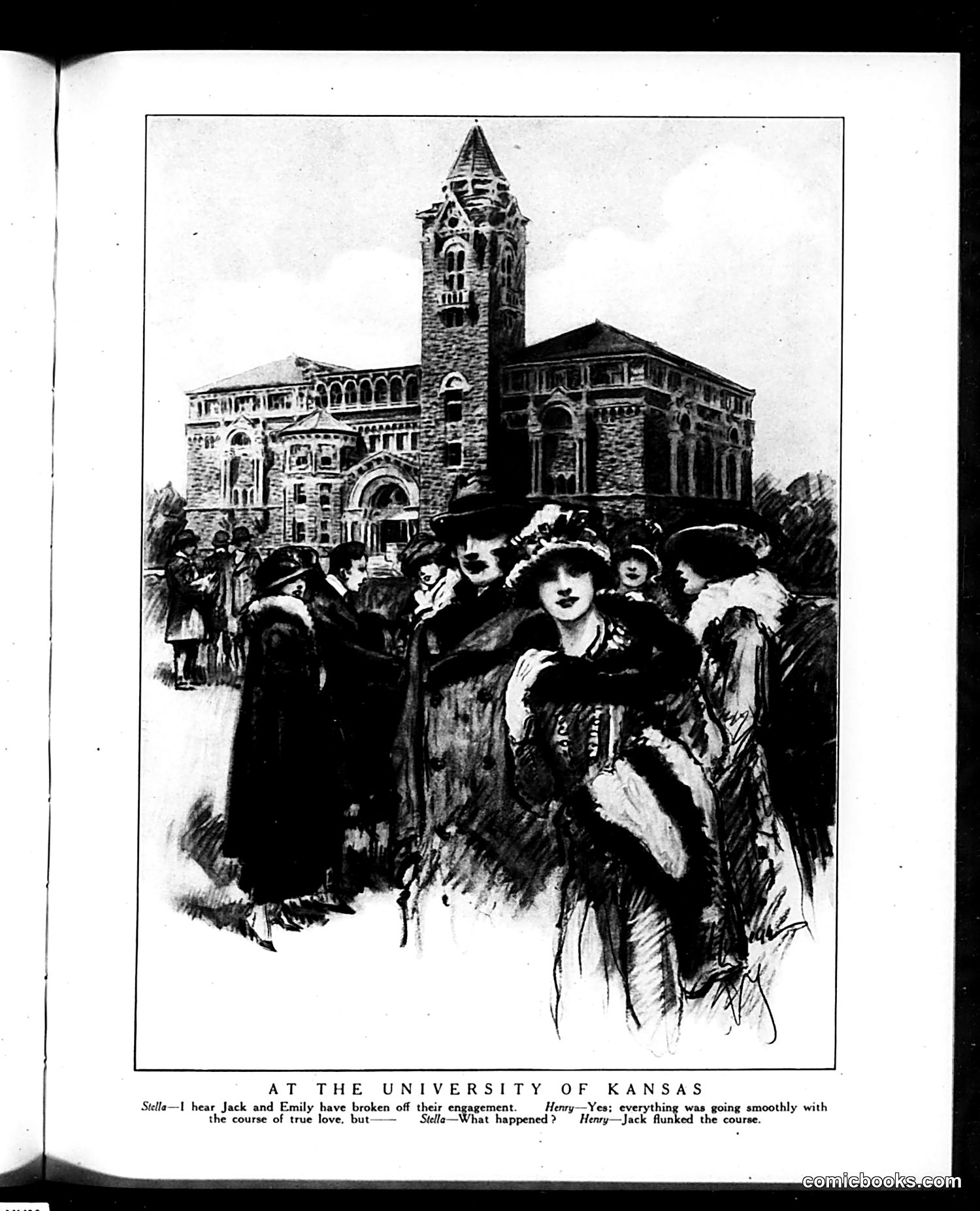
This is a comic sketch set at the University of Kansas depicting a romantic mishap with academic consequences. Two characters, Stella and Henry, discuss why Jack and Emily ended their engagement. The punchline reveals that Jack "flunked the course"—implying he failed an academic class, which caused Emily to break up with him. The humor relies on the audience expecting a dramatic romantic reason for the breakup, but instead getting a mundane academic failure. The sketch gently satirizes both the importance students (and their romantic partners) placed on academic performance in early 20th-century university life, and perhaps the superficiality of engagements based on social status rather than genuine affection. The Gothic architecture of the university building frames the scene as respectable and institutional.
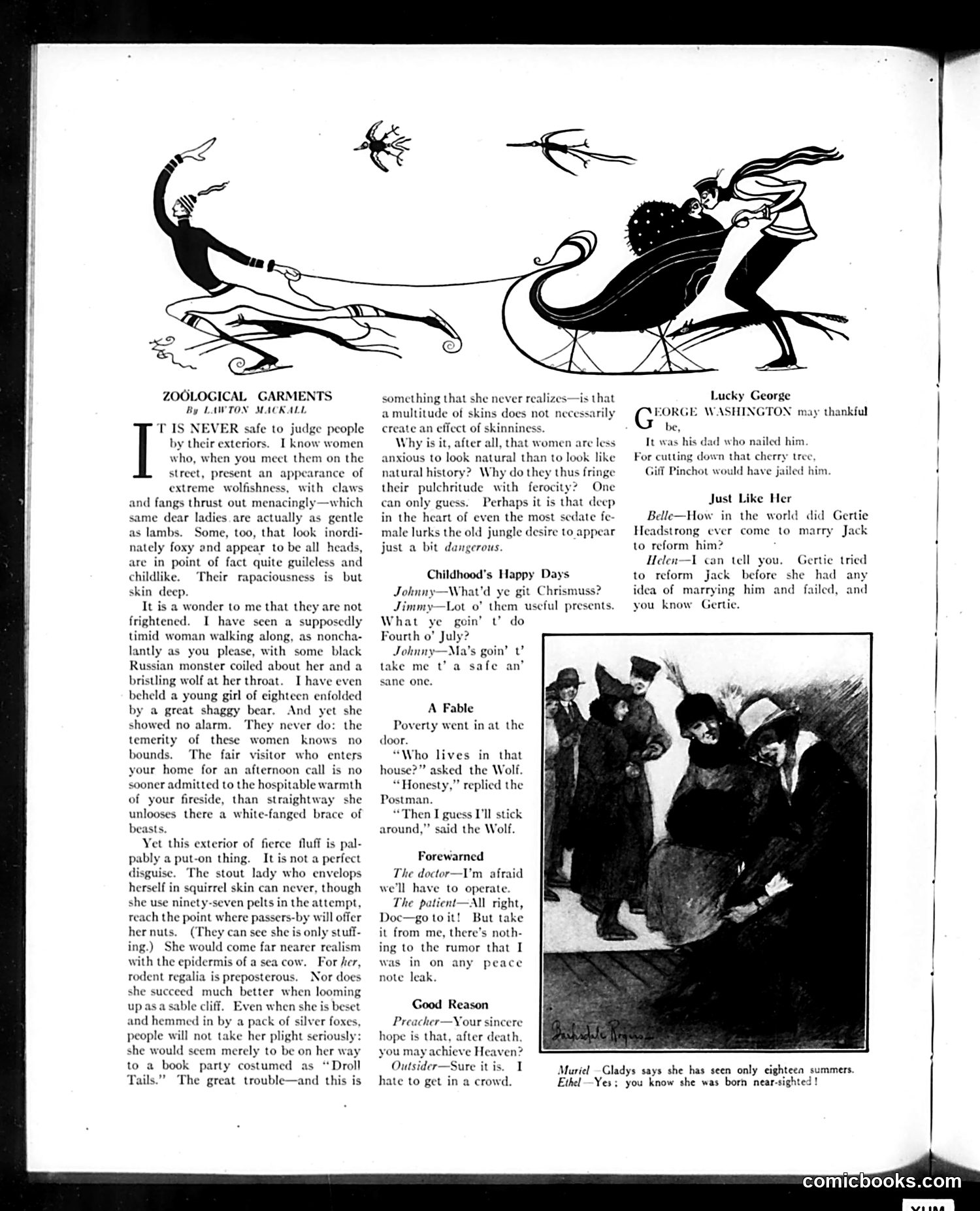
This satirical piece critiques women's fashion obsession with fur coats and animal-skin garments. The article uses exaggerated, mocking language to argue that women wear elaborate furs to appear dangerous or exotic, despite the garments being largely ineffective disguises. The cartoon at top illustrates the absurdity: a fashionable woman in furs is literally being pulled along by various wild animals, suggesting she's enslaved to this "zoological" fashion trend. Mackall's point is twofold: first, that wealthy women foolishly spend fortunes on furs hoping to seem fierce or alluring, when they merely look ridiculous; second, that this reflects a deep psychological desire among even respectable women to appear "dangerous"—a vestige of primitive instinct. The surrounding comic vignettes cover unrelated topics (childhood, poverty, religion). This reflects *Judge* magazine's typical format: satirical commentary mixed with humorous short pieces and social observation.
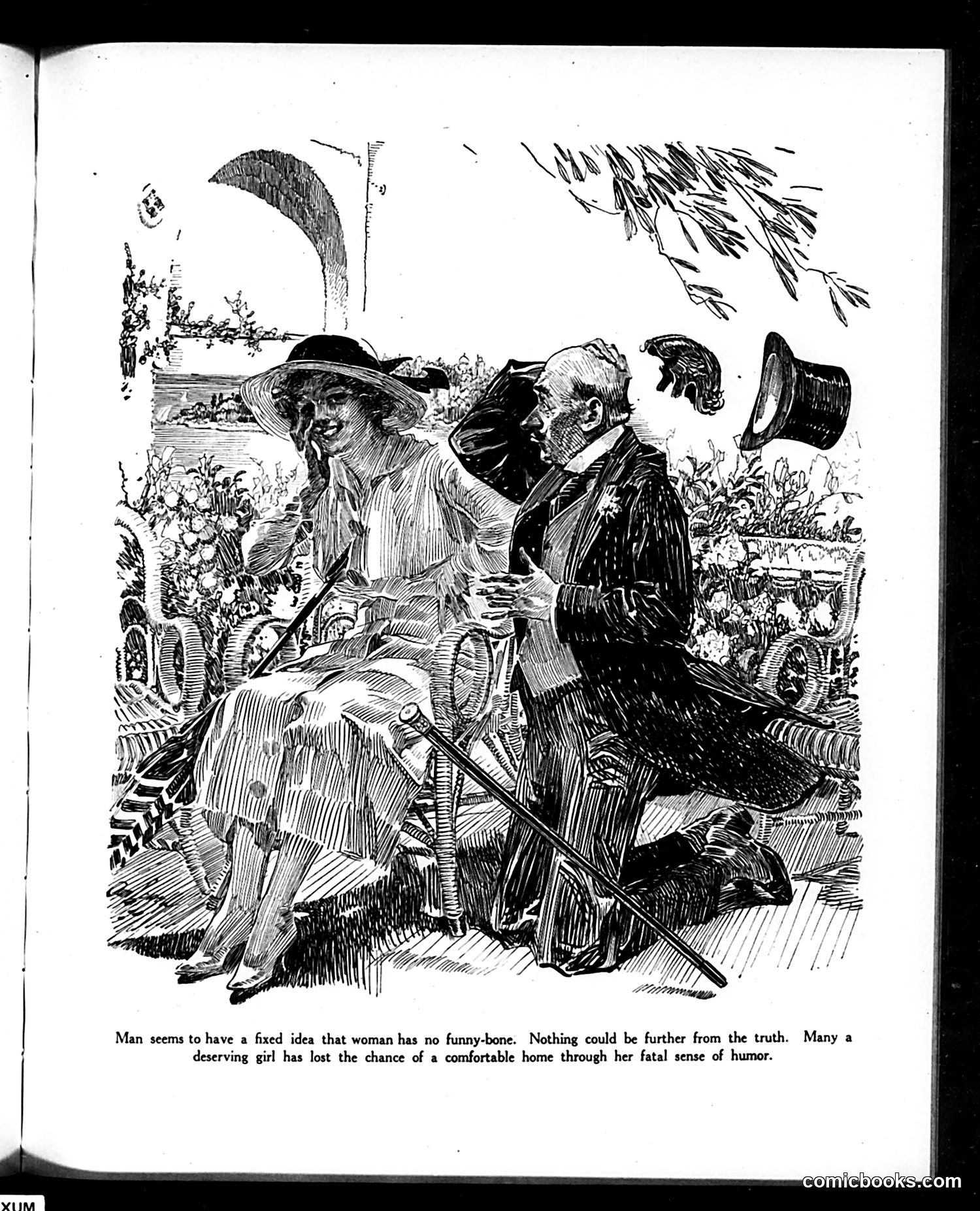
This Judge magazine cartoon satirizes Victorian-era gender expectations about women and humor. The illustration shows three figures in a garden setting—a woman in a hat speaking with two men, one holding a top hat. The caption argues that men wrongly believe women lack a sense of humor, and claims this misconception has caused women to lose marriage prospects. The satire suggests that women who display wit or humor are penalized socially—they lose "the chance of a comfortable home" (marriage being a woman's primary economic security then) because their humor threatens rigid masculine expectations of female propriety and demureness. The cartoon critiques both male prejudice and the social constraints forcing women to suppress their personalities to secure marriage.
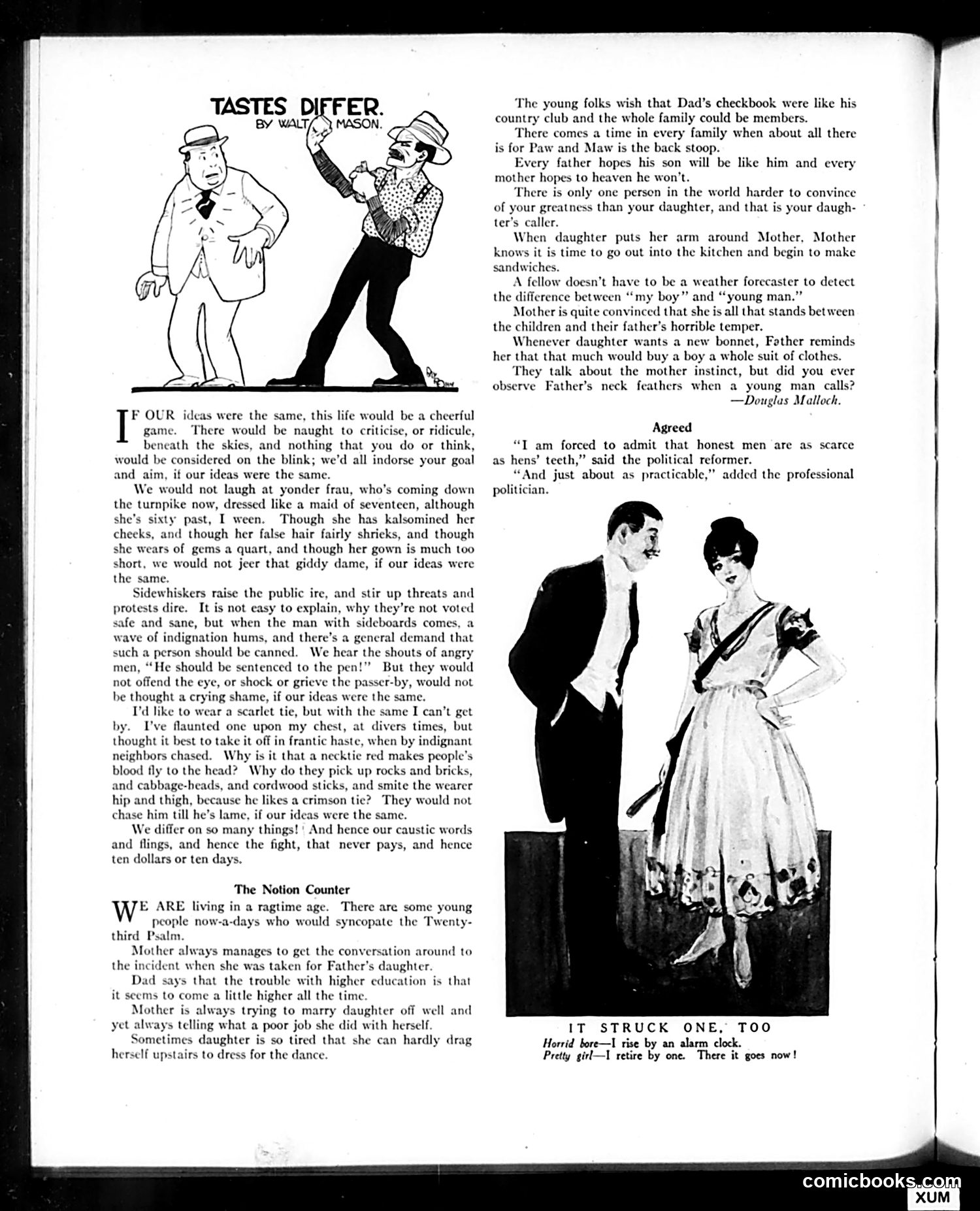
This page contains two satirical pieces targeting early 20th-century social conventions and family dynamics. **"Tastes Differ"** (top cartoon): Illustrates society's intolerance for nonconformity. The cartoon mocks how people attack those who dress unusually or wear unconventional items (the text specifically mentions a red necktie provoking violent public response). The satire argues that social friction stems from people's inability to tolerate differing opinions and appearances—if everyone thought alike, there'd be no conflict. **"The Notion Counter"** (middle section): A humorous collection of observations about family life, likely by Douglas Malloch. It satirizes parental hypocrisies: mothers wanting daughters to marry well while criticizing their own marriages; fathers hoping sons resemble them but mothers praying they don't; the family dynamics where mother mediates father's temper. **"Agreed"** (bottom cartoon): A brief joke where a political reformer and politician agree that honest men are as scarce as "hens' teeth"—implying even politicians recognize their own dishonesty. The page reflects Progressive-era critiques of social conformity and political corruption.
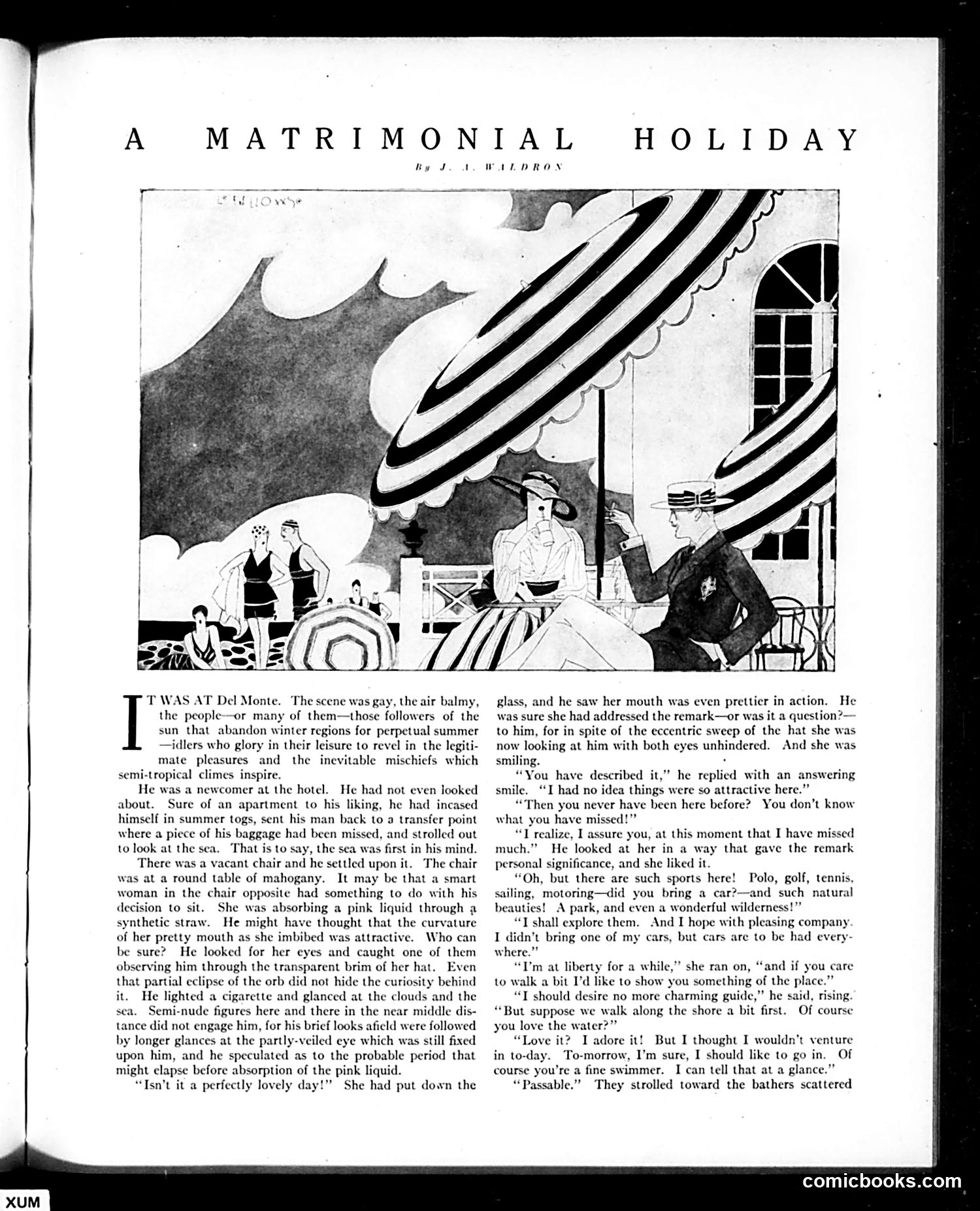
This is a romantic short story (not a political cartoon) set at Del Monte, a luxury California resort. The narrative depicts a chance meeting between a man and woman at the hotel. The man, a newcomer, sits by the sea and is observed by an attractive woman at a nearby table drinking through a straw. Their conversation develops from casual remarks about the resort's attractions (polo, golf, tennis, sailing) into clear mutual interest and flirtation. The "joke" or satirical angle appears to be the story's title—"A Matrimonial Holiday"—which suggests marriage, yet depicts instead a carefree vacation encounter between unattached people. The humor likely lies in the gap between the respectable, proper social conventions of the era and the modern, relaxed behavior of resort vacationers, where romantic encounters happen freely among the leisure class. The illustration shows striped beach umbrellas and fashionably dressed vacationers, emphasizing the resort's glamorous setting.
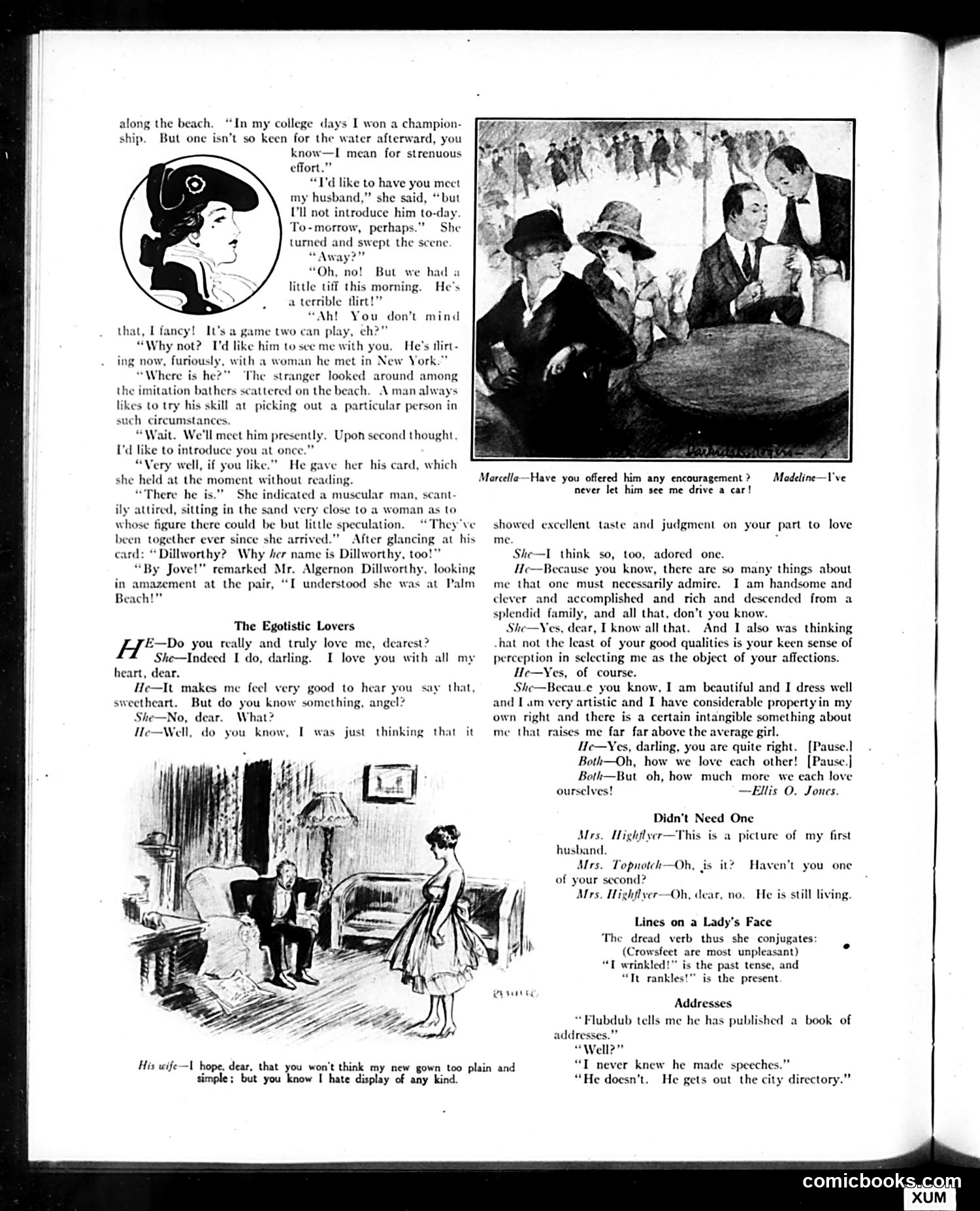
This page contains several short satirical pieces lampooning human vanity and marital dynamics: **"The Egotistic Lovers"** depicts a couple whose mutual declarations of love reveal pure narcissism—each praises the other mainly as validation of their own superiority. The punchline: they love *themselves* far more than each other. **The beach scene** (top) shows a woman introducing a stranger to her husband, who's flirting with another woman. The twist: the stranger discovers the "flirting" husband shares his surname—suggesting awkward complications or mistaken identity. **"Didn't Need One"** jokes about a woman's second husband still being alive, implying she cannot display his picture (likely because remarriage carried social stigma). **"Lines on a Lady's Face"** uses grammar conjugation to mock aging—wrinkles are conjugated as past tense ("wrinkled") and present ("rankles"). **"Addresses"** is a brief quip about a man publishing a book of addresses but never actually giving speeches, and obtaining the city directory (implying he merely copied it). The overall theme: human pretension, infidelity, and vanity in early 20th-century society.
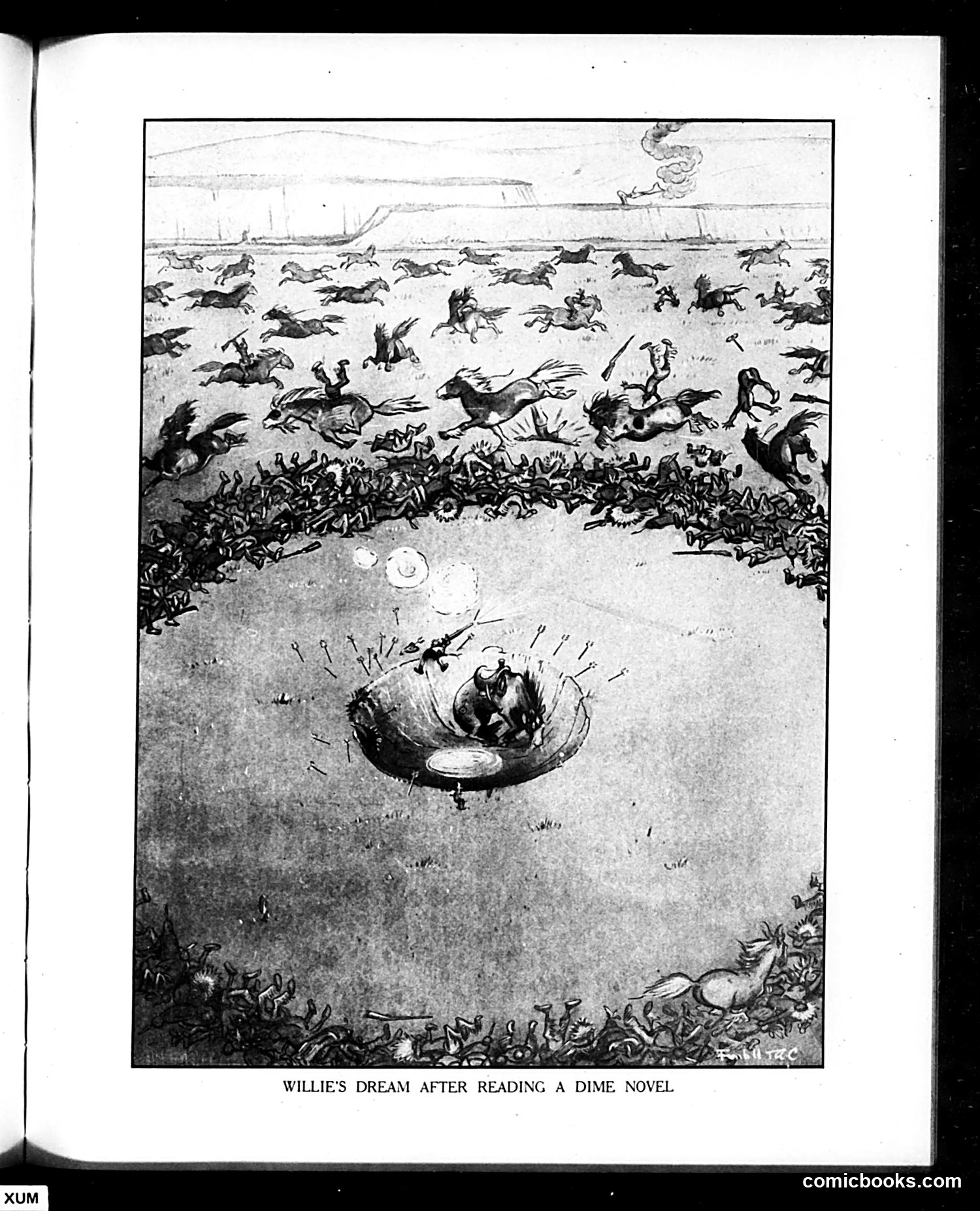
This satirical illustration depicts a young boy's fantastical dream inspired by reading "dime novels"—cheap, sensational adventure stories that were wildly popular and often considered morally corrupting by parents and educators in the late 19th/early 20th century. The cartoon shows "Willie" imagining himself at the center of an action-packed frontier scene: cowboys on horseback galloping across plains, Native Americans, gunfire, and dramatic combat. A UFO-like vessel hovers above, suggesting the fantastical, impossible nature of the dream. The satire targets concerns about dime novels' influence on youth—their depiction of violence, lawlessness, and wild adventure was believed to overstimulate young imaginations and encourage dangerous behavior. Judge magazine, as an upper-class satirical publication, likely mocked both the sensational literature and the anxieties it provoked among respectable society.
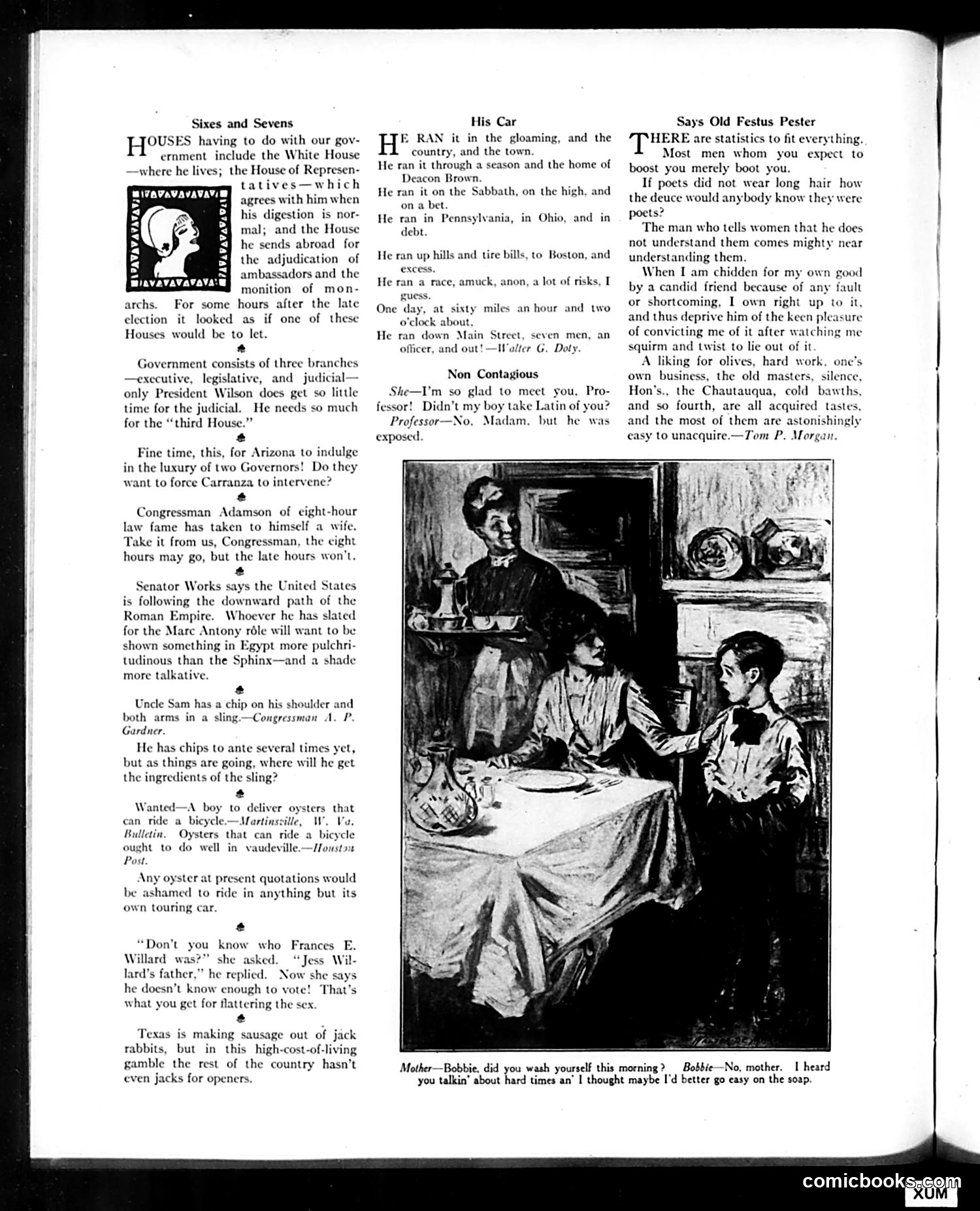
This page from Judge magazine contains political and social satire typical of the publication. The main content includes: **"Sixes and Sevens"** — Brief satirical comments on government, referencing President Wilson's workload and Arizona's dual-governor dispute (likely related to Mexican intervention debates). **"His Car"** — A poem mocking reckless automobile driving and excessive spending, reflecting early-1900s anxiety about this new technology and irresponsible motorists endangering pedestrians. **"Says Old Festus Pester"** — Aphoristic humor about human nature, poets, women, and social pretension. **"Non Contagious"** — A joke playing on "exposure" to a professor's Latin instruction. **The illustration** depicts a mother and two children, with a caption about a boy avoiding soap during hard economic times—likely Depression-era commentary on poverty. The overall tone reflects Judge's satirical stance toward government inefficiency, modern technology's dangers, and economic hardship.
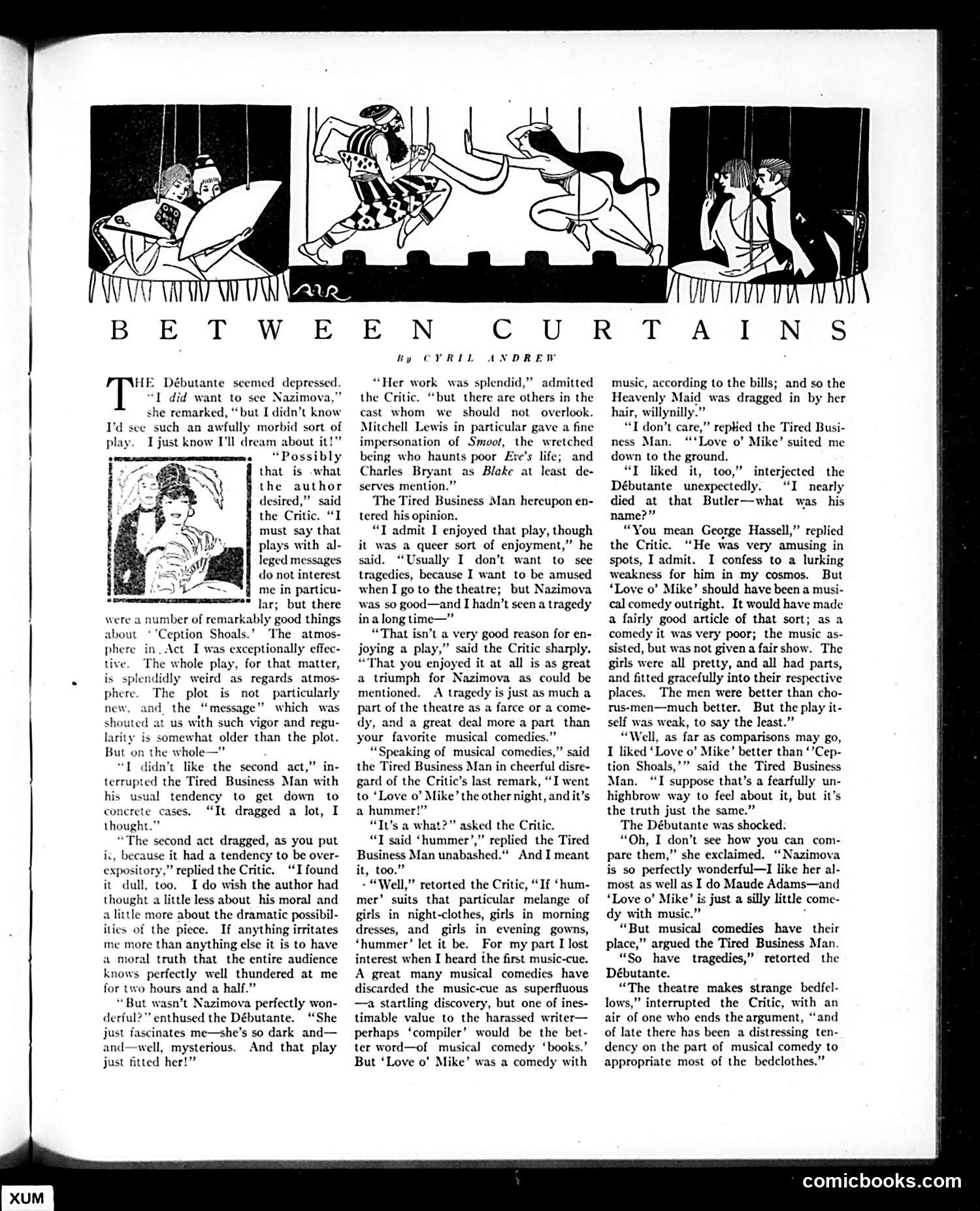
This theatrical criticism column presents a conversation between three characters discussing recent Broadway productions: a naive young Débutante, a pretentious Critic, and a pragmatic Tired Business Man. The satire targets the clash between serious dramatic art and popular entertainment. The Critic champions substantial theatre—praising Nazimova's tragic performance and dismissing musicals like "Love o' Mike" as frivolous spectacle (mere "girls in night-clothes"). Meanwhile, the Tired Business Man and Débutante openly prefer entertainment over moral instruction, enjoying plays purely for amusement. The piece mocks both camps: the Critic's pompous insistence that audiences should value artistic merit over enjoyment, and the general public's indifference to theatrical "messages." The humor lies in their mutual incomprehension—the Critic cannot fathom why anyone would enjoy a tragedy solely because the star was good, while the ordinary theatregoers simply want to be entertained, not lectured. This reflects early 20th-century debates about Broadway's purpose: art versus commerce, highbrow versus popular taste.
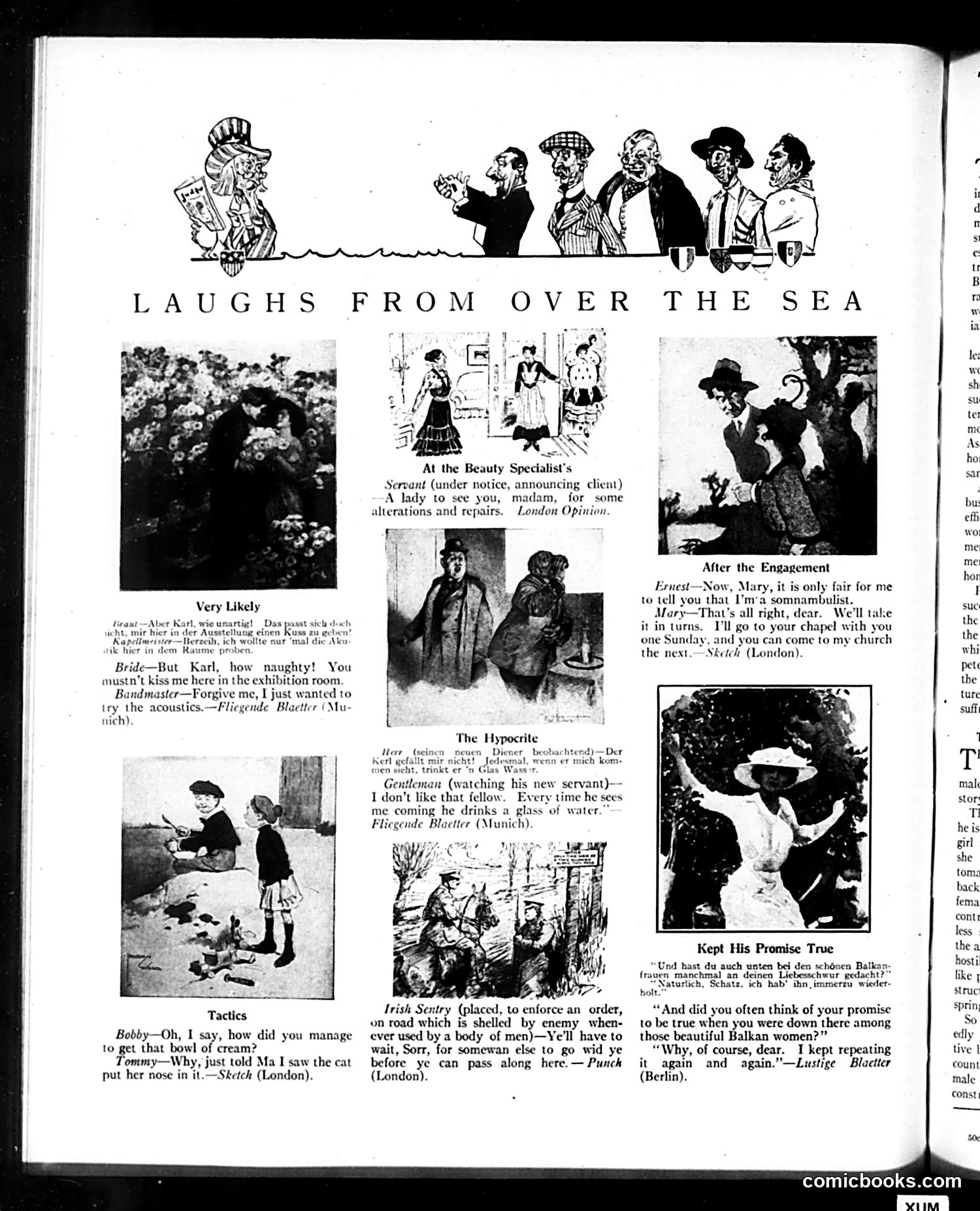
This page collects humorous anecdotes translated from European satirical magazines (Punch, Sketch, Fliegende Blaetter, Lustige Blaetter). The jokes rely on simple domestic and social scenarios: **"Very Likely"**: A bride scolds her groom for kissing her in a public exhibition room. **"Tactics"**: A child tricks his mother by falsely claiming the cat put its nose in cream, securing a bowl for himself. **"The Hypocrite"**: A gentleman dislikes his new servant because the man drinks water whenever visiting. **"Irish Sentry"**: An Irish soldier enforces a wartime road rule requiring pedestrians to travel in groups for safety. **"After the Engagement"**: An engaged couple humorously negotiate religious differences by alternating church attendance. **"Kept His Promise"**: A soldier claims he repeatedly recited his faithfulness pledge while stationed in the Balkans—the joke implying dubious sincerity. These are light, family-friendly humor pieces with no apparent political agenda, simply showcasing international comedic sensibilities of the era.
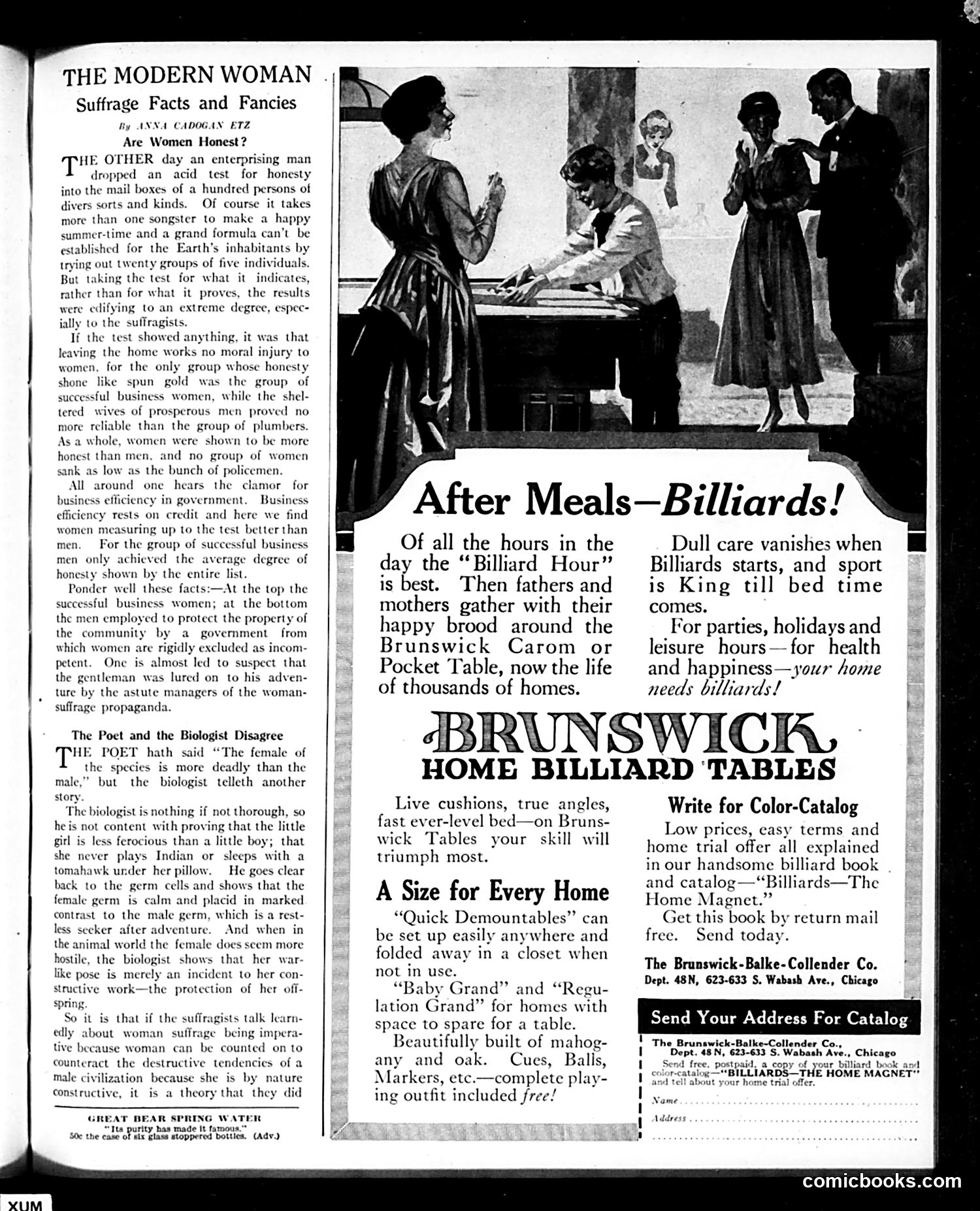
This page combines two satirical articles about "The Modern Woman" with a full-page billiard table advertisement—a juxtaposition that itself constitutes satire. **The Articles' Point:** Both pieces argue against anti-suffrage claims using mock-scientific evidence. The first presents an "honesty test" showing businesswomen outperformed businessmen, undermining claims women are unfit for public life. The second ridicules the biological argument that women are "naturally" passive by citing germ cells, then notes suffragists ironically use this same "natural constructiveness" argument to justify voting rights. **The Satire:** The articles mock both suffragists and anti-suffragists—the latter for their contradictory, pseudo-scientific objections to women's participation; the former for borrowing dubious biology to support their cause. **The Advertisement's Irony:** Immediately below sits an ad depicting men and women enjoying billiards together as a wholesome family activity. The placement suggests that while these debates rage, women are already participating in domestic leisure alongside men—implicitly questioning why they couldn't vote. The overall effect satirizes the gap between rhetorical fears about women's role and actual social reality.
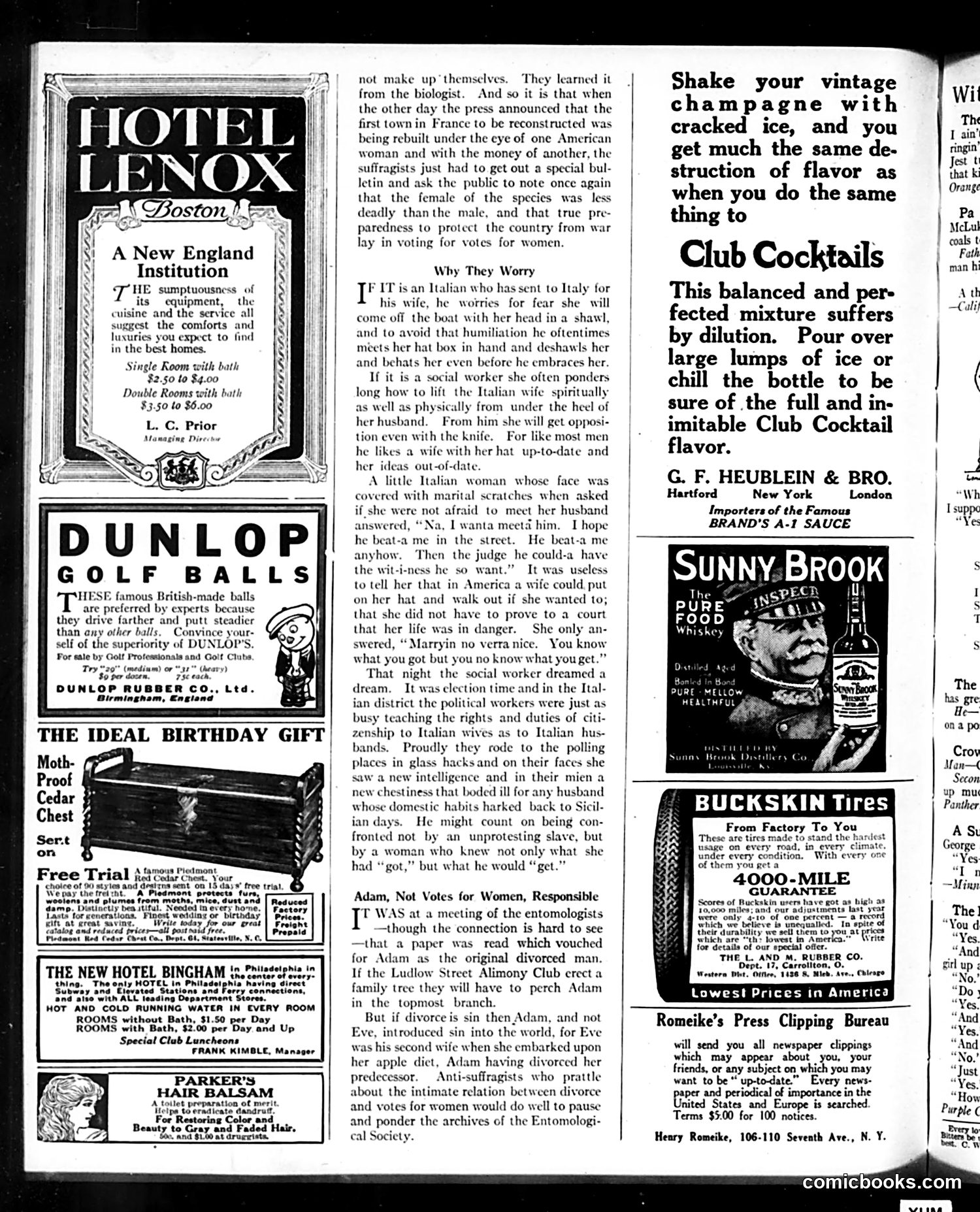
This page is primarily **advertising**, not political satire. However, the main article—"Why They Worry"—contains satirical commentary on women's suffrage and Italian immigration. The piece mocks both Italian husbands' anxiety about their wives' "modernization" and social workers' efforts to "uplift" immigrant women. It portrays an Italian woman who prefers her husband's beatings to American legal protections, dismissing women's rights as irrelevant to her life. The satire's point appears to be **anti-suffrage**: it suggests that voting rights are meaningless to working-class immigrant women who operate under entirely different cultural values. The final section jokingly traces divorce back to Adam, further trivializing women's rights concerns. The advertisements surrounding this content—for hotels, golf balls, hair treatments—are typical Judge magazine filler with no political message.
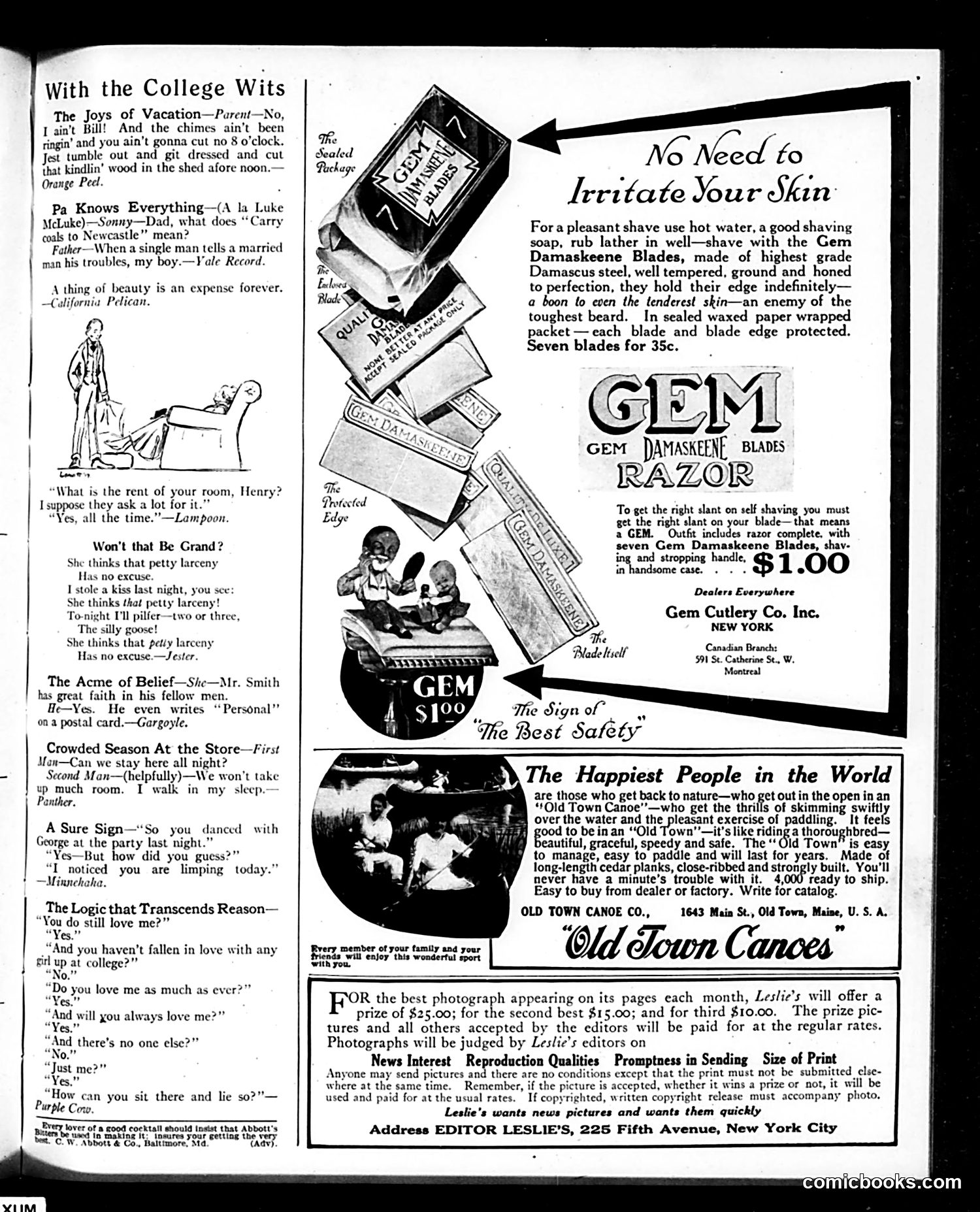
This page from *Judge* magazine contains humor columns ("With the College Wits") alongside advertisements. The columns are brief, interconnected jokes from various college publications: **The humor** targets familiar early-20th-century situations: parents expecting vacation work rather than leisure; fathers dispensing questionable wisdom; young romance ("petty larceny" of kisses); office crowding; and relationship logic. The "Logic that Transcends Reason" joke plays on a boyfriend's contradictory reassurances about fidelity—he claims undivided love while admitting he hasn't fallen for college girls, which she (logically) finds suspicious. **The satire** is gentle, relying on wordplay and domestic situations rather than political commentary. References like "Luke McLake" and college-paper attributions (Yale, Lampoon, Gargoyle) suggest these are contemporary in-jokes among educated readers. **The advertisements**—Gem razor blades, Old Town Canoes, and Abbott's Bitters—reflect early-1900s consumer culture targeting middle-class men. The page reflects *Judge's* dual function as satirical humor magazine and advertising vehicle.
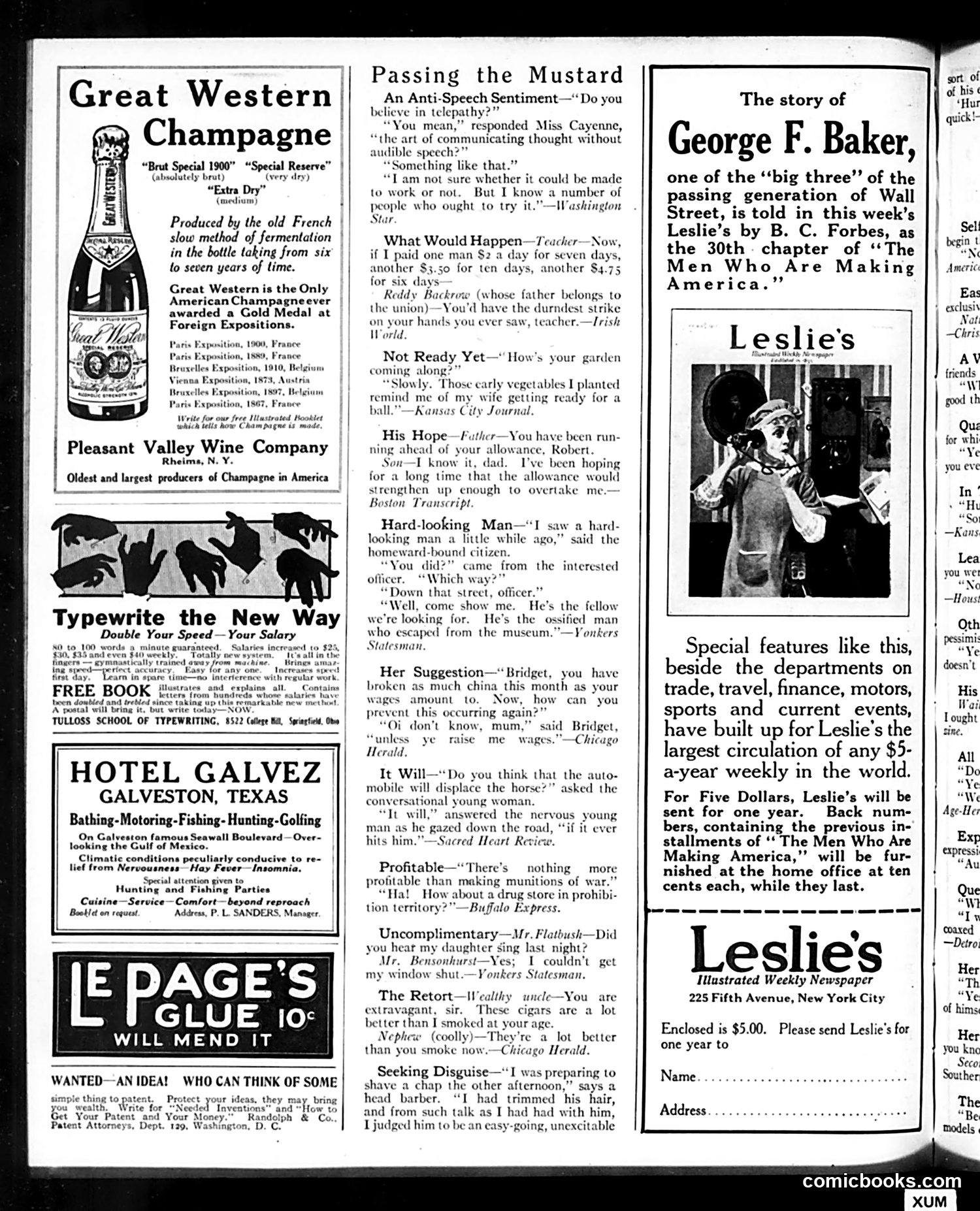
This page is primarily **advertising and editorial promotion** rather than political satire. The main content includes: **Advertisements:** Great Western Champagne, Hotel Galvez, typewriter training school, and Le Page's Glue dominate the layout. **"Passing the Mustard" Section:** A humor column featuring short jokes and anecdotes—typical of Judge magazine's satirical content. The jokes mock contemporary subjects: a man skeptical that telepathy could work better than speech; union workers threatening strikes over wage disputes; an automobile replacing horses; drug stores profiting from Prohibition; and a barber's difficulty with a chatty customer. These are gentle, domestic humor rather than sharp political commentary. **Leslie's Advertisement:** Promotes serialized biography of Wall Street financier George F. Baker as "one of the 'big three'"—likely referring to influential banking figures of the era. The page reflects early 20th-century concerns (unions, Prohibition, automobiles) through lighthearted jokes rather than incisive political cartooning.
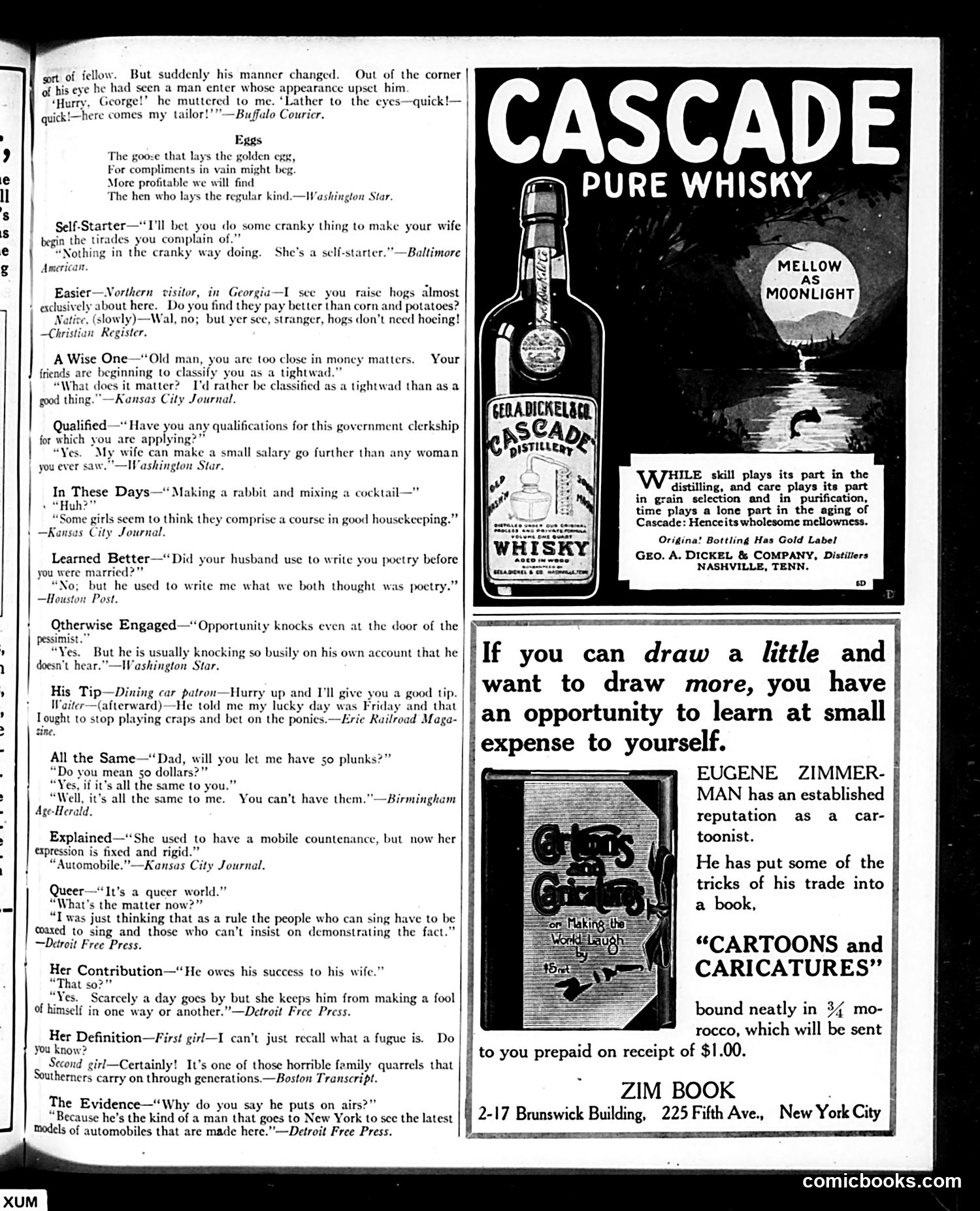
This page from Judge (a satirical weekly) contains primarily **humorous one-liners and short jokes** rather than political cartoons. The humor targets domestic life, regional stereotypes, and social pretensions common to early 20th-century America. Notable jokes include quips about tailors (suggesting anxiety about debt), wives as "self-starters" (independent-minded), and a Georgia farmer noting hogs don't need "hoeing" (playing on regional ignorance). One joke mocks a man called a "tightwad" for being frugal with friends. **The advertisements** include Cascade Pure Whisky (emphasizing its aging and mellowness) and a Eugene Zimmerman cartooning instruction book, offering to teach drawing skills. The overall tone is lighthearted domestic and social satire typical of Judge's formula: poking fun at marriage dynamics, class anxieties, regional differences, and gender roles without deeper political intent.
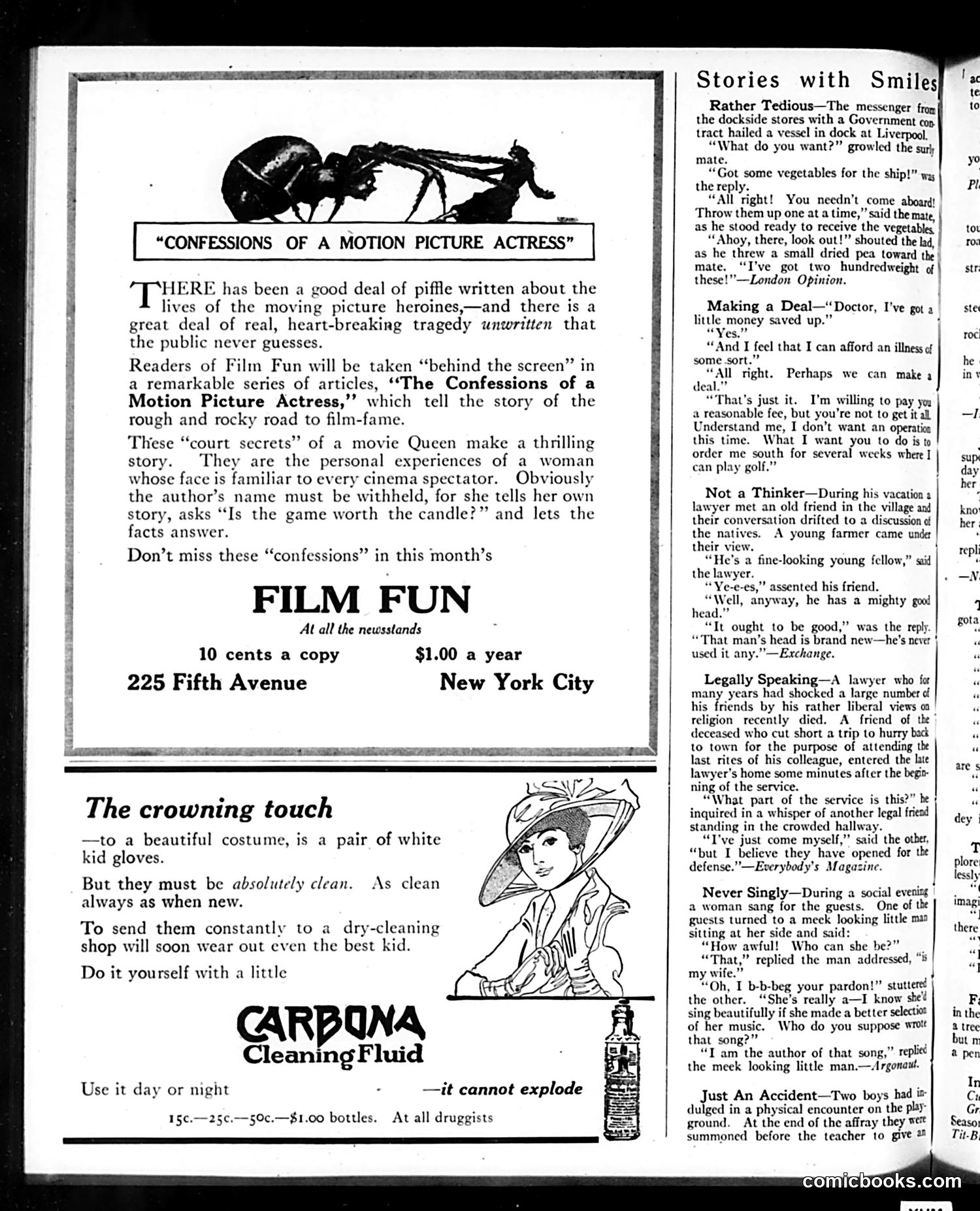
This page mixes advertising with satirical humor content typical of early 20th-century Judge magazine. **Main Content:** The page advertises "Film Fun," a companion publication featuring confessional articles supposedly by unnamed motion picture actresses, playing on public fascination with Hollywood's behind-the-scenes lives. The tagline "Is the game worth the candle?" suggests skepticism about the glamorous film industry. **The Cartoons:** Below are brief humorous anecdotes (not political cartoons). They mock various social types through wordplay and irony: a ship's mate misunderstanding "hundredweight" produce as individual peas; a doctor willing to prescribe a vacation but not surgery; a farmer's unused brain; and a wife's poor singing voice. These represent genteel humor mocking everyday people and domestic situations. **Advertising:** Carbona Cleaning Fluid advertisement targets women maintaining white kid gloves—positioning household chemistry as essential to proper feminine appearance. The page reflects 1920s attitudes: fascination with celebrity culture, mild misogyny, and class-based humor.
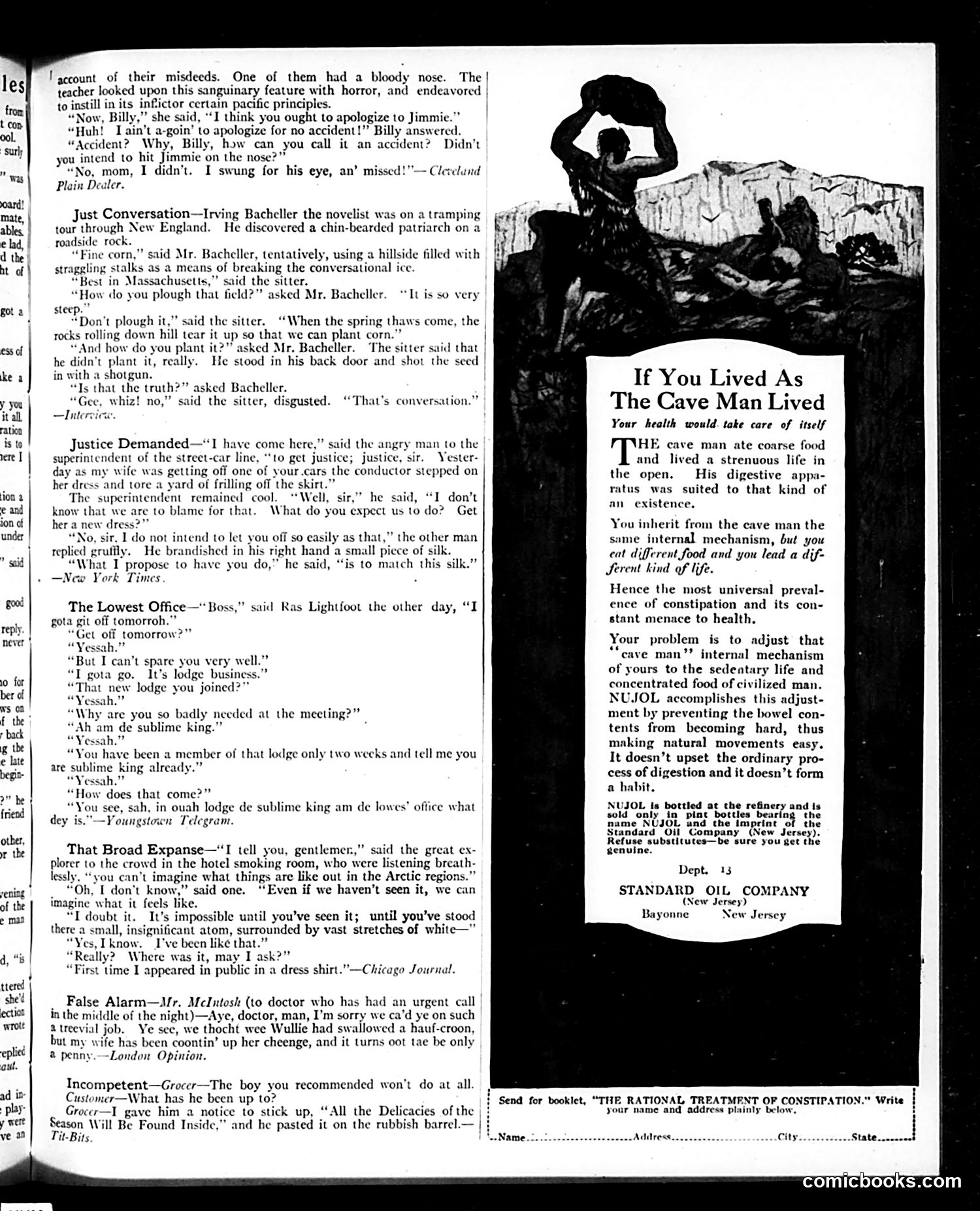
This page contains several brief satirical humor pieces typical of early-20th-century Judge magazine: **"Just Conversation"** mocks New England rural life through a novelist's encounter with a farmer who exaggerates absurdly (shooting seeds from a shotgun), then dismisses his own tall tale as mere "conversation." **"Justice Demanded"** satirizes a petty dispute where a man demands a streetcar conductor match a small silk swatch torn from his wife's dress—reducing genuine grievance procedures to absurdity. **"The Lowest Office"** plays on racial stereotypes, featuring an African American employee ("Ras Lightfoot") joining a lodge where "sublime king" is the *lowest* position—humor based on inverting hierarchy and dialect. **"That Broad Expanse"** jokes about an Arctic explorer's claims of indescribable vastness, undercut when someone compares it to wearing a dress shirt in public for the first time. The right page advertises **NUJOL**, a constipation remedy, using pseudo-medical language about digestive health.
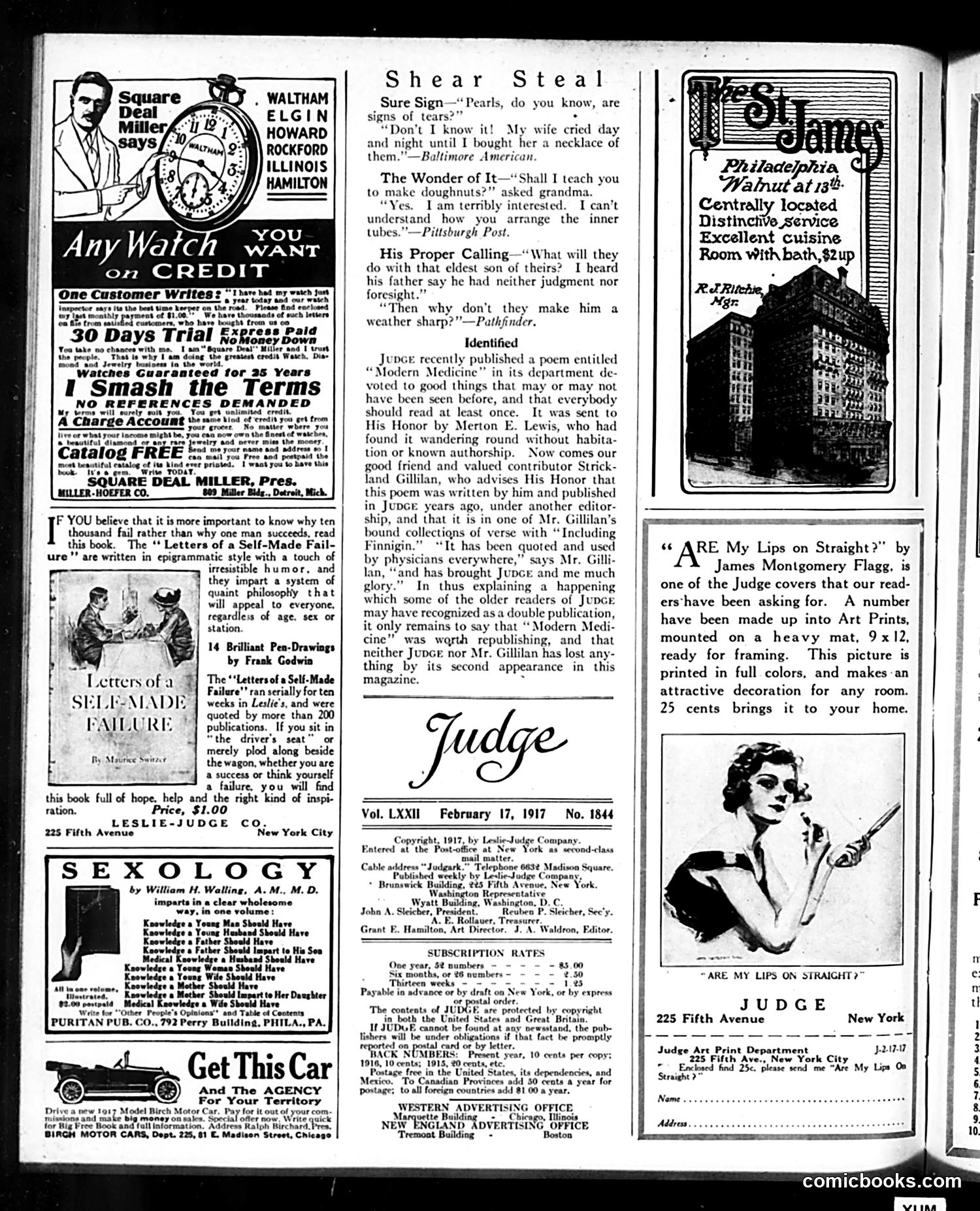
This is primarily an **advertising and miscellaneous content page** rather than a satirical cartoon page. The page consists mainly of period advertisements for watches, books, automobiles, and correspondence courses. The only substantive editorial content is a brief section titled **"Identified,"** which discusses a humorous situation involving a poem. Judge editor J.A. Waldron explains that contributor Strickland Gillilan claimed authorship of a poem titled "Modern Medicine," but the magazine's records show it was previously published years earlier under different editorship. Waldron diplomatically resolves the dispute, noting both the magazine and Gillilan deserve credit—it's "worth republishing" and neither party lost anything by the second publication. The humor is gentle and self-referential rather than politically pointed: it's an **in-joke about attribution disputes** within literary/magazine circles of the era. The page otherwise reflects typical 1917 advertising: automobile agencies, self-help books, and educational correspondence courses.
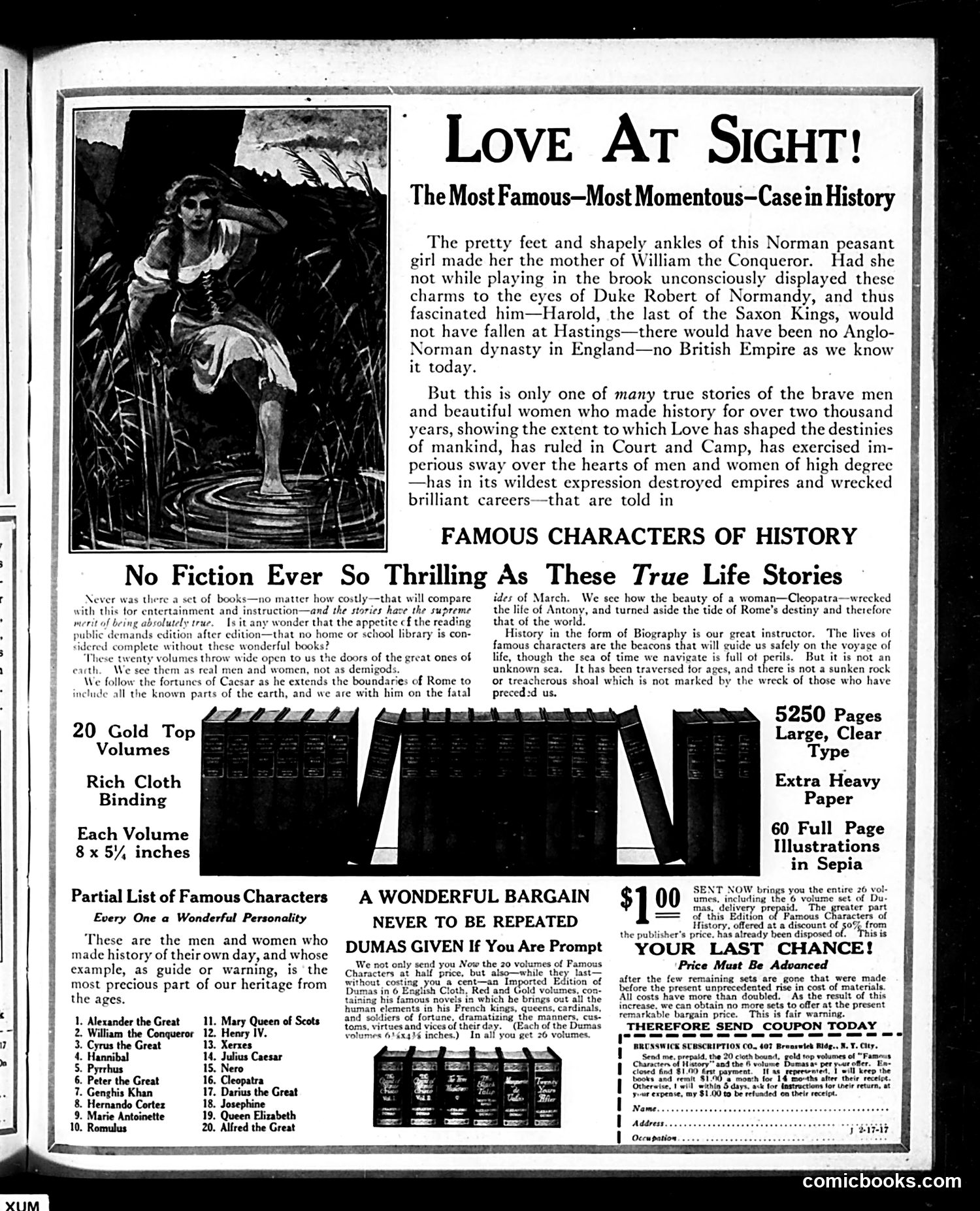
This is primarily a **book advertisement**, not political satire. It promotes a 20-volume set titled "Famous Characters of History" through an editorial-style pitch. The page opens with a historical anecdote: a Norman peasant girl whose "pretty feet and shapely ankles" caught Duke Robert of Normandy's eye, leading to William the Conqueror's birth. The advertisement argues this romance altered English history—no Anglo-Norman dynasty, no British Empire. The appeal is straightforward: history presented as biography is entertaining and instructive. The advertiser emphasizes these are **true stories**, not fiction, positioning the set as both morally edifying and thrilling. Featured figures include Alexander the Great, Julius Caesar, Cleopatra, and Napoleon. The offer itself is the hook: 20 volumes in "rich cloth binding" **at half price**, plus a bonus Dumas set, totaling 26 volumes for $1.00—explicitly labeled "never to be repeated." This reflects **early 20th-century educational marketing**: packaging history as dramatic narratives for middle-class home libraries, combining intellectual aspiration with irresistible bargain pricing.
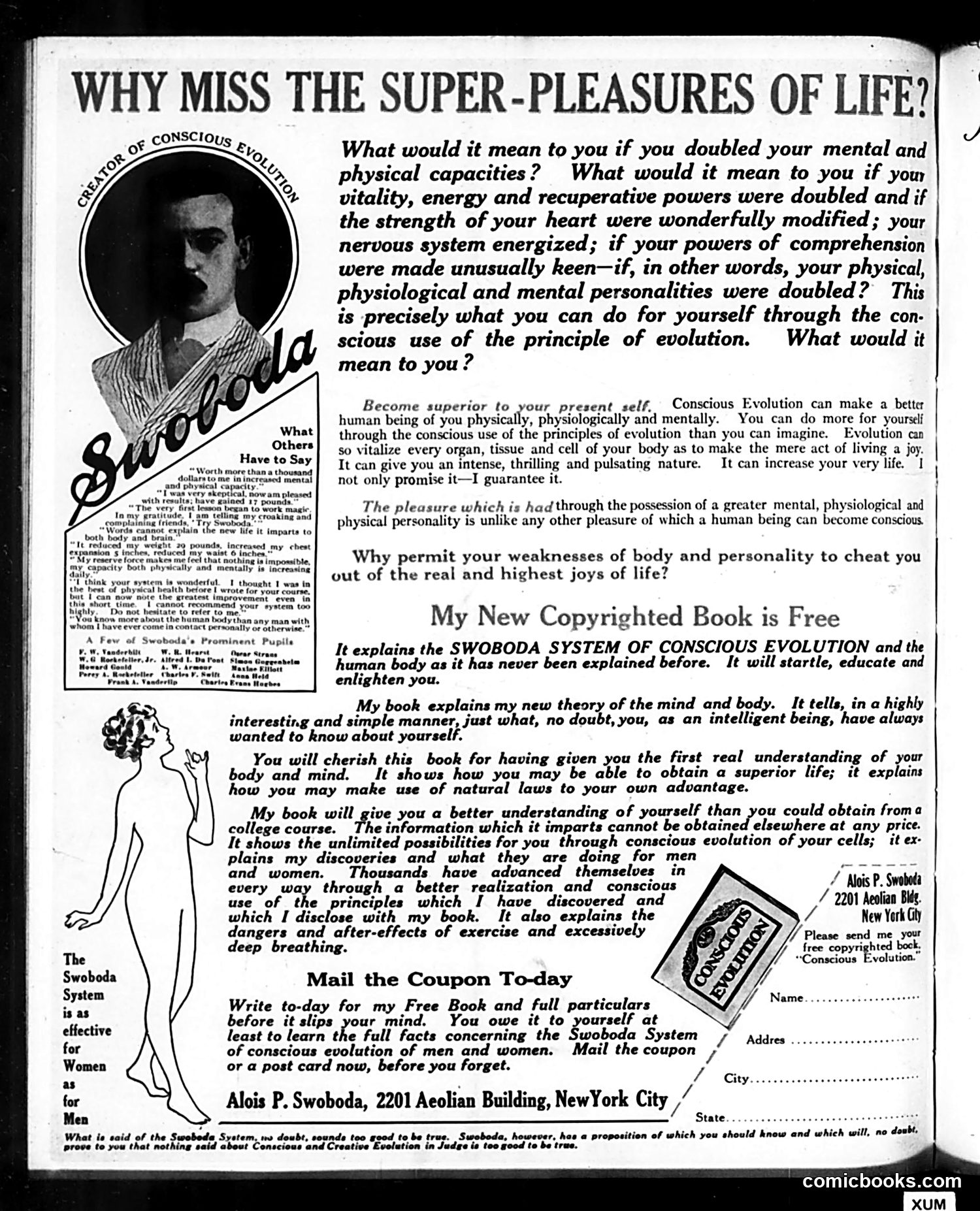
This is **not a cartoon or satire**—it's a full-page advertisement for "Conscious Evolution," a pseudo-scientific self-improvement system promoted by Alois P. Swoboda. The page features his portrait and testimonials claiming his method can double one's mental and physical capacities through evolutionary principles. The ad promises readers they can dramatically improve their bodies, energy, and minds by following Swoboda's system. It includes a free book offer and a coupon for interested parties. The inclusion in *Judge* magazine—known for satire—is notable. The ad's grandiose claims ("unlimited possibilities," guaranteed results) and pseudoscientific language ("conscious evolution of your cells") appear designed to appeal to early 20th-century readers' fascination with self-improvement and pseudo-Darwinian thinking. Whether *Judge* published this earnestly or ironically is unclear from the page alone.