
Judge, 1917-02-17 · page 17 of 28
Judge — February 17, 1917 — page 17: what you’re looking at
What you’re looking at
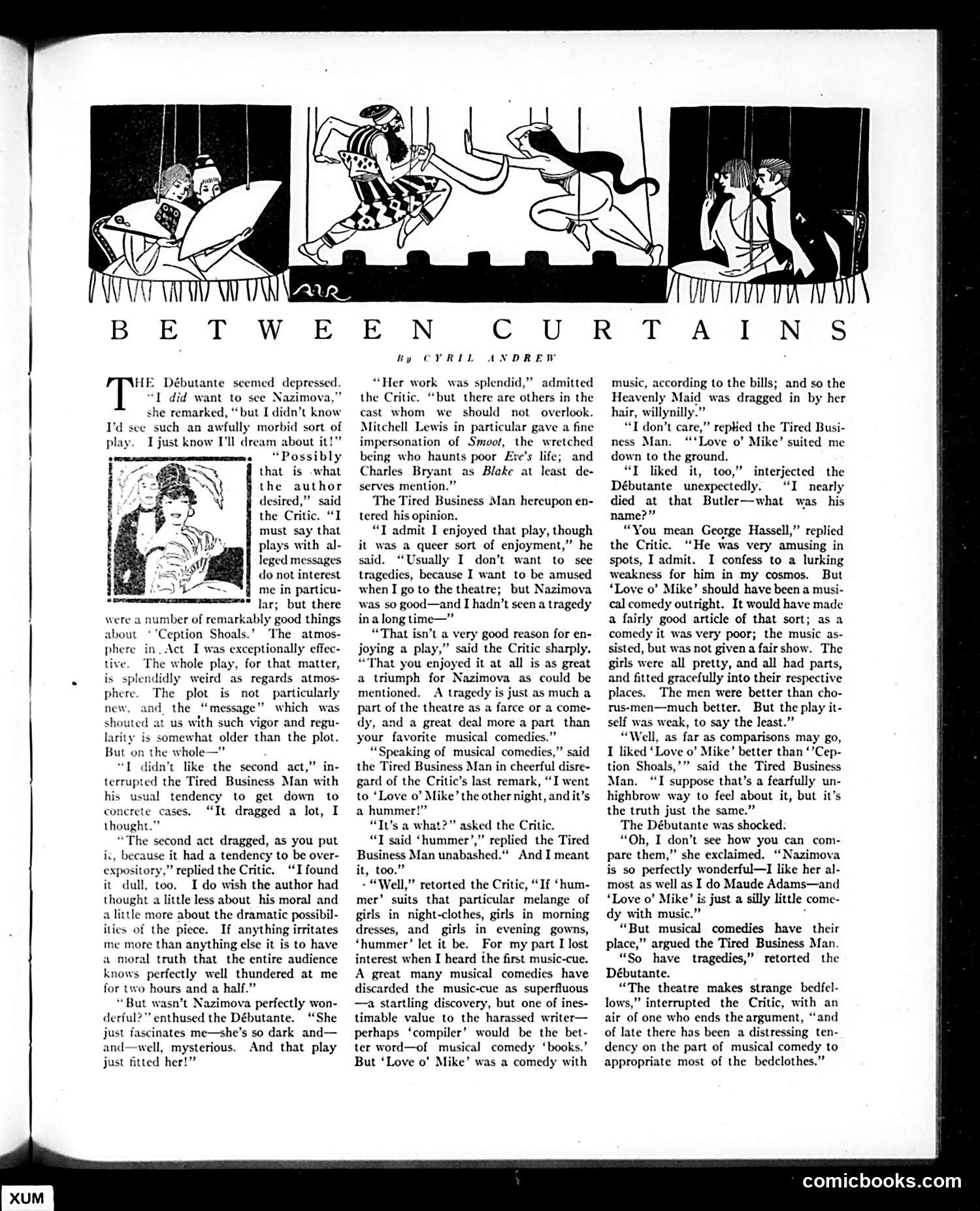
This theatrical criticism column presents a conversation between three characters discussing recent Broadway productions: a naive young Débutante, a pretentious Critic, and a pragmatic Tired Business Man. The satire targets the clash between serious dramatic art and popular entertainment. The Critic champions substantial theatre—praising Nazimova's tragic performance and dismissing musicals like "Love o' Mike" as frivolous spectacle (mere "girls in night-clothes"). Meanwhile, the Tired Business Man and Débutante openly prefer entertainment over moral instruction, enjoying plays purely for amusement. The piece mocks both camps: the Critic's pompous insistence that audiences should value artistic merit over enjoyment, and the general public's indifference to theatrical "messages." The humor lies in their mutual incomprehension—the Critic cannot fathom why anyone would enjoy a tragedy solely because the star was good, while the ordinary theatregoers simply want to be entertained, not lectured. This reflects early 20th-century debates about Broadway's purpose: art versus commerce, highbrow versus popular taste.
📄 Transcribed text from this page (OCR, searchable)
Machine-transcribed from the original scan — historical spelling and the odd misread are preserved.
ET WE HE Débutante seemed depressed. T I did want to see imova, she remarked, “but I didn’t know I’d see such an awfully morbid sort of I just know I'll dream about it!” « “Possibly that is -what the author desired,” said the Critic. “I must say that plays with al- leged messages do not interest me in particu- * lar; but there number of remarkably good things about ‘’Ception Shoals.’ The atmos- phere in, Act Iw tionally effec- tiv The whole play, for that matter, is splendidly weird as regards atmos- phere. The plot is not particularly new, and the “message” which was shouted at us with such vigor and regu- larity is somewhat older than the plot. But on the whole—” “I didn’t like the second act,” in- terrupted the Tired Business Man with his usual tendency to get down to cases. “It dragged a lot, I concrete thought. “The second act dragged, as you put ic, because it had a tendency to be over- expository,” replied the Critic. “I found it dull, too, I do wish the author had thought a little less about his moral and a little more about the dramatic possibil- ities of the piece. If anything irritates me more than anything else it is to have a moral truth that the entire audience knows perfectly well thundered at me for two hours and a half.” “But wasn’t Nazimova perfectly won- derful?” enthused the Débutante. “She just fascinates me—she’s so dark and— and—well, mysterious. And that play just fitted her!” EN By CYRIL INDREW “Her work was splendid,” admitted the Critic. “but there are others in the cast whom we should not overlook. Mitchell Lewis in particular gave a fine impersonation of Smoot, the wretched being who haunts poor Eve's life; and Charles Bryant as Blake at least de- serves mention.” The Tired Business Man hereupon en- tered his opinion. “I admit I enjoyed that play, though it was a queer sort of enjoyment,” he said. “Usually I don’t want to see tragedies, because I want to be amused when I go to the theatre; but Nazimova was so good—and I hadn’t seen a tragedy in along time—” “That isn’t a very good reason for en- joying a play,” said the Critic sharply. hat you enjoyed it at all is as great a triumph for Nazimova as could be mentioned. A tragedy is just as much a part of the theatre as a farce or a come- dy, and a great deal more a part than your favorite musical comedies.” “Speaking of musical comedies,” said the Tired Business Man in cheerful disre- gard of the Critic’s last remark, “I went to ‘Love o’ Mike’ the other night, and it’s a hummer!” “Tt’s a what?” asked the Critic. “T said ‘hummer’,” replied the Tired Business Man unabashed. And I meant it, too.” - “Well,” retorted the Critic, “If ‘hum- mer’ suits that particular melange of girls in night-clothes, girls in morning dresses, and girls in evening gowns, ‘hummer’ let it be. For my part I lost interest when I heard the first music-cue. A great many musical comedies have discarded the music-cue as superfluous —a startling discovery, but one of ines- timable value to the harassed writer— perhaps ‘compiler’ would be the bet- ter word—of musical comedy ‘books.’ But ‘Love 0’ Mike’ was a comedy with C U RTA IN §S music, according to the bills; and so the Heavenly Maid was dragged in by her hair, willynilly.” “T don’t care,” replied the Tired Busi- ness Man. ‘“‘Love o’ Mike’ suited me down to the ground. “I liked it, too,” interjected the Débutante unexpectedly. “I nearly died at that Butler—what was his name?” “You mean George Hassell,” replied the Critic. “He was very amusing in spots, I admit. I confess to a lurking weakness for him in my cosmos. But ‘Love o’ Mike’ should have been a musi- cal comedy outright. It would have made a fairly good article of that sort; as a comedy it was very poor; the music as- sisted, but was not given a fair show. The girls were all pretty, and all had parts, and fitted gracefully into their respective places. The men were better than cho- rus-men—much better. But the play it- self was weak, to say the least.” “Well, as far as comparisons may go, I liked ‘Love o’ Mike’ better than ‘’Cep- tion Shoals,’” said the Tired Business Man. “I suppose that’s a fearfully un- highbrow way to feel about it, but it’s the truth just the same.” The Débutante was shocked. “Oh, I don’t see how you can com- pare them,” she exclaimed. “Nazimova is so perfectly wonderful—I like her al- most as well as I do Maude Adams—and ‘Love o’ Mike’ is just a silly little come- dy with mus : “But musical comedies have their place,” argued the Tired Business Man. “So have tragedies,” retorted the Débutante. “The theatre makes strange bedfel- lows,” interrupted the Critic, with an air of one who ends the argument, “and of late there has been a distressing ten- dency on the part of musical comedy to appropriate most of the bedclothes.” comicbooks.com