
A complete issue · 32 pages · 1916
Judge — November 4, 1916
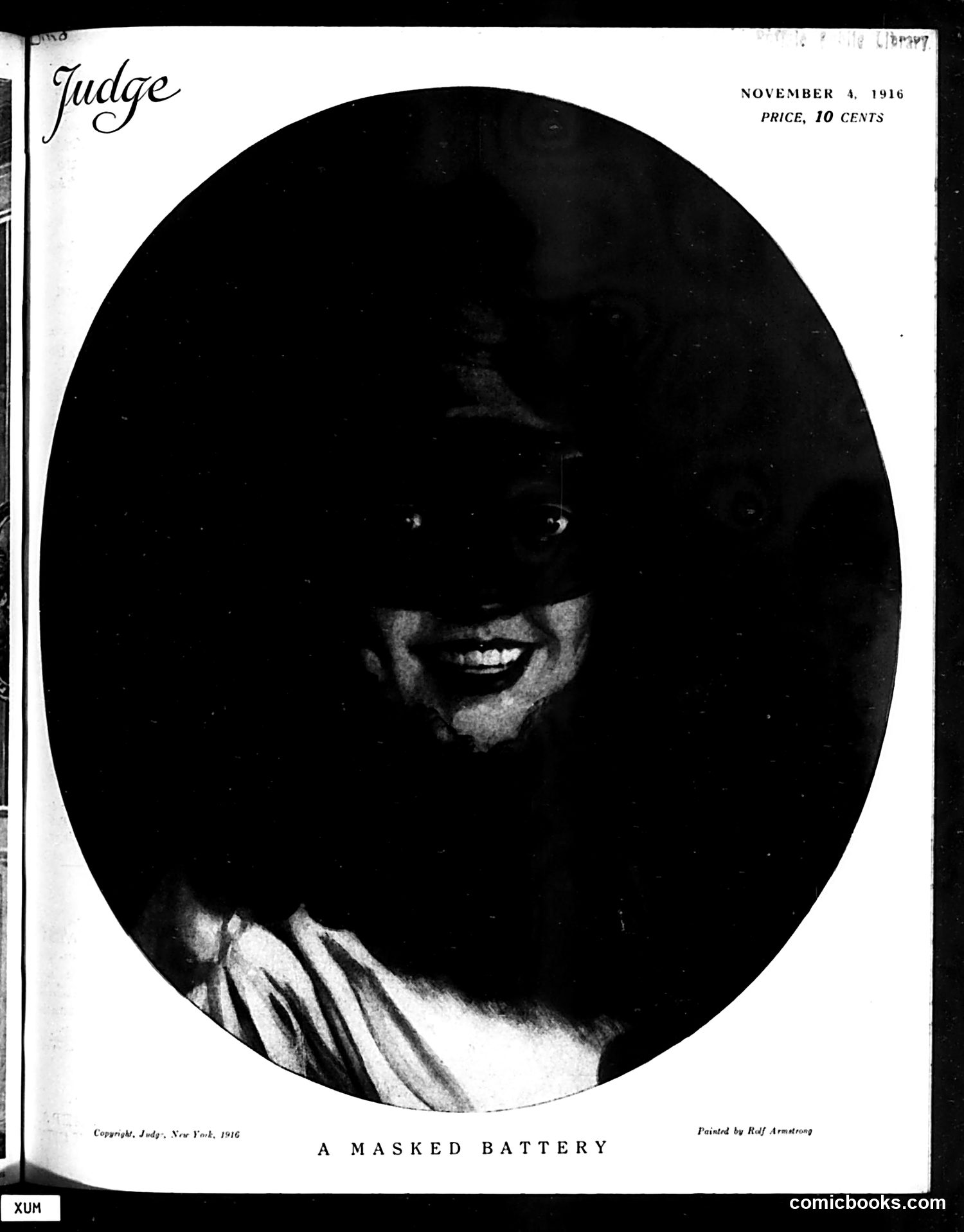
This cover depicts a figure wearing a wide-brimmed hat and mask, with a bright smile visible against the darkness. The title "A Masked Battery" suggests hidden or concealed power/weapons. Given the 1916 publication date (shortly before the U.S. presidential election), this likely refers to Theodore Roosevelt's covert political influence. Roosevelt, who had left the presidency in 1909, was rumored to be secretly backing or coordinating political attacks during campaigns while maintaining public distance from direct involvement. The "mask" represents Roosevelt's behind-the-scenes maneuvering, while "battery" suggests concentrated political firepower. The menacing smile conveys the satirical point that despite the concealment, his influence remained potent and visible to observers.
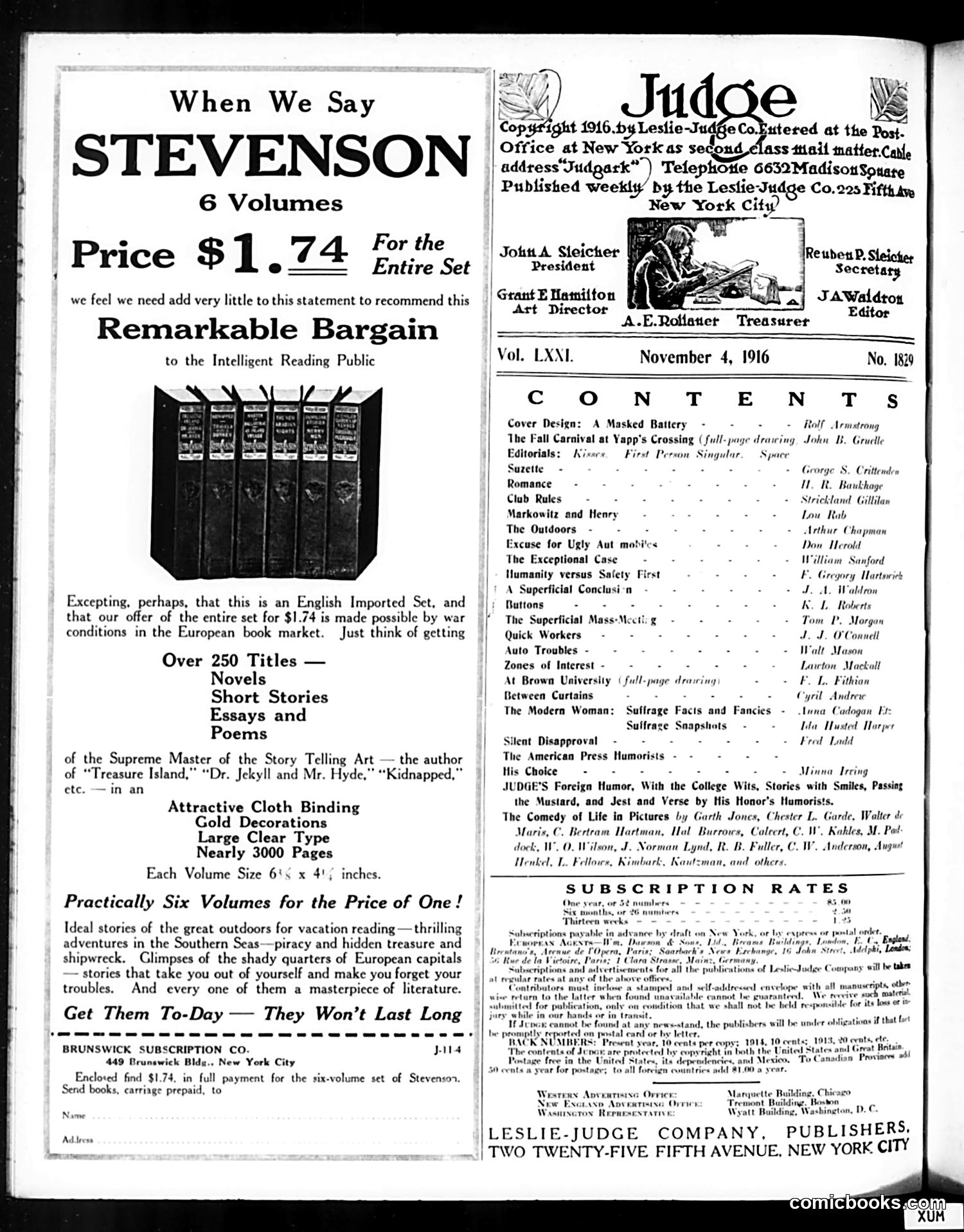
This page is primarily **advertising and editorial matter**, not political cartoons. The left side advertises a six-volume Stevenson book set for $1.74—described as a "Remarkable Bargain" containing over 250 titles of novels, stories, essays, and poems. The right side shows the magazine's masthead, staff, and table of contents for Volume LXXI, No. 1839. The contents list various articles and illustrations, including pieces on "The Outdoors," "Markowitz and Henry," and sections on humor and satire typical of Judge's satirical format. Without seeing the actual cartoon illustrations referenced in the contents, the specific satirical points remain unclear from this text-heavy page.
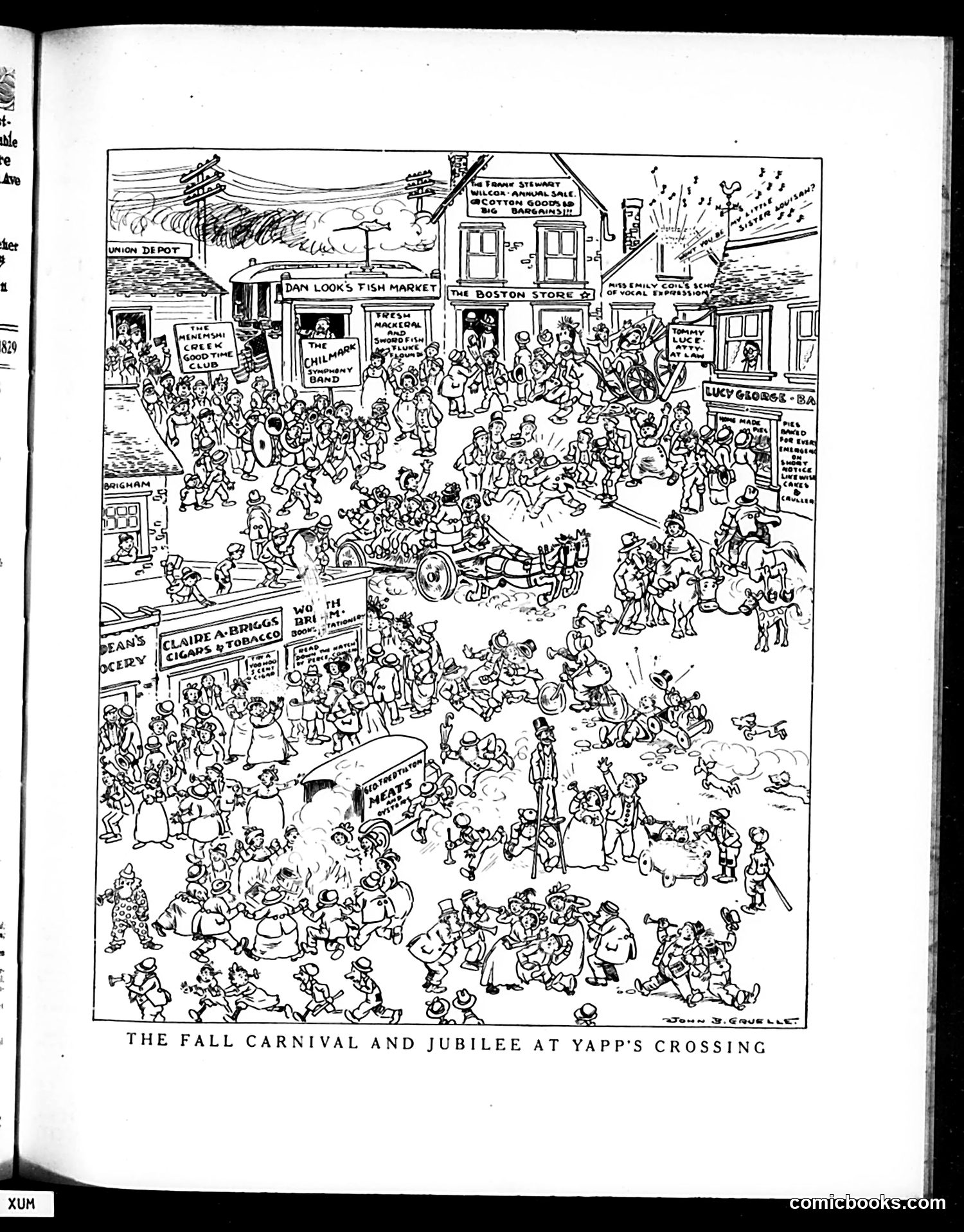
This is a detailed crowd scene illustration depicting a bustling carnival or fair at a location called "Yapp's Crossing." The image shows numerous storefronts and businesses, including Dan Look's Fish Market, The Boston Store, and various other establishments with signage. The cartoon appears to be a humorous depiction of small-town American commerce and social life, with hundreds of figures engaged in shopping, socializing, and carnival activities. The crowded, chaotic composition suggests satire of commercialism and the frenzy of community gatherings. Without clearer identification of specific figures or historical context about Yapp's Crossing, the precise satirical targets remain unclear, though the abundance of commercial signage suggests commentary on marketplace activity and consumer culture.
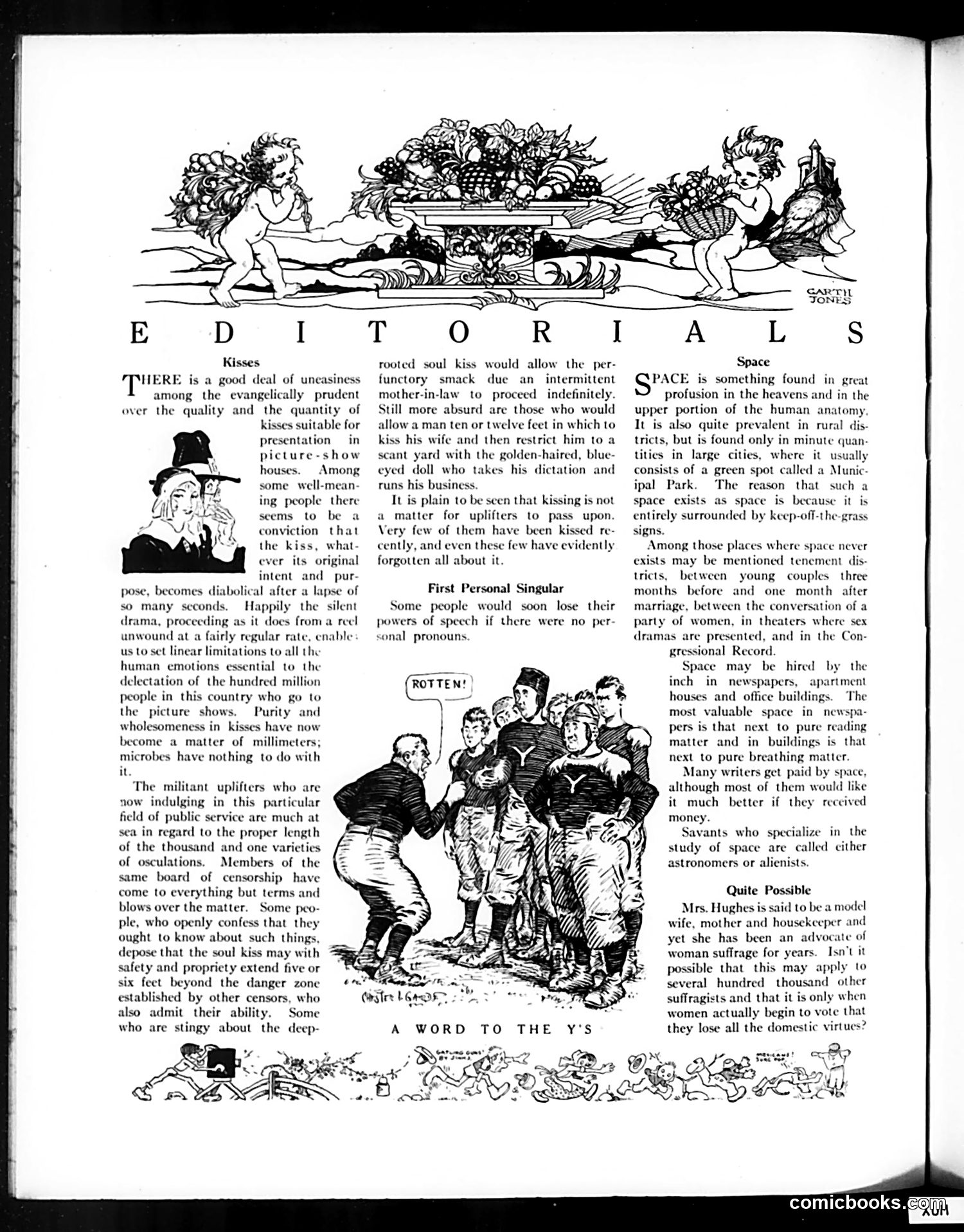
This page from *Judge* magazine contains two distinct sections: **Top Section ("Editorials"):** Three columns discussing social etiquette—"Kisses," "Space," and "First Personal Singular." These are humorous essays about modern manners: the prevalence of casual kissing among certain social groups, the value of personal space in public areas, and the importance of pronouns in speech. **Central Cartoon ("A Word to the Y's"):** Shows a man addressing a group of younger people, saying "ROTTEN!" The cartoon appears to satirize generational criticism—likely depicting an older figure scolding youth about their behavior or morals, a common Judge theme during the early 20th century. **Bottom Section ("Quite Possible"):** Brief commentary about Mrs. Hughes as a model housewife and women's suffrage advocacy. The page mixes social commentary with light humor targeting contemporary cultural anxieties about changing manners and generational conflict.
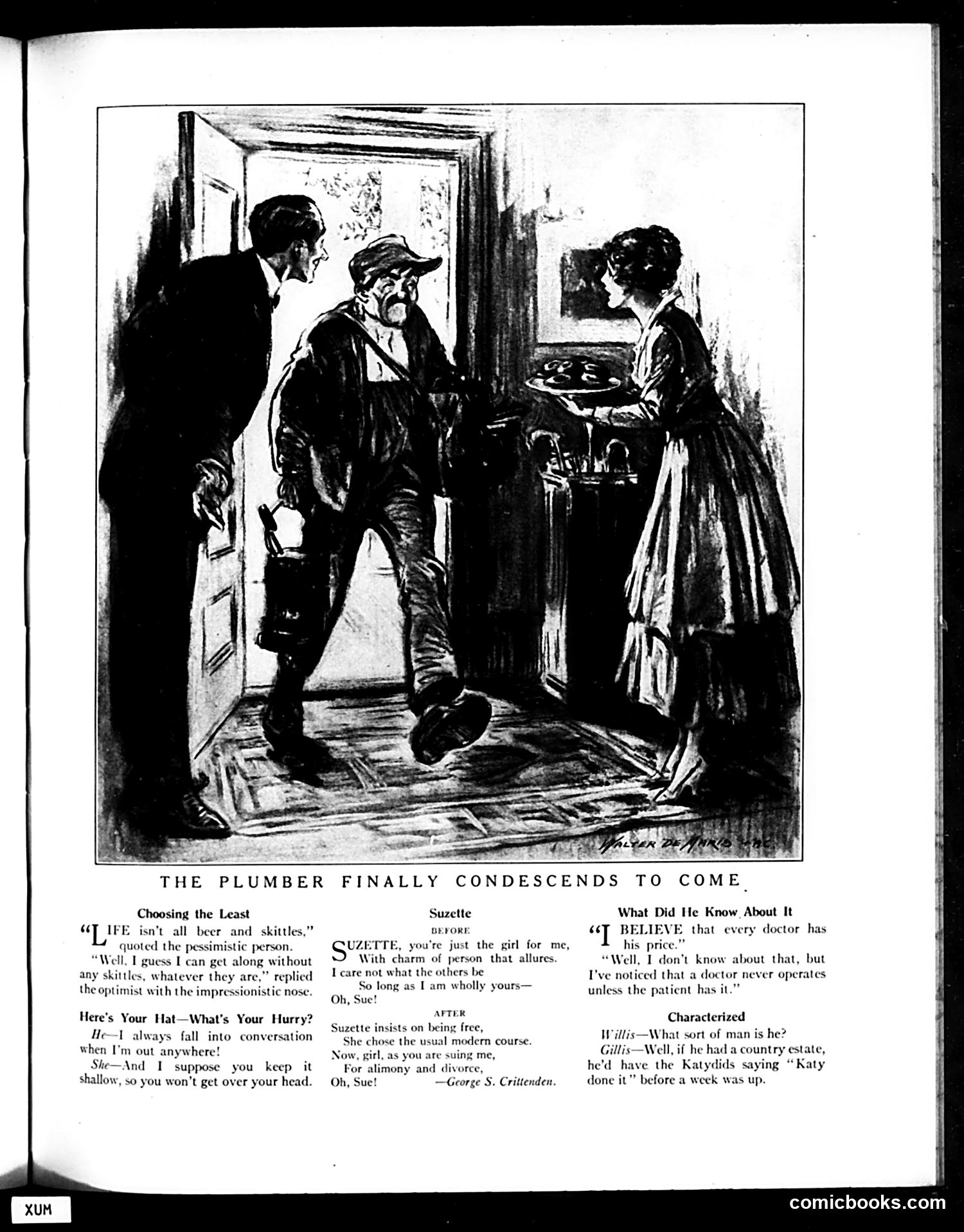
This page satirizes early-20th-century class dynamics and gender relations. The main cartoon depicts a working-class plumber arriving at an upper-class home, where he's treated with deference despite his lower social status—hence the ironic title about his "condescension." The accompanying vignettes mock common domestic scenarios: a husband and wife's conversation about his drinking habits, a woman (Suzette) choosing divorce over marriage, and a doctor's class pretensions. The satire targets how service workers held surprising social power (people needed them urgently), how marriages were dissolving over lifestyle conflicts, and how professionals adopted artificial superiority. The overall tone is cynical about modern social relationships and changing class structures.
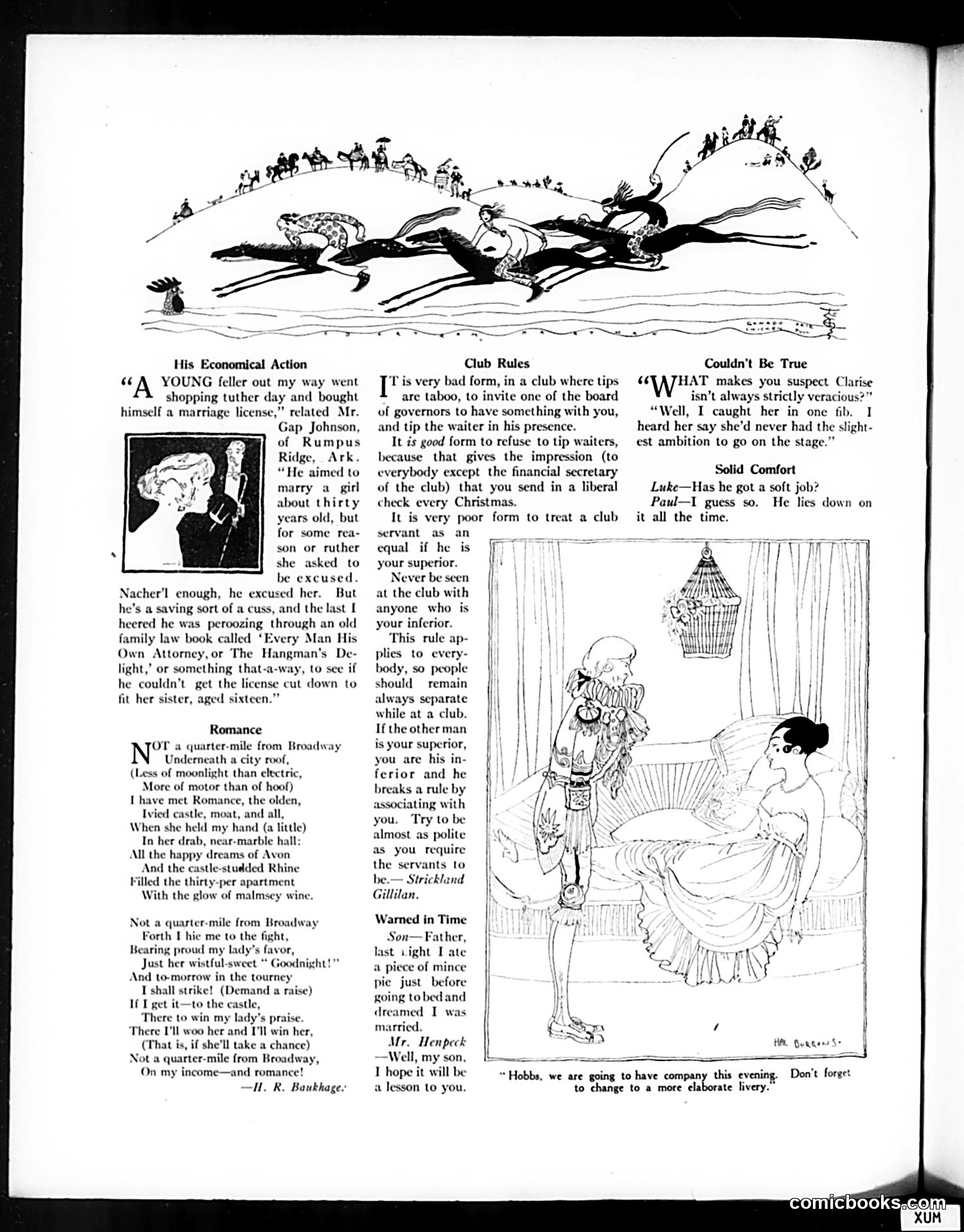
This page contains several pieces of early-20th-century American humor satirizing social conventions and courtship: **"His Economical Action"** mocks rural frugality through a dialect-heavy anecdote about a man trying to reuse a marriage license after rejection—absurd literalism played for laughs. **"Romance"** is sentimental verse about urban courtship far from Broadway's glamour, ending with the speaker hoping to win his lady by demanding a salary raise—satirizing the gap between romantic ideals and economic reality. **"Club Rules"** parodies the rigid etiquette of exclusive clubs, where contradictory rules (treat servants as inferiors but never associate with actual inferiors) expose the arbitrary snobbery of upper-class institutions. The remaining jokes mock social pretense: a woman denying stage ambitions, a man comfortable "lying down on the job," and a servant needing fancier livery for company. The overall theme: American society's obsession with status, propriety, and economic anxiety—whether rural, working-class, or elite.
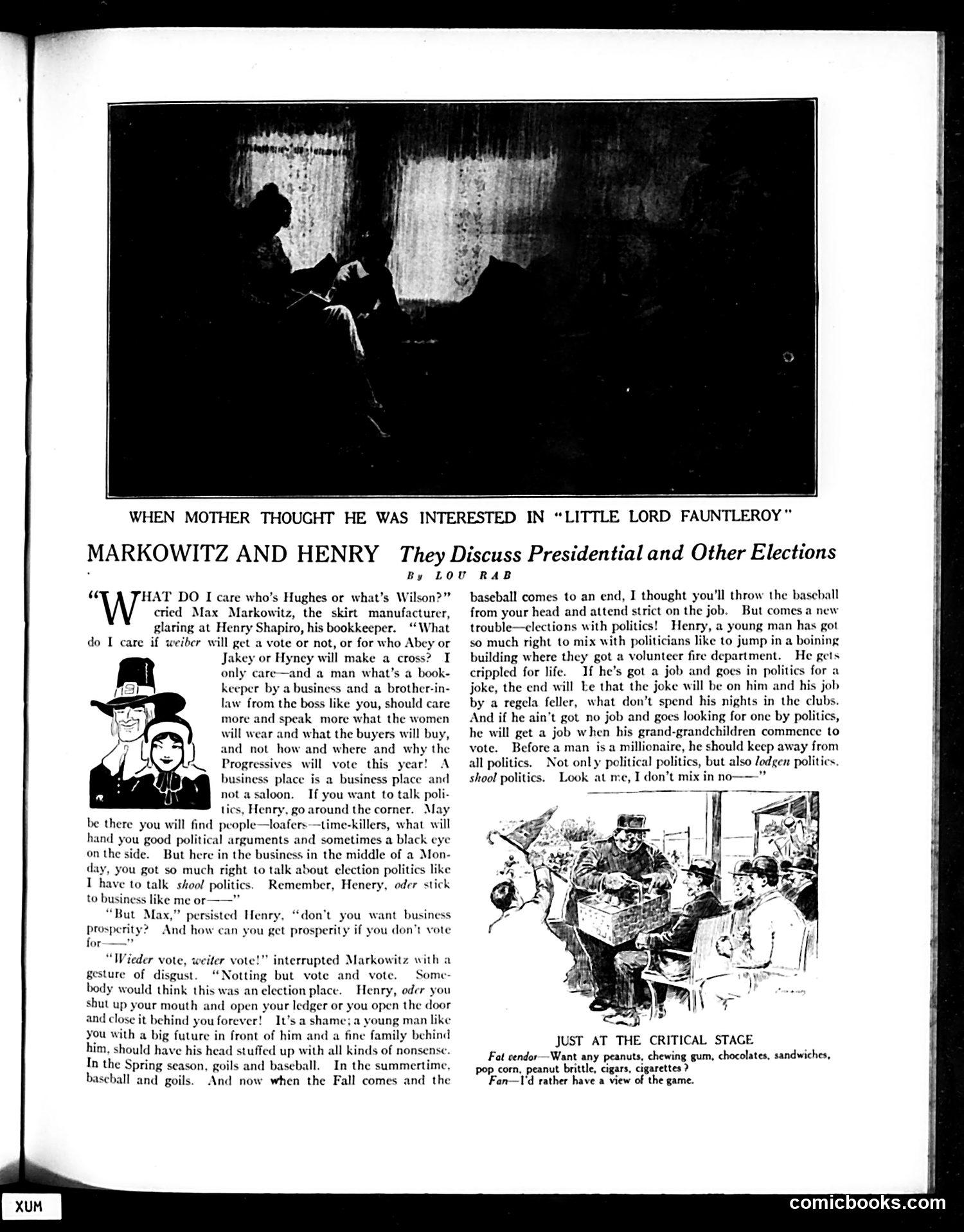
This 1916 *Judge* magazine piece satirizes immigrant Jewish businessmen's indifference to American politics. Max Markowitz, a garment manufacturer, scolds his young bookkeeper Henry Shapiro for discussing the presidential election (Hughes vs. Wilson) during work hours. Markowitz insists business owners should focus solely on commerce, not politics—dismissing voting as a distraction that ruins young men's futures. The satire cuts both ways: it mocks Markowitz's single-minded materialism and anti-civic attitude, while also gently ribbing immigrant communities for allegedly prioritizing business over civic participation. The Yiddish phrases ("weiter vote," "lodgen politics") and ethnic stereotyping reflect early 20th-century attitudes toward newly arrived immigrants. The bottom cartoon shows a baseball fan preferring the game to a food vendor—a lighter aside on American leisure priorities.
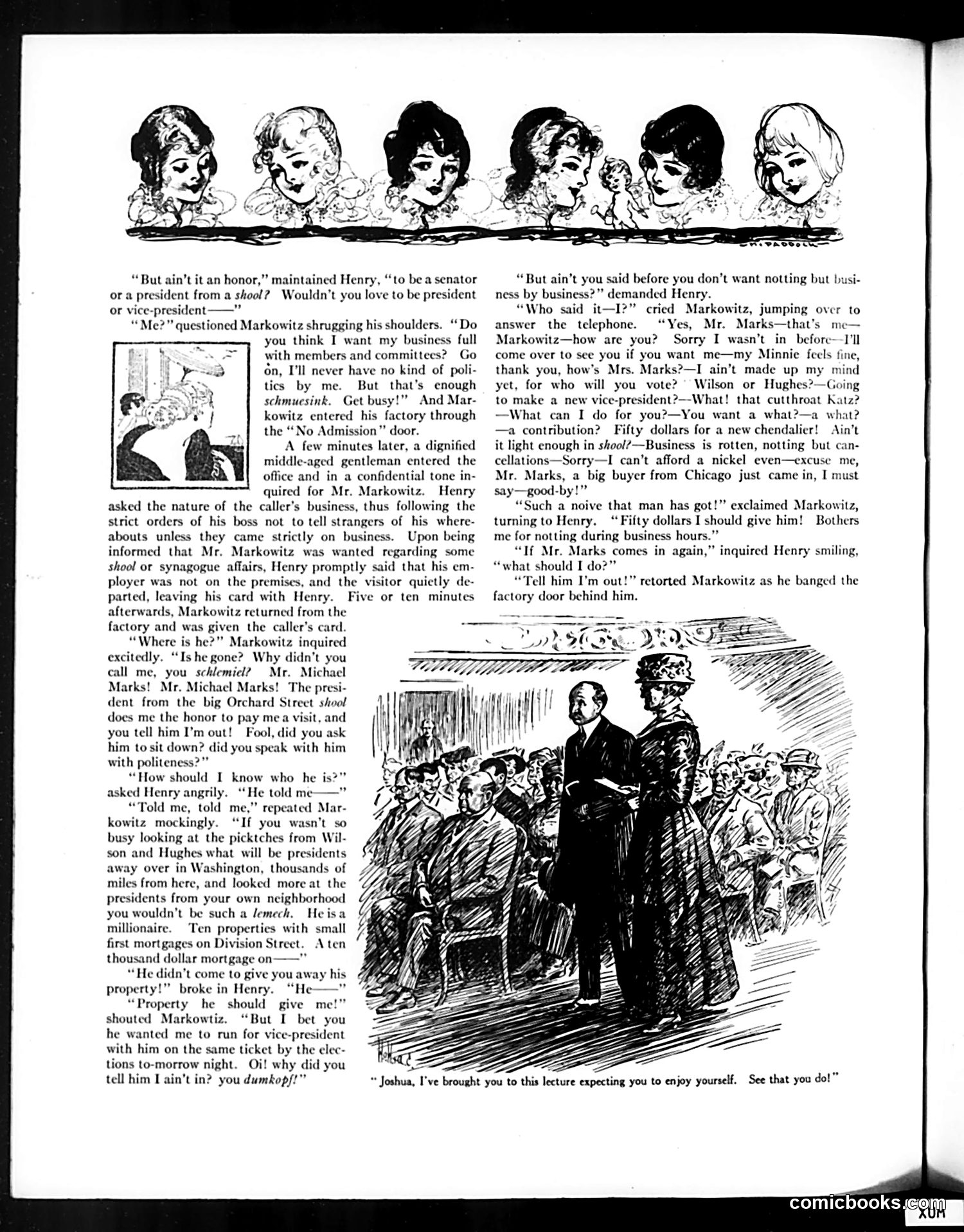
This page satirizes immigrant Jewish businessmen's simultaneous rejection of and hunger for political status. The protagonist, Markowitz, insists he wants nothing to do with politics or communal affairs—scorning his employee Henry for following Wilson and Hughes (1916 presidential candidates) instead of local matters. Yet when Michael Marks, a wealthy synagogue president and "millionaire," visits, Markowitz panics at missing him, immediately assuming Marks wants him as a vice-presidential running mate. He then receives a phone call soliciting a $50 donation and frantically makes excuses about business hardship while simultaneously boasting about properties and mortgages. The humor targets Markowitz's hypocrisy: he claims indifference to status-seeking while desperately coveting it, and professes poverty while displaying wealth. The Yiddish phrases ("schlemiel," "dumkopf," "lemech") and accent-marked English emphasize ethnic stereotyping typical of early 20th-century American satire.
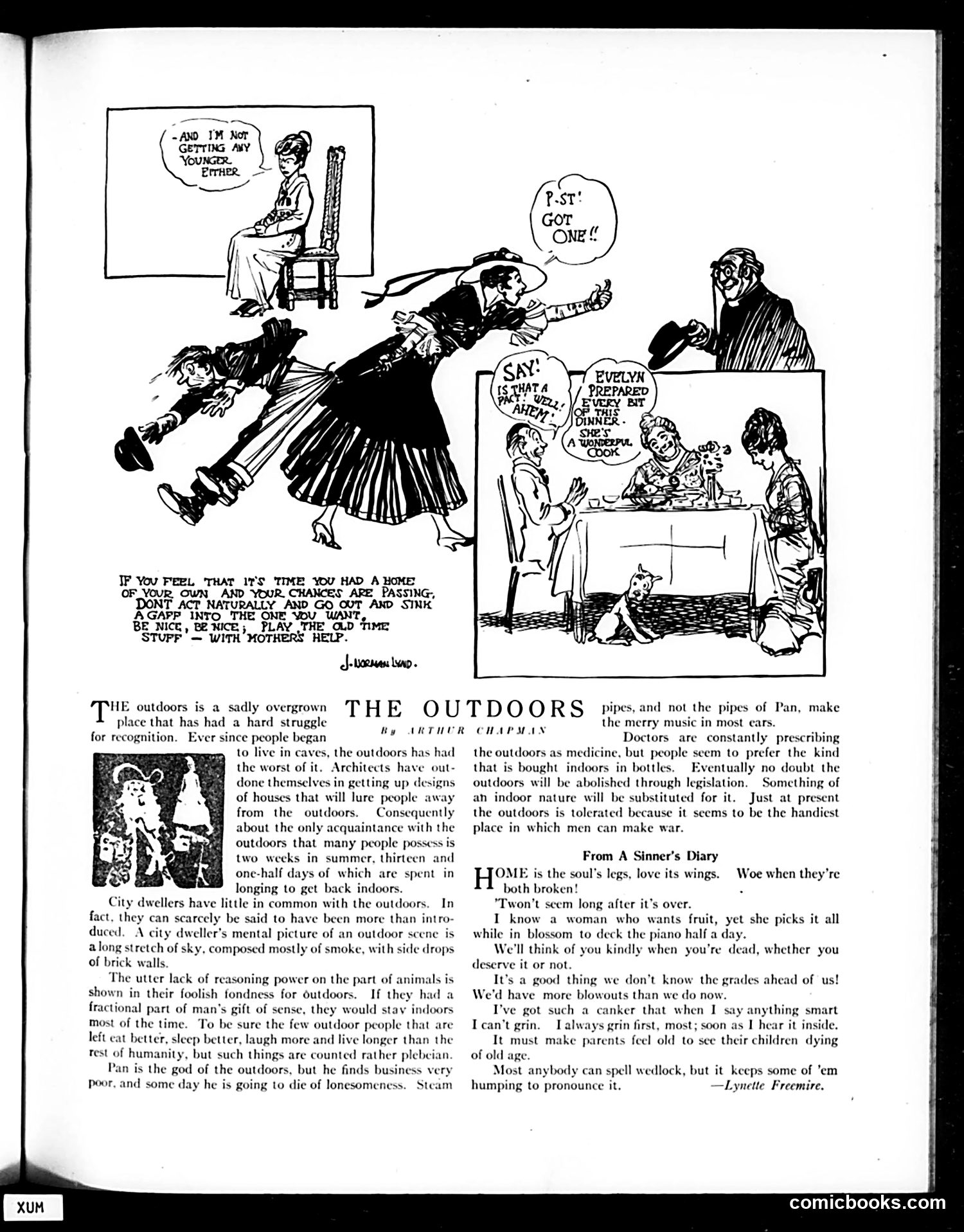
This page satirizes early 20th-century urban society's disconnection from nature. The cartoons at top show a mother advising her son to "play the old time stuff with mothers help" — encouraging wholesome outdoor play as a courtship strategy to find a wife. The main essay by Arthur Chapman mocks city dwellers who've abandoned outdoor life. Chapman argues that modern architecture, indoor entertainment, and urban development have made people prefer artificial comforts (like bottled medicine) to fresh air. He notes ironically that outdoor enthusiasts actually live longer and healthier lives, yet society dismisses this as "plebeian." The piece suggests outdoors will eventually be legislated away entirely, replaced by indoor substitutes. Chapman's wit lies in presenting this dystopian future as inevitable given humanity's preferences — a commentary on industrialization and urbanization eroding traditional outdoor culture. The accompanying "Sinner's Diary" offers cynical observations on modern life, contrasting natural desires (eating fresh fruit) with artificial urban practices (decorating pianos with blossoms).
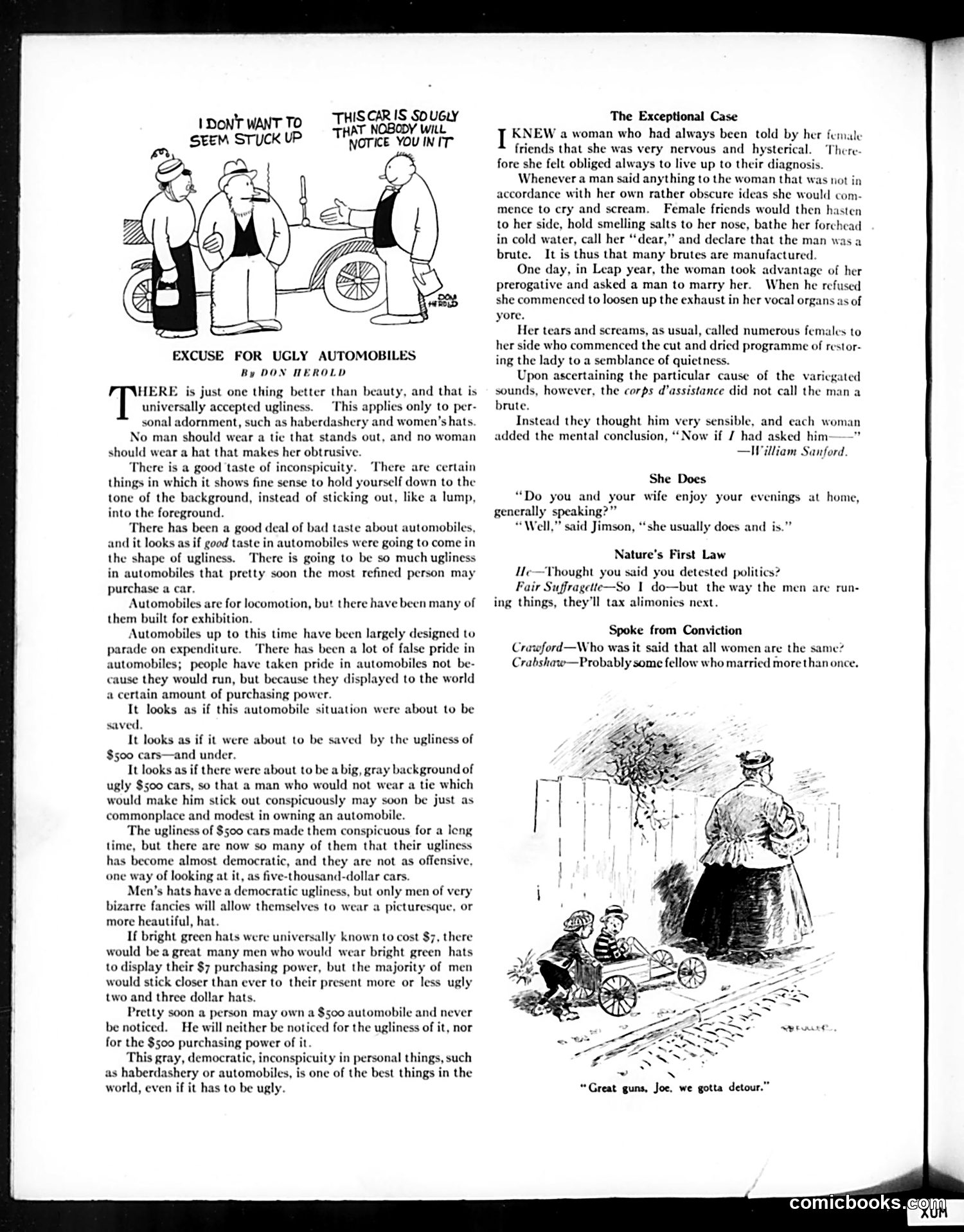
**"Excuse for Ugly Automobiles"** (top left cartoon and main article): The cartoon shows three men discussing an obviously homely car. The satire critiques early automobile culture's obsession with displaying wealth through flashy vehicles. Author Don Herold argues that as $500 cars become commonplace and universally ugly, they'll paradoxically become *democratic* and respectable—like plain neckties or cheap hats. The joke: ugliness becomes acceptable when everyone has it. He's mocking the original status-seeking impulse behind fancy cars while celebrating that mass-market mediocrity may finally make modesty fashionable. **"The Exceptional Case"** (right column): This story satirizes women who perform hysteria because they've been told (by female friends) that they're "nervous and hysterical." The narrative ironically shows how social expectations manufacture the very behavior they claim to describe. The woman's emotional outbursts are reinforced by sympathetic girlfriends with smelling salts, making her "brute" behavior seem justified—when actually her friends created the dynamic.
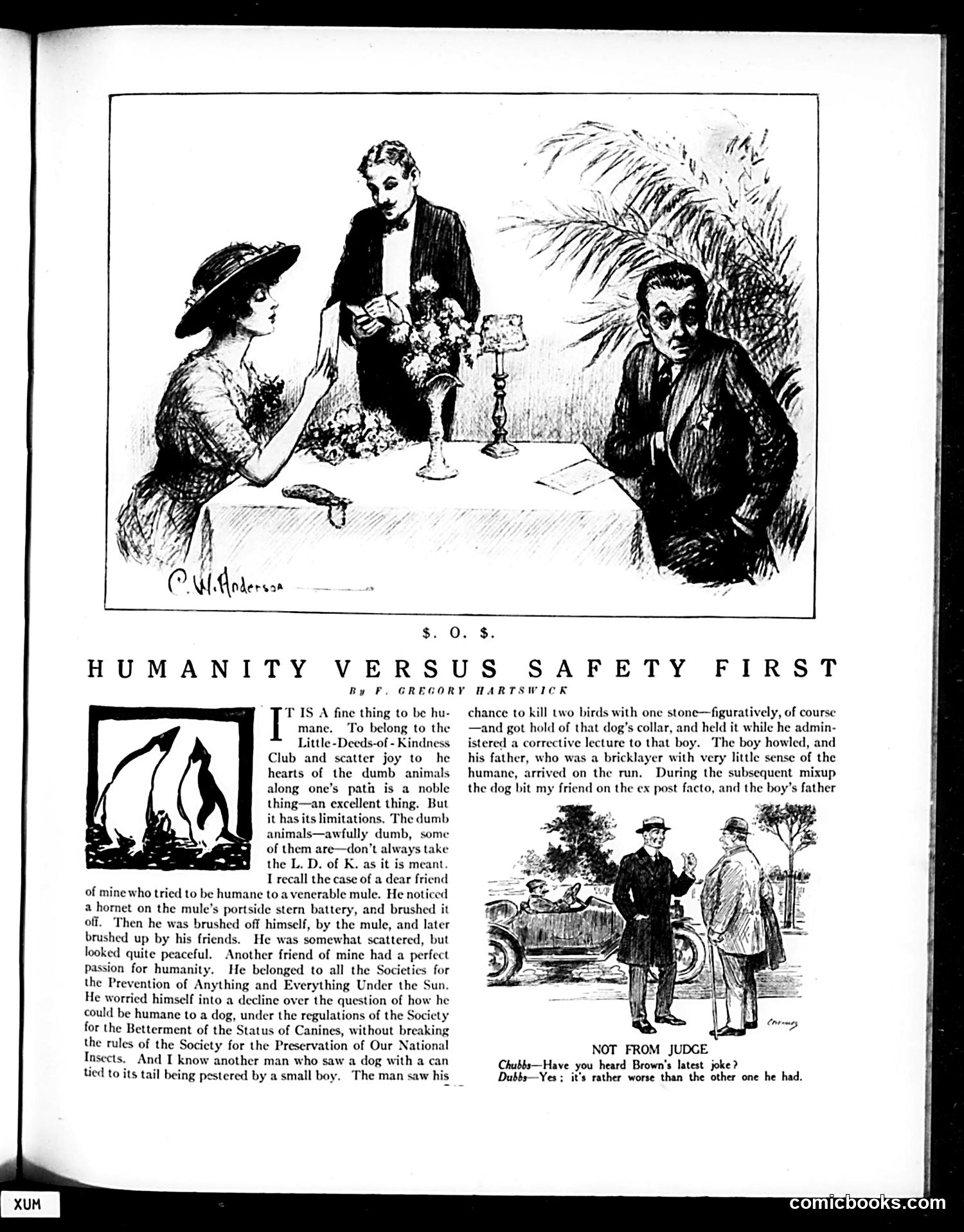
This article mocks the contradiction between fashionable "humanitarian" club membership and practical reality. The title sarcastically contrasts well-intentioned kindness with actual safety. The author recounts three anecdotes ridiculing people who belong to various do-good societies ("Little-Deeds-of-Kindness Club," "Prevention of Anything and Everything Under the Sun," etc.). Each story shows these humanitarian advocates suffering comical consequences from their own benevolence: a man is kicked by a mule after removing a hornet; another worries himself sick reconciling conflicting animal-welfare rules; a third gets bitten and beaten while trying to simultaneously lecture a boy pestering a dog—all while respecting various organizational bylaws. The satire targets early 20th-century America's proliferation of reform organizations and the self-righteous, impractical adherents who join them. The point: genuine kindness requires common sense, not rigid adherence to club rules and social virtue-signaling. The bottom cartoon ("Not from Judge") offers an unrelated joke about Brown's joke-telling ability.
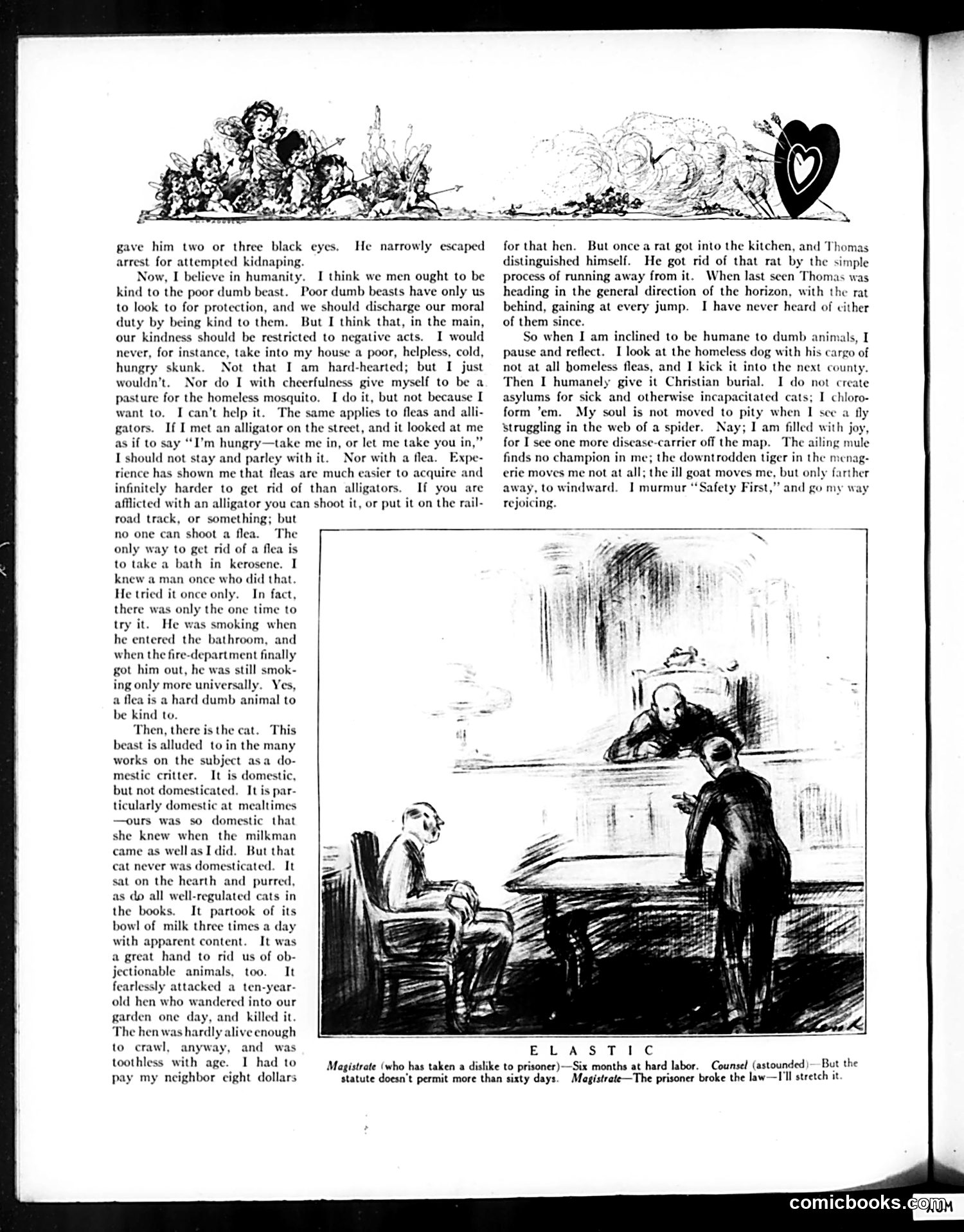
This page presents a humorous essay on animal kindness paired with a legal cartoon. The main text sarcastically argues against being kind to "dumb animals"—fleas, alligators, mosquitoes, rats, and cats—through exaggerated anecdotes. The author claims fleas are impossible to eliminate (a man caught fire bathing in kerosene to rid himself of them), and recounts how his cat killed a neighbor's hen, costing him eight dollars in damages. The cartoon titled "ELASTIC" depicts a magistrate sentencing a prisoner to six months hard labor, though the statute permits only sixty days maximum. When the counsel protests, the magistrate declares he'll "stretch it"—a visual pun showing the magistrate literally stretching the legal statute document. This satirizes judicial overreach and the arbitrary exercise of power by magistrates who ignore legal limits on their authority, treating the law as flexible rather than binding.
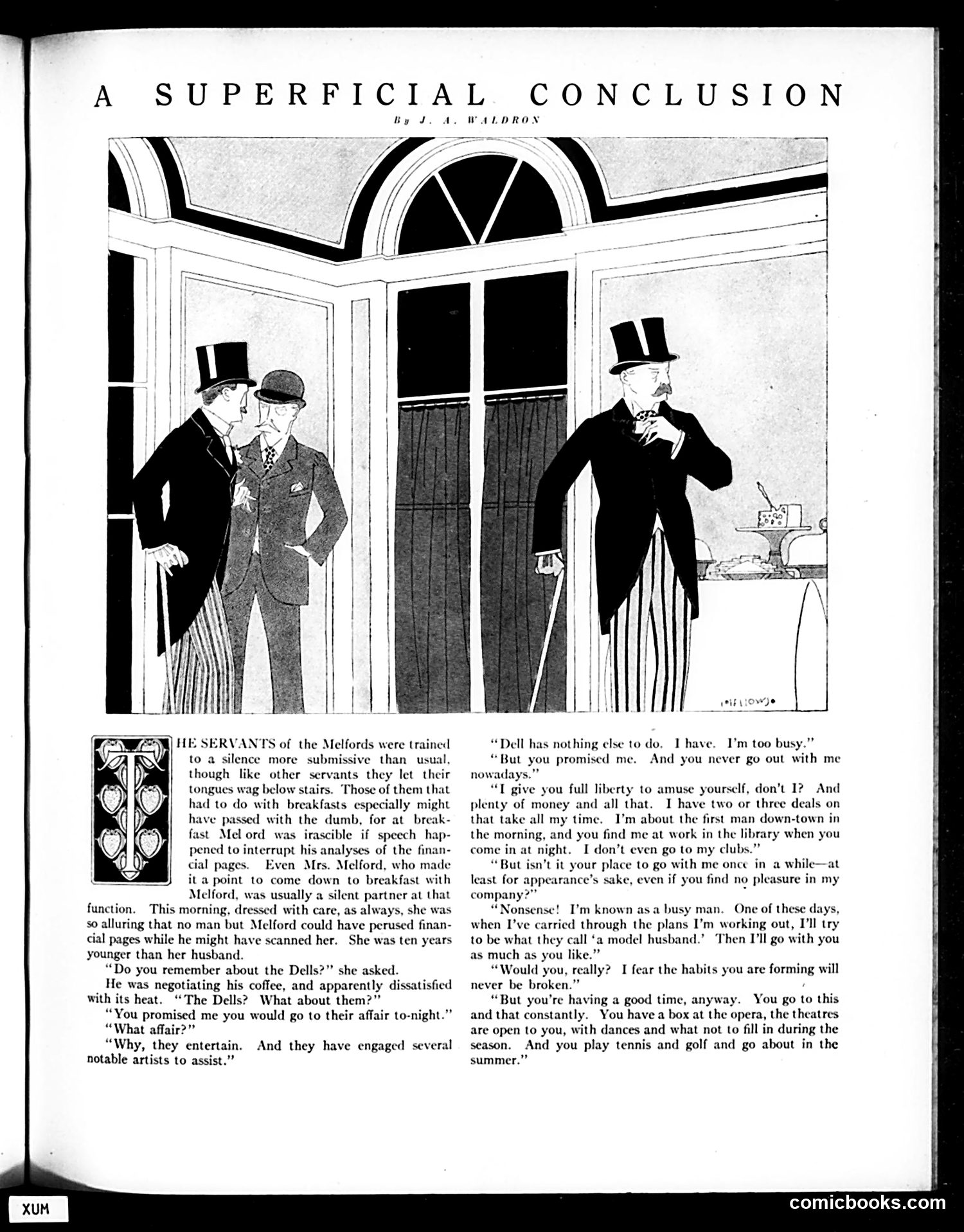
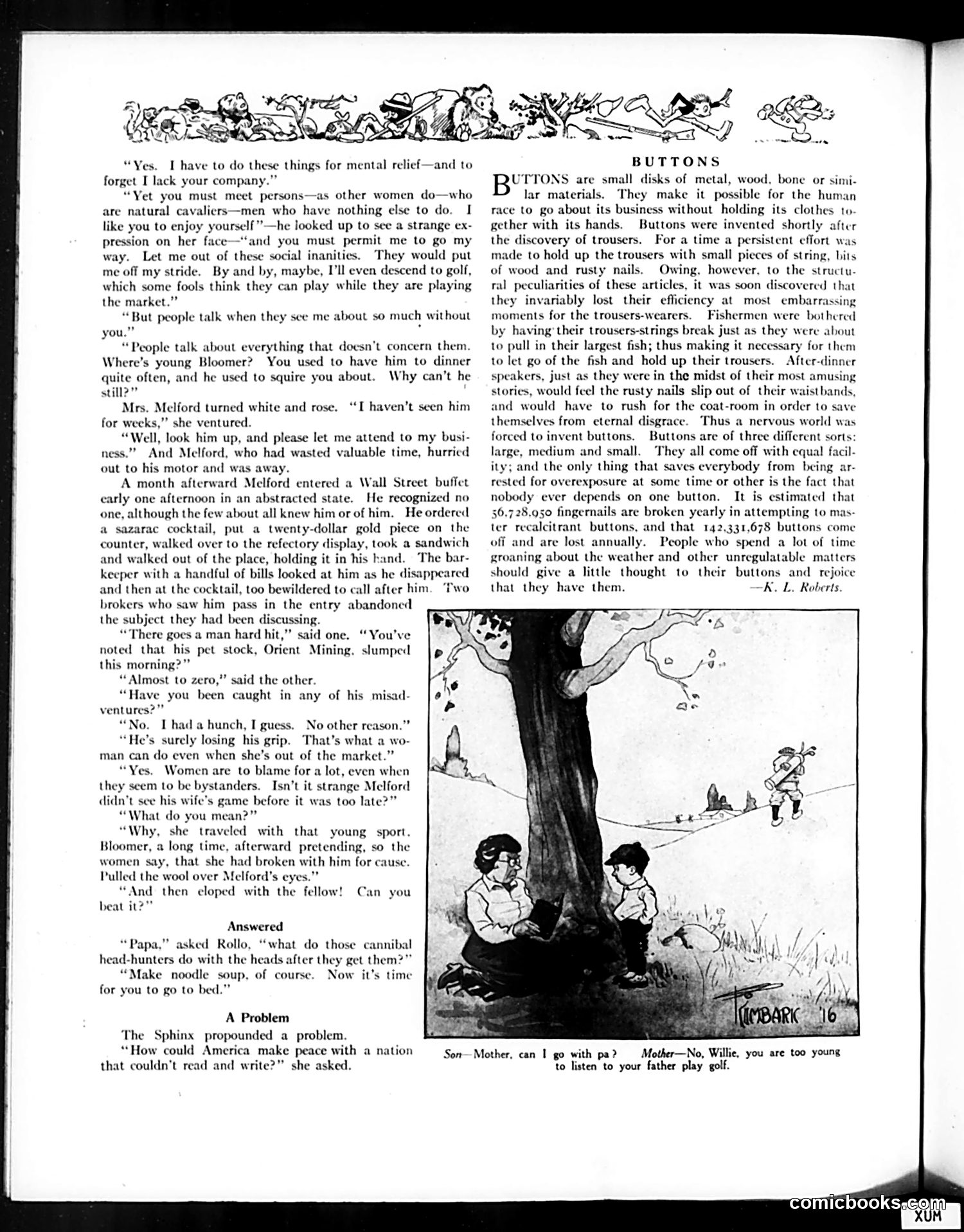
This story excerpt satirizes a wealthy married couple's deteriorating relationship. Mr. Melford, an obsessed businessman, repeatedly breaks promises to accompany his wife to social events, claiming financial deals demand all his time. He justifies his neglect by providing her money and access to entertainment—opera boxes, theaters, dances—as if material indulgences substitute for his presence and attention. The satire targets the era's "self-made" businessman archetype: men so consumed by financial advancement they neglect personal relationships, yet believe wealth absolves them of marital duties. Mrs. Melford's gentle protests expose the hollowness of this arrangement. The title "A Superficial Conclusion" suggests that financial success masks deeper personal failure—the couple's marriage is deteriorating precisely because Melford mistakes money for genuine partnership.
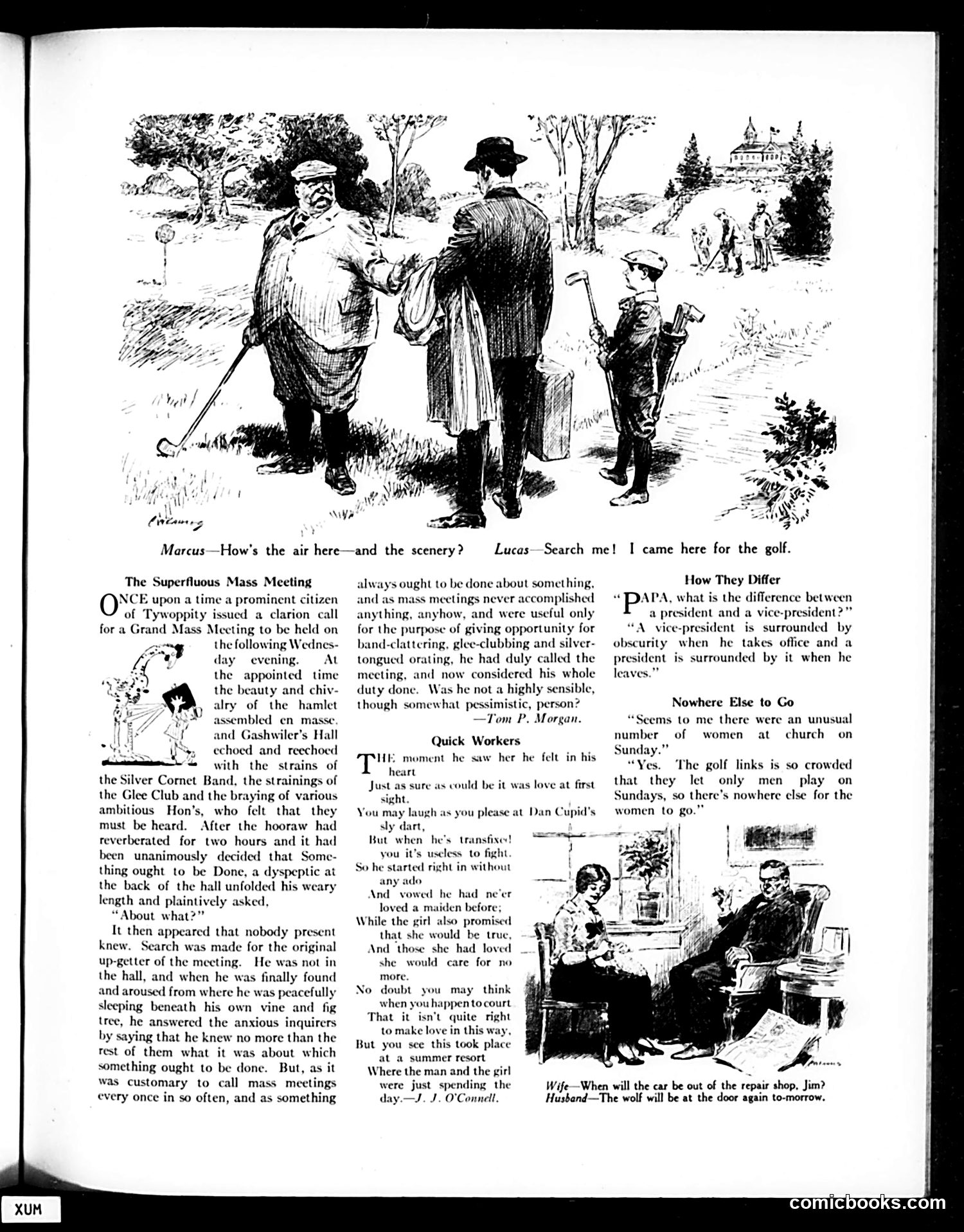
This page contains several short humorous pieces satirizing early 20th-century American social life. **"The Superfluous Mass Meeting"** mocks civic organizations and public meetings. A prominent citizen calls a grand mass meeting, which draws crowds for brass bands and speeches lasting hours. When finally asked what the meeting is *about*, no one—including the organizer—can answer. The satire targets the performative nature of civic gatherings: they're held because "something ought to be done" and mass meetings are customary, not because anything productive will result. **"Quick Workers"** humorously describes instant romance at a summer resort, where two strangers fall in love in a single day. **"How They Differ"** is a joke about presidential obscurity—a vice president gains prominence upon taking office, while a president becomes obscure when *leaving* office. **"Nowhere Else to Go"** satirizes golf's popularity among men, crowding out women from recreational spaces. The page satirizes leisure-class American social customs and the performative emptiness of institutions.
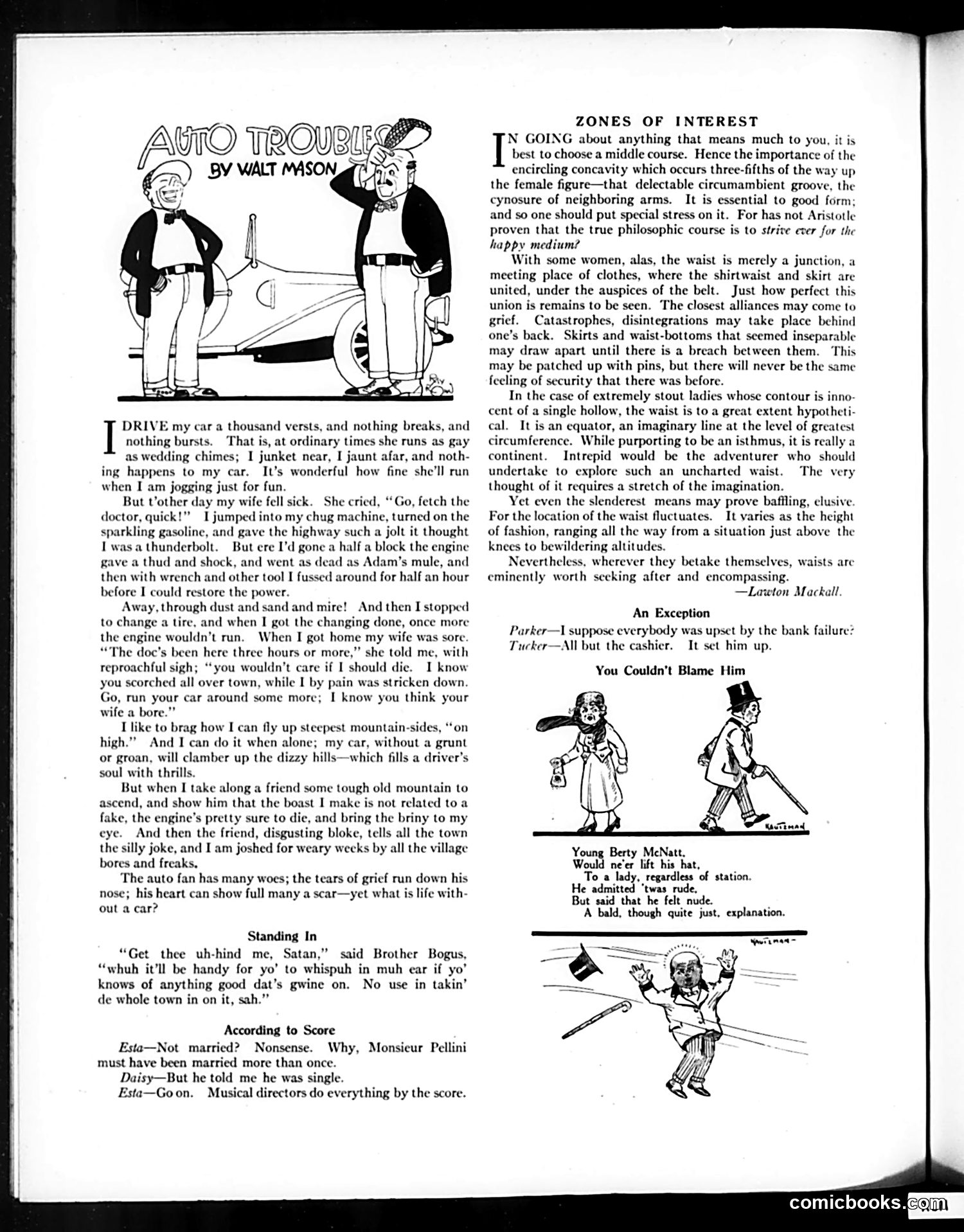
**"Auto Trouble" (left column):** Walt Mason's humorous poem about an unreliable automobile. The narrator boasts his car runs perfectly when driven for pleasure, but fails repeatedly during an actual emergency—when his wife falls ill and needs a doctor. The satire targets both automobiles' notorious unreliability in the early 20th century and drivers' misplaced priorities: the man's vanity about his car matters more than his wife's health. **"Zones of Interest" (right column):** A satirical essay mocking fashion obsession with women's waists. It ironically praises the waist as philosophically important while describing garments that constantly come undone or gap apart. The humor targets both corset-culture absurdity and women's impractical fashion constraints—waists held together by pins and belts that perpetually threaten to separate. **Minor jokes below** include puns about musical directors and marriage ("by the score"). The page exemplifies Judge's satirical approach: mocking contemporary technology failures and fashion ridiculousness through exaggerated observation.
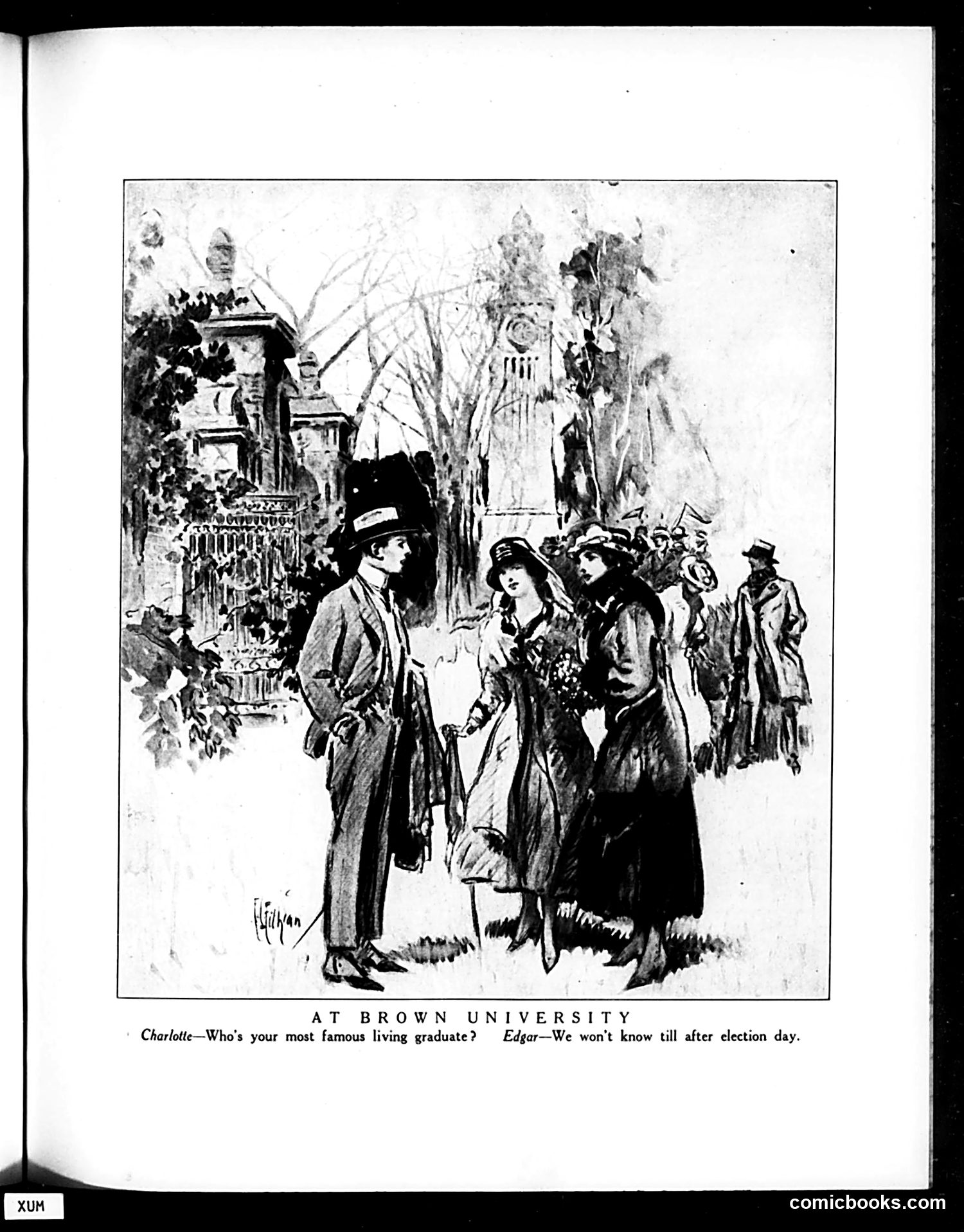
This cartoon satirizes uncertainty about Brown University's most distinguished living graduate. The joke hinges on the phrase "after election day" — suggesting that a Brown graduate's fame or prominence depends on winning an election, implying the person in question is a political candidate. The setting at Brown University and the dialogue between Charlotte and Edgar creates a humorous admission: the university cannot identify its most famous living alumnus until electoral results are decided. This reflects on how political success determines public recognition and legacy. The cartoon likely references a specific Brown graduate running for office, though the image alone doesn't identify which candidate or election year is meant. The satire critiques how fame becomes intertwined with political victory rather than other achievements or accomplishments.
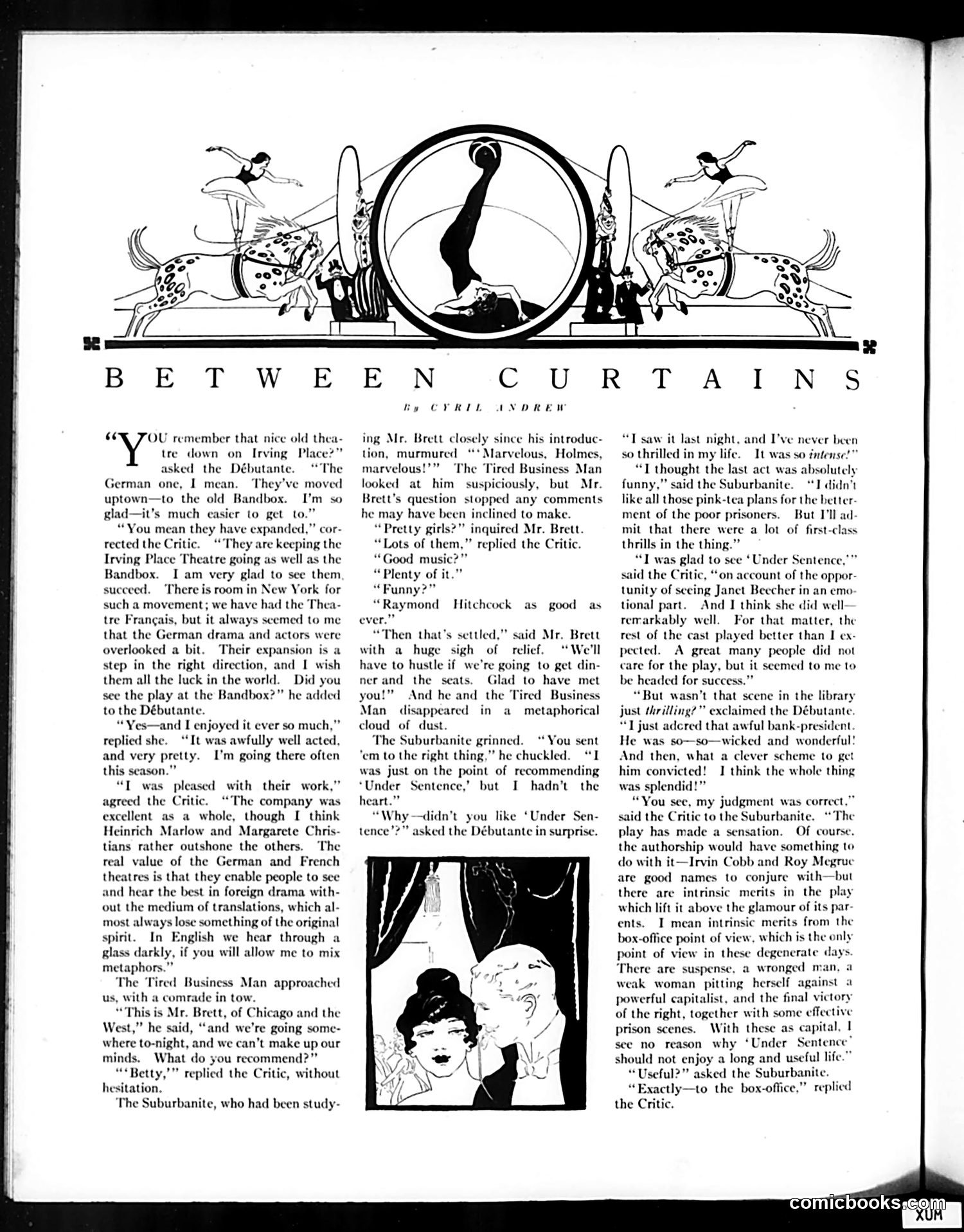
This theater criticism piece satirizes the pretensions of different theatergoers through dialogue. A Critic, Débutante, Suburbanite, and Tired Business Man discuss Broadway productions. The satire targets: 1. **The Débutante's snobbery**: She's pleased the German theater moved from Irving Place (implying the old location was unfashionable), while the Critic corrects her—the theater's expansion is culturally valuable, not merely a status upgrade. 2. **The Suburbanite's mock-erudition**: He adopts Sherlock Holmes references ("Marvelous, Holmes, marvelous!") to appear sophisticated while mocking serious theater. 3. **The Tired Business Man**: He seeks entertainment based purely on "pretty girls," "music," and "funny"—wanting a show, not art. 4. **Theater criticism itself**: The Critic proves wrong about "Under Sentence"—he dismissed it, but it becomes a success anyway. The page mocks critics' pretension to authority while actual audiences enjoy what experts overlook. The humor lies in exposing how different social classes consume theater for different (mostly superficial) reasons.
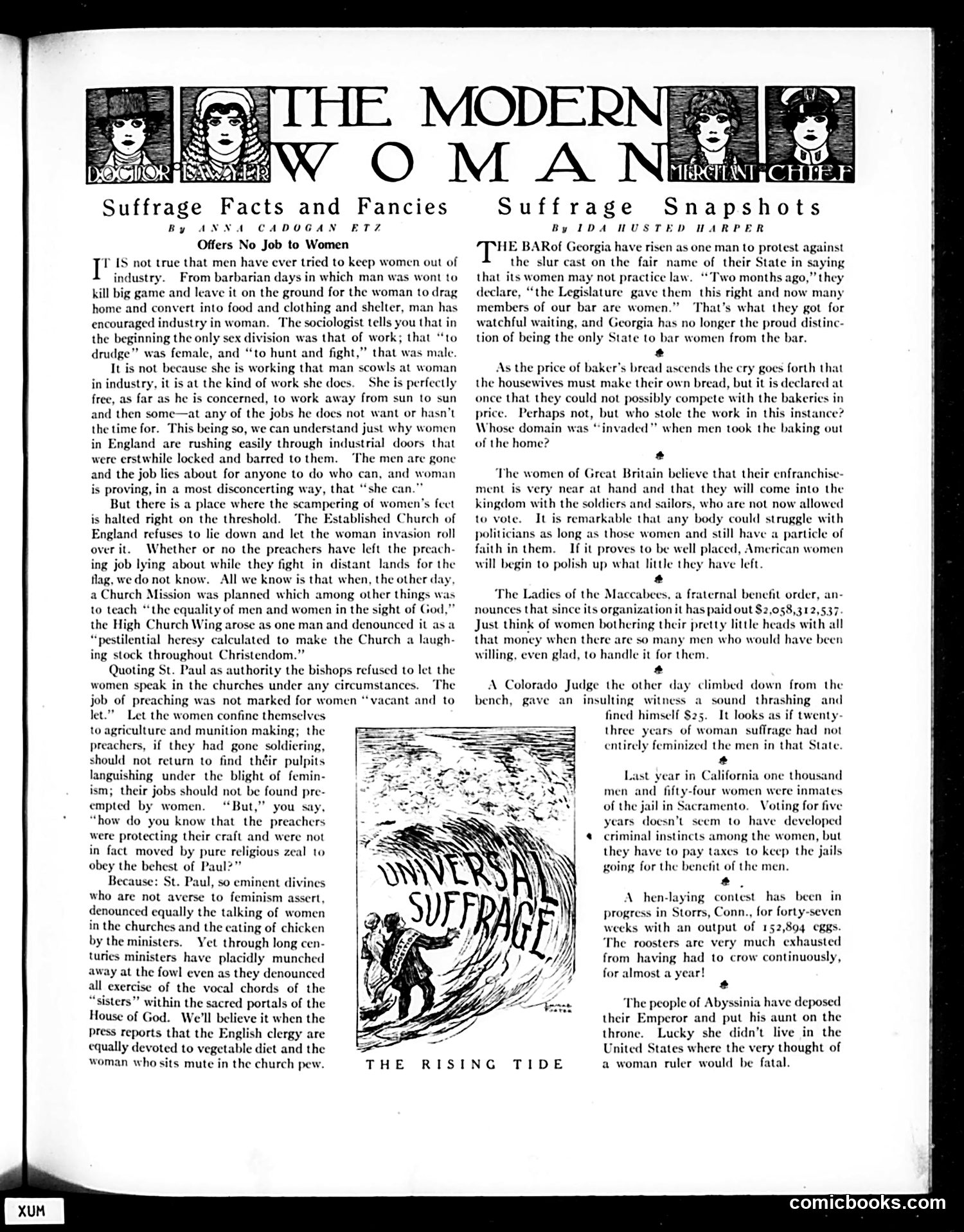
This page from Judge satirizes opposition to women's expanding roles during WWI, particularly in employment and religion. **Left column ("Suffrage Facts and Fancies"):** Author Cadogan Etz argues men don't oppose women *working*—only certain jobs. She notes English churches have paradoxically resisted women preachers while women fill wartime industrial jobs men abandoned. The satire targets the Established Church's hypocrisy: bishops cite St. Paul to forbid women preaching, yet ignore Paul's prohibition on eating chicken while ministers feast regularly. The implication: male clergy selectively invoke religious authority to protect professional turf, not genuine doctrine. **Right column ("Suffrage Snapshots"):** Harper catalogs women's progress: Georgia's male lawyers protested women being barred from legal practice, then grudgingly admitted many now practice law. The bread-making anecdote satirizes claims that housewives can't compete with bakeries—while simultaneously denying women paid work. **Central cartoon:** "The Rising Tide" depicts a figure struggling against surging waves labeled "Universal Suffrage," visualizing male anxiety about advancing women's rights as an overwhelming force. The page's overall message: male resistance to women's equality is economically motivated and hypocritically rationalized.
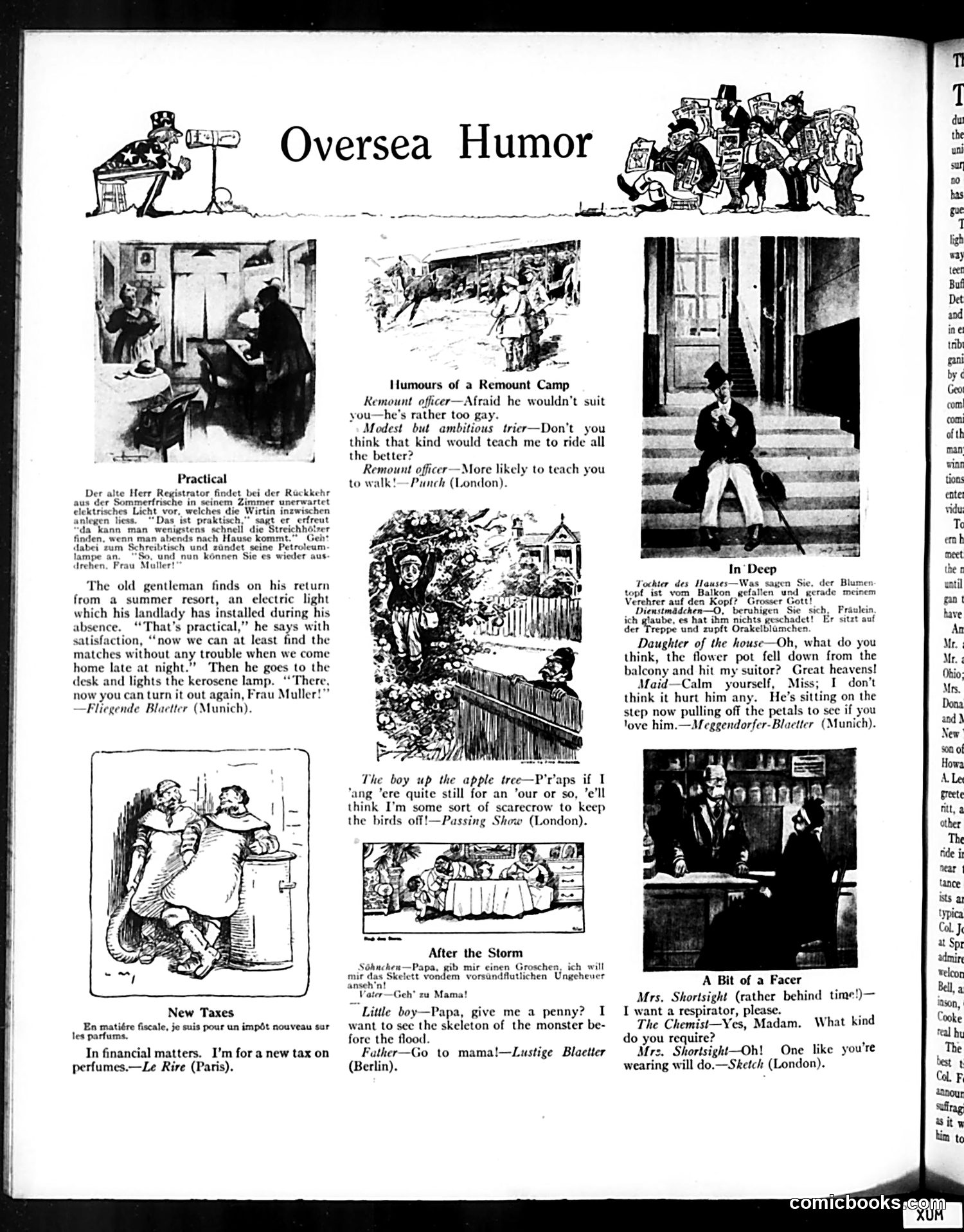
This page collects humor reprinted from European satirical magazines, showcasing different national comic traditions. **Key pieces:** - **Remount Camp** (British): A cavalry officer jokes that an overly cheerful horse wouldn't suit a nervous rider—it would teach him to walk instead, not ride. Dark military humor. - **The Practical Man** (German): An old gentleman finds electric lighting installed in his room but immediately lights a kerosene lamp instead to find matches—defeating the purpose. Satire on stubborn resistance to modern conveniences. - **Boy in Apple Tree** (British): A child stays still hoping crows will mistake him for a scarecrow. Child's logic humor. - **Flower Pot** (German): A flowerpot falls on a suitor's head; the maid reassures the daughter he's fine—he's plucking petals doing "loves me, loves me not." Sweet romantic humor. - **Respirator/Chemist** (British): A woman asks for a respirator "like you're wearing," mistaking the chemist's mask for a fashion accessory. Absurdist wordplay humor. The page represents post-WWI international humor—lighthearted, domestic, and often featuring class or gender-based comedy.
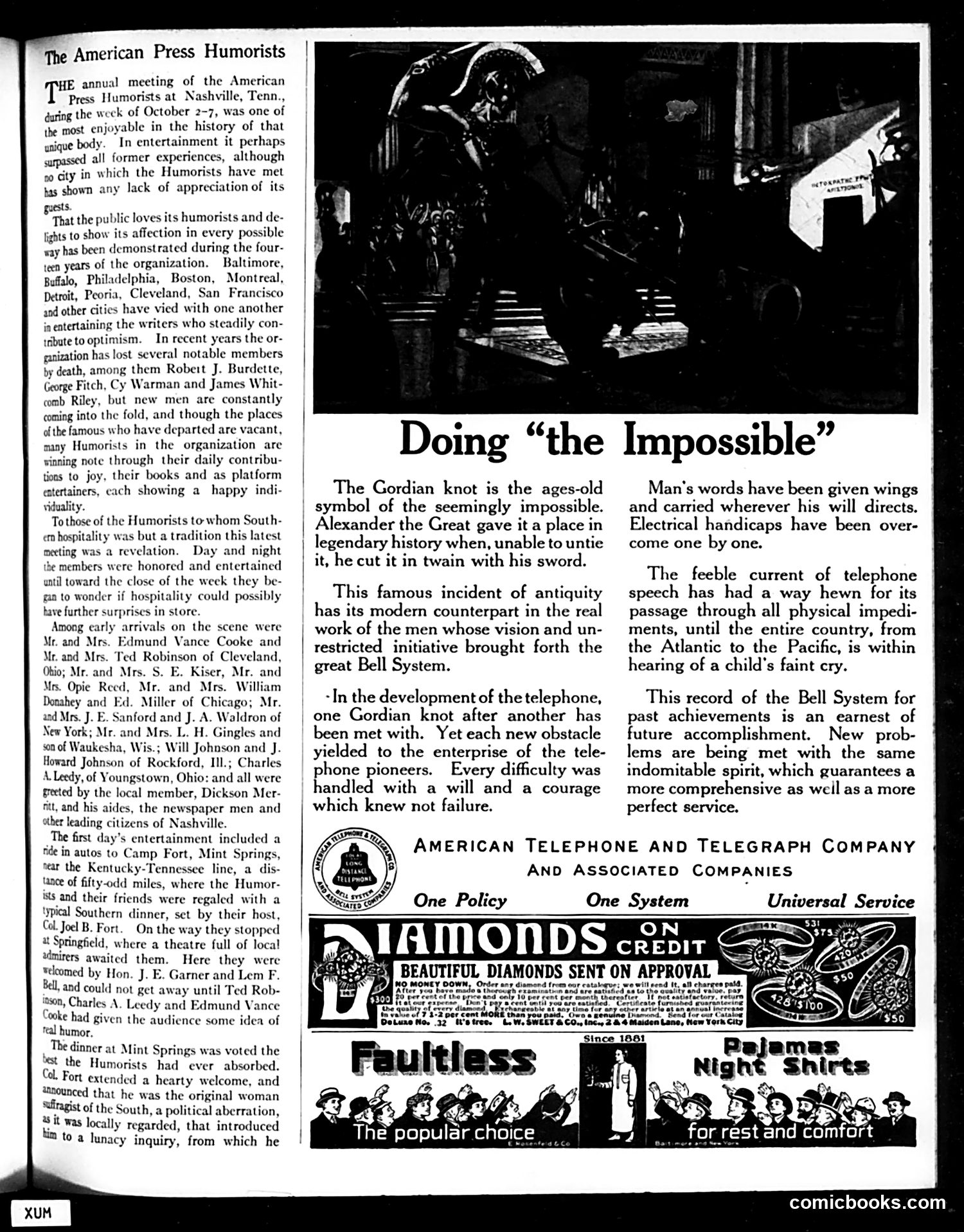
This page combines editorial content with advertising. The main article celebrates the American Press Humorists' annual convention in Nashville, Tennessee, listing prominent humor writers and describing their social events. The text honors deceased members (Robert J. Burdette, George Fitch, Cy Warman, James Whitcomb Riley) while noting new talent continually joining. The accompanying image titled "Doing 'the Impossible'" is not a political cartoon but **corporate advertising** for American Telephone and Telegraph Company. It uses the classical reference to Alexander the Gordian knot as metaphor: just as Alexander solved the "impossible" knot by cutting it, AT&T claims to overcome telephone technology's obstacles through "vision and unrestricted initiative." The page reflects early 20th-century American optimism about technological progress and corporate achievement. The humor writers' celebration and the telephone company's self-promotion both emphasize overcoming challenges through American ingenuity—a common theme of the era.
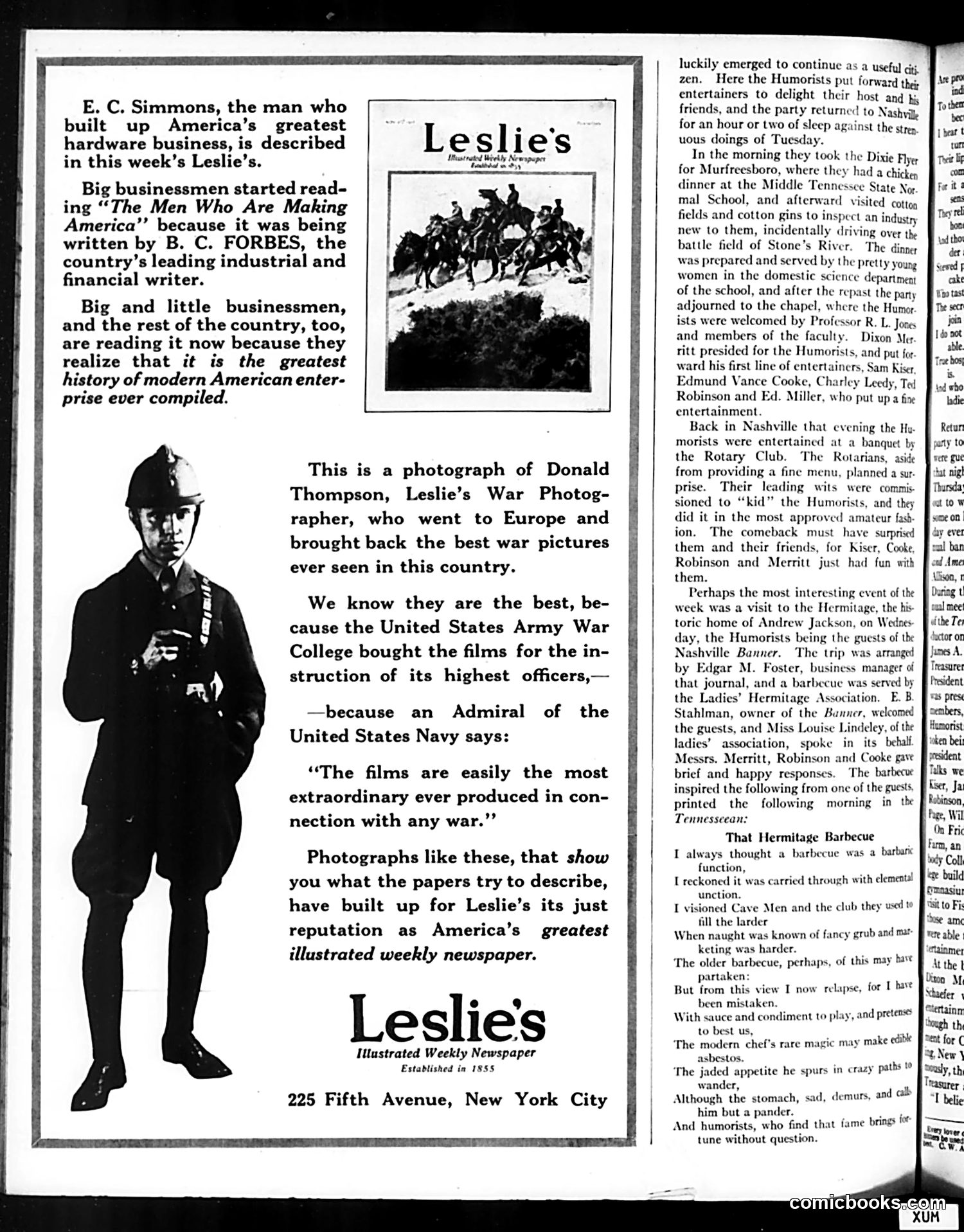
This page is primarily **advertising for Leslie's Illustrated Weekly Newspaper**, disguised as editorial content. The left side promotes Leslie's by highlighting E.C. Simmons (hardware magnate) and photographer Donald Thompson, whose WWI photographs were allegedly so superior that the U.S. Army War College purchased them for officer training. An admiral endorses them as "extraordinary." The satire is subtle: Leslie's claims its *photographs* built its reputation as "America's greatest illustrated weekly," emphasizing visual journalism over text. This was promotional positioning in an era when photojournalism was emerging as powerful media. The right column describes the "Humorists" (a touring entertainment group) visiting Nashville and Andrew Jackson's Hermitage, with a guest poem about a barbecue. This appears to be actual social reporting, not satire. **The point**: Leslie's is arguing that *pictures* — not writing alone — make a publication authoritative and valuable, positioning itself against text-heavy competitors.
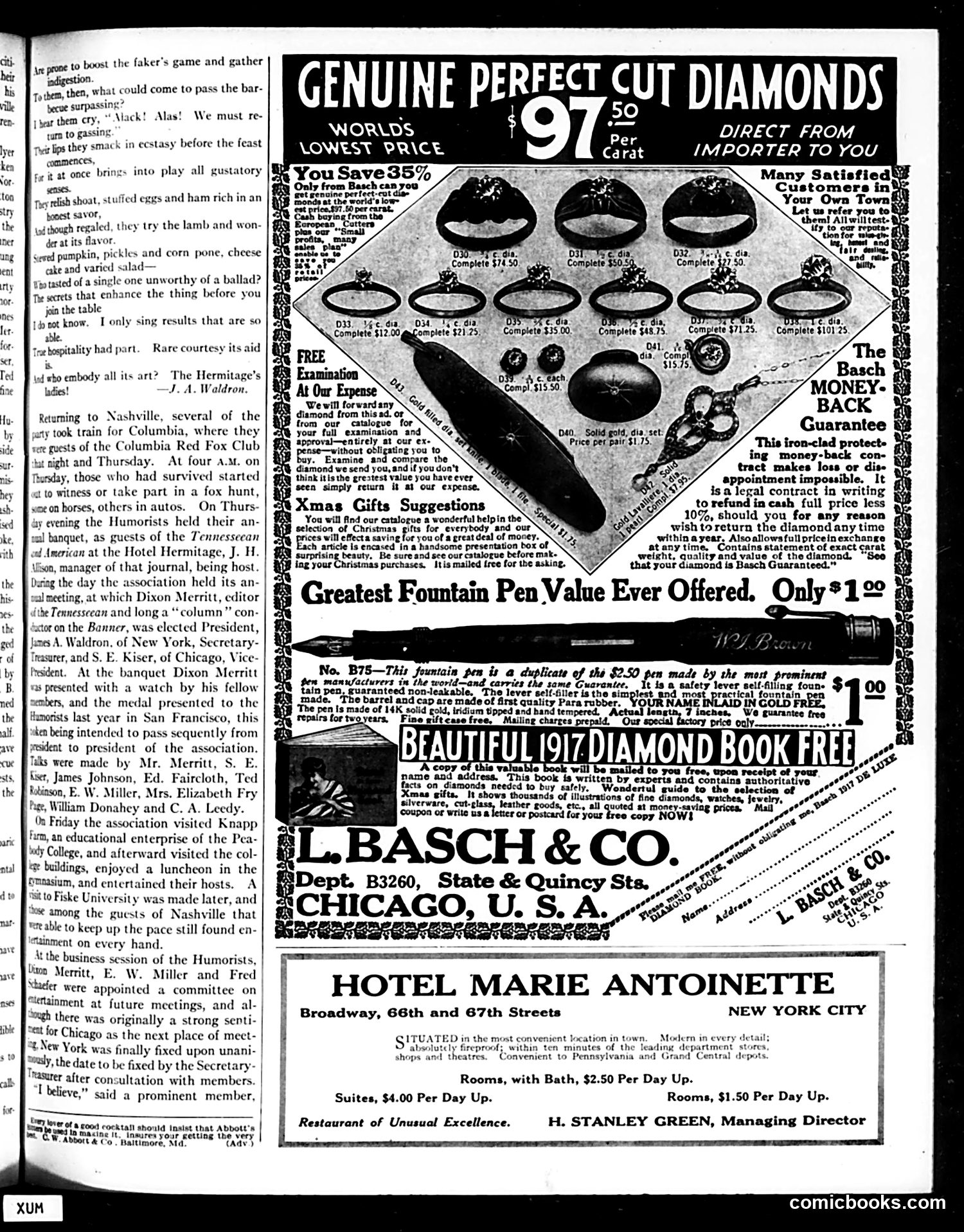
This page is primarily **advertising**, not political satire. The dominant content consists of three major advertisements: 1. **L. Basch & Co. diamonds** - selling "perfect cut diamonds" at $97.50 per carat, claiming "world's lowest price" with a money-back guarantee and free examination offer. 2. **Fountain pen advertisement** - promoting "Greatest Fountain Pen Value Ever Offered" for $1.00, with gold-inlaid trim. 3. **Hotel Marie Antoinette** - a New York City hotel advertisement listing room rates ($1.50-$4.00 per day). The left column contains a **literary piece** by J.A. Waldron describing a banquet and fox hunt in Nashville/Columbia, Tennessee, attended by members of the "Humorists" association (appears to be a professional organization of humor writers/editors). The text discusses hospitality, food, and organizational business rather than satire. This appears to be a typical Judge magazine page mixing editorial content with period advertisements rather than featuring political cartoons or satire.
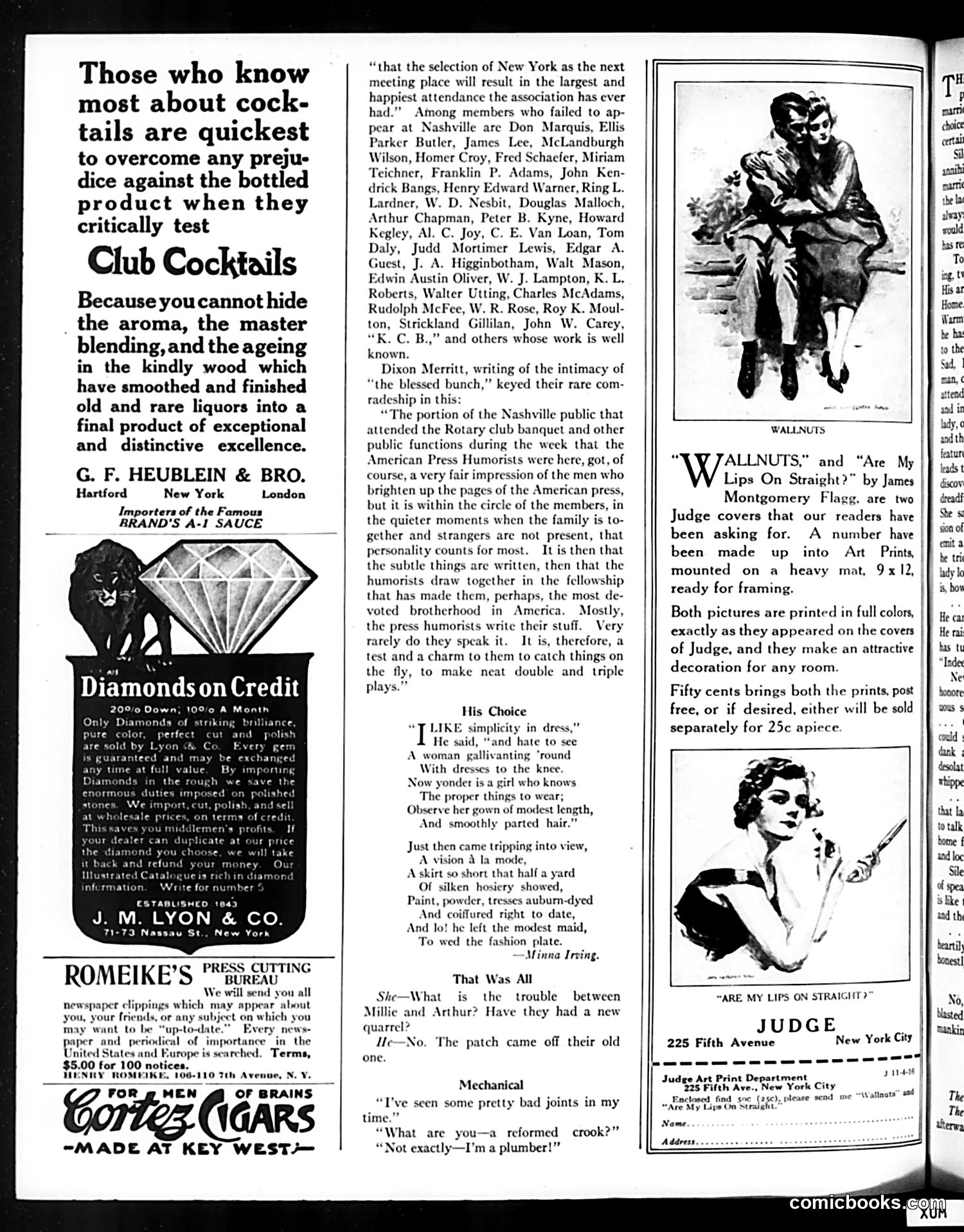
This page is primarily **advertising and filler content** rather than political satire. The main elements are: **Advertisements:** Club Cocktails (Heublein & Bro.), Diamonds on Credit, Romeike's Press Cutting Bureau, and Cortez Cigars dominate the layout. **Editorial Content:** A brief mention of the American Press Humorists' Nashville gathering, noting absent members like Ring Lardner and Ellis Parker Butler. The piece praises their "rare comradeship" and observes that humorists "rarely" speak their wit aloud—they instead "catch things on the fly." **Cartoons/Illustrations:** Two James Montgomery Flagg covers titled "Wallnuts" and "Are My Lips On Straight?" are advertised as available prints. The page also includes light humor pieces like "His Choice" (a poem about a man preferring fashionable dress) and "Mechanical" (a joke about a plumber). **Historical Context:** The page reflects Prohibition-era advertising (pre-1920) and demonstrates Judge's mix of high-brow literary humor with consumer advertising aimed at educated, affluent readers.
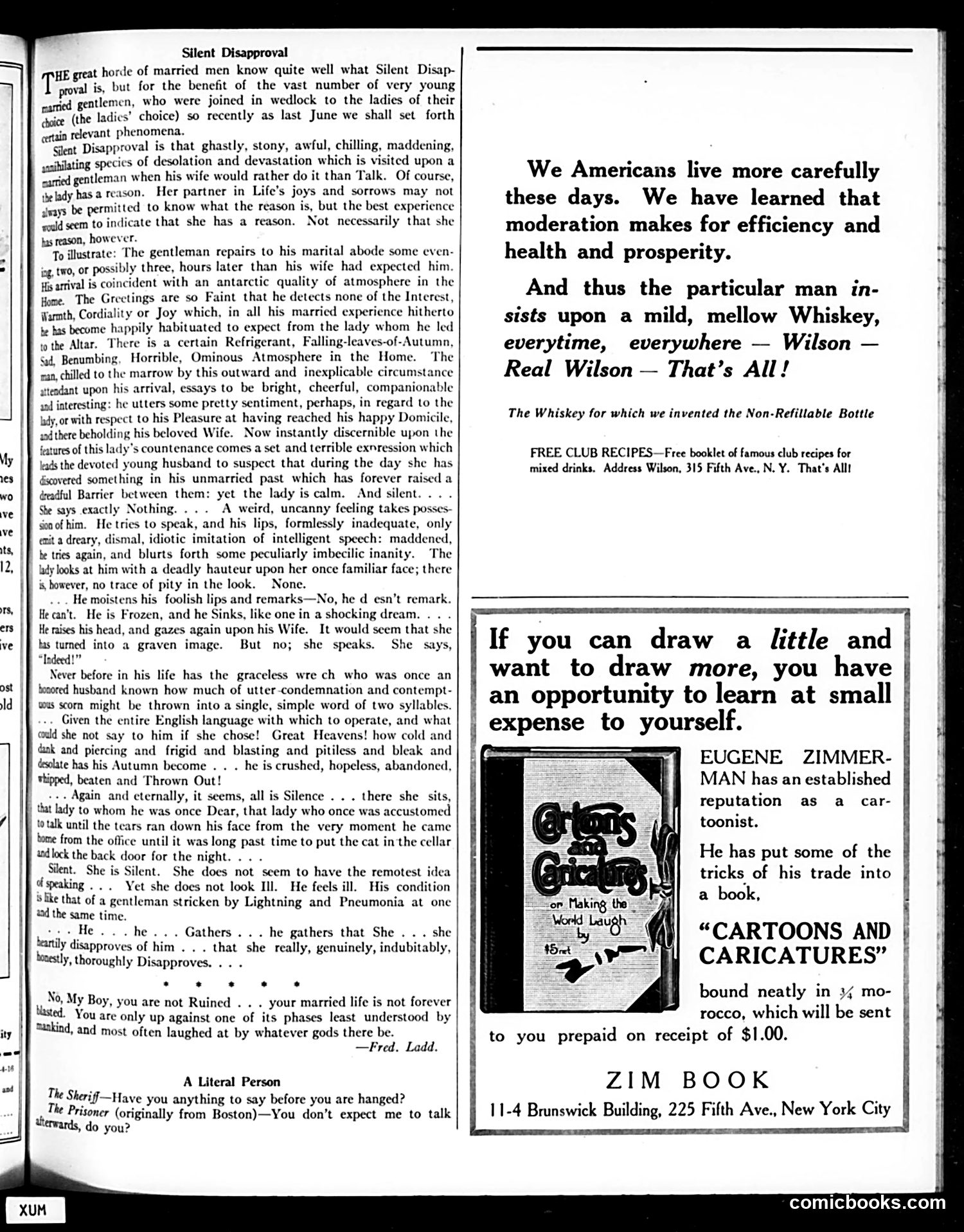
This piece is a humorous essay directed at newly married men, explaining the concept of a wife's "silent disapproval"—her refusal to speak or show warmth when displeased, typically due to her husband arriving home late. The satire targets both the husband's inadequacy (his bumbling attempts at cheerfulness and small talk) and the wife's devastating emotional weapon: complete silence and a cold demeanor. The author uses exaggerated, mock-heroic language to describe how a simple word like "Indeed!" can contain "utter condemnation and contempt." The joke's social context: this reflects early 20th-century marital dynamics where wives had limited direct power, making emotional withdrawal a primary means of expressing disapproval. The essay mockingly suggests this tactic is far more effective than actual argument or conversation. The piece is partly satirizing male obliviousness to their wives' reasons for anger, while also acknowledging wives' strategic use of silence as relationship leverage.
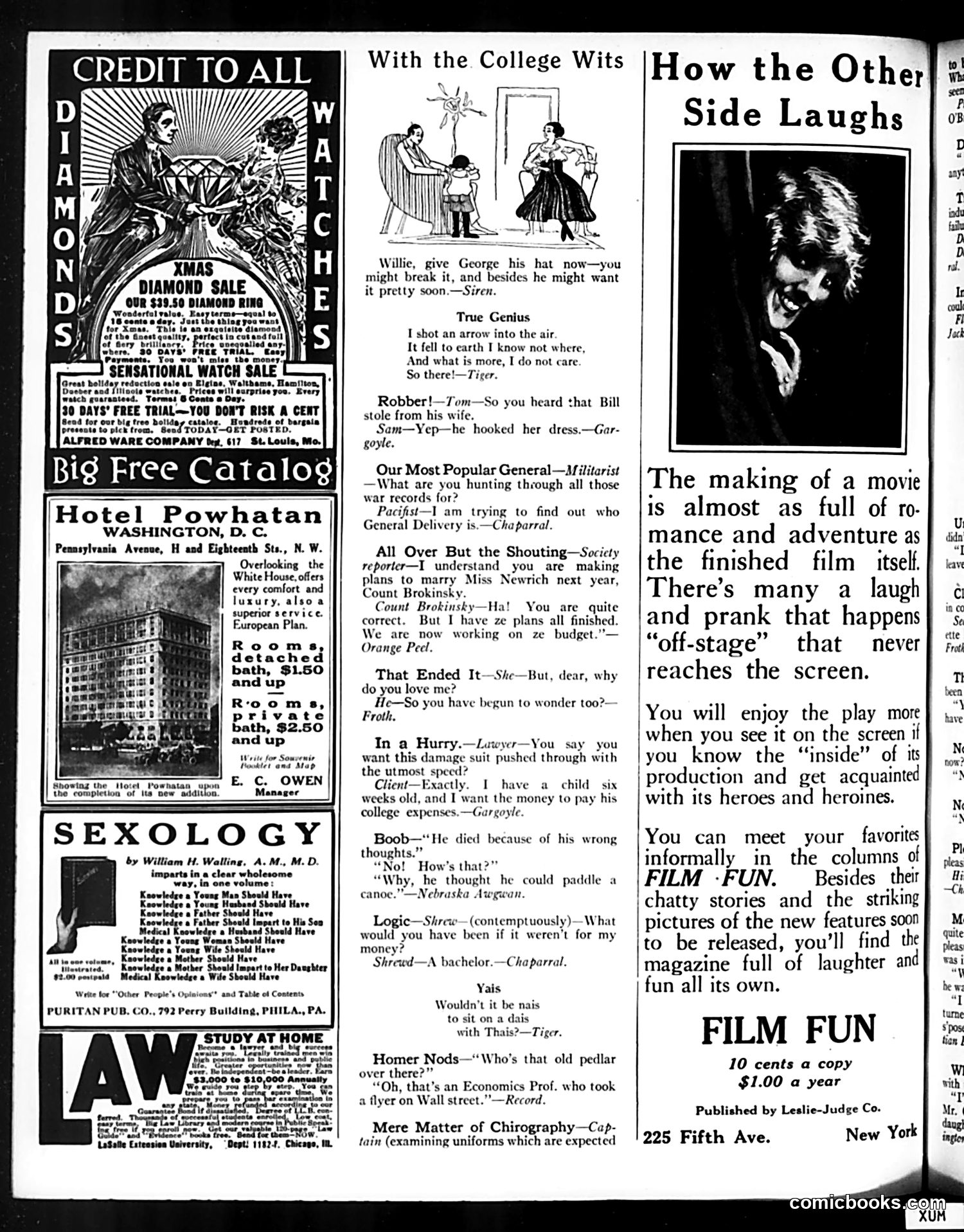
This page is primarily **advertising and humor columns** rather than political satire. The content consists of: **Main Features:** - Hotel and book advertisements (Powhatan Hotel, "Sexology" medical text, correspondence courses) - "With the College Wits" section: brief humorous one-liners from college publications, using wordplay and mild social satire - "Film Fun" magazine promotion: describes behind-the-scenes movie production stories **The Humor:** The college wit jokes employ gentle satire on everyday situations—a wife worried about a borrowed hat, a cheapskate husband stealing his wife's dress, economic professors gambling on Wall Street, and the pretensions of Russian nobility (Count Brokinsky). These are mild social observations rather than sharp political commentary. **Context for Modern Readers:** This reflects early 20th-century magazine advertising culture and campus humor tradition. The "Film Fun" promotion shows the era's fascination with emerging cinema as entertainment. Overall, this is a lighter editorial section mixing advertisements with accessible humor aimed at general readers.
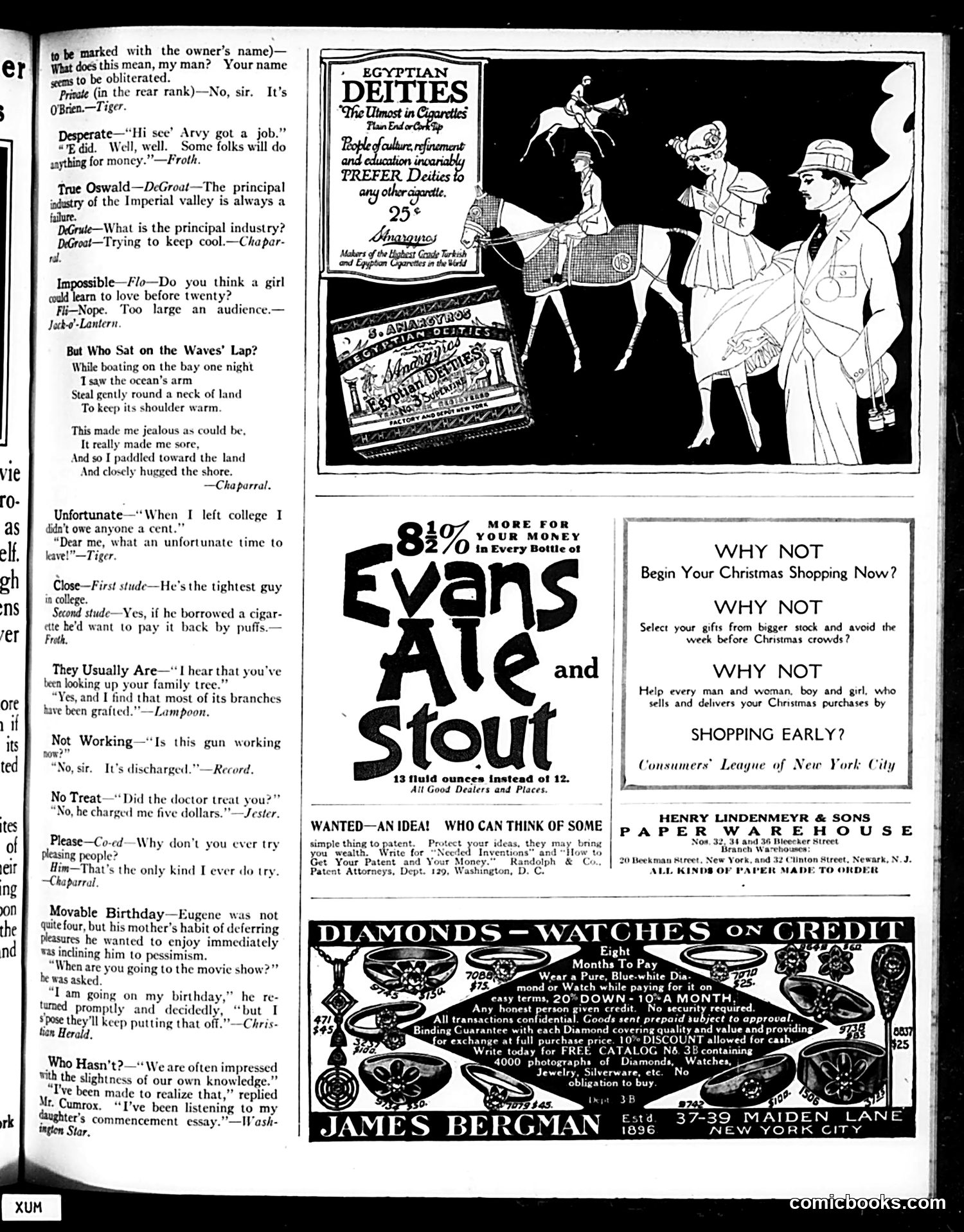
This page is primarily **advertising and humor columns**, not political cartoons. The content includes: **Humor Columns:** Brief jokes about everyday life—a soldier's name being obliterated, jealousy over the ocean, college borrowing etiquette, family tree genealogy ("grafted" branches, implying illegitimacy). These are gentle, domestic satires typical of early 20th-century magazines. **Advertisements:** The page features multiple ads for consumer goods—Egyptian Deities cigars, Evans Ale and Stout, diamonds and watches on credit, patent services, and a call for Christmas shopping early (likely WWI-era, given the appeal to help workers). The only potentially satirical visual element is the **Egyptian Deities cigarette ad** showing figures in colonial/Egyptian dress, which reflects period attitudes toward exoticism and orientalism, though the specific satire is unclear from the image alone. No identifiable political figures or major events are referenced on this page.
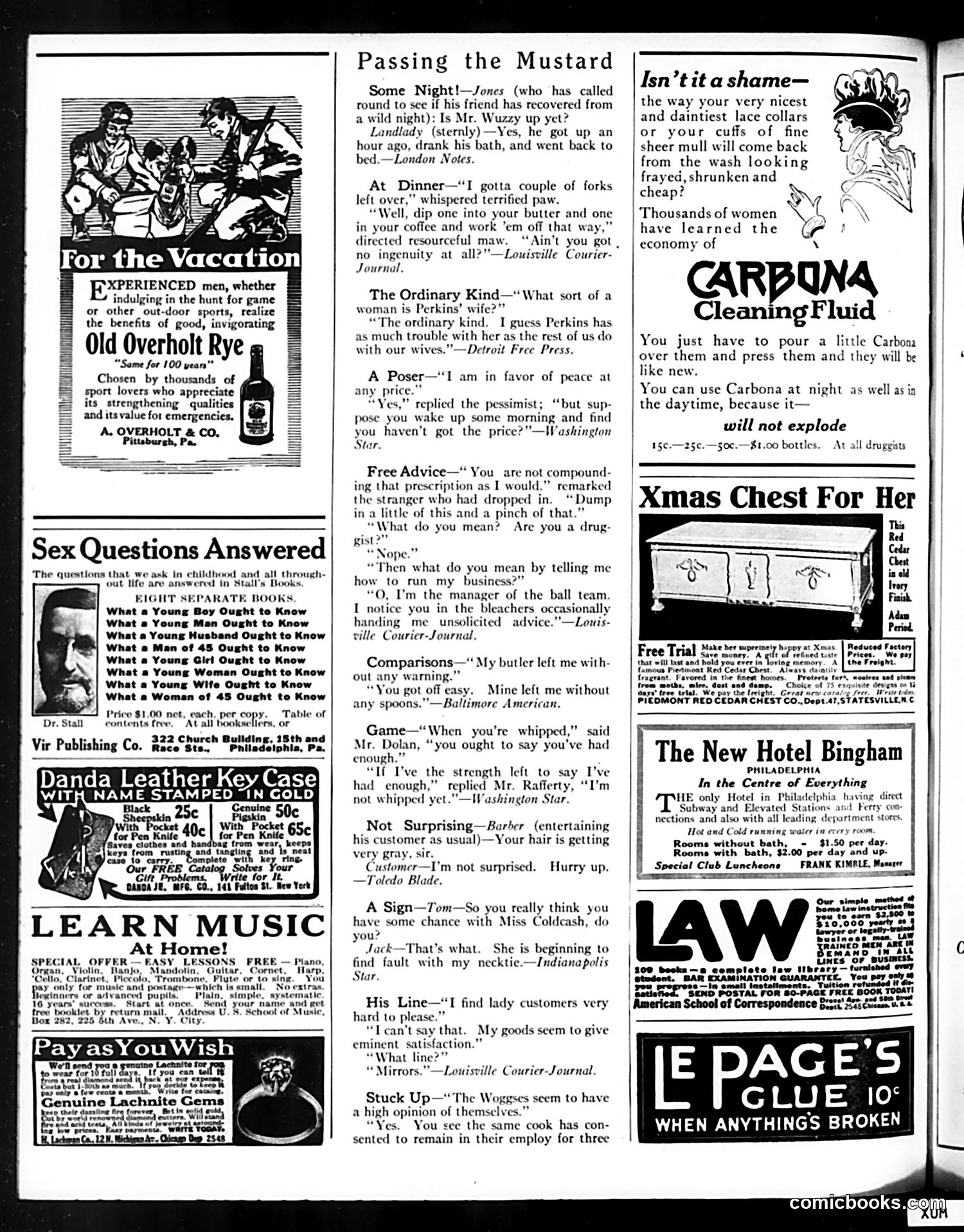
This page consists primarily of short humorous anecdotes—a common Judge magazine feature—with scattered advertisements. The jokes rely on wordplay and domestic/social mishaps typical of early 20th-century humor. Notable items: A cartoon labeled "For the Vacation" advertises Old Overholt Rye whiskey to outdoorsmen. The "Sex Questions Answered" ad promotes Dr. Stall's educational book series addressing sexual/marital topics—indicative of the era's euphemistic approach to such subjects. The humor sections mock everyday scenarios: a drunk man who "drank his bath" instead of taking one; working-class resourcefulness (using forks in butter and coffee); marital discord; and social pretension. One joke references a baseball team manager's unsolicited advice—mild satire of American sports culture. The Carbona cleaning fluid ad promises stain removal without explosion, suggesting the caustic nature of contemporary cleaning products. Overall, the page reflects modest, domestic-scale humor and consumer concerns of its historical moment.
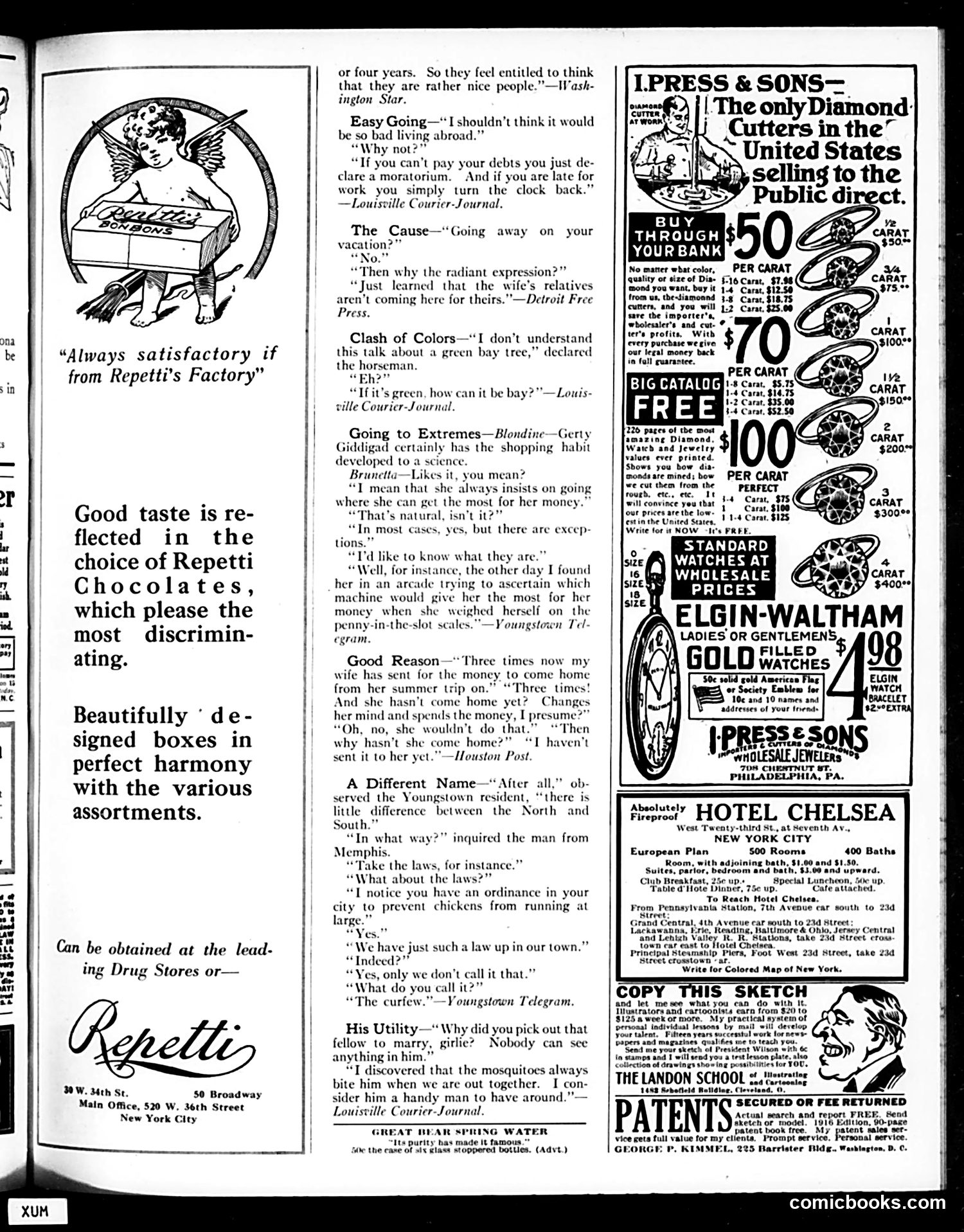
This page is primarily **advertising**, not political satire. The left side contains a Repetti Chocolates advertisement and several brief comic anecdotes (jokes) from various newspapers. The right side features multiple product advertisements: I. Press & Sons diamonds, Elgin-Waltham watches, Hotel Chelsea, and other vendors. The comic anecdotes are lighthearted observations about everyday life—marital disputes, shopping habits, municipal ordinances, and courtship—typical of early 20th-century humor. They reference no specific political figures or events. The page reflects the magazine's format: mixing satirical commentary (elsewhere in the issue) with consumer advertisements and gentle domestic humor to attract readers and advertisers.
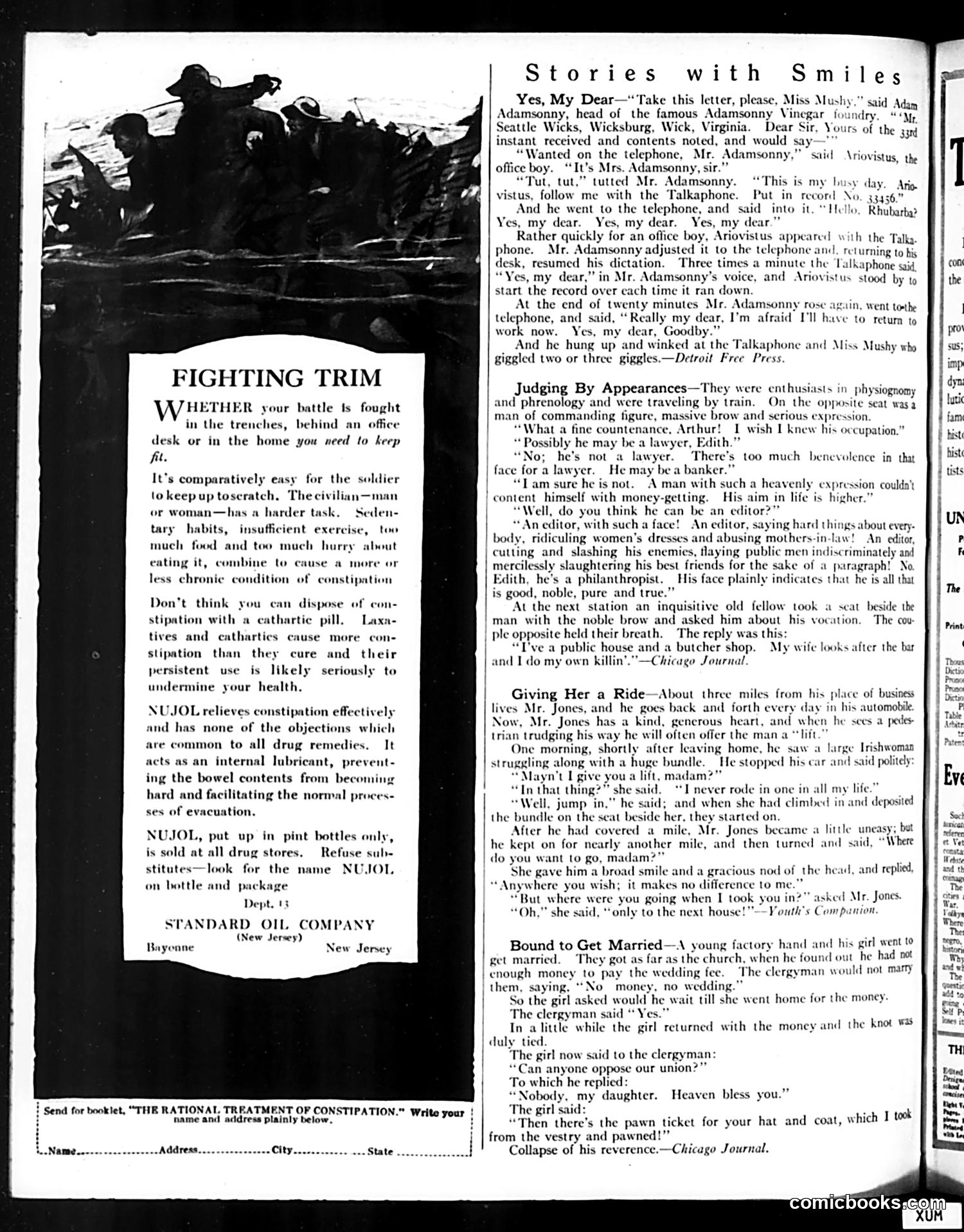
This page contains **primarily advertisements and humorous short stories**, not political cartoons. The main content includes: **"Fighting Trim"** — A NUJOL laxative ad addressing WWI-era concerns. It targets both soldiers in trenches and civilians at home, arguing that modern sedentary life causes constipation, and promoting their lubricant product over harsh cathartics. **"Stories with Smiles"** — Three brief comedic anecdotes: 1. A husband uses a "Talkaphone" (dictating device) to repeatedly play a recording of "Yes, my dear" while on the phone with his wife, allowing him to return to work. 2. Train passengers judge a man's character by his appearance and noble features, confidently speculating he's a philanthropist—only to learn he runs a pub and butcher shop. 3. A young couple seeking marriage lacks wedding funds; the clergyman agrees to marry them if the girl pawns her hat and coat. These are gentle, domestic humor pieces typical of Judge's satirical tradition, poking fun at marriage, technology, and human gullibility—not serious political commentary.
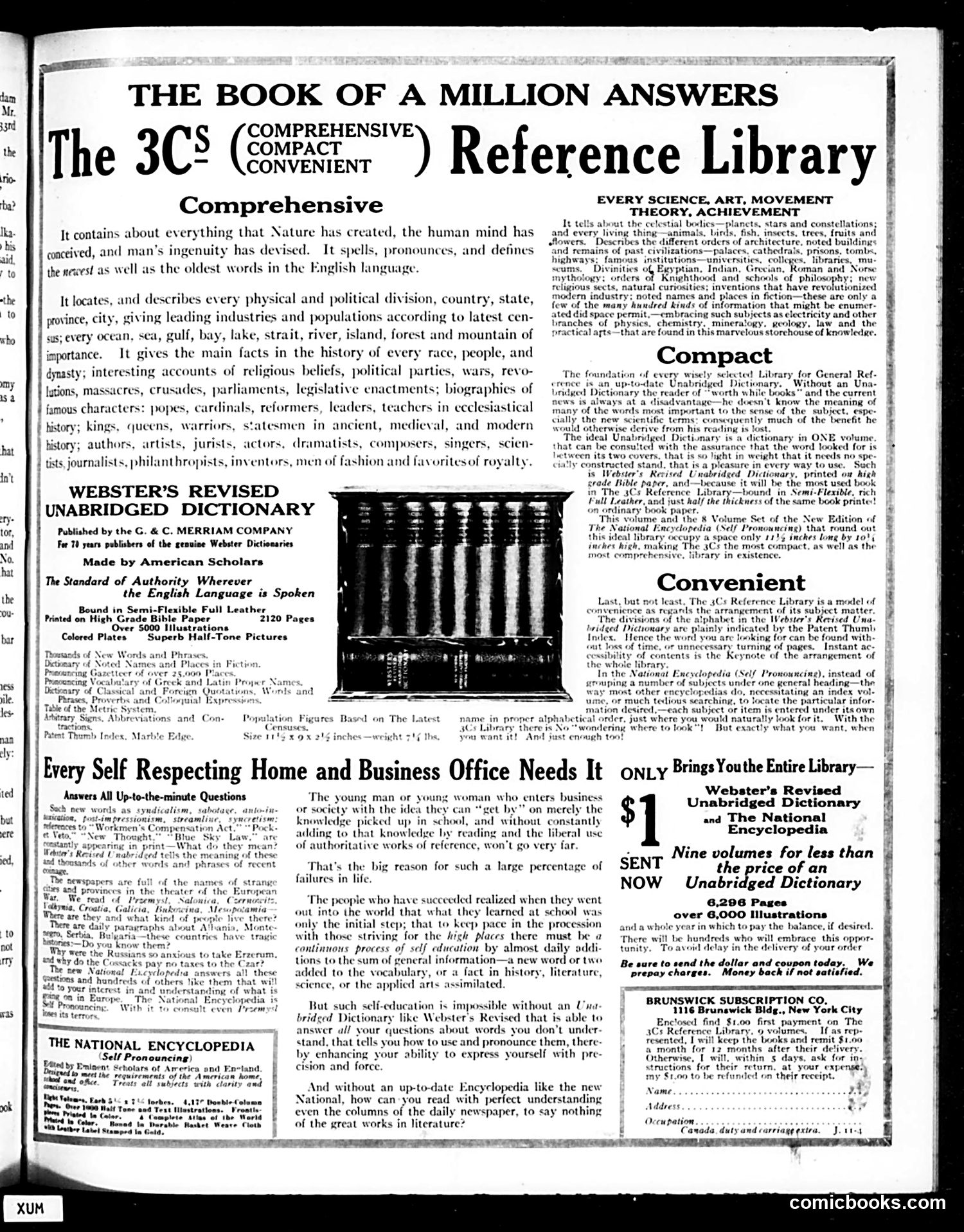
This page is primarily **advertising, not satire or political commentary**. It contains multiple product advertisements for reference books and encyclopedias, including: - **The 3CS Reference Library** (Comprehensive, Compact, Convenient) - **Webster's Revised Unabridged Dictionary** - **The National Encyclopedia** The ads emphasize these as essential reference materials for "Every Self Respecting Home and Business Office." There is no political cartoon visible on this page. The advertising copy targets middle-class readers seeking knowledge and self-improvement through affordable home libraries, a common sales pitch of the early-to-mid 20th century. This appears to be a **book advertisement page** rather than editorial or satirical content.
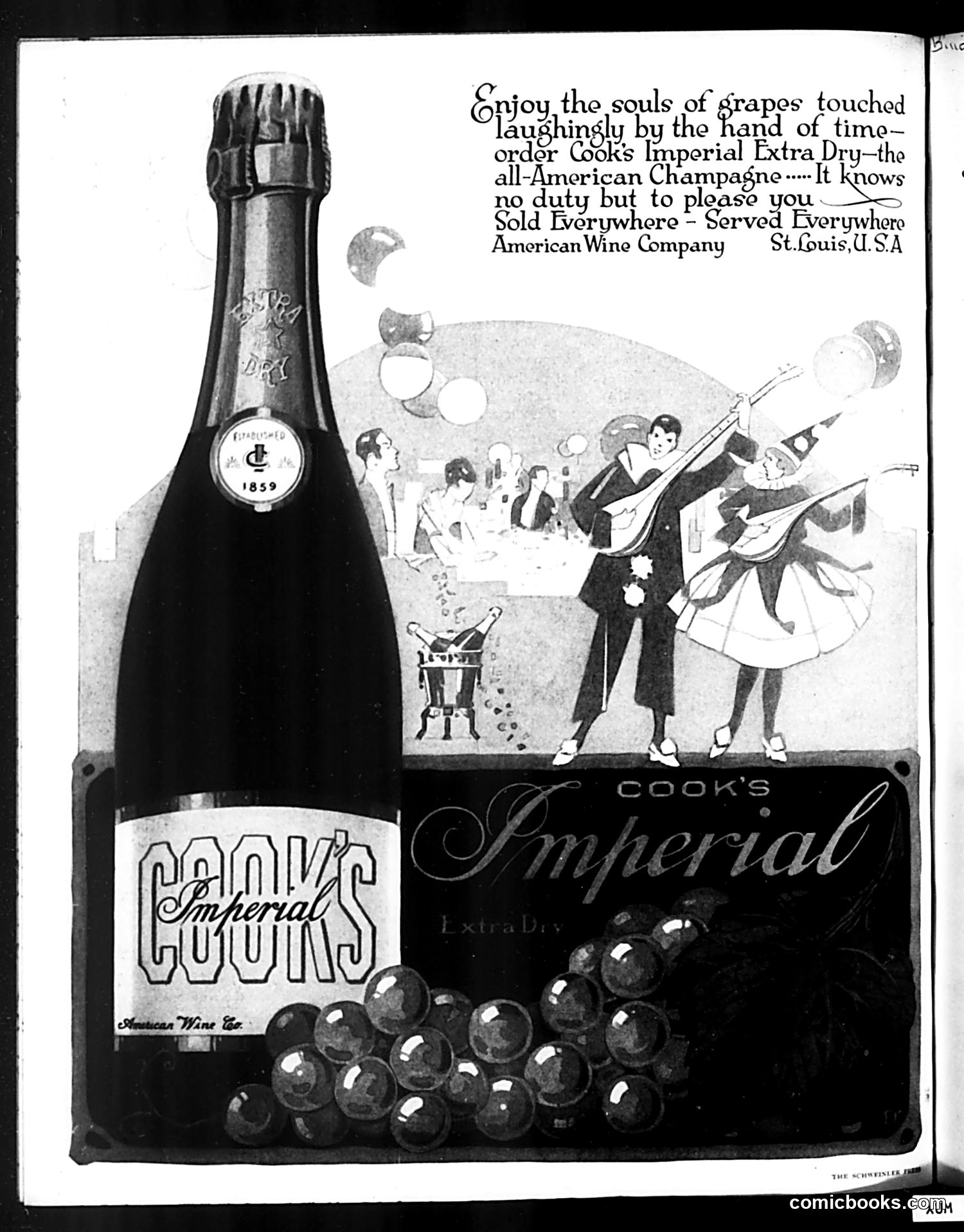
This is a **Cook's Imperial champagne advertisement**, not political satire. The ad promotes Cook's as an "all-American Champagne" made by the American Wine Company in St. Louis. The illustration depicts a festive party scene with well-dressed revelers enjoying champagne—a man in a tuxedo and woman in an evening gown dancing or celebrating, with musicians, bubbles, and grapes scattered around. The large champagne bottle dominates the left side. The copy uses poetic language ("souls of grapes touched laughingly by the hand of time") to market the product as sophisticated and pleasurable. The phrase "It knows no duty but to please you" emphasizes luxury and satisfaction. This appears to be from the Prohibition era or just after (based on the emphasis on legal American wine production), when domestic champagne producers competed heavily with imported French versions.