
Judge, 1916-11-04 · page 10 of 32
Judge — November 4, 1916 — page 10: what you’re looking at
What you’re looking at
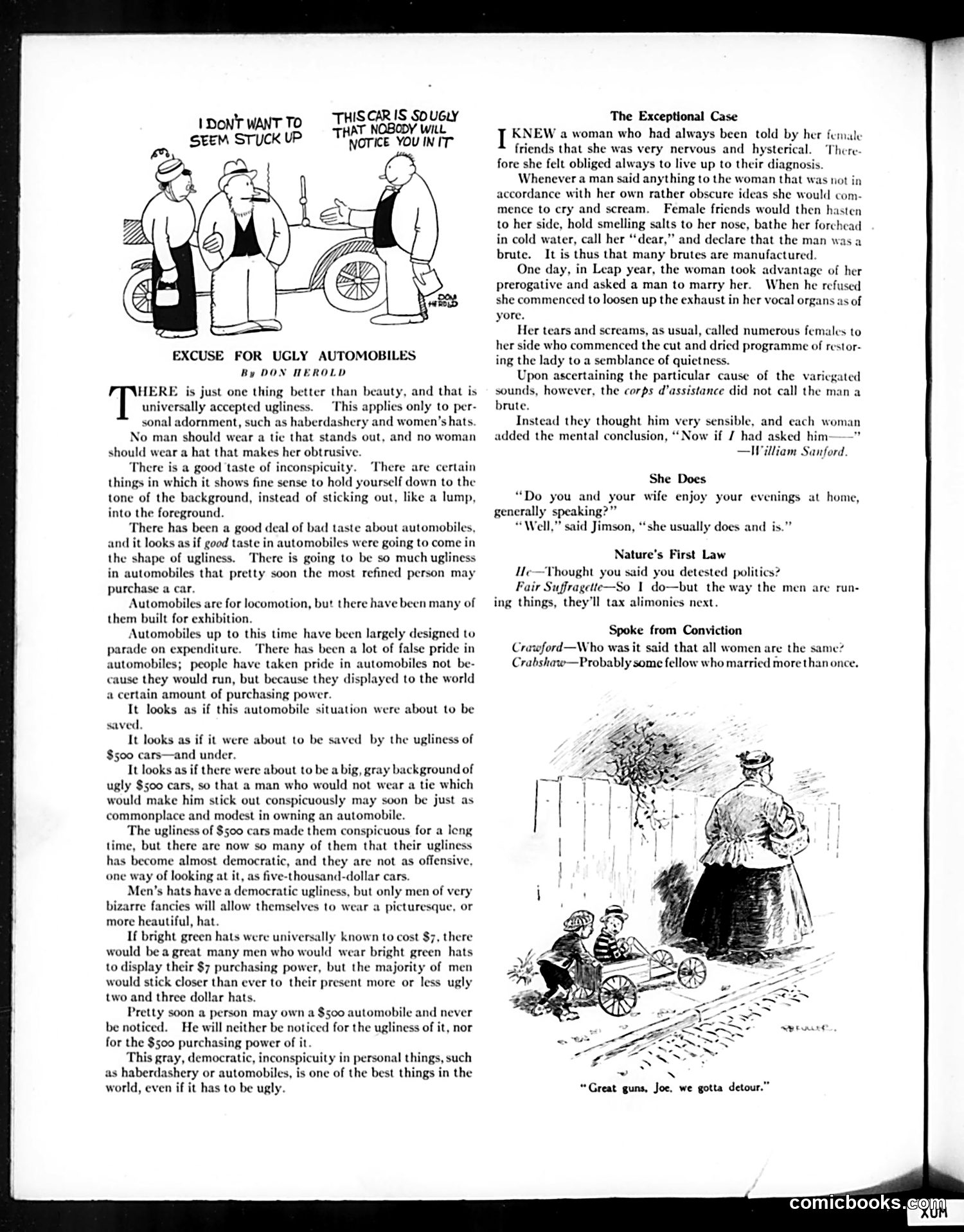
**"Excuse for Ugly Automobiles"** (top left cartoon and main article): The cartoon shows three men discussing an obviously homely car. The satire critiques early automobile culture's obsession with displaying wealth through flashy vehicles. Author Don Herold argues that as $500 cars become commonplace and universally ugly, they'll paradoxically become *democratic* and respectable—like plain neckties or cheap hats. The joke: ugliness becomes acceptable when everyone has it. He's mocking the original status-seeking impulse behind fancy cars while celebrating that mass-market mediocrity may finally make modesty fashionable. **"The Exceptional Case"** (right column): This story satirizes women who perform hysteria because they've been told (by female friends) that they're "nervous and hysterical." The narrative ironically shows how social expectations manufacture the very behavior they claim to describe. The woman's emotional outbursts are reinforced by sympathetic girlfriends with smelling salts, making her "brute" behavior seem justified—when actually her friends created the dynamic.
📄 Transcribed text from this page (OCR, searchable)
Machine-transcribed from the original scan — historical spelling and the odd misread are preserved.
THIS CARIS SouGLY THAT NOBODY wil NOTICE YOU INIT I DONT WANT To SEEM STUCK UP EXCUSE FOR UGLY AUTOMOBILES By DON HEROLD HERE is just one thing better than beauty, and that is universally accepted ugliness. This applies only to per- sonal adornment, such as haberdashery and women’s hats No man should wear a tic that stands out, and no woman should wear a hat that makes her obtrusive. There is a good taste of inconspicuity. There are certain things in which it shows fine sense to hold yourself down to the tone of the background, instead of sticking out, like a lump, into the foreground. There has been a good deal of bad taste about automobiles, and it looks as if good taste in automobiles were going to come in the shape of ugliness. There is going to be so much ugliness in automobiles that pretty soon the most refined person may purchase a car. Automobiles are for locomotion, but there have been ma them built for exhibition. Automobiles up to this time have been largely designed to parade on expenditure. There has been a lot of false pride in automobiles; people have taken pride in automobiles not be- cause they would run, but because they displayed to the world a certain amount of purchasing power. It looks as if this automobile situation were about to be y of e about to be saved by the ugliness of $500 cars—and unde It looks as if there were about to be a big, gray background of ugly $500 cars, so that a man who would not wear a tie which would make him stick out conspicuously may soon be just as commonplace and modest in owning an automobile. The ugliness of $500 cars made them conspicuous for a leng time, but there are now so many of them that their ugliness has become almost democratic, and they are not as offensive, one way of looking at it, as five-thousand-dollar cars. Men’s hats have a democratic ugliness, but only men of very bizarre fancies will allow themselves to wear a picturesque, or more heautiful, hat. If bright green hats were universally known to cost $7, there would be a great many men who would wear bright green hats to display their $7 purchasing power, but the majority of men would stick closer than ever to their present more or less ugly two and three dollar hats. Pretty soon a person may own a $500 automobile and never be noticed. He will neither be noticed for the ugliness of it, nor for the $500 purchasing power of it. This gray, democratic, inconspicuity in personal things, such as haberdashery or automobil one of the best things in the world, even if it has to be ugly. The Exceptional Case KNEW a woman who had always been told by her female friends that she was very nervous and hysterical. There- fore she felt obliged always to live up to their diagnosis. Whenever a man said anything to the woman that was not in accordance with her own rather obscure ideas she would com- mence to cry and scream. Female friends would then hasten to her side, hold smelling salts to her nose, bathe her forehead in cold water, call her “dear,” and declare that the man was a brute. It is thus that many brutes are manufactured. One day, in Leap year, the woman took advantage of her prerogative and asked a man to marry her. When he refused she commenced to loosen up the exhaust in her vocal organs as of yore. Her tears and screams, as usual, called numerous females to her side who commenced the cut and dricd programme of restor- ing the lady to a semblance of quietness. Upon ascertaining the particular cause of the variegated sounds, however, the corps d’assistance did not call the man a brute. Instead they thought him very sensible, and each woman added the mental conclusion, “Now if / had asked him——” —William Sanford. She Does “Do you and your wife enjoy your evenings at home, gencrally speaking?” “Well,” said Jimson, “she usually does and is.”” Nature's First Law He—Thought you said you detested politics? Fair Suffragette—So 1 do—but the way the men are run- ing things, they'll tax alimonies next. Spoke from Conviction ford—Who was it said that all women are the same? “Great guns, Joe, we gotta detour.” comicbooks.