
Judge, 1916-11-04 · page 16 of 32
Judge — November 4, 1916 — page 16: what you’re looking at
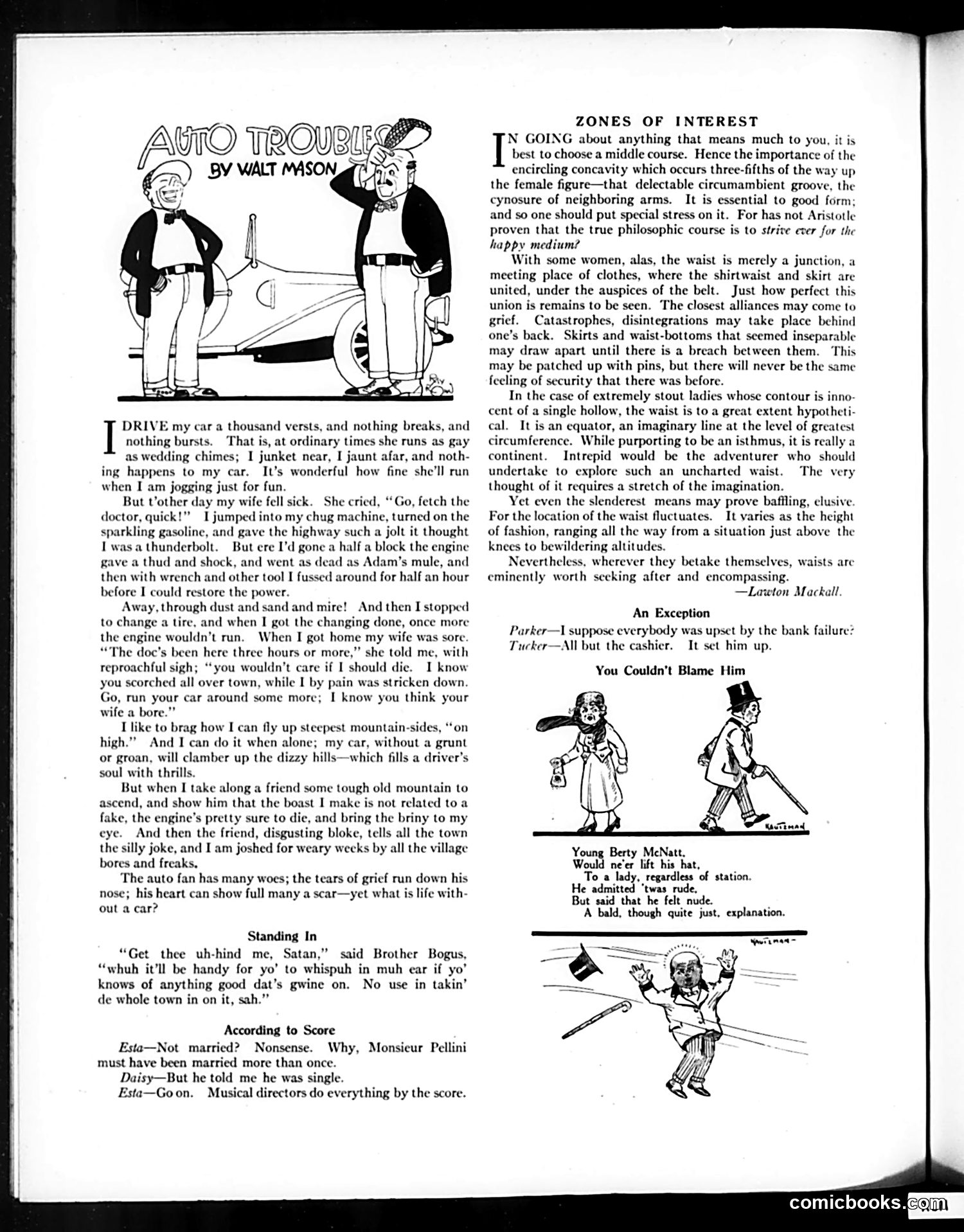
What you’re looking at
**"Auto Trouble" (left column):** Walt Mason's humorous poem about an unreliable automobile. The narrator boasts his car runs perfectly when driven for pleasure, but fails repeatedly during an actual emergency—when his wife falls ill and needs a doctor. The satire targets both automobiles' notorious unreliability in the early 20th century and drivers' misplaced priorities: the man's vanity about his car matters more than his wife's health. **"Zones of Interest" (right column):** A satirical essay mocking fashion obsession with women's waists. It ironically praises the waist as philosophically important while describing garments that constantly come undone or gap apart. The humor targets both corset-culture absurdity and women's impractical fashion constraints—waists held together by pins and belts that perpetually threaten to separate. **Minor jokes below** include puns about musical directors and marriage ("by the score"). The page exemplifies Judge's satirical approach: mocking contemporary technology failures and fashion ridiculousness through exaggerated observation.
📄 Transcribed text from this page (OCR, searchable)
Machine-transcribed from the original scan — historical spelling and the odd misread are preserved.
DRIVE my car a thousand versts, and nothing breaks, and nothing bursts. That is, at ordinary times she runs as gay as wedding chimes; I junket near, I jaunt afar, and noth- ing happens to my car. It’s wonderful how fine she'll run when I am jogging just for fun. But tother day my wife fell sick. She cried, “Go, fetch the doctor, quick!” I jumped into my chug machine, turned on the sparkling gasoline, and gave the highway such a jolt it thought athunderbolt. But ere I’d gone a half a block the engine thud and shock, and went as de: s Adam’s mule, and then with wrench and other tool I fussed around for half an hour before I could restore the power. Away, through dust and sand and mire! And then I stopped to change a tire, and when I got the changing done, once more the engine wouldn’t run. When I got home my wife was sore. “The doc’s been here three hours or more,” she told me, with reproachful sigh; “you wouldn’t care if I should die. I know you scorched all over town, while I by pain was stricken down. Go, run your car around some more; I know you think your wife a bore.” I like to brag how I can fly up steepest mountain-sides, ‘on high.” And I can do it when alone; my car, without a grunt or groan, will clamber up the dizzy hills—which fills a driver's soul with thrills. But when I take along a friend some tough old mountain to ascend, and show him that the boast I make is not related to a fake, the engine’s pretty sure to die, and bring the briny to my eye. And then the friend, disgusting bloke, tells all the town the silly joke, and I am joshed for weary weeks by all the village bores and freaks. The auto fan has many woes; the tears of grief run down his nose; his heart can show full many a scar—yet what is life with- out a car? Standing In “Get thee uh-hind me, Satan,” said Brother Bogus, “whuh it’ll be handy for yo’ to whispuh in muh ear if yo’ knows of anything good dat’s gwine on. No use in takin’ de whole town in on it, sah.” According to Score Esta—Not married? Nonsense. Why, Monsieur Pellini must have been married more than once. Daisy—But he told me he was single. Esta—Goon. Musical directors do everything by the score. ZONES OF INTEREST N GOING about anything that means much to you, it is best to choose a middle course. Hence the importance of the encircling concavity which occurs three-fifths of the way up the female figure—that delectable circumambient groove, the cynosure of neighboring arms. It is essential to good form; and so one should put special stress on it. For has not Aristotle proven that the true philosophic course is to strive ever for the happy medium? With some women, alas, the waist is merely a junction, a meeting place of clothes, where the shirtwaist and skirt are united, under the auspices of the belt. Just how perfect this union is remains to be seen. The closest alliances may come to grief. Catastrophes, disintegrations may take place behind one’s back. Skirts and waist-bottoms that scemed inseparable may draw apart until there is a breach between them. This may be patched up with pins, but there will never be the same feeling of security that there was before. In the case of extremely stout ladies whose contour is inno- cent of a single hollow, the waist is to a great extent hypotheti- cal. It is an equator, an imaginary line at the level of greatest circumference. While purporting to be an isthmus, it is really a continent. Intrepid would be the adventurer who should undertake to explore such an uncharted waist. The very thought of it requires a stretch of the imagination. Yet even the slenderest’ means may prove bafiling, clusive. For the location of the waist fluctuates. It varies as the height of fashion, ranging all the way from a situation just above the knees to bewildering altitudes. Nevertheless, wherever they betake themselves, waists are eminently worth secking after and encompassing. —Lawton Mackall. An Exception Parker—I suppose everybody was upset by the bank failure? Tucker—All but the cashier. It set him up. You Couldn't Blame Him Young Berty McNatt. Would ne’er lift his hat, To a lady, regardless of station. He admitted ‘twas rude, But said that he felt nude. A bald, though quite just, explanation. Nerina comicbooks.