
Judge, 1916-11-04 · page 6 of 32
Judge — November 4, 1916 — page 6: what you’re looking at
What you’re looking at
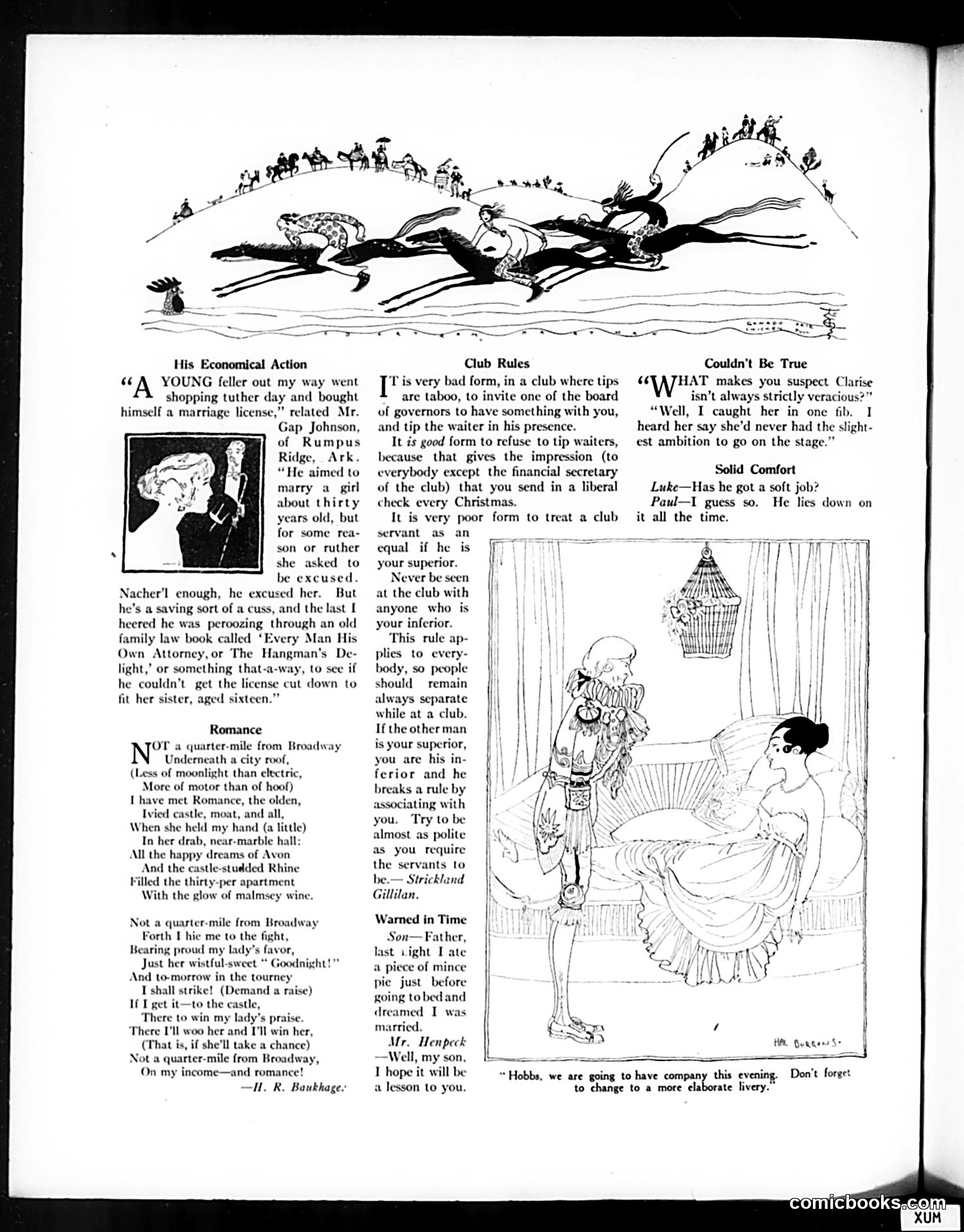
This page contains several pieces of early-20th-century American humor satirizing social conventions and courtship: **"His Economical Action"** mocks rural frugality through a dialect-heavy anecdote about a man trying to reuse a marriage license after rejection—absurd literalism played for laughs. **"Romance"** is sentimental verse about urban courtship far from Broadway's glamour, ending with the speaker hoping to win his lady by demanding a salary raise—satirizing the gap between romantic ideals and economic reality. **"Club Rules"** parodies the rigid etiquette of exclusive clubs, where contradictory rules (treat servants as inferiors but never associate with actual inferiors) expose the arbitrary snobbery of upper-class institutions. The remaining jokes mock social pretense: a woman denying stage ambitions, a man comfortable "lying down on the job," and a servant needing fancier livery for company. The overall theme: American society's obsession with status, propriety, and economic anxiety—whether rural, working-class, or elite.
📄 Transcribed text from this page (OCR, searchable)
Machine-transcribed from the original scan — historical spelling and the odd misread are preserved.
His Economical Action “A YOUNG feller out my way went shopping tuther day and bought himself a marriage license,” related Mr. Gap Johnson, of Rumpus Ridge, Ark. “He aimed to marry a girl about thirty years old, but for some rea- son or ruther she asked to be excused. Nacher’l enough, he excused her. But he’s a saving sort of a cuss, and the last L heered he was peroozing through an old family law book called ‘Every Man His Own Attorney,or The Hangman’s De- light,’ or something that-a-way, to see if he couldn't get the license cut down to fit her sister, aged sixteen.” Romance ‘OT a quarter-mile from Broadway Underneath a city roof, (Less of moonlight than electric, More of motor than of hoof) ave met Romance, the olden, J castle, moat, and all, When she held my hand (a little) In her drab, near-marble hall: All the happy dreams of Avon And the castle-studded Rhine Filled the thirty-per apartment With the glow of malmsey wine. Not a quarter-mile from Broadway Forth I hie me to the fight, Bearing proud my lady’s favor, Just her wistful-sweet “ Goodnight!” And to-morrow in the tourney I shall strike! (Demand a raise) If I get it—to the castle, There to win my lady's praise. There I'll woo her and I'll win her, take a chance) Not a quarter-mile from Broadway, On my income—and romance! H, R. Baukhage. ‘T is very bad form, in a club where tips are taboo, to invite one of the board of governors to have something with you, and tip the waiter in his presence. It is good form to refuse to tip waiters, because that gives the impression (to everybody except the financial secretary of the club) that you send in a liberal check every Christmas. It is very poor form to treat a club servant as an equal if he is your superior. Never be seen at the club with anyone who is your inferior. This rule ap- plies to every- body, so people should — remain always separate while at a club. If the other man is your superior, you are his in- ferior and he breaks a rule by associating with you. Try to be almost as polite as you require the servants to be.— Strickland Gillilan. Warned in Time Son— Father, last Light I ate a piece of mince pie just before going to bed and dreamed I was married. Mr. Henpeck Couldn't Be True OW AT makes you suspect Clarise isn’t always strictly veracious?” “Well, I caught her in one fib. I heard her say she’d never had the slight- est ambition to go on the stage.” Solid Comfort Luke—Has he got a soft job? Paul—I guess so. He lies down on it all the time. T] i TON tia GennswsS- _| -Well, my son, = I hope it will be a lesson to you. “Hobbs, we are going to have company this evening. Don’t forget to change to a more elal te livery.” comicbooks ceria