
Judge, 1916-11-04 · page 7 of 32
Judge — November 4, 1916 — page 7: what you’re looking at
What you’re looking at
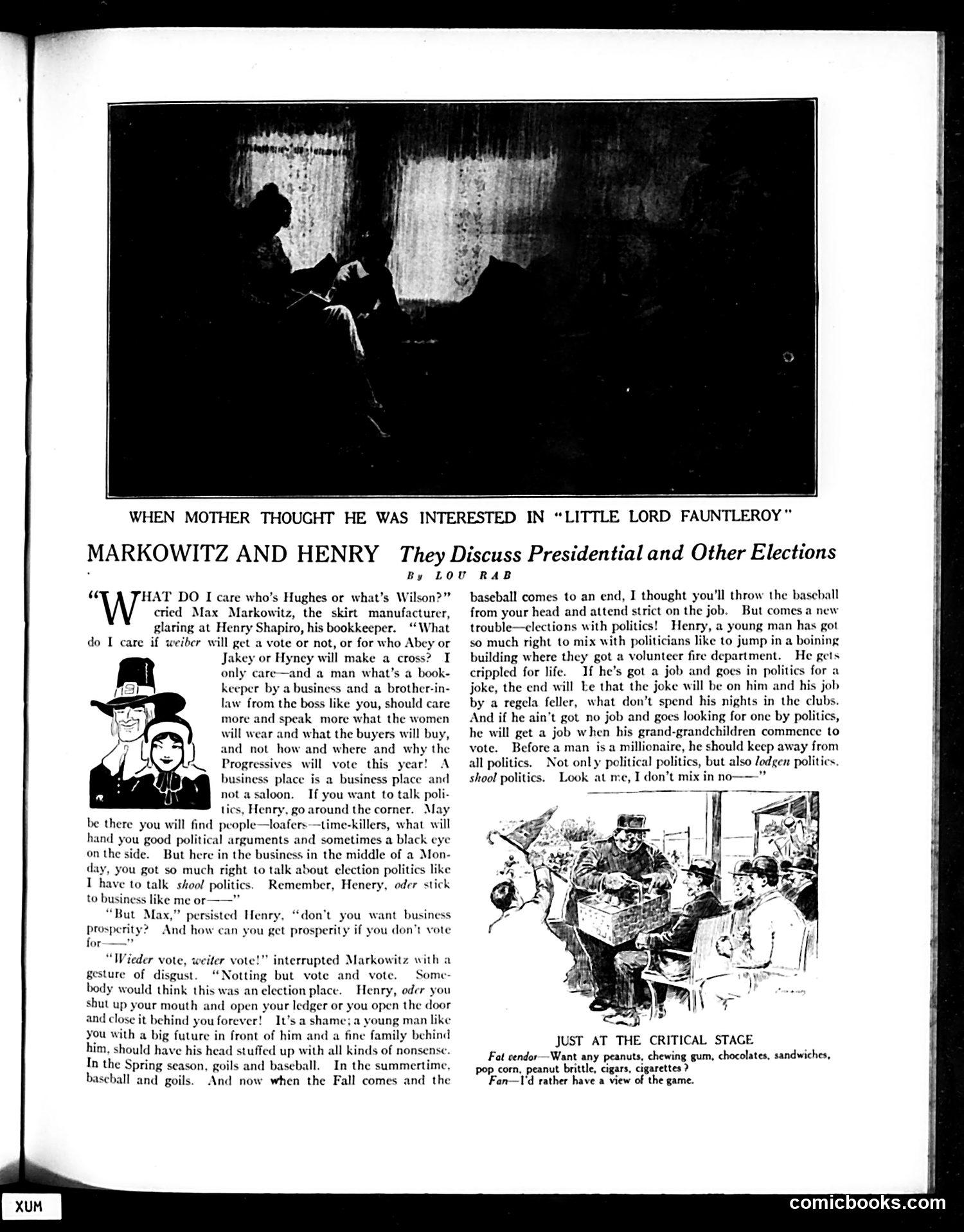
This 1916 *Judge* magazine piece satirizes immigrant Jewish businessmen's indifference to American politics. Max Markowitz, a garment manufacturer, scolds his young bookkeeper Henry Shapiro for discussing the presidential election (Hughes vs. Wilson) during work hours. Markowitz insists business owners should focus solely on commerce, not politics—dismissing voting as a distraction that ruins young men's futures. The satire cuts both ways: it mocks Markowitz's single-minded materialism and anti-civic attitude, while also gently ribbing immigrant communities for allegedly prioritizing business over civic participation. The Yiddish phrases ("weiter vote," "lodgen politics") and ethnic stereotyping reflect early 20th-century attitudes toward newly arrived immigrants. The bottom cartoon shows a baseball fan preferring the game to a food vendor—a lighter aside on American leisure priorities.
📄 Transcribed text from this page (OCR, searchable)
Machine-transcribed from the original scan — historical spelling and the odd misread are preserved.
WHEN MOTHER THOUGHT HE WAS INTERESTED IN “LITTLE LORD FAUNTLEROY” MARKOWITZ AND HENRY They Discuss Presidential and Other Elections By LOU “ HAT DO I care who’s Hughes or what’s Wilson?” cried Max Markowitz, the skirt manufacturer, glaring at Henry Shapiro, his bookkeeper. ‘What do I care if weiber will get a vote or not, or for who Abcy or Jakey or Hyney will make a cros I only care—and a man what’s a book- keeper by a business and a brothcr-in- law from the boss like you, should care more and speak more what the women will wear and what the buyers will buy, and not how and where and why the Progressives will vote this y A business place is a business ¢ and not a saloon. If you want to talk poli- tics, Henry, go around the corner. May be there you will find pcople—loafers—time-killers, what will hand you good political arguments and sometimes a black eye on the side. But here in the business in the middle of a Mon- day, you got so much right to talk about election politics like T have to talk shool politi Remember, Henery, oder stick to business like me orp—— “But Max,” persisted Henry, “don’t you want business Prose rity? And how can you get prosperity if you don’t vote for—” Wieder vote, weiter vote!” interrupted Markowitz with a gesture of disgust. “Notting but vote and vote. Some- body would think this was an election place. Henry, oder you sbut up your mouth and open your ledger or you open the door and close it behind you forever! young man like you with a big future in front of him and a fine family behind him, should have his head stuffed up with all kinds of nonsense. In the Spring season, goils and baseball. In the summertime, baseball and goils. And now when the Fall comes and the RAB baseball comes to an end, I thought you'll throw the baseball from your head and attend strict on the job. But comes a new trouble—clections with politics! Henry, a young man has got so much right to mix with politicians like to jump ina boining building where they got a volunteer fire department. He gets crippled for life. If he’s got a job and goes in politics for a joke, the end will Le that the joke will be on him and his job by a regela feller, what don’t spend his nights in the c And if he ain’t got no job and gocs looking for one by polit he will get a job when his grand-grandchildren commence to vote. Before a man isa millionaire, he should keep away from all politics. Not only political politics, but also /odgen politics. shool politics. Look at me, I don’t mix in no——” JUST AT THE CRITICAL STAGE Fat cendor—Want any peanuts, chewing gum, chocolates, sandwiches, pop corn, peanut brittle, cigars, cigarettes ? Fan—I'd rather have a view of the game. comicbooks.com