
Judge, 1916-11-04 · page 22 of 32
Judge — November 4, 1916 — page 22: what you’re looking at
What you’re looking at
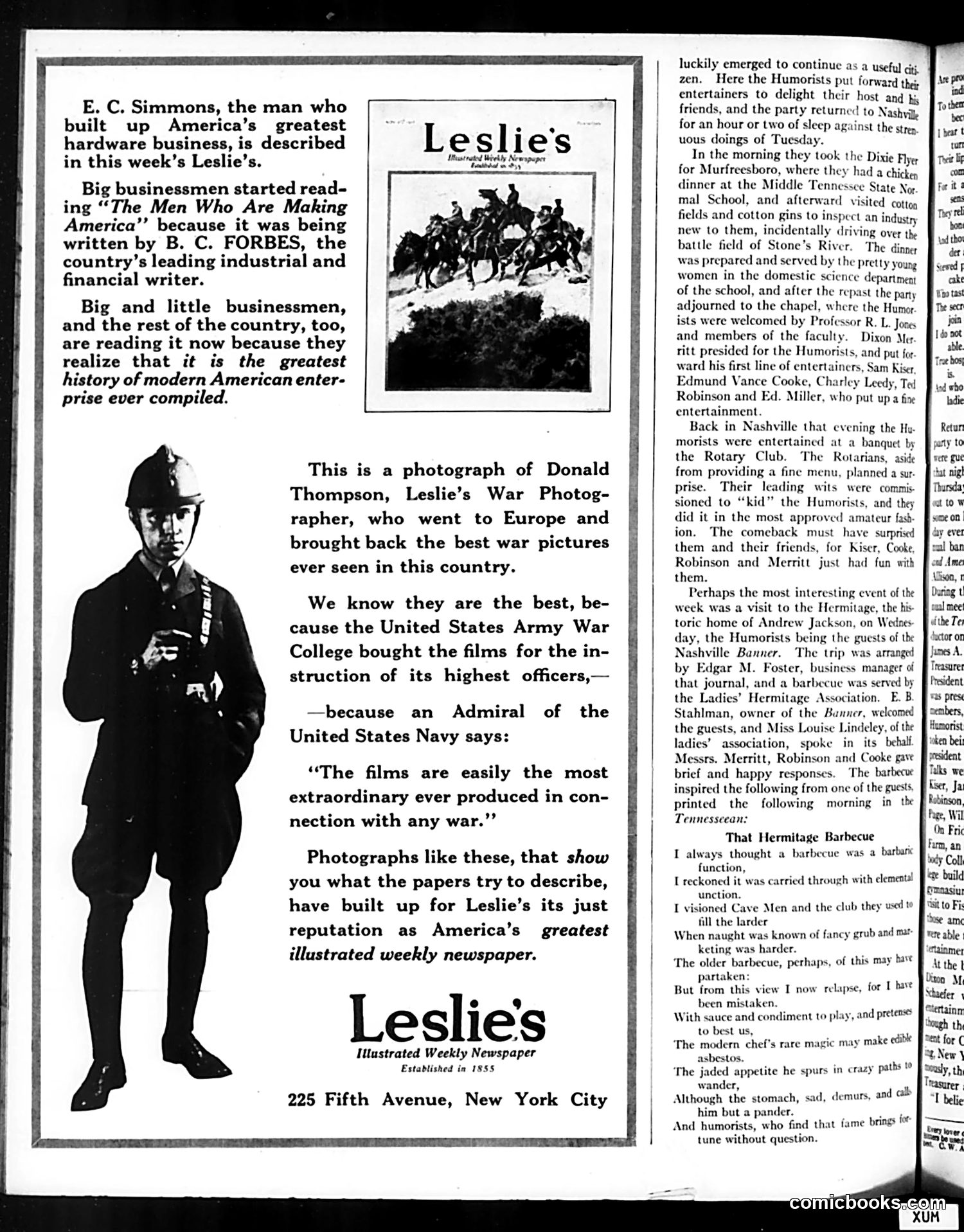
This page is primarily **advertising for Leslie's Illustrated Weekly Newspaper**, disguised as editorial content. The left side promotes Leslie's by highlighting E.C. Simmons (hardware magnate) and photographer Donald Thompson, whose WWI photographs were allegedly so superior that the U.S. Army War College purchased them for officer training. An admiral endorses them as "extraordinary." The satire is subtle: Leslie's claims its *photographs* built its reputation as "America's greatest illustrated weekly," emphasizing visual journalism over text. This was promotional positioning in an era when photojournalism was emerging as powerful media. The right column describes the "Humorists" (a touring entertainment group) visiting Nashville and Andrew Jackson's Hermitage, with a guest poem about a barbecue. This appears to be actual social reporting, not satire. **The point**: Leslie's is arguing that *pictures* — not writing alone — make a publication authoritative and valuable, positioning itself against text-heavy competitors.
📄 Transcribed text from this page (OCR, searchable)
Machine-transcribed from the original scan — historical spelling and the odd misread are preserved.
E. C. Simmons, the man who 7] built up America’s greatest C hardware business, is described in this week’s Leslie’s. Big businessmen started read- ing “The Men Who Are Making America’”’ because it was being written by B. C. FORBES, the country’s leading industrial and financial writer. Big and little businessmen, and the rest of the country, too, are reading it now because they realize that it is the greatest history of modern American enter- prise ever compiled. Leslie's This is a photograph of Donald Thompson, Leslie’s War Photog- rapher, who went to Europe and brought back the best war pictures ever seen in this country. We know they are the best, be- cause the United States Army War College bought the films for the in- struction of its highest officers,— —because an Admiral of the United States Navy says: “The films are easily the most extraordinary ever produced in con- nection with any war.’”’ Photographs like these, that show you what the papers try to describe, have built up for Leslie’s its just greatest reputation as America’s illustrated weekly newspaper. Leslie's Illustrated Weekly Newspaper Established in 1855 225 Fifth Avenue, New York City luckily emerged to continue as a useful citi. zen. Here the Humorists put forward ther entertainers to delight their host and his friends, and the party returned to Nashvilk for an hour or two of sleep against the strep. uous doings of Tuesday. In the morning they took the Dixie Flyer for Murfreesboro, where they had a chickes dinner at the Middle Tennessee State Nog. mal School, and afterward visited Cotton fields and cotton gins to inspect an industry new to them, incidentally driving over the battle field of Stone’s River. The dinner was prepared and served by the pretty young women in the domestic science department of the school, and after the repast the pany adjourned to the chapel, where the Humor. ists were welcomed by Professor R. L. Jones and members of the faculty. Dixon Me. rit presided for the Humorists, and pu ward his first line of entertainers, Sam Edmund Vance Cooke, Charley Leedy, Tel Robinson and Ed. Miller, who put up a fine entertainment. Back in Nashville that evening the Hu- morists were entertained at a banquet by the Rotary Club. The Rotarians, aside from providing a fine menu, planned a sur- prise. Their leading wits were commi sioned to “kid” the Humorists, and they did it in the most approved amateur fash ion. The comeback must have surprised them and their friends, for Kiser, Cooke, Robinson and Merritt just had fun with them. Perhaps the most interesting event of the week was a visit to the Hermitage, the his- toric home of Andrew Jackson, on Wednes day, the Humorists being the guests of the Nashville Banner. The trip was arranged by Edgar M. Foster, business manager of that journal, and a barbecue was served by the Ladies’ Hermitage Association. E. B. Stahlman, owner of the Banner, welcomed the guests, and Miss Louise Lindeley, of the ladi association, spoke in its bebalf Messrs. Merritt, Robinson and Cooke gave brief and happy responses. The barbecue inspired the following from one of the guests, printed the following morning in the Tennesseean: That Hermitage Barbecue I always thought a barbecue was a barbaric function, T reckoned it was carried through with elemental unction. I visioned Cave Men and the club they used te fill the larder When naught was known of fancy grub and mar- keting was harder. The older barbecue, perhaps, of this may have partaken: But from this view I now relapse, for been mistaken. With sauce and condiment to play, and pretense to best us, The modern chef’s rare magic may make edible asbestos. ‘The jaded appetite he spurs in crazy ps wander, Although the stomach, sad, demurs, am him but a pander. . And humorists, who find that fame brings fot tune without question. I have ths 10 id cal ductor OF fumes A. Treasurer COMIcbooks see tia