
Judge, 1916-11-04 · page 25 of 32
Judge — November 4, 1916 — page 25: what you’re looking at
What you’re looking at
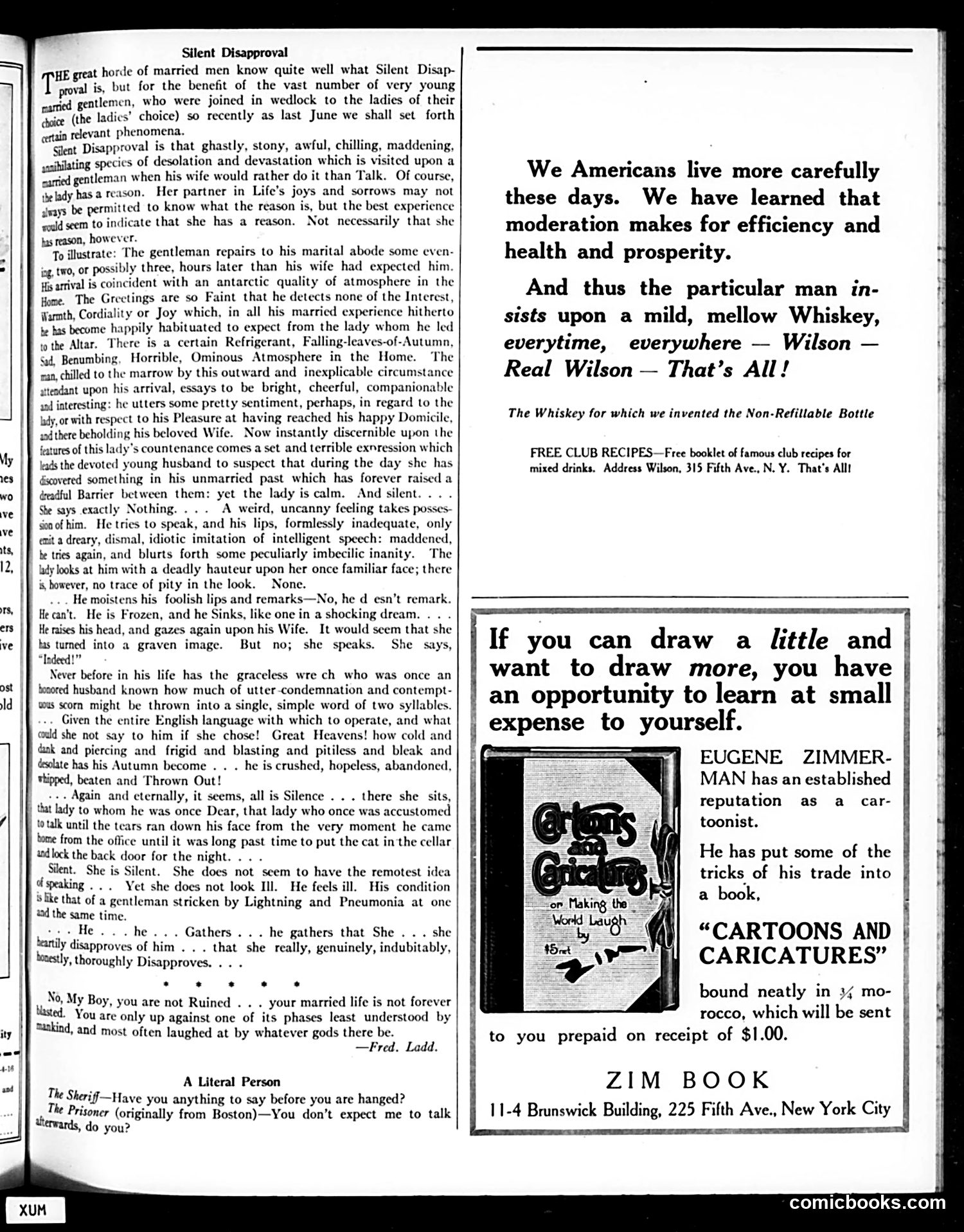
This piece is a humorous essay directed at newly married men, explaining the concept of a wife's "silent disapproval"—her refusal to speak or show warmth when displeased, typically due to her husband arriving home late. The satire targets both the husband's inadequacy (his bumbling attempts at cheerfulness and small talk) and the wife's devastating emotional weapon: complete silence and a cold demeanor. The author uses exaggerated, mock-heroic language to describe how a simple word like "Indeed!" can contain "utter condemnation and contempt." The joke's social context: this reflects early 20th-century marital dynamics where wives had limited direct power, making emotional withdrawal a primary means of expressing disapproval. The essay mockingly suggests this tactic is far more effective than actual argument or conversation. The piece is partly satirizing male obliviousness to their wives' reasons for anger, while also acknowledging wives' strategic use of silence as relationship leverage.
📄 Transcribed text from this page (OCR, searchable)
Machine-transcribed from the original scan — historical spelling and the odd misread are preserved.
Silent Disapproval } HE great horde of married men know quite well what Silent Disap- Wypera is, but for the benefit of the vast number of very young ied gentlemen, who were joined in wedlock to the ladies of their choice (the ladies’ choice) so recently as last June we shall set forth is yant phenomena. Ce eaprroval is that ghastly, stony, awful, chilling, maddening, satihilating species of desolation and devastation which is visited upon a married gentleman when his wife would rather do it than Talk. Of course, helady has a reason. Her partner in Life's joys and sorrows may not geays be permitted to know what the reason is, but the best experience ould seem to indicate that she has a reason. Not necessarily that she has reason, however. To illustrate: The gentleman repairs to his marital abode some even- ing, two, or possibly three, hours later than his wife had expected him. Hs arrival is coincident with an antarctic quality of atmosphere in the Home. The Greetings are so Faint that he detects none of the Interest, Warmth, Cordiality or Joy which, in all his married experience hitherto be bas become happily habituated to expect from the lady whom he led tothe Altar. There is a certain Refrigerant, Falling-leaves-of-Autumn, Sad, Benumbing, Horrible, Ominous Atmosphere in the Home. The nan, chilled to the marrow by this outward and inexplicable circumstance attendant upon his arrival, essays to be bright, cheerful, companionable and interesting: he utters some pretty sentiment, perhaps, in regard to the hdy,or with respect to his Pleasure at having reached his happy Domicile, and there beholding his beloved Wife. Now instantly discernible upon the features of this lady’s countenance comes a set and terrible exnression which kads the devoted young husband to suspect that during the day she has Gscovered something in his unmarried past which has forever raised a dreadful Barrier between them: yet the lady is calm. And silent. . . . Ste says exactly Nothing. . A weird, uncanny feeling takes posses- son of him. He tries to speak, and his lips, formlessly inadequate, only exit a dreary, dismal, idiotic imitation of intelligent speech: maddened, be tries again, and blurts forth some peculiarly imbecilic inanity. The dy looks at him with a deadly hauteur upon her once familiar face; there is however, no trace of pity in the look. None. He moistens his foolish lips and remarks—No, he d esn’t remark. He can't. He is Frozen, and he Sinks, like one in a shocking dream. . . . He raises his head, and gazes again upon his Wife. It would seem that she has turned into a graven image. But no; she speaks. She says, “Indeed!” Never before in his life has the graceless wre ch who was once an bonored husband known how much of utter-condemnation and contempt- ‘ous scorn might be thrown into a single, simple word of two syllables. Given the entire English language which to operate, and what cold she not say to him if she chose! Great Heavens! how cold and tank and piercing and frigid and blasting and pitiless and bleak and ésolate has his Autumn become . . . he is crushed, hopeless, abandoned, shipped, beaten and Thrown Out! ood Again and eternally, it seems, all is Silence . . . there she sits, tat lady to whom he was once Dear, that lady who once was accustomed ‘otalk until the tears ran down his face from the very moment he came tome from the office until it was long past time to put the cat in'the cellar and lock the bac She does not seem to have the remotest idea § she does not look Ill. He feels ill. His condition Slike that of a gentleman stricken by Lightning and Pneumonia at onc aad the same time. nae He ...he... Gathers... he gathers that She... she ‘anily disapproves of him . . . that she really, genuinely, indubitably, tonestly, thoroughly Disapproves. . . . + * © @ «@ (No, My Boy, you are not Ruined . . . your married life is not forever ed. You are only up against one of its phases least understood by tuakind, and most often laughed at by whatever gods there be. —Fred. Ladd. A Literal Person a Sheriff—Have you anything to say before you are hanged? ke Prisoner (originally from Boston)—You don’t expect me to talk therwards, do you? We Americans live more carefully these days. We have learned that moderation makes for efficiency and health and prosperity. And thus the particular man in- sists upon a mild, mellow Whiskey, everytime, everywhere — Wilson — Real Wilson — That’s All! The Whiskey for which we invented the Non-Refillable Bottle FREE CLUB RECIPES—Free booklet of famous club recipes for mixed drinks. Address Wilson, 315 Fifth Ave.,N. Y. That's All! If you can draw a little and want to draw more, you have an opportunity to learn at small expense to yourself. EUGENE ZIMMER- MAN has an established reputation as a car- toonist. He has put some of the tricks of his trade into a book, “CARTOONS AND CARICATURES” bound neatly in 34 mo- rocco, which will be sent to you prepaid on receipt of $1.00. ZIM BOOK 11-4 Brunswick Building, 225 Fifth Ave., New York City comicbooks.com