
A complete issue · 28 pages · 1916
Judge — October 14, 1916
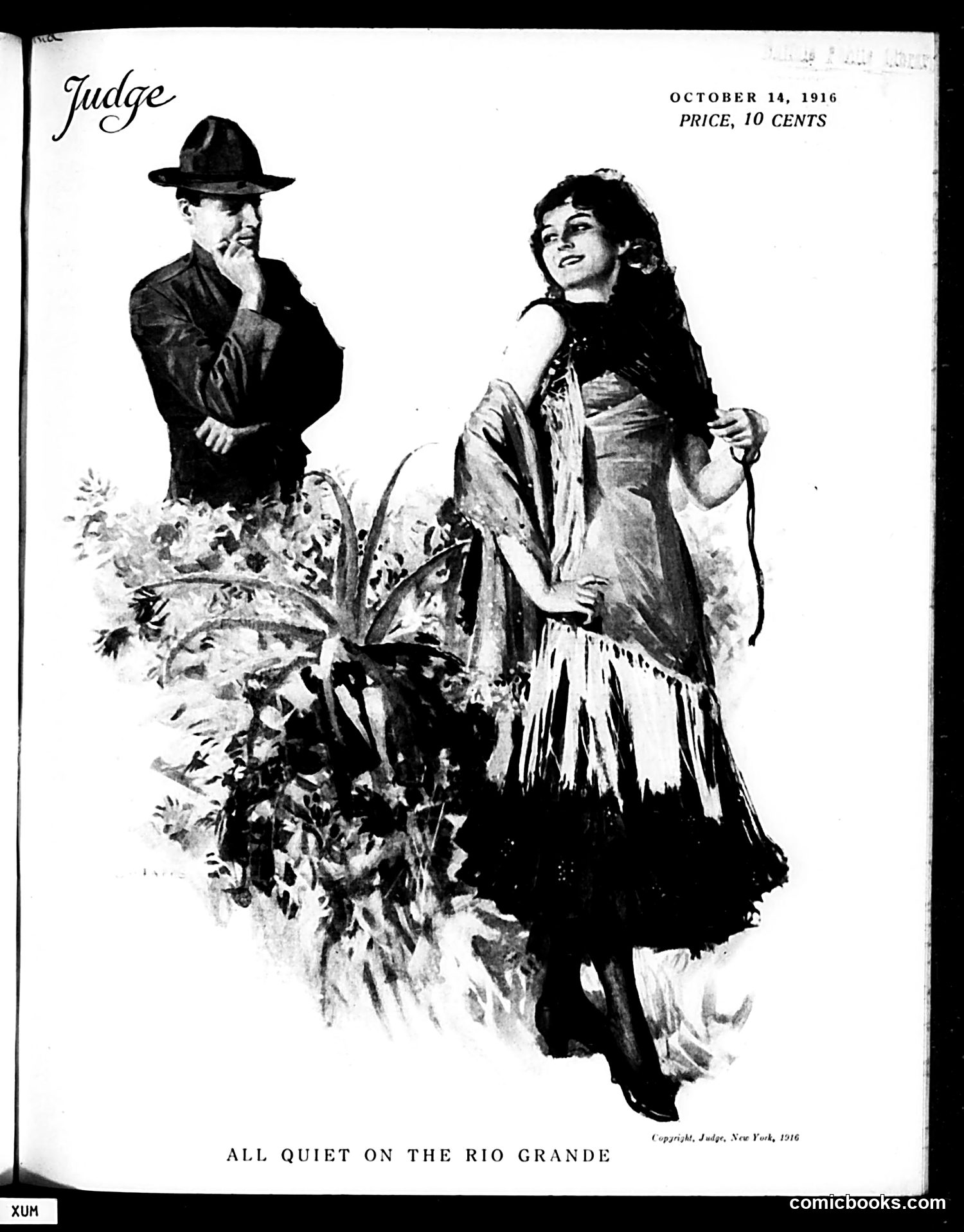
This October 1916 *Judge* cartoon appears to satirize U.S.-Mexico border relations during the Mexican Revolution. The title's ironic reference to "quiet" likely mocks the tension between the nations despite claims of peace. The illustration shows a man (possibly representing an American authority figure or politician) observing a woman in Mexican dress and indigenous styling—a common visual representation of Mexico itself in American political cartoons of this era. The composition suggests the cartoon comments on American military or diplomatic presence along the Rio Grande border. Given the 1916 date, this likely references ongoing tensions following Pancho Villa's raid into New Mexico (March 1916) and the subsequent U.S. military expedition into Mexico, despite official rhetoric of stability.
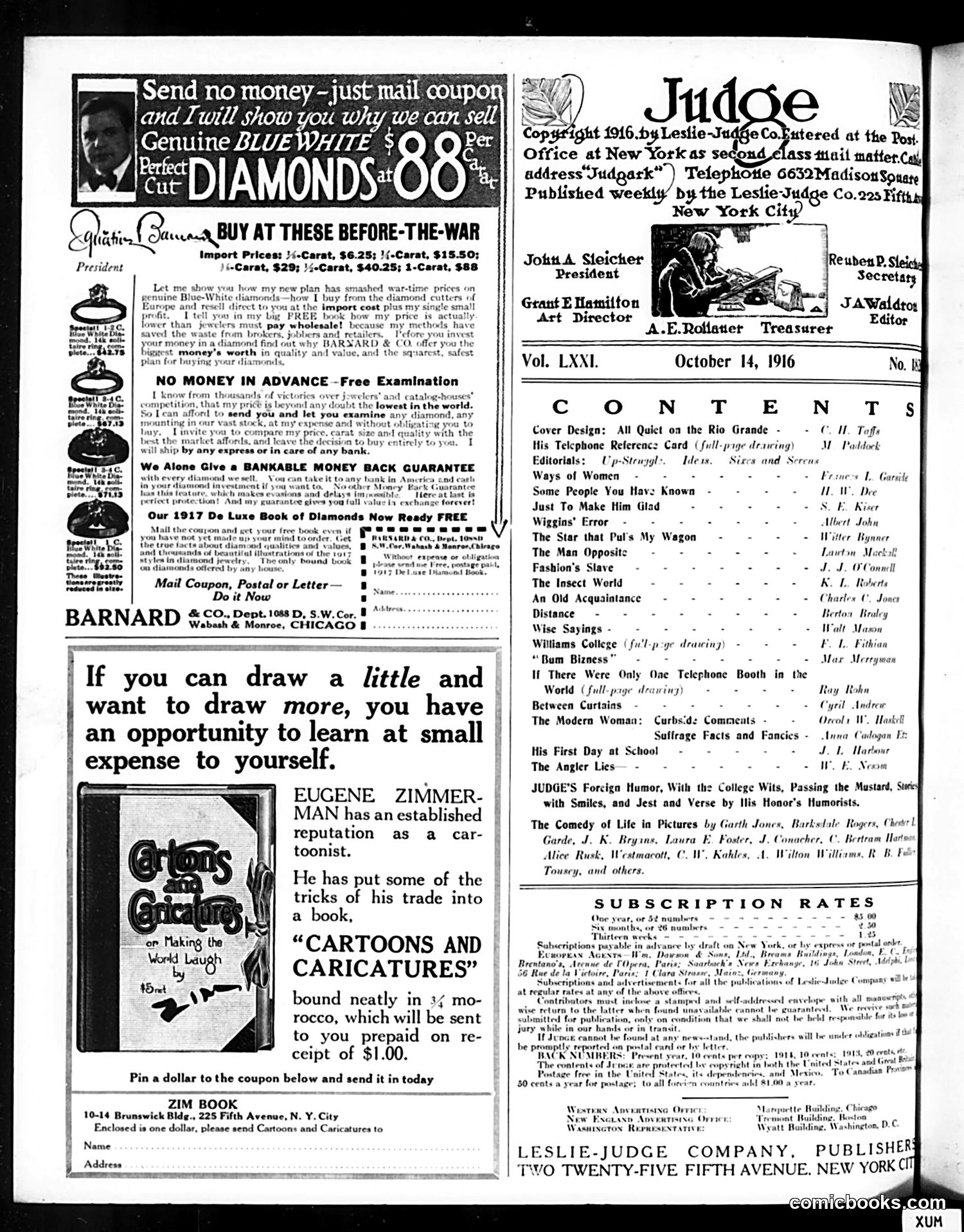
This page is primarily **advertising and masthead information** rather than political satire. The dominant features are: 1. **Diamond sales ad** (top left) - Barnard & Co. promoting "Blue White Diamonds" at $88 per carat, emphasizing wartime price reductions. 2. **Drawing instruction ad** (bottom) - Eugene Zimmerman promoting his "Cartoons and Caricatures" instructional book. 3. **Table of contents** (right side) - Lists various articles including humor pieces, editorials, and illustrations. The page lacks prominent political cartoons or satirical commentary. The only contextual detail is the implicit reference to "wartime prices" in the diamond ad, suggesting this was published during World War I (though America hadn't yet entered). No specific political figures or events are clearly identifiable from this layout.
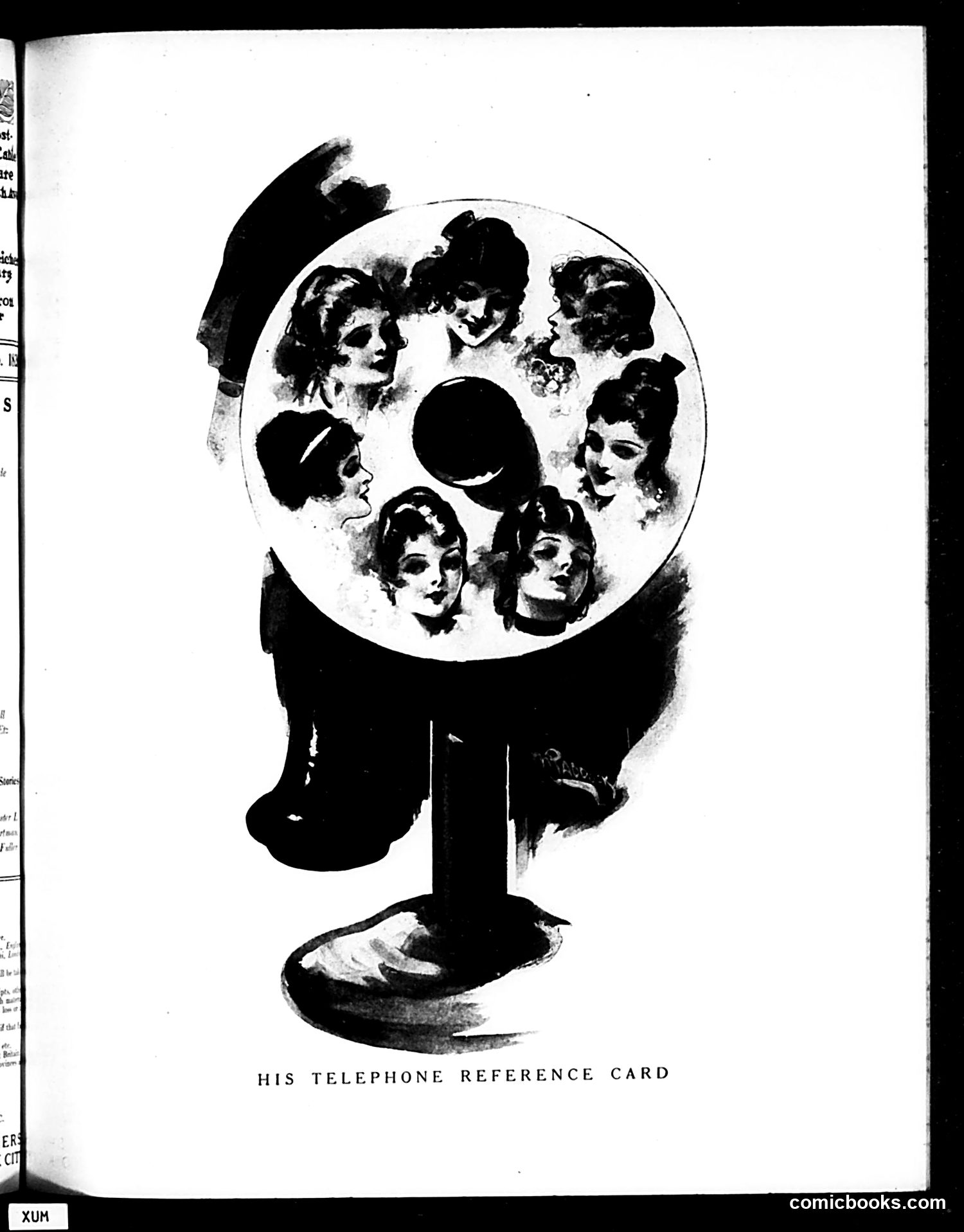
This satirical cartoon depicts a telephone handset styled as a human head, with multiple female faces arranged in a circular pattern where the dial would be. The caption "His Telephone Reference Card" suggests the joke: a man's telephone contains reminders of various women he knows—likely romantic interests or acquaintances. The satire targets the social practice of men maintaining multiple female contacts, treating women as interchangeable options to be "dialed up" as needed. This reflects early 20th-century gender dynamics where women were sometimes portrayed as objects of pursuit rather than individuals. The cartoon humorously critiques male social behavior while playing on the novelty of telephone technology itself.
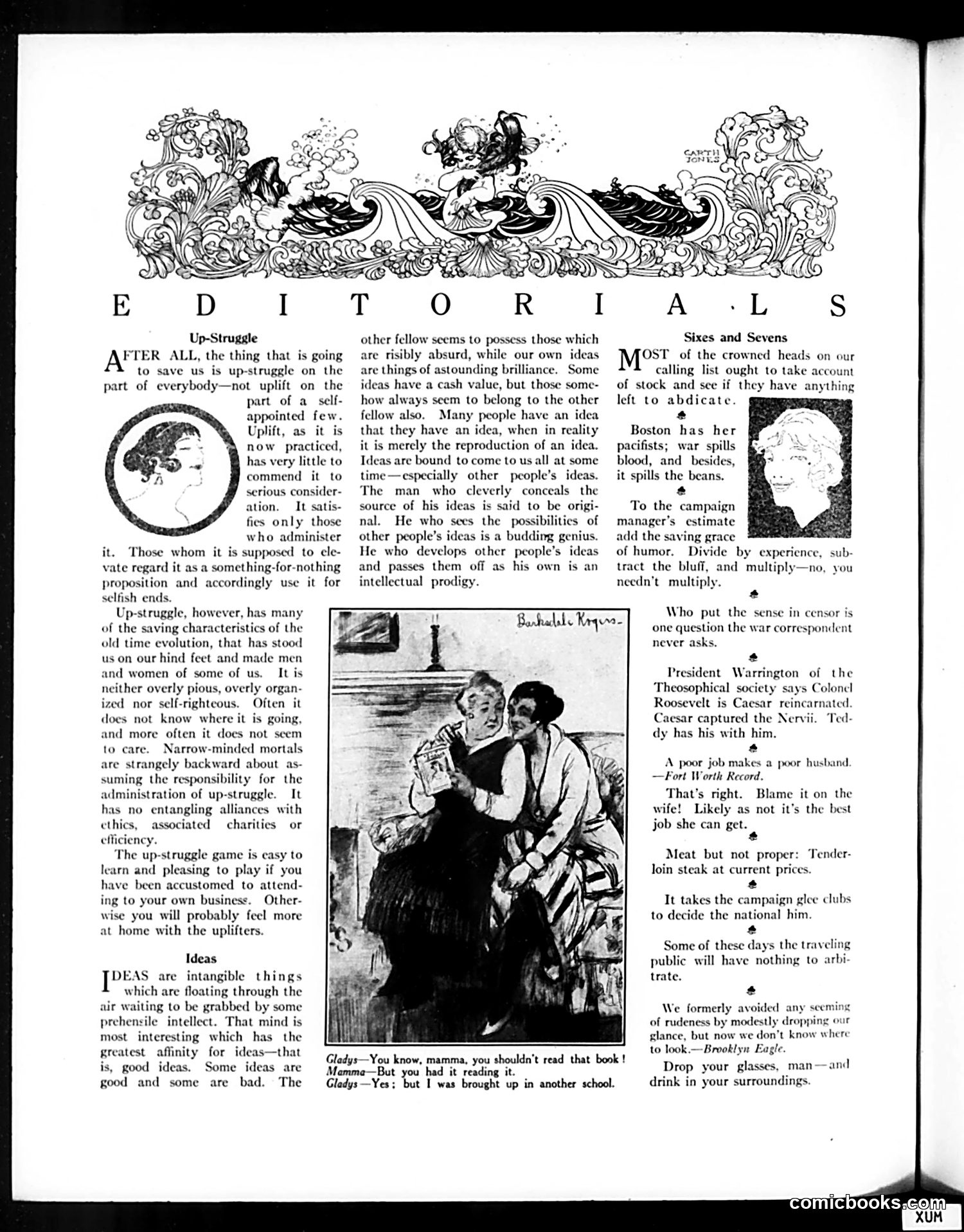
This page contains editorial commentary and a cartoon about early 20th-century social issues. The main cartoon depicts a domestic scene with a caption reading "Gladys—You know, mamma, you shouldn't read that book! Mamma—But you had it reading it. Gladys—Yes; but I was brought up in another school." The joke satirizes generational hypocrisy regarding morality and reading habits—parents condemning children for the same behaviors they engage in. The "editorials" sections address various topics including "Up-Struggle" (self-improvement efforts), ideas as floating intellectual property, and contemporary references like Theodore Roosevelt and a "Theosophical society." The page reflects early 1900s concerns about class mobility, intellectual property, and domestic morality standards.
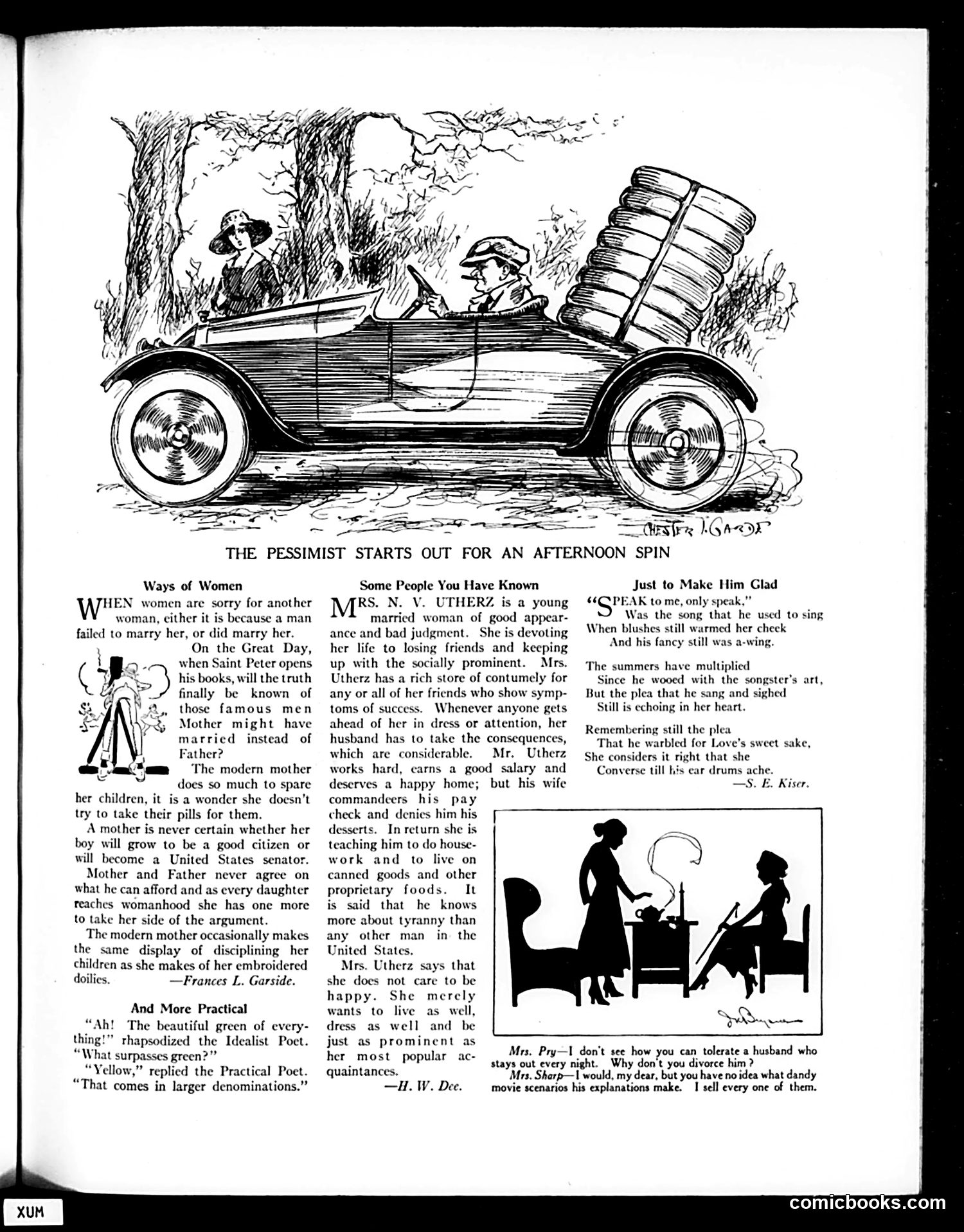
**Top Cartoon:** "The Pessimist Starts Out for an Afternoon Spin" depicts an early automobile loaded with stacked mattresses, driven by two men in hats through a rural setting. The joke appears to be about automotive unreliability—the driver has brought bedding presumably because car breakdowns were so common and lengthy that travelers might need to sleep roadside. This reflects the nascent automobile era (likely 1900s-1910s) when cars were notoriously undependable. **Text Sections:** The page contains three separate pieces: "Ways of Women" (about mothers and discipline), "Some People You Have Known" (about Mrs. N.V. Utterz), and "Just to Make Him Glad" (a sentimental poem). A bottom cartoon shows silhouettes of women discussing husbands' excuses. The overall page mixes domestic satire with automotive humor typical of Judge's content.
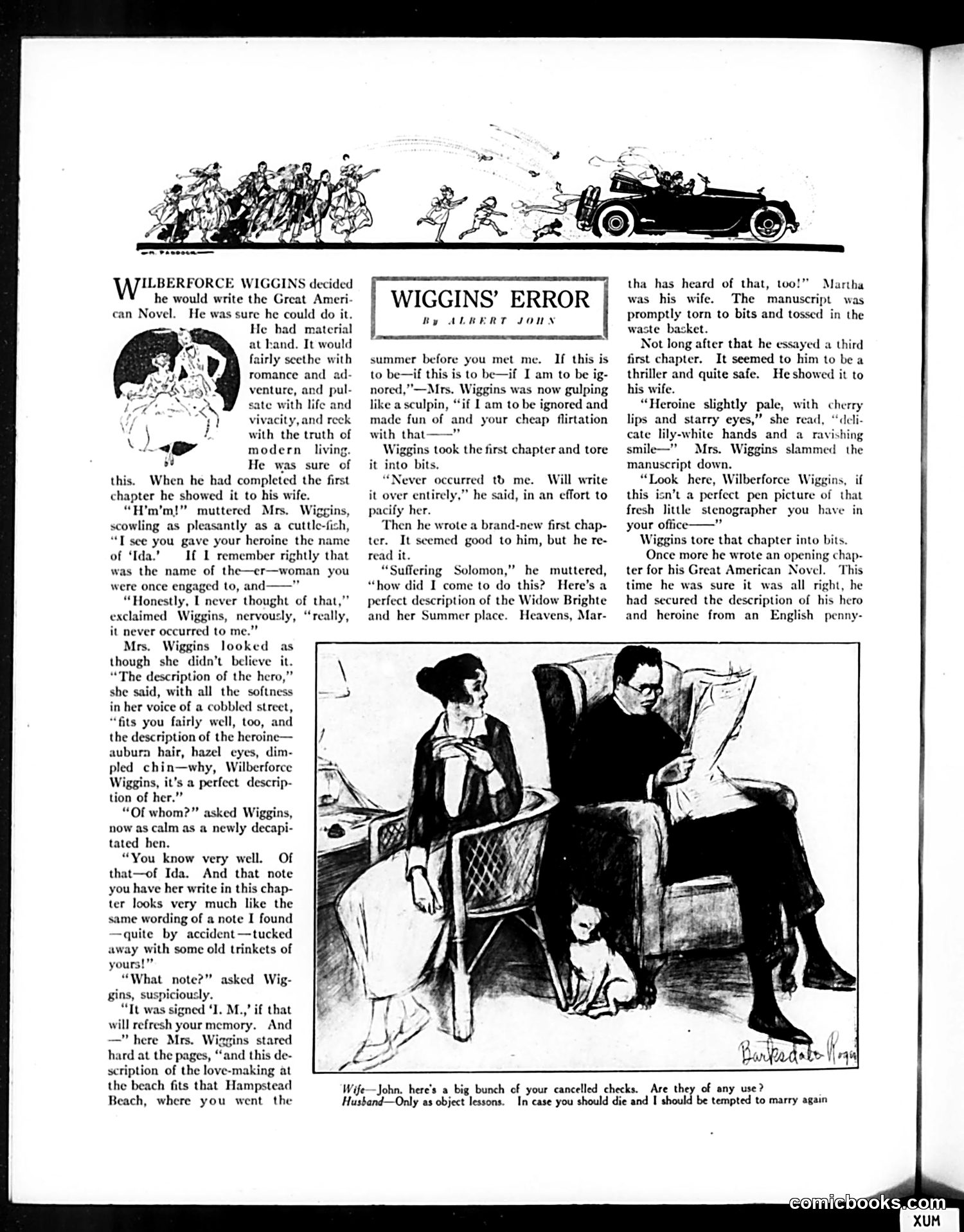
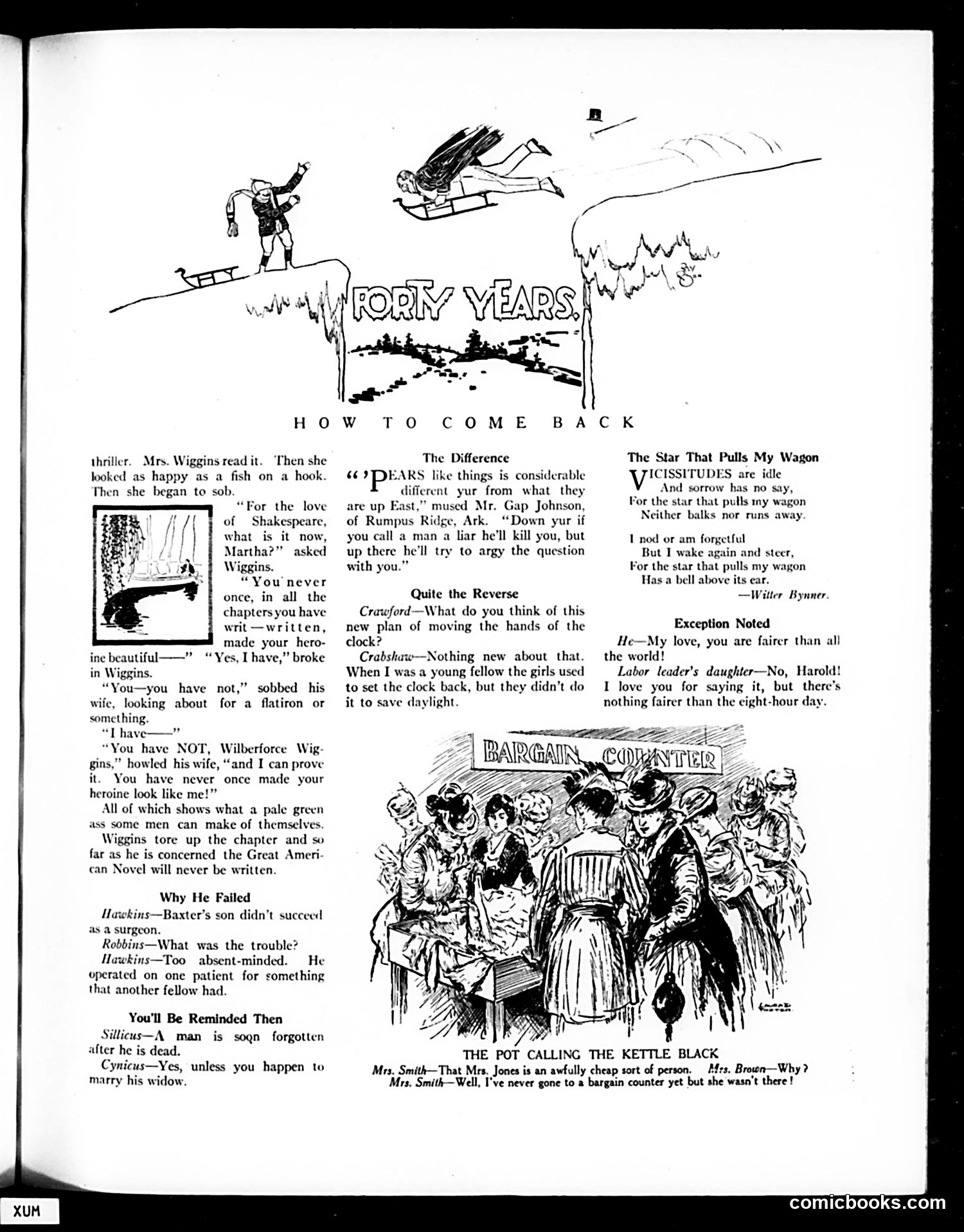
This page contains multiple short humorous pieces typical of early 20th-century satirical magazines: **Main cartoon ("The Pot Calling the Kettle Black")**: Two women gossip about a third woman's bargain-hunting, with ironic hypocrisy—the speaker admits she frequents the same bargain counters while criticizing the other woman for doing so. **Text pieces include**: - A domestic squabble where a novelist's wife criticizes his heroines' appearance, leading him to abandon his manuscript - A doctor too absent-minded to operate correctly - Regional humor contrasting Southern and Eastern attitudes toward insults - A joke about men forgetting dead husbands unless their widows remarry - A labor activist daughter reframing romantic compliments as praise for the eight-hour workday The page reflects period concerns: American novel-writing, workplace safety/medical competence, regional differences, and emerging labor movements. The humor is gentle, domestic, and relies on social observation rather than political commentary.
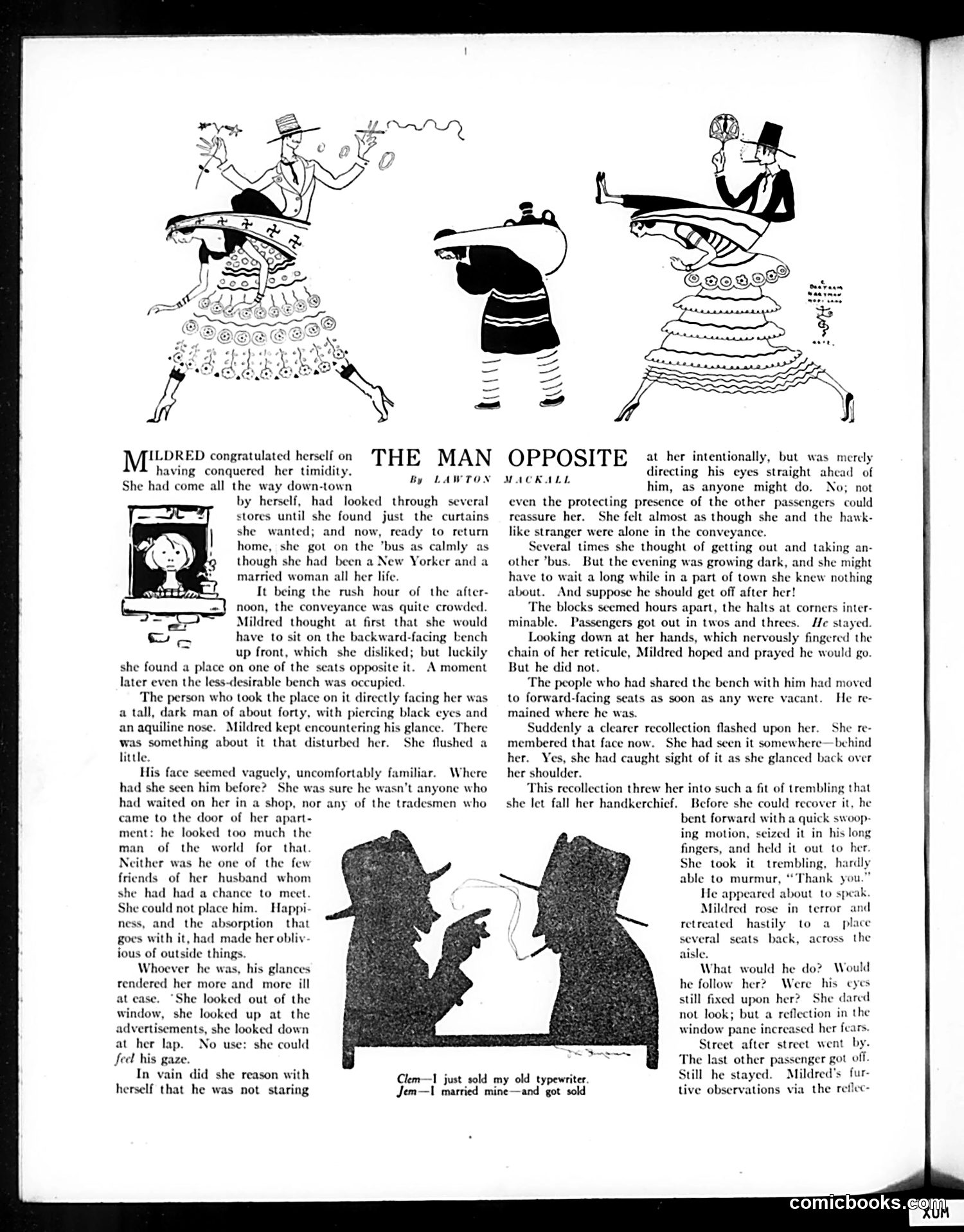
This is a short story illustration by Lawton Mackall in *Judge* magazine, not a political cartoon. It depicts a common urban anxiety narrative of the era. The plot concerns Mildred, a timid woman who has just gained confidence shopping alone in the city. On a crowded bus ride home, she becomes increasingly unsettled by a dark, piercing-eyed man sitting opposite her—his stare feels predatory. She tries to ignore him but grows panicked, eventually retreating to another seat. As other passengers disembark, he remains, intensifying her fear. The satirical point appears to be **social commentary on urban life and female vulnerability**. The story exploits contemporary anxieties about strangers, public transportation, and women's independence in the modern city. The inset cartoon with "Clem" and "Jem" provides comic relief—contrasting minor domestic complaints (selling a typewriter vs. getting married) with Mildred's escalating terror. The piece reflects early 20th-century attitudes toward women navigating public spaces and the perceived dangers of urban anonymity.
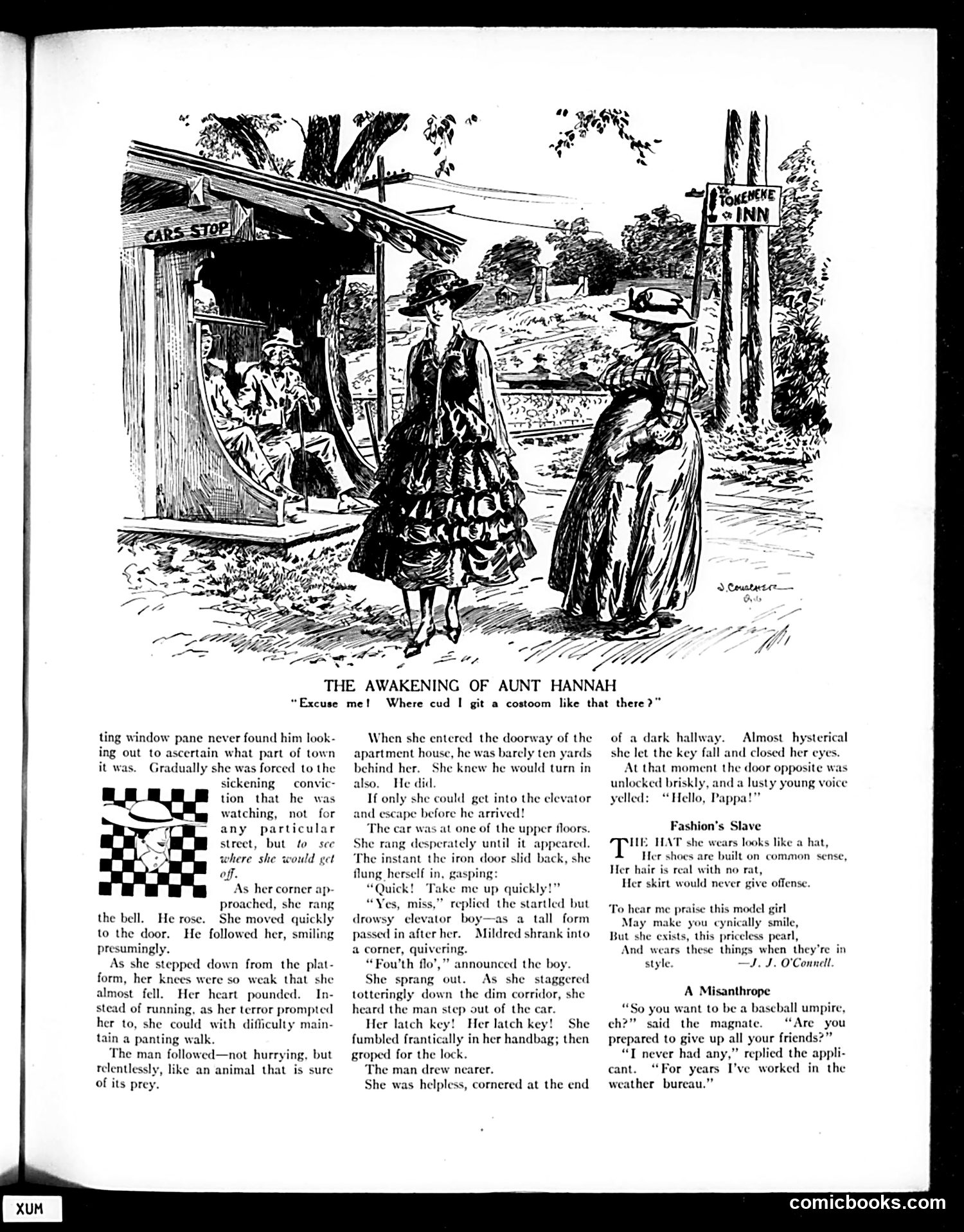
This illustration depicts a dramatic urban safety scenario circa early 1900s. A woman ("Aunt Hannah," appearing elderly based on the illustration) is being followed menacingly by a man as she enters an apartment building—a common urban danger narrative of the era. The story builds suspense as she attempts to escape via elevator, fumbles for her key in a dark hallway while he approaches, seemingly trapped. The resolution appears humorous: the door opposite opens and a young voice calls "Hello, Pappa!"—revealing the pursuer is simply her father, making her panic overwrought and comedic to readers. The cartoon satirizes the anxieties of urban life and women's vulnerability in cities, while also gently mocking how quickly innocent situations can trigger fear. The accompanying short humor pieces ("Fashion's Slave," "A Misanthrope") are unrelated editorial cartoons on beauty standards and personality types—typical Judge magazine filler content.
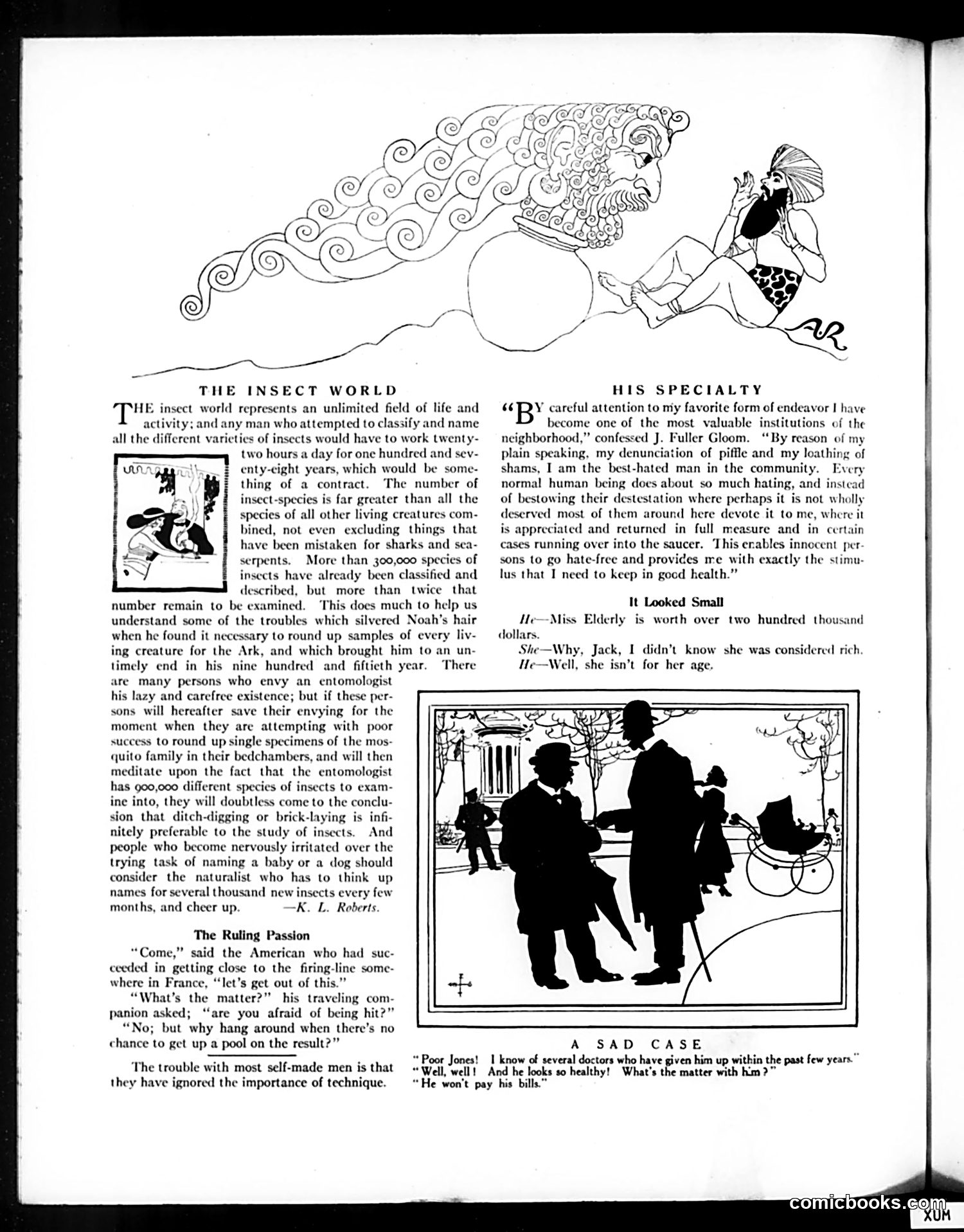
This page contains three distinct satirical pieces: **"The Insect World"** is humorous pseudo-intellectual commentary mocking both entomologists and those who envy them. It jokes that cataloging insects is so overwhelming that it killed Noah (a Biblical reference to the Ark's animal collection), making entomology preferable only to actually dealing with mosquitoes in one's bedroom. **"His Specialty"** satirizes a character named J. Fuller Gloom who claims his value to the neighborhood comes from being universally hated—he absorbs everyone's hatred, allowing others to avoid hating things deserving of it. The joke mocks sanctimonious people who wear their unpopularity as moral virtue. **"A Sad Case"** (bottom cartoon) depicts a tragic irony: doctors have given up on treating Jones because he won't pay his medical bills, not because he's actually ill—he appears perfectly healthy. This satirizes the era's credit/payment culture and the indifference of medical professionals to those who cannot pay, suggesting financial status, not health, determines one's fate.
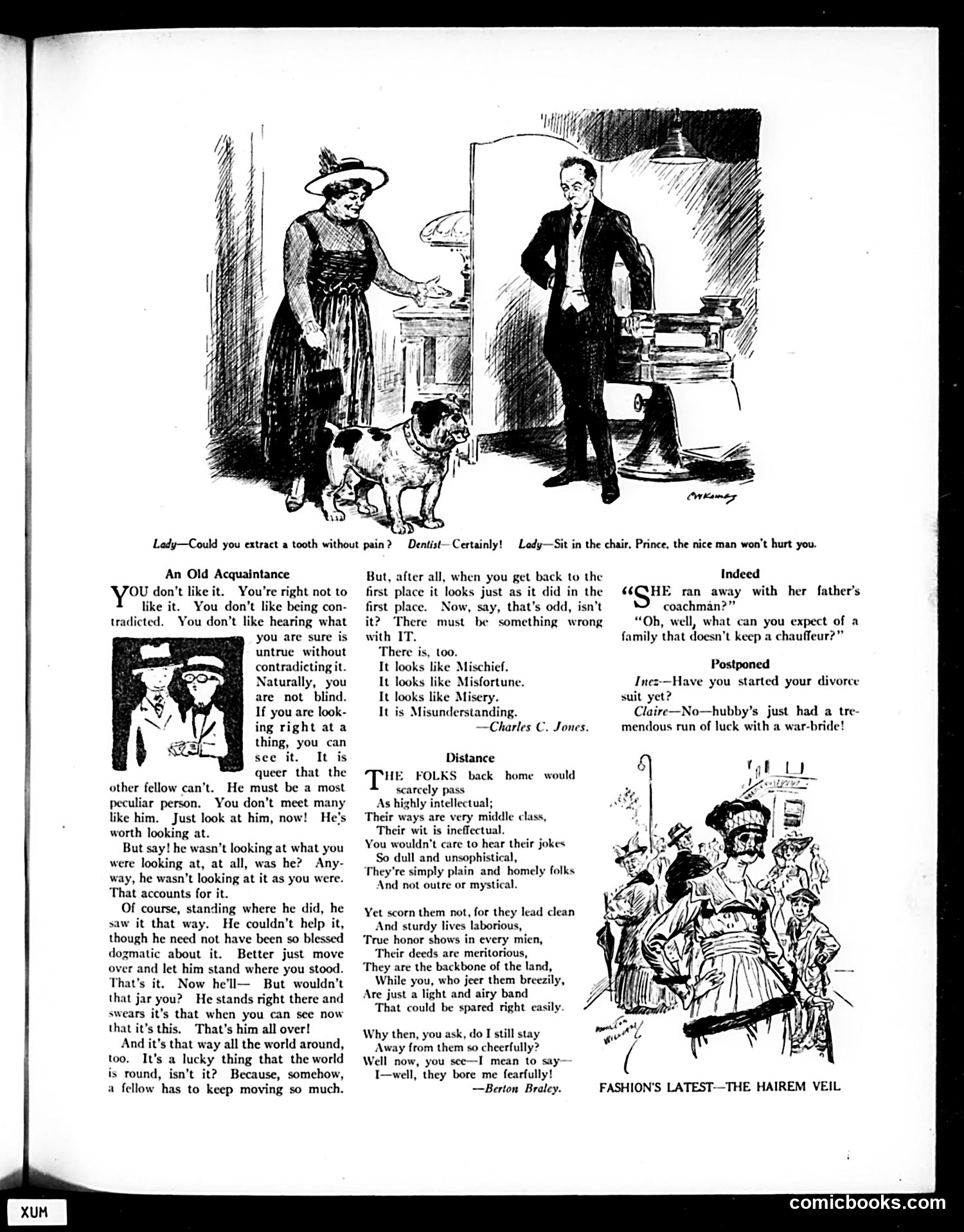
**Top Cartoon:** A lady visits a dentist with her small dog. The joke plays on the dentist's reassurance that the procedure won't hurt—but he's talking to the dog ("Prince"), not the lady, suggesting the animal is the actual patient or that the lady is being humorously treated as less important. **"An Old Acquaintance" Essay:** A philosophical piece about perspective and human nature. It humorously explains why two people viewing the same thing see it differently—they're literally standing in different positions. The essay concludes that this universal human difference in viewpoint means "the world is round" (people constantly must move/adjust), making constant motion inevitable in life. **"Indeed" Joke:** Social satire about changed class expectations. A woman ran away with her father's coachman; the response dismisses this as unsurprising for a family without a chauffeur—implying the automobile age has made horse-drawn transport and its attendants obsolete or lower-class. **"Postponed" Joke:** A divorce is delayed because the husband has "tremendous luck with a war-bride"—likely referencing marriages involving World War I soldiers, treated here as temporary romantic fortune. **"Distance" Poem:** Rural vs. urban class commentary. City dwellers condescend to rural "plain folks," yet admit they bore them—acknowledging rural people's solid virtue while maintaining snobbish distance.
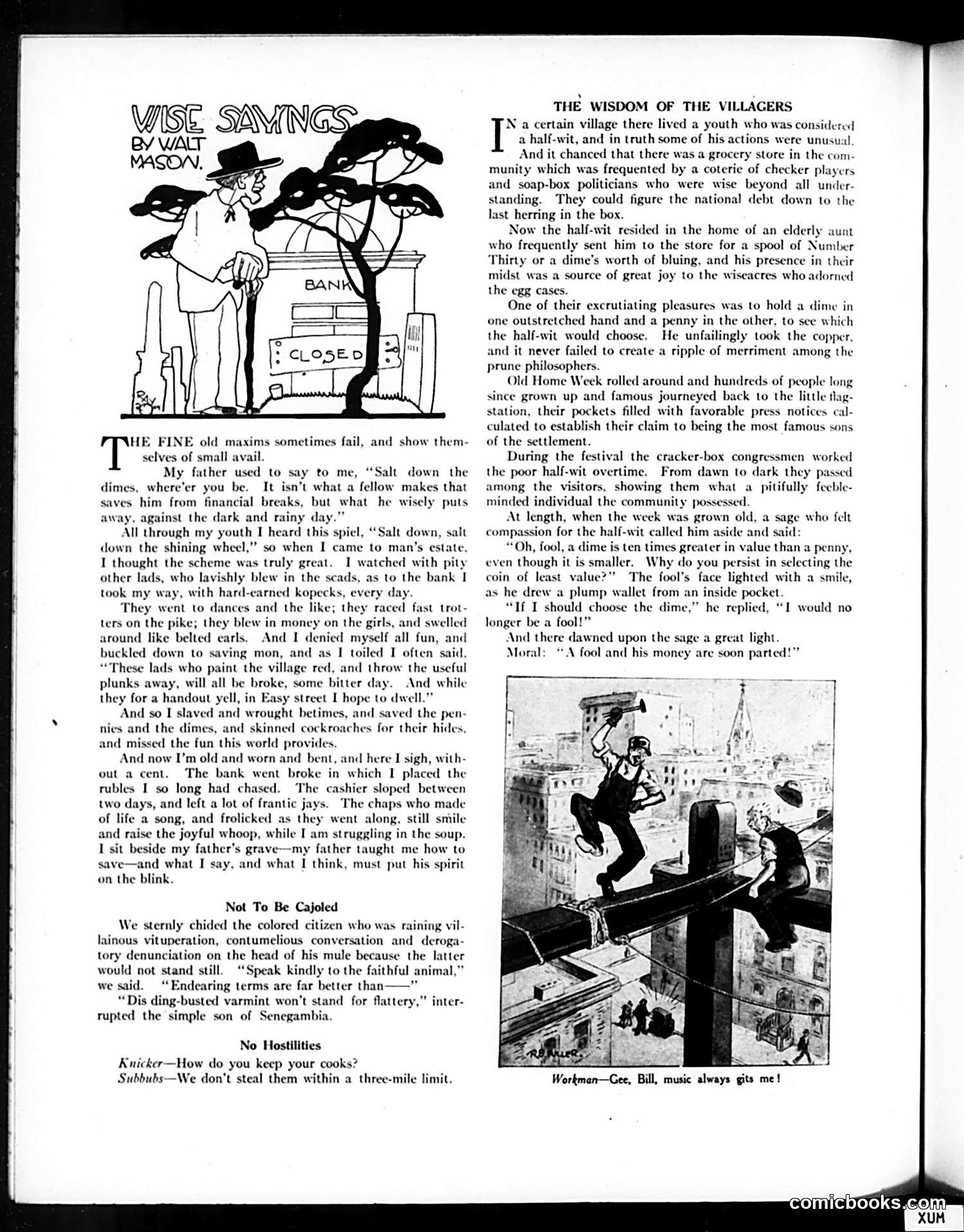
This page contains three distinct satirical pieces from *Judge* magazine: **"Wise Sayings by Walt Mason"** (top left): A cautionary tale mocking the proverb "save your money." The narrator diligently saves every penny while his spendthrift peers enjoy life. When the bank fails and he loses everything, the irony is complete—his discipline and sacrifice were pointless. The satire targets blind adherence to old financial wisdom. **"The Wisdom of the Villagers"** (right): Small-town "know-it-alls" at a general store habitually trick a simple youth into choosing a penny over a dime. When he becomes famous and returns for Old Home Week, the townspeople continue their cruel mockery, exposing their own meanness and stupidity. The satire mocks provincial arrogance and bullying. **Two brief jokes** (bottom): Minor pieces about managing servants and mules—lighthearted domestic humor typical of the era. The overarching theme: *Judge* satirizes false conventional wisdom and cruel small-mindedness through ironic reversals where smug people are proven foolish.
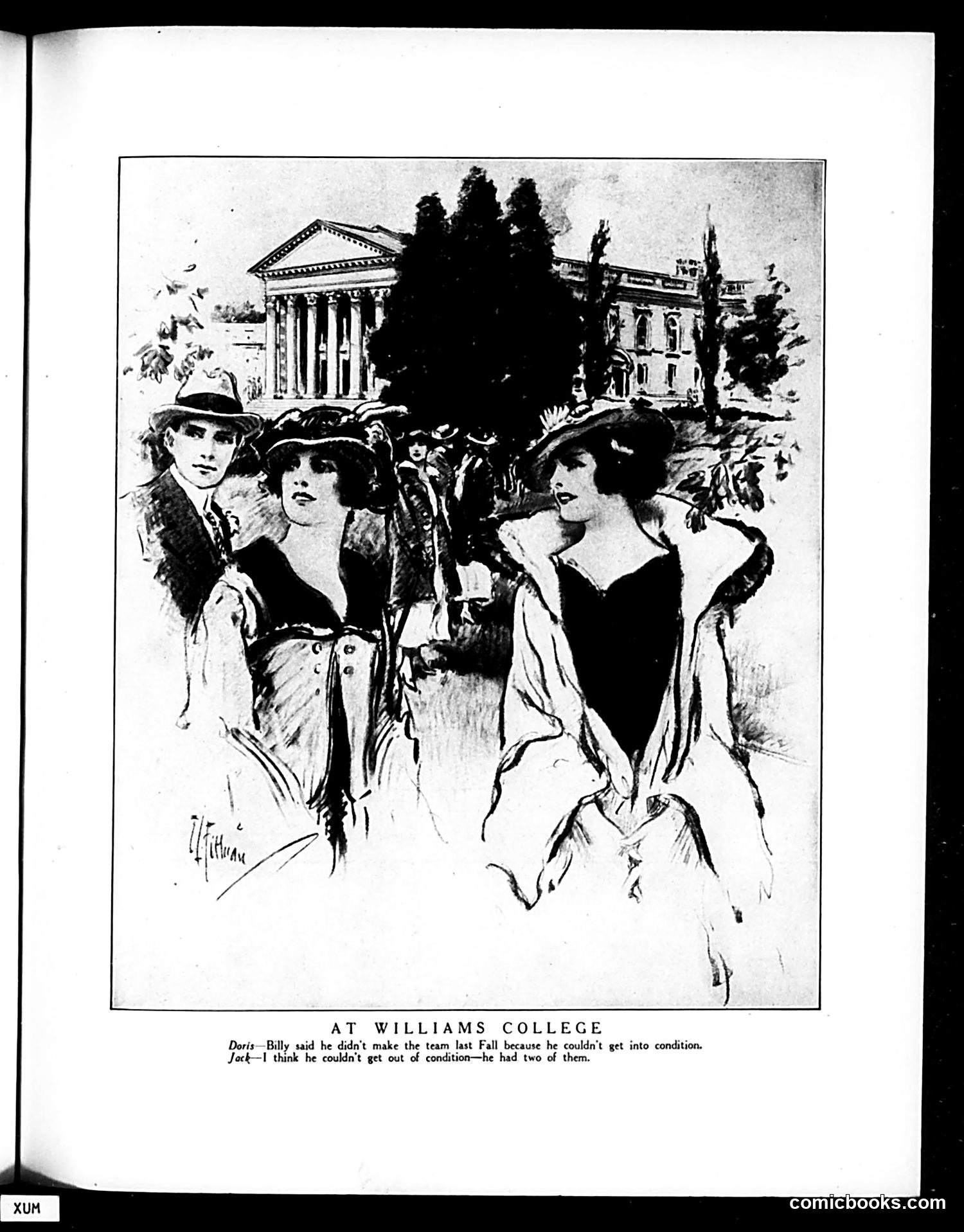
This is a joke cartoon from *Judge* magazine depicting college social life at Williams College. The illustration shows fashionably dressed young people (men in hats, women in period dress) outside a classical college building. The humor relies on a pun about "condition." Doris reports that Billy blamed missing the athletic team on poor physical conditioning. Jack's response suggests Billy couldn't shed his actual conditions—implying Billy had "two of them," likely referring to romantic entanglements or social commitments that prevented his participation. The cartoon satirizes college student excuses and the social distractions (particularly romantic pursuits) that interfere with athletic commitments, a timeless theme of college life humor.
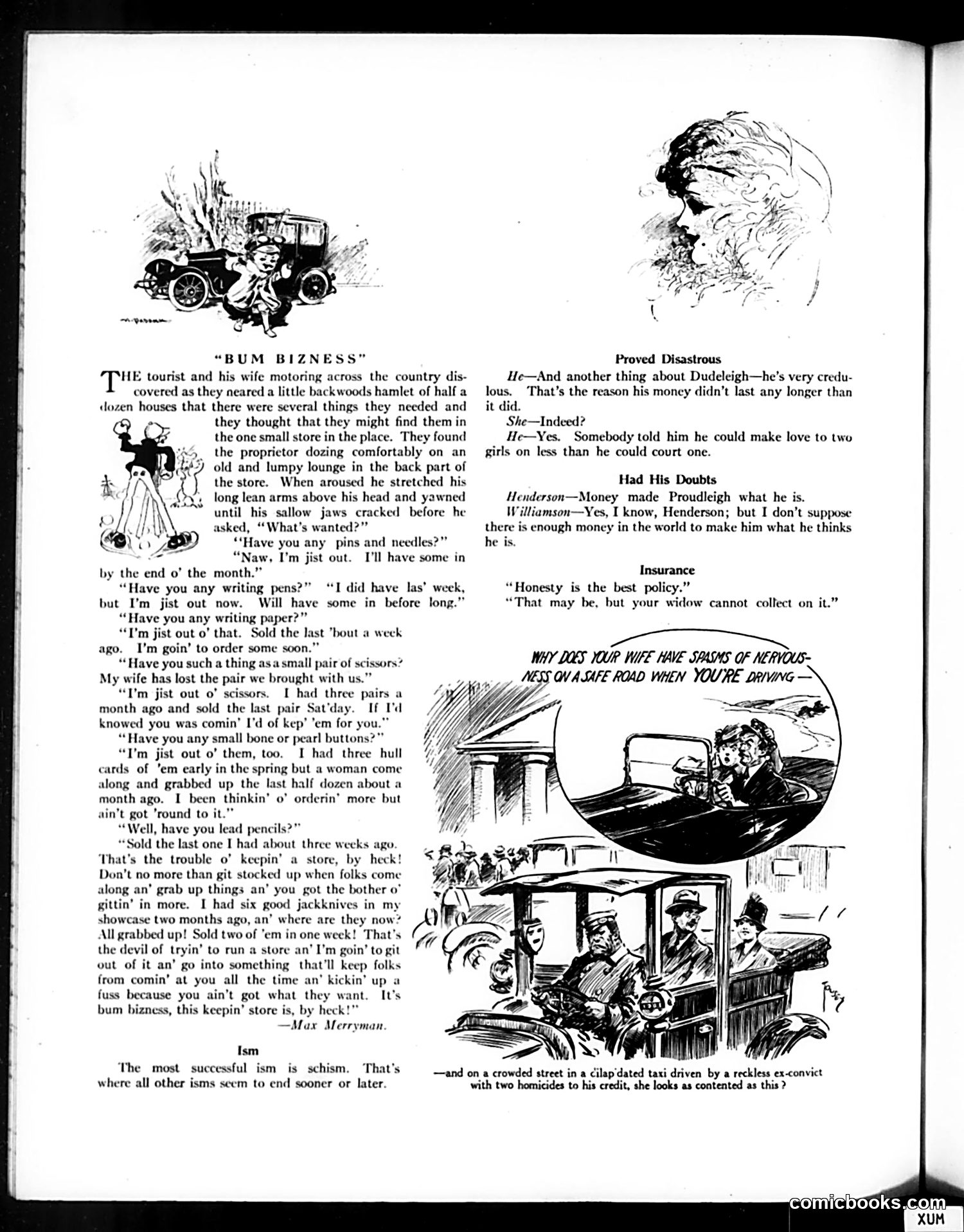
**"Bum Bizness"** satirizes rural store proprietors' chronic incompetence and laziness. A tourist couple asks a backwoods storekeeper for basic supplies (pins, pens, paper, scissors, buttons, pencils). He's perpetually "jist out" of everything, having sold his last stock weeks or months prior, always promising to reorder "soon" but never following through. The joke mocks how such stores failed customers through sheer negligence—the proprietor blames customers for buying things rather than himself for not restocking. This reflects early-20th-century frustrations with rural commerce and small-business inefficiency. The other brief items are unrelated humor: "Had His Doubts" jokes about a wealthy man's delusions; "Insurance" is wordplay about collecting insurance; and the taxi cartoon shows a wife calm despite dangerous driving by a criminal—the implied punchline being she's too nervous to react further.
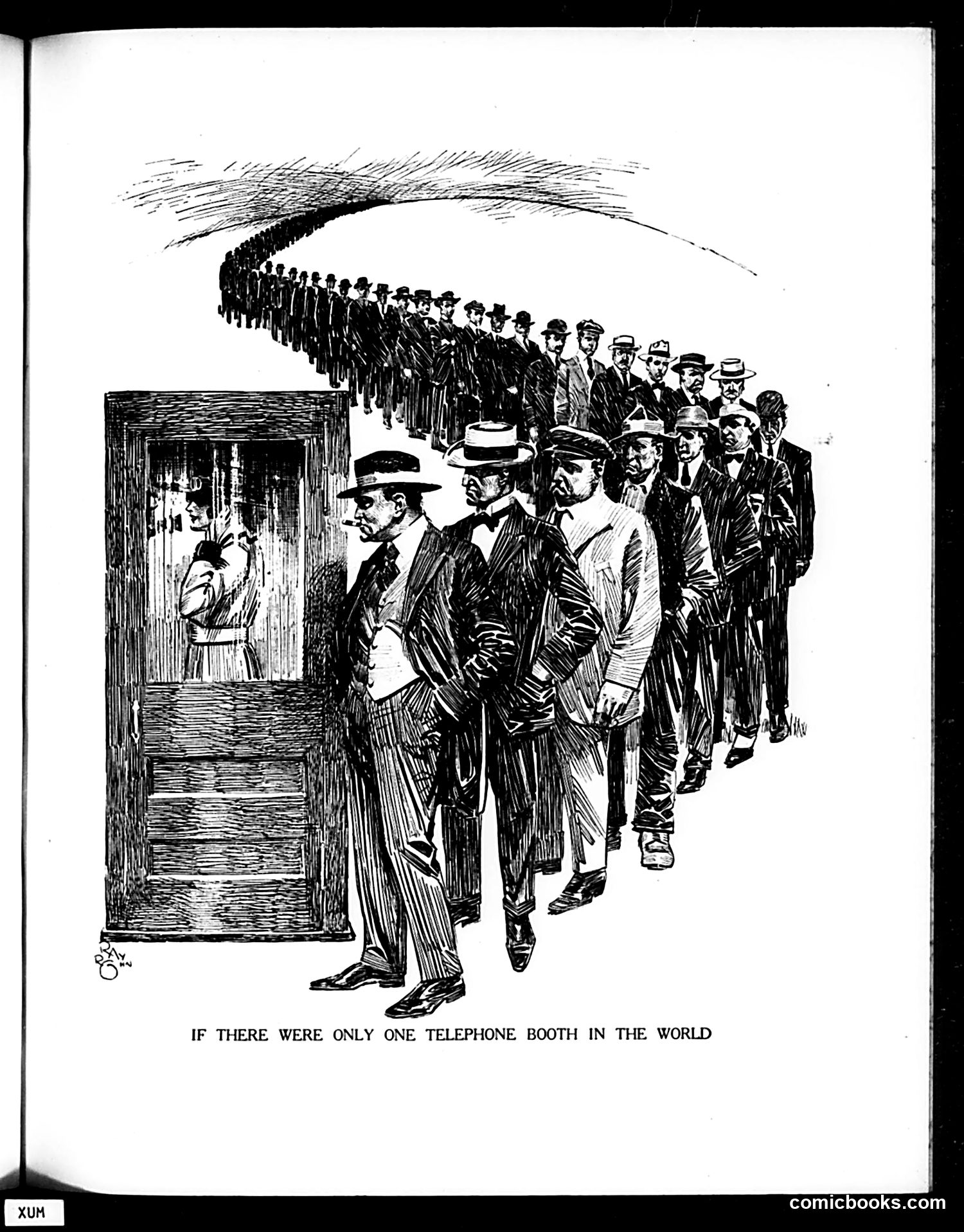
This is a satirical cartoon depicting a long queue of men waiting to use a single telephone booth. The caption reads "If There Were Only One Telephone Booth in the World." The satire jokes about the scarcity and universal demand for telephone access. In the early 20th century when *Judge* magazine published this, telephones were still relatively new technology. The cartoon exaggerates the absurd competition that would result if telephone booths were impossibly rare—showing a seemingly endless line of formally-dressed men snaking into the distance, all desperate to make calls. The humor derives from the relatable frustration of waiting for shared public resources, amplified to ridiculous extremes. It reflects contemporary anxieties about modern technology becoming essential to daily life while remaining limited in availability.
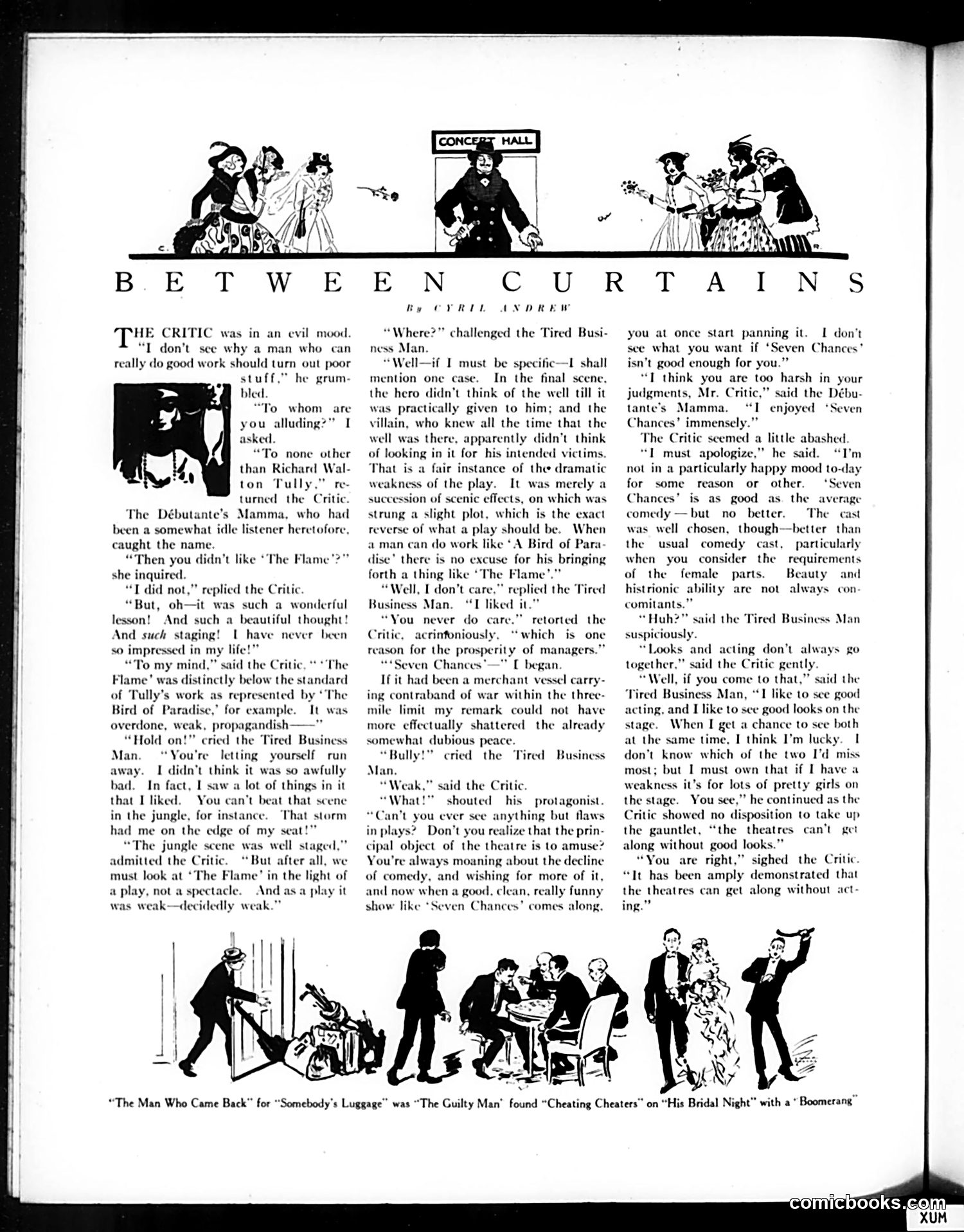
This piece satirizes theater criticism through a debate between a cranky **Critic** and a **Tired Business Man** over playwright Richard Walton Tully's recent works, particularly *"The Flame"* (compared unfavorably to Tully's earlier success *"The Bird of Paradise"*). The Critic complains the play is melodramatic spectacle lacking substance—the villain inexplicably overlooks a well as an escape route for victims. The Tired Business Man defends it, enjoying the jungle storm scene. A **Débutante's Mamma** joins in, praising the show. When discussing *"Seven Chances,"* the Critic again nitpicks, triggering the Business Man's exasperation: why criticize entertainment's primary purpose—amusement? The Mamma's endorsement embarrasses the Critic into admitting he's simply in a foul mood. The satire targets **pretentious theater critics** who obsess over dramatic construction and artistic merit while ordinary audiences simply want entertainment. The joke: the Critic's harshness reflects personal irritability, not genuine artistic judgment.
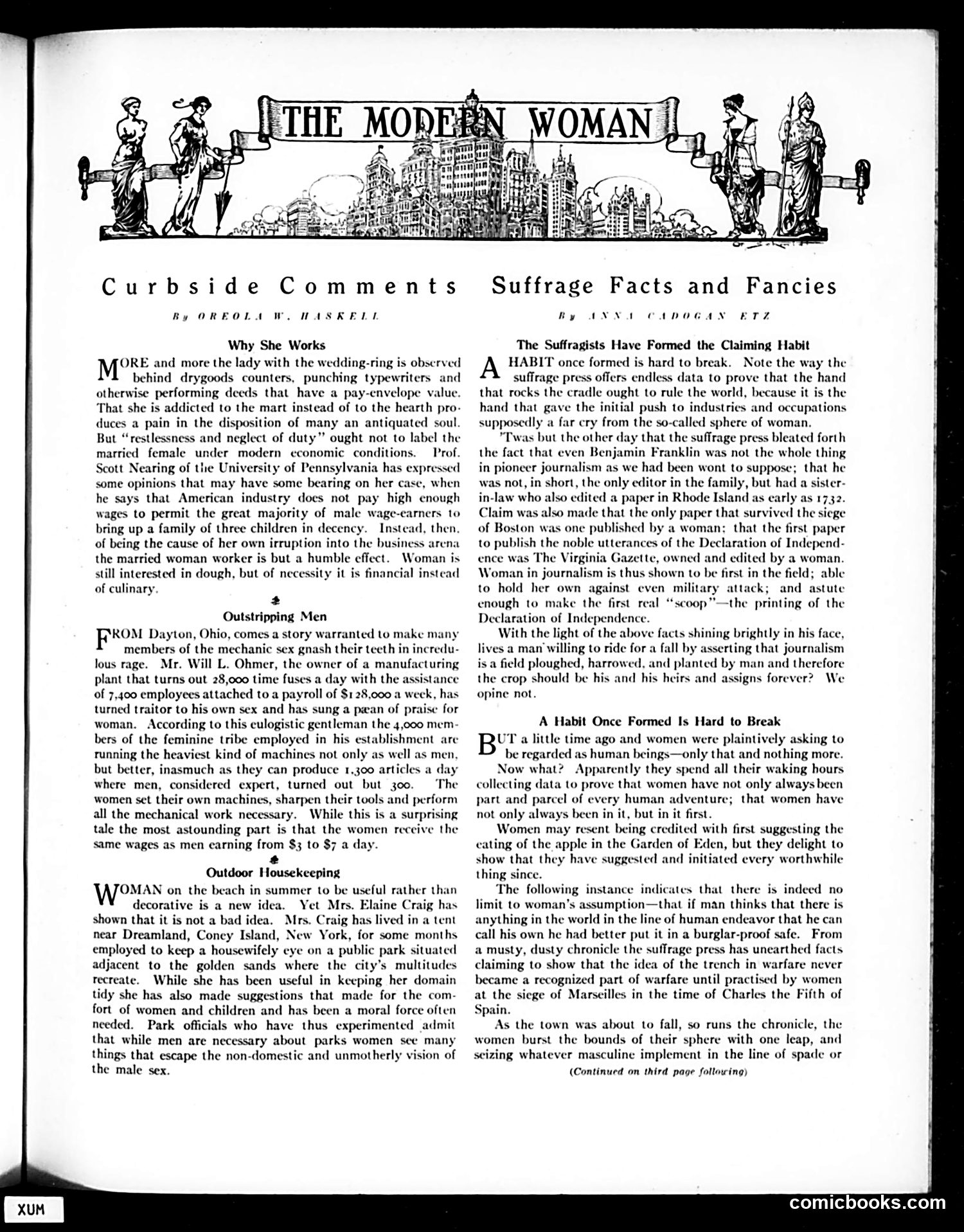
This *Judge* magazine page presents contrasting perspectives on women's expanding roles in early 20th-century America. **Left column** ("Curbside Comments" by Oreola W. Haskell) argues *supportively* that married women work out of economic necessity, not moral failing. It cites Professor Scott Nearing's claim that male wages are insufficient to support families. The "Outstripping Men" section celebrates a Dayton, Ohio factory where women operate machinery more productively than men yet receive equal pay ($3-$7/day)—presented as remarkable progress. **Right column** ("Suffrage Facts and Fancies" by Anna Cadogan Etz) takes a *dismissive* tone toward suffragists. It mocks what it calls the "claiming habit"—suffragists' tendency to credit women with historical achievements (Benjamin Franklin's sister-in-law as editor, women publishing the Declaration of Independence). The satire suggests suffragists exaggerate women's historical contributions to justify voting rights. The page juxtaposes genuine economic arguments for women's work against skeptical mockery of suffrage advocacy—reflecting contemporary tensions between acknowledging women's labor and resisting their political empowerment.
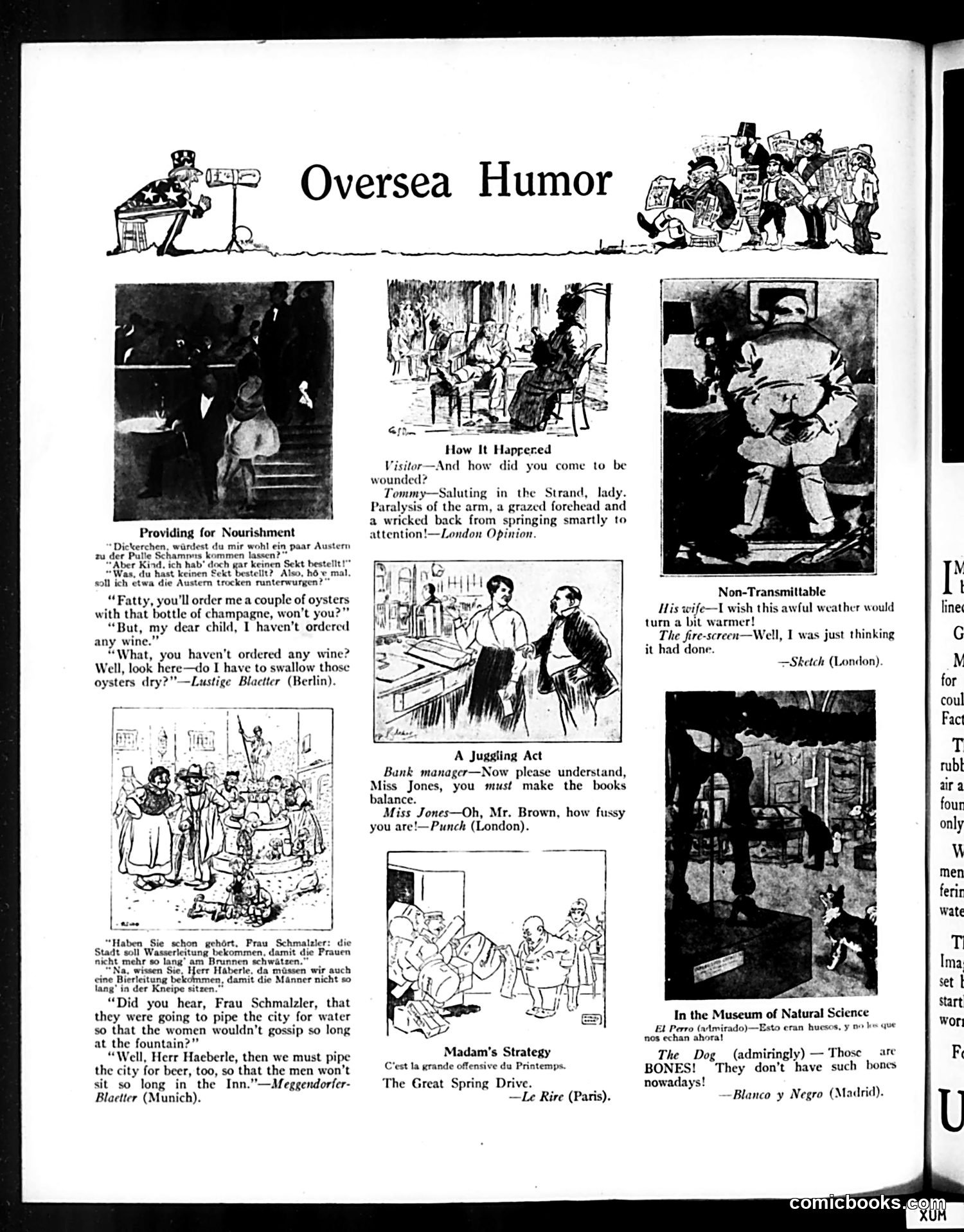
This page collects humor from European satirical magazines, translated for American readers. The cartoons present social stereotypes of various nationalities: **German humor** mocks both genders' appetites—women gossiping endlessly at fountains, men lingering in beer halls. The oyster joke plays on marital dynamics and drinking culture. **British humor** (London Opinion, Punch, Sketch) depicts Tommy the soldier comically over-saluting, a bank clerk struggling with ledgers, and domestic complaint about weather—gentle mockery of English life. **French and Spanish pieces** reference military strategy ("Spring Drive") and include a dog nostalgically admiring old bones, lamenting modern quality. The page's purpose is light, international cross-cultural comedy—"Judge" presents foreign magazine excerpts to amuse American audiences with exaggerated national characteristics: Germans as beer/food-obsessed, British as bureaucratic/militaristic, Continental Europeans as romantic or quaint. It's early 20th-century genteel stereotyping presented as sophisticated cultural humor.
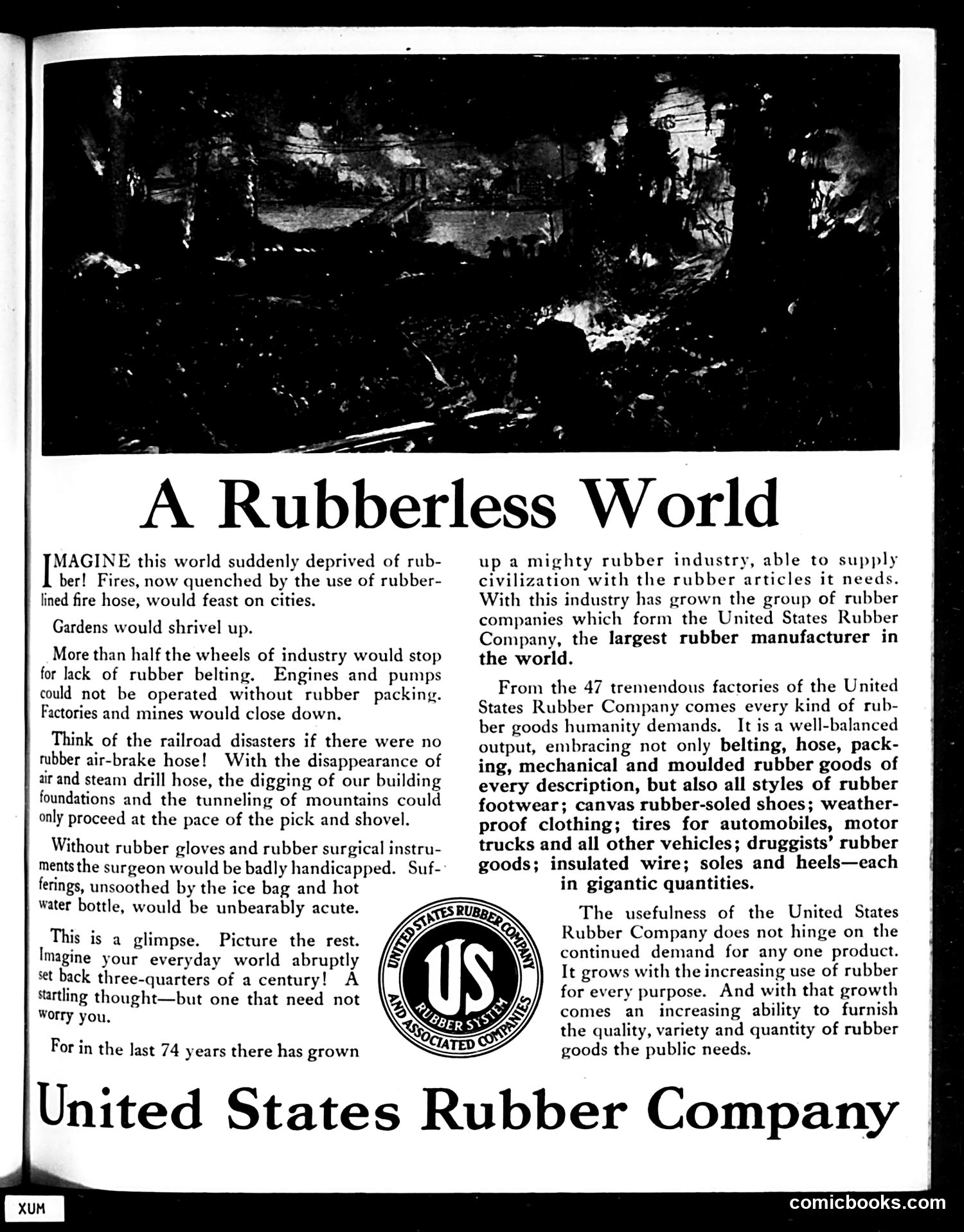
This is primarily **advertising copy**, not satire or political commentary. It's a promotional piece for the United States Rubber Company published in *Judge* magazine. The page uses a hypothetical scenario—"A Rubberless World"—as a rhetorical device to convince readers of rubber's indispensability to modern civilization. It catalogs catastrophic consequences if rubber disappeared: industrial collapse, failed fire suppression, disabled medical care, transportation disasters. The image at top appears to show an industrial or urban scene, though details are unclear in this reproduction. The text emphasizes that U.S. Rubber Company, formed from consolidated rubber manufacturers, now dominates the industry with 47 factories producing diverse rubber products—from tires and hoses to footwear and medical supplies. Rather than satire, this represents **early-twentieth-century corporate advocacy**: using alarmist speculation to position a major manufacturer as essential to national prosperity and public welfare. The appeal is to American confidence in industrial progress and modern conveniences.
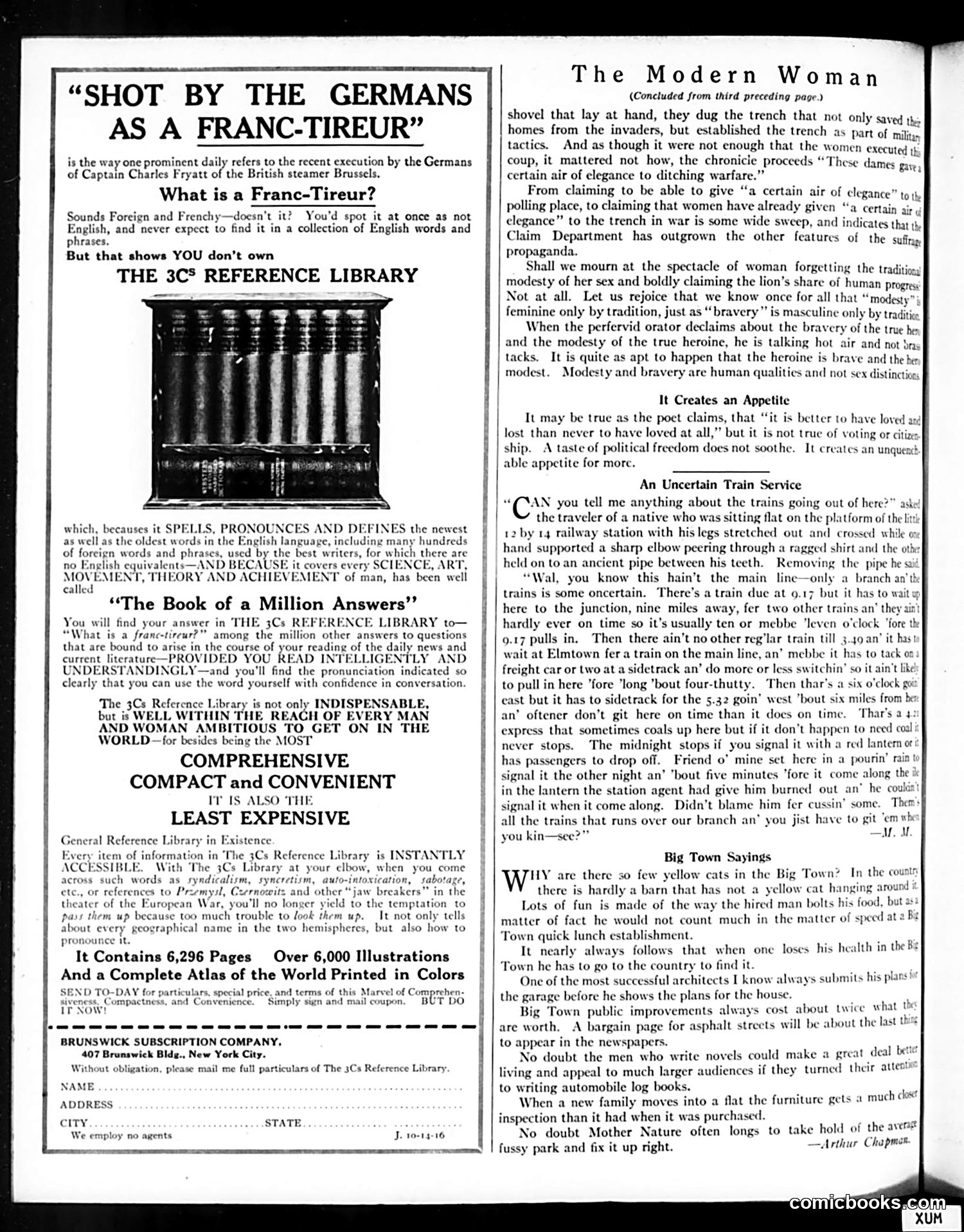
This page is primarily **advertising** for the 3Cs Reference Library, a comprehensive encyclopedia, alongside continuing an opinion piece titled "The Modern Woman." The reference library ad uses a timely hook: it explains "franc-tireur" (a French term for irregular fighter/civilian sniper), which became controversial when Germany executed British Captain Charles Fryatt of the steamer Brussels, claiming he was a franc-tireur. The ad suggests readers need this reference work to understand such current events and vocabulary appearing in daily news. The "Modern Woman" article critiques suffragists' rhetoric. It mocks claims that women have brought "elegance" to both polling places and WWI trench-digging, arguing this represents propaganda overreach. The author argues that modesty and bravery are human qualities, not sex-specific traits, and expresses skepticism about women's political ambitions creating an unhealthy "appetite" for power. This reflects early 20th-century anti-suffrage sentiment in satirical magazines.
This is a **full-page advertisement**, not a cartoon or satirical content. It's a Schlitz beer ad that cleverly uses photography science to market brown bottles. The ad exploits contemporary amateur photography knowledge (popular in the early 20th century) to justify why brown bottles preserve beer better than clear ones. The reasoning: photographers know red/brown wavelengths block ultraviolet light that would damage sensitive materials—therefore, brown bottles must protect beer's quality similarly. This is pseudo-scientific marketing disguised as educational content. Modern readers might recognize it as an early example of using technical jargon and indirect reasoning to sell a product. The actual reason breweries used brown bottles was primarily to prevent "skunky" flavor from light exposure, but the ad frames it through an analogy amateur photographers would understand and trust. The tagline "The Beer That Made Milwaukee Famous" references Schlitz's actual prominence in that brewing center.
This page is primarily **advertising and filler content** rather than political satire. The main narrative piece, "His First Day at School," is a domestic comedy about a six-year-old boy named Bobby preparing for his first day of school. The humor derives from **conflicting parental advice**: Mrs. Ellerton wants Bobby calm and well-dressed; Mr. Ellerton advises him to "stand up for yourself"; older brother Fred warns he'll get "licked" in fights; Grandma predicts teasing. The satirical point appears to be **critiquing American attitudes toward childhood toughness** — the tension between protective mothering and the masculine ideal of fighting spirit, referenced through the buzzword "preparedness" (likely alluding to pre-WWI military readiness debates). The surrounding ads (bunion relief, correspondence schools, patent services) are typical early 20th-century magazine filler. No identifiable political figures appear.
This page mixes humor and advertising typical of early 20th-century Judge magazine. **Left side:** "With the College Wits" presents brief satirical jokes from college humor magazines. The humor is mild and topical—one joke mocks the "European plan" hotel system with a pun about "trouble over borders" (likely referencing pre-WWI European tensions), another jokes about a magician's failed trick, and others play on social awkwardness and dating mishaps. These reflect concerns of the educated college crowd about modern inconveniences and romantic fumbles. **Main content:** A full-page advertisement for GEM safety razors, featuring testimonial copy from "the man who shaves himself." This promotes the then-novel idea of home shaving rather than visiting barbers—positioning it as economical, safe, and modern. **Lower advertisements:** Standard period ads for a Manhattan hotel, Faultless pajamas, and James Bergman diamonds/watches on credit. The page is primarily **advertising-driven**, with the "college wits" section serving as filler content between paid promotions. No significant political satire appears here.
This is primarily an **advertisement page**, not political satire. The left side promotes B.C. Forbes's serialized article series "The Men Who Are Making America" running in *Leslie's* magazine, targeting businessmen by naming prominent industrialists (Gary, Vanderlip, du Pont, Warburg) whose stories will appear. The right side contains **light humor pieces** typical of early 20th-century magazines: nostalgic rural poetry about fruit jars evoking childhood memories; brief jokes about women's fashion (short skirts), camping hardships (limited mirrors), and labor scarcity on farms. These are gentle, apolitical observations rather than satire. There is **no significant political cartoon or substantive satire** on this page. It represents typical Judge magazine content mixing business promotion with domestic humor aimed at middle-class readers.
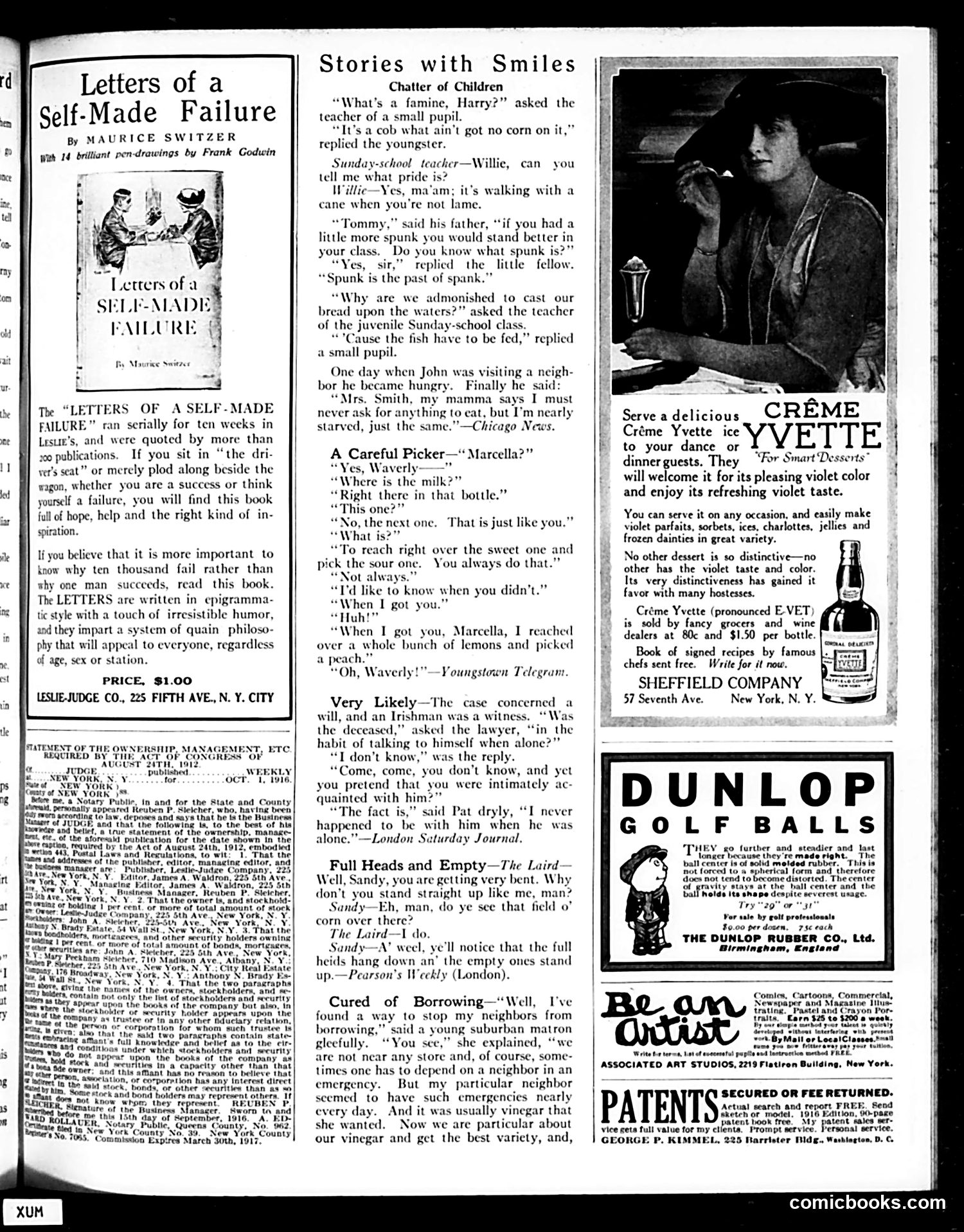
This page contains primarily **advertising and miscellaneous content** rather than political cartoons requiring satire analysis. The main feature is a book advertisement for "Letters of a Self-Made Failure" by Maurice Switzer, illustrated by Frank Godwin. The book promises humorous, epigram-style philosophy appealing to both failures and successes. Below that is a lengthy **statement of ownership and management** (required legal disclosure), followed by a "Stories with Smiles" section containing **light children's humor**—jokes featuring naive wordplay ("spunk is the past of spank," a cob without corn for "famine"). The remaining advertisements include **Crème Yvette liqueur, Dunlop golf balls, Boom Artist art supplies, and patent services**—typical Judge magazine commercial content from this era. There is **no political satire or caricature** visible on this page.
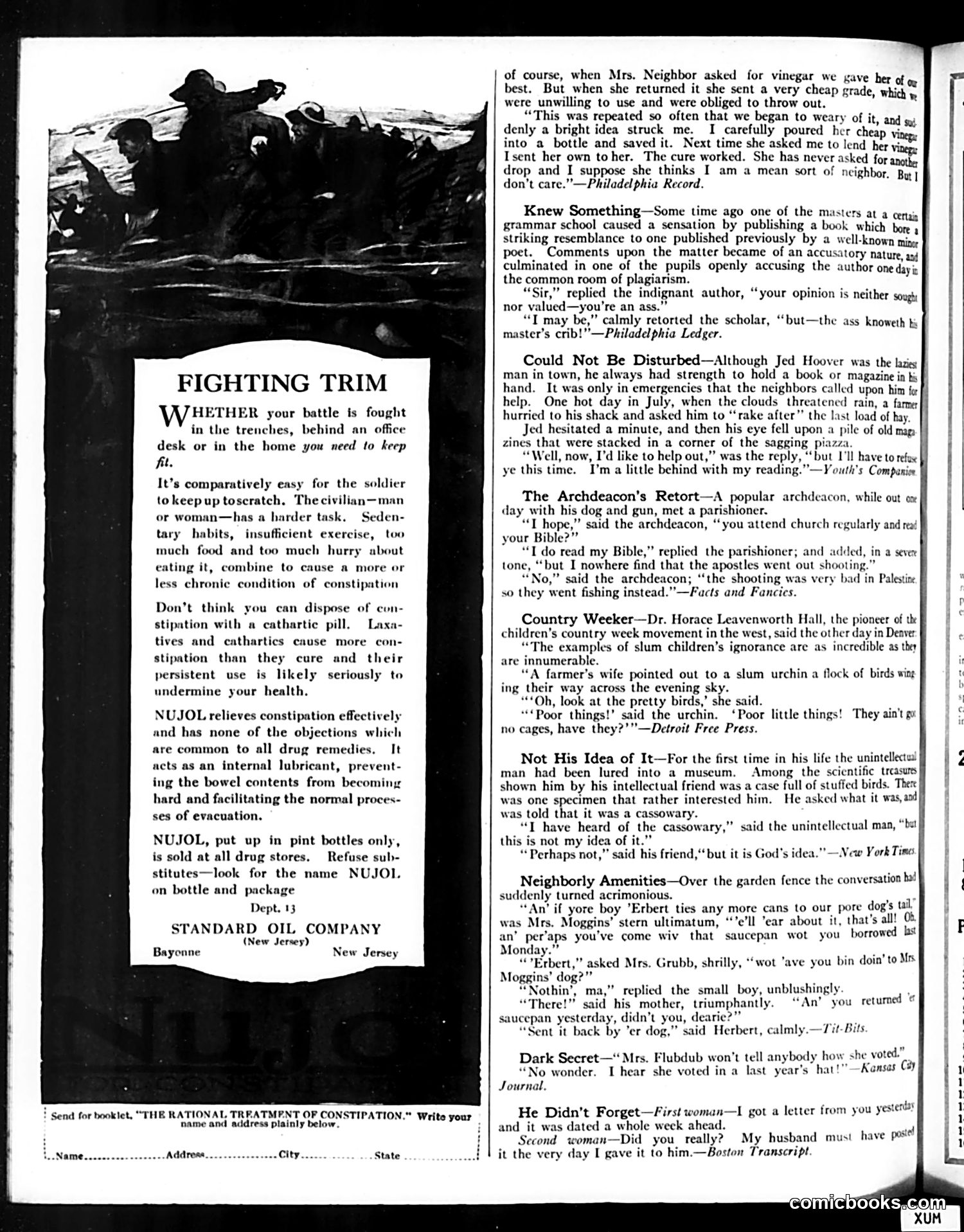
This page is primarily **advertising**, not political satire. The dominant content is a NUJOL advertisement—a Standard Oil Company product marketed as a constipation remedy that works as an "internal lubricant" rather than a harsh laxative. The ad frames constipation as a modern problem affecting soldiers, office workers, and homemakers with "sedentary habits," positioning NUJOL as the civilized solution to this embarrassing ailment. The right column contains brief humorous anecdotes unrelated to the ad: stories about petty neighbor disputes, school plagiarism accusations, laziness, religious hypocrisy (an archdeacon who hunts), and slum children's ignorance. These are mild social observations rather than pointed political satire—typical of Judge's lighter content designed to entertain while advertising dominated. The page reflects early-20th-century concerns: constipation as a serious health topic, the leisure problem of reading-obsessed Americans, and class commentary on urban poverty.
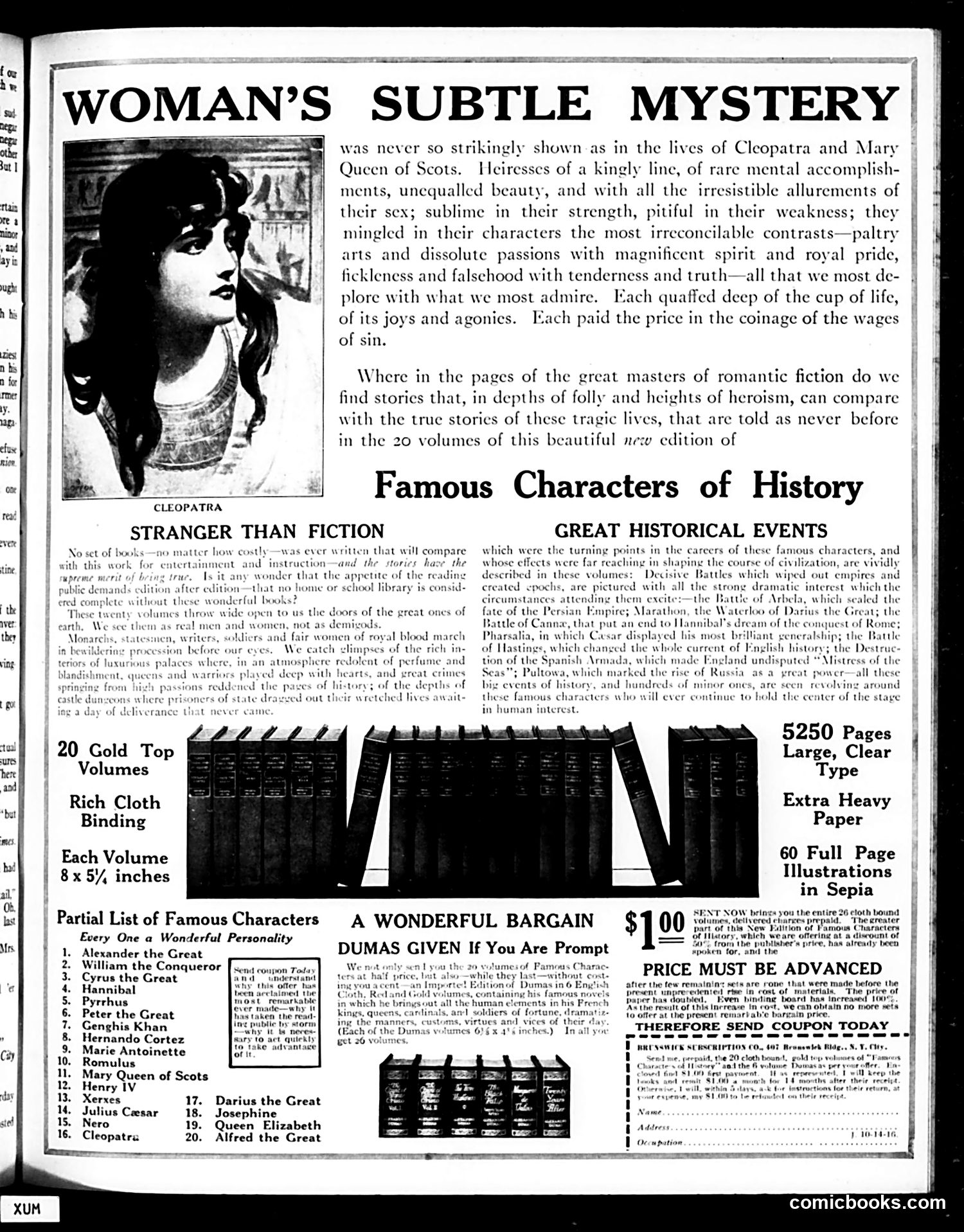
This page is primarily **advertising**, not political satire. It promotes a 20-volume book series titled *Famous Characters of History*. The "Woman's Subtle Mystery" headline and Cleopatra portrait are editorial content designed to sell the product by framing historical figures (especially women like Cleopatra and Mary Queen of Scots) as inherently dramatic and contradictory—simultaneously strong and weak, virtuous and dissolute. This reflects early 20th-century attitudes portraying women as emotionally complex and morally ambiguous. The advertisement emphasizes that these are "true stories" surpassing "romantic fiction" in drama, appealing to readers' desire for authentic historical narratives. The $1.00 offer ("A Wonderful Bargain") and urgency messaging ("Price Must Be Advanced") were standard direct-mail sales tactics of the era. The partial list of 20 historical figures—from Alexander the Great to Alfred the Great—suggests comprehensive coverage of "great men" (and a few notable women) in world history.
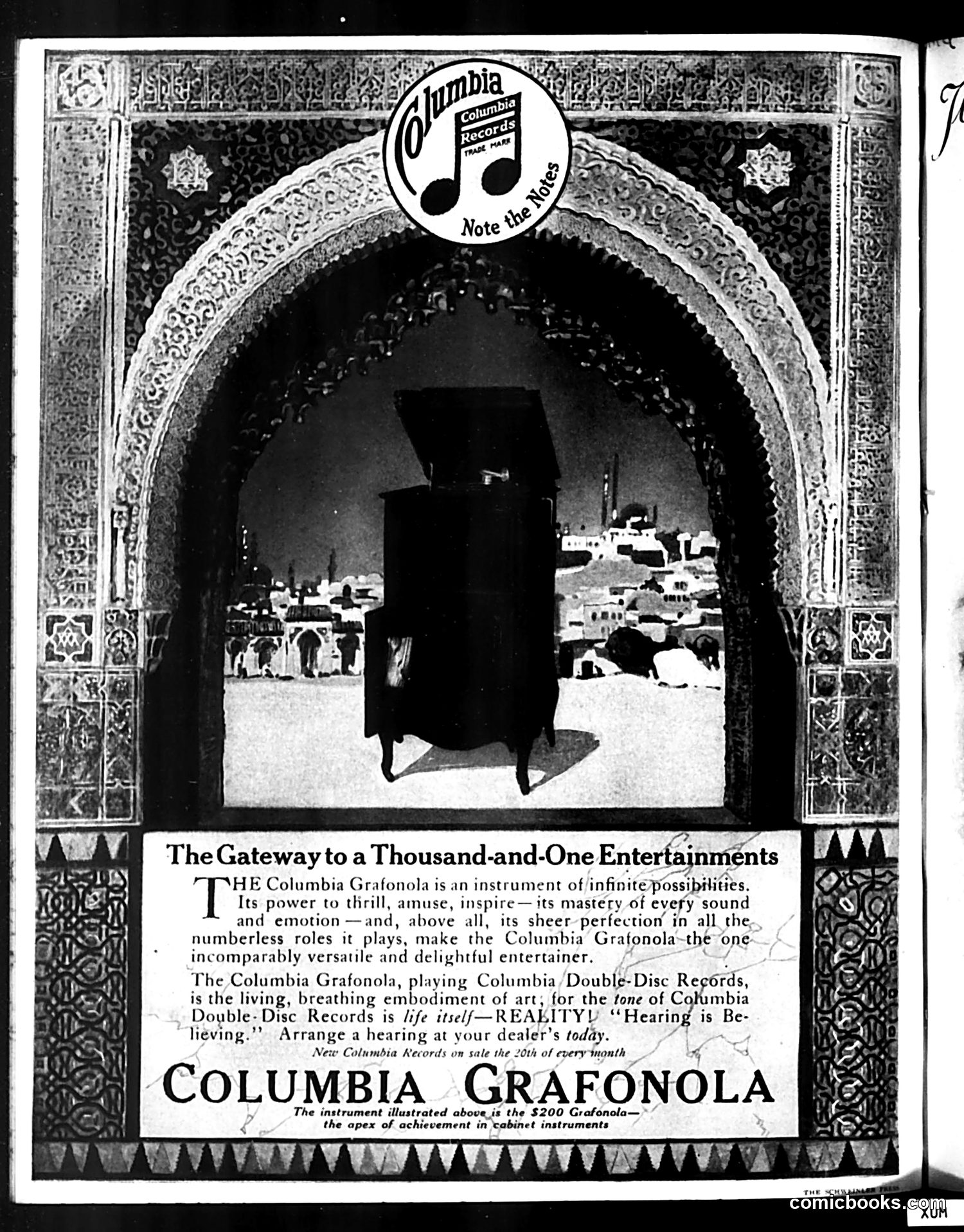
This is **not a cartoon or satire**, but rather a **full-page advertisement** for the Columbia Grafonola (a phonograph/record player). The image shows an ornate arched gateway—evoking exotic, Orientalist architecture reminiscent of "A Thousand and One Nights"—with a silhouetted figure standing in the opening, gazing at a distant cityscape. The visual metaphor suggests the grafonola as a "gateway" to diverse entertainments and worlds of sound. The advertising copy emphasizes the device's versatility and fidelity, claiming it reproduces sound with perfect "reality." The tagline "Hearing is Believing" plays on the notion that recorded sound is now indistinguishable from live performance. The $200 model advertised was positioned as a premium, cabinet-style instrument. This represents early 20th-century consumer marketing that used aspirational imagery and grandiose language to sell emerging audio technology to middle and upper-class households.