
Judge, 1916-10-14 · page 16 of 28
Judge — October 14, 1916 — page 16: what you’re looking at
What you’re looking at
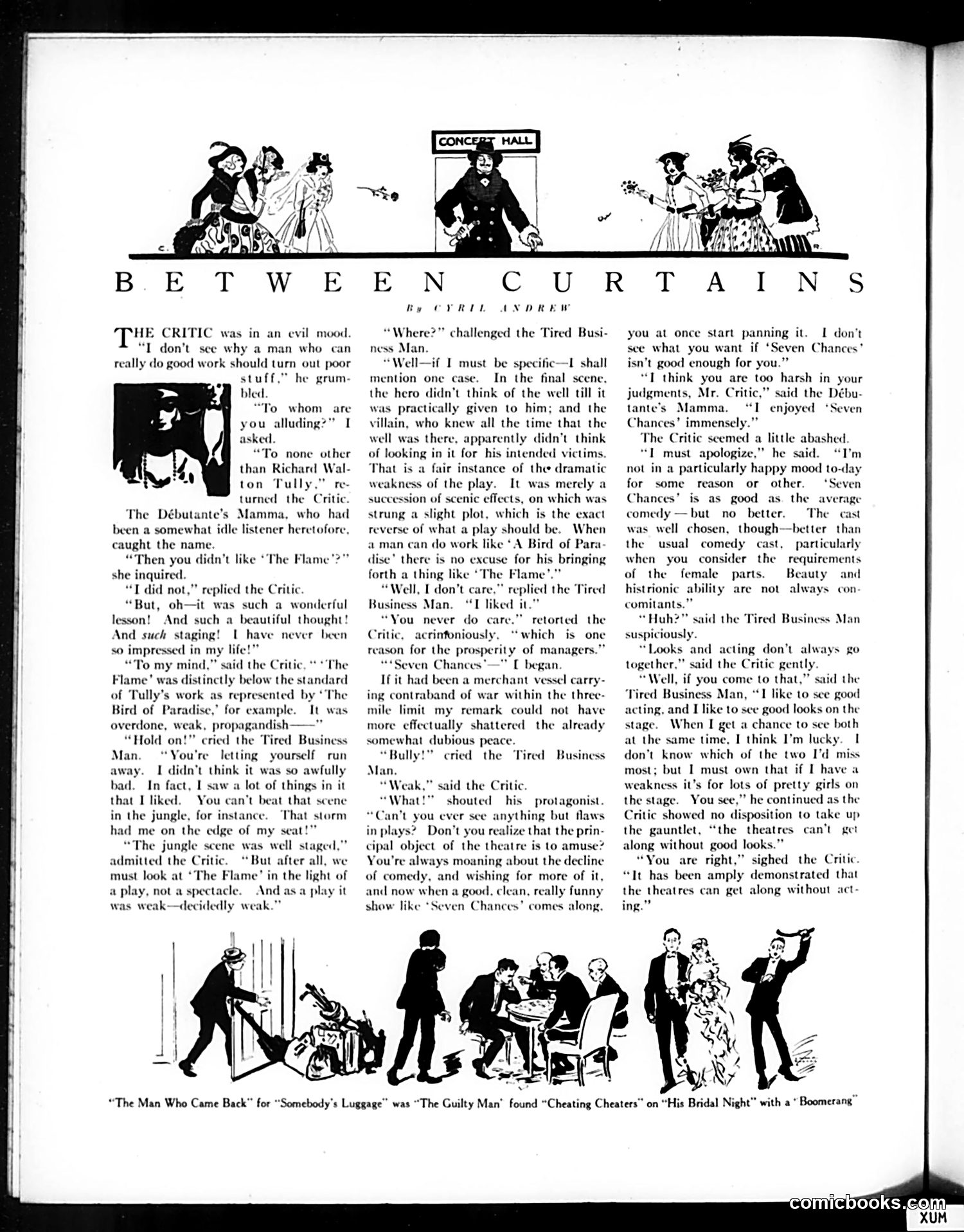
This piece satirizes theater criticism through a debate between a cranky **Critic** and a **Tired Business Man** over playwright Richard Walton Tully's recent works, particularly *"The Flame"* (compared unfavorably to Tully's earlier success *"The Bird of Paradise"*). The Critic complains the play is melodramatic spectacle lacking substance—the villain inexplicably overlooks a well as an escape route for victims. The Tired Business Man defends it, enjoying the jungle storm scene. A **Débutante's Mamma** joins in, praising the show. When discussing *"Seven Chances,"* the Critic again nitpicks, triggering the Business Man's exasperation: why criticize entertainment's primary purpose—amusement? The Mamma's endorsement embarrasses the Critic into admitting he's simply in a foul mood. The satire targets **pretentious theater critics** who obsess over dramatic construction and artistic merit while ordinary audiences simply want entertainment. The joke: the Critic's harshness reflects personal irritability, not genuine artistic judgment.
📄 Transcribed text from this page (OCR, searchable)
Machine-transcribed from the original scan — historical spelling and the odd misread are preserved.
B E T WE HE CRITIC was in an evil mood. “I don’t see why a man who can really do good work should turn out poor stuff,” he grum- bled “To whom are you alluding?” I ked. To none other than Richard Wal- ton Tully,” re- turned the Critic. Mamma, who had idle listener heretofore, The Débutant been a somew caught the name. Then you didn’t like she inquired. “T did not,” replied the Critic. “But, oh—it was such a wonderful lesson! And such a beautiful thought! And such staging! | have never been so impressed in my life!” “To my mind,” said the Critic, * * The Flame’ was distinctly below the standard of Tully's work as represented by ‘The Bird of Paradise,’ It was overdone, weak, 4 “Hold on!” cried the Tired Business Man. “You're letting yourself run away. I didn’t think it was so awfully bad. In fact, I saw a lot of things in it that I liked. You can’t beat that scene in the jungle, for instance. That storm ha ad me on the edge of my sea “The jungle scene was well staged,” admitted the Critic “But after all, we must look at ‘The Flame’ in the light of a play, not a spectacle. And asa play it was weak—decidedly weak.” “The Flame “The Man Who Came Back” for “Somebody's Luggage” E N “Where?” ness Man. “Well—if I must be specifice—I shall mention one case, In the final scene. the hero didn’t think of the well till it was practically given to him; and the villain, who knew all the time that the well was there, apparently didn’t think of looking in it for his intended victims. That is a fair instance of the dramatic weakness of the play. It was merely a succession of scenic effects, on which was strung a slight plot, which is the exact reverse of what a play should be. When a man can do work like ‘A Bird of Para dise’ there is no excuse for his bringing forth a thing like ‘The Flame’.” “Well, [don’t care,” replied the Tired Business Man. “I liked it.” “You never do care. Critic, acrinfoniously. reason for the prospe **Seven Chances* If it had been a merchant ves ing contraband of war within the three- mile limit my remark could not have effectua shattered the already lubious peace cried the Tired YRIL ANDREW challenged the Tired Busi- retorted the which is one ty of m. more somewhat Business said the Critic. shouted his protagonist. ‘an’t you ever see anything but flaws in plays? Don’t you realize that the prin- cipal object of the theatre is to amuse? You're always moaning about the decline of comedy, and wishing for more of it, and now when a good, clean, really funny show like ‘Seven Chances’ comes along, was “The Guilty Man’ found “Cheating Cheaters” C U R TA you at once start panning it. 1 don’t see what you want if ‘Seven Chances’ isn’t good enough for you.” “T think you are too harsh in your judgments, Mr. Critic,” said the Débu- tante’s Mamma. “I enjoyed ‘Seven Chances’ immensely.” The Critic seemed a little abashed “1 must apologize,” he said. “I'm not in a particularly happy mood to-day for some reason or other. ‘Se Chances’ is as good as the average comedy —but no better. The cast was well chosen, though—better than the usual comedy particularly when you consider the requirements of the female parts. Beauty and histrionic ability are not always con comitants “Huh?” said the suspiciously. “Looks and acting don’t always go together,” said the Critic gently. “Well, if you come to that,”” said the ‘Tired Business Man, “I like to sce good ig, and I like to sce good looks on the When I get a chance to see both at the same time, I think I’m lucky. 1 don't know which of the two I'd miss most; but I must own that if I have a weakness it’s for lots of pretty girls on the stage. You see continued as the Critic showed no disposition to take up the gauntlet, “the theatres can’t get along without good looks.” “You are right,” sighed the Critic “It has been amply demonstrated that the theatres can get along without act- cast, Fired Business Man on “His Bridal Night” with a * Boomerang”