
Judge, 1916-10-14 · page 9 of 28
Judge — October 14, 1916 — page 9: what you’re looking at
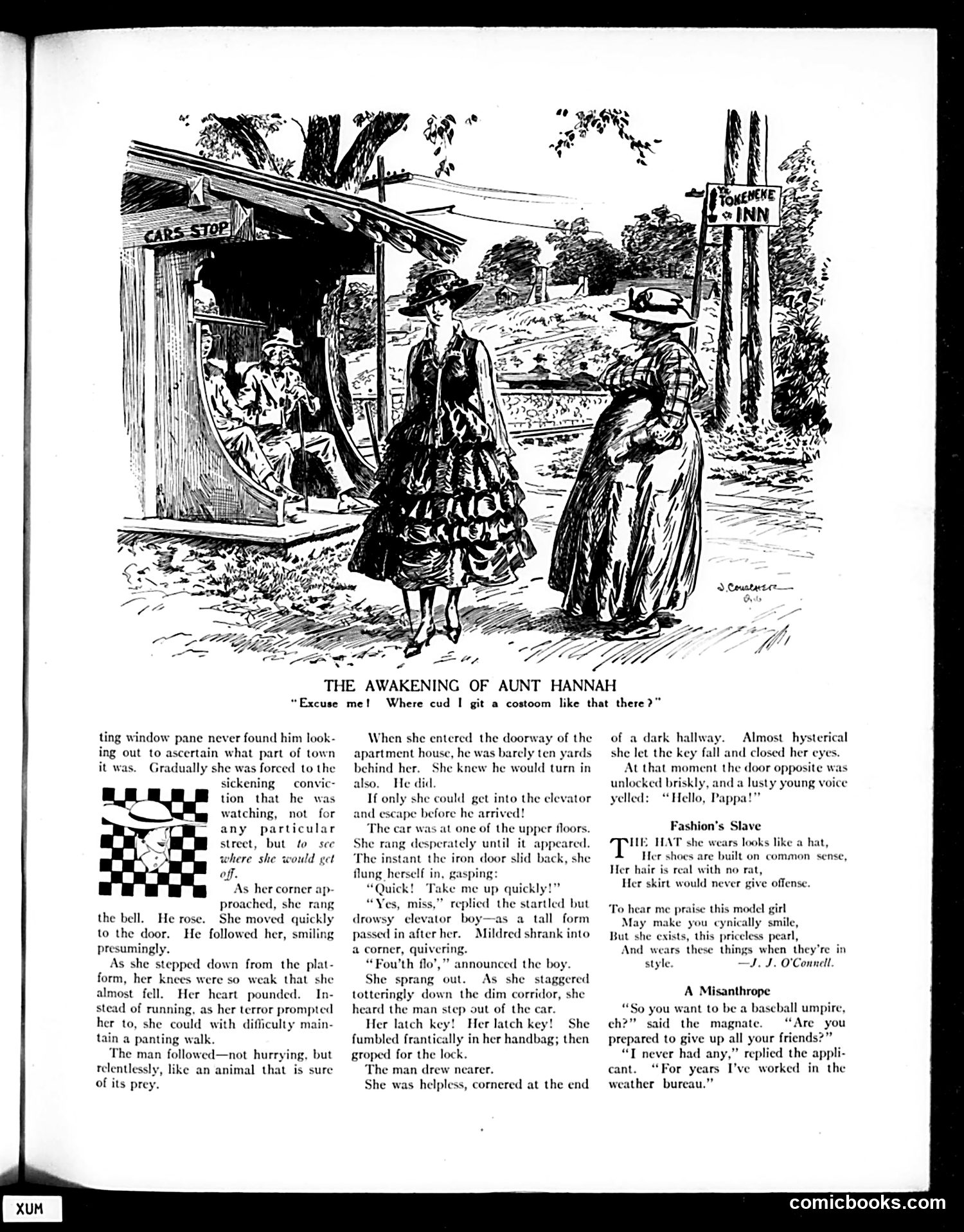
What you’re looking at
This illustration depicts a dramatic urban safety scenario circa early 1900s. A woman ("Aunt Hannah," appearing elderly based on the illustration) is being followed menacingly by a man as she enters an apartment building—a common urban danger narrative of the era. The story builds suspense as she attempts to escape via elevator, fumbles for her key in a dark hallway while he approaches, seemingly trapped. The resolution appears humorous: the door opposite opens and a young voice calls "Hello, Pappa!"—revealing the pursuer is simply her father, making her panic overwrought and comedic to readers. The cartoon satirizes the anxieties of urban life and women's vulnerability in cities, while also gently mocking how quickly innocent situations can trigger fear. The accompanying short humor pieces ("Fashion's Slave," "A Misanthrope") are unrelated editorial cartoons on beauty standards and personality types—typical Judge magazine filler content.
📄 Transcribed text from this page (OCR, searchable)
Machine-transcribed from the original scan — historical spelling and the odd misread are preserved.
THE AWAKENING OF AUNT HANNAH “Excuse me! ting window pane never found him look- ing out to ascertain what part of town it was. Gradually she was forced to the sickening — convic- tion that he was watching, not for any particular street, but fo see where she would get off. As her corner ap- proached, she rang the bell. He rose. She moved quickly to the door. He followed her, smiling presumingly. As she stepped down from the plat- form, her knees were so weak that she almost fell. Her heart pounded. In- stead of running, as her terror prompted her to, she could with difficulty main- tain a panting walk. The man followed—not hurrying, but relentlessly, like an animal that is sure of its prey. When she entered the doorway of the apartment house, he barely ten yards behind her. She knew he would turn in also. He did. If only she could get into the elevator and escape before he arrived! The car was at one of the upper floors. ng desperately until it appeared. t the iron door slid back, she If in, gasping: Take me up quickly * replied the startled but drowsy clevator boy—as a tall form passed in after her. Mildred shrank into a corner, quivering. “Fou'th flo’,” announced the boy. She sprang out. As she staggered totteringly down the dim corridor, she heard the man step out of the car. Her latch key! Her latch key! She fumbled frantically in her handbag; then groped for the lock. The man drew nearer. She was helpless, cornered at the end Where cud I git a costoom like that there?” of a dark hallway. Almost hysterical she let the key fall and closed her ey At that moment the door opposite ed briskly, and a lusty young voice “Hello, Pappa!” unlo yelled: Fashion's Slave ILE HAT she wears looks like a hat, Her shoes are built on common sense, Her hair is real with no rat, Her skirt would never give offense. ‘To hear me praise this model girl May make you cynically smile, But she exists, this priceless pearl, And wears these things when they’re in style. —J. J. O'Connell. A Misanthrope “So you want to be a baseball umpire, c said the magnate. “Are you prepared to give up all your friends?” “T never had any,” replied the appli- cant. “For years I’ve worked in the weather bureau.” comicbooks.com