
Judge, 1916-10-14 · page 8 of 28
Judge — October 14, 1916 — page 8: what you’re looking at
What you’re looking at
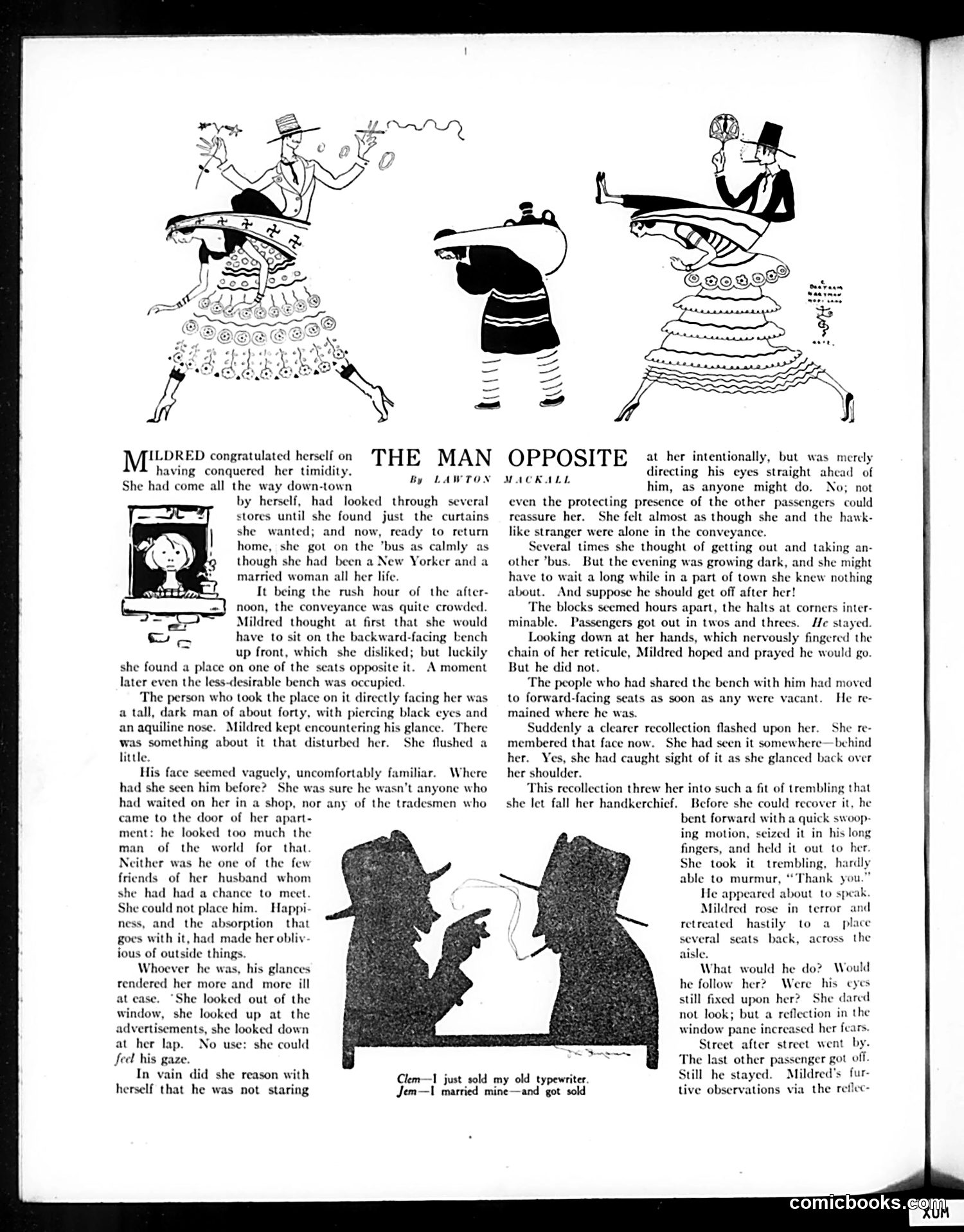
This is a short story illustration by Lawton Mackall in *Judge* magazine, not a political cartoon. It depicts a common urban anxiety narrative of the era. The plot concerns Mildred, a timid woman who has just gained confidence shopping alone in the city. On a crowded bus ride home, she becomes increasingly unsettled by a dark, piercing-eyed man sitting opposite her—his stare feels predatory. She tries to ignore him but grows panicked, eventually retreating to another seat. As other passengers disembark, he remains, intensifying her fear. The satirical point appears to be **social commentary on urban life and female vulnerability**. The story exploits contemporary anxieties about strangers, public transportation, and women's independence in the modern city. The inset cartoon with "Clem" and "Jem" provides comic relief—contrasting minor domestic complaints (selling a typewriter vs. getting married) with Mildred's escalating terror. The piece reflects early 20th-century attitudes toward women navigating public spaces and the perceived dangers of urban anonymity.
📄 Transcribed text from this page (OCR, searchable)
Machine-transcribed from the original scan — historical spelling and the odd misread are preserved.
THE MAN MibbReD congratulated herself on By LAWTON having conquered her timidity. She had come all the way down-town by herself, had looked through several stores until she found just the curtains she wanted; and now, ready to return home, she got on the ‘bus as calmly as though she had been a New Yorker and a married woman all her life. It being the rush hour of the after- noon, the conveyance was quite crowded. Mildred thought at first that she would have to sit on the backward-facing bench up front, which she disliked; but luckily she found a place on one of the seats opposite it. A moment later even the less-desirable bench was occupied. The person who took the place on it directly fa a tall, dark man of about forty, with piercing black an aquiline nose. Mildred kept encountering his glance. as something about it that disturbed her. little. His face seemed vaguely, uncomfortabl. Where had she seen him before? She was sure he wasn’t anyone who had waited on her in a shop, nor any of the tradesmen who came to the door of her apart- ment: he looked too much the man of the world for that Neither was he one of the few friends of her husband whom she had had a chance to meet. She could not place him. Happi ness, and the absorption that goes with it, had made her obliv- ious of outside things. Whoever he was, his glances rendered her more and more ill at case, “She looked out of the window, she looked up at the advertisements, she looked down at her lap. No use: she could feel his gaze. In vain did she reason with herself that he was not staring g her was. yes and There She flushed a amiliar. Clem—I just sold my old typewriter Jem—I married mine—and got sold at her intentionally, but was merely directing his eyes straight ahead of him, as anyone might do. No; not even the protecting presence of the other passengers could reassure her. She felt almost as though she and the hawk- like stranger were alone in the conveyance. Several times she thought of getting out and taking an- other ’bus. But the evening was growing dark, and she might have to wait a long while in a part of town she knew nothing about. And suppose he should get off after her! The blocks seemed hou part, the halts at corners inter- minable. Passengers got out in twos and thre He stayed. Looking down at her hands, which nervously fingered the chain of her reticule, Mildred hoped and prayed he would go. But he did not. The people who had shared the bench with him had moved to forward-facing seats as soon as any were vacant. He re- mained where he was. Suddenly a clearer recollection flashed upon her. membered that face now. She had seen it somewhere her. Yes, she had caught sight of it as she glanced back over her shoulder. This recollection threw her into such a fit of trembling that she let fall her handkerchief. Before she could recover it, he bent forward with a quick swoop- ing motion, seized it in his long fingers, and held it out to her She took it trembling, hardly able to murmur, “Thank you.” He appeared about to speak Mildred rose in terror and retreated hastily to a place several seats back, across the OPPOSITE MACKALL She re- behind yhat would he do? Would he follow her? Were his still fixed upon her? She not look; but a reflection in the window pane increased her fears. Street after street went | The last other passenger got off. Still he stayed. Mildred’s fur- observations via the reflec eyes ared comicbooks.