
Judge, 1916-10-14 · page 17 of 28
Judge — October 14, 1916 — page 17: what you’re looking at
What you’re looking at
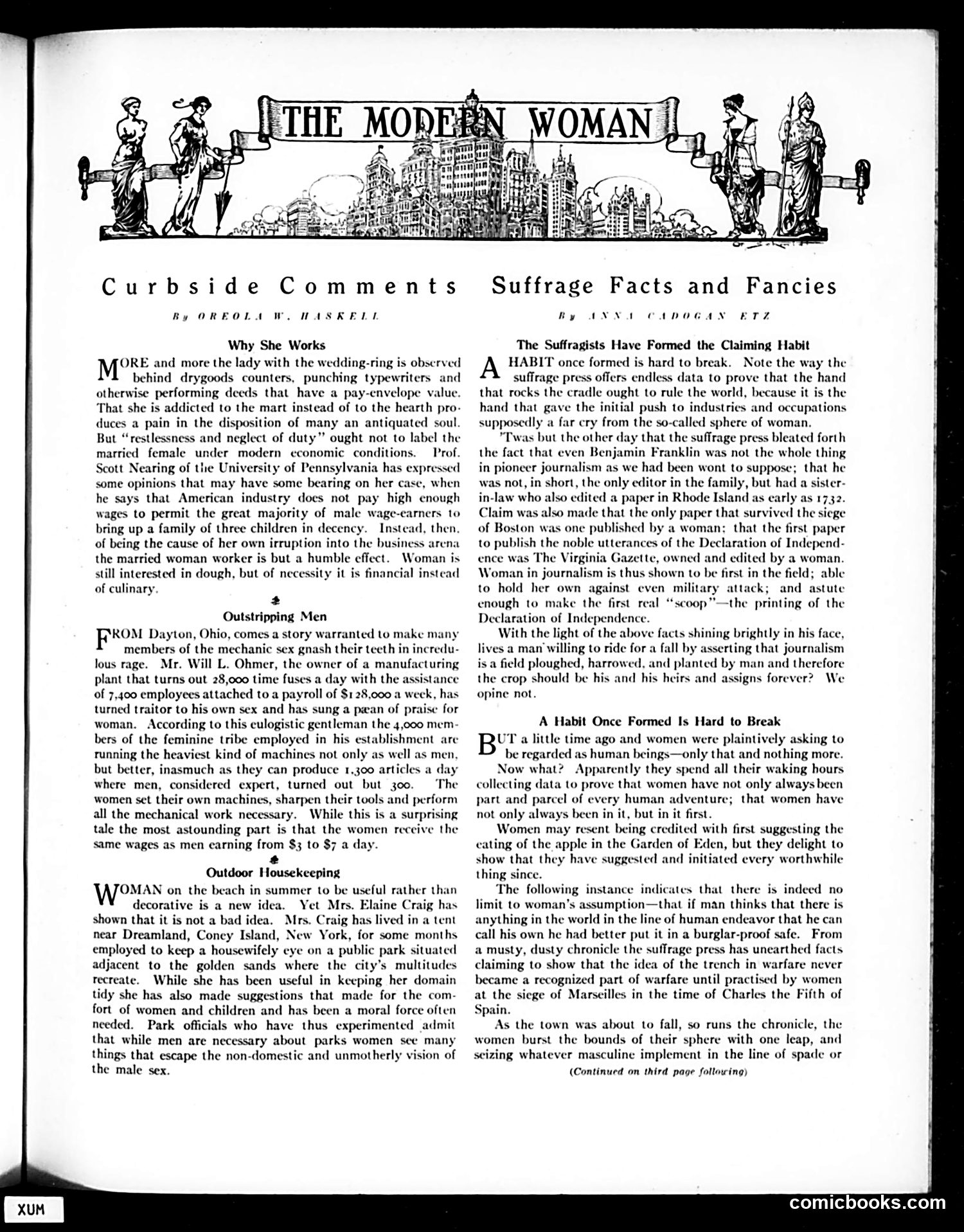
This *Judge* magazine page presents contrasting perspectives on women's expanding roles in early 20th-century America. **Left column** ("Curbside Comments" by Oreola W. Haskell) argues *supportively* that married women work out of economic necessity, not moral failing. It cites Professor Scott Nearing's claim that male wages are insufficient to support families. The "Outstripping Men" section celebrates a Dayton, Ohio factory where women operate machinery more productively than men yet receive equal pay ($3-$7/day)—presented as remarkable progress. **Right column** ("Suffrage Facts and Fancies" by Anna Cadogan Etz) takes a *dismissive* tone toward suffragists. It mocks what it calls the "claiming habit"—suffragists' tendency to credit women with historical achievements (Benjamin Franklin's sister-in-law as editor, women publishing the Declaration of Independence). The satire suggests suffragists exaggerate women's historical contributions to justify voting rights. The page juxtaposes genuine economic arguments for women's work against skeptical mockery of suffrage advocacy—reflecting contemporary tensions between acknowledging women's labor and resisting their political empowerment.
📄 Transcribed text from this page (OCR, searchable)
Machine-transcribed from the original scan — historical spelling and the odd misread are preserved.
Curbside Comments By OREOLA W. HASKELL Why She Works ORE and more the lady with the wedding-ring is observed behind drygoods counters, punching typewriters and otherwise performing deeds that have a pay-envelope value. That she is addicted to the mart instead of to the hearth pro- duces a pain in the disposition of many an antiquated soul. But “restlessness and neglect of duty” ought not to label the married female under modern economic conditio: Prof. Scott Nearing of the University of Pennsylvania has expressed some opinions that may have some bearing on her ¢ when he says that American industry does not pay high enough wages to permit the great majority of male wage-earners to bring up a family of three children in decency. Instead, then. of being the cause of her own irruption into the business arena the married woman worker is but a humble effect. Woman is still interested in dough, but of necessity it is financial instead of culinary. + Outstripping Men ROM Dayton, Ohio, comes a story warranted to make many members of the mechanic sex gnash their teeth in incredu- lous rage. Mr. Will L. Ohmer, the owner of a manufacturing plant that turns out 28,000 time fuses a day with the assistance of 7,400 employees attached to a payroll of $128,000 a w s turned traitor to his own sex and has sung a pwan of praise for woman. According to this culogistic gentleman the 4,000 mem- bers of the feminine tribe employed in his establishment are running the heaviest kind of machines not only as well as men, but better, inasmuch as they can produce 1,300 articles a day where men, considered expert, turned out but 300. The women set their own machines, sharpen their tools and perform all the mechanical work necessary. While this is a surprising tale the most astounding part is that the women receive the same wages as men earning from $3 to $7 a day. # Outdoor Housekeeping OMAN on the beach in summer to be useful rather than decorative is a new idea. Yet Mrs. Elaine Craig has shown that it is not a bad idea. Mrs. Craig has lived in a tent near Dreamland, Coney Island, New York, for some months employed to keep a housewifely eye on a public park situated adjacent to the golden sands where the city’s multitudes recreate. While she has been useful in keeping her domain tidy she has also made suggestions that made for the com- fort of women and children and has been a moral force often needed. Park officials who have thus experimented admit that while men are necessary about parks women see many things that escape the non-domestic and unmotherly vision of the male sex. Suffrage Facts and Fancies Ry ANNA CADOGAN ETL The Suffragists Have Formed the Claiming Habit HABIT once formed is hard to break. Note the way the suffrage press offers endless data to prove that the hand that rocks the cradle ought to rule the world, because it is the hand that gave the initial push to industries and occupations supposedly a far cry from the so-called sphere of woman. Twas but the other day that the suffrage press bleated forth the fact that ¢ Benjamin Franklin was not the whole thing in pioneer journalism as we had been wont to suppose; that he was not, in short, the only editor in the family, but had a sister- in-law who also edited a paper in Rhode Island as Claim was also made that the only paper that surviv of Boston was one published by a woman; that the first paper to publish the noble utterances of the Declaration of Independ- ence W he Virginia Gazette, owned and edited by a woman. Woman in journalism is thus shown to be first in the field; able to hold her own against even military attack; and astute enough to make the first real “scoop”’—the printing of the Declaration of Independence. With the light of the above facts shining brightly in his face, lives a man willing to ride for a fall by asserting that journalism isa field ploughed, harrowed, and planted by man and therefore the crop should be his and his heirs and assigns forever? We opine not. A Habit Once Formed Is Hard to Break UT a little time ago and women were plaintively asking to be regarded as human beings—only that and nothing more. Now what? Apparently they spend all their waking hours collecting data to prove that women have not only always been part and parcel of every human adventure; that women have not only always been in it, but in it first. Women may resent being credited with first suggesting the cating of the apple in the Garden of Eden, but they delight to show that they have suggested and initiated every worthwhile thing since. The following instance indicates that there is indeed no limit to woman’s assumption—that if man thinks that there is anything in the world in the line of human endeavor that he can call his own he had better put it in a burglar-proof safe. From a musty, dusty chronicle the suffrage press has unearthed facts claiming to show that the idea of the trench in warfare never became a recognized part of warfare until practised by women at the siege of Marseilles in the time of Charles the Fifth of Spain. As the town was about to fall, so runs the chronicle, the women burst the bounds of their sphere with one leap, and ig whatever masculine implement in the line of spade or (Continued on third page following) comicbooks.com