
Judge, 1916-10-14 · page 7 of 28
Judge — October 14, 1916 — page 7: what you’re looking at
What you’re looking at
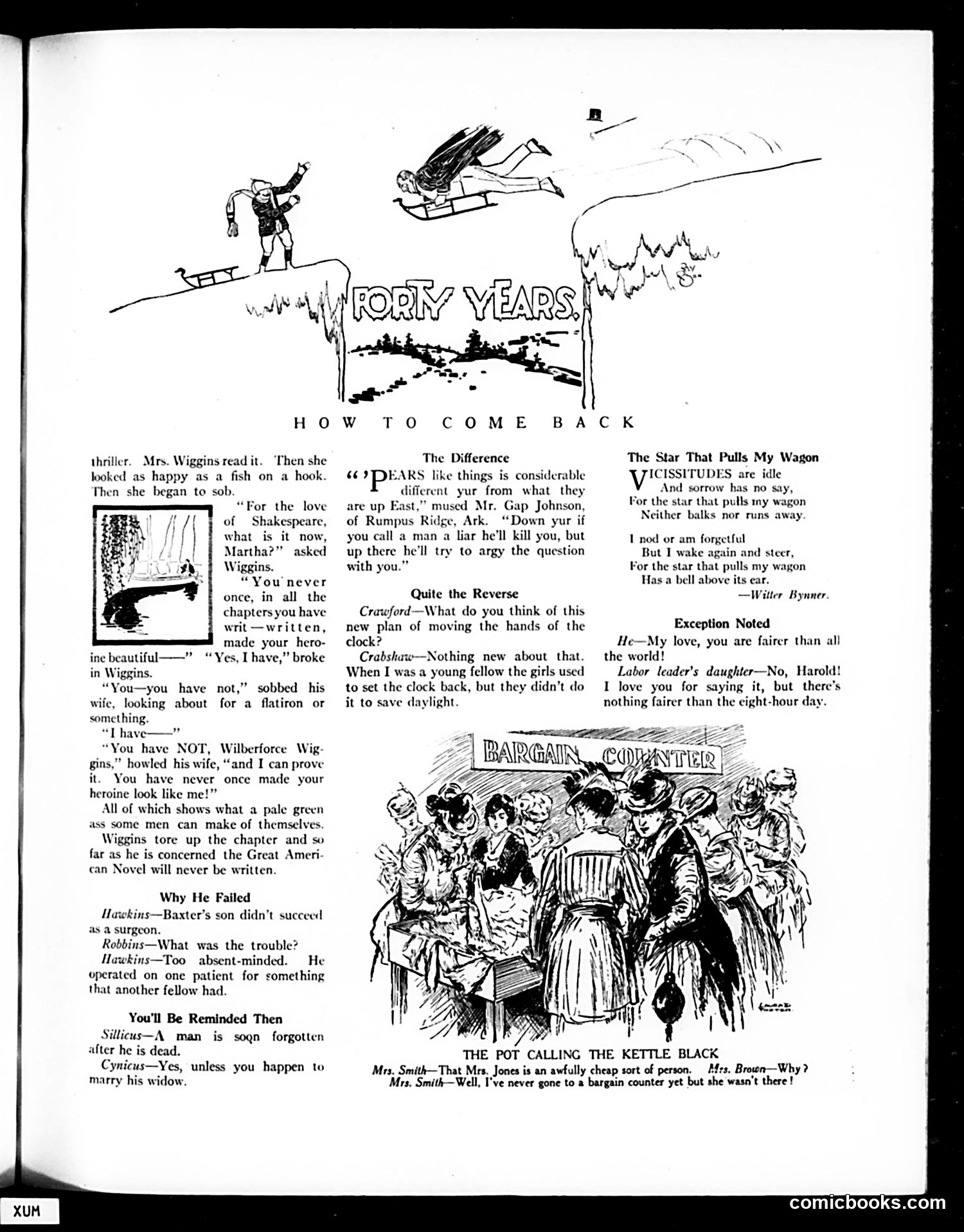
This page contains multiple short humorous pieces typical of early 20th-century satirical magazines: **Main cartoon ("The Pot Calling the Kettle Black")**: Two women gossip about a third woman's bargain-hunting, with ironic hypocrisy—the speaker admits she frequents the same bargain counters while criticizing the other woman for doing so. **Text pieces include**: - A domestic squabble where a novelist's wife criticizes his heroines' appearance, leading him to abandon his manuscript - A doctor too absent-minded to operate correctly - Regional humor contrasting Southern and Eastern attitudes toward insults - A joke about men forgetting dead husbands unless their widows remarry - A labor activist daughter reframing romantic compliments as praise for the eight-hour workday The page reflects period concerns: American novel-writing, workplace safety/medical competence, regional differences, and emerging labor movements. The humor is gentle, domestic, and relies on social observation rather than political commentary.
📄 Transcribed text from this page (OCR, searchable)
Machine-transcribed from the original scan — historical spelling and the odd misread are preserved.
HOW thriller. Mrs. Wiggins read it. ‘Then she looked as happy as a fish on a hook. Then she began to sob. “For the love of Shakespeare, what is it now, Martha?” asked Wiggins. “You never once, in all the chapters you have writ —written, made your hero- ine beautiful——” “ Yes, I have,” broke in Wiggins. “You—you have not,” sobbed his wife, looking about for a flatiron or something. “Thave—”" “You have NOT, Wilberforce Wig- gins,” howled his wife, ‘and I can prove it. You have never once made your heroine look like me!” All of which shows what a pale green ass some men can make of themselves. Wiggins tore up the chapter and so far as he is concerned the Great Ameri can Novel will never be written. Why He Failed Hawkins—Baxter’s son didn’t succeed as a surgeon. Robbins—What was the trouble? Hawkins—Too absent-minded. He operated on one patient for something that another fellow had. You'll Be Reminded Then Sillicus—A man is sogn forgotten after he is dead. Cynicus—Yes, unless you happen to marry his widow. TO COME BA The Difference “ 1 DEARS like things is considerable different. yur from what they are up East,” mused Mr. Gap Johnson, of Rumpus Ridge, Ark. “Down yur if you calla man a liar he'll kill you, but up there he'll try to argy the question with you.” Quite the Reverse Crawford—What do you think of this new plan of moving the hands of the clock? Crabshaw—Nothing new about that. When I was a young fellow the girls used to set the clock back, but they didn’t do it to save daylight. CK The Star That Pulls My Wagon ICISSITUDES are idle ‘And sorrow has no say, For the star that pulls my wagon Neither balks nor runs away 1 nod or am fo ful But I wake in and steer, For the star that pulls my wagon Has a bell above its ear. —Witter Bynner. Exception Noted He—My love, you are fairer than all the world! Labor leader's daughter—No, Harold! I love you for saying it, but there’s nothing fairer than the eight-hour day. THE POT CALLING THE KETTLE BLACK Mrs. Smith—That Mrs. Jones is an awfully cheap sort of person. Mrs. Brown—Why ? Mrs. Smith—Well, I've never gone to a bargain counter yet but she wasn’t there! comicbooks.com