
Judge, 1916-10-14 · page 12 of 28
Judge — October 14, 1916 — page 12: what you’re looking at
What you’re looking at
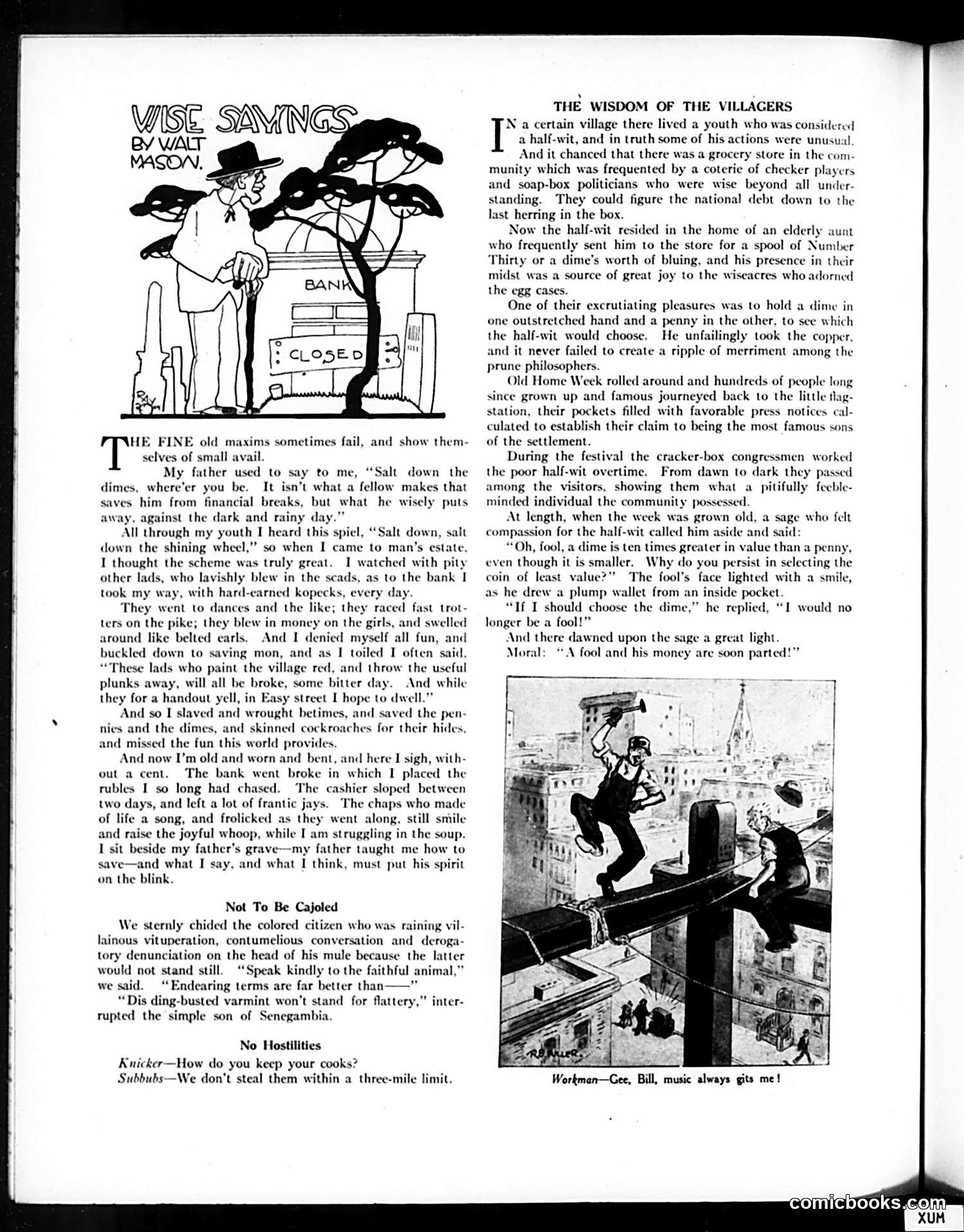
This page contains three distinct satirical pieces from *Judge* magazine: **"Wise Sayings by Walt Mason"** (top left): A cautionary tale mocking the proverb "save your money." The narrator diligently saves every penny while his spendthrift peers enjoy life. When the bank fails and he loses everything, the irony is complete—his discipline and sacrifice were pointless. The satire targets blind adherence to old financial wisdom. **"The Wisdom of the Villagers"** (right): Small-town "know-it-alls" at a general store habitually trick a simple youth into choosing a penny over a dime. When he becomes famous and returns for Old Home Week, the townspeople continue their cruel mockery, exposing their own meanness and stupidity. The satire mocks provincial arrogance and bullying. **Two brief jokes** (bottom): Minor pieces about managing servants and mules—lighthearted domestic humor typical of the era. The overarching theme: *Judge* satirizes false conventional wisdom and cruel small-mindedness through ironic reversals where smug people are proven foolish.
📄 Transcribed text from this page (OCR, searchable)
Machine-transcribed from the original scan — historical spelling and the odd misread are preserved.
HE FINE old maxims sometimes fail, and show them- T selves of small avail. My father used to say to me, “Salt down the dimes, where’er you be. It isn’t what a fellow makes that saves him from financial breaks, but what he wisely puts a . against the dark and rainy d. All through my youth I heard this spiel, “Salt down, salt down the shining wheel,” so when I came to man’s estate. I thought the scheme was truly great. I watched with pity other lads, who lavishly blew in the scads, as to the bank I took my way, with hard-earned kopecks, every day. They went to dane nd the like; they raced fast trot- ters on the pike; they blew in money on the girls, and swelled around like belted earls. And I denied myself all fun, and buckled down to saving mon, and I toiled I often said, “These lads who paint the village red, and throw the useful plunks away, will all be broke, some bitter day. And while they for a handout yell, in Easy street I hope to dwell.” And so I slaved and wrought betimes, and saved the pen- nies and the dimes, and skinned cockroaches for their hides. and missed the fun this world provides. And now I'm old and worn and bent, and here I sigh, with- out a cent. The bank went broke in which I placed the rubles I so long had chased. The cashier sloped between , and left a lot of frantic j The chaps who made a song, and frolicked as they went along, still smile and raise the joyful whoop, while I am struggling in the soup. side my father’s grave—my father taught me how to and what I say, and what I think, must put his spirit on the blink. Not To Be Cajoled We sternly chided the colored citizen who was raining vil- lainous vituperation, contumelious conversation and deroga- tory denunciation on the head of his mule because the latter would not stand still. “Speak kindly to the faithful a we said. “Endearing terms are far better than— “Dis ding-busted varmint won't stand for flattery rupted the simple son of Senegambia. inter- No Hostilities Knicker—How do you keep your cooks? Subbubs—We don’t steal them within a three-mile limit. THE WISDOM OF THE VILLAGERS ‘a certain village there lived a youth who was considered a half-wit, and in truth some of his actions were unusual. And it chanced that there was a grocery store in the com- munity which was frequented by a coterie of checker players and soap-box politicians who were wise beyond all under- standing. They could figure the national debt down to the last herring in the box. Now the half-wit resided in the home of an elderly aunt who frequently sent him to the store for a spool of Number Thirty or a dime’s worth of bluing, and his presence in their midst was a source of great joy to the wiseacres who adorned the egg cases. One of their excrutiating pleasures was to hold a dime in one outstretched hand and a penny in the other, to see which the half-wit would choose. He unfailingly took the copper, and it never failed to create a ripple of merriment among the prune philosophers. Old Home Week rolled around and hundreds of people long since grown up and famous journeyed back to the little flag- station, their pockets filled with favorable press notices cal- culated to establish their claim to being the most famous sons of the settlement. During the festival the cracker-box congressmen worked the poor half-wit overtime. From dawn to dark they passed among the visitors, showing them what a pitifully feeble- minded individual the community possessed At length, when the week was grown old, a sage who felt compassion for the half-wit called him aside and said: “Oh, fool, a dime is ten times greater in value than a penny, even though it is smaller. Why do you persist in selecting the coin of least value?” The fool’s face lighted with a smile, as he drew a plump wallet from an inside pocket. “If I should choose the dime,” he replied, “1 would no longer be a fool!” And there dawned upon the sa; Moral: “A fool and his money a great light. are soon parted!” Werben Cbs Bill, music always gits me!