
A complete issue · 28 pages · 1916
Judge — September 2, 1916
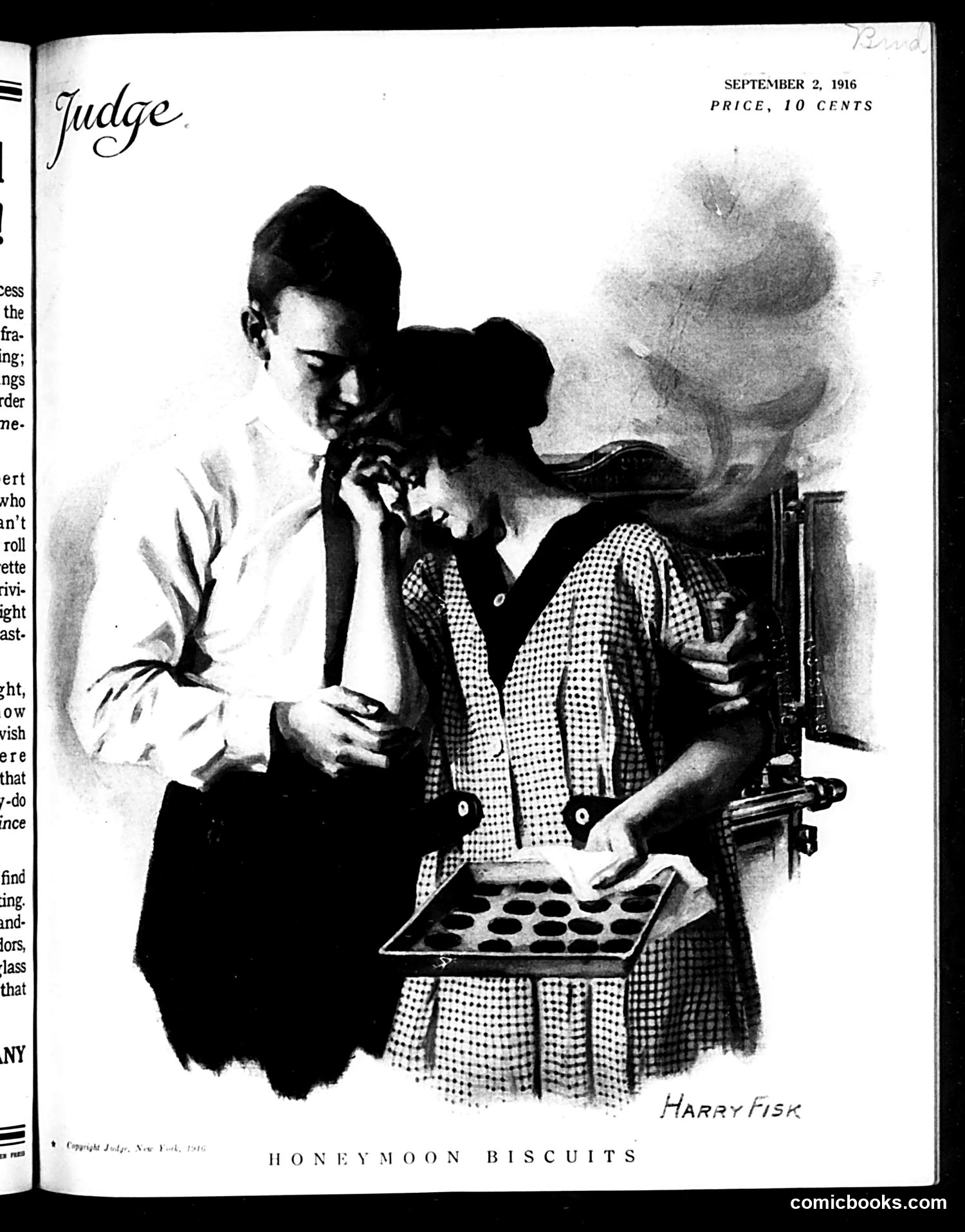
This cartoon by Harry Fisk depicts a newlywed couple examining what appears to be a baking tray or mold with circular indentations. The title "Honeymoon Biscuits" suggests a domestic humor joke about newlyweds and cooking. The satire likely plays on early-20th-century expectations that wives would manage household duties, particularly baking. The woman's focused attention on the biscuit mold, combined with the "honeymoon" framing, creates gentle humor around the transition from romance to domestic routines that newly married couples faced. The illustration style—the man gazing at his new wife while she concentrates on baking—reinforces traditional gender roles of the 1916 era, presenting domesticity as the natural follow-up to romantic marriage.
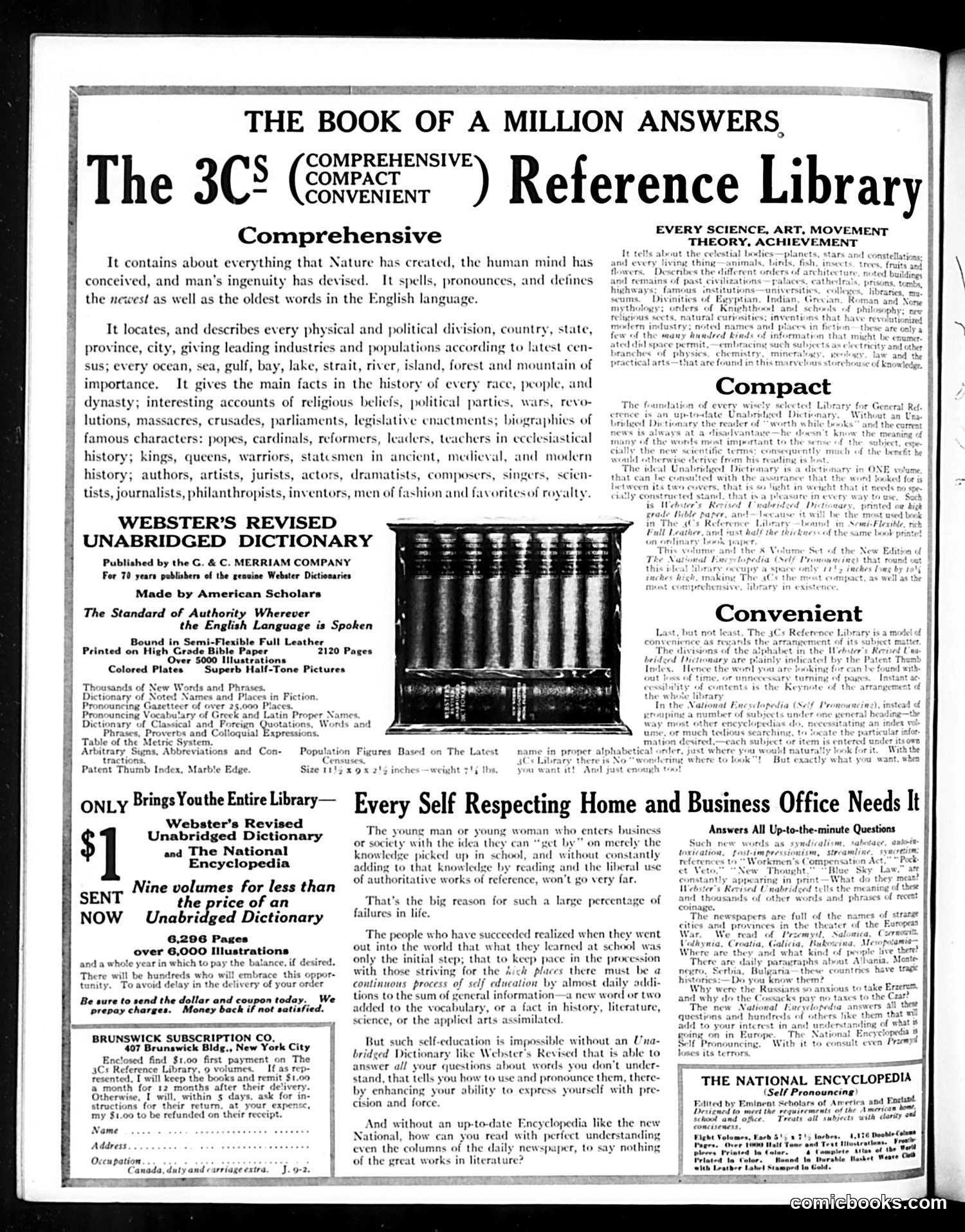
This page is **primarily advertising**, not satire or editorial cartoon. It promotes three reference works: 1. **Webster's Revised Unabridged Dictionary** — marketed as essential for proper English and "the Standard of American Dictionaries" 2. **The 3C's Reference Library** — a nine-volume encyclopedia claiming to contain "everything that Nature has created, the human mind has conceived" 3. **The National Encyclopedia** — advertised for pronunciation guidance The ads emphasize self-improvement and social advancement ("Every Self Respecting Home and Business Office Needs It"), suggesting these books enable readers to "get by" without formal education. The copy targets aspirational audiences seeking knowledge and proper language to succeed in business and society. There are no visible political cartoons or satirical commentary on this particular page.
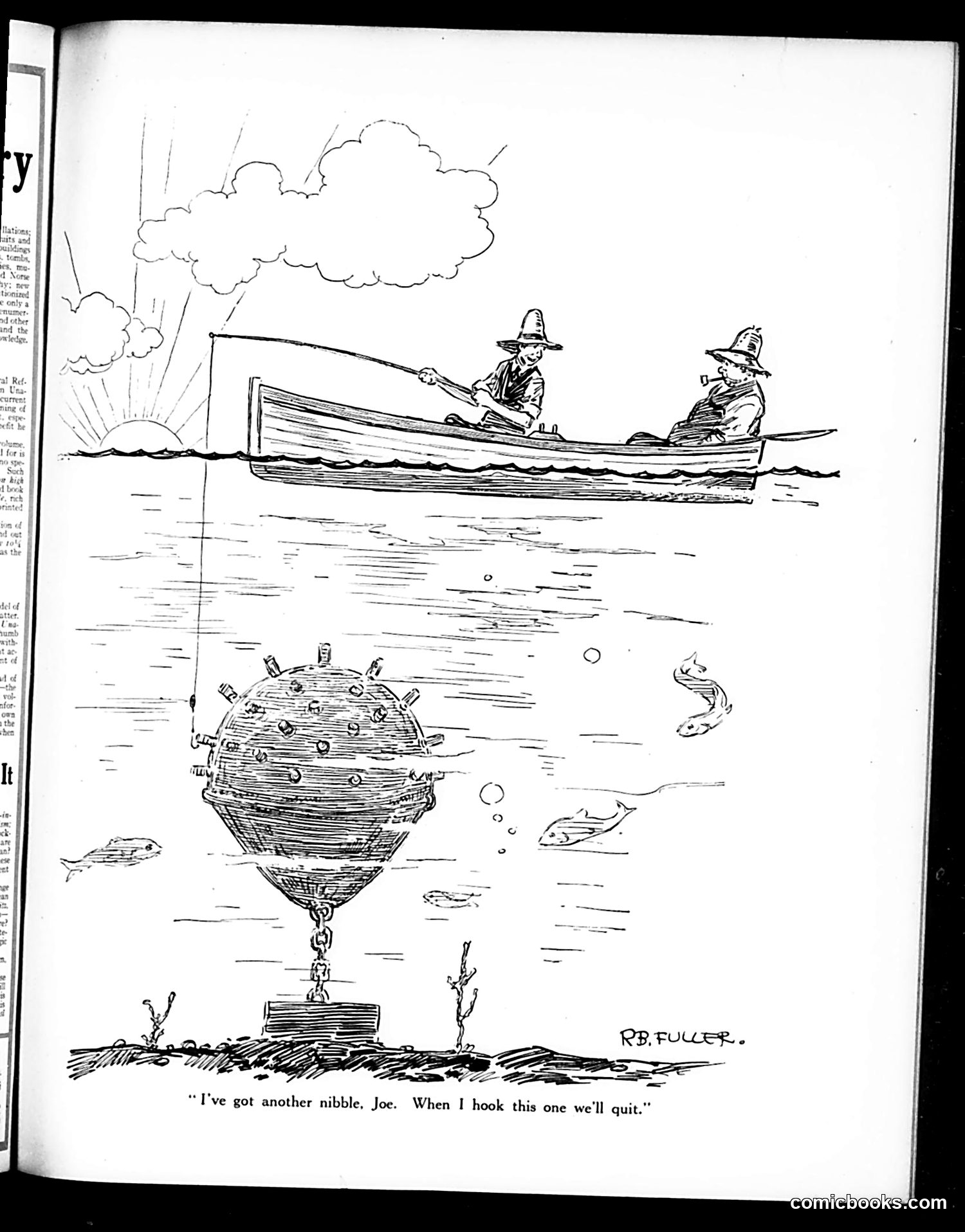
This R.B. Fuller cartoon depicts two fishermen in a boat above an underwater mining or dredging device. The caption reads: "I've got another nibble, Joe. When I hook this one we'll quit." The humor appears to be a visual pun playing on fishing terminology. What the fishermen believe are fish "nibbling" at their lines are actually contacts with an underwater mechanical apparatus (likely a mining dredge or submarine device). The joke suggests they're mistakenly interpreting mechanical interference as successful fishing, planning to quit once they've "hooked" what they think is a large catch. The cartoon likely satirizes either incompetence, misplaced optimism, or perhaps technological disruption of traditional activities—the fishermen remain oblivious to modern machinery interfering with their work.
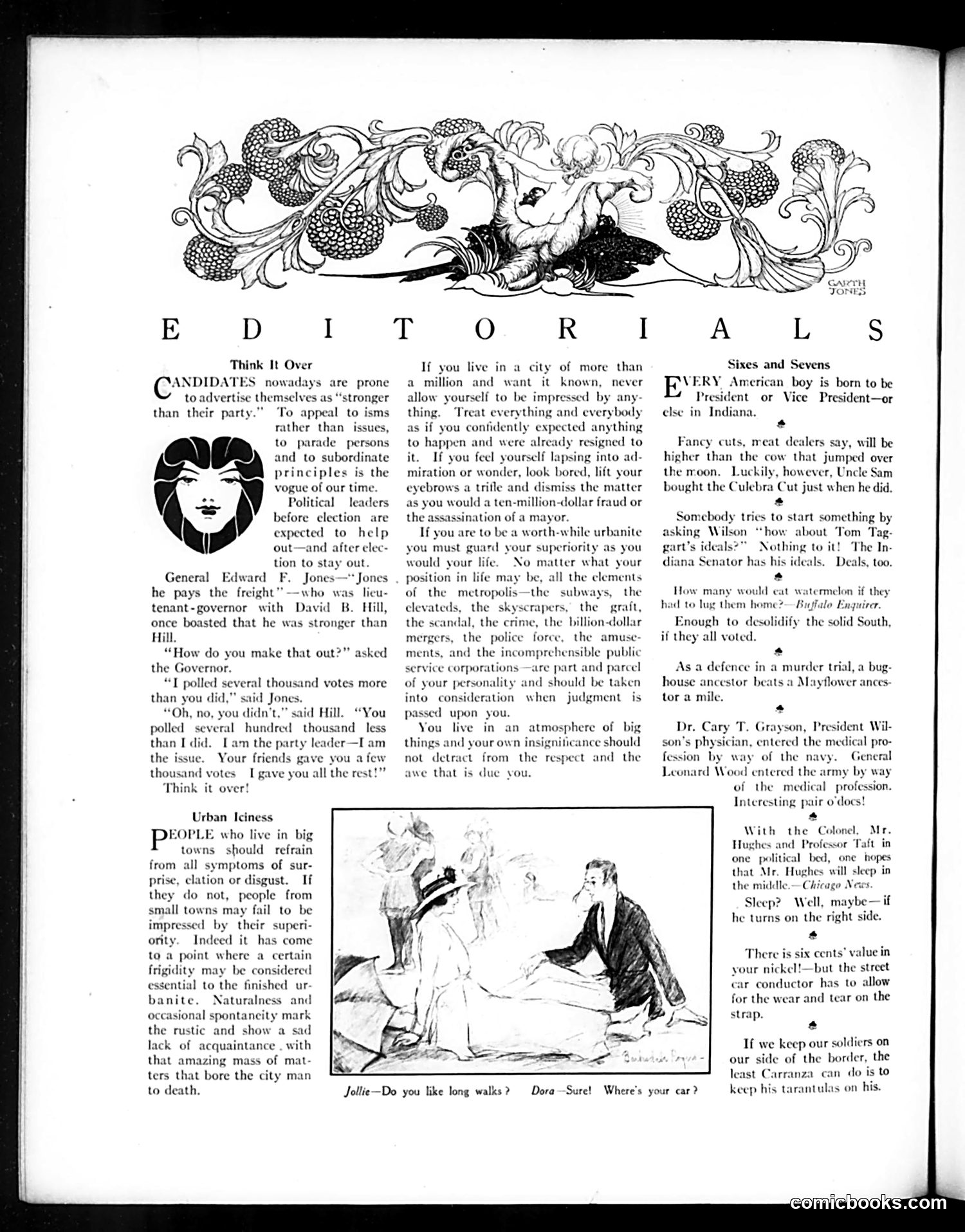
This page contains political editorials and social commentary typical of Judge's satirical style. The main cartoon depicts two figures in what appears to be a romantic or social situation, captioned "Jolie—Do you like long walks? Dora—Sure! Where's your car?" The joke satirizes modern urban dating customs, mocking the expectation that courtship involves automobile travel rather than traditional walking. This reflects 1920s anxieties about how automobiles were changing courtship and social interaction. The surrounding editorials address candidates advertising themselves as "stronger" than competitors, urban pretension, and political ambition—typical Judge fare attacking self-promotion and social climbing among the wealthy and political classes. The commentary is generally conservative, warning against affectation and excessive ambition.
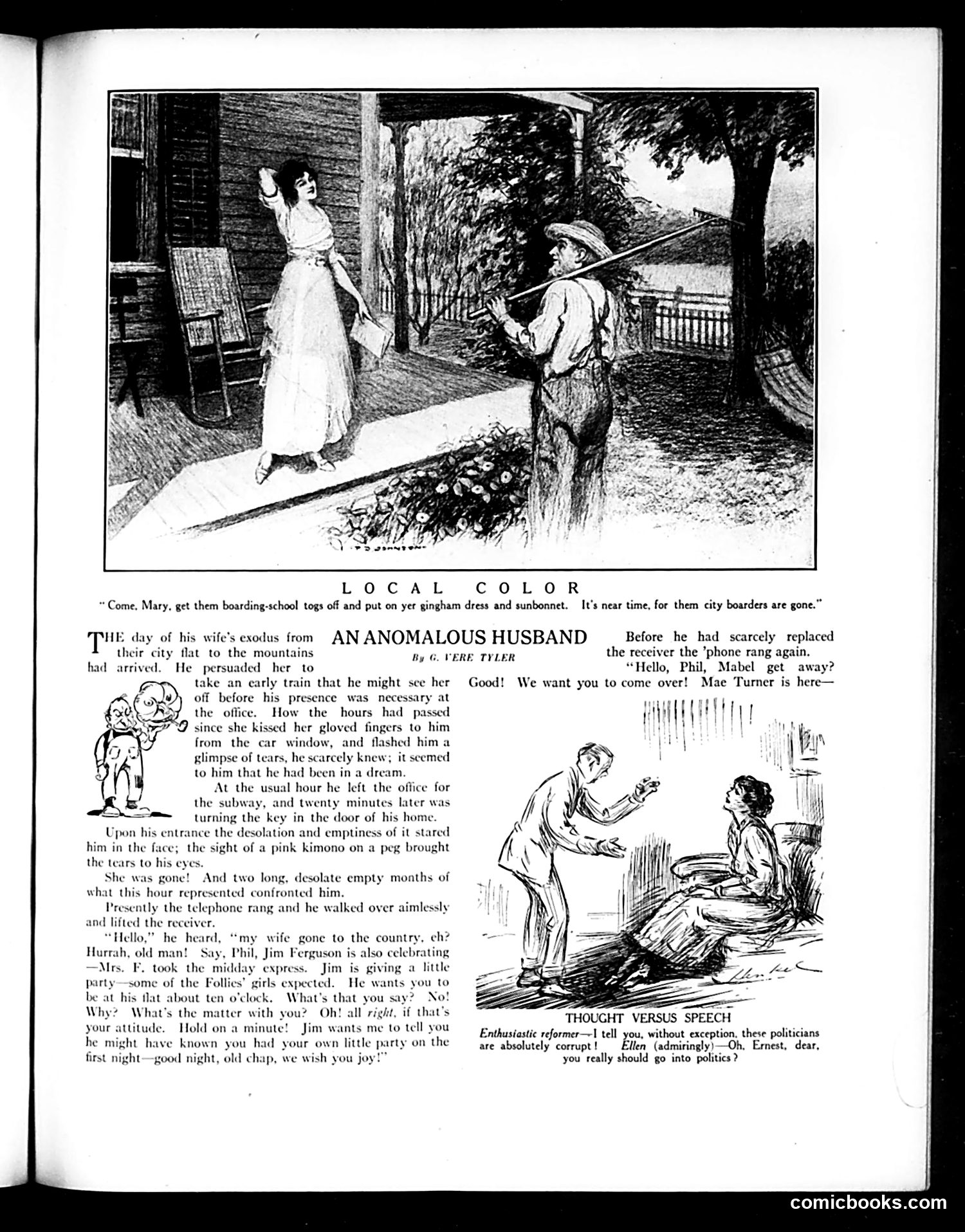
**Top Illustration ("Local Color"):** Shows a woman in a long dress speaking to a man in work clothes near a country cottage, with the caption about boarding school and city fashions. This appears to be rural/pastoral humor about country life versus city pretensions. **Main Story ("An Anomalous Husband" by G. Vere Tyler):** Depicts a husband whose wife has left for the country. The narrative humorously describes his emotional response—tears, loneliness, and his friends calling to cheer him up. The joke plays on gender role expectations: a man abandoned by his wife is portrayed as emotionally devastated, inverting typical 1910s-era assumptions about masculine stoicism and female dependence. **Lower Cartoon ("Thought Versus Speech"):** Shows political discussion being corrupted—a commentary on honest discourse versus rhetoric.
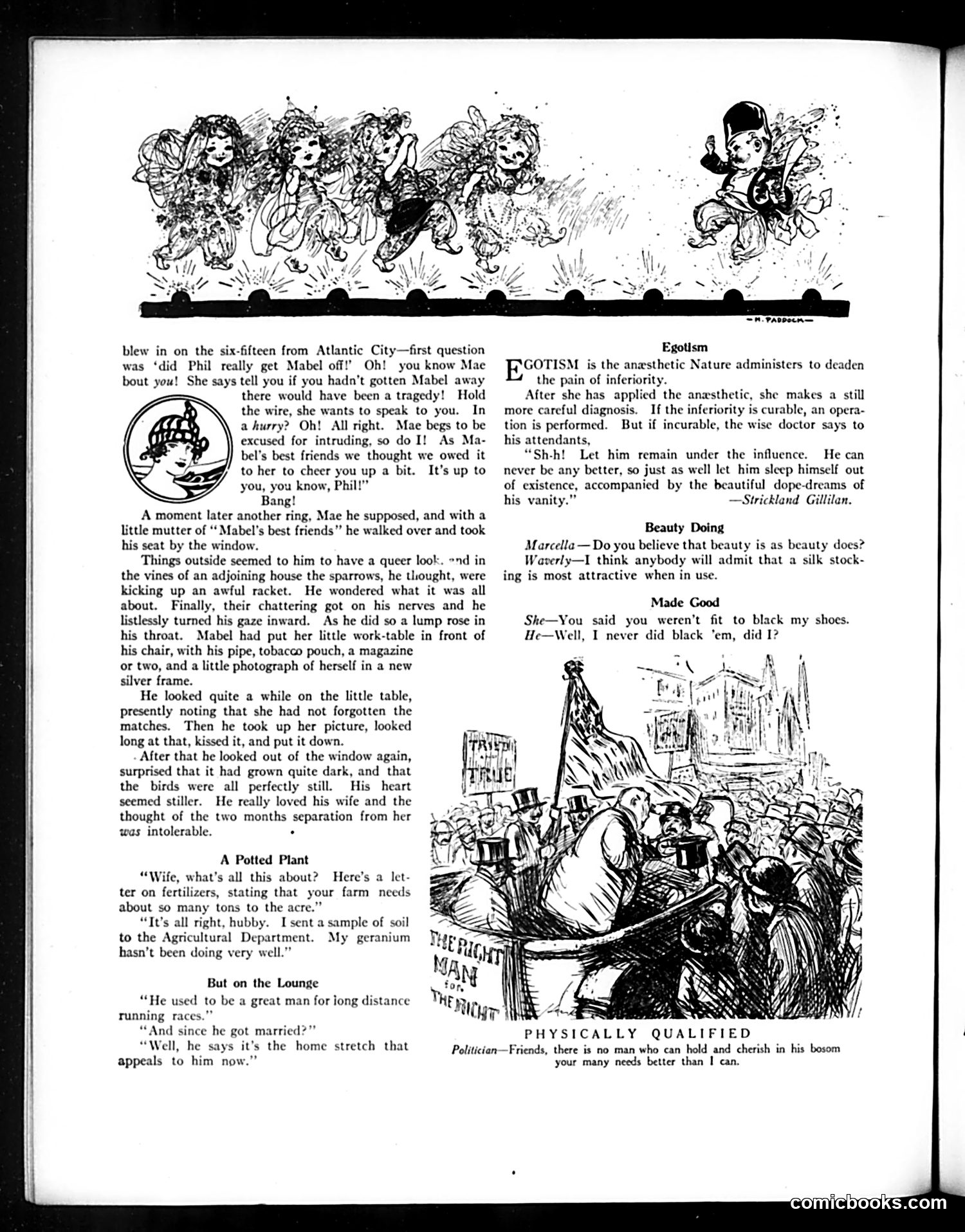
This page contains several short humorous pieces typical of early 20th-century satirical magazines: **Main Story**: A domestic comedy about a husband separated from his wife "Mabel" for two months. He receives gossipy phone calls from her friends discussing whether he "got Mabel off" (likely referring to a trip or social engagement). The pathos lies in his discovering she's prepared his workspace with his pipe and her photograph—he realizes he loves her and finds the separation unbearable. **Side Jokes**: Brief quips about marriage, including one about a former long-distance runner who now prefers "the home stretch" (marital domesticity), and exchanges about shoes and fertilizer—typical domestic humor. **Political Cartoon** (bottom right): Labeled "Physically Qualified," it depicts a politician addressing constituents, promising to address "your many needs." The satire targets politicians' empty rhetoric and self-serving ambition—the implication being that politicians claim capability they don't possess. The page reflects era-appropriate humor: sentimental domesticity mixed with cynicism about politicians.
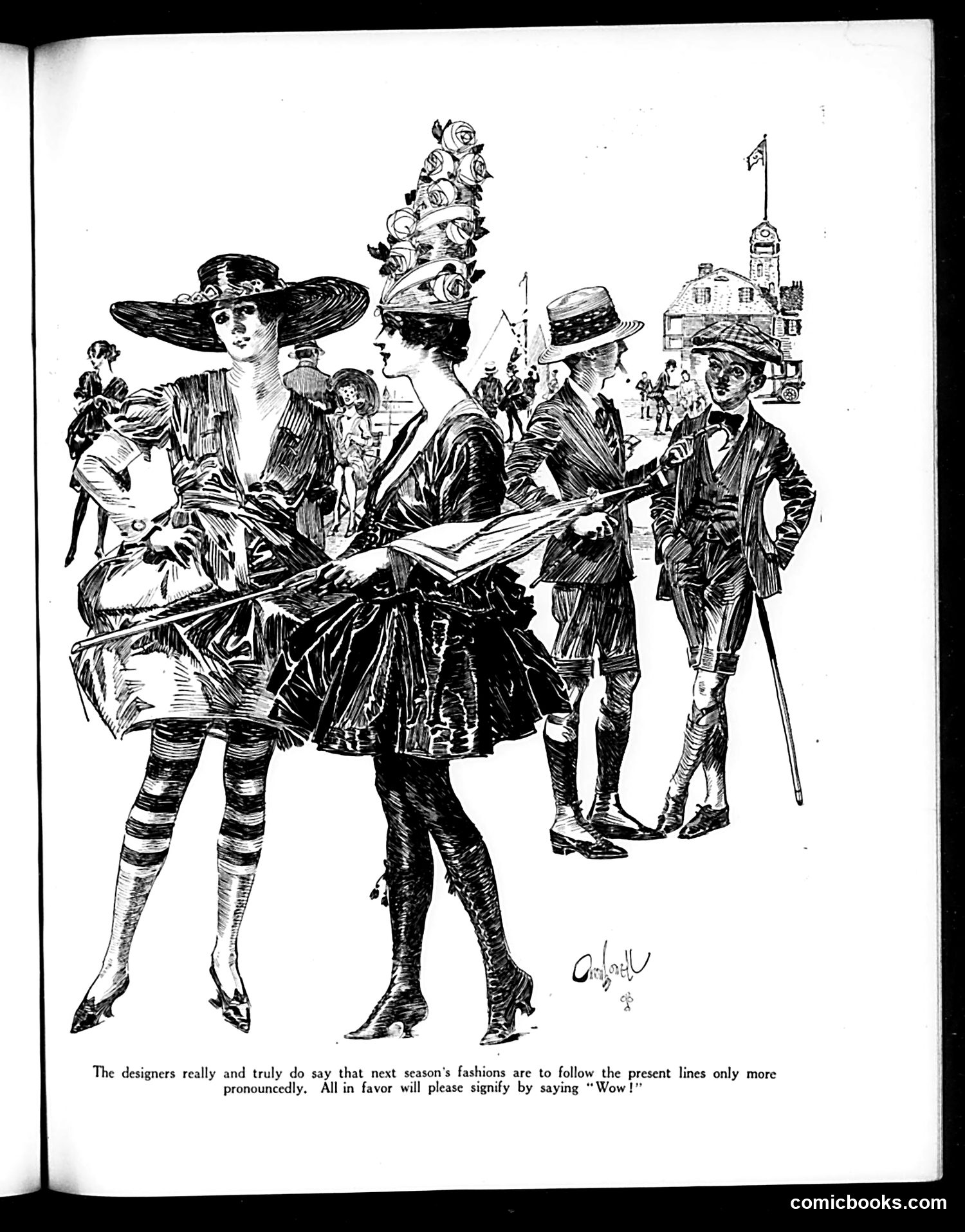
This illustration mocks the fashion industry's tendency to exaggerate and promote extreme trends. The cartoon depicts fashionably dressed figures, prominently featuring women with dramatically elongated silhouettes—notably exaggerated legs and pronounced curves typical of early 20th-century "Gibson Girl" aesthetics pushed to absurdity. The caption satirizes fashion designers' claims that upcoming styles will simply amplify current trends "more pronouncedly." The instruction to say "Wow!" is sarcastic commentary on how consumers enthusiastically adopt increasingly ridiculous fashions without question. The background cityscape and varied figures suggest high society or urban fashion circles. The artist (signed "Cesare," likely) uses exaggeration to critique the fashion industry's circular logic: continuously pushing silhouettes further while claiming this represents genuine design innovation rather than mere marketing manipulation.
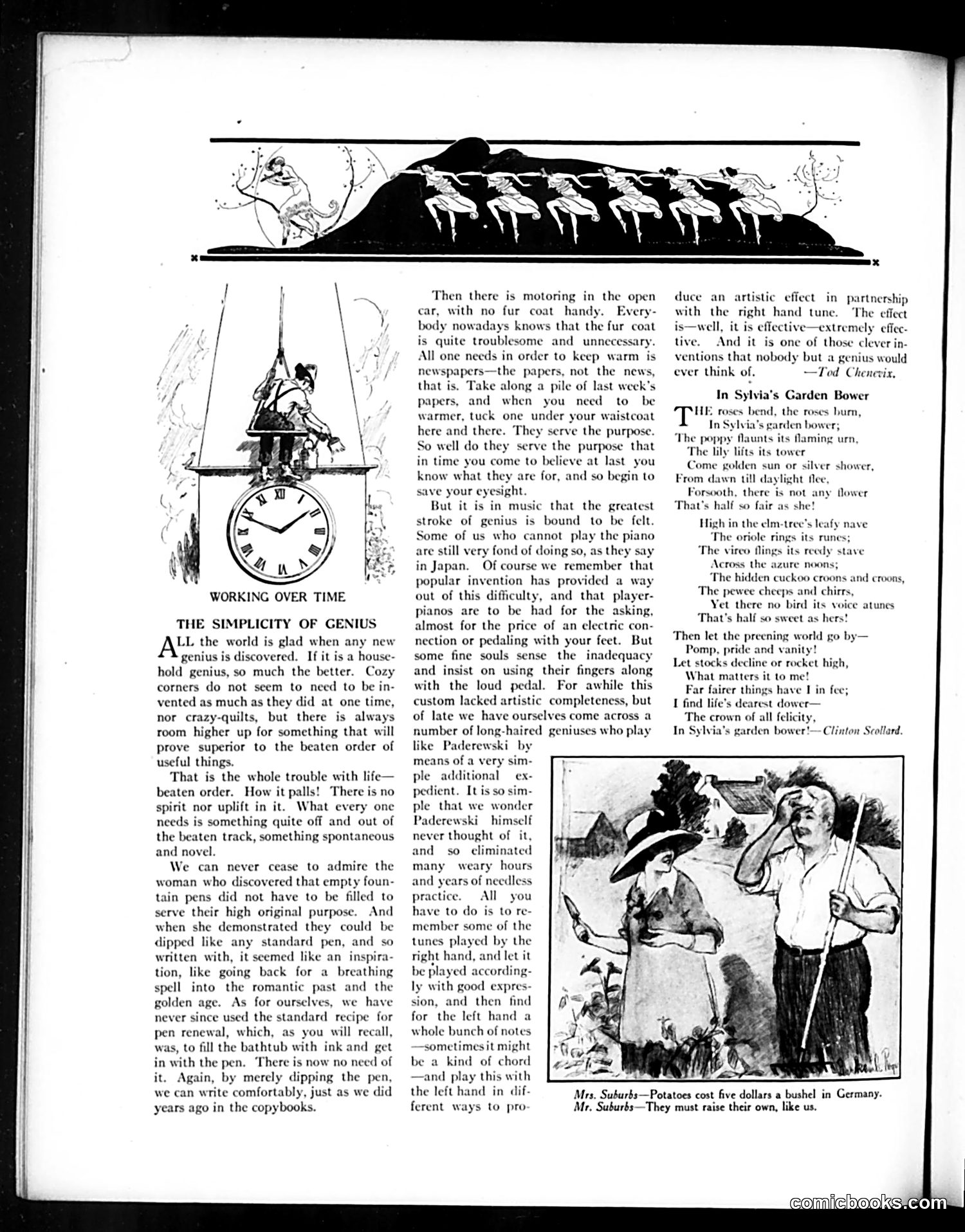
This page contains satirical commentary on "genius" and modern conveniences disguised as innovation. **"The Simplicity of Genius"** mocks people who celebrate trivial "inventions" as breakthroughs. The article ridicules: 1. **Empty fountain pens** that can be dipped instead of filled—presented as a revolutionary discovery 2. **Using newspapers for warmth** instead of fur coats while motoring (open-air driving), suggesting people fool themselves into thinking waste paper serves a practical purpose 3. **Amateur piano playing with "Paderewski tricks"**—the satire suggests someone invented a method where players memorize right-hand melodies and improvise random left-hand notes, calling it artistic genius comparable to the famous pianist Ignacy Jan Paderewski The cartoon lampoons how ordinary people and society celebrate minor conveniences as if they were major innovations, and how self-deception allows mediocrity to masquerade as cleverness. The "working over time" imagery at top reinforces the theme of unnecessary complication of simple tasks.
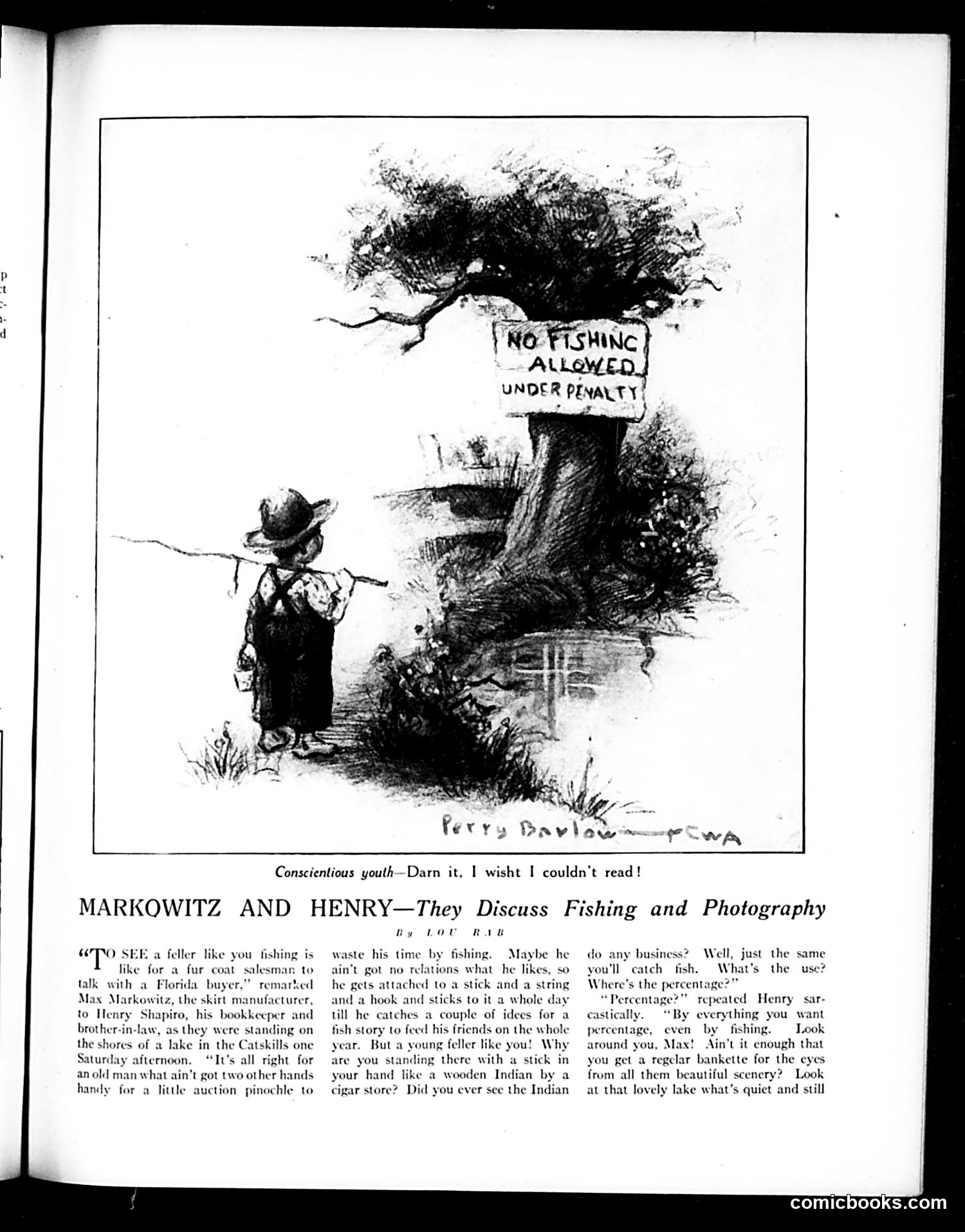
This cartoon satirizes Jewish immigrant businessmen through ethnic stereotypes. The illustrated figure shows a young man fishing beneath a "No Fishing Allowed" sign—the visual joke being his "conscientious" nature makes him regret his literacy. The text presents a dialogue between Max Markowitz (a "skirt manufacturer") and Henry Shapiro (a bookkeeper) debating fishing's practical value. Markowitz argues fishing is pointless—there's no "percentage" (profit/advantage) in it. He sarcastically compares Henry to a wooden cigar-store Indian: decorative but nonproductive. The satire plays on contemporary stereotypes of Jewish immigrants as shrewd businessmen obsessed with profit and dismissive of leisure or nature appreciation. The Yiddish-inflected dialogue ("what ain't got," "perc-a-ntage") and merchant characters reflect Judge's ethnic humor typical of early 20th-century American satire. The joke assumes readers will find it amusing that these characters prioritize business over simple pleasures.
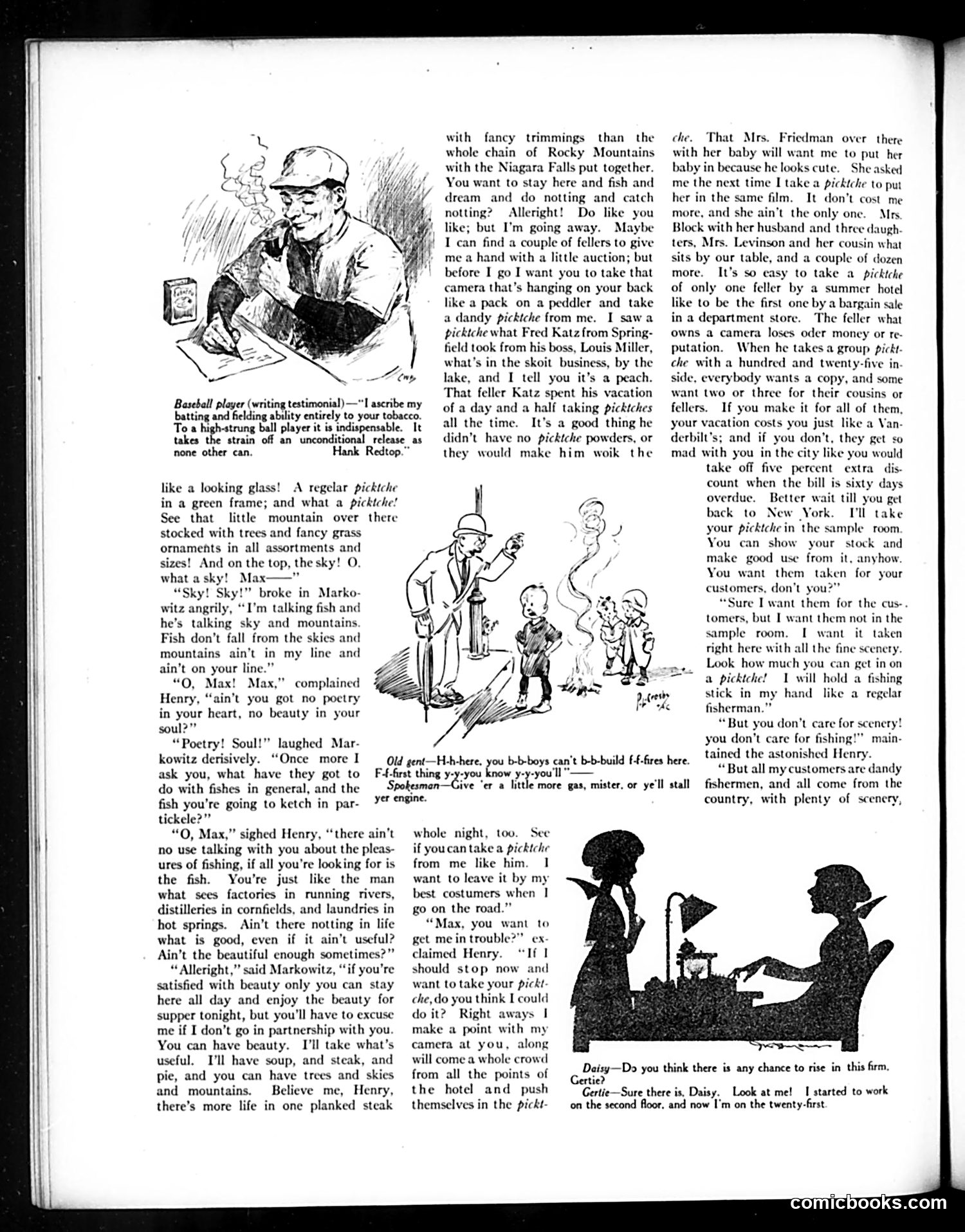
This page from *Judge* magazine contains two distinct pieces of humor: **The Main Story: "Max and Henry"** A comic dialogue between two Jewish characters (identifiable by their Yiddish-inflected English dialect) debating practicality versus aesthetics. Markowitz represents utilitarian pragmatism—he wants fish, not scenery—while Henry values beauty and poetry. Markowitz ultimately asks Henry to photograph him, contradicting his own philosophy. The humor relies on ethnic-dialect comedy (common in early 20th-century American humor) and the irony of a materialist reluctantly embracing artistic documentation. **The Sidebar: Baseball Player's Testimonial** A parody advertisement where a baseball player credits his talent to tobacco, sarcastically claiming it's "indispensable." This satirizes the ubiquitous false celebrity endorsements that plagued early advertising. **Context**: Both pieces mock immigrant working-class culture and consumerism, using exaggerated dialects and situations typical of *Judge*'s satirical approach to American society.
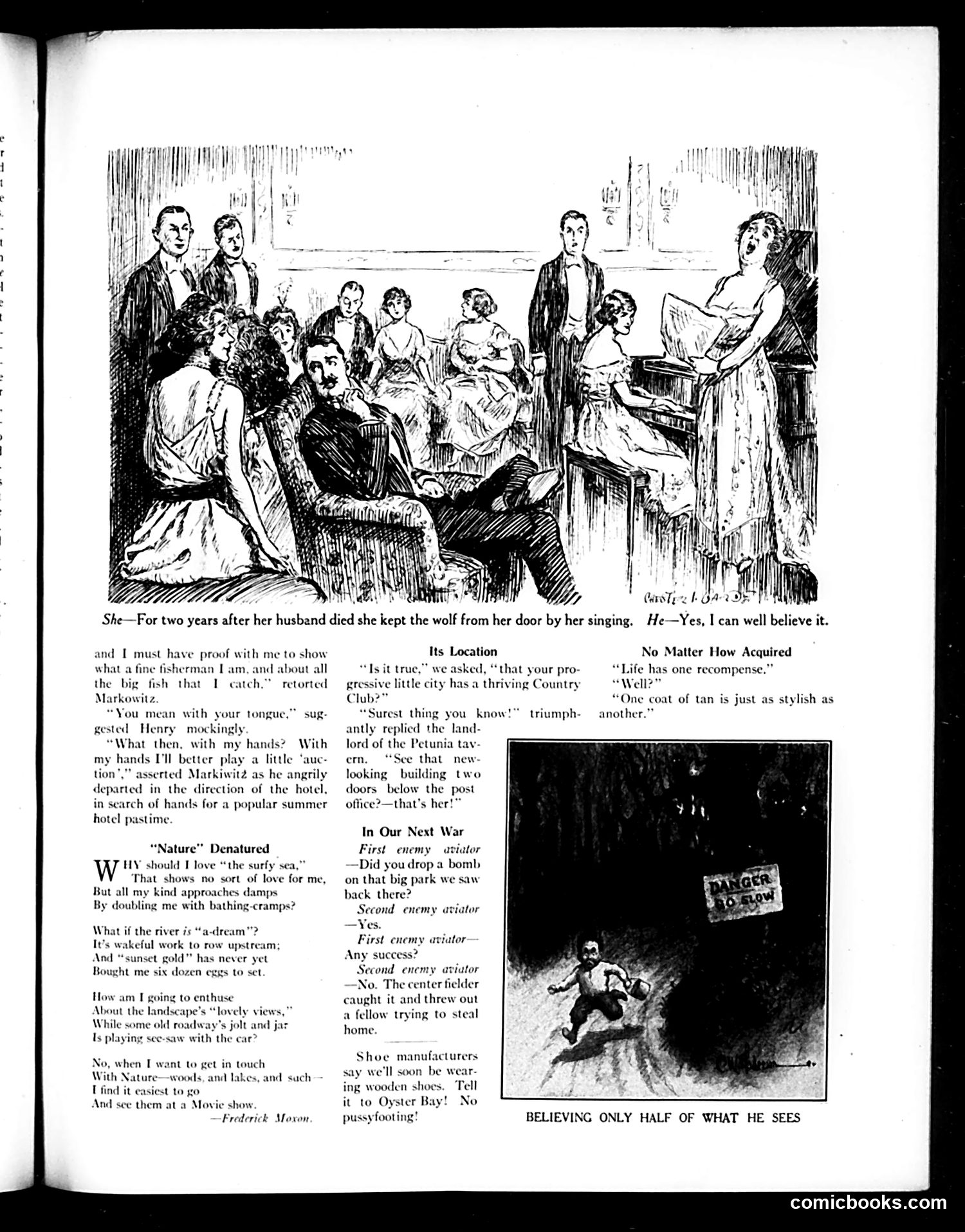
This page contains several brief satirical pieces typical of early 20th-century American humor: **Top cartoon**: A woman's terrible singing is the joke—she supposedly kept poverty away ("the wolf from her door") through two years of widowhood via her singing voice, implying her voice was so dreadful it frightened away misfortune rather than attracted sympathy or income. **"Nature" Denatured**: Frederick Moxon's poem mocks romantic idealization of nature. Rather than celebrating pastoral beauty, he catalogs practical annoyances—swimming cramps, difficult rowing, and car-sickness—satirizing the period's sentimental nature poetry by grounding it in unglamorous reality. **"In Our Next War"**: A brief satirical dialogue imagining aerial bombing during a future conflict. The joke presents absurdist futility: a baseball player catches the dropped bomb and throws out a base-stealer, reducing war to sports comedy. This likely reflects pre-WWI anxieties about modern warfare technology. Other brief items satirize fishing exaggeration, a country club's pretensions, and consumerism ("one coat of tan is just as stylish as another").
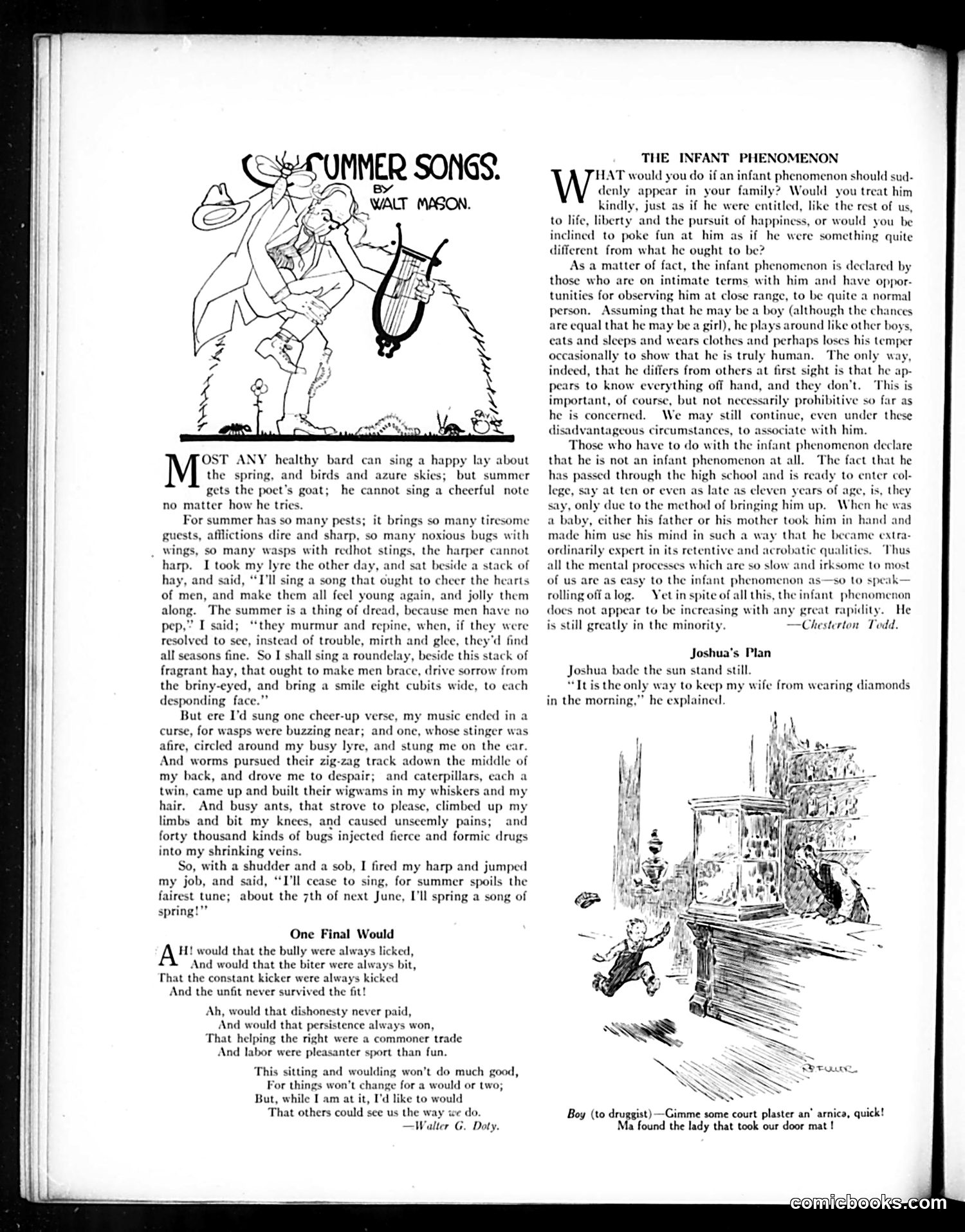
This *Judge* page contains two distinct pieces: **"Summer Songs" (left):** A humorous poem by Walt Mason depicting a poet's failed attempt to write cheerful summer verses. The joke is straightforward: despite his intentions to inspire joy, he's attacked by insects—wasps, worms, caterpillars, ants, and bugs—forcing him to abandon his lyre and postpone singing until spring. It's a relatable complaint about summer's discomforts, likely resonating with early-20th-century readers who lacked air conditioning. **"The Infant Phenomenon" (right):** An essay by Chesterton Todd discussing precocious children. The piece argues that gifted children shouldn't be treated as curiosities or mocked as "different," but as normal people who simply learn faster due to better education methods. It advocates for treating intellectual prodigies with the same kindness as ordinary children—a progressive stance on child development for the era. The accompanying sketch shows a small figure in an urban setting, likely illustrating the "infant phenomenon" concept.
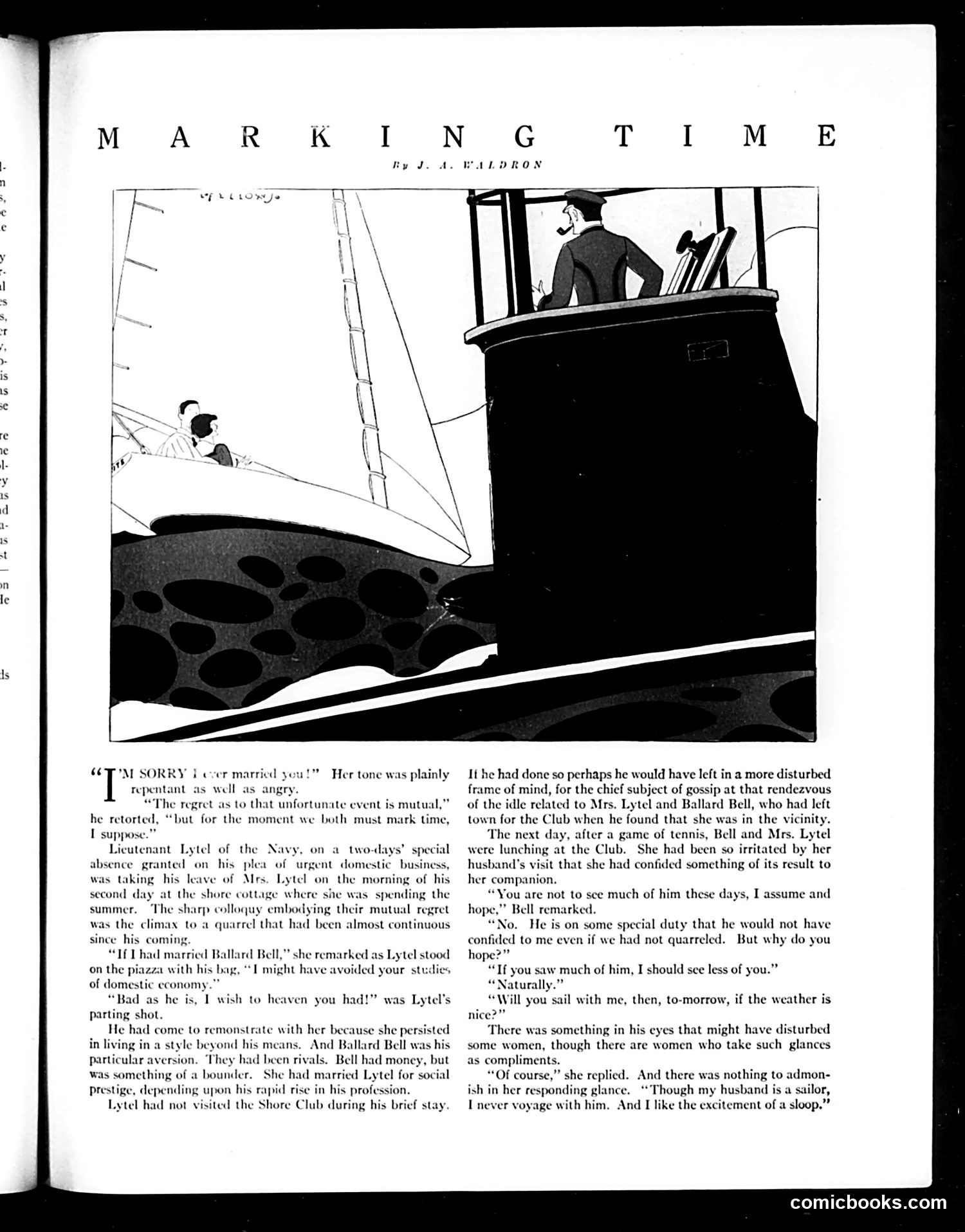
This story-illustration depicts a domestic scandal among the leisure class. Lieutenant Lytel, a Navy officer, visits his wife at a shore cottage and quarrels with her over extravagant spending beyond his means. She regrets marrying him, wishing she'd married Ballard Bell instead—a wealthier rival whom Lytel dislikes as "a bounder" (an unscrupulous social climber). After Lytel departs, Mrs. Lytel encounters Bell at the Shore Club. He invites her sailing, and her accepting glance suggests a developing affair. The satire targets the era's idle wealthy class: a woman prioritizing social prestige and luxury over marital fidelity, and a rival exploiting marital discord. The title "Marking Time" implies the couple's hollow marriage, merely enduring until opportunity allows escape or scandal erupts.
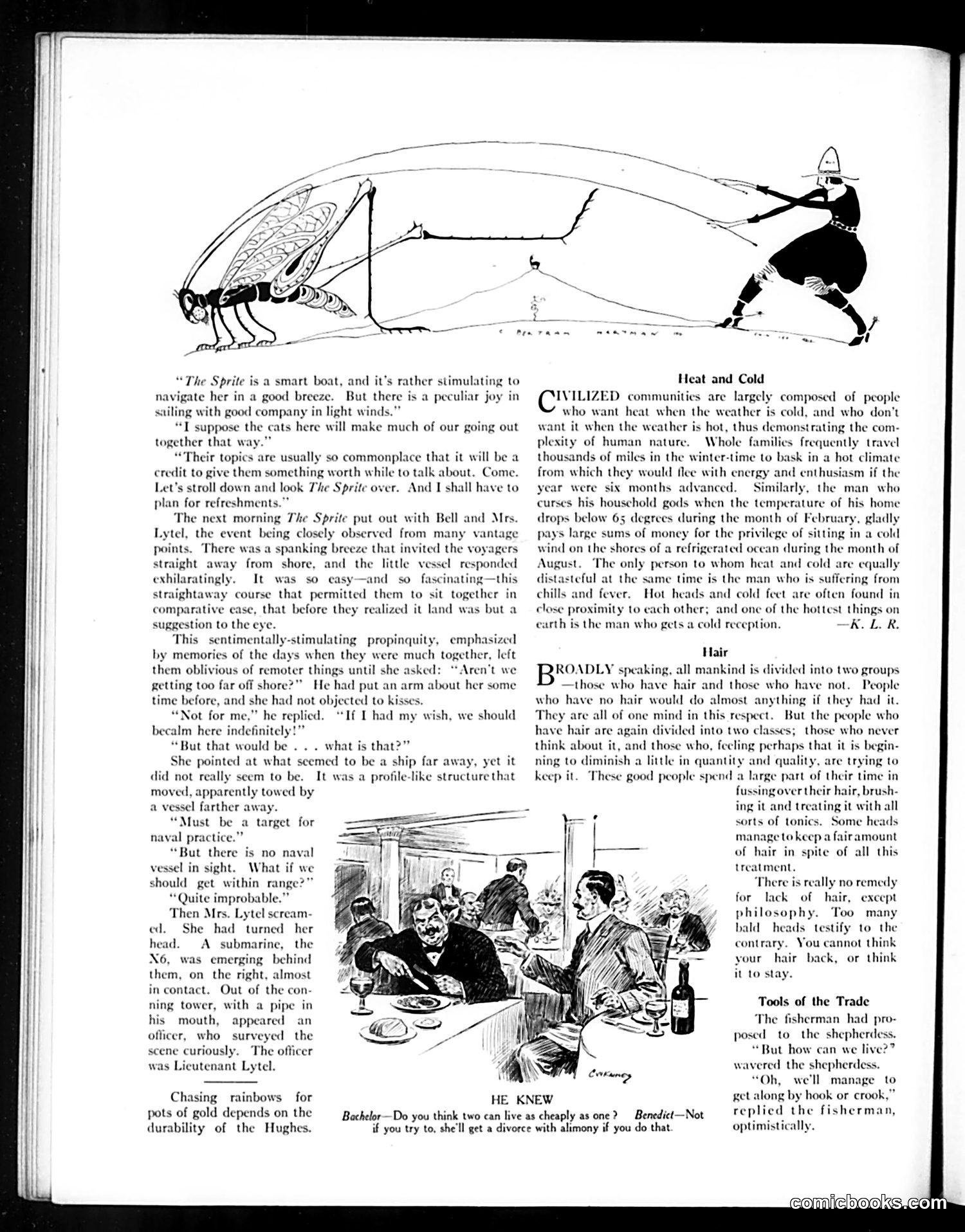
This page contains two narrative elements: a serialized romantic story and satirical commentary pieces. **The top illustration** shows a man and woman sailing, with a submarine emerging behind them—the woman's husband, Lieutenant Lytel, appearing unexpectedly. This is dramatic fiction, not satire. **The three short satirical pieces** are humorous social commentary: 1. **"Heat and Cold"** mocks human inconsistency—people travel thousands of miles seeking opposite climates depending on season, yet complain about home temperatures year-round. 2. **"Hair"** jokes about humanity's vanity, dividing mankind into those with and without hair, both groups obsessing over it. The humor lies in poking fun at widespread anxiety about hair loss and grooming. 3. **"Tools of the Trade"** presents a fisherman-shepherd dialogue about survival without tools—light satire on pragmatism versus idealism. 4. **"Bachelor" caption** mocks marriage economics: a bachelor claims two can live as cheaply as one, but the punchline warns this leads to expensive alimony. These are typical Judge magazine fare—gentle social satire targeting universal human foibles rather than specific political targets.
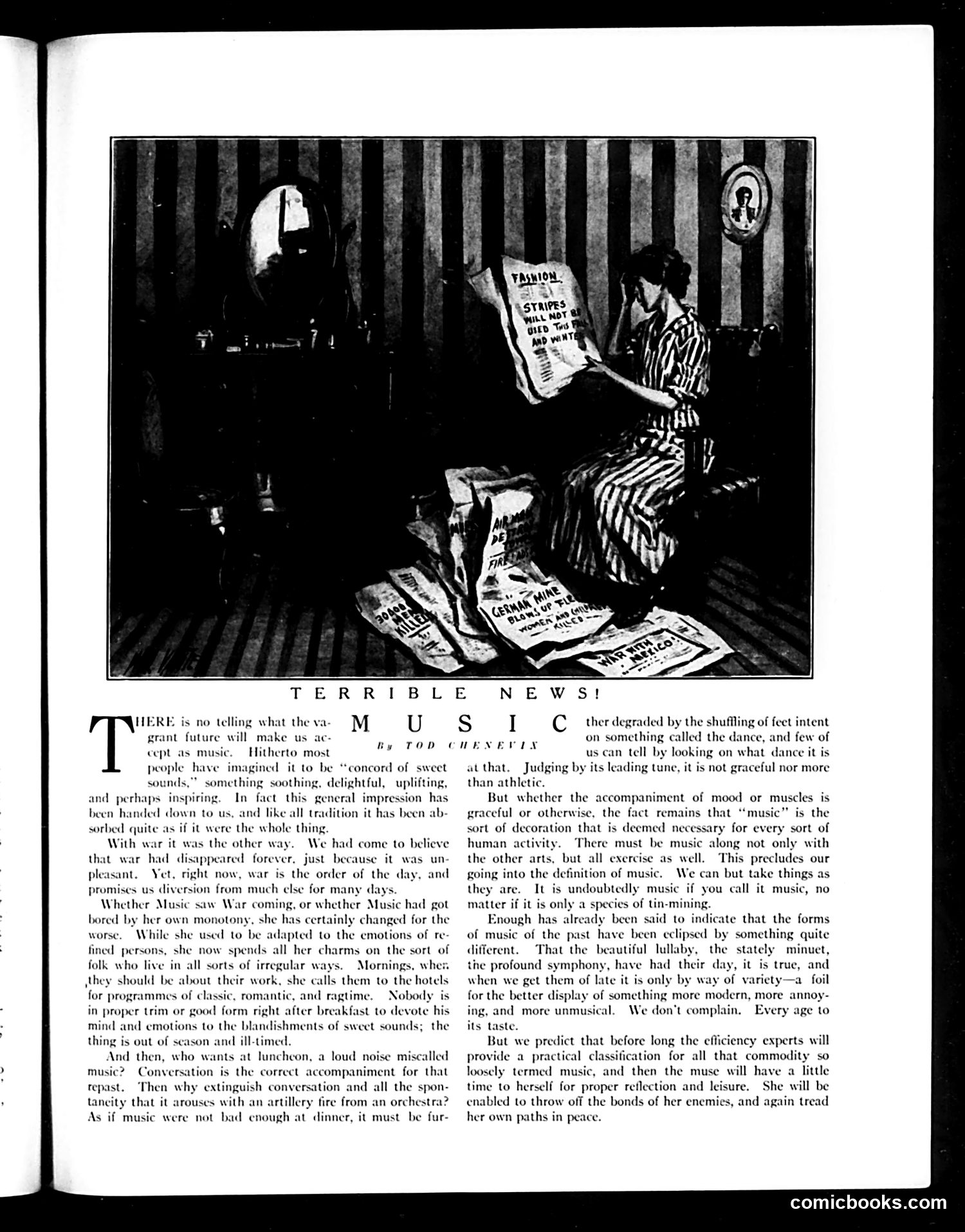
This editorial cartoon and essay lament the decline of "proper" music in the modern era, particularly during World War I. The illustration shows a woman (representing Music personified) sitting in what appears to be a prison cell, reading newspapers—a visual metaphor for her confinement by contemporary culture. The article argues that traditional music—refined lullabies, minuets, symphonies—has been displaced by loud, degrading forms: hotel performances interrupting work, orchestral noise at restaurants drowning out conversation, and especially **jazz dancing**, which the author dismisses as mere "shuffling of feet" lacking grace or athleticism. The satire targets post-war society's embrace of modern, energetic music and entertainment, which the author views as culturally coarse and disruptive. The "terrible news" is that refined artistic tradition is being destroyed by efficiency-driven commercialism and popular taste. The prediction that "efficiency experts" will eventually restore music's dignity offers sardonic hope that rationalization might rescue high culture from the masses.
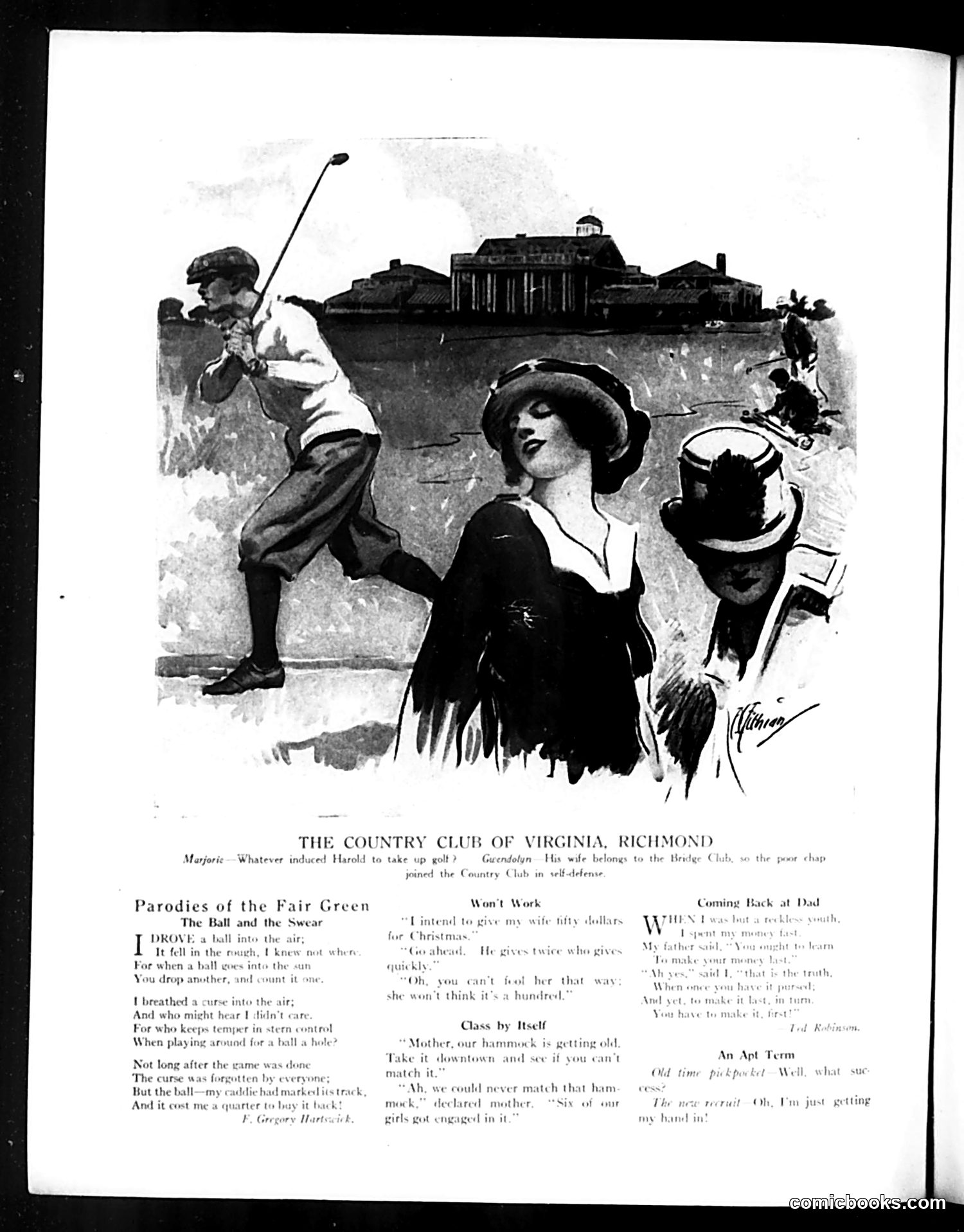
This illustration satirizes early 20th-century upper-class leisure culture, specifically golf and country club society. The central joke involves a man (Harold) taking up golf only because his wife belongs to the country club—suggesting he's motivated by social obligation rather than genuine interest. The accompanying comic verses parody golf etiquette and marital dynamics. They humorously depict: husbands spending money on wives' leisure activities; the difficulty maintaining composure during golf; and the social pretensions of club membership. References to "the Fair Green" and broken equipment humorously suggest golf's frustrations. The smaller comic segments mock class consciousness and conspicuous consumption—including a joke about a deteriorating hammock that six girls got "engaged in," likely a double entendre about social entanglement or romantic interest. The satire targets the leisured wealthy and their performative participation in fashionable activities, presenting country club culture as inherently absurd.
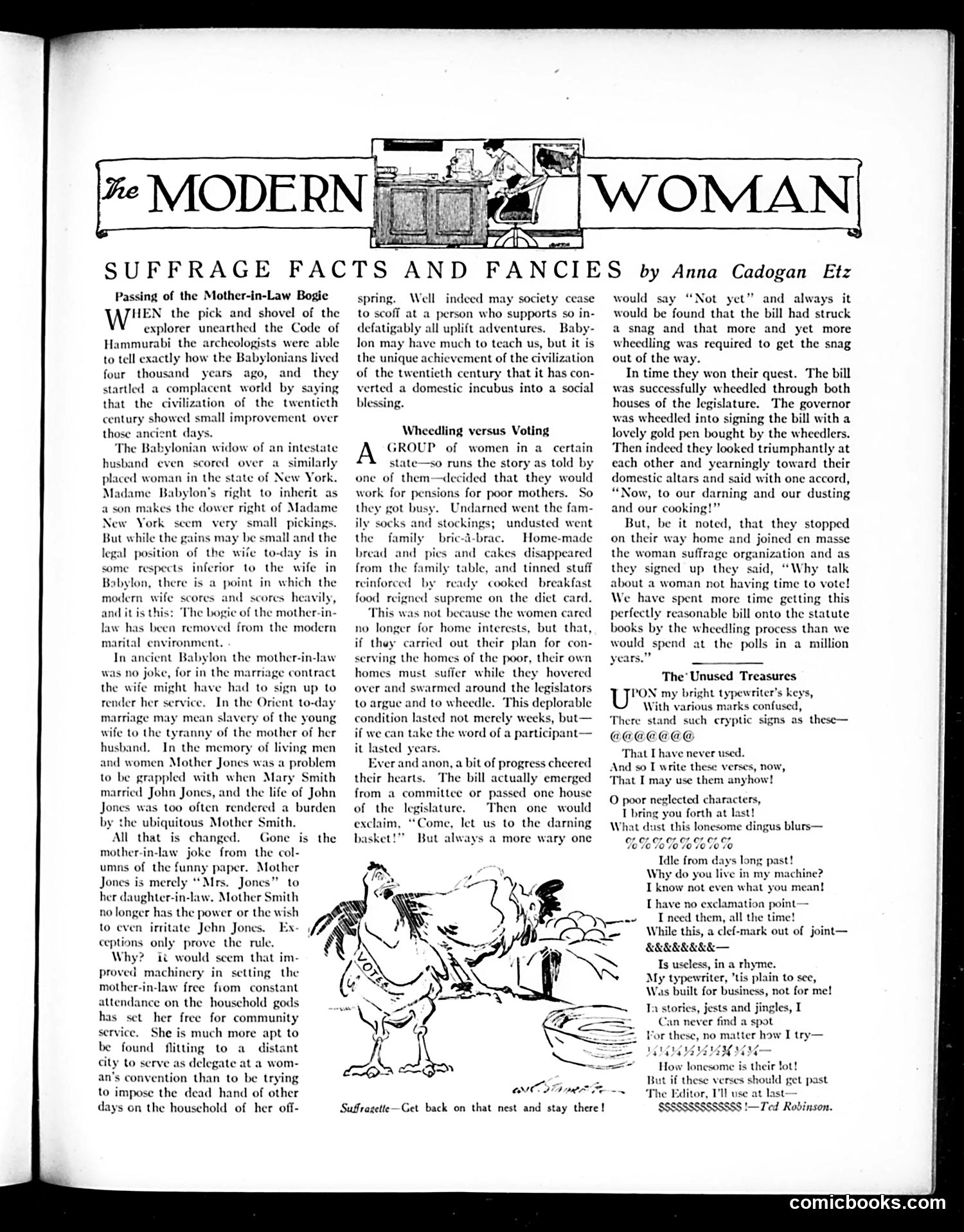
This page from Judge magazine contains satirical commentary on women's issues by Anna Cadogan Etz, focusing on suffrage and women's activism. **Main cartoons/articles:** 1. **"Passing of the Mother-in-Law Bogie"** argues that modern machinery freeing mothers-in-law from household drudgery has transformed them from domestic tyrants into active community organizers—a positive social change. 2. **"Wheeling versus Voting"** satirizes women activists lobbying legislators for poor mothers' pensions. While they neglect their own homes (undone laundry, tinned food replacing home cooking) to "wheedle" politicians, the cartoon at bottom depicts a suffragette as a brooding hen, suggesting women should stay domestic rather than engage in political activism. **The satire's point:** The page presents contradictory arguments—praising women's community service while simultaneously mocking their political engagement through the cartoon. This reflects Judge's ambivalent or critical stance toward women's suffrage and activism during this era.
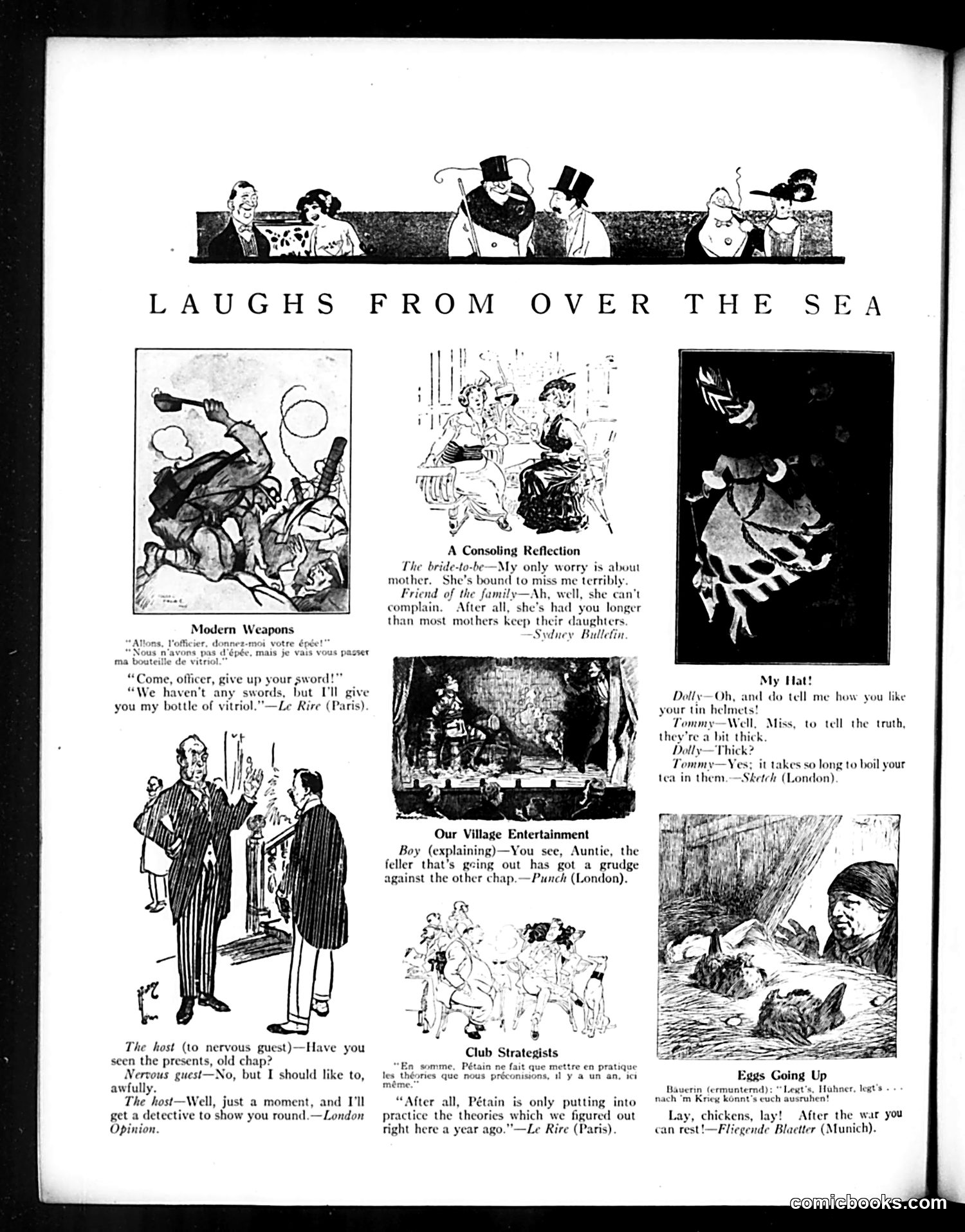
This page collects brief jokes and cartoons reprinted from international satirical publications (French, British, German sources cited). The humor reflects **World War I-era concerns**: **"Modern Weapons"** mocks wartime desperation—French soldiers lack proper arms, offering vinegar instead of swords. **"A Consoling Reflection"** uses dark humor about marriage, suggesting daughters burden mothers. **"Club Strategists"** references **Marshal Pétain**, the French military leader, implying strategists now claim credit for tactics they'd previously proposed—satirizing post-hoc vindication. **"My Hat!"** jokes about soldiers' tin helmets being so thick they take forever to heat water in—mocking military-issue equipment as impractical. **"Eggs Going Up"** shows German farmers urged to maximize egg production for the war effort, with promised rest "after the war"—satirizing wartime propaganda and endless sacrifice. The page collects international wartime satire, treating the conflict's absurdities through dark humor.

This is primarily a **Schlitz beer advertisement**, not political satire. The ad makes a pseudo-scientific argument to sell beer: The copywriter draws an analogy between how skin naturally protects itself from X-ray damage (by developing brown pigmentation) and how Schlitz's brown bottles protect beer from light damage. The argument claims that light rays decompose beer's protein, creating a "skunky taste"—but brown bottles block this, preserving Schlitz's quality. This is **misleading marketing disguised as science**. The X-ray comparison lends false credibility to what is essentially a product differentiation claim. While light *does* affect beer, the connection to medical X-ray protection is tenuous advertising rhetoric rather than genuine scientific explanation. The page reflects early 20th-century advertising's tendency to appropriate scientific language and imagery to make products seem sophisticated and trustworthy—a practice modern readers would recognize as deceptive marketing.
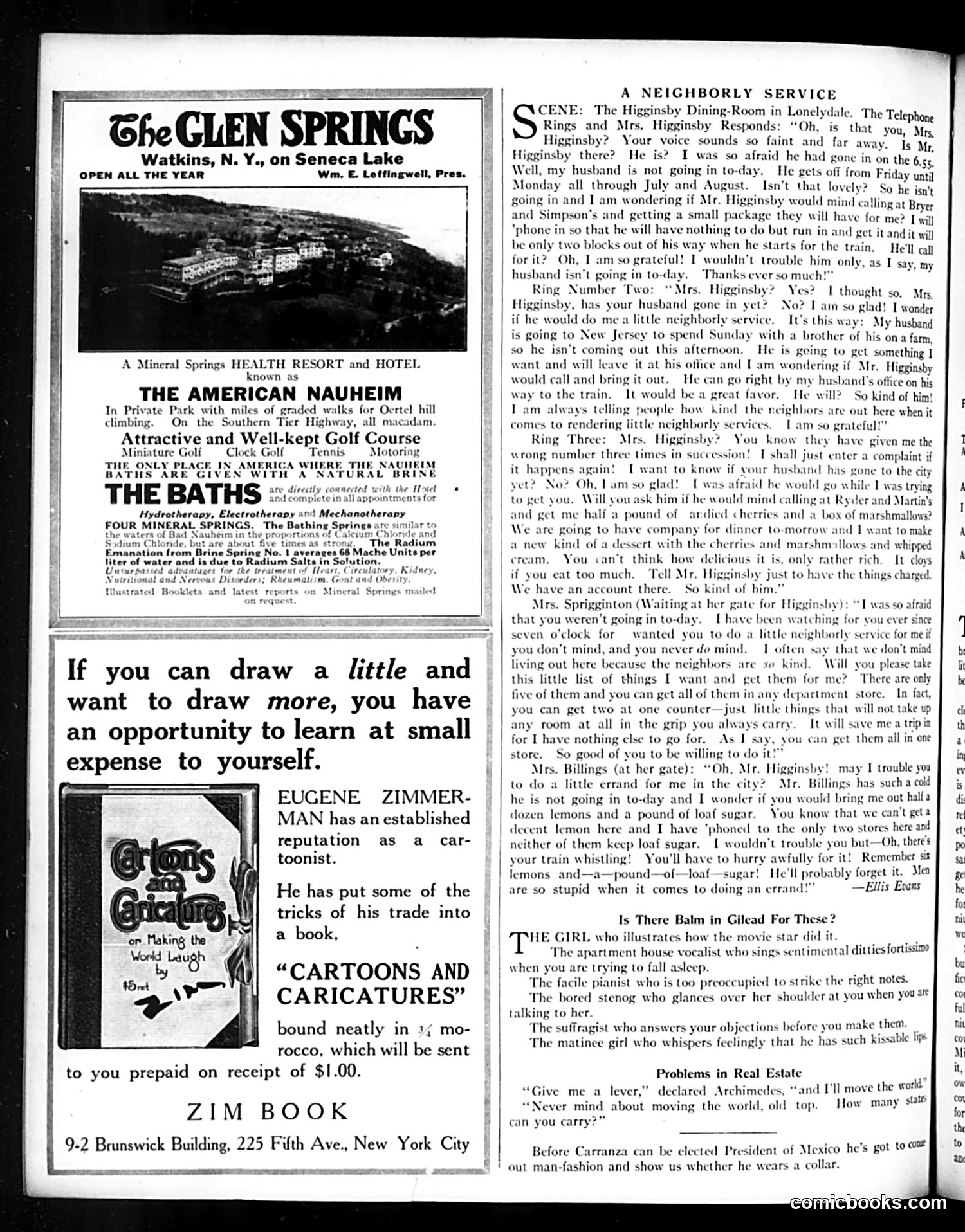
This page is primarily **advertising** for resorts and instructional books, but the right column contains a substantial satirical article. "A Neighborly Service" mocks the excessive demands working-class wives place on their husbands' limited free time. The piece uses a comedic telephone conversation to show how Mrs. Higginsby and her neighbors exploit Mr. Higginsby's commute into the city, each calling to ask him to run errands—a pound of sugar, dried cherries, packages from stores—on his way to the train. The satire targets the **selfishness of modern suburban life**: women treat neighboring husbands as personal errand boys, justified by appeals to friendship and neighborliness. The repetition of similar requests and the characters' obliviousness to imposing on his time underscores how normalized this exploitation has become. The humor lies in how politely these demands are framed ("So kind of you!") while being entirely unreasonable, and how the "service" is expected as neighborly obligation rather than recognized as burdensome.
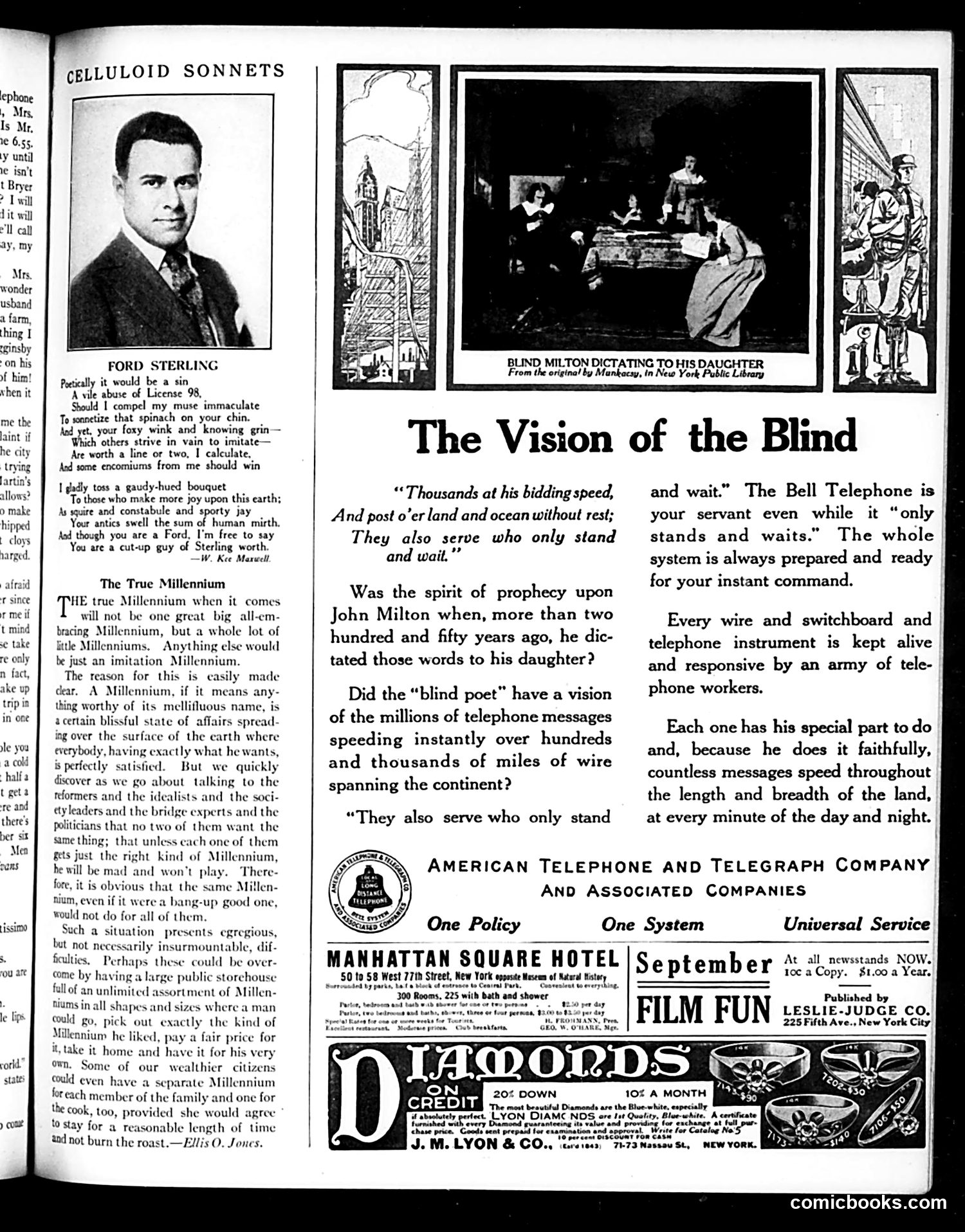
This page is primarily a Bell Telephone advertisement disguised as editorial content. It references John Milton's famous lines from *Paradise Lost* ("They also serve who only stand and wait") to create a metaphorical connection between Milton's blind servitude and telephone workers' invisible labor. The ad argues that telephone operators and infrastructure workers, though unseen, perform essential service—much as Milton claimed even those who "stand and wait" serve a purpose. The invocation of the 17th-century blind poet lends dignity to modern telephone workers' unglamorous but vital roles. The accompanying illustration shows Milton dictating to his daughter, creating a sentimental historical parallel meant to ennoble contemporary telephone company employees and justify their labor as part of a grand communicative vision spanning the continent. The satire is subtle: the ad dignifies worker servitude through literary allusion while advancing corporate messaging about universal service and system readiness.
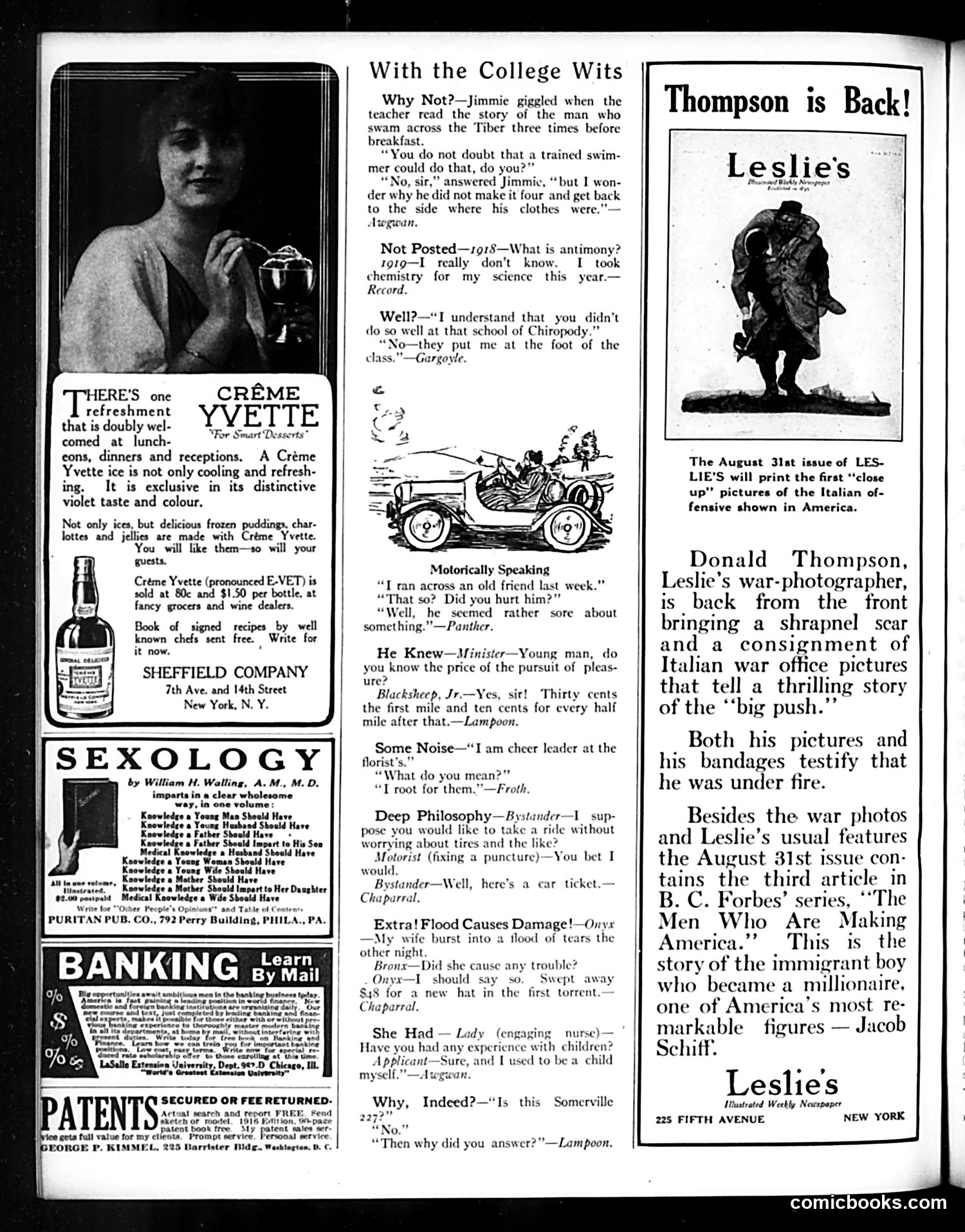
This page is primarily **advertising and announcements**, not satirical political cartoons. The main content features: 1. **"With the College Wits"** — A humor column collecting jokes from college publications (Record, Gargoyle, Chaparral, etc.). These are mild jokes about student life: a swimmer who doesn't retrieve his clothes, chemistry ignorance, chiropody school failures, and automotive mishaps. The humor relies on simple wordplay and absurdist situations rather than social commentary. 2. **Advertisements** — Prominent ads for Crème Yvette liqueur, banking services, sexology books, and patent services dominate the page. 3. **Leslie's Magazine announcement** — A significant sidebar announces war photographer Donald Thompson's return from the Italian front with photographs and shrapnel wounds, plus an article on immigrant millionaire Jacob Schiff. **For modern readers:** This reflects WWI-era college humor (light, pun-based) and demonstrates how magazines of this period integrated editorial content with heavy advertising. The Thompson announcement shows contemporary interest in firsthand war documentation.
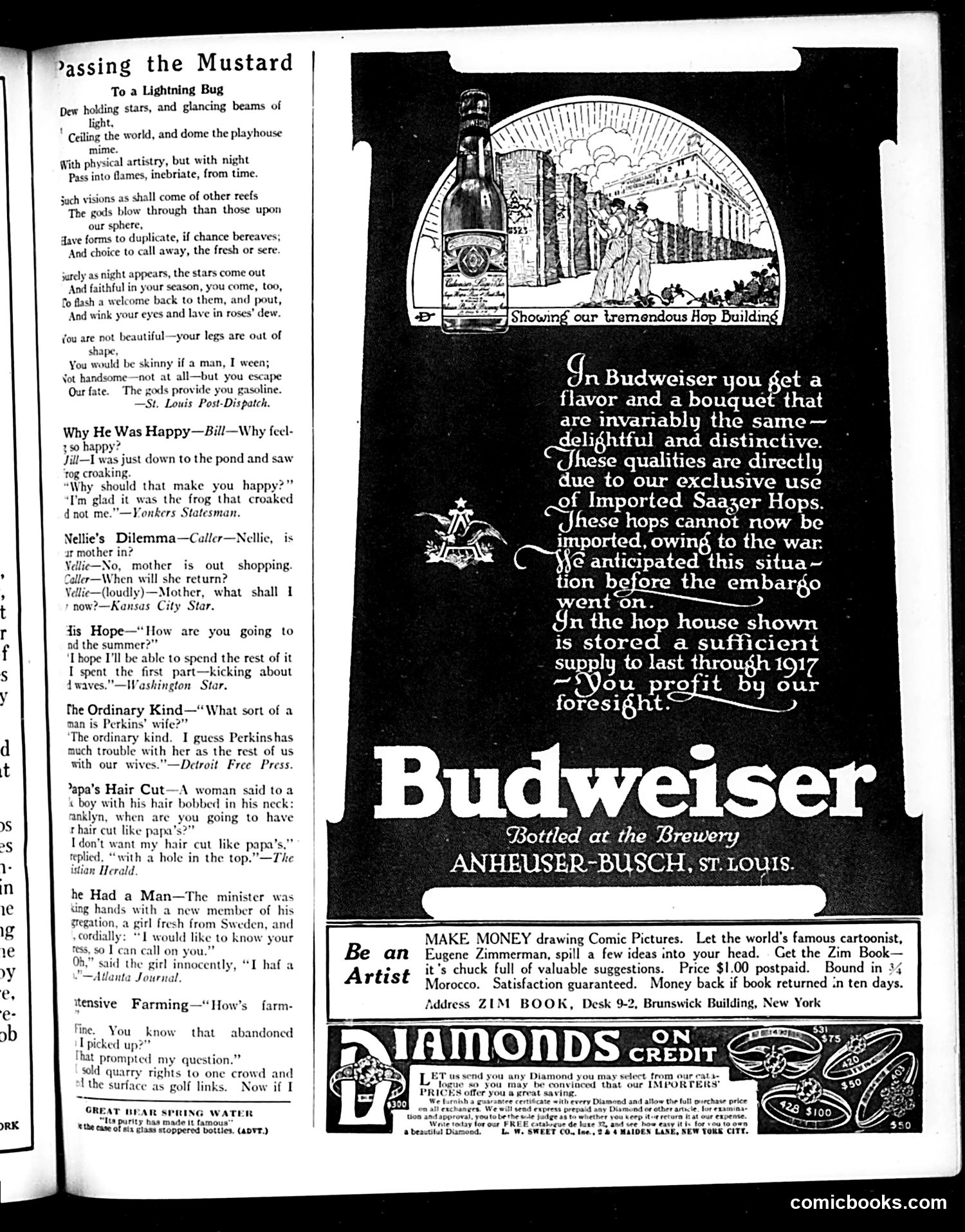
This page contains **short humorous anecdotes** (left column) and **advertisements** (right side), typical of Judge's satirical format. The anecdotes are brief joke-stories about everyday situations—a couple discussing a frog's croak, a mother's whereabouts, summer plans, a minister meeting a Swedish congregant. They rely on wordplay and mild domestic humor rather than political satire. The **dominant advertisement** is for **Budweiser beer**, which references World War I. The copy boasts of stockpiling German-imported Saazer hops before the war embargo, claiming foresight to profit consumers through 1917. This is significant: the ad tacitly acknowledges the war and German suppliers while marketing American beer patriotically. Below is an ad for drawing instruction and a diamonds-on-credit advertisement. The page demonstrates how wartime economics infiltrated even consumer advertising—breweries publicly justified their product quality by referencing their pre-embargo purchasing strategy, making commerce itself part of the war narrative.
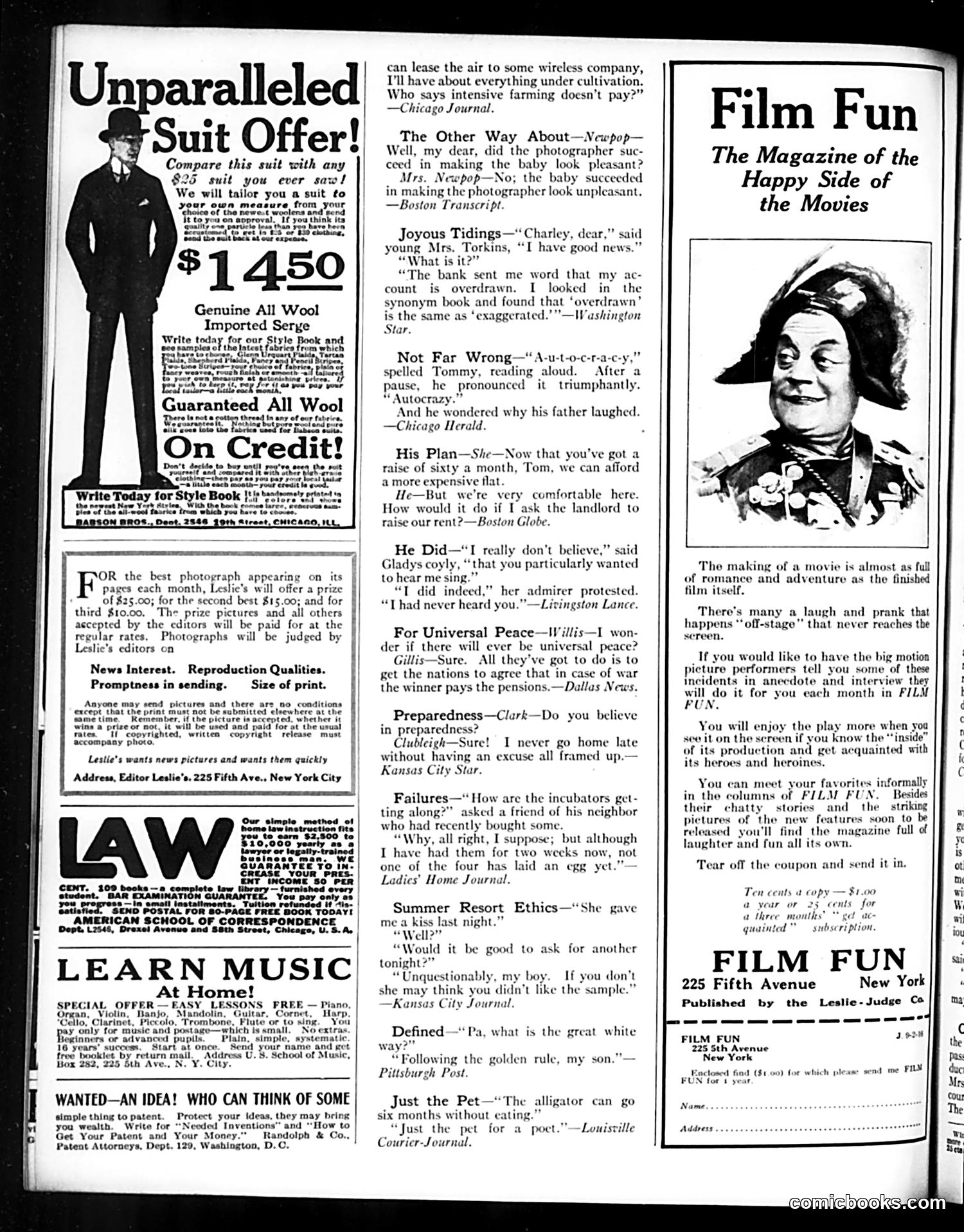
This is primarily an **advertising page** with humor sections interspersed. The main content includes: **Advertisements:** - Suit tailoring offer ($1,450 for all-wool serge, available on credit) - Leslie's photography prize contest - Correspondence schools for music and law - Patent attorney services **Humor Section ("Jokes"):** The page contains brief satirical quips mocking early 20th-century middle-class life: - A farmer boasting about "intensive farming" while leasing airspace to wireless companies (satirizes agricultural modernization and new technology) - New parents where baby makes photographer look unpleasant (gentle domestic humor) - A wife discovering "overdrawn" means "exaggerated" (wordplay on financial anxiety) - A child mispronouncing "autocracy" as "autocrazy" (political wordplay, unclear if satirizing actual autocrats) The jokes reflect *Judge's* typical approach: light social satire targeting urban middle-class concerns—finances, technology, domestic life—rather than sharp political commentary. No specific political figures or events appear identifiable here.
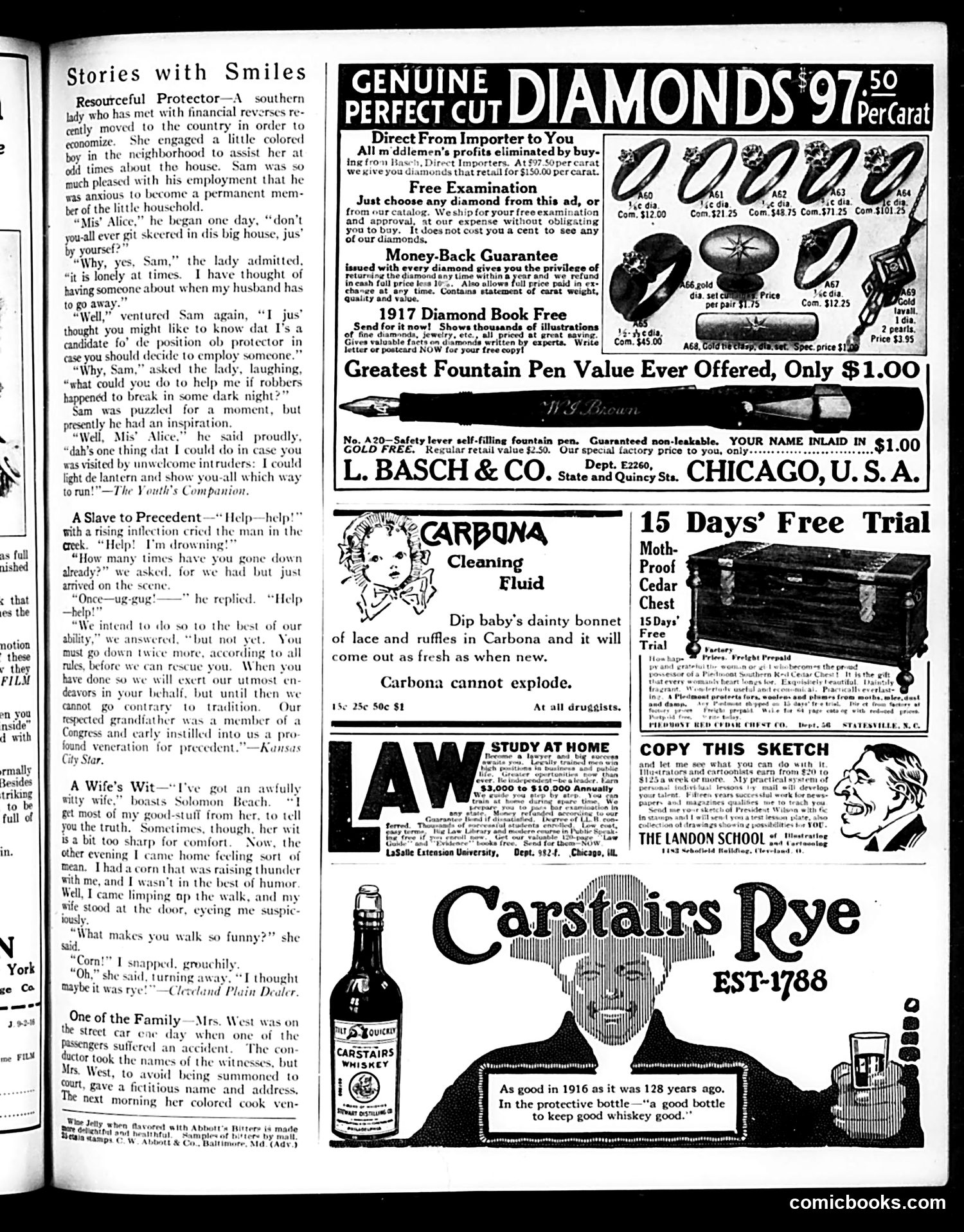
This page is primarily **advertising**, not political satire. It contains humorous short stories ("Stories with Smiles") in the left column and commercial advertisements on the right. The stories use racial stereotypes common to early 20th-century American humor: a Black servant character ("Sam") speaks in heavy dialect and is portrayed as dim-witted, offering absurd solutions to problems. These anecdotes rely on minstrel-show conventions now recognized as deeply offensive. The advertisements—for diamonds, fountain pens, Carbona cleaning fluid, correspondence courses, cedar chests, and Carstairs whiskey—represent typical Judge magazine commercial content. Notable is the "Genuine Perfect Cut Diamonds" ad, claiming direct-from-importer pricing to undercut middlemen, a sales pitch reflecting early mail-order retail competition. The page offers little political commentary; it's a snapshot of period commercial culture and prevailing (racist) entertainment conventions.
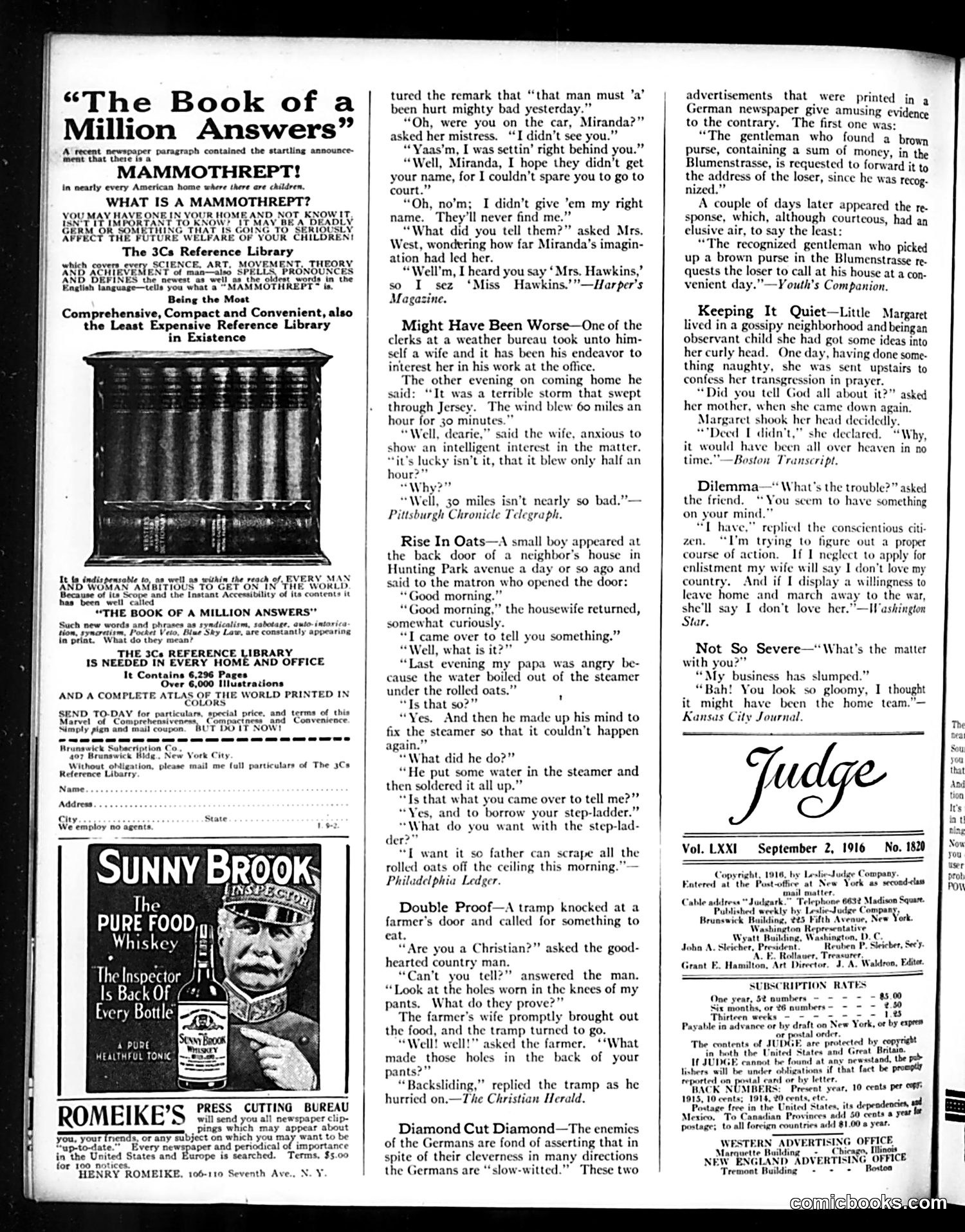
This page is primarily **advertisements and humor columns** rather than political cartoons. The main content includes: **Advertisement Focus:** The dominant feature is an ad for "The 3Cs Reference Library," a comprehensive encyclopedia marketed as solving the problem of not knowing what unfamiliar new words mean—particularly modern terms like "syndicalism," "sabotage," and "auto-intoxication" that were appearing in newspapers. **Humor Columns:** The page contains several short anecdotes illustrating comedic misunderstandings: - A Black domestic servant gives a false name to avoid legal trouble after a streetcar accident - A wife misunderstands her husband's weather report - A boy explains his father's humorous solution to a household problem **Context:** These pieces reflect early 20th-century middle-class American life and humor, with stereotypical depictions common to that era. The overall message is that modern life requires constant education and reference materials to navigate unfamiliar terminology and social situations.
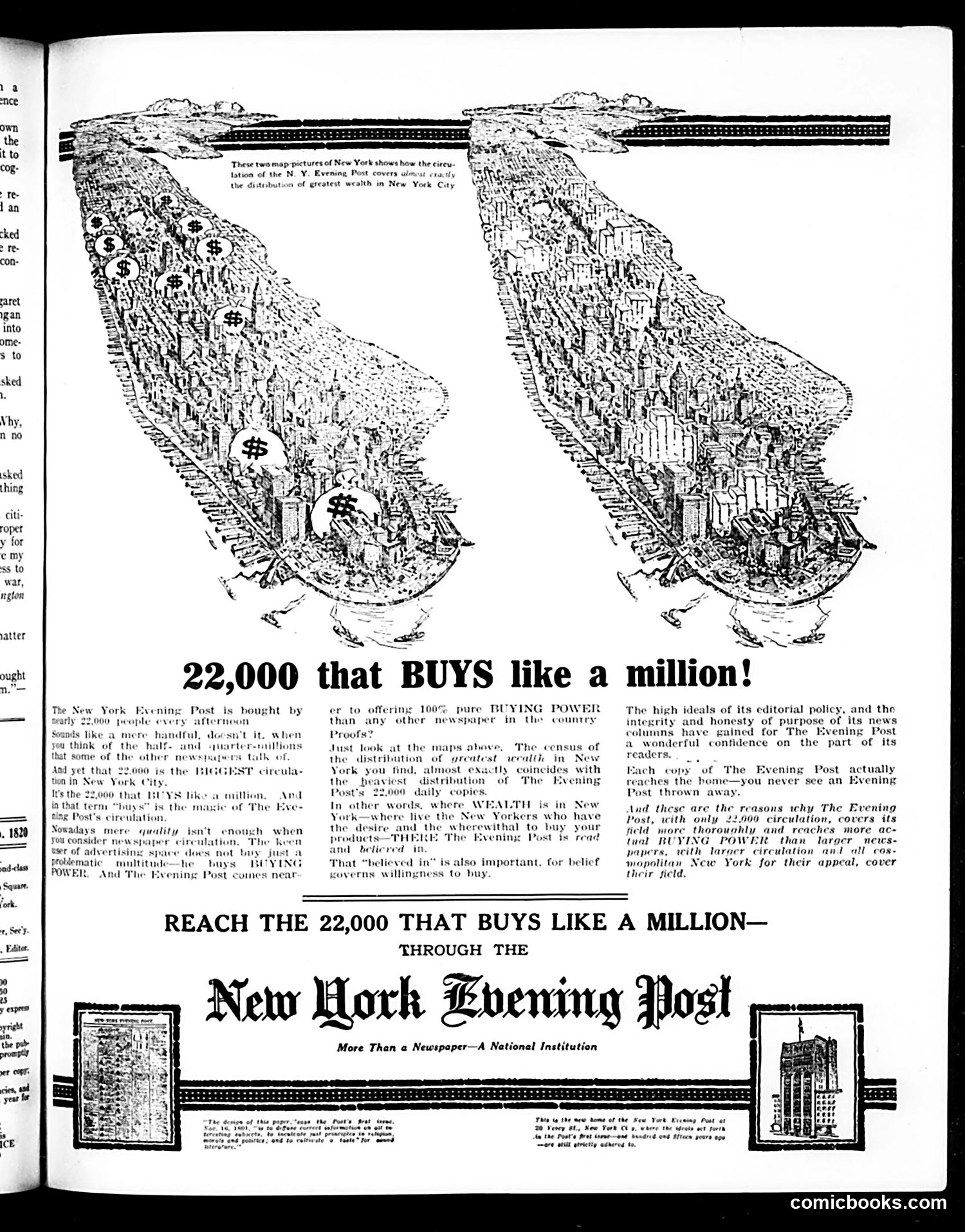
This is a **newspaper advertisement**, not a political cartoon. It promotes the *New York Evening Post* to potential advertisers by arguing that quality circulation matters more than quantity. The two isometric maps of Manhattan show how the Evening Post's 22,000 daily readers geographically align with the city's concentrated wealth distribution. The ad's central claim: these 22,000 readers represent affluent New Yorkers with actual "buying power," making them more valuable to advertisers than competitors' larger but less wealthy readerships. The satirical angle targets rival newspapers that boast larger circulation numbers but reach poorer audiences. The headline "22,000 that BUYS like a million" uses irony—suggesting that *quality* readership (wealthy consumers) outweighs *quantity* in advertising value. This reflects early 20th-century advertising strategy: targeting affluent consumers rather than mass markets. The Post positions itself as the smart choice for luxury goods advertisers.
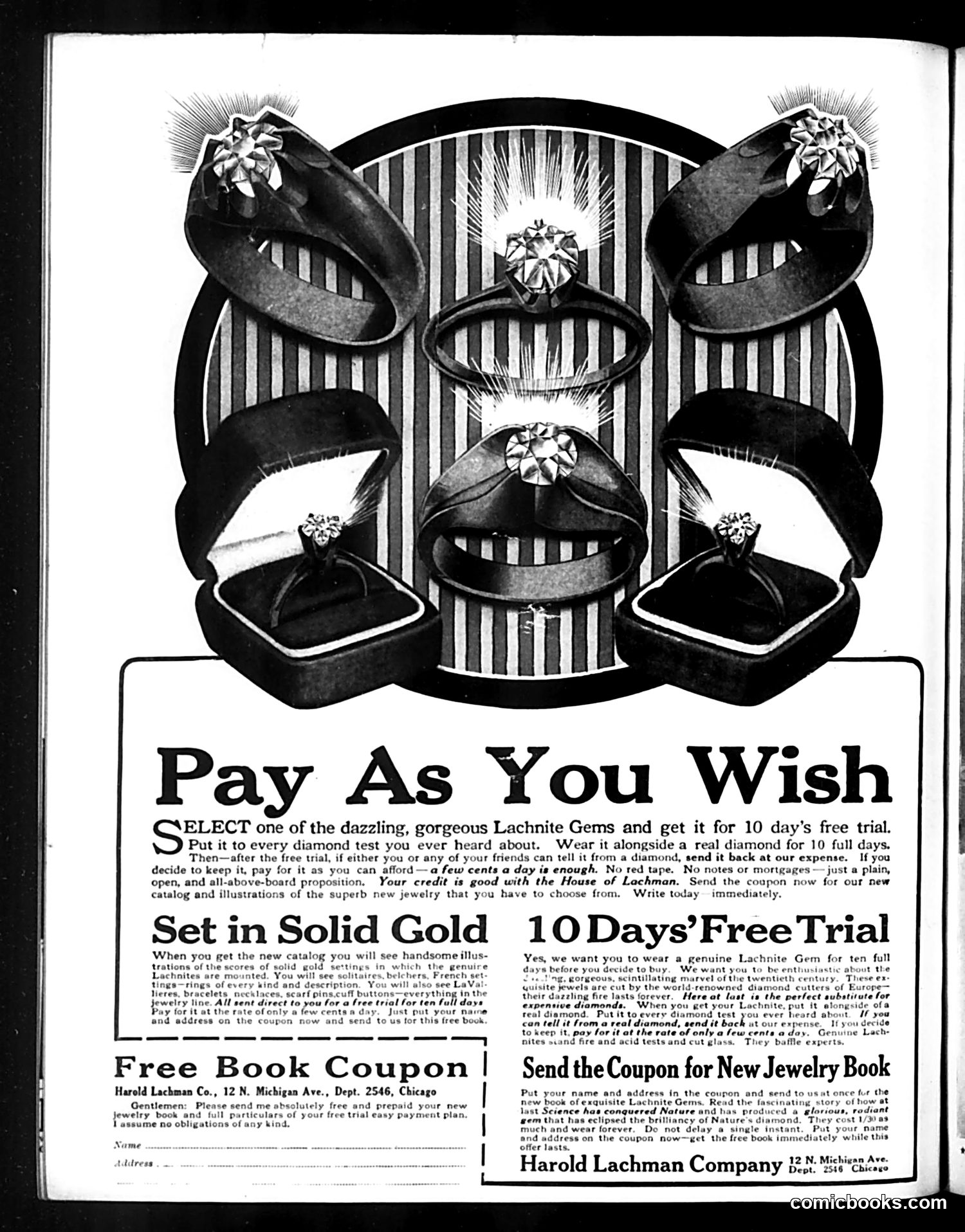
This page is primarily **a full-page advertisement**, not political satire. It advertises "Lachnite Gems"—synthetic diamonds marketed by the Harold Lachman Company of Chicago. The advertisement's pitch exploits early 20th-century consumer anxieties: it offers a 10-day free trial wearing the fake gem alongside real diamonds, betting customers can't tell the difference. The payment scheme ("Pay As You Wish," "a few cents a day") targets working-class buyers who couldn't afford genuine diamonds. The ornate illustration shows the gems in various settings—rings, brooches, and jewelry boxes—emphasizing luxury and desirability. The text claims Lachnite gems withstand standard diamond tests and possess comparable "fire and brilliance." This reflects the historical moment when synthetic gems became commercially viable, creating both consumer opportunity and moral anxiety about authenticity in jewelry—a genuine social concern of the era that advertisers exploited shamelessly.