
Judge, 1916-09-02 · page 8 of 28
Judge — September 2, 1916 — page 8: what you’re looking at
What you’re looking at
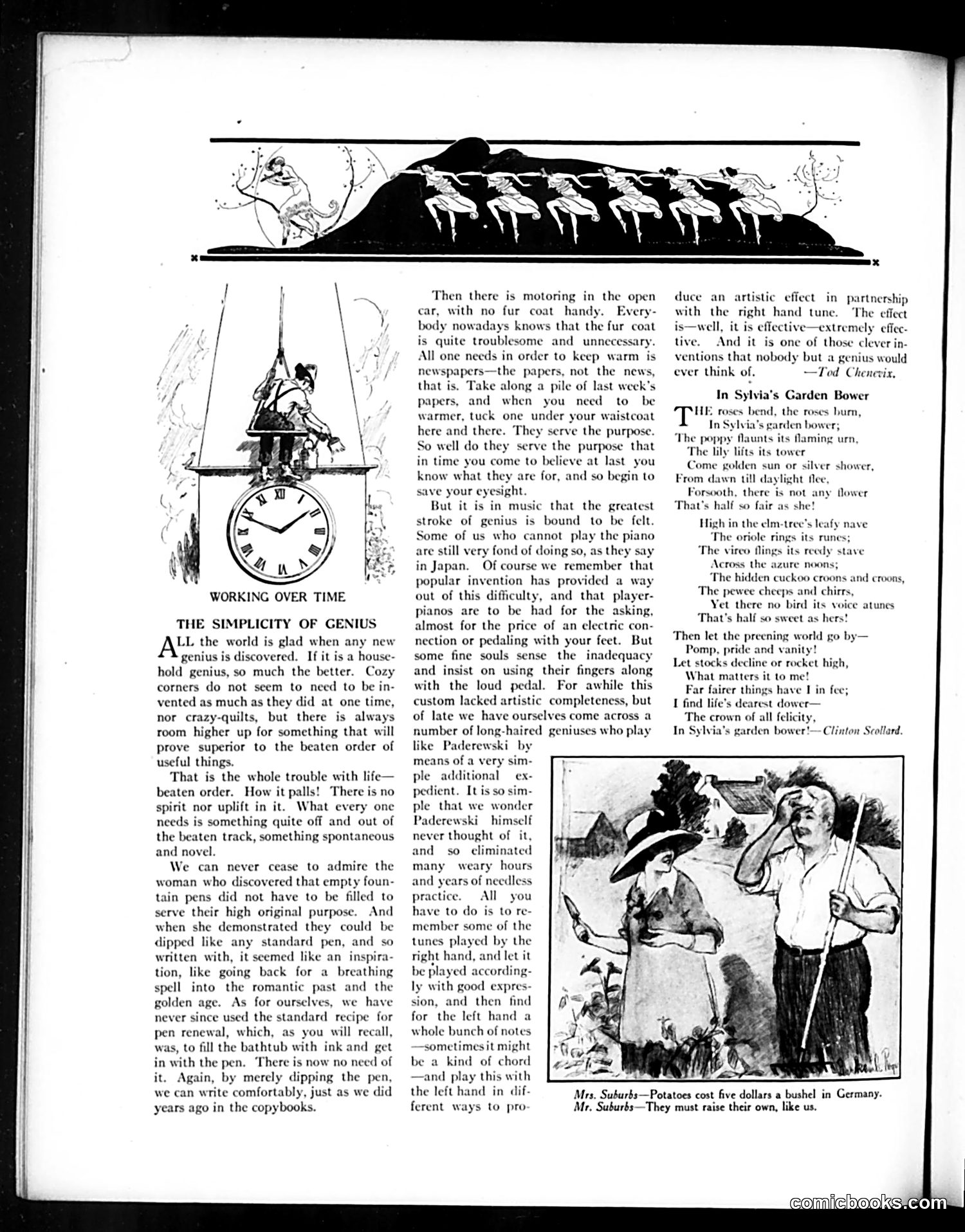
This page contains satirical commentary on "genius" and modern conveniences disguised as innovation. **"The Simplicity of Genius"** mocks people who celebrate trivial "inventions" as breakthroughs. The article ridicules: 1. **Empty fountain pens** that can be dipped instead of filled—presented as a revolutionary discovery 2. **Using newspapers for warmth** instead of fur coats while motoring (open-air driving), suggesting people fool themselves into thinking waste paper serves a practical purpose 3. **Amateur piano playing with "Paderewski tricks"**—the satire suggests someone invented a method where players memorize right-hand melodies and improvise random left-hand notes, calling it artistic genius comparable to the famous pianist Ignacy Jan Paderewski The cartoon lampoons how ordinary people and society celebrate minor conveniences as if they were major innovations, and how self-deception allows mediocrity to masquerade as cleverness. The "working over time" imagery at top reinforces the theme of unnecessary complication of simple tasks.
📄 Transcribed text from this page (OCR, searchable)
Machine-transcribed from the original scan — historical spelling and the odd misread are preserved.
WORKING OVER TIME THE SIMPLICITY OF GENIUS LL the world is glad when any new genius is discovered. If it is a house- hold genius, so much the better. Cozy corners do not seem to need to be in- vented as much as they did at one time, nor crazy-quilts, but there is always room higher up for something that will prove superior to the beaten order of useful things. That is the whole trouble with life— beaten order. How it palls! There is no spirit nor uplift in it. What every one is something quite off and out of the beaten track, something spontaneous and novel. We can never cease to admire the woman who discovered that empty foun- tain pens did not h; to be filled to serve their high original purpose. And when she demonstrated they could be dipped like any standard pen, and so written with, it seemed like an inspira- tion, like going back for a breathing spell into the romantic past and the golden As for ourselves, we have never since used the standard recipe for pen renewal, which, as you will recall, was, to fill the bathtub with ink and get in with the pen. There is now no need of it. Again, by merely dipping the pen, we can write comfortably, just as we did years ago in the copybooks. Then there is motoring in the open car, with no fur coat handy. Every- body nowadays knows that the fur coat is quite troublesome and unnecessary. All one needs in order to keep warm is newspapers—the papers, not the news, that is. Take along a pile of last week's papers, and when you need to be warmer, tuck one under your waistcoat here and there. They serve the purpose. So well do they serve the purpose that in time you come to believe at last you know what they are for, and so begin to save your eyesight. But it is in music that the greatest stroke of genius is bound to be felt. Some of us who cannot play the piano are still very fond of doing so, as they say in Japan. Of course we remember that popular invention has provided a way out of this difficulty, and that player- pianos are to be had for the asking, almost for the price of an electric con- nection or pedaling with your feet. But some fine souls sense the inadequacy and insist on using their fingers along with the loud pedal. For awhile this custom lacked artistic completeness, but of late we have ourselves come across a number of long-haired geniuses who play like Paderewski by means of a very sim- ple additional ex- pedient. [tis so sim- ple that we wonder Paderewski himself never thought of it, and so climinated many weary hours and years of needless practice. All you have to do is to re- member some of the tunes played by the right hand, and let it be played according- ly with good expres- sion, and then find for the left hand a whole bunch of notes -sometimesit might be a kind of chord —and play this with the left hand in dif- ferent ways to pro x duce an artistic effect in’ partnership with the right hand tune. The effect is—well, it is effective—extremely effec- tive. And it is one of those clever in- ventions that nobody but a genius would ever think of. od Chenevix, In Sylvia’s Garden Bower HE. roses bend, the roses bum, In Sylvia’s garden bower; ‘The poppy flaunts its flaming urn, The lily lifts its tower Come golden sun or silver shower, From dawn till dayli Forsooth, there is not any Dower That's half so fair as she! High in the elm-tree’s leafy nave ‘The oriole rings its runcs; The vireo flings its reedy stave Across the azure noons; ‘The hidden cuckoo croons and croons, The pewee cheeps and chirrs, Yet there no bird its voice atunes That's half so sweet as hers! Then let the preening world go by— Pomp, pride and vanity! Let stocks decline or rocket high, What matters it to me! Far fairer things have I in fee; I find life’s dearest dower— The crown of all felicity, In Sylvia's garden bower!— Clinton Scollard. Mrs. Suburbs—Potatoes cost five dollars a bushel in Germany. Mr. Suburbs—They must raise their own, like us.