
Judge, 1916-09-02 · page 13 of 28
Judge — September 2, 1916 — page 13: what you’re looking at
What you’re looking at
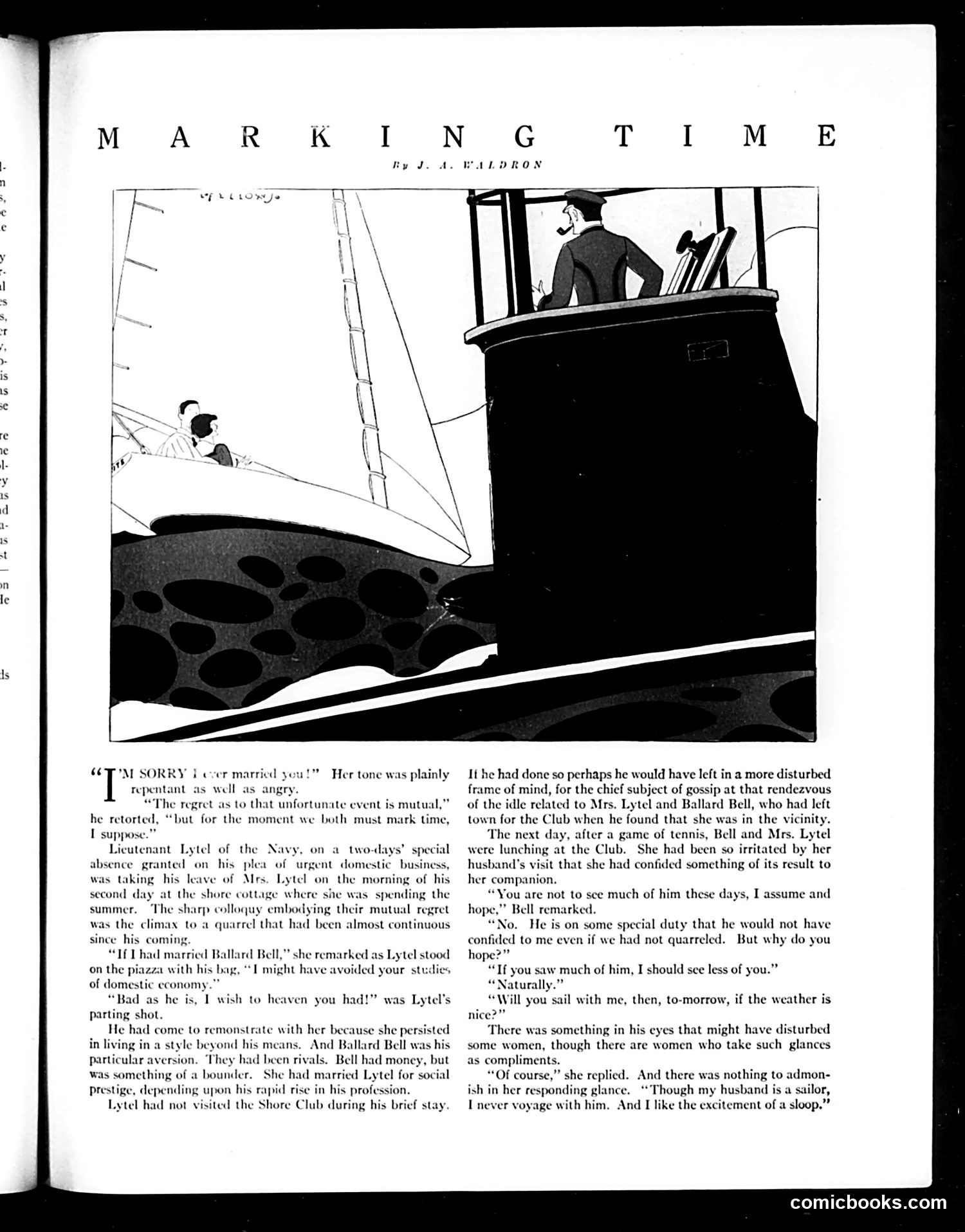
This story-illustration depicts a domestic scandal among the leisure class. Lieutenant Lytel, a Navy officer, visits his wife at a shore cottage and quarrels with her over extravagant spending beyond his means. She regrets marrying him, wishing she'd married Ballard Bell instead—a wealthier rival whom Lytel dislikes as "a bounder" (an unscrupulous social climber). After Lytel departs, Mrs. Lytel encounters Bell at the Shore Club. He invites her sailing, and her accepting glance suggests a developing affair. The satire targets the era's idle wealthy class: a woman prioritizing social prestige and luxury over marital fidelity, and a rival exploiting marital discord. The title "Marking Time" implies the couple's hollow marriage, merely enduring until opportunity allows escape or scandal erupts.
📄 Transcribed text from this page (OCR, searchable)
Machine-transcribed from the original scan — historical spelling and the odd misread are preserved.
M G WALDRON PLL LOW Je | Her tone was plainly OTM SORRY | ever married you I repentant as well as angry. “The regret as to that unfortunate event is mutual, he retorted, “but for the moment we both must mark time, I suppose.” Licute absence granted on his plea of urgent: domestic special business, was taking his leave of Mrs. Lytel on the morning of his second day at the shore cottage where she spending the summer. ‘The sharp colloquy embodying their mutual regret was the climax to a quarrel that had been almost continuous since his coming. “Tf Thad married Ballard Bell,” she rei on the piazza with his bag, “1 might hav of domestic economy “Bad as he is, | wish to heaven you had!” was Lytel’s parting shot. ¢ had come to remonstrate with her because she persisted ng ina style beyond his means. And Ballard Bell was his particular aversion. They had been rivals. Bell had money, but was something of a bounder. She had married Lytel for social Prestige, depending upon his rapid rise in his profession. Lytel had not visited the Shore Club during his brief stay: int Lytel of the Navy, on a_ two-d; arked as Lytel stood avoided your studies It he had done so perhaps he would have left in a more disturbed frame of mind, for the chief subject of gossip at that rendezvous of the idle related to Mrs. Lytel and Ballard Bell, who had left town for the Club when he found that she was in the vicinit The next day, after a game of tennis, Bell and Mrs. Lytel were lunching at the Club. She had been so irritated by her husband’s visit that she had confided something of its result to her companion. You are not to sce much of him these days, I assume and Bell remarked. He is on some special duty that he would not have confided to me even if we had not quarrel But why do you hope?” “Tf you saw much of him, I should sce less of you.” “Naturally.” “Will you sail with me, then, to-morrow, if the weather is nice?” There was something in his eyes that might have disturbed some women, though there are women who take such glances as compliment: “Of course,” she replied. And there was nothing to admon- ish in her responding glance. “Though my husband is a sailor, I never voyage with him. And I like the excitement of a sloop.” comicbooks.com