
Judge, 1916-09-02 · page 15 of 28
Judge — September 2, 1916 — page 15: what you’re looking at
What you’re looking at
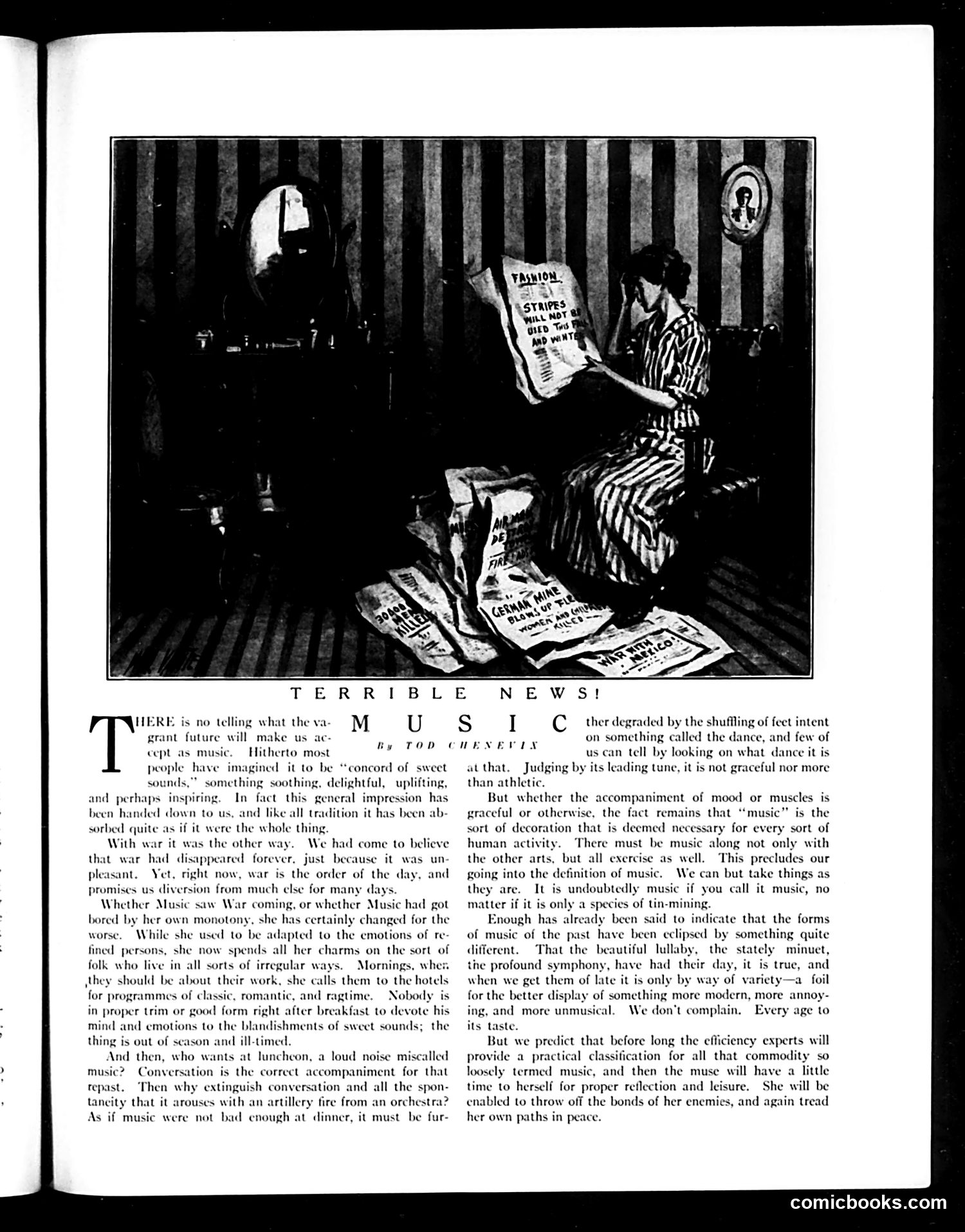
This editorial cartoon and essay lament the decline of "proper" music in the modern era, particularly during World War I. The illustration shows a woman (representing Music personified) sitting in what appears to be a prison cell, reading newspapers—a visual metaphor for her confinement by contemporary culture. The article argues that traditional music—refined lullabies, minuets, symphonies—has been displaced by loud, degrading forms: hotel performances interrupting work, orchestral noise at restaurants drowning out conversation, and especially **jazz dancing**, which the author dismisses as mere "shuffling of feet" lacking grace or athleticism. The satire targets post-war society's embrace of modern, energetic music and entertainment, which the author views as culturally coarse and disruptive. The "terrible news" is that refined artistic tradition is being destroyed by efficiency-driven commercialism and popular taste. The prediction that "efficiency experts" will eventually restore music's dignity offers sardonic hope that rationalization might rescue high culture from the masses.
📄 Transcribed text from this page (OCR, searchable)
Machine-transcribed from the original scan — historical spelling and the odd misread are preserved.
TERR HERE is no telling what the va- M grant future will make us ac- Hitherto: most people have imagined it to be “concord of sweet sounds,” something soothing, delightful, uplifting, and perhaps inspiring. In fact this general impression has been handed down to us, and like all tradition it has been ab- sorbed quite as if it were the whole thing. With war it was the other way. We had come to believe that war had disappeared forever, just’ because it was un- pleasant. Yet, right now, war is the order of the day, and promises us diversion from much else for many days. Whether Music saw War coming, or whether Music had got bored by her own monotony, she has certainly changed for the worse. While she used to be adapted to the emotions of re- fined persons, she now spends all her charms on the sort of folk who live in all sorts of irregular way Mornings, when ithey should be about their work, she calls them to the hotels for programmes of classic, romantic, and ragtime. body is in proper trim or good form right after breakfast to devote his mind and emotions to the blandishments of swect sounds; the ; » TOD cept as music. thing is out of season and ill-timed. And then, who wants at luncheon, a loud noise miscalled music? Conversation is the correct accompaniment for that repast. ‘Then why extinguish conversation and all the spon- tancity that it arouses with an artillery fire from an orchestra? As if music were not bad cnough at dinner, it must be fur- CHENEVIXN NEW S! I Cc ther degraded by the shuffling of fect intent on something called the dance, and few of us can tell by looking on what dance it is at that. Judging by its leading tune, it is not graceful nor more than athletic. But whether the accompaniment of mood or muscles is graceful or otherwise, the fact remains that “music” is the sort of decoration that is deemed necessary y human activity. There must be music along not only with the other arts, but all exercise as well. This precludes our going into the definition of music. We can but take things as they are. It is undoubtedly music if you call it music, no matter if it is only a species of tin-minin, Enough has already been said to indicate t the forms of music of the past have been eclipsed by something quite different. That the beautiful lullaby, the stately minuet, the profound symphony, have had their day, it is true, and when we get them of late it is only by way of variety—a_foil for the better display of something more modern, more annoy- ing, and more unmusical. We don’t complain. Every age to its taste. But we predict that before long the efficiency experts will provide a practical classification for all that commodity so loosely termed music, and then the muse will have a litle time to herself for proper reflection and leisure. She will be enabled to throw off the bonds of her enemi nd again tread her own paths in peace. comicbooks.com