
Judge, 1916-09-02 · page 10 of 28
Judge — September 2, 1916 — page 10: what you’re looking at
What you’re looking at
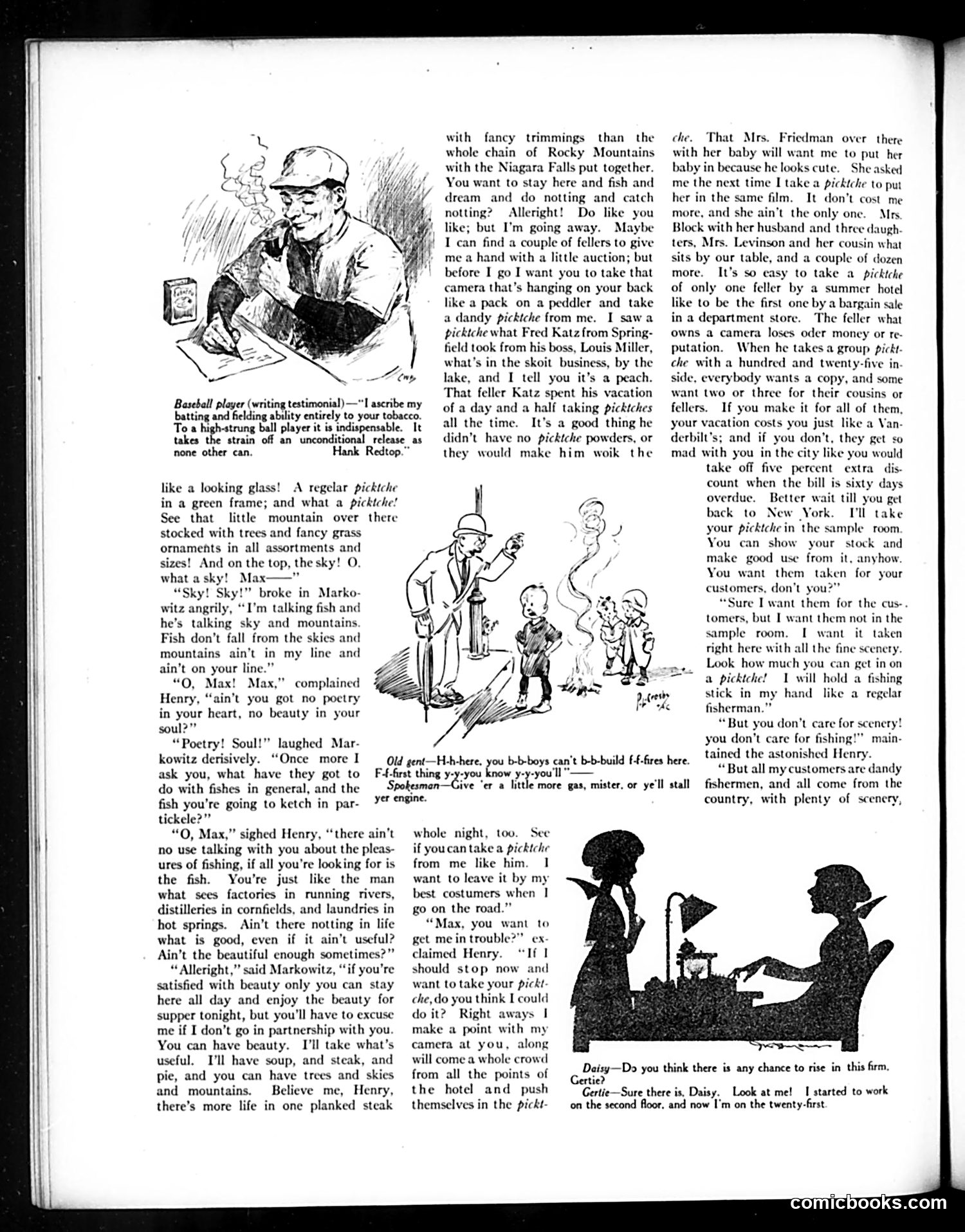
This page from *Judge* magazine contains two distinct pieces of humor: **The Main Story: "Max and Henry"** A comic dialogue between two Jewish characters (identifiable by their Yiddish-inflected English dialect) debating practicality versus aesthetics. Markowitz represents utilitarian pragmatism—he wants fish, not scenery—while Henry values beauty and poetry. Markowitz ultimately asks Henry to photograph him, contradicting his own philosophy. The humor relies on ethnic-dialect comedy (common in early 20th-century American humor) and the irony of a materialist reluctantly embracing artistic documentation. **The Sidebar: Baseball Player's Testimonial** A parody advertisement where a baseball player credits his talent to tobacco, sarcastically claiming it's "indispensable." This satirizes the ubiquitous false celebrity endorsements that plagued early advertising. **Context**: Both pieces mock immigrant working-class culture and consumerism, using exaggerated dialects and situations typical of *Judge*'s satirical approach to American society.
📄 Transcribed text from this page (OCR, searchable)
Machine-transcribed from the original scan — historical spelling and the odd misread are preserved.
Baseball player (writing testimonial) To a hi takes none other can. like a looking glass! A regelar picktche in a green frame; and what a picktche! See that little mountain over there stocked with trees and fancy grass ornaments in all assortments and sizes! And on the top, the sky! O. what a sky! Max——” Sk: broke in Marko- witz angrily, “I'm talking fish and he’s talking sky and mountains, Fish don’t fall from the skies and mountains ain't in my line and ain’t on your line.”” “O, Max! Max,” complained Henry, “ain’t you got no poctry in your heart, no beauty in your soul?” “Poetry! Soul!” laughed Mar- kowitz derisively. “Once more I ask you, what have they got to do with fishes in general, and the fish you're going to ketch in par- tickele?”” “O, Max,” sighed Henry, “there ain't no use talking with you about the pleas- ures of fishing, if all you're looking for is the fish. You're just like the man what sees factories in running rivers, distilleries in cornfields, and laundries in hot springs. Ain’t there notting in life what is good, even if it ain't useful? Ain’t the beautiful enough sometimes?” “ Alleright,” said Markowitz, “if you're satisfied with beauty only you can stay here all day and enjoy the beauty for supper tonight, but you'll have to excuse me if I don’t go in partnership with you. You can have beauty. I'll take what's useful. I'll have soup, and steak, and pie, and you can have trees and skies and mountains. Believe me, Henry, “T ascribe my batting and fielding ability entirely to your tobacco. strung ball player it is indispensable. It strain off an unconditional release as dtp” with fancy trimmings than the whole chain of Rocky Mountains with the Niagara Falls put together. You want to stay here and fish and dream and do notting and catch notting? Alleright! Do like you like; but I’m going away. Maybe I can find a couple of fellers to give me a hand with a little auction; but before I go I want you to take that camera that’s hanging on your back like a pack on a peddler and take a dandy picktche from me. I sawa picktche what Fred Katz from Spring- field took from his boss, Louis Miller, what's in the skoit business, by the lake, and I tell you it’s a peach. That feller Katz spent his vacation of a day and a half taking picktches all the time. It’s a good thing he didn’t have no picktche powders, or they would make him woik the Old gent—H-h-here, you b-b-boys can’t b-b-build f-f-fires here. F--first thing y- Spokesman: yer engine. ou know yy-you'll — ive “er a little whole night, too. See if youcan take a picktche from me like him. 1 want to leave it by my best costumers when | go on the road.” “Max, you want to get mein trouble?” ex claimed Henry. “If 1 should stop now and want to take your pickt che,do you think I could do it? Right aways I make a point with my camera at you, along will come a whole crowd from all the points of the hotel and push Gaus ‘more gas, mister, or ye'll stall Gertie—Sure there is, Daisy. che. That Mrs. Friedman over there with her baby will want me to put her baby in because he loo me the next time I take her in the same film. It don’t cost me more, and she ain’t the only one. Mrs. Block with her husband and three daugh- ters, Mrs. Levinson and her cousin what sits by our table, and a couple of dozen more. It’s so easy to take a picktche of only one feller by a summer hotel like to be the first one by a bargain sale in a department store. The feller what owns a camera loses oder money or re- putation. When he takes a group pickt- che with a hundred and twenty-five in. side, everybody wants a copy, and some want two or three for their cousins or fellers. If you make it for all of them, your vacation costs you just like a Van- derbilt’s; and if you don’t, they get so mad with you in the city like you would take off five percent ra dis- count when the bill y days overdue. Better wait till you get back to New York. I'll take your picktchein the sample room You can show your stock and make good use from it, anyhow. You want them taken for your customers, don’t you?” “Sure I want them for the cus-. tomers, but I want them not in the sample room. [ want it taken right here with all the fine scenery. Look how much you can get in on a picktche! 1 will hold a fishing stick in my hand like a regelar fisherman.” “But you don’t care for scenery! you don’t care for fishing!” main- tained the astonished Henry. “But all my customers are dandy fishermen, and all come from the country, with plenty of scenery, TI Daisy—Do you think there is any chance to rise in this firm, Look at me! I started to work there’s more life in one planked steak themselves in the pickt- on the second floor, and now I'm on the twenty-first Ccomicbooks.com